
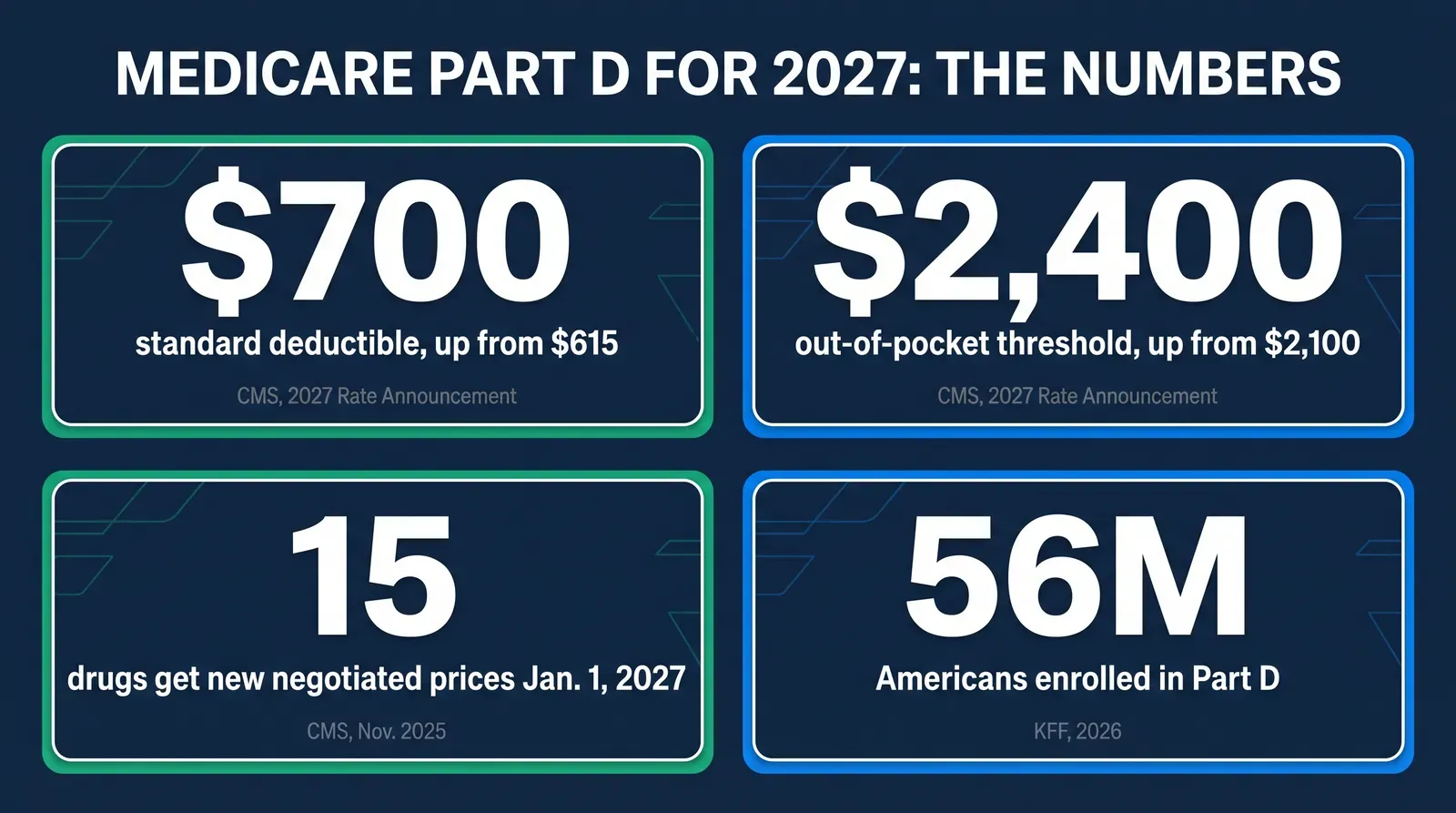
The 2027 Medicare Part D deductible is $700, up from $615. The out-of-pocket threshold that triggers catastrophic coverage is $2,400, up from $2,100. Both numbers come from CMS’s Calendar Year 2027 Rate Announcement, released April 6, 2026, and both apply to every standard Part D plan your clients will be choosing from this AEP (CMS, 2027 Rate Announcement). Fifteen more drugs get government-negotiated prices starting January 1, 2027. None of that tells you which of your clients are actually affected — and that’s the part that usually gets figured out in November, on a call, after the client already opened their ANOC letter and got annoyed.
Key takeaways
- The 2027 standard Part D deductible is $700 (up $85 from $615) and the out-of-pocket threshold is $2,400 (up $300 from $2,100) — CMS, 2027 Rate Announcement.
- Fifteen more drugs, including the Ozempic family, Trelegy Ellipta, and Ibrance, get negotiated Maximum Fair Prices effective January 1, 2027 — bringing the total to 25 drugs across two negotiation cycles.
- MA-PD formularies leaned much harder on coinsurance in 2026 than 2025 — 56% of MA-PD enrollees now face coinsurance on preferred brands, up from 27% the year before, per KFF. That volatility trend is the real reason a plan that fit in 2026 may not fit in 2027.
- You can't run the actual 2027 formulary comparison until CMS's Plan Finder data goes live around October 1 — but you can identify which clients take a newly negotiated drug and flag their ANOC letters right now.
- Ambrose's Brain queries CMS and NADAC drug-pricing data directly, so checking a client's regimen against federal data doesn't mean fifteen browser tabs and an afternoon.
- Client medication lists tied to a name are PHI — don't paste them into a general AI tool without a compliance layer in front of it.
What actually changed for Part D in 2027
Every year, CMS updates two numbers that define the standard Part D benefit: the deductible, and the out-of-pocket threshold that triggers the catastrophic phase where the beneficiary owes nothing further. Both are calculated by a statutory formula — the prior year’s amount multiplied by CMS’s Annual Percentage Increase, then rounded per the statute — not chosen arbitrarily (CMS, 2027 Rate Announcement, p. 3807-3812). For 2027, that formula produced the biggest jump since the Inflation Reduction Act’s redesign took effect in 2025.
| Parameter | 2026 | 2027 | Change |
|---|---|---|---|
| Standard deductible | $615 | $700 | +$85 (13.8%) |
| Annual out-of-pocket threshold | $2,100 | $2,400 | +$300 (14.3%) |
| Retiree Drug Subsidy cost threshold | $615 | $700 | +$85 |
| Retiree Drug Subsidy cost limit | $12,650 | $14,400 | +$1,750 |
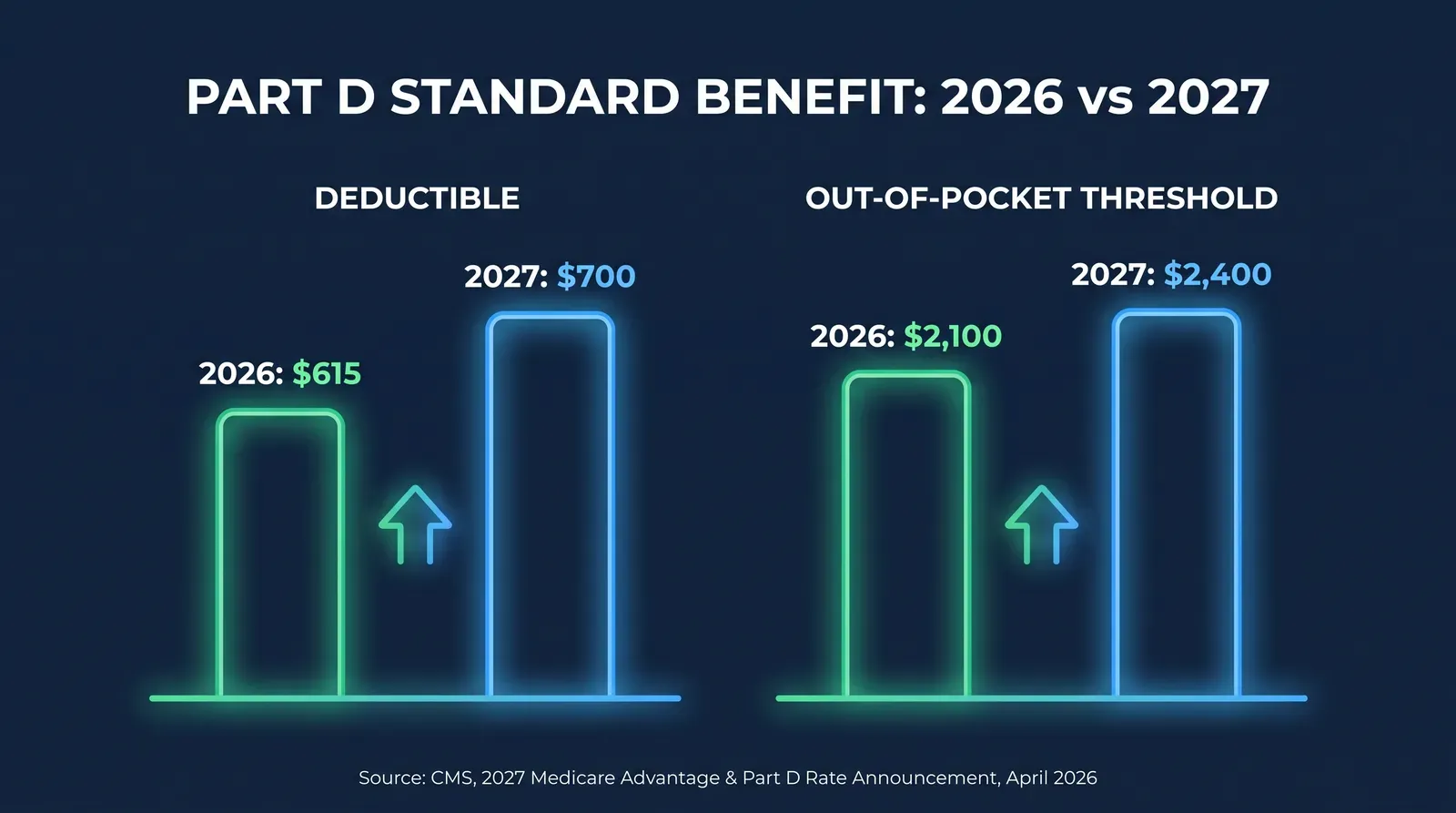
The mechanism matters here, because it tells you this isn’t a one-time policy choice you can shrug off as noise. CMS’s own commentary on the rule acknowledges the increase is driven by projected Part D drug spending growth running higher for 2027 than the growth rate used to calculate the 2026 figures — the deductible and threshold are indexed to spending, so as spending accelerates, so do these numbers (CMS, 2027 Rate Announcement, p. 3138-3146). A client who paid a $615 deductible for years and treated it as background noise is going to notice $700. A client near the catastrophic threshold on a specialty drug is going to notice the extra $300 they now have to spend before their costs cap out for the year.
Fifteen more drugs just got price-negotiated for 2027
The second thing that changed for 2027 is which drugs get government-negotiated pricing. CMS announced Maximum Fair Prices for a second group of 15 Part D drugs on November 25, 2025, effective January 1, 2027 (CMS, press release). That brings the total under the Medicare Drug Price Negotiation Program to 25 drugs across the first two negotiation cycles.
| Drug | Primary use |
|---|---|
| Austedo, Austedo XR | Involuntary movement disorders (tardive dyskinesia, Huntington's chorea) |
| Breo Ellipta | Chronic obstructive pulmonary disease (COPD) |
| Calquence | Blood cancers (leukemias, lymphomas) |
| Ibrance | Breast cancer |
| Janumet, Janumet XR | Type 2 diabetes |
| Linzess | Irritable bowel syndrome with constipation |
| Ofev | Pulmonary fibrosis |
| Otezla | Psoriasis and psoriatic arthritis |
| Ozempic, Rybelsus, Wegovy | Type 2 diabetes and weight management |
| Pomalyst | Multiple myeloma |
| Tradjenta | Type 2 diabetes |
| Trelegy Ellipta | COPD |
| Vraylar | Bipolar disorder and schizophrenia |
| Xifaxan | Traveler's diarrhea and hepatic encephalopathy |
| Xtandi | Prostate cancer |
Look down that list and you’ll almost certainly recognize a client. These aren’t rare-disease drugs — Ozempic, Wegovy, and Rybelsus alone cover a huge share of your Medicare book on diabetes or weight-management therapy, and Trelegy and Breo cover a big chunk of your COPD clients. CMS says these 15 drugs represented roughly $42.5 billion in gross Part D drug costs in 2024, about 15% of total Part D spending, and that the negotiated prices produce a 44% net savings — about $12 billion — compared to what Medicare paid for these same drugs the year before (CMS, press release, Nov. 25, 2025).
Here’s the part that actually matters for your AEP conversations: a negotiated price changes what the plan and manufacturer pay, not automatically what tier a plan places the drug on or what the client’s copay looks like. Plans still design their own formularies within CMS rules. A drug entering negotiated pricing is exactly the kind of change that can shift a plan’s tier placement or utilization management for that drug — and that’s a plan-specific decision you won’t see until formulary data for 2027 goes live.
Why formularies are getting less predictable, not just pricier
This is the number that should worry you more than the deductible. KFF’s analysis of 2026 Part D plan data found that the share of MA-PD enrollees facing coinsurance (a percentage of the drug’s cost) rather than a flat copay on preferred brand drugs jumped from 27% in 2025 to 56% in 2026 — more than doubling in one year. For non-preferred drugs, it went from 56% to 89% (KFF, Medicare Part D Enrollment, Premiums, and Cost Sharing in 2026). A flat copay is predictable — the client pays the same $47 every month regardless of the drug’s list price. Coinsurance moves with the drug’s price, which means a client’s monthly cost can change even when nothing about their plan formally “changed” — the underlying drug price moved, and their coinsurance moved with it.
That’s the mechanism behind why a client who was fine on their plan in 2026 can genuinely be worse off in 2027 without their plan doing anything you’d call a mistake. As plans lean harder into coinsurance to manage their own cost exposure under the IRA redesign’s manufacturer-liability shift, the predictability that used to come with a flat-copay formulary is eroding. CMS’s own 2026 KFF-analyzed data shows the average beneficiary has access to 21 of 32 MA-PD options and 2 of 11 PDP options in their area (KFF) — plenty of plans, but plenty of formulary structures to actually compare, drug by drug, if you’re going to do it right.
Nationally, Part D covers 56 million beneficiaries — 24.9 million in stand-alone PDPs and 31.4 million in MA-PDs, plus 13.6 million who receive the Low-Income Subsidy (KFF). If your book looks anything like that national mix, a meaningful share of your clients are on an MA-PD formulary that just got noticeably less predictable, heading into a year where the deductible and out-of-pocket ceiling both moved too.
A flat copay hides a price increase from the client. Coinsurance doesn't. 2027 is the year more of your clients start feeling the underlying drug price directly, whether the plan "changed" or not.
Mike MooreThe manual method: checking client drug coverage by hand before AEP
None of this requires anything beyond what CMS already publishes for free. Here’s the process, in the order it actually becomes possible to run each step. This is the full method — nothing held back for later.
Build one list: client, current plan, current drug regimen
If this doesn't already exist in your AMS or CRM as a clean, exportable list, that's step zero and it's the biggest single time sink in this whole process. You cannot check anything against 2027 data if you don't have an accurate, current drug list per client to check it against.
Cross-reference against the 15 newly negotiated drugs, right now
Search your list against the 15 drugs in the table above. You don't need next year's formulary data to do this — the drug names and effective date are public today. Flag every client match for a closer look once formulary data lands.
Set expectations on the deductible and out-of-pocket threshold now
Every client on a standard-benefit plan is looking at a higher deductible and a higher out-of-pocket ceiling in 2027, regardless of formulary tier changes. A short, proactive note — "your deductible is going up $85 industry-wide, here's what that means for you" — beats a defensive call in December.
Watch every ANOC letter as it lands, in September
Plans send Annual Notice of Change letters to every enrollee each fall — Medicare.gov tells beneficiaries to expect it in September, ahead of AEP. That letter discloses that specific plan's 2027 formulary and cost-sharing changes before Plan Finder data goes public. Ask flagged clients to forward or photograph theirs the day it arrives.
Run the real comparison once Plan Finder data is live, around October 1
This is when you can finally do the actual work: pull each flagged client's full drug list into Medicare Plan Finder, compare their current plan's 2027 costs against realistic alternatives, and quantify the difference in real dollars for that specific person.
Prioritize by dollar impact, not alphabetically
With two weeks between Plan Finder going live and AEP opening, and six weeks of AEP itself, you won't get to everyone with the same urgency. Rank your flagged list by estimated dollar swing so the client facing a $1,200 annual difference gets called before the one facing $40.
Worked example: what the deductible change alone means
A client with no drug coverage below their deductible pays the full $700 out of pocket in 2027 before any Part D cost-sharing kicks in, versus $615 in 2026 — an extra $85 they didn't budget for, spread across however many fills it takes to clear it. That's not a formulary change, a tier change, or anything the client did differently. It's the standard benefit parameter CMS set for every plan, and it's worth mentioning to every client on a standard-deductible plan, not just the ones you've flagged for a drug-specific check.
Run all six steps by hand, on a spreadsheet, with Medicare Plan Finder open in a browser tab, and you will get a genuinely accurate answer for every client. The honest problem isn’t accuracy. It’s time.
Where the manual method actually breaks down
Step one alone — a clean, current drug list per client — is where most agents’ process quietly fails. Drug regimens change between renewals. A client starts a new medication in March, mentions it once on a call, and it never makes it into a spreadsheet anywhere. By August, the list you’re checking against 2027 data is already stale for a meaningful share of your book.
Assume a book of 150 active Medicare clients, an average of four to five medications each, and even a conservative five minutes per client to check current medications against the negotiated-drug list and note anything else worth flagging. That’s roughly 12 hours of work before you’ve even gotten to a single ANOC letter or a single Plan Finder comparison — and that’s the fast, mechanical part of the process, not the part where you’re actually re-shopping anyone. Multiply that by every AEP, every year, on top of the actual client conversations and enrollments that are the real job, and it’s obvious why this step gets skipped or rushed. Nobody skips it because they don’t care. They skip it because the manual version doesn’t scale to a real book of business without giving up something else.
How Ambrose’s Brain does the data-pulling part
This is the part of the job that’s pure data lookup, not judgment — which is exactly the kind of task that shouldn’t need a person doing it fifteen browser tabs at a time. Ambrose OS fronts what its own documentation calls the Brain: an internal service that connects to “25+ federal/healthcare data MCPs (CMS, NADAC, FDA, Federal Register, FEMA, …)” (Ambrose docs, Glossary; Ambrose docs, Architecture: Services). NADAC — the National Average Drug Acquisition Cost, CMS’s own weekly-updated drug pricing survey of more than 60,000 pharmacies nationwide — sits inside that same set of sources, alongside the CMS data your formulary and plan comparisons already depend on.
What that means in practice for the task above: instead of manually cross-referencing a client roster against a drug list, a formulary PDF, and a pricing lookup in three separate browser tabs, you can point an Ambrose agent or team at the question and get an answer sourced from the same federal data, in one query, without re-typing anything. The numbers come from the federal source behind the endpoint, not from a model’s memory of what a formulary usually looks like — which is the actual problem with asking a general chatbot this kind of question in the first place. A generic AI tool will happily generate a plausible-sounding answer about drug tier placement with no live connection to this year’s actual CMS data. The Brain’s answers are sourced to the federal system behind them.
Once, not every year by hand
Ambrose's Routines feature lets you attach a scheduled prompt — cron-based, five-field schedule — to an agent or team, with the results sent to Slack, email, a GHL note, or logged (Ambrose docs, Routines). A routine set to fire once CMS's Plan Finder data typically goes live in early October, re-checking your flagged client list against that year's actual formulary data and posting the results to Slack, replaces the version of this task where you remember to sit down and do it manually every single AEP.
A client's drug list tied to their name is PHI
The moment you attach a real client's name to their medication list, you're handling protected health information, and a consumer AI tool almost certainly doesn't have a Business Associate Agreement with your agency. Ambrose's PHI Rail exists specifically for this: it scrubs identifiers before a prompt reaches any destination that isn't BAA-approved, replaces them with typed aliases like PERSON_xxxx, and splices the real values back into the response afterward — with every scrub event logged, never the actual values (Ambrose docs, PHI Rail). That's the mechanism, not a marketing claim — it's documented as a "redact-then-rehydrate" pipeline that checks destination approval before anything real leaves the system.
| Part of the task | What actually addresses it |
|---|---|
| Cross-referencing 150 clients against negotiated-drug and formulary data | Ambrose's Brain — CMS and NADAC federal data, queried directly, one prompt instead of fifteen tabs |
| Re-running the check automatically once October data lands | A scheduled Routine posting results to Slack |
| Keeping a real client's name and drug list out of an unprotected AI tool | The PHI Rail's alias-and-rehydrate pipeline |
| Deciding which flagged clients actually need a re-shop conversation | You — no tool replaces the judgment call |
To be direct about what this doesn’t do: the Brain doesn’t replace reading a client’s ANOC letter, and it doesn’t make the call on whether a specific client should switch plans. It does the mechanical cross-referencing against federal data that eats the twelve hours in the example above, so the time you do spend goes into the conversations that actually need a licensed human’s judgment.
What you get by joining
One Ambrose seat, including the Brain, comes with a Tech Savvy Insurance membership: $97 a month, billed monthly, cancel anytime, founding rate locked in while the membership stays active. Alongside the seat: weekly Zoom calls with open Q&A and build-with-you sessions, 30+ hours of recorded training, Meta Ads, AI, and marketing training built for this industry specifically, pre-built AI templates and bot deployments, and a free annual in-person member workshop. It’s also an explicit no-recruiting zone — you can ask a real question about how to point the Brain at your own client list without ending up on someone’s downline pitch list.
Ambrose usage runs separately from the $97 seat
The membership includes one Ambrose seat. See the full Ambrose docs for what else is available beyond what's covered here.
Everything in the manual method above works whether you ever join anything or not. Go run it by hand this AEP — or let the Brain run the cross-referencing while you spend your hours on the clients it flags.
Compliance: what this touches, and what it doesn’t
Reaching out to a client about a formulary or deductible change is a service touch, not a marketing communication, as long as you’re not using it to steer toward a specific plan sale without the required steps. If the conversation turns into marketing — discussing specific plan benefits with the intent to enroll — the TPMO disclaimer at 42 CFR 422.2267(e)(41) applies to that call, chat, or piece of material the same as it always has; we cover the exact required wording in our Medicare marketing claims article. Separately, CMS’s Contract Year 2027 final rule removes restrictions on the time and manner by which beneficiaries can have conversations with licensed agents and brokers (CMS, Fact Sheet: Contract Year 2027 Medicare Advantage and Part D Final Rule) — that’s a separate provision from the disclaimer requirement, and it doesn’t remove the disclaimer.
If AI tools touch any part of how you check client drug coverage or draft outreach about it, the NAIC’s Model Bulletin on the Use of Artificial Intelligence Systems by Insurers sets the governance expectation regulators increasingly apply: AI-supported decisions have to comply with applicable insurance law, you need to be able to show how you govern your use of the tools, and that documentation needs to be available if a state Department of Insurance asks during an exam (NAIC, Insurance Topics: Artificial Intelligence) — see our reference page on which states have adopted the NAIC AI Model Bulletin for the current state-by-state list. Ambrose is HIPAA-aware by default, not HIPAA certified — there’s no such thing as HIPAA certification for a software platform, and any vendor claiming otherwise is worth a second look.
The close
The deductible is $700. The threshold is $2,400. Fifteen more drugs are on the negotiated-price list. None of those three facts tell you a single thing about a specific client until you actually run the check — and running it by hand across a real book, every AEP, is the twelve-hour task nobody has time for in September. If you’d rather have the Brain do the cross-referencing while you spend your hours on the calls that actually need you, one Ambrose seat comes with a Tech Savvy membership, and the weekly build-with-you calls are where agents actually get this set up before AEP volume hits: https://techsavvyinsurance.com/.
Before you rely on any figure in this article
Tech Savvy Insurance is a training and software community, not an insurance company, agency, or law firm, and does not provide insurance, legal, tax, or compliance advice. You are responsible for your own licensure and for complying with all applicable CMS, HIPAA, state, and carrier regulations. Regulations and enforcement priorities can change — confirm current requirements directly with CMS, your state Department of Insurance, or qualified legal counsel before relying on any figure here. AI-generated outputs may contain errors — always verify. Results may vary.
Frequently asked questions
Sources
- CMS — Announcement of Calendar Year (CY) 2027 Medicare Advantage Capitation Rates and Part C and Part D Payment Policies (2027 Rate Announcement), April 6, 2026 — cms.gov
- CMS — Press Release: CMS Delivers Savings for Seniors on 15 Major Drugs for Cancer, Chronic Disease, November 25, 2025 — cms.gov
- CMS — Medicare Drug Price Negotiation Program: Selected Drugs and Negotiated Prices — cms.gov
- CMS — Fact Sheet: Contract Year 2027 Medicare Advantage and Part D Final Rule — cms.gov
- KFF — Medicare Part D Enrollment, Premiums, and Cost Sharing in 2026, June 11, 2026 — kff.org
- Cornell Law School, Legal Information Institute — 42 CFR § 422.2267 (TPMO disclaimer requirement) — law.cornell.edu
- CMS — Medicare Open Enrollment partner resources (2026 AEP dates) — cms.gov
- Medicare.gov — Plan Annual Notice of Change (ANOC) — medicare.gov
- Ambrose docs — Glossary (the Brain) — app.hiambrose.com
- Ambrose docs — Architecture: Services (the Brain, port 8150) — app.hiambrose.com
- Ambrose docs — PHI Rail — app.hiambrose.com
- Ambrose docs — Routines — app.hiambrose.com
- Ambrose docs — What is Ambrose — app.hiambrose.com
- NAIC — Insurance Topics: Artificial Intelligence (Model Bulletin background) — content.naic.org
Ready to put this into practice?
Join a private community of Health & Life insurance professionals using AI, Meta Ads, and automation to grow — without draining their bank account.
Join Tech Savvy — $97/month