
CMS caps what a carrier can pay an independent agent for a 2026 Medicare Advantage enrollment at $694 nationally. That’s a ceiling, not a floor — the regulation says compensation must be “at or below” fair market value, and this AEP, more agents than usual are finding out the hard way that “below” can mean zero. Some carriers have started cutting commissions on specific plans mid-cycle, and there’s no single public page where you can look up a plan ID and get a straight yes-or-no answer on whether it still pays. Here’s what CMS actually allows, what happened in Idaho when a state tried to push back, and the manual check that works today, before you build a single dollar of AEP marketing spend around a plan you haven’t confirmed.
Key takeaways
- CMS's 2026 national fair market value (FMV) cap is $694 for an initial Medicare Advantage enrollment and $347 for a renewal — a maximum, not a guarantee (CMS, June 18, 2025).
- The rule that sets that cap also gives carriers the room to pay nothing: compensation "must be at or below" FMV, with no floor specified (42 C.F.R. § 422.2274(d)(2)).
- CMS raised the CY2027 national rate to $725 initial / $363 renewal, and added a new voluntary HPMS field for carriers to flag $0-compensation plans — a field CMS says will not be posted publicly (CMS, June 1, 2026).
- Idaho's Department of Insurance issued cease-and-desist orders against UnitedHealthcare of the Rockies, PacificSource, and Care Improvement Plus South-Central in October 2025 over commission cuts paired with restricted application access; a federal judge sided with the insurers on preemption grounds that December (LocalNews8, Oct. 30, 2025; Morgan Lewis, Feb. 2026).
- Ambrose's medicare-watchdog and plan-quoter spokes call the Brain, an internal service fronting 25+ federal and healthcare data MCPs including CMS, to speed up plan research once you know which plans you're actually working (Ambrose docs, fetched August 2026).
This article covers commission status on new business, not your existing book
If you're checking whether your current clients' plans are still a good fit for the new plan year — Star Ratings, network, formulary — that's a different job, covered in our guide to re-shopping your Medicare book before AEP. This article is specifically about what a plan pays you before you spend marketing dollars pushing it to new prospects.
What “non-commissionable” actually means
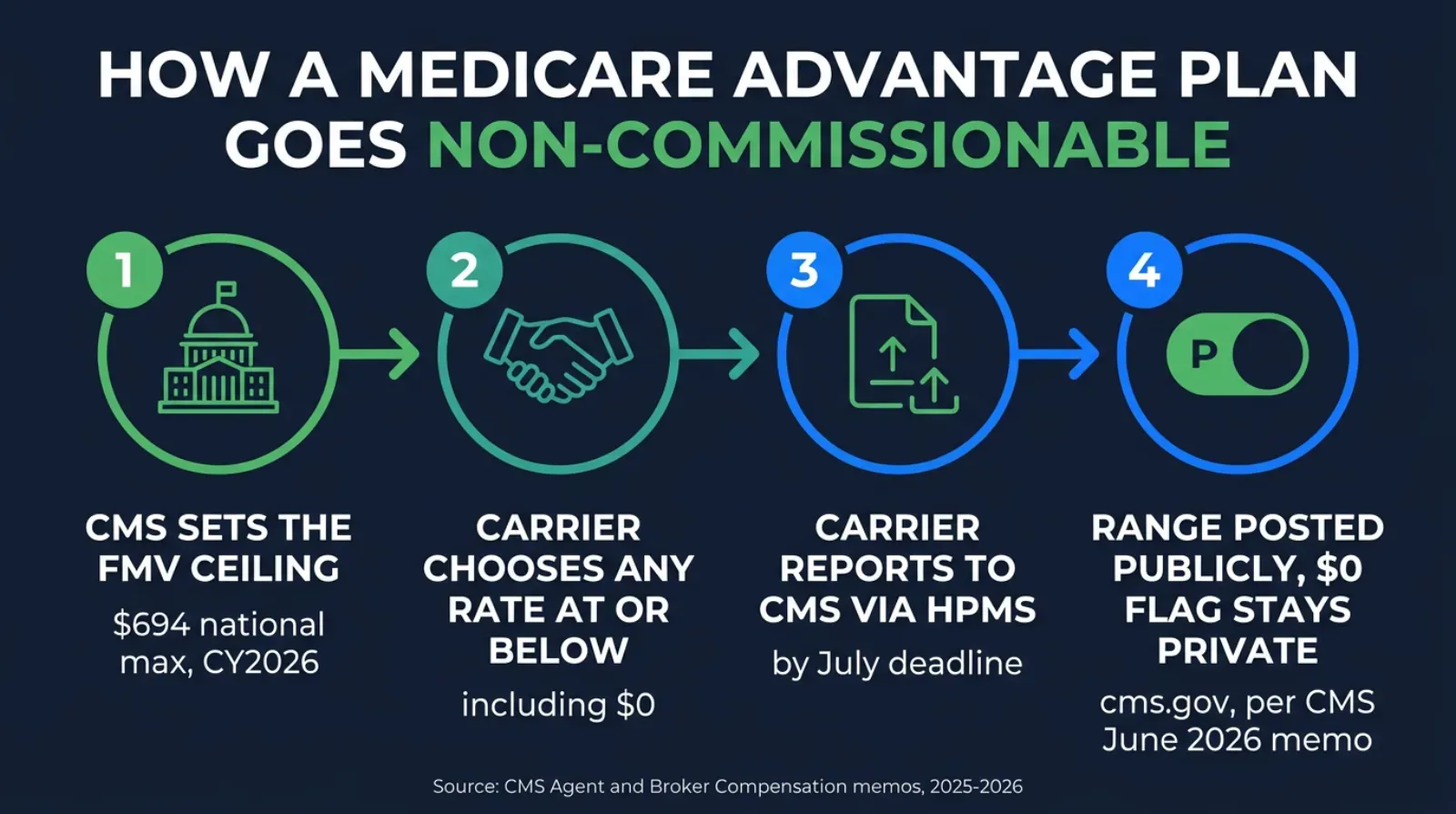
A non-commissionable Medicare Advantage plan is one where the carrier has decided to pay $0 to independent agents and brokers for new enrollments into that specific plan benefit package, for that plan year. It’s not a CMS designation and it’s not a special legal category — it’s a business decision a carrier is allowed to make under the same regulation that sets the maximum they’re allowed to pay.
Here’s the mechanism, straight from the source. CMS’s Contract Year 2026 memo states plainly: “the compensation amount an organization pays to an independent agent or broker for an initial enrollment must be at or below the fair market value (FMV),” citing 42 C.F.R. §§ 422.2274(d)(2) and 423.2274(d)(2). Renewal compensation is capped separately, at a maximum of 50% of FMV, under §§ 422.2274(d)(3) and 423.2274(d)(3) (CMS, Contract Year 2026 Agent and Broker Compensation Rates memo, June 18, 2025). Read that sentence again: “at or below.” CMS sets the ceiling. Nothing in the rule sets a floor. A carrier that pays the full $694 and a carrier that pays $0 are both, technically, in compliance with the same regulation.
This isn’t new language written for 2026 specifically — it’s the standing structure of how MA and Part D compensation has worked for years. What’s different this AEP is how many carriers are choosing to exercise the “or below” half of that sentence, and how publicly the resulting friction with agents and state regulators has played out.
| Plan type / region | CY2026 initial | CY2026 renewal | CY2027 initial | CY2027 renewal |
|---|---|---|---|---|
| MA/Cost Plan — National | $694 | $347 | $725 | $363 |
| MA/Cost Plan — CT, PA, D.C. | $781 | $391 | $816 | $408 |
| MA/Cost Plan — CA, NJ | $864 | $432 | $902 | $451 |
| MA/Cost Plan — PR, USVI | $474 | $237 | $495 | $248 |
| PDP — National | $114 | $57 | $130 | $65 |
| Referral fee — MA / PDP | $100 / $25 | — | $100 / $25 | — |
Source: CMS, Contract Year 2026 Agent and Broker Compensation memo (June 18, 2025) and Contract Year 2027 Agent and Broker Compensation memo (June 1, 2026). Figures are maximums a carrier is allowed to pay, not guarantees.
The pain: you spent the last two weeks marketing a plan that pays you nothing
Here’s the version of this that’s actually happening this AEP season, based on the pattern showing up in trade reporting and state regulatory filings. You picked a strong plan for a target county — good Star Rating, competitive premium, solid network — and built three weeks of Meta ads, direct mail, and a seminar around it. Your FMO’s commission schedule from spring still shows the full $694. Then, sometime between when you started marketing and when you sit down to write the first application, you learn the carrier quietly moved that specific plan benefit package to a zero-commission list. The plan didn’t get worse for the client. It just stopped paying you to sell it, and nobody sent you a memo with your name on it — you found out from a portal notice, a producer bulletin, or a fellow agent in a Facebook group.
This is exactly the pattern Idaho’s Department of Insurance documented when it opened its investigation in September 2025: carriers cutting commissions on Medicare Advantage plans while, in some cases, also making it harder to submit new applications — both happening during the same open enrollment window agents had already built their year around (LocalNews8/KIFI, October 30, 2025). The frustrating part isn’t that carriers are allowed to make this call — they are. It’s that there’s no reliable early-warning system pointing agents at which plans just changed status, so the agent doing the most marketing work on a plan is often the last to know its economics shifted underneath them.
Why 2026 is different: the regulatory timeline
This didn’t come out of nowhere, and the timeline explains why so much of the current friction is landing in the same six-month window.
July 2024: The U.S. District Court for the Northern District of Texas, in Americans for Beneficiary Choice v. HHS (No. 4:24-cv-00439) and Council for Medicare Choice v. HHS (No. 4:24-cv-00446), stayed the effective date of several 2025 rule provisions that had amended the agent/broker compensation regulation itself, 42 C.F.R. § 422.2274 (CMS, CY2026 memo, June 18, 2025). That stay meant the older, pre-2025 compensation methodology stayed in effect for CY2026 planning purposes.
August 18, 2025: The same court issued a final ruling that vacated those provisions outright, rather than just staying them. The government did not appeal (CMS, CY2027 memo, June 1, 2026). That decision locked in the older compensation-cap structure — the one carriers are currently operating under — as the governing framework going into both the 2026 and 2027 plan years, with no clear signal of when or whether CMS will try again to change it through new rulemaking.
September–October 2025: With AEP prep underway, reports of commission cuts on specific Medicare Advantage plans accelerated, and Idaho’s Department of Insurance opened its investigation into UnitedHealthcare of the Rockies and PacificSource Community Health Plans.
Late October 2025: Idaho issued cease-and-desist orders against those two carriers plus Care Improvement Plus South-Central Insurance Co., under docket 18-4775-25, alleging the combination of commission cuts and application restrictions amounted to unfair trade practices under state law (LocalNews8/KIFI, October 30, 2025). PacificSource had reportedly required agents to sign zero-commission contracts by November 1, 2025, to keep selling other products, and UnitedHealthcare had ended commissions on certain plans that October (Insurance Business, November 7, 2025).
December 2025: A federal judge granted UnitedHealthcare and PacificSource preliminary injunctions, finding they were likely to succeed on their argument that federal Medicare law preempts Idaho’s regulatory action — a legal theory with implications well beyond Idaho, since it questions whether any state can regulate MA broker compensation at all (Morgan Lewis, healthlawscan, February 2026). The same review notes a separate DOJ complaint filed in Massachusetts federal court against several major MA plans and broker organizations over broker-compensation practices — a different case, but part of the same overall pattern of federal attention on how agents get paid to sell Medicare Advantage.
June 1, 2026: CMS released its CY2027 compensation memo, raising the national FMV to $725 initial / $363 renewal, and — directly citing “concerns, including those expressed by several states, regarding agent and broker compensation raised during the 2026 Annual Enrollment Period” — added a new voluntary HPMS field where carriers can flag when they intend to pay $0 for a specific plan benefit package. CMS was explicit that this new field “will not be posted on the CMS website,” unlike the required minimum-to-maximum range data, which is posted publicly each year (CMS, CY2027 memo, June 1, 2026).
Put plainly: CMS itself now formally acknowledges the 2026 AEP commission-cut pattern was significant enough to prompt a policy response. It just hasn’t made the resulting data public yet.
What it actually costs, in dollars
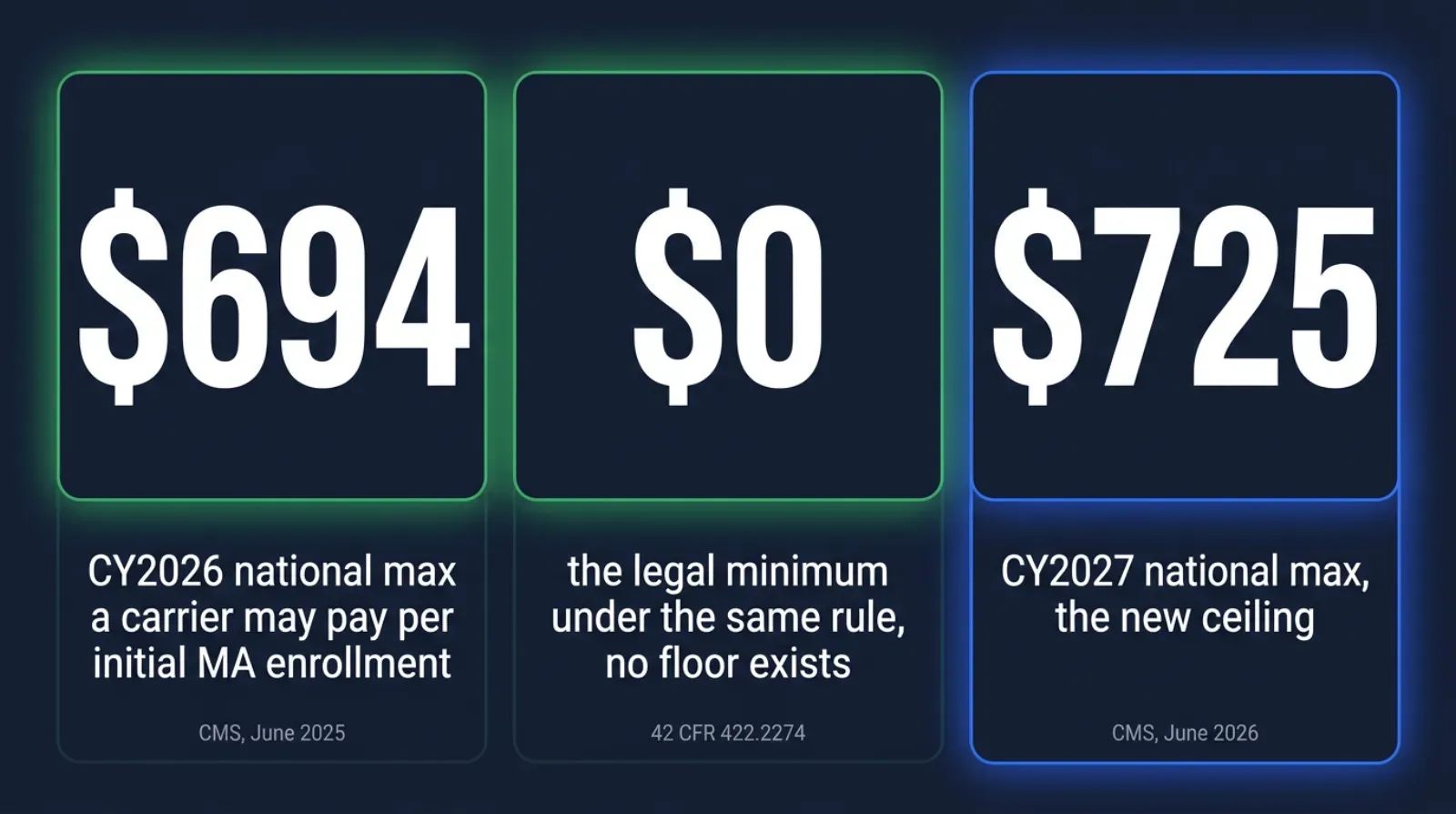
Run the math on a modest AEP push: twenty new enrollments into a single plan at the full national CY2026 rate is $13,880 in initial-year compensation. The same twenty enrollments into a plan a carrier quietly moved to $0 is exactly that — zero — while the marketing spend, the appointment time, and the paperwork cost the same either way. The gap isn’t a rounding error on a commission statement; it’s the entire return on that slice of your AEP marketing budget, gone, with nothing in the regulation that required the carrier to warn you before the season started.
National MA fair market value cap, initial vs. renewal, CY2026 vs. CY2027
Maximum a carrier is permitted to pay — not what any specific plan actually pays.
Source: CMS, Contract Year 2026 and Contract Year 2027 Agent and Broker Compensation memos.
CMS didn't remove the ceiling. It just made it easier to see, in hindsight, how many carriers spent this AEP testing the floor.
Mike MooreThe Idaho fight: what it shows about the limits of state protection
Idaho is worth understanding in detail because it’s the most fully documented example of what happens when a state tries to draw a line between “a carrier’s legal right to set its own commission” and “a carrier using that right in a way regulators consider deceptive.”
The Idaho Department of Insurance’s investigation, opened in September 2025, centered on a specific combination: carriers allegedly cutting broker commissions on Medicare Advantage plans at the same time they restricted the online and paper application channels beneficiaries would need to actually enroll — including, according to reporting on the order, discouraging agents from selling certain plans and pulling applications from public platforms during open enrollment (LocalNews8/KIFI, October 30, 2025). It wasn’t the commission cut alone that triggered the order — carriers can legally do that under the federal FMV rule. It was the state’s read that pairing a commission cut with restricted access crossed into deceptive trade practice territory under Idaho law.
The cease-and-desist order, docket 18-4775-25, named UnitedHealthcare of the Rockies, PacificSource Community Health Plans, and Care Improvement Plus South-Central Insurance Co. Per that reporting, PacificSource had told agents that continuing to sell other PacificSource products required signing a zero-commission contract by November 1, 2025, and UnitedHealthcare had already ended commissions on certain plans that October (Insurance Business, November 7, 2025).
UnitedHealthcare and PacificSource responded by suing Idaho’s insurance director, arguing that federal Medicare law preempts state regulation of MA broker compensation entirely — that if CMS sets the compensation framework, a state can’t layer its own rules on top of it, even rules aimed at a different harm (restricted access) than the compensation itself. In December 2025, a federal judge agreed with the insurers on a preliminary basis, granting injunctions that blocked Idaho from enforcing its order while the case proceeds (Morgan Lewis, healthlawscan, February 2026).
The practical takeaway for agents outside Idaho: don’t assume a state regulator can or will step in if a carrier cuts your commission mid-AEP. The one documented attempt is currently on hold, on preemption grounds that would apply just as easily to any other state trying the same move. Your own state’s Department of Insurance may still be a resource if a specific plan’s access restrictions look deceptive on their own terms — several other states reportedly issued similar warnings during the same period — but treat commission stability as something you confirm directly with the carrier, not something you assume a regulator will guarantee.
How to check whether a specific plan still pays, done completely by hand
This is the part we’re not holding back. If you want to run this check with zero tools and no membership, here’s the real process, in order.
Get the current commission schedule in writing, this week
A spring commission schedule from your FMO is not current data in an AEP where carriers are changing plan-level rates mid-cycle. Request a written, dated commission schedule for every plan you intend to market, not a verbal confirmation.
Check the carrier's own broker portal directly
Producer bulletins announcing a plan-level commission change typically post to the carrier's broker portal before they reach your FMO's newsletter. If you're marketing a specific carrier's plans heavily, check that portal weekly through AEP, not once at the start of the season.
Don't rely on the CMS-published range alone
CMS does post the required minimum-to-maximum compensation range each year at cms.gov, but a range that reads "$0 to $694" is technically accurate for a plan paying full commission and for one paying nothing. The voluntary $0-specific flag CMS added for CY2027 explicitly will not be posted publicly, so the range alone won't resolve the question.
Get a specific plan's status confirmed in writing before you spend
Before committing ad spend, direct mail, or a seminar to a specific plan benefit package, email your carrier or FMO contact asking for written confirmation of that exact plan's current new-enrollment commission status. A dated email reply is enough of a record to act on and to keep for your own files.
Watch your state Department of Insurance for bulletins
Several states issued public warnings about commission-cut practices during the 2026 AEP. A bulletin from your own state DOI is a faster, more specific signal than a national trend piece, and it's the channel that matters if you ever need to document a complaint.
Re-verify mid-season, not just at the start
The Idaho case shows commission status changing after AEP prep was already underway. Treat "confirmed in September" as expired information by November. Re-check the plans carrying the most of your marketing budget at least once more before December 7.
This works whether you're solo or on a team
None of the six steps above require software. They require a habit: treat commission status as a piece of live data that expires, the same way you'd treat a plan's Star Rating or network status, instead of something you check once in September and trust through December.
Where the manual check breaks down at scale
The six steps above are complete, and they work for a handful of target plans in a handful of counties. They get genuinely hard to sustain once you’re marketing across multiple counties, multiple carriers, and a real AEP calendar, because the check isn’t a one-time lookup — it’s a recurring one, on plans whose status can change mid-season, layered on top of everything else a real plan comparison requires: Star Ratings, network adequacy, formulary coverage, and premium, all of which still matter regardless of what a plan pays you.
That’s the actual gap. Confirming commission status is a direct-to-carrier conversation no data source replaces. But once you’ve confirmed which plans in a county are actually worth your marketing dollars, comparing them against each other — rates, benefits, Star Ratings, drug coverage — is exactly the kind of repetitive, structured lookup that doesn’t need to happen one plan at a time in a browser tab.
How Ambrose’s plan-quoter and medicare-watchdog spokes speed up what’s left
Ambrose OS, the platform included with a Tech Savvy membership, doesn’t have a documented capability that ingests CMS’s agent/broker compensation submissions — we checked the current spoke catalog and glossary this session, and there’s no source doing that job yet, so we’re not going to claim there is one. What Ambrose does confirm, per its own documentation, is fast plan research once you know which plans are actually in play.
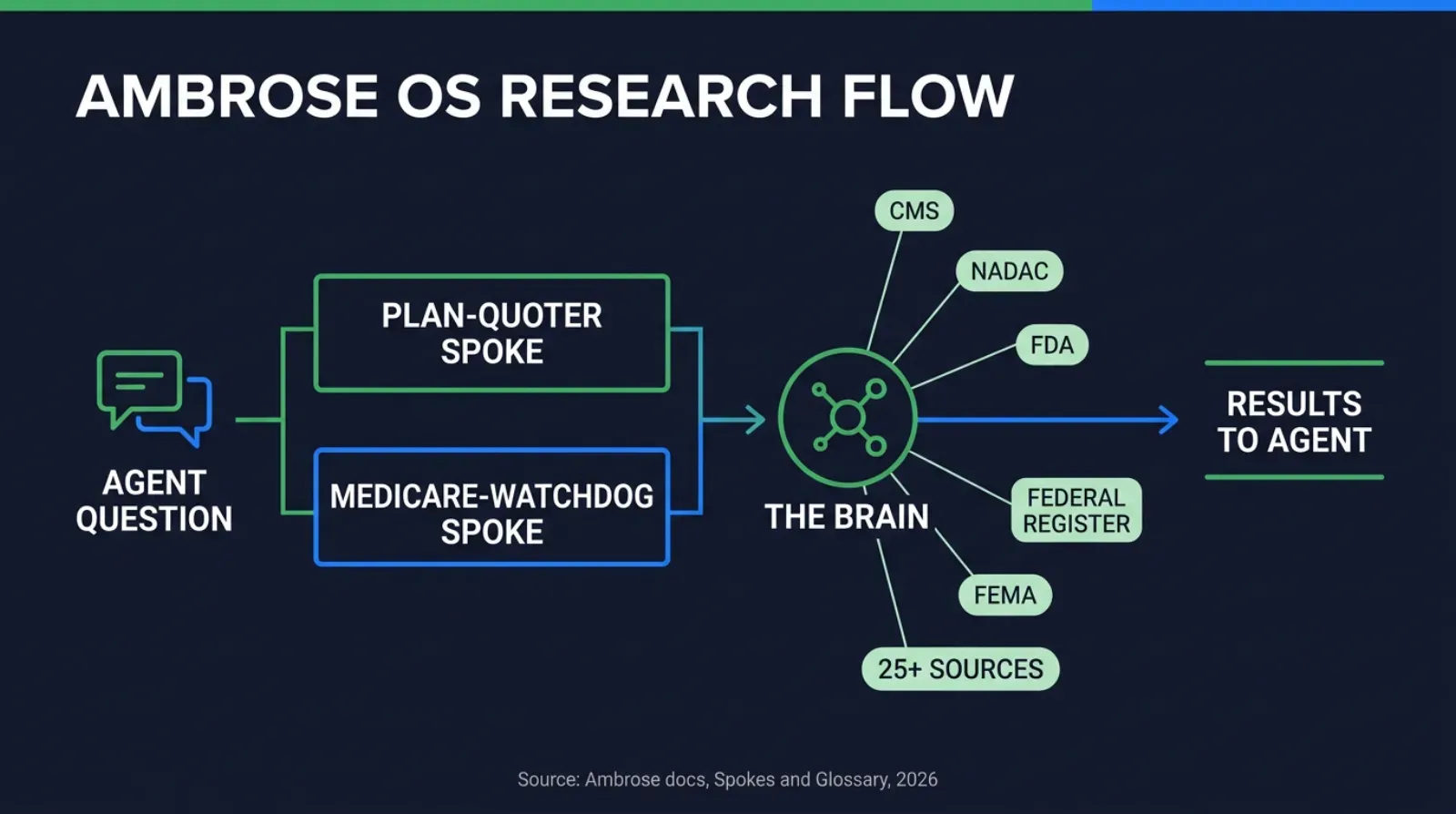
Two spokes matter here. plan-quoter handles “ICHRA + Medicare + ACA quoting,” and medicare-watchdog runs “Scheduled MAPD/PDP/Med Supp intelligence” (Ambrose docs, Spokes). Both draw on what Ambrose’s own glossary calls the Brain — an internal service described as fronting “25+ federal/healthcare data MCPs (CMS, NADAC, FDA, Federal Register, FEMA, …),” which “the named research spokes call” (Ambrose docs, Glossary, fetched August 2026). In practice, that means once you’ve confirmed a shortlist of commissionable plans for a county through the manual process above, you can ask Ambrose to pull rates, benefits, and Star Ratings for that shortlist in one question instead of opening Medicare Plan Finder once per plan.
| Manual step | Ambrose equivalent |
|---|---|
| Confirm commission status directly with carrier/FMO | No documented equivalent — still a direct human check, per Ambrose's current spoke catalog |
| Look up each plan's rates and benefits, one at a time, on Medicare Plan Finder | plan-quoter quotes Medicare, ACA, and ICHRA plans against the Brain's federal data sources |
| Track Star Ratings, cost changes, and network shifts per plan across a county | medicare-watchdog runs scheduled MAPD/PDP/Med Supp intelligence |
| Remember to re-check mid-season | A Routine — a scheduled prompt on a cron schedule — can post a fresh check to Slack, email, or a GHL note automatically (Ambrose docs, Routines) |
If you want the re-check step to happen without you remembering it, a Routine is a scheduled prompt attached to an agent or team, running on a standard five-field cron schedule, with output that can post to “Slack, email, GHL note, log only” (Ambrose docs, Routines). Set one to re-run your shortlisted plans’ Star Ratings and cost data weekly through AEP, and the “did anything change since I last checked” question answers itself in a Slack message instead of a fresh round of manual lookups.
A plan-research tool doesn't replace the compensation conversation
Nothing above changes the core fact: commission status is a direct-to-carrier confirmation, not a data lookup. Ambrose speeds up comparing plans you've already confirmed you can profitably market — it doesn't (as of this article) tell you which plans are non-commissionable. Don't build a marketing plan around an assumption either tool hasn't actually confirmed.
Compliance: what doesn’t change here
Because this touches Medicare marketing directly, the standard rules apply regardless of what a plan pays you. The TPMO disclaimer requirement under 42 C.F.R. § 422.2267(e)(41) still governs any Medicare Advantage, Part D, or Medicare Supplement marketing content — verbally on sales calls before benefits are discussed, electronically for email and chat, and prominently on any TPMO website or printed material (Cornell Law eCFR mirror). Dropping a non-commissionable plan from your active pitch list changes the number of organizations and products you represent, which means updating the count in your disclaimer text, not skipping the disclaimer.
If any part of your commission-checking process involves pasting client information into a general-purpose AI tool to draft outreach or track status, stop — client identifiers and plan details tied to a real person are exactly what shouldn’t go to a destination without a signed BAA. Ambrose’s PHI Rail is built for this specific problem: it runs a “redact-then-rehydrate pipeline” that checks whether a destination qualifies for BAA treatment, and if it doesn’t, scrubs identifiers into typed aliases like “PERSON_xxxx” before anything reaches the model, then splices the real values back in on the way out (Ambrose docs, PHI Rail architecture, fetched August 2026). The NAIC’s AI Model Bulletin expectations apply too, the same way they apply to any AI-assisted process touching an insurance decision: a written policy on how the tool is used, human review of what it produces before anyone acts on it, and documentation if a regulator or carrier ever asks.
What you get by joining
One Ambrose seat, including plan-quoter and medicare-watchdog, comes with a Tech Savvy Insurance membership: $97 a month, billed monthly, cancel anytime, founding rate locked in while the membership stays active. Alongside the seat: weekly Zoom calls with open Q&A and build-with-you sessions, 30+ hours of recorded training, Meta Ads and marketing training built for this industry, pre-built AI templates and bot deployments, and a free annual in-person member workshop. It’s also an explicit no-recruiting zone — you can ask a real question about a commission dispute with a carrier without ending up on someone’s downline pitch list, which is a genuine point of difference from most agent Facebook groups.
Ambrose usage is separate from the $97 seat
The membership includes one Ambrose seat; usage inside Ambrose runs through its own credit ledger with spend caps, so cost stays visible instead of appearing as a surprise line item. See the full Spokes catalog for what else is available beyond plan-quoter and medicare-watchdog.
The close
Everything above — the written-confirmation habit, the broker-portal check, the mid-season re-verify, the exact TPMO disclaimer language — works whether you ever join anything or not. That’s the point of writing it out completely. If you’d rather have the plan-comparison half of this running on a schedule instead of a browser tab, with plan-quoter and medicare-watchdog pulling from live federal data and a Routine posting the re-check to Slack automatically, one Ambrose seat comes with a Tech Savvy membership, and the weekly build-with-you calls are where agents actually set up their first plan-research routine, on their own target counties, with people who’ve already done it: https://techsavvyinsurance.com/.
Before you build a marketing plan around any specific plan
Tech Savvy Insurance is a training and software community, not an insurance company, agency, or law firm, and does not provide insurance, legal, tax, or compliance advice. You are responsible for your own licensure and for complying with all applicable CMS, HIPAA, state, and carrier regulations, including TPMO disclaimer and Scope of Appointment requirements. Commission rates and non-commissionable status can change during the plan year — confirm current status directly with your carrier or FMO before relying on any figure in this article. AI-generated outputs may contain errors — always verify. Results may vary.
Frequently asked questions
Sources
- CMS — Contract Year 2026 Agent and Broker Compensation Rates, Referral/Finder's Fees, Submissions, and Training and Testing Requirements (June 18, 2025) — ritterim.com
- CMS — Contract Year 2027 Agent and Broker Compensation Rates, Referral/Finder's Fees, Submissions, and Training and Testing Requirements (June 1, 2026) — psmbrokerage.com
- 42 CFR 422.2267(e)(41), TPMO disclaimer text — Cornell Law eCFR mirror — law.cornell.edu
- LocalNews8/KIFI — Idaho Department of Insurance Issues Cease and Desist Order for UnitedHealthcare (October 30, 2025) — localnews8.com
- Insurance Business — Idaho Orders Insurers to Halt Restrictions on Medicare Advantage Applications (November 7, 2025) — insurancebusinessmag.com
- Morgan Lewis — Medicare Advantage Agent and Broker Agreements: 2025 in Review (February 2026) — morganlewis.com
- Ambrose docs — Glossary ("the Brain") — app.hiambrose.com
- Ambrose docs — Spokes — app.hiambrose.com
- Ambrose docs — PHI Rail architecture — app.hiambrose.com
- Ambrose docs — Routines — app.hiambrose.com
Ready to put this into practice?
Join a private community of Health & Life insurance professionals using AI, Meta Ads, and automation to grow — without draining their bank account.
Join Tech Savvy — $97/month