
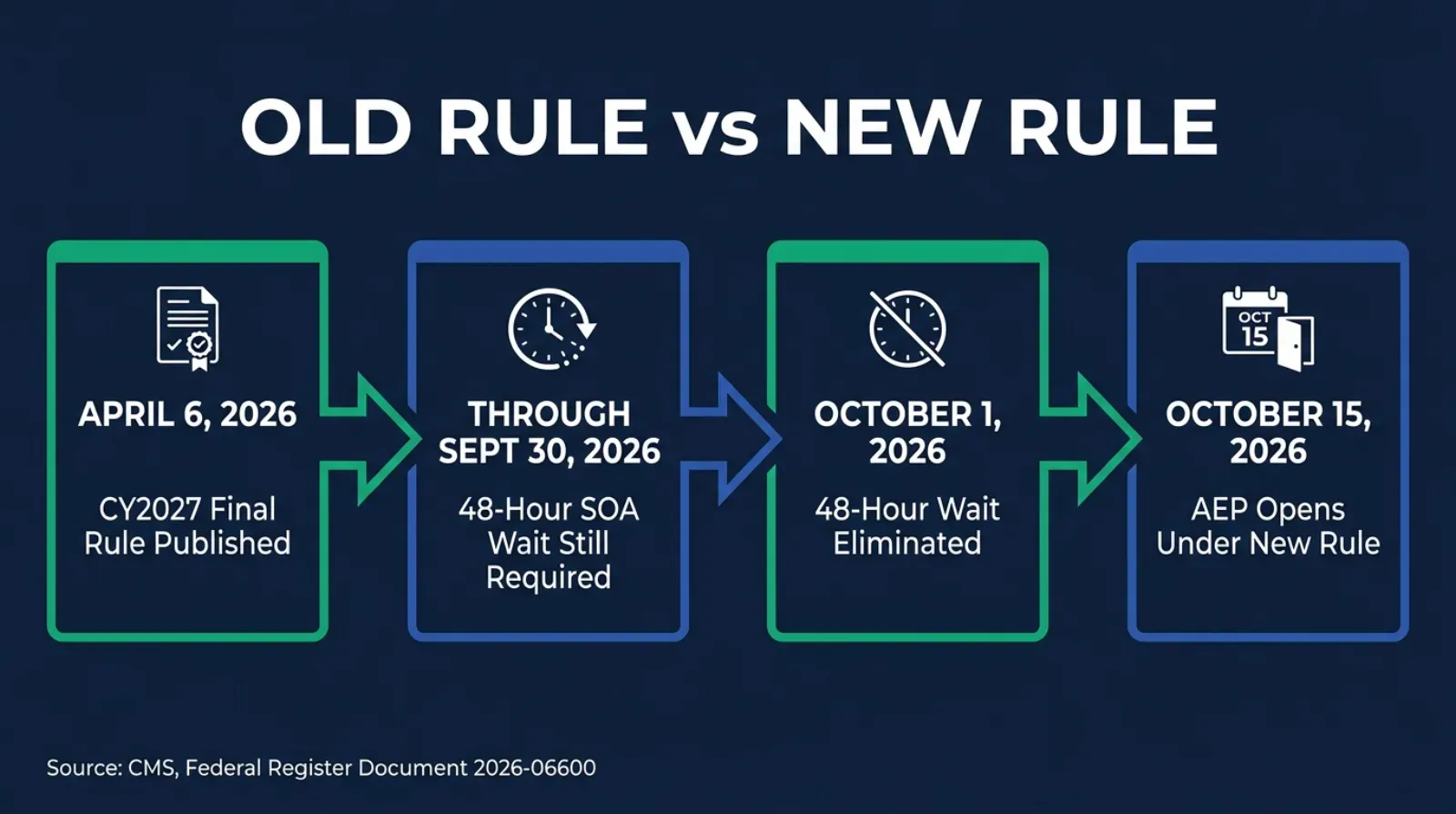
CMS killed the 48-hour Scope of Appointment wait period. In its Contract Year 2027 Medicare Advantage and Part D final rule, published in the Federal Register on April 6, 2026, CMS struck the requirement that an SOA be signed at least 48 hours before a personal marketing appointment (Hall Render, June 1, 2026). If you’ve spent the last two AEPs training yourself, and maybe your whole downline, to never touch plan benefits inside that 48-hour window, that instinct is about to be wrong — but not yet, and not for everyone, and not in the way most of the recap posts flying around right now are describing it. This article is the version with the actual CFR citations, the actual effective date, and the actual gap between “the rule changed” and “the rule applies to you today.”
Key takeaways
- CMS eliminated the 48-hour SOA waiting period at 42 CFR 422.2264(c)(3)(i) / 423.2264(c)(3)(i) in the CY2027 final rule, published April 6, 2026 (Hall Render, June 2026).
- The change is applicable to CY2027 marketing and communications beginning October 1, 2026 — the old 48-hour rule still governs anything you do before that date.
- The SOA itself is not eliminated: it still must be in writing for an in-person appointment and is still valid for 12 months from signature (42 CFR 422.2264, current text).
- CMS/OIG marketing-violation penalty exposure runs up to $25,000 per determination, and up to $100,000 for enhanced violations, under 42 CFR 422.760.
- AEP 2026 runs October 15 through December 7 (CMS.gov) — meaning the new SOA rule is in effect for the entire selling season this year, not the old one.
What actually changed: the 48-hour wait is gone, the SOA isn’t
Here’s the change in one sentence: CMS removed the requirement that a beneficiary’s Scope of Appointment be agreed to and signed at least 48 hours before the personal marketing appointment it authorizes. That requirement was written into 42 CFR 422.2264(c)(3)(i) for Medicare Advantage and the mirrored 423.2264(c)(3)(i) for Part D, and CMS struck it in the Contract Year 2027 Medicare Advantage and Part D final rule (Hall Render, June 1, 2026; CMS fact sheet, Apr. 2, 2026). CMS’s own fact sheet describes the broader intent in the “Reducing Regulatory Burden and Costs” section of the rule as “removing restrictions on the time and manner by which beneficiaries can have conversations with licensed agents and brokers” — the SOA timing change is the specific, concrete version of that general statement.
What did not change is worth saying just as plainly, because it’s the part that gets dropped from a lot of the recap content circulating right now. Pull up the current regulatory text at 42 CFR 422.2264 and it still requires the SOA to be in writing for in-person personal marketing appointments, and it still says an SOA is valid for 12 months following the beneficiary’s signature date or the date of their initial request for information (Cornell Law, eCFR mirror). Nobody is telling you the SOA requirement itself is gone. It’s the same document, filled out the same way, for the same 12-month validity window. The only thing that moved is when you’re allowed to use it after it’s signed.
CMS also narrowed a related definition in the same rule. “Personal marketing appointment” is now defined as an appointment “tailored to an individual or small group (for example, a married couple) for purposes of discussing marketing topics” (Hall Render, June 1, 2026). That’s a narrower category than a lot of agents had been operating under out of caution, and it matters because the SOA requirement attaches specifically to that defined category of appointment, not to every conversation that happens to touch a plan.
| Requirement | Rule through Sept. 30, 2026 | Rule from Oct. 1, 2026 |
|---|---|---|
| Written SOA required for in-person personal marketing appointment | Yes | Yes — unchanged |
| Waiting period between SOA signature and appointment | At least 48 hours (42 CFR 422.2264(c)(3)(i), prior text) | None — 48-hour requirement struck |
| SOA validity period | 12 months from signature | 12 months from signature — unchanged |
| "Personal marketing appointment" definition | Broader, less specifically defined | Individual or small group (e.g., a married couple), for marketing topics specifically |
| TPMO disclaimer required text (42 CFR 422.2267(e)(41)) | Two standard versions, unchanged | Two standard versions, unchanged |
This article covers the SOA timing rule specifically, not a full Medicare marketing script
This piece is about one specific, confirmed rule change and its effective date. For the broader current TPMO, disclaimer, and call-recording landscape, see our AI compliance guide. If you also work Medicare Advantage renewals and terminations, our guide to re-shopping your book before AEP covers the plan-year-transition side of AEP prep.
Why CMS reversed itself, and why this isn’t the first flip
The 48-hour wait wasn’t always the rule, and it isn’t likely to be the last version of this rule either. CMS has moved Medicare marketing regulation in and out of stricter postures repeatedly over the last several years — tightening SOA and disclaimer requirements in earlier rulemaking cycles, then loosening specific pieces of that same framework in the CY2027 final rule after industry and broker feedback argued the timing restrictions were costing beneficiaries same-day access to a licensed agent without demonstrated evidence that the wait period itself prevented harm. CMS’s own fact sheet frames the change as part of a “Reducing Regulatory Burden and Costs” section of the rule, which is CMS’s own language for “we heard the complaints and we’re walking part of this back.”
That framing matters for how you plan around the next version of this rule, whatever it turns out to be. A regulation CMS is actively adjusting in response to industry input isn’t a fixed target — it’s a moving one, and it moves on CMS’s rulemaking calendar, not on any individual agent’s compliance training schedule. The 2024 crackdown taught a generation of agents to treat the 48-hour wait as gospel. The 2027 final rule just proved that gospel has an expiration date CMS controls, not you.
The rule you memorized two AEPs ago isn't a law of physics. It's a CMS rulemaking decision, and CMS just showed you it revisits those decisions.
Mike MooreThis is also why “read the recap blog and move on” is a worse strategy for this specific kind of change than it is for most compliance topics. A recap article, including parts of this one, is a snapshot of a rule that CMS can and does amend again. The Federal Register document itself — 2026-06600, published April 6, 2026 — is the actual source of truth, and it’s a public document anyone can pull up directly rather than trusting secondhand.
What it costs to get the timing wrong
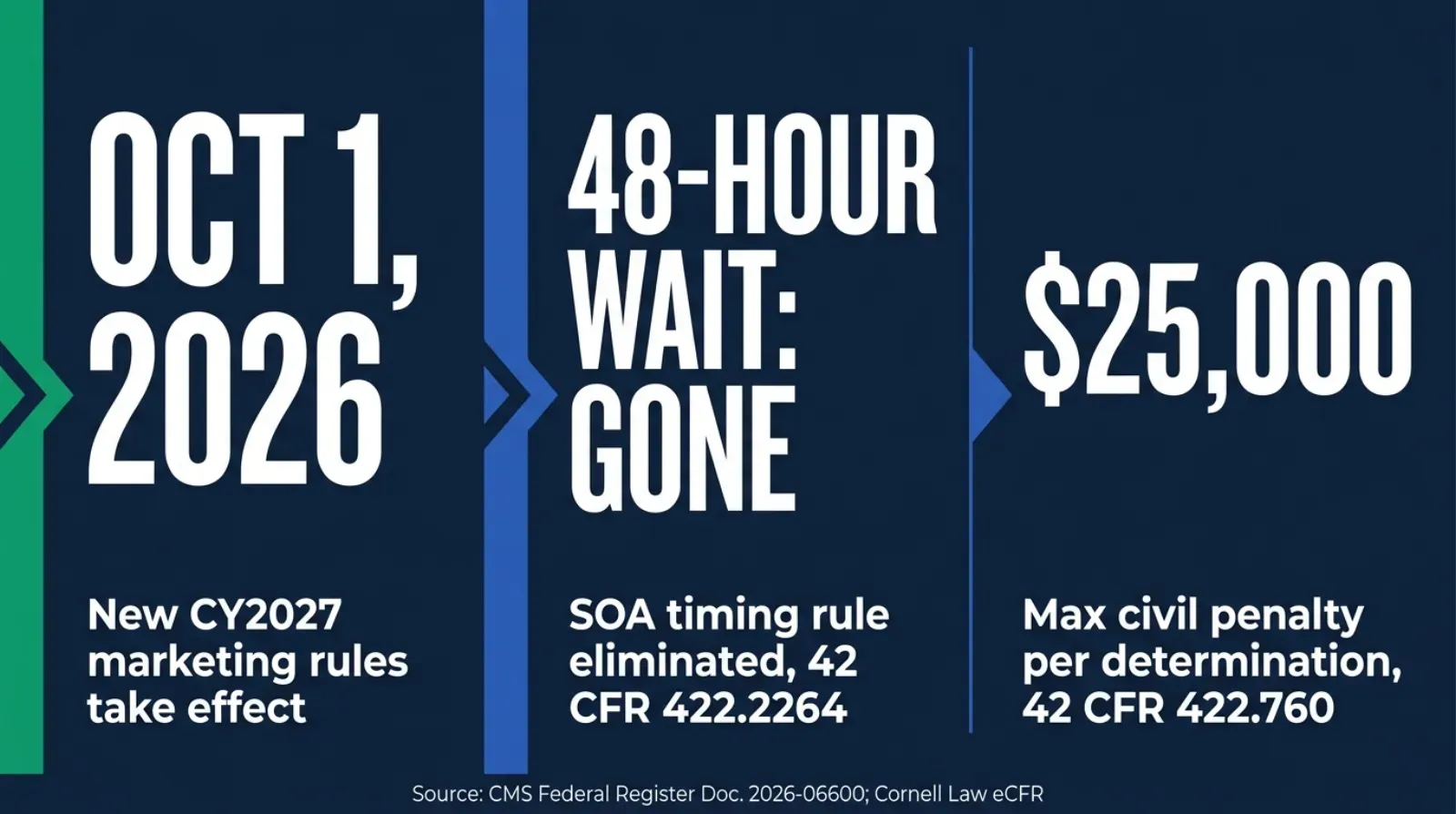
Two different mistakes are possible here, and they cost you in opposite directions. The first is dropping the 48-hour wait early — treating the rule as already gone the moment you read a recap article about it, when it’s actually still in force through September 30. Any personal marketing appointment you hold before October 1 without the SOA-plus-48-hours combination is still a violation of the rule as currently applicable, full stop, regardless of what the CY2027 final rule says about October and beyond.
The second mistake is the mirror image: still imposing the 48-hour wait on yourself in October, November, and December, past the date it stopped being required, and needlessly losing same-day appointment opportunities during the 54-day stretch from October 15 through December 7 that is Medicare’s Annual Election Period (CMS.gov, Medicare Open Enrollment partner resources). That’s not a compliance violation, it’s a self-imposed cost — a beneficiary who wants to enroll today, who you make wait two more days out of habit, in the seven-week window where every other agent marketing to that same household is no longer waiting.
The regulatory exposure on the first mistake is real and it’s not small. Under 42 CFR 422.760, CMS or the HHS Office of Inspector General can impose civil money penalties of up to $25,000 per determination, adjusted annually under 45 CFR part 102, for each finding against a Medicare Advantage organization tied to a marketing or communications deficiency, with the same $25,000 ceiling applying per enrollee directly and adversely affected by the conduct (Cornell Law, eCFR mirror of 42 CFR 422.760). Uncorrected deficiencies carry their own exposure of up to $10,000 per week, and CMS reserves enhanced penalties of up to $100,000 for determinations under the more serious violation categories in 42 CFR 422.752(a)(4) and (a)(5)(i).
Civil money penalty ceilings by violation category, 42 CFR 422.760
Maximum penalty amounts CMS or the OIG can impose, per determination unless noted; adjusted annually under 45 CFR part 102.
Source: Cornell Law, Legal Information Institute, current eCFR text of 42 CFR 422.760.
These ceilings apply broadly, not specifically to the SOA timing change
Section 422.760 sets the general civil money penalty framework for Medicare Advantage marketing and communications violations — it isn't a penalty schedule written specifically for the SOA rule. The point of including it here isn't to predict CMS enforcement against the transition window; it's to show the actual scale of exposure that makes "I didn't realize the rule changed on October 1" an expensive sentence to say to a compliance officer.
The current rule, given away completely: what to actually do
You don’t need a membership or a piece of software to get this right. Here’s the complete, current answer, as of this article.
Keep the 48-hour wait until October 1
If you're holding a personal marketing appointment before October 1, 2026, the current rule — 48 hours between SOA signature and appointment — still applies. Don't drop it early because you read a recap article.
Update your SOA workflow for October 1 forward
From October 1 on, you can hold the appointment the same day the SOA is signed. Update your CRM's appointment-scheduling logic, your team's training materials, and any automated reminder that currently blocks scheduling inside the old 48-hour window.
Keep collecting a written SOA every time
Nothing about the requirement to have a signed, written SOA before an in-person personal marketing appointment changed. Neither did its 12-month validity window. Keep your current SOA form and process — only the wait after signing it changes.
Re-check what counts as a "personal marketing appointment"
CMS's narrowed definition — an appointment tailored to an individual or small group, like a married couple, for discussing marketing topics — may mean some conversations you'd previously required an SOA for don't fall under the definition at all. Don't assume; check the current definition against your specific scenario.
Keep your TPMO disclaimer exactly as written
The disclaimer text at 42 CFR 422.2267(e)(41) didn't change in this rule. Use the version that matches whether you represent every plan available in your area or not — both are reproduced below.
Document the date, either way
Whichever side of October 1 an appointment falls on, keep a record of when the SOA was signed and when the appointment happened. That record is what proves you followed whichever version of the rule was actually in force on that date, if anyone ever asks.
| If your TPMO... | Required disclaimer text |
|---|---|
| Does not sell every plan available in the service area | "We do not offer every plan available in your area. Currently we represent [insert number of organizations] organizations which offer [insert number of plans] products in your area. Please contact Medicare.gov or 1-800-MEDICARE to get information on all of your options." |
| Sells every plan available in the service area | "Currently we represent [insert number of organizations] organizations which offer [insert number of plans] products in your area. You can always contact Medicare.gov or 1-800-MEDICARE for help with plan choices." |
Source: Cornell Law, Legal Information Institute, current eCFR text of 42 CFR 422.2267.
A worked example: the same appointment, two dates
Take one scenario and run it against both sides of October 1, because the abstract version of this rule is easy to nod along with and the concrete version is where agents actually trip.
A beneficiary calls you on September 15, 2026, wanting to talk through Medicare Advantage options for next year. You collect a written SOA that day. Under the rule in force on September 15, you cannot hold the personal marketing appointment until at least 48 hours have passed — September 17 at the earliest. If you meet with them on September 16 instead, you’ve held the appointment inside the still-mandatory wait period, a violation of the rule as it stood that day, regardless of the fact that the wait period disappears two weeks later.
Now move the same scenario to October 20, 2026 — inside AEP. The beneficiary calls, you collect a written SOA, and because the CY2027 rule’s SOA timing change is applicable by then, you can hold the personal marketing appointment that same day if the beneficiary wants to. No 48-hour gap required. Same script, same form, same agent — different outcome, purely because of which side of October 1 the calendar landed on.
| SOA signed | Earliest compliant appointment | Rule in force |
|---|---|---|
| September 15, 2026 | September 17, 2026 (48 hours later) | Pre-October 1: 48-hour wait applies |
| October 20, 2026 | October 20, 2026 (same day, if beneficiary wants) | Post-October 1: wait eliminated |
Tech Savvy Insurance is not a law firm and this is not legal advice
Tech Savvy Insurance is a training and software community, not an insurance company, agency, or law firm, and does not provide insurance, legal, tax, or compliance advice. Confirm current CMS Medicare Communications and Marketing Guidelines requirements, and check with your own carrier's compliance team, before relying on any date or rule described in this article for a specific appointment.
CMS sets the floor. Your carrier contract can still be stricter
Nothing in this article means every carrier and FMO you’re contracted with drops the 48-hour wait the moment CMS does. CMS’s marketing rules are a regulatory floor that applies across all Medicare Advantage organizations and Part D sponsors — carriers are free to layer their own, stricter requirements on top of that floor through their agent and broker agreements, the same way they already do with things like caller ID requirements, CRM mandates, or additional training beyond CMS’s own AHIP-style certification.
That means the honest answer to “can I stop waiting 48 hours on October 1” is “check your specific carrier agreements, plural.” A national FMO that writes for a dozen carriers may have a dozen slightly different internal policies, and some carriers move slower than CMS’s own effective date — either because their compliance team hasn’t finished updating internal guidance yet, or because they’ve made a business decision to keep the more conservative posture regardless of what CMS requires. If your upline or FMO hasn’t sent an update by late September confirming they’re adopting the new timing, ask directly rather than assuming CMS’s effective date is automatically your effective date. A carrier can always require more than the federal floor. It can’t require less.
A practical way to confirm, before AEP opens
Email your FMO or carrier contract manager directly, reference the CY2027 final rule and the SOA timing change specifically, and ask them to confirm in writing whether their internal policy is adopting CMS's October 1 effective date as-is or keeping an additional buffer. That written confirmation is also exactly the kind of documentation a compliance officer wants to see if the question ever comes up later — you didn't just assume, you asked and got an answer on file.
What to tell your team or downline before October 1
If you manage other agents, the timing confusion described in this article multiplies by however many people are on your team, each interpreting the news differently. A short, direct message before the transition date heads off most of it:
State the exact date
"The 48-hour SOA wait is required through September 30. Starting October 1, it's gone — same-day appointments are allowed with a signed SOA." One sentence, no ambiguity about which side of the date applies.
Confirm the carrier-by-carrier reality
List which of your contracted carriers have confirmed they're adopting CMS's date as-is, and flag any that haven't responded yet or are keeping a longer internal buffer.
Update the shared SOA template and CRM logic together
If your team shares a CRM appointment-booking flow, update the scheduling restriction in one place on September 30, not agent by agent whenever each person remembers.
How to not get caught flat-footed by the next reversal
Reading this article gets you current as of today. It doesn’t do anything about the next time CMS revisits this rule — and the pattern of the last several years says there will be a next time. That’s the actual problem underneath “what changed with the 48-hour rule”: not one rule, but the fact that nobody on a busy sales calendar has a reliable habit of checking whether a rule they memorized two years ago is still the current rule.
This is where Ambrose OS, the platform included with a Tech Savvy membership, has an actual mechanism, not a generic “AI helps with this” wave. According to Ambrose’s documentation, a routine is a scheduled prompt attached to an agent or a team — the docs describe it as “the easiest way to make Ambrose run on its own,” with example use cases including a weekly renewal scan on Mondays and a daily watchdog check running compliance scans (Ambrose docs, Routines). A routine has five parts: a cron schedule, a target agent or team, a prompt body, an optional output sink like Slack, and an optional PHI mode. Point one at a research prompt — “check for new CMS Medicare Advantage and Part D marketing guidance and summarize anything new” — set it to run weekly, and send the output to Slack, and you’ve replaced “remember to check” with “it’s already in the channel Monday morning.”
That prompt has something real to query against. The Brain, Ambrose’s internal data service, is documented as fronting “25-plus federal and healthcare data MCPs,” with the Federal Register named specifically as one of them, alongside CMS, NADAC, and FDA (Ambrose docs, Glossary; Ambrose docs, Architecture). A routine built on top of that source isn’t guessing at what changed from a training cutoff — it can query the live federal source at run time, the same way any research spoke does.
If a question comes up mid-week that can’t wait for the next scheduled run, Ambrose’s War Room is the other piece worth naming specifically. It’s documented as a roster of nine executive personas, dispatched by Ambrose in the role of Chief of Staff, including Dr. Elena Reyes under Compliance (Ambrose docs, War Room). You ask a question in plain English, Ambrose routes it to the relevant head or heads, and each head runs its own session with its own tools. It’s a place to ask “does the SOA change apply to what I’m doing Thursday” and get routed to something built around that specific lane, instead of a single generalist chatbot answering everything the same way.
| Manual habit | Ambrose equivalent |
|---|---|
| Remembering to check CMS.gov and the Federal Register periodically | A scheduled routine with a research prompt, run weekly, output to Slack (Ambrose docs, Routines) |
| Digging through search results to find the primary source | The Brain's federal-register source, queried at run time, not from training memory (Ambrose docs, Glossary) |
| Asking around the office whether a rule applies to a specific scenario | The War Room's Compliance persona, reachable in plain English (Ambrose docs, War Room) |
Ambrose usage runs on its own credit ledger
The membership includes one Ambrose seat; usage inside Ambrose runs through its own credit ledger with spend caps, so cost stays visible instead of showing up as a surprise line item ([Ambrose docs, What is Ambrose](https://app.hiambrose.com/docs/what-is-ambrose)). That's the same pricing shape across every Ambrose spoke and routine, not something specific to this use case.
Everything above works whether you ever touch Ambrose or not — set your own calendar reminder for the last week of September and the first week of October, bookmark the CMS fact sheet, and check back. If you’d rather have that check running on a schedule with the result landing in Slack instead of on a sticky note, that’s what the routine does, and it’s the kind of thing agents actually build during the weekly Tuesday calls, with people who’ve set one up before watching the screen.
Compliance in this transition, and where AI fits
Because this article touches Medicare marketing directly, the standard obligations apply regardless of what changed on October 1: the current CMS Medicare Communications and Marketing Guidelines and TPMO disclaimer requirements under 42 CFR Part 422/423 Subpart V govern any Medicare Advantage, Part D, or Medicare Supplement marketing content, and nothing in this article changes what a compliant piece of Medicare marketing is required to say — only when an SOA-based appointment can happen.
Because part of the fix described here involves an AI tool doing research and monitoring work, the NAIC’s AI Model Bulletin is worth naming too. The bulletin, adopted by NAIC membership in December 2023, expects insurers — and in practice, this flows down through agencies — to maintain a written program for the responsible use of AI systems, with senior-management accountability, human oversight of what the system produces, testing for bias and unfair discrimination, and oversight of third-party AI vendors (NAIC, Insurance Topics: Artificial Intelligence). As of March 2025, 24 states had adopted the bulletin (Quarles & Brady, March 2025 analysis). A routine that flags a regulatory change is an input to your own review, not a replacement for reading the rule yourself — the same discipline applies here as to any AI-assisted process touching a compliance decision: a human reads what it surfaces before anyone acts on it.
Never paste a beneficiary’s name, contact information, or health details into a general-purpose AI tool to ask a compliance question — that’s exactly the kind of exposure Ambrose’s PHI Rail is built around, aliasing identifiers before anything reaches a non-BAA destination (Ambrose docs, What is Ambrose). The routine described in this article queries public federal regulatory sources, not client data, which is precisely why it’s a safe use case for this kind of automation in the first place.
What you get by joining
One Ambrose seat, including Routines and the War Room, comes with a Tech Savvy Insurance membership: $97 a month, billed monthly, cancel anytime, founding rate locked in while the membership stays active. Alongside the seat: weekly Zoom calls with open Q&A and build-with-you sessions, 30-plus hours of recorded training, Meta Ads and marketing training built for this industry, pre-built AI templates and bot deployments, and a free annual in-person member workshop. It’s also an explicit no-recruiting zone — you can ask a real compliance question without ending up on someone’s downline pitch list, which is a genuine point of difference from most agent Facebook groups.
The close
The rule itself, the actual dates, the actual CFR sections, the actual disclaimer text, is all above, and it works whether you join anything or not. Bookmark it, set your own reminder for October 1, and go run AEP. If you’d rather have a routine doing that check on a schedule and posting the answer to Slack before you even think to ask, one Ambrose seat comes with a Tech Savvy membership, and the weekly build-with-you calls are where agents actually set one up, on their own workflow, with people who’ve done it: https://techsavvyinsurance.com/.
Before you rely on any date in this article
Tech Savvy Insurance is a training and software community, not an insurance company, agency, or law firm, and does not provide insurance, legal, tax, or compliance advice. You are responsible for your own licensure and for complying with all applicable CMS, HIPAA, state, and carrier regulations. AI-generated outputs, including any Ambrose routine result, may contain errors — always verify against the current Federal Register text and your carrier's compliance guidance before acting on it. Results may vary.
Frequently asked questions
Sources
- CMS — Contract Year 2027 Medicare Advantage and Part D Final Rule (fact sheet, Apr. 2, 2026) — cms.gov
- Federal Register — Medicare Program; Contract Year 2027 and Certain Contract Year 2026 Policy and Technical Changes (2026-06600, published Apr. 6, 2026) — federalregister.gov
- Hall Render — CMS Revises Medicare Advantage Marketing Guidance for Scope of Appointment Forms (Jun. 1, 2026) — hallrender.com
- Cornell Law, Legal Information Institute — 42 CFR 422.2264, current eCFR text — law.cornell.edu
- Cornell Law, Legal Information Institute — 42 CFR 422.2267, current eCFR text — law.cornell.edu
- Cornell Law, Legal Information Institute — 42 CFR 422.760, current eCFR text — law.cornell.edu
- CMS — Medicare Open Enrollment partner resources (AEP dates) — cms.gov
- NAIC — Insurance Topics: Artificial Intelligence (Model Bulletin summary) — content.naic.org
- Quarles & Brady — Nearly Half of States Have Now Adopted NAIC Model Bulletin on Insurers' Use of AI — quarles.com
- Ambrose docs — What is Ambrose — app.hiambrose.com
- Ambrose docs — Routines — app.hiambrose.com
- Ambrose docs — War Room — app.hiambrose.com
- Ambrose docs — Glossary — app.hiambrose.com
- Ambrose docs — Architecture — app.hiambrose.com
Ready to put this into practice?
Join a private community of Health & Life insurance professionals using AI, Meta Ads, and automation to grow — without draining their bank account.
Join Tech Savvy — $97/month