
Re-shopping your Medicare book before AEP 2026 means checking every client’s current plan against next year’s Star Ratings, premiums, network, and formulary before October 15, so you’re the one calling with a fix instead of the one explaining why you didn’t notice. Going into the 2026 plan year, 13% of everyone enrolled in an individual Medicare Advantage prescription drug plan in 2025, about 2.6 million people, had that plan terminate rather than renew (KFF, March 13, 2026). If even a slice of your book falls into that group and you find out from the client instead of from a scan, you’ve already lost the conversation.
Key takeaways
- 13% of individual MA-PD enrollees in 2025, about 2.6 million people, had their plan terminate rather than renew for 2026 — more than double the 6% affected the year before (KFF, March 2026).
- 3,373 Medicare Advantage plans are available nationwide for 2026, 346 fewer than 2025, and the average beneficiary now has 32 MA-PD options instead of 34 (KFF, December 2025).
- Only about 40% of MA-PD contracts (207 of 516) earned four stars or higher for 2026, and the standalone Part D average rating fell to 3.01 from 3.12 (CMS, November 2025).
- Plans must mail the Annual Notice of Change by September 30, and non-renewal notices go out by October 2 — both before AEP opens October 15 (CMS, as of November 2025).
- Ambrose's medicare-watchdog and aca-watchdog spokes run this exact check on a schedule, using four and three tools respectively, on public federal data only (Ambrose docs).
What “re-shopping the book” actually means
Re-shopping a book of business is the annual process of checking every existing client’s current plan against what’s changing for the new plan year, before the client finds out on their own. For a Medicare book that means pulling each client’s plan contract and plan benefit package (PBP) ID, then checking four things against the new plan year: is the plan still being offered at all, did its Star Rating move, did the premium or cost-sharing change materially, and did the provider network or drug formulary shift enough to matter to that specific client.
It’s not the same task as writing new business. New business is finding people who need a plan. Re-shopping is making sure the people who already trusted you with one still have the right plan a year later, without you needing them to ask first.
This article covers the manual process and the Ambrose mechanism, not a Medicare marketing script
Everything below assumes you already understand TPMO disclaimer, Scope of Appointment, and call-recording obligations. If you need a refresher on those rules specifically, see our AI compliance guide — this piece is about finding who to call, not what to say once you do.
The pain: you find out your client’s plan died the same day they do
Here’s the version of this that actually happens. A client calls in early November, confused, holding an Annual Notice of Change letter that says their plan isn’t being offered next year, or that their premium is jumping $40 a month, or that their cardiologist is no longer in-network. They’re not calling to thank you for the heads-up. They’re calling because you didn’t give them one, and now they’re deciding, in real time, whether to trust you with the fix or Google “Medicare plans near me” and end up with whichever agent answers first.
That second option is a genuine competitor. AEP is the one time of year every Medicare-eligible household in the country gets marketing mail, calls, and ads from agents they’ve never met, all pointing at the exact confusion your silence just created. A client who has to figure out on their own that something changed is a client who’s actively being marketed to by someone else at that exact moment.
The frustrating part is that the information to prevent this exists well before the client’s letter arrives. CMS publishes the new Star Ratings in the fall. Carriers file their new-year rates before that. Plan non-renewal decisions are finalized before the client’s mailbox sees anything. The data was available. Nobody checked it against your specific book in time to act on it.
Why it happens every single year, on a predictable schedule
This isn’t a rare event you can’t plan around. It’s an annual cycle with fixed dates, and once you know the calendar, “I didn’t know” stops being a defensible excuse.
CMS publishes updated Star Ratings each fall — the 2026 ratings were published on the Medicare Plan Finder on October 9, 2025, based on the prior year’s performance data (CMS, 2026 Star Ratings Fact Sheet). Carriers separately decide, plan by plan, whether to renew, adjust premiums and benefits, or exit a market entirely, and those decisions get locked in well before open enrollment. The consumer-facing mailing calendar CMS publishes each year lays out exactly when each notice goes out:
| Date | Notice | What it tells the client |
|---|---|---|
| By September 30 | Annual Notice of Change (ANOC) and Evidence of Coverage | Formulary, benefit design, and premium changes for the new plan year |
| Late September | "Medicare & You" handbook | General benefits summary and a list of available plans |
| October 1 | Plan marketing materials | Plans begin actively marketing next year's options |
| By October 2 | Plan Non-Renewal Notice | Their current plan is leaving Medicare next year |
| Late October | Consistent Poor Performer Notice | Their plan has held under 3 stars for 3+ consecutive years |
| October 15 – December 7 | Annual Election Period (AEP) | The window to actually change plans |
Source: [CMS, Guide to Consumer Mailings from CMS, Social Security, and Plans in 2025/2026, as of November 2025](https://www.cms.gov/Medicare/Prescription-Drug-Coverage/LimitedIncomeandResources/Downloads/Consumer-Mailings.pdf).
Look at that sequence. The ANOC goes out by September 30. Marketing materials from competing plans and agents start October 1 — the day after. The client’s own plan tells them something changed two weeks before every other agent in the country is legally allowed to start pitching them a replacement. If you haven’t already reached out by the time that marketing wave hits, you’re not early anymore. You’re one voice in a pile of mail the client is holding, and not necessarily the first one they open.
What it actually costs when nobody checks
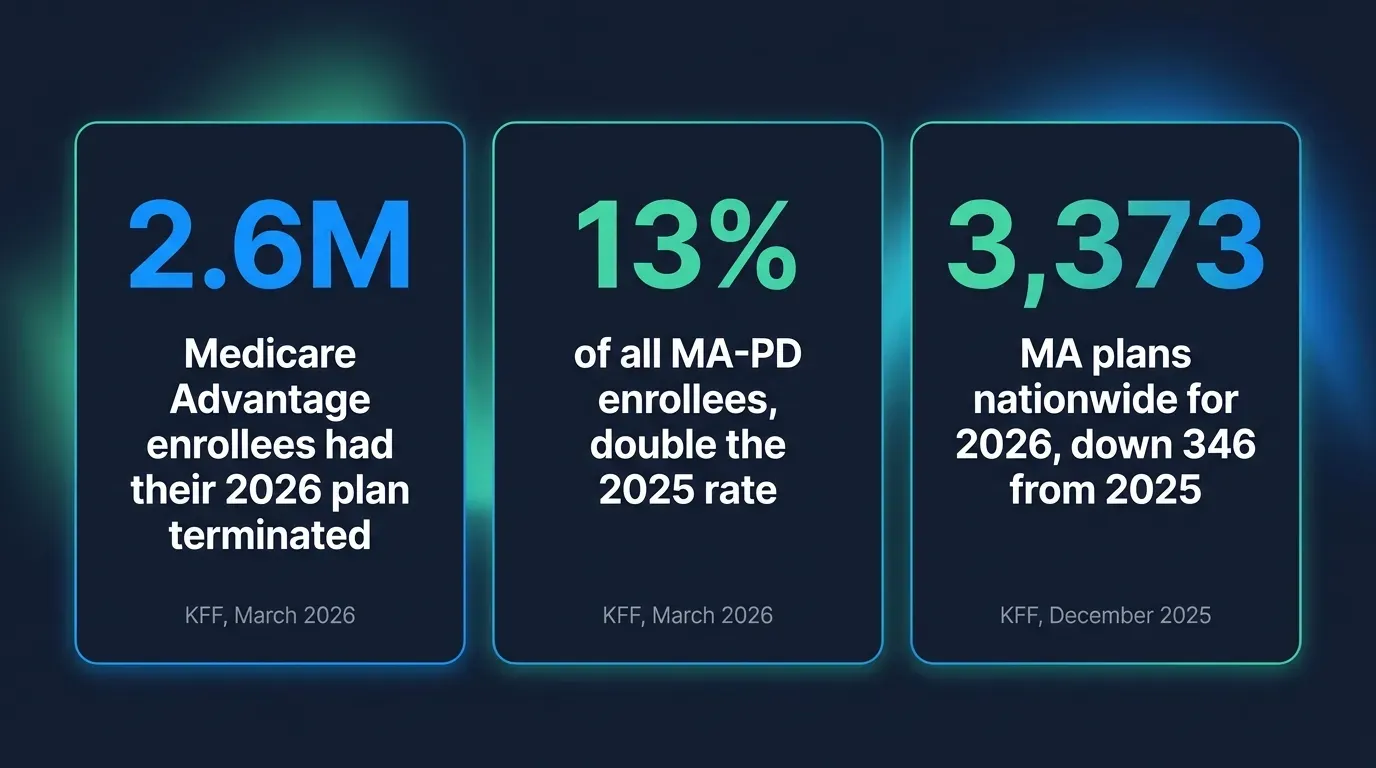
The scale of plan disruption heading into 2026 is not a normal year’s background noise. KFF’s tracking shows 13% of everyone enrolled in an individual Medicare Advantage prescription drug plan in 2025, about 2.6 million people nationwide, had that plan terminate rather than renew for 2026 — more than double the 6% affected the year before (KFF, March 13, 2026). Most of those people land somewhere reasonable: 98.9% have at least one MA-PD option available for 2026, with an average of 25 plans in their area, and 83% retained access to a zero-premium plan. But “somewhere reasonable” isn’t the same as “the plan you’d have picked for them,” and only 1.1% — roughly 28,472 people nationally — have no MA-PD option in their area at all, which is small in percentage terms and not small if one of those people is your client.
Choice is also shrinking overall, separate from the termination question. There are 3,373 Medicare Advantage plans available for individual enrollment nationwide in 2026, 346 fewer than 2025, a 9% drop. The average beneficiary now has 32 MA-PD plans to choose from instead of 34, and 39 total plans including non-drug options instead of 42. Thirty-five states, plus DC and Puerto Rico, saw fewer choices in 2026 than 2025, with New Hampshire losing 13 plans and Minnesota losing 11 (KFF, December 9, 2025). And 122 counties across 13 states now have zero Medicare Advantage plan options at all for 2026.
Quality isn’t moving in one direction either, which is exactly why you can’t rely on a headline instead of a per-client check. The enrollment-weighted average Star Rating across all rated MA-PD contracts actually ticked up slightly for 2026, to 3.98 from 3.95, and only about 40% of MA-PD contracts (207 of 516 rated contracts) earned four stars or higher. Standalone Part D plans moved the opposite direction: the enrollment-weighted average Part D rating fell to 3.01 in 2026 from 3.12 in 2025 (CMS, 2026 Star Ratings Fact Sheet, Nov. 18, 2025). A client in a strong MA-PD plan and a client in a standalone Part D plan are looking at two different trend lines this year, and a “the industry is fine” summary tells you nothing about either one specifically.
Share of individual MA-PD enrollees affected by plan termination, 2024 vs. 2025
Percentage of enrollees whose plan did not renew for the following plan year.
Source: KFF, Most Medicare Beneficiaries Affected by Plan Terminations in 2025 Have Robust Medicare Advantage Options in 2026, March 13, 2026.
The Star Ratings didn't collapse this year. The plan count did. Those are two different problems, and a client can be hit by either one without the other moving at all.
Mike MooreWhy the ratings moved the way they did this year
Star Ratings don’t drift randomly, and knowing the mechanism helps you explain a change to a client instead of just reporting it. CMS adjusts the methodology through its own rulemaking most years, and 2026 carried three specific changes worth knowing before you’re on a call explaining why a client’s plan dropped from 4 stars to 3.5. The weight CMS gives to patient experience and complaints measures was cut in half, from a weight of four down to two, which pulls the overall score for any contract that leans on strong patient-experience scores closer to the middle. A brand-new measure, Kidney Health Evaluation for Patients with Diabetes, was added to the Part C measure set for the first time. And two measures that had been pulled for retooling, Improving or Maintaining Physical Health and Improving or Maintaining Mental Health, came back this year at a lower weight, with a bigger weight scheduled to hit in 2027 (CMS, 2026 Star Ratings Fact Sheet, Nov. 18, 2025). A contract that looked stable under last year’s weighting can move under this year’s weighting without the plan itself having gotten worse at anything. That’s a legitimate thing to tell a client who’s alarmed by a rating drop: sometimes the plan changed, and sometimes the ruler changed.
Ownership structure correlates with performance too, which is useful context when you’re deciding how much scrutiny a given contract deserves. Non-profit MA-PD contracts were roughly 50% likely to earn four or more stars for 2026, compared to 36% of for-profit contracts; the same pattern held for standalone Part D plans, where 28% of non-profit PDPs hit four-plus stars against 14% of for-profit PDPs (CMS, 2026 Star Ratings Fact Sheet, Nov. 18, 2025). That’s not a reason to avoid for-profit carriers wholesale — plenty of individual for-profit contracts rate well — but it’s a reasonable signal to weight when you’re triaging which clients in your book are more likely to be sitting on a plan worth a closer look this year.
A worked example: what 13% looks like against your own book
The national termination rate is easy to read past as an abstraction, so run it against a real number. Take a solo agent with 150 active Medicare clients on individual MA-PD plans, roughly the size of book a few years of steady production produces.
| Line item | Figure |
|---|---|
| Active individual MA-PD clients | 150 |
| National termination rate, 2025 → 2026 | 13% |
| Illustrative clients whose plan did not renew | ~19-20 |
| Clients needing a new plan before Dec. 7 if unaddressed | ~19-20 |
Illustrative math, not a forecast for your specific book
The national rate is an average across carriers and states; your book's actual exposure depends on which carriers and counties your clients are concentrated in. Run the real check against your own contract IDs rather than assuming the national percentage applies evenly. Results may vary.
Nineteen or twenty clients isn’t a rounding error in a solo book. It’s roughly two calls a day for two weeks if you start the moment the ANOC wave lands, or it’s twenty clients discovering the news from a letter and a stack of competing mail if you don’t. The math is the same whether you find them through an afternoon of manual lookups or a scheduled scan — the only variable that changes is how many hours it costs you to build that list of twenty names, and whether you have it built before October 1 or you’re still building it during AEP while also trying to work it.
The manual re-shop process, done completely by hand
This is the part we’re not going to hold back to make a sale. If you want to run this entirely by hand, with no software beyond a spreadsheet, here’s the actual process.
Export your book with contract and PBP IDs
Pull every active Medicare client from your CRM or AMS with their current carrier, contract ID, and plan benefit package (PBP) ID. Without the contract/PBP pair, you can't reliably match a client to a specific plan in CMS data.
Pull the current Star Ratings fact sheet
CMS publishes the new Star Ratings fact sheet and technical notes each fall on cms.gov. Cross-reference each client's contract ID against the rating tables to see whether their plan gained, held, or lost stars.
Check the state landscape file for plan availability
CMS publishes state-by-state Medicare Advantage and Part D landscape files. Confirm each client's specific contract/PBP is still listed for the new plan year before you assume it renewed.
Watch for the ANOC and non-renewal notice dates
By September 30, ANOCs go out. By October 2, non-renewal notices go out. If you can get a client's ANOC (many will forward it if you ask), it lists exact premium, formulary, and network changes for their specific plan.
Spot-check network and formulary on Medicare Plan Finder
For clients with a specific must-keep provider or high-cost drug, run their plan through Medicare.gov's Plan Finder tool directly to confirm the provider and drug are still covered for the new year.
Build one prioritized outreach list
Sort into three tiers: terminated (must switch, contact first), materially changed (rating drop, premium spike, network loss — contact second), and stable (a shorter, lower-priority check-in).
| Client | Current plan / contract-PBP | 2026 status | Action needed |
|---|---|---|---|
| Example: J. Alvarez | H1234-002 | Not renewed for 2026 | Priority outreach, needs new plan before Dec. 7 |
| Example: R. Chen | H5678-014 | Renewed, rating dropped 4.0 → 3.0 | Contact to review, confirm still a fit |
| Example: P. Okafor | H9012-001 | Renewed, no material change | Short check-in, no urgency |
For a book of even a hundred active Medicare clients, that’s a hundred individual contract-ID lookups against a fact sheet, a landscape file, and Plan Finder, done before the same October 15 deadline every agent in the country is racing toward. It’s genuinely doable. It’s also genuinely a lot of hours in the exact weeks you should be having client conversations instead of running spreadsheet lookups.
Do the highest-risk slice first if you're short on time
If you can't get through the whole book by hand before AEP, prioritize by the categories most likely to have moved: any client whose plan is a smaller regional carrier (more exit risk), anyone on a standalone Part D plan (average rating fell this year), and anyone you haven't touched since last AEP. That's a smaller, higher-yield list than starting alphabetically.
Where the manual process breaks down at scale
The manual method above is complete and it works. It also doesn’t scale the way a growing book needs it to. Every client added to your book is another contract-ID lookup, every year, on the same compressed six-week calendar, and the lookup itself doesn’t get any faster because you have more clients this year than last.
That’s the actual gap, and it’s not a hypothetical one: CMS re-publishes Star Ratings and landscape data every fall, on a fixed schedule, in a machine-readable format. A book of Medicare clients is a fixed list of contract IDs. Checking a fixed list against a fixed dataset, on a schedule, every year, is exactly the kind of task that doesn’t need a human doing the lookup by hand — it needs the lookup automated and the human spending the freed-up hours on the calls the scan surfaces.
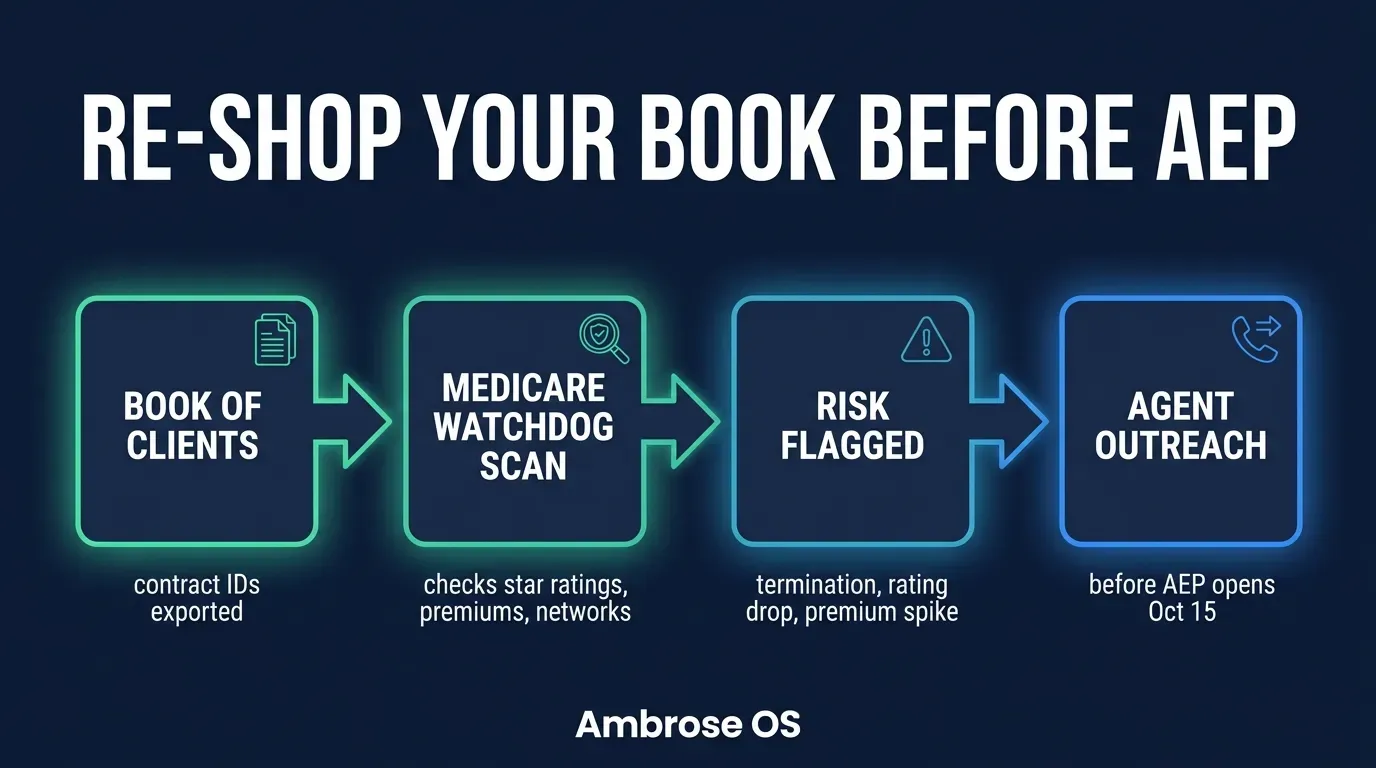
How medicare-watchdog and aca-watchdog do this automatically
Ambrose OS, the platform included with a Tech Savvy membership, ships a spoke built for exactly this job. According to Ambrose’s documentation, medicare-watchdog runs “scheduled MAPD / PDP / Med Supp intelligence — cost hikes, plan discontinuations, network changes, Star Ratings, rate filings,” through four tools: medicare_scan_book, which scans a book for risk signals; medicare_check_plan, which pulls status and costs for a specific plan; medicare_star_diff, which compares Star Ratings year over year; and medicare_rate_filing, which retrieves the latest rate filing for a plan (Ambrose docs, spoke-medicare-watchdog). It’s documented at the “free” HIPAA posture — public federal data only, no client identifier has to cross the wire for the scan itself to run — and it’s listed as a standard spoke, not a beta feature.
For agents running ACA business too, aca-watchdog does the same job for the marketplace book: “scheduled ACA marketplace intelligence — cost hikes, carrier exits, benefit cuts, plan-year transitions,” through aca_scan_book, aca_check_carrier_status, and aca_plan_year_diff. It automatically posts what it finds to Ambrose Notifications, with anything unresolved showing up in a watchdog widget on the agency dashboard (Ambrose docs, spoke-aca-watchdog).
| Manual step | medicare-watchdog / aca-watchdog equivalent |
|---|---|
| Export book with contract/PBP IDs | medicare_scan_book / aca_scan_book reads the book directly, on a schedule |
| Cross-reference Star Ratings fact sheet by hand | medicare_star_diff compares ratings year over year automatically |
| Check landscape file for plan discontinuation | medicare_check_plan pulls current plan status and cost |
| Track carrier rate filings manually | medicare_rate_filing retrieves the latest filing |
| Track ACA carrier exits and plan-year transitions | aca_check_carrier_status / aca_plan_year_diff |
| Build a prioritized spreadsheet by hand | Flagged risk signals post to Ambrose Notifications and the dashboard widget |
Run either spoke as a scheduled Ambrose routine and it does the same lookup the manual checklist above walks through — just on the full book, every time, without the lookup itself eating the six weeks between the ANOC mailing and AEP opening. That’s the actual pitch here: not “AI does your job,” but “the specific, repetitive lookup you just read the manual version of runs on a schedule instead of a deadline.”
A scan finds who to call. It doesn't replace the compliant call itself
Neither spoke gives advice or contacts a client on your behalf — it surfaces a risk signal so you know who needs a conversation. Once you're reaching out about specific plan benefits, the normal CMS marketing rules still apply: a valid Scope of Appointment, the TPMO disclaimer, and a recorded, retained line for any sales-related call. Tech Savvy Insurance is a training and software community, not a law firm, and this isn't legal or compliance advice — confirm current CMS Medicare Communications and Marketing Guidelines requirements before you place the call.
The NAIC’s AI Model Bulletin expectations apply here too, the same way they apply to any AI-assisted process touching an insurance decision: written policy on how the tool is used, a human reviewing what it flags before anyone acts on it, and documentation of the process if a regulator or carrier ever asks. A watchdog scan that flags a plan change is an input to your judgment, not a replacement for it — you’re still the one deciding what to say and confirming the client’s best interest before you make the call.
What you get by joining
One Ambrose seat, including medicare-watchdog and aca-watchdog, comes with a Tech Savvy Insurance membership: $97 a month, billed monthly, cancel anytime, founding rate locked in while the membership stays active. Alongside the seat: weekly Zoom calls with open Q&A and build-with-you sessions, 30+ hours of recorded training, Meta Ads and marketing training built for this industry, pre-built AI templates and bot deployments, and a free annual in-person member workshop. It’s also an explicit no-recruiting zone — you can ask a real question about your book without ending up on someone’s downline pitch list, which is a real point of difference from most agent Facebook groups.
Ambrose usage is separate from the $97 seat
The membership includes one Ambrose seat; usage inside Ambrose runs through its own credit ledger with spend caps, so cost stays visible instead of appearing as a surprise line item ([Ambrose docs, What is Ambrose](https://app.hiambrose.com/docs/what-is-ambrose)). That's the same pricing shape across every Ambrose spoke, not something unique to the watchdogs — see the full [Spokes catalog](https://app.hiambrose.com/docs/spokes) for what else is available.
What about Medicare Supplement and Special Needs Plan clients
Not every client in a Health & Life book fits the MA-PD termination scenario, and it’s worth being precise about which parts of the re-shop process apply where. Medicare Supplement (Med Supp) plans work on a different mechanism entirely — they’re standardized by letter plan (Plan G, Plan N, and so on) and don’t get discontinued the way an MA-PD contract can, though the carrier underwriting them can still raise the premium at renewal. The re-shop check for a Med Supp client is a premium and rate-increase check, not a Star Ratings or network check, and medicare-watchdog’s scope, per Ambrose’s documentation, does include Med Supp intelligence alongside MAPD and PDP.
Special Needs Plans (SNPs), which serve members who qualify by dual Medicare/Medicaid eligibility, chronic condition, or institutional status, carry their own eligibility-verification requirements on top of the standard re-shop check — a client can lose SNP eligibility independent of anything happening to the plan itself, which is a separate trigger worth tracking alongside plan-level changes. If SNP business is a meaningful part of your book, treat eligibility redetermination as its own line item on your re-shop calendar, not something the plan-level scan alone will catch.
The practical takeaway: run the plan-level check (terminated, rating change, network, formulary) across your whole Medicare book the same way regardless of plan type, and layer on the plan-type-specific check — rate increase for Med Supp, eligibility redetermination for SNP — as a second pass for the clients it applies to.
Building this into your AEP calendar, whether you automate it or not
Whether you run this by hand this year or set up a scheduled scan, the calendar doesn’t move. Anchor your own process to the same dates CMS anchors theirs to:
- Now through mid-September: Pull your book and confirm every contract/PBP ID is current and accurate. A re-shop is only as good as the list feeding it.
- Late September, as ANOCs land: Run the check (manual or scheduled) and start building your prioritized outreach list before October 1.
- October 1–2: Marketing materials and non-renewal notices go out. If your list isn’t built by now, you’re behind the competing mail your clients are about to receive.
- October 15–December 7: AEP. Work the priority list first — terminated plans, then material changes, then stable check-ins — and keep every sales-related call inside the required compliance framework.
The close
Everything above, the contract-ID export, the Star Ratings cross-reference, the landscape file check, works whether you ever join anything or not — that’s the point of writing it out in full. If you’d rather have that same lookup run on a schedule instead of a deadline, with the results waiting in a dashboard widget instead of a spreadsheet you built at midnight, one Ambrose seat comes with a Tech Savvy membership, and the weekly build-with-you calls are where agents actually set up their first watchdog routine, on their own book, with people who’ve already done it: https://techsavvyinsurance.com/.
Before you contact anyone in your book
Tech Savvy Insurance is a training and software community, not an insurance company, agency, or law firm, and does not provide insurance, legal, tax, or compliance advice. You are responsible for your own licensure and for complying with all applicable CMS, HIPAA, state, and carrier regulations, including TPMO disclaimer, Scope of Appointment, and call-recording requirements. AI-generated outputs, including any watchdog scan result, may contain errors — always verify against the current CMS data before acting on it. Results may vary.
Frequently asked questions
Sources
- CMS — 2026 Medicare Advantage and Part D Star Ratings Fact Sheet (Nov. 18, 2025) — cms.gov
- KFF — Medicare Advantage 2026 Spotlight: A First Look at Plan Offerings (Dec. 9, 2025) — kff.org
- KFF — Most Medicare Beneficiaries Affected by Plan Terminations in 2025 Have Robust Medicare Advantage Options in 2026 (Mar. 13, 2026) — kff.org
- CMS — Guide to Consumer Mailings from CMS, Social Security, and Plans in 2025/2026 (as of Nov. 2025) — cms.gov
- Ambrose docs — spoke-medicare-watchdog — app.hiambrose.com
- Ambrose docs — spoke-aca-watchdog — app.hiambrose.com
- Ambrose docs — Spokes — app.hiambrose.com
- Ambrose docs — What is Ambrose — app.hiambrose.com
Ready to put this into practice?
Join a private community of Health & Life insurance professionals using AI, Meta Ads, and automation to grow — without draining their bank account.
Join Tech Savvy — $97/month