
CMS just told you that you can call a plan “the best in the county” without a folder of supporting data to back it up. That’s true, and it’s also the kind of headline that gets agents in trouble the moment they read it as “anything goes.” The Contract Year 2027 Medicare Advantage and Part D final rule removed the requirement to keep documentation on file for superlative claims in marketing materials, at 42 CFR 422.2262 and its Part D twin, 423.2262 (Spark Advisors, CMS Final Rule 2027 broker guide; Cornell LII, 42 CFR § 422.2262). It also loosened the old 12-hour separation between an educational event and the marketing event that can follow it. What didn’t move: the flat ban on marketing that misleads, confuses, or is materially inaccurate, written into the same section CMS just amended. This article is the version with the actual CFR citations, the actual effective dates, and the difference between what got easier and what’s still exactly as risky as it was in 2026.
Key takeaways
- CMS removed the superlative-language documentation requirement in 42 CFR 422.2262 and 423.2262 — agents no longer have to keep supporting data on file for claims like "best" or "top-rated" in the material itself.
- The general ban on misleading, confusing, or materially inaccurate marketing, in the same section, is unchanged. That's the standard your claims are still measured against.
- The 12-hour gap between an educational event and a marketing event at the same location is gone. Beneficiaries just need to be told the educational portion is ending and get a real chance to leave, per 42 CFR 422.2264.
- Scope of Appointment forms can now be collected at an educational event itself — sales presentations and applications still can't happen there.
- The rule took effect June 1, 2026; the marketing and communications provisions apply to CY2027 activity starting October 1, 2026, two weeks before AEP opens October 15.
- Civil money penalty exposure for a marketing violation that adversely affects an enrollee is unchanged: up to $25,000 per determination, up to $10,000 per week for an uncorrected deficiency (42 CFR 422.760).
This is a different pair of provisions than the 48-hour SOA rule
If you're thinking of the change everyone talked about this spring — the elimination of the 48-hour wait between signing a Scope of Appointment and the personal appointment it authorizes — that's covered in full in our CMS Drops the 48-Hour SOA Rule article. This one covers what you're allowed to say in your marketing materials, and what can happen at an educational event, from the same final rule.
What actually changed: two provisions, one rule
CMS issued its Contract Year 2027 Medicare Advantage and Part D final rule on April 2, 2026 (CMS, Fact Sheet: Contract Year 2027 Medicare Advantage and Part D Final Rule), publishing it in the Federal Register on April 6, 2026 as document 2026-06600 (91 FR 17583). Its marketing and communications provisions apply to CY2027 activity beginning October 1, 2026 (Federal Register, document 2026-06600). Two separate provisions inside that rule affect what you can say and do around a Medicare sale, and they get talked about together in agent forums as if they’re one change. They aren’t.
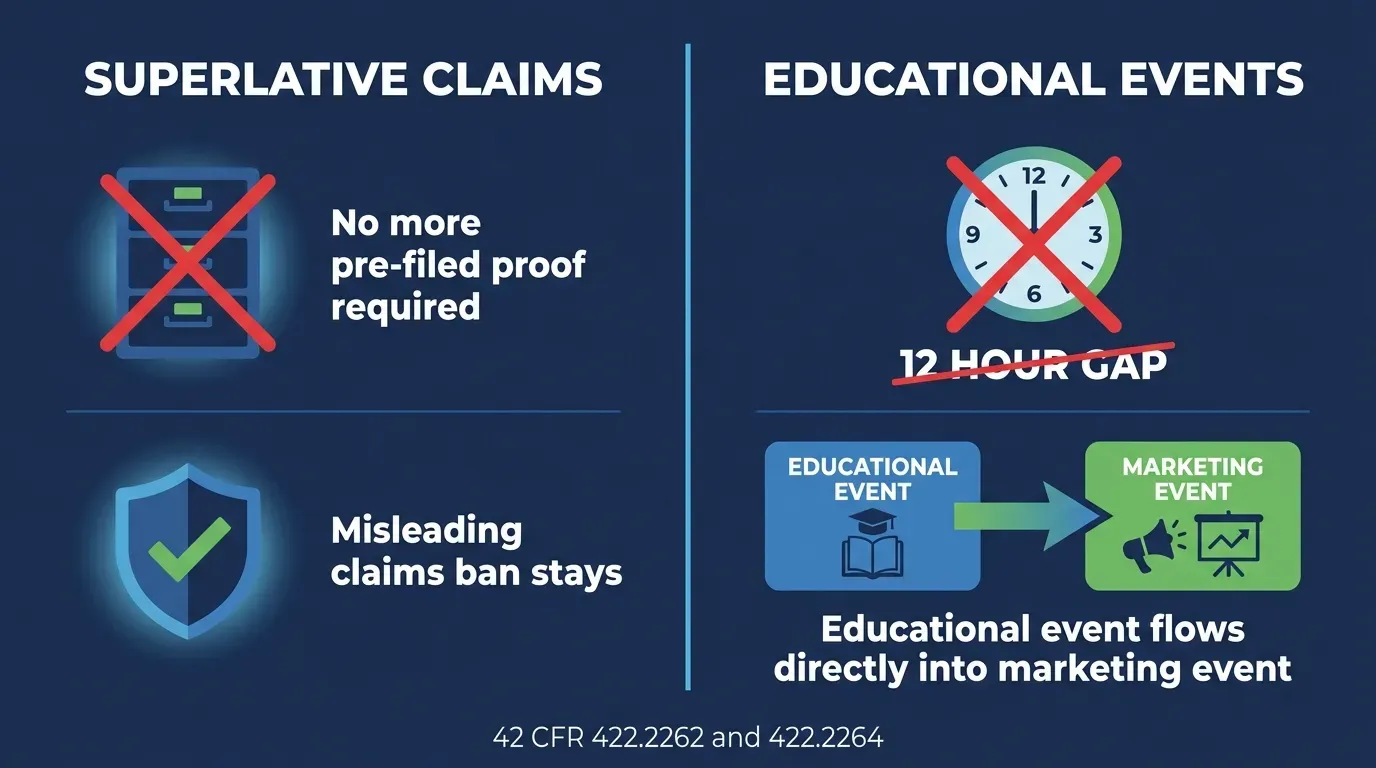
The first is the superlative-language documentation requirement. Before this rule, if your marketing material used a superlative or comparative claim, you had to have supporting documentation or data on file, referenced in the material itself, and that documentation had to reflect data from the current or prior contract year. The CY2027 rule removed that requirement from 42 CFR 422.2262 and the parallel Part D section, 423.2262: “agents can now use superlative language without the prior requirement to have supporting documentation on file,” though “the underlying rule against misleading claims still applies” (Spark Advisors, CMS Final Rule 2027 broker guide). What CMS left untouched, in the same section, is the baseline rule: “MA organizations may not mislead, confuse, or provide materially inaccurate information to current or potential enrollees” (Cornell LII, 42 CFR § 422.2262). CMS’s own framing, echoed across the trade analyses of the rule, is that the documentation requirement was redundant paperwork sitting on top of a prohibition that already existed — if the claim is false or misleading, it’s still a violation, filing cabinet or not.
The second is the educational-event-to-marketing-event transition. The prior rule generally treated a 12-hour gap between an educational event and a marketing event at the same location as necessary separation, so beneficiaries had a clean break between neutral education and a sales pitch. The current text of 42 CFR 422.2264 drops that specific separation window. What the section requires instead: an educational event has to be advertised and conducted as educational, with no marketing of specific plans or benefits, and activities there are limited to distributing materials, answering beneficiary questions, handing out business cards, and collecting contact information — including Business Reply Cards and Scope of Appointment forms. A marketing or sales event can follow, at the same location, once the beneficiary is told the educational portion is ending, a marketing event is about to begin, and they’ve had a real opportunity to leave (Cornell LII, 42 CFR § 422.2264).
| Rule | Before CY2027 | Now | Citation |
|---|---|---|---|
| Superlative claim documentation | Supporting data required on file, referenced in the material | No documentation requirement | 42 CFR 422.2262 / 423.2262 |
| Ban on misleading or materially inaccurate claims | In effect | In effect, unchanged | 42 CFR 422.2262 |
| Gap between educational and marketing events | Generally treated as requiring 12 hours of separation | No specific hour requirement; notice + opportunity to leave instead | 42 CFR 422.2264 |
| SOA collection at an educational event | Not a listed permitted activity | Expressly permitted | 42 CFR 422.2264 |
| Sales presentations or applications at an educational event | Prohibited | Still prohibited | 42 CFR 422.2264 |
Why CMS made this change without loosening the actual standard
Read the two changes side by side and a pattern shows up: CMS is cutting the process step that sat on top of an existing substantive rule, in both cases. The documentation requirement for superlatives never made a false claim more or less illegal — it made a true claim provable in advance and a false claim easier to catch on a spot check. Remove it, and the enforcement question just moves from “did you file the proof” to “was the claim actually accurate,” which was always the real question underneath. Same logic on the event side: the 12-hour gap was a proxy for “beneficiaries got a genuine chance to leave before the pitch started.” CMS replaced the proxy with the actual requirement — tell them the pitch is starting, let them leave if they want — instead of a fixed clock that didn’t necessarily track whether anyone actually had that chance.
That’s a meaningfully different kind of deregulation than it sounds like from a headline. It’s not “CMS stopped caring whether your claims are true” or “CMS stopped caring whether beneficiaries get pressured.” It’s “CMS decided the specific mechanism it used to enforce those things was more paperwork than protection, and cut the paperwork.” The protection itself — the misleading-claims ban, the requirement that beneficiaries have a real opportunity to leave — is still fully in the regulation. If you’re building your AEP marketing plan around “the rules got looser,” you’re building it around the wrong half of the sentence.
What it actually costs to get “misleading” wrong
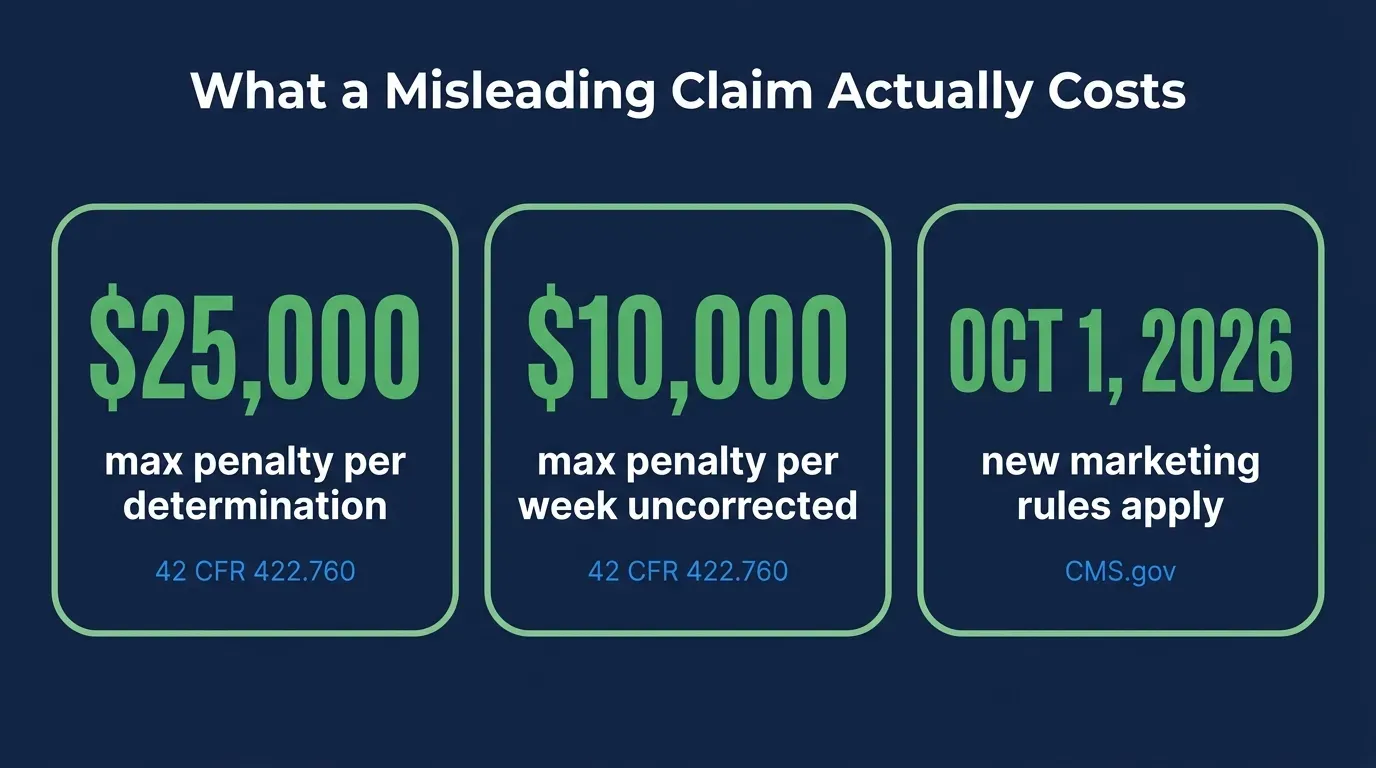
Both dollar figures are adjusted annually under 45 CFR part 102, and both are set at the section governing civil money penalties and assessments for Medicare Advantage organizations, 42 CFR 422.760 (Cornell LII, 42 CFR § 422.760). Neither number moved when CMS dropped the documentation requirement, because the documentation requirement was never what created the exposure — the underlying misleading-claims prohibition was, and still is. What actually changes in practice is where the evidence comes from. In 2026, a program auditor could ask to see your supporting data for “top-rated” and you’d hand over the file. Starting this October, there’s no file to hand over — the question becomes whether the claim itself holds up against whatever CMS, a beneficiary complaint, or your own carrier’s compliance review turns up. That’s a real shift in how you’d get caught, even though it isn’t a shift in whether you’d get caught for the same underlying claim.
Losing the paperwork requirement doesn't lower your exposure. It just means nobody's going to catch a bad claim for you before it runs.
Mike MooreThe manual way to build a compliant claims review, step by step
None of this requires software you don’t already have. If you write your own ad copy and run your own educational events, here’s the process, and it costs nothing but the discipline to run it every time.
Write the claim, then write the proof — even though you don't have to file it
Before you publish "top-rated" or "best value," write down, for yourself, exactly what makes it true this contract year: the Star Rating, the premium comparison, the specific benefit. If you can't write that sentence, you can't run the claim, documentation requirement or not.
Date-stamp your source
Star Ratings, premiums, and plan comparisons change every contract year. A claim that was true in 2026 can be false in 2027 with the exact same wording. Note the year and source of whatever number backs your claim, even in a private note, so you can re-check it before you reuse the copy next AEP.
Read the claim as a beneficiary who's never met you
"Best Medicare agent in the county" reads differently to someone who doesn't know it's your personal opinion versus a ranked fact. If a reasonable beneficiary could take the claim as a verified ranking rather than an opinion, treat it like a factual claim that needs to be true, not marketing flourish.
Script the educational-to-marketing transition, word for word
Write the exact sentence you'll say: the educational portion is ending, a marketing event is about to start, and anyone who wants to leave is free to. Say it before a single plan-specific benefit gets mentioned, every time, not just when someone new walks in.
Keep the educational content actually educational
No plan comparisons, no benefit walkthroughs, no "and here's why Plan X is the best option" during the educational portion, even now that a marketing event can follow immediately. The content restriction on the educational event itself didn't change — only the gap before the next event did.
Re-review every piece of standing ad copy before October 1
Anything you wrote under the old documentation-required regime is still fine to keep running — the underlying accuracy standard hasn't changed. But if you have claims sitting unused because you never finished the paperwork, this is the window to revisit them, verify they're still true for 2027, and get them live.
Worked example: the difference a year makes
Say you ran "Highest-rated Medicare Advantage plan in [county] for 2026" last AEP, backed by that plan's actual Star Rating at the time. If that same plan drops a star for 2027 and you keep running identical copy, the documentation requirement wouldn't have caught that for you either — it only required proof the claim was accurate when filed, not an ongoing obligation to update it. The gap that got you in trouble in either regime is the same one: not re-checking a comparative claim against current-year data. That discipline was always on you, filing cabinet or not.
Everything in that checklist works whether you ever touch a piece of software built for this or not. Go run it by hand this AEP — the six steps above are the entire manual method, no gaps.
Five real claims, run through the standard
The checklist above is abstract until you put an actual sentence next to it. Here’s how five claims agents actually write hold up against the rule that’s left standing — the misleading-claims ban, not the documentation requirement that used to sit in front of it.
| Claim | Why it holds up, or doesn't |
|---|---|
| "Highest-rated Medicare Advantage plan in [county] for 2027" | Fine, if you've actually checked this contract year's Star Ratings for that county and it's true. Not fine if it's last year's rating carried forward, or a rating for a different county in the same service area. |
| "I've helped 200 people in [county] find their plan" | A factual, checkable claim about your own activity, not a comparative ranking. Easier to defend than a superlative precisely because it isn't one — it's a number you can actually produce if asked. |
| "Best Medicare agent in [city]" | The riskiest phrasing on this list. "Best" implies a ranking against every other agent in the city, which nothing you have actually establishes. A beneficiary reading it as a verified fact, not your opinion, is exactly the confusion the rule still prohibits. |
| "This plan could save you money on your prescriptions" | Fine if hedged and true for that specific person's actual drug list — a real comparison you ran, not a generic assumption. Turns misleading fast if it's a blanket claim applied to every prospect regardless of their medications. |
| "Top-rated in the state" (about a plan only sold in three counties) | A geography mismatch is its own kind of misleading, independent of whether the rating itself is accurate. "State" implies statewide relevance the plan doesn't have. |
The pattern across all five: the documentation requirement never would have stopped the risky ones from being written, only from being published without a citation attached. What actually separates a defensible claim from a violation is whether it’s true, specific, and current — the same three things it’s always been.
Where AI-drafted ad copy fits, and what NAIC expects around it
A lot of agents are going to use an AI tool to draft ad copy this AEP, and superlative claims are exactly the kind of line an AI model generates confidently and without checking your current Star Rating data. “The top-rated plan in [county]” is a sentence a general-purpose chatbot will write for you in one prompt, with no idea whether it’s true this contract year, because it has no access to this year’s actual ratings data — it’s pattern-matching on the kind of sentence that sounds like good ad copy.
The NAIC’s Model Bulletin on the Use of Artificial Intelligence Systems by Insurers, adopted by NAIC membership in December 2023 and, as of March 2025, adopted by at least 24 states plus D.C. (Quarles & Brady, March 2025), sets the governance expectation that applies here: decisions or actions supported by AI have to comply with applicable insurance law, insurers need to be able to show how they govern their AI use, and regulators can ask for that documentation during an investigation or exam (NAIC, Insurance Topics: Artificial Intelligence). An agent who lets an AI tool draft a superlative claim and publishes it without a human checking it against this year’s actual data is the exact ungoverned pattern that expectation is written to catch. The fix isn’t “don’t use AI to draft copy.” It’s “a licensed human checks every comparative or superlative claim against current-year data before it runs,” whether a person or a model wrote the first draft.
What not to paste into a general AI tool while you're at it
If you're using an AI tool to draft ad copy and you paste in a real client's testimonial, a real complaint you're trying to rebut, or a real beneficiary's plan history as an example, you've handed protected health information to a destination that likely doesn't have a Business Associate Agreement with you. Draft with hypothetical or anonymized examples. Save the real client detail for a tool that's actually built to handle it.
If you’d rather not build that review discipline from scratch, that’s the kind of thing we work through on a Tuesday call with Ambrose open on the screen — $97 a month, cancel anytime, and nobody’s going to pitch you a downline while you’re trying to ask a compliance question.
Getting a second opinion before a claim goes live
This is the part where most agents are on their own: you’ve written the claim, you think it’s defensible, and there’s nobody in the room to push back on it before it runs. That’s a real gap, and it’s not one a spoke or a data source fixes — it’s a “someone else looks at this before you hit publish” problem.
Ambrose’s War Room is built around exactly that gap. It’s a conversational hub where you ask a question and a roster of specialized personas responds — per Ambrose’s own documentation, the roster includes a Chief Marketing Officer (Morgan Chase), a Chief Compliance Officer (Taylor Brooks), and a separate Compliance Officer persona (Dr. Elena Reyes), alongside COO, CFO, CRO, CTO, and Research heads, each running its own session with its own tools, able to dispatch to sub-specialists for depth (Ambrose docs, War Room). Ask the War Room whether “best-rated plan in the county” is a claim you can defend this contract year, and you’re not asking a generic chatbot to guess — you’re asking a persona built specifically around the compliance lens, inside your agency’s own tenant.
To be direct about what this is and isn’t: the War Room isn’t a substitute for a licensed compliance professional’s sign-off, and this article isn’t claiming it issues a legal ruling on your ad copy. What it does, documented and real, is give you a second read from a persona whose entire job is the compliance angle, before you’re standing alone at 9pm deciding whether a headline is defensible. That’s a meaningfully different position than having nobody to ask at all.
| Part of the problem | What actually addresses it |
|---|---|
| Confirming a claim is true this contract year | Your own check against current Star Ratings and plan data — no tool replaces this |
| Scripting the educational-to-marketing transition correctly | A written script, checked against 42 CFR 422.2264 — a discipline, not a product |
| A second opinion on whether a claim is defensible before it runs | Ambrose's War Room, Compliance and CCO personas |
| Governance documentation if a regulator asks how you use AI in marketing | A written policy plus a record of who reviewed what — your process, not Ambrose's |
What you get by joining
One Ambrose seat, including War Room access, comes with a Tech Savvy Insurance membership: $97 a month, billed monthly, cancel anytime, founding rate locked in while the membership stays active. Alongside the seat: weekly Zoom calls with open Q&A and build-with-you sessions, 30+ hours of recorded training, Meta Ads, AI, and marketing training built specifically for this industry, pre-built AI templates and bot deployments, and a free annual in-person member workshop. It’s also an explicit no-recruiting zone — you can bring a real question about whether your AEP headline is defensible without ending up on someone’s downline pitch list.
Ambrose usage runs separately from the $97 seat
The membership includes one Ambrose seat. See the full Ambrose docs for what else is available beyond what's covered here.
Compliance: what this touches, and what it doesn’t
If you market or sell Medicare Advantage or Part D coverage and get compensated to do it, the rules covered in this article apply to you directly as a third-party marketing organization, defined at 42 CFR 422.2260 to include independent agents and brokers performing marketing, sales, or enrollment functions (Cornell LII, 42 CFR § 422.2260), not just to the carrier you’re appointed with. The TPMO disclaimer requirement at 42 CFR 422.2267(e)(41) didn’t change here and still applies to every marketing call, chat, and piece of material — we cover the exact required wording in our Medicare call recording retention article. None of this is legal advice, and CMS guidance and enforcement priorities shift — confirm your own agency’s specific obligations with CMS’s Medicare Communications and Marketing Guidelines, your upline’s compliance team, or qualified counsel before you finalize new ad copy for this AEP.
If AI tools touch any part of your marketing content pipeline, the NAIC’s Model Bulletin sets the expectation regulators increasingly apply: AI-supported decisions have to comply with applicable insurance law, insurers need governance around how the tools are used, and documentation has to be available if a state department of insurance asks for it. Ambrose is HIPAA-aware by default, not HIPAA certified — there’s no such thing as HIPAA certification for a software platform, and any vendor claiming otherwise is worth a second look.
One more layer worth naming: CMS’s marketing rule is federal, and it governs Medicare Advantage and Part D specifically. Most states also enforce their own unfair-trade-practices standards against misleading insurance advertising generally, through the state Department of Insurance, independent of anything CMS does. Dropping a federal documentation requirement doesn’t touch whatever your own state expects of insurance advertising as a category — check with your state DOI or your carrier’s compliance team before assuming “CMS says it’s fine” is the whole answer for a given state.
The close
The documentation requirement is gone. The misleading-claims ban isn’t. That’s the whole shift, and building a one-page claims-review habit around it costs nothing and takes an afternoon, whether you ever join anything or not. If you’d rather have a second opinion in the room before a headline goes live — the War Room’s compliance personas, on your own agency’s data — one Ambrose seat comes with a Tech Savvy membership, and the weekly build-with-you calls are where agents actually put this into practice before AEP volume hits: https://techsavvyinsurance.com/.
Before you rely on any figure in this article
Tech Savvy Insurance is a training and software community, not an insurance company, agency, or law firm, and does not provide insurance, legal, tax, or compliance advice. You are responsible for your own licensure and for complying with all applicable CMS, HIPAA, state, and carrier regulations. Regulations and enforcement priorities can change — confirm current requirements directly with CMS, your state Department of Insurance, or qualified legal counsel before relying on any figure here. AI-generated outputs may contain errors — always verify. Results may vary.
Frequently asked questions
Sources
- Federal Register — Medicare Program; Contract Year 2027 and Certain Contract Year 2026 Policy and Technical Changes (document 2026-06600 / 91 FR 17583), full text — federalregister.gov
- CMS — Fact Sheet: Contract Year 2027 Medicare Advantage and Part D Final Rule — cms.gov
- CMS — Medicare Open Enrollment partner resources (2026 AEP dates) — cms.gov
- Cornell Law School, Legal Information Institute — 42 CFR § 422.2260 (marketing definitions) — law.cornell.edu
- Cornell Law School, Legal Information Institute — 42 CFR § 422.2262 (general communications requirements, superlative language) — law.cornell.edu
- Cornell Law School, Legal Information Institute — 42 CFR § 422.2264 (beneficiary contact, educational and marketing events) — law.cornell.edu
- Cornell Law School, Legal Information Institute — 42 CFR § 422.760 (civil money penalty amounts) — law.cornell.edu
- Spark Advisors — CMS Final Rule 2027: What Brokers Need to Know — sparkadvisors.com
- NAIC — Insurance Topics: Artificial Intelligence (Model Bulletin background) — content.naic.org
- Quarles & Brady — Nearly Half of States Have Now Adopted NAIC Model Bulletin on Insurers' Use of AI (March 2025) — quarles.com
- Ambrose docs — War Room — app.hiambrose.com
- Ambrose docs — What is Ambrose — app.hiambrose.com
Ready to put this into practice?
Join a private community of Health & Life insurance professionals using AI, Meta Ads, and automation to grow — without draining their bank account.
Join Tech Savvy — $97/month