
A Medicare outbound education and verification (OEV) call is a callback the plan sponsor is required to make, within 15 days of your submission, to confirm your client actually requested the enrollment and understands the plan — and CMS requires a minimum of three documented attempts plus a letter before that confirmation counts as complete. You don’t make this call. You can’t be there when it happens. And if your client doesn’t answer a number they don’t recognize, from a carrier whose name they half-remember, about a form they signed three weeks ago, the enrollment you worked for can sit unconfirmed through the back half of AEP without you knowing anything is wrong.
Key takeaways
- CMS requires every Medicare Advantage organization and Part D sponsor to run an outbound verification call on agent- and broker-effectuated enrollments — made by the plan's own staff, never the selling agent, and never by automated dialer (42 CFR 422.2272(b)/423.2272(b); CMS, Medicare Managed Care Manual, Section 70.6).
- The floor is three documented call attempts plus a verification letter, all expected inside 15 calendar days of the plan receiving the enrollment request (CMS, Section 70.6).
- CMS's August 25, 2026 memo releasing the CY2027 enrollment and disenrollment guidance changed a long list of things — it did not touch this verification-call requirement (CMS, HPMS Memo, August 25, 2026).
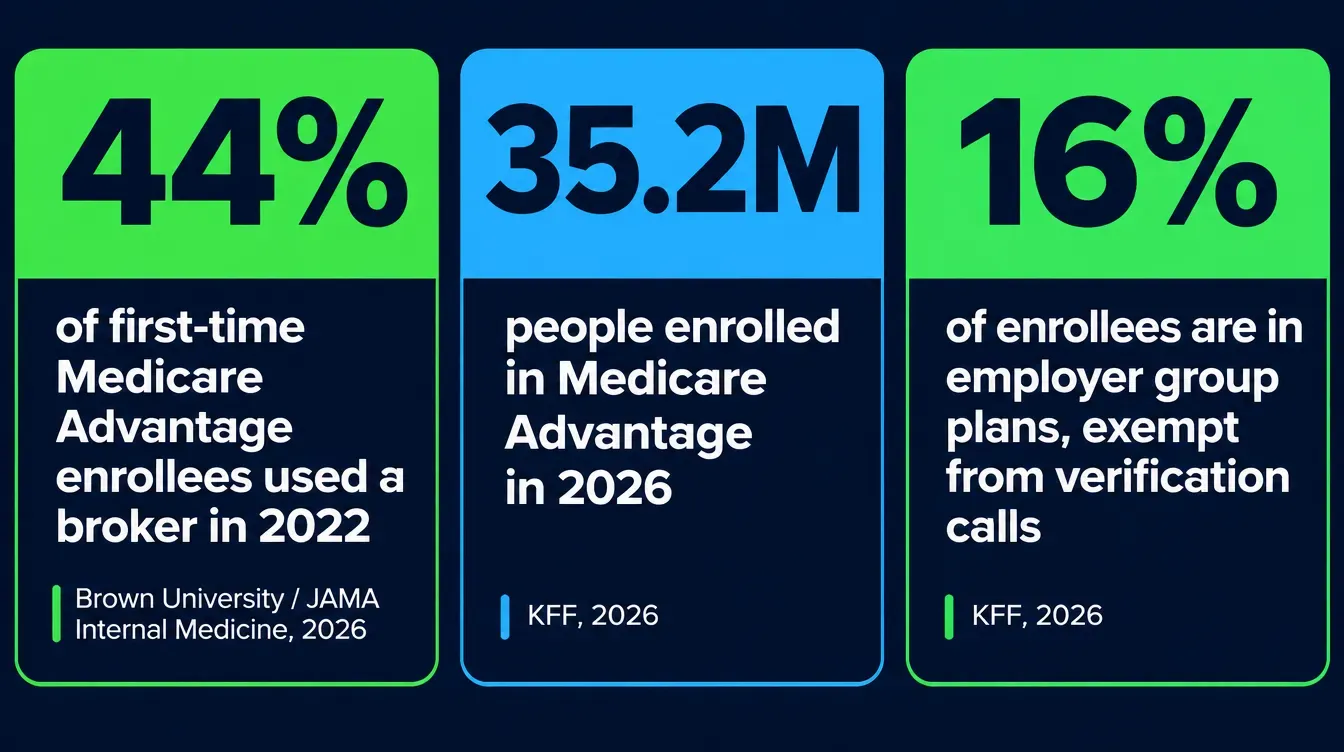
- Employer and union group plans, PACE, auto-enrollments, and a short list of other categories are exempt — but those exemptions cover only 16% of Medicare Advantage's 35.2 million enrollees, per KFF's 2026 data, and 44% of first-time Medicare Advantage enrollees used a broker in 2022, per a Brown University-led JAMA Internal Medicine research letter — so most of what you sell is squarely in scope.
- Ambrose can't make the call for you — CMS says the plan sponsor must — but a Routine can remind you to check in with a client before the 15-day window closes, and client-vault can log that you did.
The pain: a call you’ll never see happen, to a number your client doesn’t trust
Here’s the sequence, start to finish, the way it actually plays out. You sit with a client, walk through a plan, get the application in. CMS’s enrollment effective-date rules take over from there, and somewhere in the next two weeks, a call comes into your client’s phone from an 800-number or a toll-free line with no caller ID name attached. Your client, like most people over 65 who’ve spent a decade fielding scam robocalls about their “Medicare benefits,” doesn’t answer. The voicemail, if they get one, mentions a carrier name that sounds vaguely familiar and asks them to call back about their enrollment. They mean to. They don’t, because nothing about the message felt urgent, and nothing in your own conversation with them mentioned to expect it.
You, meanwhile, have moved on to your next appointment. You have no visibility into whether that call connected, whether a letter went out, or whether your client is now sitting inside a seven-day cancellation window they don’t know exists. The first you’ll hear about any of it, if you hear about it at all, is weeks later when the client calls confused about why their new plan “isn’t working” at the pharmacy — because the enrollment that you submitted, and that CMS and the carrier both have on file as pending your client’s confirmation, never actually got confirmed.
This isn't the Scope of Appointment article, and it isn't the TPMO disclaimer article
Scope of Appointment governs what has to happen before you can discuss specific plan benefits — see CMS Drops the 48-Hour SOA Rule for the rule that changed for AEP 2026. The TPMO disclaimer governs what has to be said during the sales conversation itself — see TPMO Disclaimer 2027. This article is about what happens after you've already submitted the application: a verification step CMS requires the plan to run on its own, that you have no hand in and very little visibility into.
What an OEV call actually is, and the rule behind it
Strip away the acronym and it’s simple: CMS requires every Medicare Advantage organization and every Part D plan sponsor to build and run a system that confirms two things after an agent- or broker-assisted enrollment — that the beneficiary actually enrolled on purpose, and that they understand the rules of the plan they’re now in. The regulatory text is short and has sat largely unchanged since its last amendment: the organization must “establish and maintain a system… for confirming that enrolled individuals have, in fact, enrolled in [the] plan, and that the beneficiaries understand the rules applicable under the plan” (42 CFR 422.2272(b), current text via Cornell Law School’s Legal Information Institute, last amended April 12, 2023; the parallel Part D citation is 42 CFR 423.2272(b)).
The operational detail — how plans are actually expected to run that system — lives in CMS’s own sub-regulatory guidance, Section 70.6 of the Medicare Managed Care Manual, titled “Outbound Education and Verification Calls to All New Enrollees.” Four things in that guidance matter most to you as the selling agent:
It applies to every enrollment you or a captive agent personally effectuate. CMS’s language is explicit: “all plan sponsors are required to conduct outbound education and verification calls for enrollments effectuated by agents and brokers – including both independent and employed agents and brokers.” Captive status doesn’t exempt you from this; it only changes how you’re compensated, which is a separate rule entirely (CMS, Medicare Managed Care Manual, Section 70.6).
You’re deliberately kept out of it. “The plan sponsor must ensure that the verification calls made to beneficiaries are not made directly by sales agents and also that the sales agents are not with the beneficiaries at the time of the verification call.” CMS also bars automated dialers for this specific call — “our expectation is the calls will be interactive” — so a real person from the carrier’s enrollment or verification team has to actually get your client on the phone and talk to them (CMS, Section 70.6).
The timeline is tight and specific. CMS’s floor: “a minimum of three documented attempts to contact the applicant by telephone within fifteen (15) calendar days of receiving the enrollment request.” If the first attempt fails, the sponsor is expected to mail a model enrollment verification letter, then make “at least two additional attempts” by phone — all of it, calls and letter together, inside that same 15-day window (CMS, Section 70.6).
A handful of enrollment types are exempt. CMS’s own list of categorical exclusions: “enrollments into employer or union sponsored plans, enrollments into PACE plans, auto-enrollments, facilitated enrollments, and reassignments effectuated by CMS, enrollments submitted by State Pharmaceutical Assistance Programs (SPAPs), and enrollments from one plan to another plan offered by the same MA organization or PDP sponsor.” CMS also flags one wrinkle worth knowing: if a member with the Low-Income Subsidy makes their own enrollment choice that overrides a CMS-generated enrollment, and an agent or broker effectuates that election, the outbound verification requirement still applies (CMS, Section 70.6).
| Category | OEV call required? | Source |
|---|---|---|
| Individual MA or Part D enrollment, agent- or broker-effectuated | Yes | CMS, Section 70.6 |
| LIS member's own election overriding a CMS-generated enrollment, effectuated by an agent/broker | Yes | CMS, Section 70.6 |
| Employer or union sponsored group plan enrollment | No — categorical exclusion | CMS, Section 70.6 |
| PACE enrollment, auto-enrollment, facilitated enrollment, or CMS reassignment | No — categorical exclusion | CMS, Section 70.6 |
| Plan-to-plan change within the same MA organization or PDP sponsor | No — categorical exclusion | CMS, Section 70.6 |
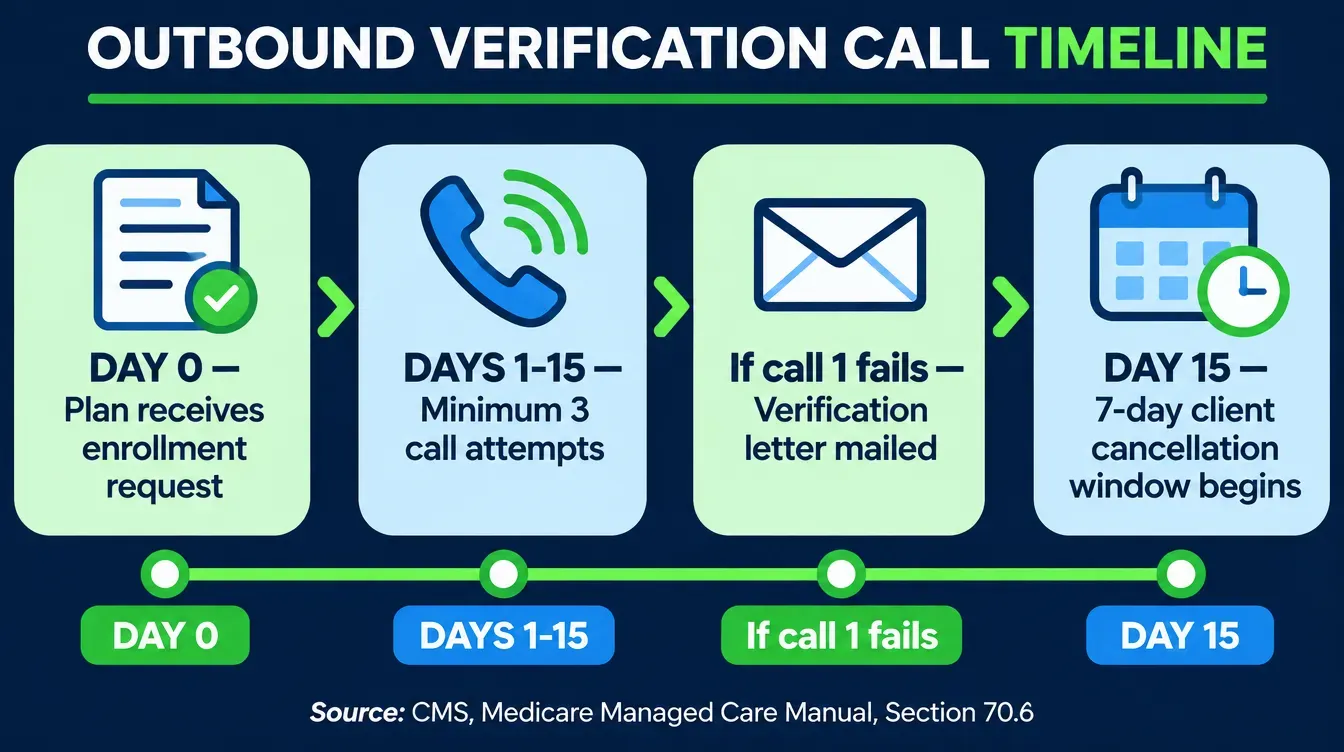
One more detail agents consistently miss: CMS requires the plan’s sales staff to collect “the verification phone number” from the beneficiary during the application itself, and to tell the beneficiary what the verification process will look like, at the time of application (CMS, Section 70.6). That’s your one real point of leverage in this entire process, and most agents skip right past it.
Why it happens: the rule was built to keep you out, and it works
This isn’t a case of agents dropping the ball. CMS designed this specific control to run with zero agent involvement, on purpose, because the entire point of an OEV call is to catch an enrollment the selling agent misrepresented or a client didn’t actually want. You being present, or you making the call, would defeat its purpose. So CMS built a verification system that depends entirely on a stranger reaching your client on the phone, cold, inside a 15-day window you have no visibility into and no way to extend.
Every structural piece of that design works against a smooth outcome. The call comes from a number your client has never called before, often with a toll-free prefix and no recognizable caller ID name, during exactly the season when every senior’s phone is also getting hit with Medicare scam calls, spoofed carrier numbers, and robocalls pretending to be CMS. CMS’s own interactive-call requirement, meant to protect against a different failure mode, means there’s no way to pre-record a friendlier, more identifiable message either. And the 15-day window starts running from when the plan receives the enrollment request, not from any date your client is tracking, so there’s no natural reminder on their calendar telling them a call is coming.
CMS built a verification system specifically designed to not involve you. The problem is, your client doesn't know that — so when an unfamiliar number calls about their "enrollment," the only context they have is every scam call they've ever gotten about the exact same subject.
Mike MooreAdd one more wrinkle specific to this year: CMS’s August 25, 2026 memo releasing the CY2027 Medicare Advantage and Part D Enrollment and Disenrollment Guidance runs through a long, specific list of what changed for the coming plan year — revised definitions, enrollment capacity limit guidance, SEP timing corrections, new model notices for D-SNP transitions (CMS, HPMS Memo, August 25, 2026). The outbound verification call requirement isn’t on that list at all. Nothing about it changed. That’s a useful, boring fact: whatever else is different about AEP 2026 and plan year 2027, the verification-call mechanics your clients are navigating right now are the same ones that have applied since 2010.
What it costs: how much of your book this actually touches
Here’s the part that should change how seriously you take this. This isn’t a narrow edge case.
A research letter published May 18, 2026 in JAMA Internal Medicine, led by Brown University School of Public Health researchers using data obtained through a Freedom of Information Act request, found that the share of first-time Medicare Advantage enrollees who used a broker rose from 36% in 2014 to 44% by 2022 — nearly half of all new Medicare Advantage business, nationally, going through an agent or broker (Brown University, press release on Meyers et al., May 18, 2026). Broker compensation over that same period roughly doubled, from about $3.9 billion a year to roughly $10 billion. If you sell Medicare Advantage at all, you are not a rounding error in this system — you’re close to half of it.
Now size the exemption list against the current market. KFF’s 2026 enrollment data puts total Medicare Advantage enrollment at 35.2 million people, 55% of the roughly 64.2 million Medicare beneficiaries who have both Part A and Part B — and employer or union sponsored group plans, the single biggest categorical exclusion from the OEV requirement, cover about 5.7 million of those enrollees, or 16% of the total (KFF, Medicare Advantage in 2026: Enrollment Update and Key Trends, June 5, 2026, updated July 1, 2026). Run the arithmetic: 84% of the Medicare Advantage population sits in plan types where an agent-effectuated enrollment is, by default, in scope for an outbound verification call. The exemption list is real, but it’s small next to what it doesn’t cover.
What it costs when a specific client’s verification fails, in dollars, isn’t a number CMS publishes anywhere we could find, and we’re not going to invent one. Neither CMS’s Section 70.6 guidance nor the current 42 CFR 422.2272(b)/423.2272(b) regulatory text mentions agent or broker compensation at all — both are written entirely around the plan sponsor’s obligation to confirm the enrollment. That silence is itself the useful fact: whatever happens to your commission when a client’s enrollment doesn’t get verified is a question for your specific carrier’s contract and chargeback policy, not something a CMS citation will answer for you. If you don’t already know your top three carriers’ answer to that question, that’s worth a call to broker services before this AEP ends on December 7, not after.
How to catch this before it becomes a problem — the manual version
None of this needs a tool. It needs you to build one new habit into every application you submit, and a short follow-up check two weeks later.
Step 1: Collect the verification phone number on purpose, at the application. CMS expects plan sales staff to get “the verification phone number” from the beneficiary during the application process, and to describe the verification process to them at that time (CMS, Section 70.6). Don’t assume the number on file is the one they’ll actually answer. Ask directly: “What’s the best number for you to actually pick up a call from your new plan in the next couple weeks?” — and write down whatever they tell you, separately from the application itself if your CRM has a note field for it.
Step 2: Tell them the call is coming, specifically. This is the single highest-leverage thing you can do, and it costs thirty seconds. “In the next two weeks, you’re going to get a call from [carrier name] confirming your enrollment. It might come from a number you don’t recognize, and it won’t be me — by law, I’m not allowed to be the one who calls or to be there when it happens. Please answer it, or call back as soon as you can if you miss it.” Naming the carrier, naming the timeframe, and naming the fact that it legitimately won’t be you does more to get that call answered than anything else in this article.
Step 3: Mark your own calendar at day 10, not day 15. CMS’s window is 15 calendar days from when the plan receives the request — which isn’t necessarily the day you submitted it. Give yourself a buffer and check in with the client around day 10: “Have you gotten a call yet from [carrier] about your new plan?” If they haven’t, that’s still time to tell them to expect it and to watch for the letter.
Step 4: If they say yes, confirm what the call actually covered. Ask them what the caller asked. If they can describe it (confirming they wanted the plan, a basic benefits question, maybe a premium confirmation), it almost certainly completed. If they say “some automated thing” or “I’m not sure, I hung up,” that’s a flag — CMS requires these calls to be interactive, not automated, so an automated-sounding call either wasn’t the real verification call or wasn’t handled the way CMS expects, and either way it’s worth a call to the carrier’s broker line to check enrollment status directly.
Step 5: Write down that you did Steps 1 through 4. Date, what number you confirmed, what you told them to expect, and whether they confirmed the call happened. If an enrollment ever does lapse for a verification failure, this is the record that shows you did everything in your control before the plan sponsor’s own process took over.
A script for the end of every application appointment
"One more thing before we wrap up. In the next week or two, [carrier] is going to call you to confirm this enrollment — it's required, and it's not me, I'm not allowed to be part of that call. It might come from a number you don't recognize. Please pick it up, or call them back right away if you miss it, because if they can't reach you, the enrollment doesn't go through. Is [phone number] still the best number for that call?"
How to check status if a verification call seems to have gone wrong
If a client tells you they never got a call, or you’re past day 12 and haven’t heard anything, you have two real options: call the specific carrier’s broker or agent support line and ask for the enrollment’s verification status directly, or have the client check their own plan portal or member materials for a confirmation or cancellation notice. Neither of those is something CMS, Ambrose, or any third-party tool can see on your behalf — the verification status lives entirely inside the plan sponsor’s own enrollment system, and the plan sponsor is the only party CMS requires to track it. If the window closes without a completed verification and the enrollment lapses, your client still has options if they act before December 7: during AEP itself, they can submit a new enrollment request with you or another agent, since AEP allows multiple plan changes with only the last one before the deadline taking effect (CMS, Medicare Open Enrollment Partner Resources). After AEP closes, their options narrow to whatever Special Election Period, if any, actually applies to their situation — which is exactly the kind of judgment call that belongs in a conversation with the client, not a blanket assumption.
Where Ambrose actually fits, and where it honestly doesn’t
Ambrose doesn’t have a feature called “make the verification call,” and it never will — CMS requires the plan sponsor’s own staff to place it, and no agent-side software changes who CMS says has to do that. What Ambrose does document is a genuine fit for the two pieces of the manual workflow above that fall apart under real caseloads during AEP: remembering to check in at day 10 across every client you enrolled that week, and having a real place to log that you did.
Routines are scheduled prompts attached to an agent or a team, triggered on a standard five-field cron schedule, with an output sink currently documented as Slack, email, a GHL note, or a log entry only (Ambrose docs, Routines, accessed November 2026). A Routine set to fire daily during AEP, checking your recent-enrollments list for anything at the 10-day mark and posting a Slack reminder — “follow up with these clients on their verification call” — turns Step 3 above from something you have to remember for every single application into something that shows up whether you remember or not.
client-vault is documented as a client-facing enrollment and policy store with four confirmed tools: client_get (fetch a client record), client_list_policies (all policies for a client), client_add_document (attach a document), and client_search (search within one client’s data) (Ambrose docs, Spokes catalog and spoke-client-vault page, accessed November 2026). That’s Step 5, with somewhere real to put it: log the date you briefed the client, the verification number you confirmed, and whether they told you the call happened.
The five-step check from this article
- Confirm the real verification phone number at the application
- Tell the client specifically to expect a call, and from whom
- Check in around day 10, not day 15
- Confirm what the call actually covered
- Write down that you did all four, every time
A scheduled nudge and a real place to log it
- A Routine fires daily during AEP, prompting the day-10 check
- client_search and client_list_policies surface who's due for a follow-up
- client_add_document holds the dated record of the conversation
- Comes with one Ambrose seat included in the Tech Savvy membership
The honest version of this section
Neither Routines nor client-vault can see inside a carrier's own verification system — they can't tell you whether a specific call actually completed, because that status lives entirely on the plan sponsor's side, per Ambrose's documentation. What Ambrose does is make sure the habit of checking in, and the record of having checked in, doesn't depend entirely on your memory during the eight busiest weeks of your year.
If you’re using any general-purpose AI tool to help organize which clients are mid-verification, treat their phone numbers and enrollment status the same way you’d treat any other protected health information tied to a real person’s Medicare coverage — it doesn’t belong in a consumer chatbot with no Business Associate Agreement. Our companion article, What Not to Paste Into ChatGPT, covers exactly where that line sits. Ambrose is described in its own documentation as HIPAA aware by default, never HIPAA certified — verify any AI-assisted output before you act on it.
Everything in the five-step version above works whether you ever touch Ambrose or join anything. It’s a habit you add to an appointment you’re already having, not a purchase.
What you get by joining
One Ambrose seat, including Routines and client-vault, comes with a Tech Savvy Insurance membership: $97 a month, billed monthly, cancel anytime, founding rate locked in while the membership stays active. Alongside the seat: weekly Zoom calls with open Q&A and build-with-you sessions, 30-plus hours of recorded training, Meta Ads and AI training built for this industry specifically, pre-built AI templates and bot deployments, and a free annual in-person member workshop. It’s also an explicit no-recruiting zone — you can ask a specific question about setting up a day-10 Routine for your own enrollment list without ending up on someone’s downline pitch list, which is a real point of difference from most agent Facebook groups.
Ambrose usage runs separately from the $97 seat
The membership includes one Ambrose seat; usage inside Ambrose runs through its own credit ledger with spend caps, so cost stays visible instead of showing up as a surprise. See the full Spokes catalog for what else is available beyond Routines and client-vault.
Confirm the verification number
Ask for it directly at the application — don't assume the file has it right.
Brief the client by name and timeframe
Naming the carrier and the window is what actually gets the call answered.
Check in at day 10, not day 15
CMS's window is 15 days from the plan's receipt, not your submission date.
Know your carrier's commission answer in advance
CMS is silent on it — your contract and chargeback policy isn't.
Let a Routine remind you daily during AEP
A scheduled Slack nudge for every client approaching the 10-day mark.
File the record in client-vault
client_add_document holds the dated confirmation, attached to the right client.
Build the day-10 check before your next wave of enrollments
The five-step version above works whether you ever join anything or not. If you'd rather have a Routine already reminding you and client-vault already holding the record, with people watching your screen while you set it up, one Ambrose seat comes with the Tech Savvy membership.
Join Tech Savvy — $97/monthThe close
CMS built this verification step to run with zero agent involvement, and that’s exactly why most agents never think about it until a client’s enrollment has already gone sideways. Three call attempts, a letter, fifteen days, and a client who doesn’t know any of it is coming — that’s the system, unchanged for 2027, running right now on close to half of everything you sell this AEP. Tell your client specifically to expect the call, check in at day 10, and write it down. If you’d rather have a Routine already reminding you and client-vault already holding the record, that’s a Tuesday conversation in the Tech Savvy community: $97 a month, cancel anytime, and nobody will pitch you a downline. https://techsavvyinsurance.com/
Before you rely on any figure in this article
Tech Savvy Insurance is a training and software community, not an insurance company, agency, or law firm, and does not provide insurance, legal, tax, or compliance advice. You are responsible for your own licensure and for complying with all applicable CMS marketing and enrollment rules, your specific carrier and FMO contracts, state insurance department requirements, and HIPAA. Verification-call procedures and enrollment and disenrollment guidance are set and updated by CMS and administered by individual plan sponsors — confirm current requirements and your own commission treatment directly with CMS, your specific carriers, or qualified legal counsel before relying on any figure here. AI outputs may contain errors — always verify. Results may vary.
Frequently asked questions
Sources
- CMS — Medicare Managed Care Manual, Section 70.6: Outbound Education and Verification Calls to All New Enrollees (PDF) — cms.gov
- Cornell Law School, Legal Information Institute — 42 CFR 422.2272 (current text) — law.cornell.edu
- CMS — HPMS Memo: Medicare Advantage and Part D Enrollment and Disenrollment Guidance for CY 2027 (August 25, 2026) — cms.gov
- CMS — Medicare Open Enrollment Partner Resources (AEP dates) — cms.gov
- Brown University — Study finds payments to Medicare Advantage brokers potentially reached $10 billion annually (on Meyers et al., JAMA Internal Medicine research letter, May 18, 2026) — brown.edu
- KFF — Medicare Advantage in 2026: Enrollment Update and Key Trends (June 5, 2026, updated July 1, 2026) — kff.org
- Ambrose docs — Routines — app.hiambrose.com
- Ambrose docs — Spokes catalog — app.hiambrose.com
- Ambrose docs — spoke-client-vault — app.hiambrose.com
Ready to put this into practice?
Join a private community of Health & Life insurance professionals using AI, Meta Ads, and automation to grow — without draining their bank account.
Join Tech Savvy — $97/month