
If you sell Medicare Advantage or Part D for more than one carrier, the TPMO disclaimer is the sentence you have to say, write, or display — word for word, in one of two fixed versions — on a sales call, in a marketing email, on your website, and in your marketing materials before a beneficiary can act on anything you’re telling them about a plan. For CY2027, starting October 1, 2026, CMS changed when you have to say it on a call and quietly dropped a phrase a lot of agents are still reading off an old script. This article gives you the exact text for every channel it’s required on, the channel the rule doesn’t clearly name, and what actually counts as “required” versus “best practice.”
Key takeaways
- The TPMO disclaimer has two fixed versions — one for a TPMO that doesn't sell every plan in the area, one for a TPMO that does — written as quoted text in 42 CFR § 422.2267(e)(41), not as talking points to paraphrase.
- For CY2027 marketing beginning October 1, 2026: read it verbally before discussing any benefit on a call, not within the first minute, and the reference to State Health Insurance Assistance Programs (SHIPs) is gone.
- The regulation names four places it's explicitly required: sales calls, electronic communications (email, online chat, "or other electronic means"), TPMO websites, and marketing materials including print and TV. Text messages aren't named at all.
- Call recordings now have to be kept 6 years instead of 10, with transcripts allowed for years 4 through 6 — a long window for a missed or mistimed disclaimer to still be sitting on file.
- Everything below — every version of the required text, every channel's rule — is pulled directly from the current regulation and CMS's own CY2027 guidance, free to use whether you ever join anything or not.
What the TPMO disclaimer actually says
The disclaimer isn’t a concept you explain in your own words. It’s quoted text at 42 CFR § 422.2267(e)(41), and CMS gives you two fixed versions depending on how many Medicare Advantage organizations you represent in the beneficiary’s service area.
If you don’t sell every plan available in the area, use this version, filling in your real, current numbers in the brackets:
Disclaimer, version 1 — you don't sell every plan in the area
"We do not offer every plan available in your area. Currently we represent [insert number of organizations] organizations which offer [insert number of plans] products in your area. Please contact Medicare.gov or 1-800-MEDICARE to get information on all of your options."
If you do sell every Medicare Advantage organization available in that specific service area, drop the first sentence and use the shorter closing line:
Disclaimer, version 2 — you sell every plan in the area
"Currently we represent [insert number of organizations] organizations which offer [insert number of plans] products in your area. You can always contact Medicare.gov or 1-800-MEDICARE for help with plan choices."
Both versions come directly from the current text of 42 CFR § 422.2267(e)(41) (Cornell Law School, Legal Information Institute, 42 CFR § 422.2267). Notice what’s not in either version anymore: a reference to your state’s State Health Insurance Assistance Program. CMS removed it for CY2027, a change confirmed independently by the regulation’s own current text and by CMS’s own CY2027 summary, which says the change was made “to streamline beneficiary guidance to 1-800-Medicare, ensuring a consistent contact point is emphasized in all TPMO marketing calls” (CMS, CY2027 Changes to the Medicare Advantage Organization and Medicare Drug Plan Sponsors Marketing Regulations). If your script, landing page, or email template still says “or your local SHIP,” it’s reading from a version of this rule that predates October 1, 2026.
| Your situation | Version to use | What changes in the text |
|---|---|---|
| You represent some, not all, MA organizations in the area | Version 1 (long) | Opens with "We do not offer every plan available in your area" |
| You represent every MA organization in that specific service area | Version 2 (short) | Drops that opening sentence entirely |
| Either version, any date before October 1, 2026 | Outdated | Likely still names a SHIP — update it now, not at AEP |
Are you actually a TPMO? What the rule covers
The disclaimer requirement only applies if you’re a TPMO in the first place, and that term has a specific legal definition, not a loose “anyone doing Medicare marketing” meaning. CMS defines it this way: “Third-party marketing organization (TPMO) means organizations and individuals, including independent agents and brokers, who are compensated to perform lead generation, marketing, sales, and enrollment related functions” as part of a beneficiary’s path from learning about a plan to enrolling in it (Cornell Law School, Legal Information Institute, 42 CFR § 422.2260).
Read literally, that’s most independent Medicare agents. Contracted with more than one carrier, compensated for selling or generating leads, doing any part of the sales or enrollment process — being a one-person shop doesn’t exempt you. A genuinely captive agent, selling exclusively for a single carrier, generally falls outside this specific rule, though their carrier’s own internal compliance rules can still require similar disclosures.
The same section also defines “marketing” and “communications” as two different things, and the distinction matters for which materials the disclaimer rule actually reaches. “Marketing means communications materials and activities that meet both” an intent standard (drawing attention to a plan, influencing a plan choice, or encouraging someone to stay enrolled) and a content standard (addressing benefits, premiums, cost sharing, star ratings, or rewards) (Cornell Law School, Legal Information Institute, 42 CFR § 422.2260). “Communications” is the broader category — anything that informs current or prospective enrollees about plan-related matters. Marketing is a subset of it, and the disclaimer rule attaches to marketing specifically.
Just "communications" — probably no disclaimer required
A general reminder that AEP is open, a birthday card, a "thanks for your business" note that names no plan, benefit, premium, or rating.
"Marketing" under the rule — disclaimer required
Anything naming a specific plan's benefit, premium, cost-sharing detail, star rating, or reward, aimed at drawing attention to that plan or shaping the beneficiary's choice.
What changed for CY2027, and when it applies
CMS finalized six changes to Medicare Advantage and Part D marketing and communications rules through final rule CMS-4212-F, issued April 2, 2026, and every one of them applies to CY2027 marketing and communications materials starting October 1, 2026 — the same date AEP marketing activity begins each year (CMS, CY2027 Changes to the Medicare Advantage Organization and Medicare Drug Plan Sponsors Marketing Regulations). Two of those six changes are the TPMO disclaimer updates this article is about.
Timing moved from "first minute" to "before benefits"
The old rule said read it within the first minute of the call, regardless of what the call was about. The current rule requires it "conveyed verbally... before any benefits are discussed" ([Cornell Law School, Legal Information Institute, 42 CFR § 422.2267](https://www.law.cornell.edu/cfr/text/42/422.2267)) — a gate tied to content, not a stopwatch.
SHIP reference removed
Both disclaimer versions used to point a beneficiary to Medicare.gov, 1-800-MEDICARE, or their local SHIP. The SHIP reference is gone from the current text; the disclaimer now routes every beneficiary to the same two contact points.
Call recording retention cut to 6 years
Down from 10 years, with transcripts allowed to stand in for the actual audio in years 4 through 6 (CMS, CY2027 Changes, Product No. 12237-P). Still long enough that a bad habit on a script doesn't age out quickly.
Why "before benefits" is easier to run than "first minute"
Under the old rule, a general question — when does AEP end — still triggered the disclaimer within sixty seconds, before anyone knew the call would touch a specific plan. Under the current rule, you read it only once the conversation turns toward a plan's benefit or cost-sharing detail. A short informational call that never gets there doesn't need it at all.
The exact words for a sales call
On a call, the disclaimer is a spoken gate, not an opening-line formality. The current rule requires it “conveyed verbally… before any benefits are discussed” (Cornell Law School, Legal Information Institute, 42 CFR § 422.2267) — meaning you can complete identification, intake, and even a Scope of Appointment discussion before you read it, as long as you stop and read it the instant you’re about to name a specific plan’s benefit, premium, or cost-sharing detail.
Here’s how that plays out, condensed to the moment that matters:
- Identify yourself and confirm who you’re speaking with. Name, Medicare beneficiary status, what prompted the call — no disclaimer needed yet.
- Handle any general question that doesn’t name a plan. “When does AEP end” can be answered in full with nothing plan-specific triggering the rule.
- The instant a specific plan enters the conversation, stop and read the disclaimer, word for word. Version 1 or 2 above, depending on your contracting in that service area.
- Continue into the plan discussion. Once it’s read, you’re clear for the rest of the call — no requirement to repeat it.
We walk through a complete, start-to-finish compliant call script, staged the same way, in Medicare Sales Call Scripts That Stay Inside the 2027 Rules. This section is the rule behind that script; that article is the script itself, line by line.
A recording doesn't take your word for where you read it
Sales and marketing calls now have to be retained for 6 years, with transcripts standing in for raw audio in years 4 through 6 (CMS, CY2027 Changes, Product No. 12237-P). A program audit pulling that file doesn't ask you where in the call the disclaimer landed — it listens for it. We cover the full retention rule, including what counts as a "sales or marketing" call versus one that doesn't need to be kept at all, in Medicare Call Recording Retention in 2027.
The exact words for texts, and the real gap in the rule
This is the channel most agents get wrong, not because they’re careless, but because the regulation genuinely doesn’t name it. Read the text of 42 CFR § 422.2267(e)(41) and you’ll find the disclaimer required for “electronic communications” sent “by email, online chat, or other electronic means of communication” (Cornell Law School, Legal Information Institute, 42 CFR § 422.2267). Text messages aren’t listed by name, and this article’s research didn’t find a CMS sub-regulatory document that resolves the question one way or the other.
That’s an honest gap, not a loophole. “Other electronic means of communication” is broad language, and a marketing text sent to a Medicare beneficiary — “Hi [name], following up on the Medicare Advantage plans available in your area” — reads like exactly the kind of electronic communication the rule is describing. The safer, and frankly simpler, approach most compliance-minded agencies take is to treat a marketing text the same as a marketing email: carry the disclaimer, in full, every time a message touches a specific plan’s benefit or premium.
Use a shortened reference with a link if character count is tight, but keep the substance intact:
A text-length version that keeps the required substance
"We represent [X] organizations offering [Y] plans in your area. Call 1-800-MEDICARE or visit Medicare.gov for all your options." If you represent every plan in the area, drop the first sentence. It's shorter than the full version, but every required element — the organization count, the plan count, and both official contact points — is still there.
Texting a Medicare beneficiary also triggers a completely separate body of law that has nothing to do with the TPMO disclaimer: TCPA consent requirements for the text itself. Having the right disclaimer language doesn’t fix a text sent without the right consent on file, and vice versa. We cover the consent side — what counts as valid prior express written consent, quiet hours, and opt-out handling — separately in TCPA Rules for Insurance Agents in 2026.
The exact words for email and online chat
Email and online chat are named explicitly in the regulation, so there’s no ambiguity here the way there is with texts. The disclaimer is required “when communicating with a beneficiary by email, online chat, or other electronic means of communication” (Cornell Law School, Legal Information Institute, 42 CFR § 422.2267) — read that as a per-communication requirement, not a one-time disclosure you send once and never again.
For email specifically, the practical fix most agencies land on is a standing signature block or footer carrying the current disclaimer text, so it rides along on every outbound marketing email automatically instead of depending on someone remembering to paste it in. For live chat on a website or landing page, the same text needs to appear before the conversation turns to a specific plan’s benefits — either as a persistent banner on the chat widget or as the chat bot’s/agent’s first substantive reply once a plan is named.
A generic "thank you for contacting us" email usually isn't "marketing"
Remember the definition from earlier: marketing requires both intent to influence plan choice and content about benefits, premiums, cost-sharing, or ratings (42 CFR § 422.2260). An autoreply that just confirms receipt and promises a callback, with no plan details in it, generally isn't marketing under this rule and doesn't need the disclaimer on its own. The moment that thread turns to a specific plan's benefits, the next message does.
Websites, print, and TV: the same disclaimer, a different display rule
Two more channels round out the list. TPMO websites require the disclaimer “prominently displayed,” and marketing materials broadly — “any marketing materials developed, used, or distributed by the TPMO,” explicitly including print and TV — require it included in the material itself (Cornell Law School, Legal Information Institute, 42 CFR § 422.2267). “Prominently displayed” sounds easy but is the one agents get wrong most on a landing page — a disclaimer buried in 8-point gray footer text doesn’t meet that standard the way a visible banner near the headline does. We go deep on exactly what a compliant landing page needs in Medicare Landing Page Compliance in 2026.
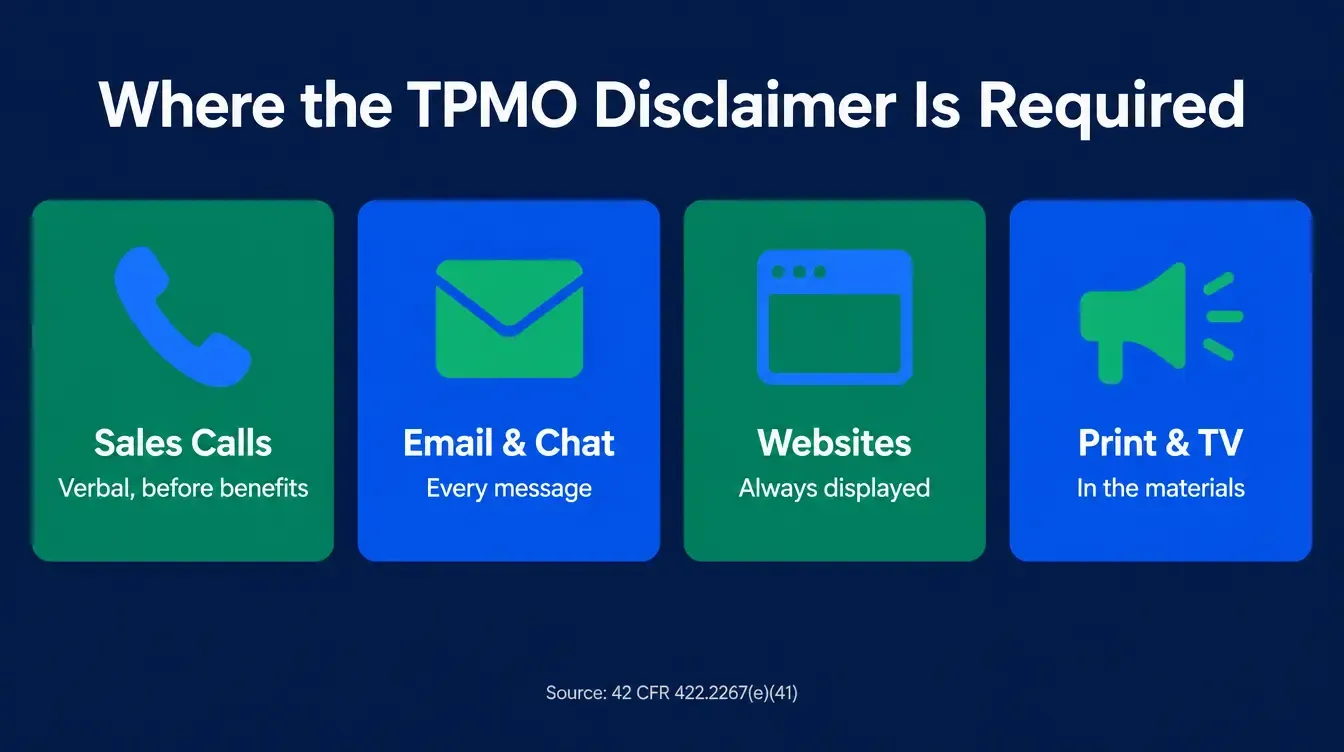
| Channel | Named in the regulation? | Required form |
|---|---|---|
| Sales calls | Yes | Spoken, verbatim, before any benefit is discussed |
| Yes | Written, every marketing message | |
| Online chat | Yes | Written, before plan specifics are discussed |
| TPMO websites | Yes | Prominently displayed |
| Marketing materials (print, TV) | Yes | Included in the material |
| Text messages (SMS) | Not by name — covered under "other electronic means" on a plain reading | No CMS-published format found; treat like email until guidance says otherwise |
What it actually costs to get this wrong
There’s no single published dollar figure for a TPMO disclaimer violation specifically, and this article isn’t going to manufacture one — the sourcing standard this site holds itself to means a number with no primary source gets deleted, not softened into “could cost thousands.” What’s actually verified, and arguably more useful: the regulatory mechanics of how a missed or mistimed disclaimer turns into exposure.
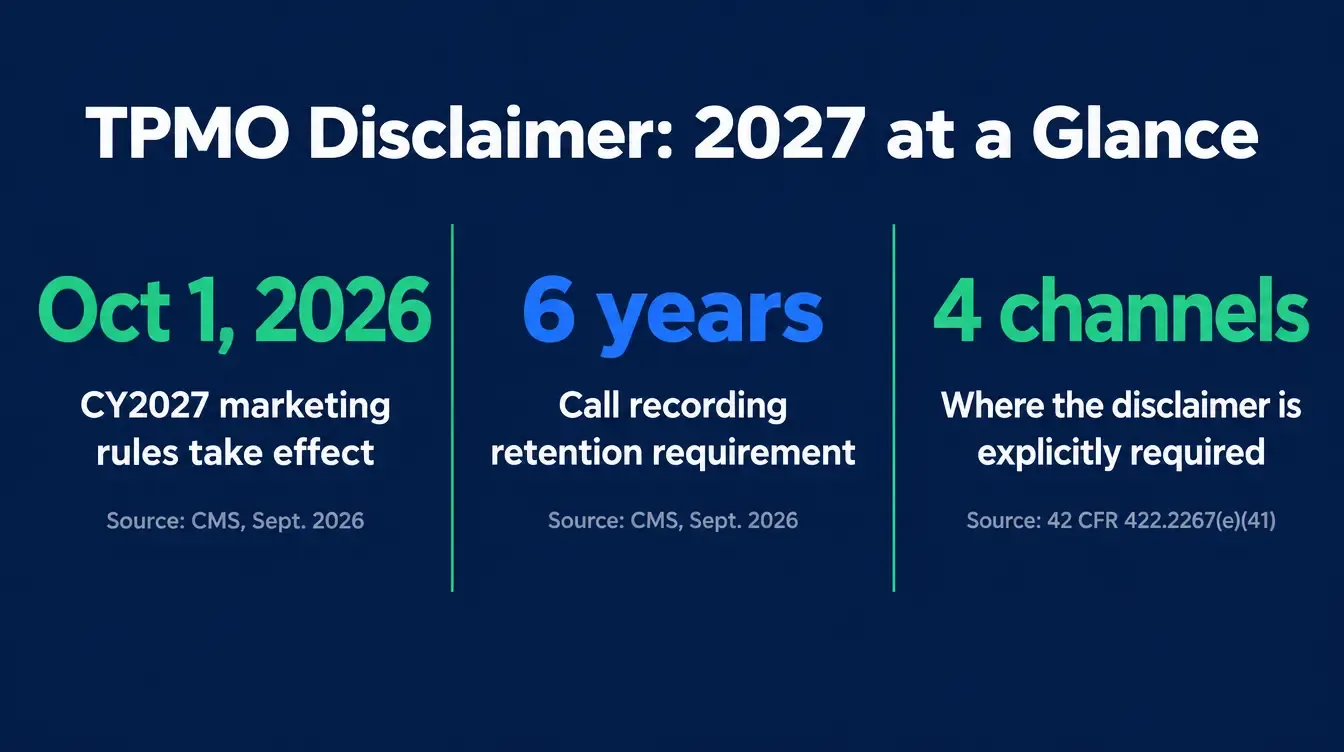
The mechanism that actually bites is downstream oversight, not a direct fine against you by name. An MA organization is contractually on the hook for the marketing conduct of the TPMOs it works with, which is why carriers run secret-shop calls, audit landing pages, and request recordings from the agents they contract with. A disclaimer read at the wrong moment usually doesn’t show up as a CMS letter addressed to you — it shows up as a carrier compliance flag, a corrective-action request, or a termination for cause. The six-year window means that flag can surface long after AEP ends, from a call nobody thought twice about at the time.
The rule doesn't ask you to guess at the right moment. It tells you exactly where the gate is — the only question is whether your script actually stops there.
Victoria CabreraBuild the channel-by-channel checklist by hand
None of this requires software. Here’s a working checklist you can build this afternoon, pulled straight from the regulation sections above.
Pick your version
Count the MA organizations you represent in each service area you market to. Not every organization there, you're on version 1; every one, version 2 — this can differ by county.
Fill in real, current numbers
The bracketed organization and plan counts have to be accurate for that service area, not rounded. Recheck every contracting season.
Mark the gate in your call script
Write "STOP — read disclaimer here" at the point a specific plan benefit first comes up, not at the top. Train reps on recognizing that moment.
Build it into email and text templates
Add the disclaimer (full version for email, shortened for texts) to every template that names a plan's benefits. A signature-block approach for email makes it automatic.
Check your website's display
"Prominently displayed" means visible without scrolling to a footer. Load your own landing page as a stranger would and time how long it takes to find it.
Purge the SHIP reference everywhere
Search every script, template, and page for "SHIP" and remove it. A two-minute find-and-replace with an outsized payoff.
Everything above works whether you ever join anything or not. Six steps, sourced straight from the regulation’s own text, and a working afternoon gets you compliant templates across every channel.
How Ambrose reviews outbound scripts and messages before they go out
The manual checklist above still depends on someone remembering to check it, every time, across every rep and every template. That’s the part that actually breaks at scale — not the knowledge, the consistency.
Here’s what’s actually documented, without stretching it into a claim it doesn’t make. An agent’s persona lives in its own markdown files (Ambrose docs, Agents), and those files are “plain-English files you edit in the browser, and changes take effect when you save” (Ambrose docs, What is Ambrose) — no developer, no separate deployment step. An instruction like “always include the current TPMO disclaimer in outbound SMS and email drafts” is something you write into an agent’s own file in plain sentences.
Outbound SMS, email, and Telegram messages route through Ambrose’s channel-bridge spoke, an “outbound email / SMS / Telegram dispatcher” running under a “scrubbed” PHI posture — protected health information is stripped before anything leaves the platform and re-hydrated when a reply comes back (Ambrose docs, Spokes). Separately, Ambrose’s documented approval model applies to anything an agent writes out: it “waits for your approval (Allow, Deny, or Always Allow),” and “every agent action is logged” (Ambrose docs, What is Ambrose).
Put those three pieces together and the workflow is this: you tell the agent, in its own markdown file, what has to be in a draft. The agent drafts the text or email through channel-bridge. The draft sits in your approval queue — you read it, confirm the disclaimer is there and placed correctly, and approve, deny, or always-allow it. Nothing here claims to catch a missing disclaimer automatically; what’s real is that nothing goes out without a human seeing it first, with a logged record of what was sent and when.
| Piece | What you write | What's documented |
|---|---|---|
| The disclaimer rule | "Always include version 1 of the TPMO disclaimer in outbound drafts" | Lives in the agent's editable markdown file; takes effect on save |
| Sending the message | Nothing — the agent drafts it | Routes through the channel-bridge spoke (email, SMS, Telegram), scrubbed PHI posture |
| The human check | You read the draft before it sends | Approval queue — Allow, Deny, or Always Allow — with every action logged |
This is LIVE documented behavior, not a beta promise
The agent markdown model, the channel-bridge spoke, and the approval queue are all described in Ambrose's current, live documentation as of this article's research. What Ambrose doesn't claim — and this article won't either — is an automated disclaimer compliance scanner. The review is still a human reading the draft; the platform's job is making sure that draft exists and that nothing skips the human.
What you get by joining
One Ambrose seat, with everything described above, comes included in a Tech Savvy Insurance membership: $97 a month, billed monthly, cancel anytime, with the founding rate locked in while the membership stays active. Alongside the seat: weekly Zoom calls with open Q&A and build-with-you sessions, 30+ hours of recorded training, Meta Ads, AI, and marketing training built for this industry specifically, pre-built AI templates and bot deployments, and a free annual in-person member workshop. It’s an explicit no-recruiting zone — you can bring your own call script or text template to a Tuesday call and have someone actually look at where your disclaimer gate sits, without the conversation turning into a pitch for a downline.
Ambrose usage runs separately from the $97 seat
The membership includes one Ambrose seat. Usage inside Ambrose runs through its own credit ledger with spend caps, so cost stays visible rather than showing up as a surprise. Everything in this article — the exact disclaimer text, the channel checklist, the timing rule — is free to use on its own, whether you ever join anything or not.
Compliance: what this covers, and what it doesn’t
This article explains what the current TPMO disclaimer regulation requires, the CY2027 changes to it, and a practical checklist for building it into your own scripts and templates. It is not legal advice. It doesn’t cover state-level telemarketing or consent rules (see our TCPA guide for that), carrier-specific marketing material submission requirements, or non-Medicare lines where this specific rule doesn’t apply. The “other electronic means” question for text messages is this article’s own reading of the regulation’s plain text, not a quote from a CMS guidance document resolving it directly — treat it as a reasoned recommendation, not a confirmed rule, until CMS publishes something more specific. Confirm your own carrier’s current marketing material requirements and have your own counsel or compliance team review your scripts and templates before relying on this article as your agency’s compliance documentation.
The close
The TPMO disclaimer isn’t vague guidance you can approximate — it’s two fixed blocks of text, a clear gate for when to say them on a call, and four named channels where CMS expects them, with text messages sitting in a real gap the regulation hasn’t closed yet. Pull the SHIP reference out of every script and template you own, move the gate on your call script from “first minute” to “before benefits,” and you’re compliant with the CY2027 change starting today, not October 1. If you’d rather build that checklist with people watching your screen, and have Ambrose draft the messages with the disclaimer built into the agent’s own instructions, one seat comes with a Tech Savvy Insurance membership: https://techsavvyinsurance.com/.
Before you rely on any figure in this article
Tech Savvy Insurance is a training and software community, not an insurance company, agency, or law firm, and does not provide insurance, legal, tax, or compliance advice. You are responsible for your own licensure and for complying with all applicable CMS, HIPAA, state, and carrier regulations. Regulations and enforcement priorities can change — confirm current requirements directly with CMS, your carrier's compliance team, or qualified legal counsel before relying on any figure here. AI-generated outputs may contain errors — always verify. Results may vary.
Frequently asked questions
Sources
- Cornell Law School, Legal Information Institute — 42 CFR § 422.2267 (TPMO disclaimer requirements, current text) — law.cornell.edu
- Cornell Law School, Legal Information Institute — 42 CFR § 422.2260 (TPMO, marketing, and communications definitions, current text) — law.cornell.edu
- CMS — Changes to the Medicare Advantage Organization and Medicare Drug Plan Sponsors Marketing Guidelines (Partner Tip Sheet, CMS Product No. 12237-P, September 2026) — cms.gov
- CMS — CY 2027 Changes to the Medicare Advantage Organization and Medicare Drug Plan Sponsors Marketing Regulations (presentation) — cms.gov
- Ambrose docs — What is Ambrose — app.hiambrose.com
- Ambrose docs — Agents — app.hiambrose.com
- Ambrose docs — Spokes — app.hiambrose.com
Ready to put this into practice?
Join a private community of Health & Life insurance professionals using AI, Meta Ads, and automation to grow — without draining their bank account.
Join Tech Savvy — $97/month