
Your opening line used to work because the disclaimer came first, fast, before the beneficiary had a chance to ask a real question. That line is wrong now. CMS’s Contract Year 2027 Medicare Advantage and Part D final rule moved the required TPMO disclaimer from “within the first minute of the call” to “prior to the discussion of any benefits,” which means a script built around the old timing reads the disclaimer either too early, before you know if the call even needs it, or at a moment that no longer matches the rule. If you’re still running a 2026 call script in 2027, it’s wrong in at least one specific, checkable place, and this article hands you the corrected version, line by line, along with the Scope of Appointment language that goes with it.
Key takeaways
- CMS's CY2027 final rule (91 FR 17384, effective June 1, 2026, applicable to marketing activity beginning October 1, 2026) moved the TPMO disclaimer requirement from "within the first minute of the call" to "prior to the discussion of any benefits," and dropped SHIPs as a referral source from the disclaimer text.
- The 48-hour Scope of Appointment waiting period is gone, but the SOA requirement itself is not. An SOA must still be agreed upon and recorded before a personal marketing appointment, in writing if it's in person.
- An SOA is now required for every personal marketing appointment, whether the plan, the agent, or the beneficiary started it, including an unscheduled inbound call, because CMS removed the word "scheduled" from the definition.
- CMS's own civil monetary penalty schedule caps a marketing-rule violation at $48,833, confirmed unchanged for 2026 by an HHS notice published October 21, 2026.
- A handful of states, including California and Florida, require all-party consent before you can legally record a call at all. One opening line covers every state.
What actually changed in the disclaimer timing for 2027
CMS’s Contract Year 2027 Medicare Advantage and Part D final rule revised 42 CFR 422.2267(e)(41)(ii) and the identical Part D section at 423.2267(e)(41)(ii) (Federal Register, document 2026-06600, 91 FR 17384). The rule itself explains why: CMS writes that requiring the disclaimer within the first minute “is not always the appropriate time to notify the beneficiary of the number of plan choices available,” because many calls open with basic demographic intake that determines whether the call should proceed to a benefit discussion at all, or whether the beneficiary doesn’t have a valid election period and the call ends before benefits ever come up. Forcing the disclaimer into a fixed sixty-second window, regardless of where the conversation actually was, didn’t reliably improve beneficiary understanding. So CMS replaced the clock with a trigger: read it before you discuss benefits, whenever that happens to land. CMS’s own summary for plans confirms the same change in plain language: plans are now “required… to verbally give the disclaimer before benefits are discussed, rather than within the first minute of a call” (CMS, Partner Tip Sheet, CMS Product No. 12237-P, September 2026).
That sounds like it gives you more room, and it does, but it also removes the one thing the old rule had going for it: a script writer could hard-code “disclaimer at :00:45” and never think about it again. The new rule asks you to actually track where the conversation is. CMS was specific about what starts that clock, in its own words from the final rule’s preamble: “CMS does not consider the mere mention of a benefit, for example pointing out that nearly all MA organizations offer routine dental care, constitutes a discussion of benefits.” What does count is “discussing the specificity of a benefit with the intent to draw a beneficiary’s attention to an MA or Part D plan(s), or to influence a beneficiary’s decision-making process when making an MA or Part D plan selection, or to influence a beneficiary’s decision to stay enrolled in a plan” (Federal Register, document 2026-06600, 91 FR 17384). CMS’s own example of where that line sits: talking through the benefits listed in a plan’s Evidence of Coverage, or how a specific plan’s cost-sharing structure would apply to this beneficiary’s situation.
The script you were probably running through 2026
"Hi, this is [name] with [agency]. Before we go any further, I'm required to tell you: we do not offer every plan available in your area..." — recited inside the first sixty seconds, before you know whether the beneficiary even has a valid election period or wants to talk about plans at all.
What the script needs to do for 2027
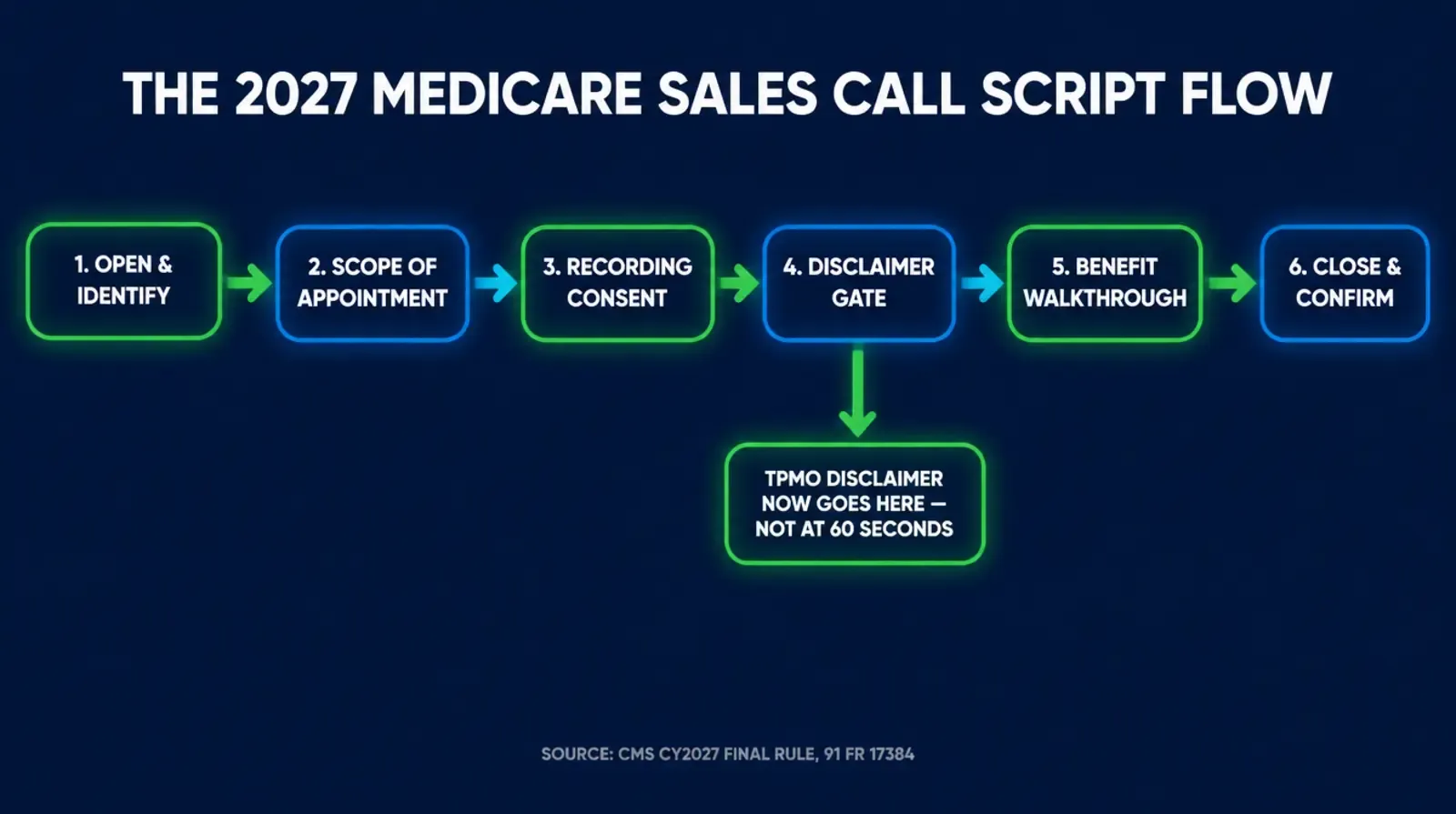
Open with identification, intake, and the Scope of Appointment. Hold the disclaimer in reserve. The instant you're about to name a specific benefit, a specific plan's cost-sharing, or anything meant to draw attention toward or away from a plan, stop and read the disclaimer first. Then continue.
The disclaimer text itself didn’t change, only the timing and the referral line. If you don’t represent every Medicare Advantage organization available in the beneficiary’s service area, the required language is still to this effect: “We do not offer every plan available in your area. Currently we represent [insert number of organizations] organizations which offer [insert number of plans] products in your area” (Cornell LII, 42 CFR § 422.2267). What’s new is the close: CMS removed the reference to State Health Insurance Assistance Programs, so the required referral is now only to Medicare.gov or 1-800-MEDICARE. If you represent every plan in the service area, the opening sentence drops and the rest stays. This has to be conveyed verbally on sales calls, electronically in email or chat, prominently on your website, and in all print and broadcast marketing materials — none of that part changed.
The Scope of Appointment line now that the 48-hour wait is gone
The other headline change from the same rule is the one most agents already heard about: CMS eliminated the 48-hour waiting period between completing a Scope of Appointment and holding the personal marketing appointment it covers, along with the two exceptions that existed around that waiting period (Federal Register, document 2026-06600, 91 FR 17384). What a lot of agents didn’t catch is what stayed. The SOA requirement itself is untouched. Current text at 42 CFR 422.2264(c)(3)(i) still reads that “prior to the personal marketing appointment,” the agent or broker “must agree upon and record” the Scope of Appointment with the beneficiary (Cornell LII, 42 CFR § 422.2264). You can now do that and move straight into the plan conversation in the same call. You still have to do it.
Two details matter for your script specifically, and both come straight out of the final rule text. First, CMS added a line that wasn’t there before: “The Scope of Appointment must be in writing for in-person personal marketing appointments” (Cornell LII, 42 CFR § 422.2264). For a phone call, that’s not the standard — an audio or audio-visual recording, or an electronic record, is sufficient to document the SOA, which in practice means your call recording itself can serve as the SOA record as long as it actually captures the exchange. Second, CMS removed the word “scheduled” from how a personal marketing appointment is defined. That sounds small and isn’t: it means an SOA is now required for every personal marketing appointment regardless of who initiated it, plan, agent, or beneficiary, which explicitly includes an unscheduled inbound call or a walk-in, not just a pre-booked meeting (Federal Register, document 2026-06600, 91 FR 17384). If your script only has an SOA step for outbound calls you scheduled in advance, it’s missing the inbound case the rule now covers by name.
| Setting | SOA collection now allowed | Format required |
|---|---|---|
| Phone or video call, inbound or outbound | Yes, at any point before the personal marketing appointment, no 48-hour wait | Audio, audio-visual, or electronic record |
| In-person personal marketing appointment | Yes, same no-wait rule | Must be in writing |
| Educational event | Yes, newly permitted for CY2027 — reversing the 2021 restriction | Same as the setting that follows; no plan-specific marketing during the educational portion itself |
| Marketing event immediately following an educational event, same location | Yes, newly permitted, provided beneficiaries are notified and given a chance to leave first | Standard marketing-event rules apply once the marketing portion starts |
CMS’s own words on why it reversed the educational-event restriction: it finalized “the proposal to permit plans and agents/brokers holding or participating in educational events with beneficiaries to make available and receive SOA forms at those same educational events,” reversing a 2021 rule that had kept the two activities apart (Federal Register, document 2026-06600, 91 FR 17384; CMS, Partner Tip Sheet). If you run educational seminars, that changes your follow-up workflow this AEP: you can now walk out of the room with signed SOAs in hand instead of chasing them down separately afterward.
This is a companion piece, not a repeat
We covered the 48-hour repeal itself in full in our CMS Drops the 48-Hour SOA Rule article, and the recording retention side of the same rule in Medicare Call Recording Retention in 2027. This one is about what you actually say, in order, on the call itself.
The full script, start to close
None of what follows requires anything you don’t already have: a phone, a recording app, and a willingness to actually read it the first dozen times instead of winging it. Build this into your dialer’s call notes or print it and keep it next to the handset.
Open and identify yourself
"Hi, this is [your name], a licensed insurance agent with [agency name]. I want to let you know up front that this call is being recorded for quality and compliance purposes." That one sentence satisfies the strictest all-party-consent state on the list and costs nothing anywhere else.
Confirm who you're speaking with and why
Basic intake: name, that they're a Medicare beneficiary, what prompted the call. This is the demographic-intake phase CMS itself describes as happening before any benefit discussion — it's allowed to happen before the disclaimer because nothing specific to a plan has come up yet.
Take the Scope of Appointment
"Before we talk about any specific plans, I need your permission to discuss certain products with you today. Are you interested in discussing Medicare Advantage, Medicare Supplement, Part D, or [the specific product types you're appointed to sell]?" Record the answer. This step now applies whether you called them or they called you.
The gate: read the disclaimer before one specific benefit comes up
The instant you're about to name a plan's specific benefit, premium, or cost-sharing detail, stop. "Before we go further, I want to let you know: we do not offer every plan available in your area. Currently we represent [X] organizations which offer [Y] products in your area. You can contact Medicare.gov or 1-800-MEDICARE for information on all of your options." If you represent every plan in the area, drop the first sentence and keep the rest.
Walk through benefits against what the beneficiary told you
Now that the gate's cleared, you can discuss actual plan details: Evidence of Coverage benefits, specific cost-sharing, how a particular plan structure applies to what this beneficiary described. This is the part of the call that actually sells, and it's fully open once the disclaimer's been read.
Close and confirm, out loud, on the recording
Read back the plan name, the effective date, and the next step, whether that's enrollment or a follow-up call. A read-back that's actually on tape is the single easiest thing to point to later if a client disputes what they agreed to.
Worked example: an inbound call that never needs the disclaimer
A beneficiary calls asking a general question about when AEP ends. You answer it, you don't name a plan or a benefit, and the call ends. Under CMS's own standard, "if there is no discussion of benefits, CMS would not expect TPMOs to provide the disclaimer to beneficiaries." Not every call needs the gate at step 4 — only the ones that actually get there.
The old rule let you memorize a timestamp. The new one asks you to actually notice the moment the conversation turns into a plan pitch.
Mike MooreA full call, so you can hear where the gate actually sits
Here’s an inbound call, condensed, with the six stages marked so you can see exactly where the disclaimer lands relative to everything else. This is the kind of call that used to get the disclaimer crammed into the first breath, before anyone knew whether it was needed.
[01 — Open and identify] “Hi, this is Dana, a licensed insurance agent with Coastal Benefits Group. I want to let you know up front that this call is being recorded for quality and compliance purposes. Thanks for calling — how can I help you today?”
[02 — Intake] “I’m calling about my Medicare Advantage plan. I think I might want to switch.” / “Happy to help with that. Can I confirm I’m speaking with the Medicare beneficiary, and get your name and date of birth so I can pull up the right information?”
[03 — Scope of Appointment] “Before we go any further into specific plans, I need your okay to discuss certain products with you today. Are you interested in talking about Medicare Advantage plans specifically, or would you also want to hear about Medicare Supplement or Part D options?” / “Just Medicare Advantage for now.” — Dana notes the scope, timestamped on the recording, which under the current rule satisfies the SOA documentation requirement for a call that isn’t in person.
At this point the conversation could still go a few directions without ever triggering the disclaimer. If the beneficiary asked a general question — when AEP ends, how to find their current plan’s ID number, whether their doctor is in-network in general terms — none of that names a specific benefit or cost-sharing detail tied to a plan, and CMS’s own standard doesn’t require the disclaimer for it. The gate opens the moment a specific plan enters the conversation.
[04 — The gate] “Before I walk you through what’s available, I want to let you know: we do not offer every plan available in your area. Currently we represent nine organizations which offer twenty-three products in your area. You can contact Medicare.gov or 1-800-MEDICARE for information on all of your options.” Dana reads this before naming a single plan, a single premium, or a single benefit — not at the sixty-second mark, at the actual moment the conversation turns into a plan discussion, which in this call happened to land around minute four.
[05 — Benefit walkthrough] “Given what you told me about your current prescriptions, here’s a plan that keeps your specialist copay close to what you’re paying now, and adds a dental allowance your current plan doesn’t have…” This is the part of the call where the actual selling happens, and it’s wide open now that the gate’s cleared — no further disclaimer requirement attaches to continuing the plan conversation once it’s been read.
[06 — Close and confirm] “So to confirm what we just covered: you’re enrolling in [plan name], effective [date], and I’ll send you written confirmation along with the Summary of Benefits today. Does that match what you understood?” Read back on the recording, not assumed.
Run that same call with last year’s script and the disclaimer gets read during step 01 or 02, before anyone knows whether the beneficiary even wants to talk about a specific plan. Under the current rule, that’s not just early, it’s reading the disclaimer for calls that may never reach a benefit discussion at all, which is exactly the pattern CMS says it was trying to fix.
Everything in this section works whether you ever join anything or not — print it, read it, run it. Go do it by hand on your next call, or bring it to one of the weekly build-with-you Zooms and have someone who’s already moved their team onto the new timing walk through it with you.
What it costs to get the order wrong
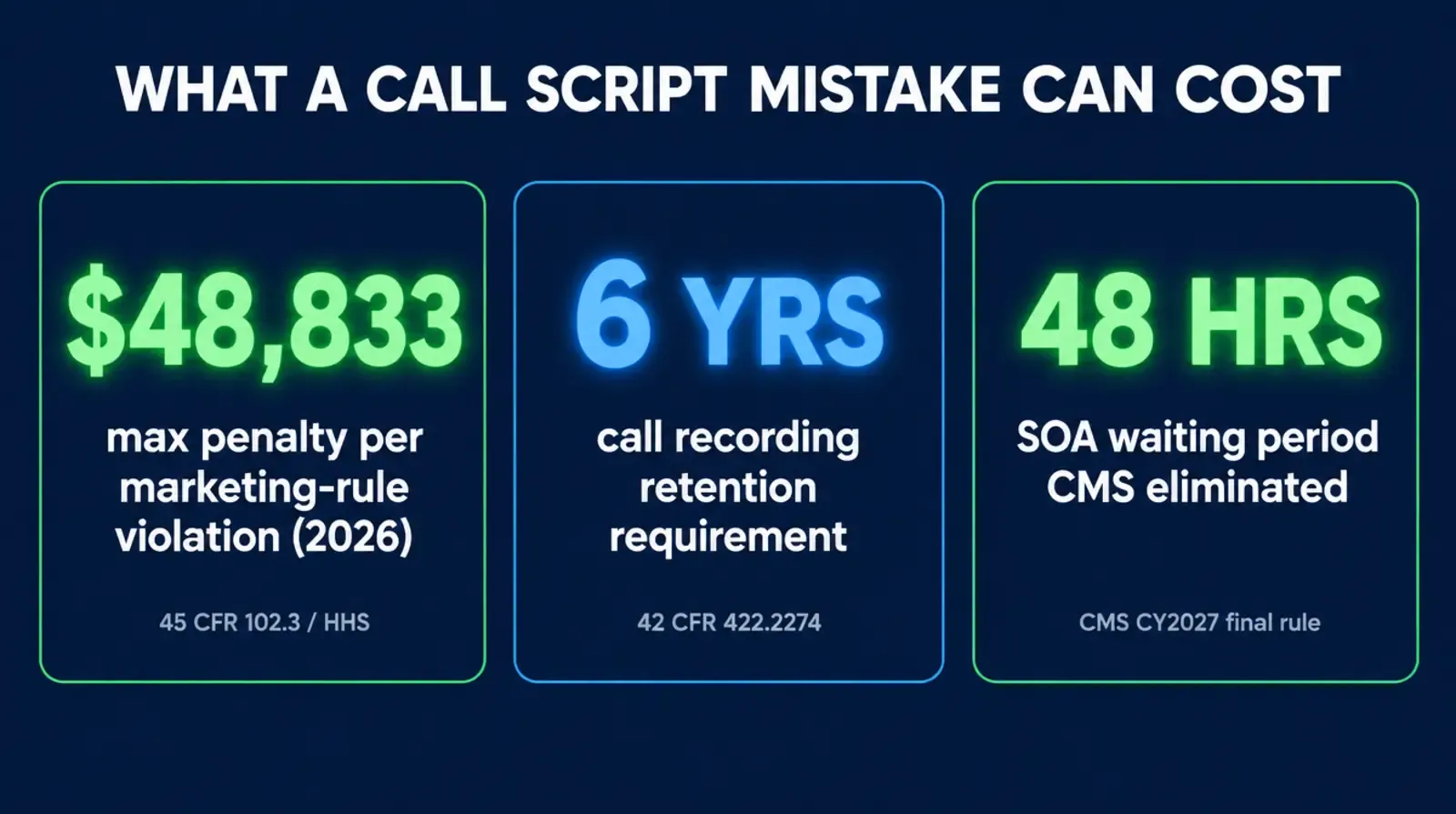
CMS’s civil monetary penalty schedule, published under 45 CFR 102.3 and reviewed annually for inflation, caps a Medicare Advantage organization’s exposure at $48,833 per violation for failing to comply with marketing restrictions or the regulations implementing them (Cornell LII, 45 CFR § 102.3). A disclaimer read at the wrong point, or not read at all before a benefit discussion, sits squarely inside that category. That figure was set at the 2025 level, and it’s worth being precise about why it’s still accurate in 2026: HHS published a notice in the Federal Register on October 21, 2026, titled “No Adjustment to HHS Civil Monetary Penalty Amounts for 2026,” stating plainly that “HHS will continue to use the 2025 civil monetary penalty levels because there will be no cost-of-living adjustment for 2026” (Federal Register, document 2026-21524). That’s not an old number going stale. It’s the current number, reconfirmed two days before this article was written.
What that figure doesn’t capture is the part that actually costs you time: once a call is recorded, it’s retained for six years under the same rule that moved your disclaimer timing, and a program audit doesn’t take your word for where in the call you read it. The recording either shows the gate in the right place or it doesn’t. A script you’re not actually running, word for word, is a liability sitting on a six-year clock whether or not anyone ever pulls the file.
The consent line CMS doesn’t mention: your state’s own recording law
CMS’s rule tells you that you must record marketing and sales calls. It says nothing about whether you’re legally allowed to do that without saying so out loud in the state your beneficiary lives in, and that’s governed by state wiretapping law, not CMS. Most states are one-party consent, meaning your own participation in the call satisfies the law. A meaningful minority require consent from every party on the line, and getting that wrong isn’t a CMS compliance problem, it’s a separate state criminal exposure.
California is one of them. Penal Code 632 makes it illegal to use a recording device on a confidential communication without the consent of every party, and the statute itself sets the penalty: “a fine not exceeding two thousand five hundred dollars ($2,500) per violation,” up to a year in county jail, or both, for a first offense, rising to a $10,000 maximum fine for a repeat violation (FindLaw, California Penal Code § 632). Florida is another. Statute 934.03 makes it unlawful to intercept a wire, oral, or electronic communication without the consent of all parties, with a general violation classified as a third-degree felony, subject to a specific consent exception at subsection (2)(d) when every party has agreed in advance (Florida Legislature, Fla. Stat. § 934.03).
| State | Rule | First-offense exposure | Citation |
|---|---|---|---|
| California | All parties must consent before a confidential communication is recorded | Up to $2,500 fine, up to 1 year county jail, or both | Penal Code § 632 |
| Florida | All parties must consent to interception of a wire, oral, or electronic communication | Third-degree felony, per Fla. Stat. § 934.03(4)(a) | Fla. Stat. § 934.03 |
The fix is step 01 of the script above and it’s free: say “this call is being recorded for quality and compliance purposes” before you do anything else. In a one-party state it’s good practice and doubles as a timestamp of disclosure. In an all-party state it’s the difference between a recording that satisfies both CMS’s federal mandate and your state’s criminal statute, and one that’s simultaneously federally compliant and a state law violation. Check your own state specifically — this article names two examples, not all fifty, and state wiretapping law is exactly the kind of detail that changes without a CMS press release to flag it. If you want someone to double-check your specific state’s rule with you before you roll a revised script out to a whole team, that’s the kind of question the Tech Savvy community works through on a Tuesday call, not something you have to sort out alone from a forum thread.
How Ambrose catches a bad line after the call ends
Everything above is a discipline, not a product. You can run this script from a printed sheet with zero software and be fully compliant. Where a second set of eyes earns its place is after the call, when you’re trying to tell whether you, or anyone on your team, is actually running it right, call after call, without a manager relistening to every single one.
That’s the gap Ambrose’s documented Call Intelligence pipeline is built to close. Per Ambrose’s own documentation, the pipeline runs as four chained skills: call-sweep-ghl/call-sweep-vapi/call-sweep-retell/call-sweep-justcall finds calls newer than the last run from a connected source; call-intake-anywhere archives the recording and gets a transcript; call-junk-filter separates real conversations from voicemails, no-answers, and wrong numbers; and call-analyzer scores the conversation against the scorecard template matching that call type, tagging the objections it heard against your agency’s own taxonomy (Ambrose docs, Call Intelligence overview). One of the four default scorecard templates is specifically a Medicare closing scorecard, matched automatically by call type and editable in your agency’s own vault (Ambrose docs, Call Intelligence config).
The output lands in two places that matter here. The Objections view ranks what’s actually costing deals, not just what comes up most often. The Team & 1:1 view gives one card per rep, and per Ambrose’s documentation that card includes call volume, average score, goal-met rate, the rep’s most common objection, and “any compliance incidents” flagged for that rep (Ambrose docs, Objections & Team / 1:1). To be direct about where the honest line sits: Ambrose’s published documentation doesn’t spell out the exact pass-fail wording inside the Medicare closing scorecard, so this article isn’t going to claim the analyzer specifically detects the new “prior to discussion of benefits” timing rule by name. What’s documented and confirmed is that compliance incidents get flagged per rep, automatically, on every call your agency is already recording — which is the layer that turns “I think we’re reading the disclaimer correctly” into something you can actually check instead of assume.
| Part of the problem | What actually addresses it |
|---|---|
| Reading the right line at the right point, every call | The script above, printed and actually used — a discipline, not a product |
| Recording the call correctly and disclosing it per your state | Your dialer's recording settings plus the opening line in step 01 |
| Knowing whether you, or your team, is actually running the script | Ambrose's Call Intelligence pipeline and its per-rep compliance-incident flags |
What you get by joining
One Ambrose seat, including the Call Intelligence pipeline described above, comes with a Tech Savvy Insurance membership: $97 a month, billed monthly, cancel anytime, with the founding rate locked in while the membership stays active. Alongside the seat: weekly Zoom calls with open Q&A and build-with-you sessions, 30+ hours of recorded training, Meta Ads, AI, and marketing training built for this industry specifically, pre-built AI templates and bot deployments, and a free annual in-person member workshop. It’s also an explicit no-recruiting zone, which matters more than it sounds: you can ask a real question about your own call script without ending up on someone’s downline pitch list, which is not the norm in most agent Facebook groups.
Ambrose usage runs separately from the $97 seat
The membership includes one Ambrose seat. Usage inside Ambrose runs through its own credit ledger with spend caps, so cost stays visible instead of showing up as a surprise line item. See the Call Intelligence docs for what else is covered beyond what's in this article.
Writing the script with AI, without creating a new problem
If you’re going to draft or refine this script with an AI tool, that’s fine for the generic language. What isn’t fine is pasting a real beneficiary’s enrollment history, health conditions, or specific plan details into a general-purpose AI tool that hasn’t signed a Business Associate Agreement with you — that’s protected health information leaving your control, with no accountability on the other end for how it’s stored or used. The NAIC’s Model Bulletin on the Use of Artificial Intelligence Systems by Insurers sets the expectation that’s increasingly applied downstream to agencies even where it isn’t yet formally adopted in your state: a written policy on how AI gets used, human review before AI output reaches a client-facing decision, and documentation you could produce if a regulator or carrier asked how a determination was made.
What not to paste into a general AI tool
A real transcript or call summary naming a specific beneficiary and tying them to a health condition, a plan selection, or enrollment status, sent to any destination without a signed Business Associate Agreement. Draft the script itself with AI freely. Keep the client's actual data out of the tool that drafted it.
Ambrose’s architecture is built around that exact boundary: Ambrose is HIPAA-aware by default, not HIPAA certified — there’s no such thing as HIPAA certification for a software platform, and any vendor claiming otherwise is worth a second look. If you want the mechanism behind that claim rather than a marketing line, our call recording retention article covers Ambrose’s PHI Rail and phi-gateway spoke in detail, including how it keeps a transcript safe once you’re ready to put it in front of an AI model.
Compliance: what this touches, and what it doesn’t
If you market or sell Medicare Advantage or Part D coverage and get compensated for it, the script and timing rules covered here apply to you directly as a third-party marketing organization, not just to the carrier you’re appointed with. None of this article is legal advice, and CMS guidance and enforcement priorities shift. Confirm your own agency’s specific obligations with CMS’s Medicare Communications and Marketing Guidelines, your upline’s compliance team, or qualified legal counsel before you roll a revised script out to a live team ahead of AEP volume. This article also doesn’t touch TCPA texting consent or revocation rules, which we cover separately in our TCPA guide, or the broader marketing-claims rules for 2027, covered in Medicare Marketing Claims in 2027.
The close
Six stages, one of them moved: the disclaimer now sits at the gate right before you name a specific benefit, not at a fixed timestamp. Writing that into a printed script and actually reading it costs nothing and takes an afternoon, whether you ever join anything or not. If you’d rather have a documented way to check that you and your team are actually running it, not just assuming you are, one Ambrose seat comes with a Tech Savvy membership, and the weekly build-with-you calls are where agents actually wire this up before AEP volume hits: https://techsavvyinsurance.com/.
Before you rely on any figure in this article
Tech Savvy Insurance is a training and software community, not an insurance company, agency, or law firm, and does not provide insurance, legal, tax, or compliance advice. You are responsible for your own licensure and for complying with all applicable CMS, HIPAA, state, and carrier regulations, including your own state's recording consent laws. Regulations and enforcement priorities can change — confirm current requirements directly with CMS, your state Department of Insurance, or qualified legal counsel before relying on any figure here. AI-generated outputs may contain errors — always verify. Results may vary.
Frequently asked questions
Sources
- Federal Register — Medicare Program; CY2027 and Certain CY2026 Policy and Technical Changes to the Medicare Advantage and Medicare Prescription Drug Benefit Programs, final rule (document 2026-06600 / 91 FR 17384), full text — govinfo.gov
- CMS — Partner Tip Sheet: Changes to the Medicare Advantage Organization and Medicare Drug Plan Sponsors Marketing Guidelines (CMS Product No. 12237-P, September 2026) — cms.gov
- Cornell Law School, Legal Information Institute — 42 CFR § 422.2267 (TPMO disclaimer requirements, current text) — law.cornell.edu
- Cornell Law School, Legal Information Institute — 42 CFR § 422.2264 (Scope of Appointment requirements, current text) — law.cornell.edu
- Cornell Law School, Legal Information Institute — 45 CFR § 102.3 (civil monetary penalty inflation-adjustment table) — law.cornell.edu
- Federal Register — No Adjustment to HHS Civil Monetary Penalty Amounts for 2026 (document 2026-21524, published October 21, 2026) — federalregister.gov
- FindLaw — California Penal Code § 632 (recording confidential communications) — codes.findlaw.com
- Florida Legislature — Fla. Stat. § 934.03 (interception and disclosure of wire, oral, or electronic communications) — leg.state.fl.us
- NAIC — Insurance Topics: Artificial Intelligence (Model Bulletin background) — content.naic.org
- Ambrose docs — Call Intelligence overview — app.hiambrose.com
- Ambrose docs — Objections & Team / 1:1 — app.hiambrose.com
- Ambrose docs — Call Intelligence config (scorecards & objection taxonomy) — app.hiambrose.com
Ready to put this into practice?
Join a private community of Health & Life insurance professionals using AI, Meta Ads, and automation to grow — without draining their bank account.
Join Tech Savvy — $97/month