
Right now, in 2026, you still need prior express written consent before texting or robocalling a lead about a specific plan, you still cannot call or text before 8 a.m. or after 9 p.m. in the recipient’s own time zone, and you still have to honor a revocation the moment it comes in. What you do not need anymore is one separate consent per seller for every unrelated topic, because the rule that would have required that was thrown out by a federal appeals court, in a case an insurance industry group brought and won (Insurance Marketing Coalition Ltd. v. FCC, No. 24-10277, 11th Cir., Jan. 24, 2025). A second, separate rule change, one that would make a single revocation cancel consent for every unrelated message from you, was supposed to arrive this year. It didn’t. The FCC pushed it back again, to January 31, 2027, in an order it released on January 6, 2026 (FCC, DA 26-12). This article walks through what’s actually in force, what’s still pending, what it costs to get wrong, and how to build a compliant follow-up sequence by hand before touching any software.
Key takeaways
- The FCC's "one-to-one consent" and "logically and topically related" restrictions on TCPA consent were vacated by the Eleventh Circuit on January 24, 2025 — they never took effect and don't apply to your texts.
- The separate "revoke-all" rule, which would make one STOP cover every unrelated topic, is delayed again, now to January 31, 2027, per an FCC order adopted January 6, 2026.
- Everything else in 47 CFR 64.1200 is unchanged: written consent for marketing texts, the 8 a.m.–9 p.m. local-time calling window, and immediate honoring of any revocation.
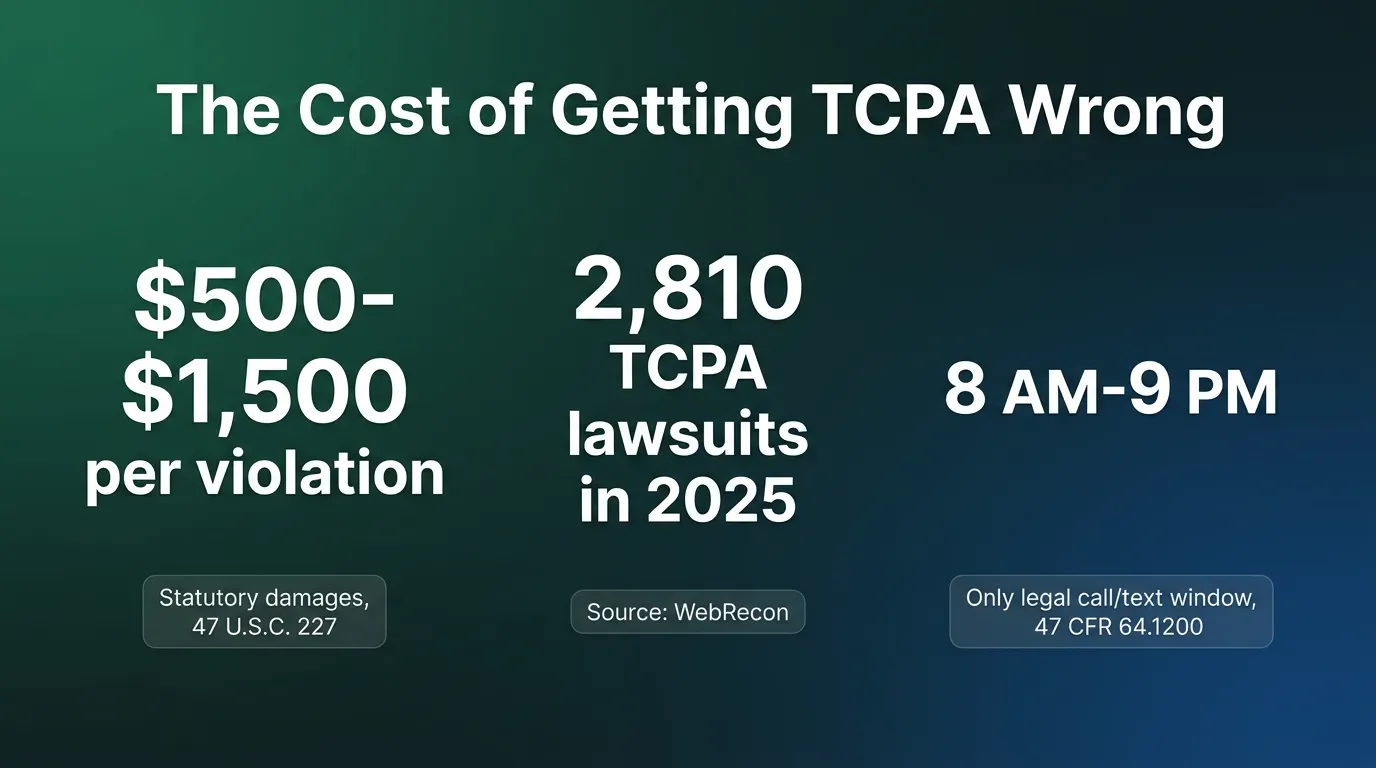
- TCPA violations carry statutory damages of $500 per violation, up to $1,500 for a willful violation, and WebRecon counted 2,810 TCPA lawsuits filed in federal court in 2025.
- Ambrose's campaign-metrics spoke shows which touch in a shorter, more deliberate sequence actually books calls; its channel-bridge and reply-bot spokes send and draft messages but do not manage your consent records — that stays your responsibility.
The pain: the rule keeps moving and nobody told you which version is live
If you run any kind of text or call follow-up sequence, you’ve probably heard three contradictory things in the last eighteen months: that you now need separate consent for every single topic you text someone about, that a single “stop texting me” cancels everything you’re allowed to send that person forever, and that none of it matters because “the TCPA thing got struck down.” All three are half-true, which is worse than being wrong, because half-true compliance advice is the kind agents actually act on.
Here’s why this particular rule is so easy to get wrong: it changed twice in one direction and then reversed, on two different tracks, inside of about eighteen months. One track (one-to-one consent) got fully vacated by a court. The other track (revoke-all) is still technically coming, just not yet, and its start date has been pushed back twice already. An agent skimming a single article from mid-2025 could easily walk away thinking either track is settled law today. Neither summary holds up if you only read it once and never go back to check the date.
This is guidance about federal rules, not legal advice
Tech Savvy Insurance is a training and software community, not a law firm or an insurance agency. This article describes what public FCC orders and a public court opinion say, as of the dates cited. It is not legal advice about how these rules apply to your specific book of business or your specific state's additional telemarketing law. Read the primary sources yourself, linked throughout, and talk to your own counsel or your carrier's compliance department before changing your workflow based on this article.
Why this keeps happening: the actual timeline
Start with what the TCPA itself says, because everything else is built on top of it. The Telephone Consumer Protection Act requires anyone making a robocall, a term the FCC has long interpreted by regulation to include text messages, to get the called party’s “prior express consent” before making it, and prior express written consent specifically when the message is telemarketing or advertising (47 U.S.C. § 227(b)(1)(A)–(B); 47 CFR 64.1200(a)(2)–(3)). That part hasn’t moved in this whole saga and isn’t going anywhere.
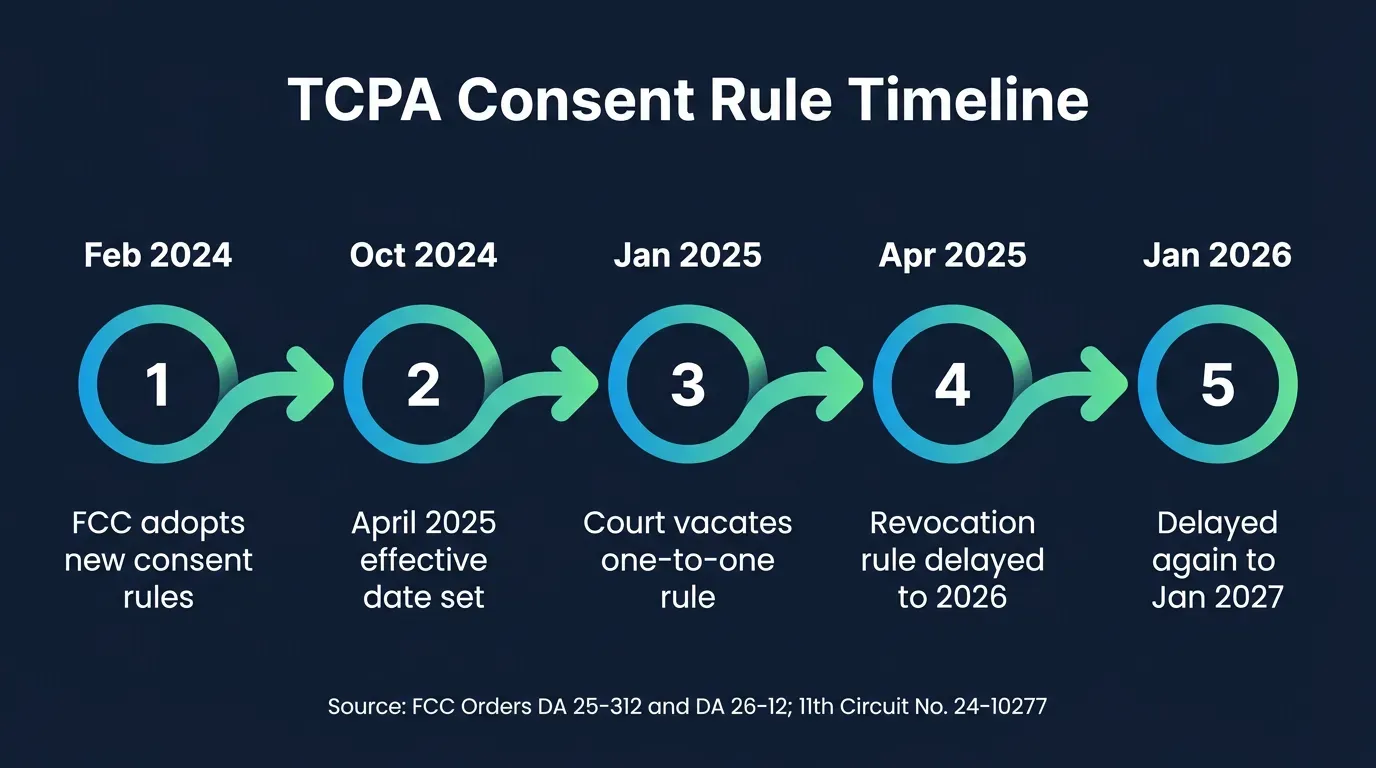
What has moved is a second layer the FCC tried to add on top of it. Here’s the sequence, each step sourced to the actual order or opinion:
February 16, 2024. The FCC releases what the industry calls the TCPA Consent Order, adopting new interpretations of “prior express consent.” Two pieces of it matter here: a requirement that consent be obtained one seller at a time rather than covering multiple telemarketers under one blanket consent (the “one-to-one” rule), and a requirement that any call or text be “logically and topically associated” with whatever prompted the original consent. The same order also adopts section 64.1200(a)(10), the “revoke-all” provision, which would treat a revocation made in response to one type of message as applying to all future unrelated messages from that caller.
October 11, 2024. The FCC publishes notice in the Federal Register that the new rules take effect April 11, 2025.
January 24, 2025. The Eleventh Circuit rules on a petition filed by the Insurance Marketing Coalition, an insurance lead-generation industry group, challenging the one-to-one and logically-and-topically-related restrictions. The court’s holding is direct: the FCC “exceeded its statutory authority in redefining ‘prior express consent’ to include the additional ‘prior express consent’ restrictions,” and the court finds vacatur, not remand without vacatur, the appropriate remedy (opinion, pp. 23–25). Those two restrictions are gone. They never took effect.
April 7, 2025. Separately from the court case, the FCC’s Consumer and Governmental Affairs Bureau grants a one-year waiver of the revoke-all rule’s effective date, pushing section 64.1200(a)(10) compliance from April 11, 2025 to April 11, 2026, after financial-industry trade groups argued they needed more time to build systems that could process a revocation received on one topic and apply it across unrelated business lines (FCC Order DA 25-312).
January 6, 2026. The FCC extends that waiver again, this time to January 31, 2027, citing an open rulemaking proceeding it wants to finish reviewing before the rule locks in, and the desire to avoid forcing “potentially unnecessary compliance costs” on affected parties while that review is pending (FCC Order DA 26-12).
So as of today, one track is permanently dead (one-to-one consent, logically-and-topically-related) and the other is alive but not yet in force (revoke-all, now targeting January 31, 2027). Everything else, written consent, the calling-hours window, per-topic revocation, was never part of either fight and has been sitting there unchanged the whole time.
What’s actually in force right now, piece by piece
Strip away the two moving pieces and here’s the TCPA framework that governs your follow-up texts and calls today, unchanged by anything in the last two years:
Consent. For any call or text that constitutes telemarketing or advertising, you need the called party’s prior express written consent before you send it (47 CFR 64.1200(a)(2)–(3)). A lead who fills out a quote request form and checks a consent box has given you consent to be contacted about that request. It does not, by itself, license you to add them to an unrelated newsletter or a different product line’s drip campaign, not because of the vacated one-to-one rule, but because ordinary consent scope was never that broad to begin with. Write down what a given consent actually covers, in your own CRM notes, at the moment you capture it.
Calling and texting hours. No telephone solicitation before 8 a.m. or after 9 p.m., “local time at the called party’s location” (47 CFR 64.1200(c)(1)). That’s the recipient’s clock, not yours. If you work from a home office in the Eastern time zone and a lead from a lead-buy list lives in Arizona, a text that goes out at 8:30 a.m. Eastern is 5:30 a.m. Mountain Standard, well outside the window, on autopilot, unless your system checks the lead’s area code or address against a time zone before it fires.
Revocation. A called party can revoke consent by any reasonable method: replying STOP, saying so on a call, using an opt-out link, or another clear method that expresses they don’t want further contact (47 CFR 64.1200(a)(10)). Once revoked, you cannot send further robocalls or robotexts to that person on that topic, and the rule requires honoring the request “within a reasonable time,” not to exceed ten business days. Right now, that revocation obligation is still scoped to the topic it was made about, not automatically to every unrelated thing you might otherwise contact them about. That’s the piece the revoke-all rule would change, once it actually takes effect.
Consent is per-seller in ordinary practice, just not by the vacated FCC restriction. This is the nuance worth sitting with. The Eleventh Circuit didn’t rule that one consent can cover unlimited unrelated sellers and topics forever; it ruled the FCC lacked authority to write a specific, additional regulatory requirement forcing that scope narrowly. Ordinary contract and consent principles, the same ones the court said should govern instead, still mean a consent means what it says it means. If your consent language says “to receive calls and texts from [Agency Name] about health insurance options,” that’s the scope you actually have, vacatur or no vacatur.
| Rule | Status in 2026 | Source |
|---|---|---|
| One-to-one consent (separate consent per seller) | Vacated. Never took effect. Does not apply. | 11th Cir., IMC v. FCC, Jan. 24, 2025 |
| "Logically and topically related" restriction | Vacated alongside one-to-one consent. | 11th Cir., IMC v. FCC, Jan. 24, 2025 |
| Revoke-all (one STOP cancels all unrelated consent) | Delayed, not vacated. Effective Jan. 31, 2027. | FCC Order DA 26-12, Jan. 6, 2026 |
| Prior express written consent for marketing texts/calls | Unchanged. In force. | 47 CFR 64.1200(a)(2)–(3) |
| 8 a.m.–9 p.m. local-time calling window | Unchanged. In force. | 47 CFR 64.1200(c)(1) |
| Per-topic revocation, honored within a reasonable time (≤10 business days) | Unchanged. In force. | 47 CFR 64.1200(a)(10) |
Where the confusion actually comes from
A lot of the "TCPA got struck down, you're fine now" chatter conflates the vacated one-to-one rule with the entire TCPA. It didn't strike down the TCPA. It struck down one additional restriction the FCC tried to layer on top of consent. The base statute, the written-consent requirement, the calling hours, and the revocation rule are all still fully in force, and confusing "one rule got vacated" with "the law doesn't apply" is exactly the kind of plausible-sounding claim that costs an agent real money.
What it actually costs to get this wrong
The TCPA gives a called party a private right of action: recover actual monetary loss, or $500 per violation, whichever is greater, and a court may increase that award to as much as three times that amount, up to $1,500 per violation, if the violation was willful or knowing (47 U.S.C. § 227(b)(3)). Those numbers are per call or per text, not per lawsuit. A single automated sequence that sends five out-of-window texts to a hundred people who never gave written consent is, on paper, five hundred separate violations before anyone even gets to whether it was willful.
This isn’t a hypothetical rulebook nobody actually uses. WebRecon, which tracks consumer-litigation filings monthly with a published, consistent methodology, counted 2,810 TCPA lawsuits filed in federal court over the complete 2025 calendar year, up 0.8% from 2024’s total (WebRecon, Dec. 2025 stats & year in review). That figure comes from a single tracker; we found no independent second count of the same period to corroborate it against, so treat it as directionally solid rather than independently confirmed twice. It’s still roughly 234 new TCPA suits filed every month, in a year when one of the FCC’s own restrictions had just been struck down. The plaintiffs’ bar didn’t go quiet because one rule got vacated; the base statute and its statutory-damages structure are exactly what keeps this area litigated regardless of which regulatory layer is currently in force.
TCPA lawsuits filed in federal court, 2024 vs. 2025
Same tracker, two consecutive year-end reports.
Source: WebRecon, Dec. 2024 stats and Dec. 2025 stats & year in review. TCPA filings were essentially flat year over year, up 0.8%, despite the one-to-one consent rule being vacated in between the two reports.
There’s a second cost that’s harder to put a number on but just as real: overcorrecting. An agent who read one alarming article about revoke-all in early 2025 and quietly stopped texting leads altogether, or cut a working five-touch sequence down to one message out of caution, gave up real production against a rule that still isn’t even in effect. Reading the primary source instead of the panic costs you twenty minutes. Overcorrecting against a rule two years before it applies costs you every lead who would have converted on touch three.
The rule that's actually in force is smaller and more stable than the version everyone's arguing about. Read the order itself before you change how you talk to a lead.
Mike MooreState law can go further than the TCPA does
Everything above is federal law, and federal law is a floor, not a ceiling. Several states run their own telemarketing statutes on top of the TCPA, and at least one of them is stricter and more heavily litigated than the federal version. Florida’s Telephone Solicitation Act, codified at Fla. Stat. § 501.059 and commonly called Florida’s “mini-TCPA,” requires prior express written consent for an automated telephonic sales call, text message, or voicemail, defined the same way the TCPA does: a signed authorization, which can be an affirmative act like checking a box, that names the specific phone number and discloses that consent isn’t a condition of purchase (Fla. Stat. § 501.059). Damages run the same way as the federal statute: actual damages or $500 per violation, whichever is greater, with courts able to treble that to $1,500 for a willful or knowing violation.
| Provision | Federal TCPA | Florida FTSA (Fla. Stat. 501.059) |
|---|---|---|
| Consent required | Prior express written consent for marketing calls/texts | Prior express written consent, signed or an equivalent affirmative act |
| Base statutory damages | $500 per violation, or actual damages if greater | $500 per violation, or actual damages if greater |
| Willful/knowing violation | Up to 3x, so up to $1,500 per violation | Up to 3x, so up to $1,500 per violation |
| Private right of action | Yes, 47 U.S.C. 227(b)(3) | Yes, Fla. Stat. 501.059 |
The reason this matters beyond Florida specifically is the pattern, not just the one state. A rule change at the federal level, like the one-to-one consent vacatur this article opens with, doesn’t touch a state’s own statute at all. If your lead list includes Florida residents, or residents of any other state running a comparable law, you have two separate compliance obligations to satisfy, and being clean under the federal TCPA doesn’t automatically clear you under a state’s own version. This article isn’t a 50-state survey, and it would be dishonest to pretend otherwise: check whether your own state runs a telemarketing statute with a private right of action before assuming federal compliance is the whole picture, the same way a Texas or California agent has to check their own state insurance regulator’s rules on top of federal Medicare marketing law.
The manual method: build a TCPA-safe follow-up sequence by hand
None of what follows requires any software beyond whatever CRM or spreadsheet you already have. Here’s how to build a defensible, compliant text and call follow-up process this week.
Capture the actual consent language, not just a checkbox
Save the exact text the lead agreed to, the date, the timestamp, and the source (which form, which ad, which call). "They opted in somewhere" isn't a record. The specific sentence they agreed to is.
Scope every campaign to what the consent actually covers
If the consent was for a Medicare quote request, don't fold that contact into an unrelated ACA or final-expense campaign without a separate basis for it. Write the topic into your CRM tag, not just "lead."
Build the 8 a.m.–9 p.m. window against their time zone, not yours
Most CRMs, including GoHighLevel, let you set a business-hours window on a workflow. Set it against the contact's area code or state field, not a single office time zone, if your leads span more than one region.
Treat any opt-out language as an immediate stop
STOP, "please don't text me," "remove me," a hang-up mid-call after asking not to be contacted, all of it. Ten business days is the outer legal limit for acting on it, not a target. Build your workflow to suppress on the same day.
Keep a suppression list that actually gets checked
A spreadsheet of every number that's opted out, cross-checked before any new campaign goes out, not just relied on inside one workflow. Lists get bought, leads get re-imported, and an old suppression list that nobody re-checks is how a resolved opt-out gets re-texted by accident.
Recheck the FCC's own order pages quarterly
The revoke-all rule's effective date has already moved twice. Put a calendar reminder to check docs.fcc.gov and the FCC's TCPA docket before assuming January 31, 2027 will hold, the same way the two prior dates didn't.
What most agent follow-up sequences actually do
- One generic consent checkbox covering every future campaign
- Sequences fire on the agent's own clock, not the lead's time zone
- STOP requests get handled "when someone notices"
- An old lead list gets re-imported without a suppression check
What the same sequence looks like done right
- Consent language saved verbatim, scoped to a specific topic
- Send windows built against the contact's own time zone
- Opt-outs suppress the same day, logged with a timestamp
- Every new import runs against the current suppression list first
This is the whole method
Save the actual consent text, scope campaigns to what it covers, build send windows against the recipient's time zone, suppress opt-outs same-day, keep a checked suppression list, and recheck the FCC's dates quarterly. None of it costs anything but the time to set it up once.
A worked example: one lead, one week
Say a lead fills out a quote form for Medicare Advantage plans on a Tuesday and checks a box consenting to be texted “about Medicare plan options in my area.” Here’s what a TCPA-defensible sequence looks like against everything above.
You log the exact consent text, the timestamp, and the source URL of the form in the lead’s CRM record. Your first text goes out that same day, scoped to Medicare, nothing else. Before it sends, your workflow checks the lead’s area code against a time zone table, confirming the send falls inside 8 a.m. to 9 p.m. in that zone rather than yours. Over the next week you run three more touches, an SMS, a call attempt, another SMS, each still scoped to the Medicare quote, each still checked against the recipient’s local window.
On Thursday, the lead replies “stop texting me.” Your workflow suppresses that number immediately, same day, well inside the ten-business-day ceiling the rule allows, and logs the date and the exact reply. Three weeks later, someone on your team imports a fresh list for an ACA open-enrollment push. Before it goes out, that list runs against your suppression file, and the Tuesday lead’s number gets excluded automatically, because the ACA campaign was never inside the scope of a consent that was specific to Medicare in the first place, and the person also separately opted out.
That’s the entire mechanism this article describes, applied to one real lead. Nothing in it requires the revoke-all rule to be in effect, and nothing in it depends on whether one-to-one consent ever existed. It’s just consent, scope, timing, and a suppression list that actually gets checked.
Where Ambrose fits, and where it honestly doesn’t
Everything above works with a spreadsheet and a CRM you already have. Where a platform actually helps is once your sequence gets shorter and more deliberate, because a scoped, opt-out-respecting sequence sends fewer messages than “blast every channel at everyone,” which means you need to know which of the touches you kept are actually the ones producing a booked call.
That’s what Ambrose’s campaign-metrics spoke is built for. Per its own documentation, it tracks funnel performance across email, SMS, and social, “opens, clicks, replies, booked-call rates,” with three tools: metrics_campaign_summary for a single campaign’s topline numbers, metrics_recipient_engagement for engagement at the individual-recipient level, and metrics_funnel_breakdown for a stage-by-stage view of where a sequence gains or loses people (Ambrose docs, spoke-campaign-metrics). Per-recipient identifiers are stripped before any model sees them; the model works from aggregates, and identifiers only re-enter for an action list you specifically approve. Ask it, in plain English, which touch in your four-message Medicare sequence is producing the booked calls, and which one is dead weight you’re sending out of habit, and you get a stage-by-stage answer instead of a guess.
Ambrose’s channel-bridge spoke is what actually sends the message, dispatching email through Gmail, a GHL conversation, or direct SMTP, and SMS through Twilio or a GHL conversation (Ambrose docs, spoke-channel-bridge). Its reply-bot spoke can draft a reply or an appointment-booking response, with a confidence score and a reasoning trace, by default requiring your review before anything sends (Ambrose docs, spoke-reply-bot).
Here’s the part worth being straight about: neither spoke’s documentation describes built-in TCPA consent tracking, time-zone-aware send windows, or STOP-keyword suppression logic. That layer, the actual compliance mechanism this article walks through, still lives in your CRM workflow rules or dialer settings, and it’s still your job to build and maintain it, Ambrose seat or not. What Ambrose adds isn’t a compliance shortcut. It’s visibility into which of the fewer, better-scoped messages you’re now sending is actually working, and a drafting and dispatch layer you still review before it goes out.
Name the mechanism, not just "AI"
The specific thing worth naming is campaign-metrics' stage-by-stage funnel breakdown and channel-bridge's dispatch across email and SMS, not a general claim that "AI keeps you TCPA compliant." No AI platform, Ambrose included, manages your consent scope or your suppression list for you today. Build that part yourself, the way this article shows, whether or not you ever use a platform for the rest.
What you get by joining
One Ambrose seat, including the campaign-metrics, channel-bridge, and reply-bot spokes referenced above, comes included with a Tech Savvy Insurance membership: $97 a month, billed monthly, cancel anytime, with the founding rate locked in while the membership stays active. Ambrose usage runs through its own credit ledger with spend caps, so cost stays visible instead of showing up as a surprise later. Alongside the seat: weekly Zoom calls with open Q&A and build-with-you sessions, more than 30 hours of recorded training, Meta Ads and marketing training built for this industry, pre-built AI templates and bot deployments, and a free annual in-person member workshop. It’s also an explicit no-recruiting zone, you can ask a real compliance question without ending up on someone’s downline pitch an hour later, which isn’t true of most agent Facebook groups.
Close
The rule everyone’s been arguing about, one consent per seller, is dead, vacated by a federal court in a case an insurance industry group actually won. The rule some agents are bracing for, revoke-all, isn’t here yet and won’t be until at least January 31, 2027, and that date has already moved twice. What’s actually governing your texts today is the same thing that’s governed them for years: written consent scoped to what it says, an 8 a.m.–9 p.m. window measured on the recipient’s clock, and an immediate stop the moment someone opts out. Build that by hand this week using the method above, whether or not you ever join anything. If you’d rather see how campaign-metrics shows you which touch in a shorter sequence is actually working, with people building the same suppression list alongside you on a Tuesday call, one Ambrose seat comes with a Tech Savvy membership: https://techsavvyinsurance.com/. See also our guide on the AI follow-up system that replaces your lead chase and our broader look at AI compliance for insurance agents in 2026.
Before you act on any of this
Tech Savvy Insurance is a training and software community, not an insurance company, agency, or law firm, and does not provide insurance, legal, tax, or compliance advice. You are responsible for your own licensure and for complying with the TCPA, FCC rules, state telemarketing law, CMS Medicare marketing and TPMO requirements, and your carriers' own rules. AI-generated outputs may contain errors: always verify against the current primary source, including reading the FCC orders and the Eleventh Circuit opinion cited above yourself, before changing anything based on this article. Results may vary.
Frequently asked questions
Sources
- Insurance Marketing Coalition Limited v. FCC, No. 24-10277 (11th Cir., decided Jan. 24, 2025) — media.ca11.uscourts.gov
- FCC, Order DA 25-312 — waiver delaying TCPA revocation rule to April 11, 2026 (adopted/released Apr. 7, 2025) — docs.fcc.gov
- FCC, Order DA 26-12 — further extension of TCPA revocation rule to January 31, 2027 (adopted/released Jan. 6, 2026) — docs.fcc.gov
- Cornell Law School, Legal Information Institute — 47 CFR 64.1200 (current text) — law.cornell.edu
- Cornell Law School, Legal Information Institute — 47 U.S.C. 227 — law.cornell.edu
- WebRecon — December 2025 litigation stats and year in review — webrecon.com
- WebRecon — December 2024 litigation stats — webrecon.com
- Florida Statute 501.059 — Florida Telephone Solicitation Act (FTSA) — codes.findlaw.com
- NAIC — Artificial Intelligence (CIPR topic page, Model Bulletin background) — content.naic.org
- Ambrose docs — What is Ambrose — app.hiambrose.com
- Ambrose docs — Spokes (catalog) — app.hiambrose.com
- Ambrose docs — spoke-campaign-metrics — app.hiambrose.com
- Ambrose docs — spoke-channel-bridge — app.hiambrose.com
- Ambrose docs — spoke-reply-bot — app.hiambrose.com
Ready to put this into practice?
Join a private community of Health & Life insurance professionals using AI, Meta Ads, and automation to grow — without draining their bank account.
Join Tech Savvy — $97/month