
Short answer: don’t paste a real client’s name, birth date, phone number, or any other identifier into ChatGPT alongside their health, plan, or financial details, unless your agency has a signed Business Associate Agreement covering that specific tool. Free and Plus ChatGPT accounts don’t come with one, so anything identifiable you type in has left a HIPAA-covered environment with no contract protecting it on the other end. That’s the whole rule. Everything below is what it actually means in practice, what it costs when agents get it wrong, and the manual habit that keeps you inside the line — for free, before we ever mention what Ambrose automates.
Key takeaways
- PHI is health information combined with an identifier — a diagnosis alone isn't PHI, but a diagnosis attached to a name, birth date, or policy number is.
- Free, Plus, and Team ChatGPT accounts have no Business Associate Agreement with OpenAI by default; only Enterprise and specific API agreements can carry one, so assume yours doesn't unless you've confirmed it.
- Cyberhaven's 2026 AI Adoption & Risk Report found 39.7% of all AI interactions involve sensitive data, and that employees put sensitive data into AI tools once every three days on average (Cyberhaven, published Feb. 11, 2026).
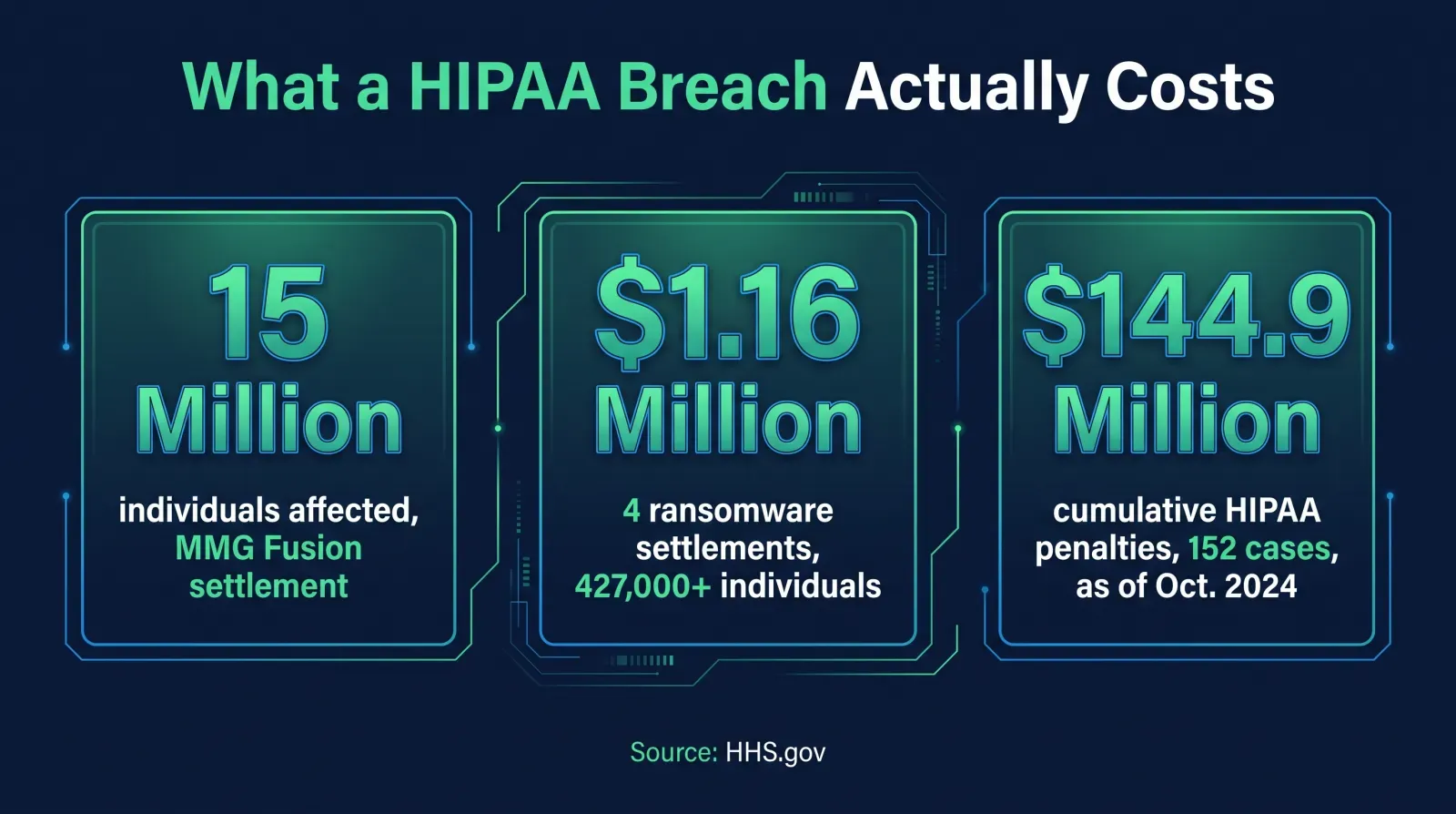
- HHS OCR settled with MMG Fusion for a breach that exposed data on roughly 15 million people, and with four healthcare entities over ransomware breaches affecting more than 427,000 people combined, in the same eight-week stretch in early 2026 (HHS press releases, March and April 2026).
- The HIPAA Safe Harbor method under 45 CFR 164.514(b)(2) lists 18 specific identifiers to strip before health information counts as de-identified — that list is the manual checklist this article walks through.
- Ambrose's PHI Rail is documented to alias identifiers into placeholders like PERSON_xxxx before any non-BAA destination sees them, then restore the real values in the response — the same de-identification habit, running automatically.
What actually counts as PHI in a chat window
Protected health information is health information plus something that identifies whose health information it is. HIPAA’s Privacy Rule defines it as individually identifiable health information transmitted or maintained by a covered entity — health status, treatment, or payment information tied to an identifier for a specific person (HHS, De-identification guidance). That combination is the whole test. “A 58-year-old with a recent diabetes diagnosis” isn’t PHI on its own, because nobody reading it can point to a specific person. “Maria Delgado, born 6/2/1968, diagnosed with diabetes last month” is PHI, because now it’s attached to someone you could identify and contact.
This matters for a chat window specifically because agents rarely think of a quick question as “handling PHI.” You’re not filling out a HIPAA authorization form or emailing a chart — you’re typing a fast question into a tool that answers in three seconds. But the legal definition doesn’t care about the interface. If the text you type includes a name, a birth date, a phone number, a Medicare Beneficiary Identifier, or a policy number, alongside anything about that person’s health, plan enrollment, or claims, you’ve created a PHI disclosure the moment you hit enter and the request leaves your device.
| What you type | Identifier present? | Health/plan detail present? | Is it PHI? |
|---|---|---|---|
| "My client Maria Delgado, DOB 6/2/1968, is on a Humana MA plan and was just diagnosed with diabetes — draft a follow-up email" | Yes — name, DOB | Yes — diagnosis, carrier | Yes |
| "A 57-year-old Medicare Advantage member with a recent diabetes diagnosis — draft a follow-up email" | No | Yes | No — de-identified |
| "Explain how the Part D deductible works for 2027" | No | No specific person | No — general plan information |
| "Client John R., policy #MA-40218, wants to know why his claim for [procedure] was denied" | Yes — partial name + policy number | Yes — claim, procedure | Yes — a policy number alone is an identifier |
Life insurance and ACA data aren't automatically exempt
HIPAA governs health information specifically, so a life insurance application without a medical exam result, or a pure income-and-household question for an ACA subsidy estimate, may not be PHI in the strict HIPAA sense. But a client's Social Security number, bank account, or income figures are still financial information covered by the Gramm-Leach-Bliley Act, which requires insurance agents and producers, as financial institutions under the FTC's Safeguards Rule, to protect customer information with administrative, technical, and physical safeguards (FTC, Gramm-Leach-Bliley Act guidance). The specific statute changes depending on what you're selling; the practical rule — don't paste identifiable client data into a tool with no data protection agreement — doesn't.
Why it happens: agents aren’t being careless, they’re being fast
Nobody sits down and decides to violate HIPAA. This happens because the exact moment an agent reaches for ChatGPT is the same moment they’re moving fastest: a client just asked a follow-up question mid-call, or an appeal letter needs to go out before end of day, and typing the real details in gets a usable answer in ten seconds. Stopping to strip out the name and birth date first feels like the kind of extra step that only matters in a training video, not in the actual rush of a Tuesday afternoon.
The data backs up how common this is. Cyberhaven’s 2026 AI Adoption & Risk Report, published February 11, 2026, found that 39.7% of all AI interactions — across prompt text, copy-paste actions, and file uploads — involve sensitive data, and that on average, employees put sensitive data into AI tools once every three days (Cyberhaven, 2026 AI Adoption & Risk Report). The same report found that 32.3% of ChatGPT usage happens through personal accounts rather than a managed business account (same source) — which matters because a personal ChatGPT account is even less likely to have any organizational data agreement behind it at all. This is the only current dataset of its kind this article could verify this session; if a second, independently produced measurement of the same behavior exists, this article hasn’t confirmed it — take the specific percentage as one credible measurement, not a settled industry-wide constant.
Nobody decides to violate HIPAA on a Tuesday afternoon. They decide to answer a client's question fast, and the PHI rides along without anyone noticing it left the building.
Mike MooreThere’s also a specific misconception doing a lot of damage here: agents assume that because ChatGPT feels private — it’s just you and a text box — it behaves like a phone call to a colleague. It doesn’t. Whatever you type is processed on OpenAI’s servers, and unless your specific account and plan carry a Business Associate Agreement, that transmission is a disclosure to a third party with no HIPAA-required safeguards contractually attached to it. OpenAI’s own account settings control things like chat history retention and whether your inputs train future models, but none of those settings substitute for a BAA — a BAA is a specific legal instrument, and account settings aren’t it.
What it actually costs when this goes wrong
The dollar figures on individual HIPAA violations vary case by case, but two recent HHS Office for Civil Rights settlements, both from early 2026, show the range and the pattern. On March 5, 2026, OCR announced a settlement with MMG Fusion, LLC over a breach — originating from unauthorized access to its systems in December 2020 — that exposed protected health information, including names, phone numbers, mailing addresses, email addresses, dates of birth, and appointment dates and times, for approximately 15 million individuals; MMG paid $10,000 and agreed to a corrective action plan OCR will monitor for three years, after OCR determined the company had failed to conduct a proper risk analysis and had not notified the covered entities affected by the incident (HHS, MMG Fusion settlement, March 5, 2026). Then on April 23, 2026, OCR announced settlements with four separate healthcare entities — Regional Women’s Health Group (Axia Women’s Health), Assured Imaging, Consociate Health, and Star Group’s health benefits plan — over ransomware breaches that together exposed names, addresses, birth dates, Social Security numbers, driver’s license numbers, diagnoses, lab results, medications, and health insurance details for more than 427,000 people; the four settlements totaled $1,165,000, and each entity agreed to a two-year corrective action plan (HHS, four ransomware settlements, April 23, 2026).
Read both of those side by side and the real cost isn’t just the settlement check. It’s the multi-year corrective action plan — a court-enforceable commitment to specific security changes that OCR checks on for two to three years, with your agency’s compliance program under a magnifying glass the entire time. HHS’s own enforcement highlights page shows OCR had settled or imposed a civil money penalty in 152 cases for a cumulative total of $144,878,972, as of October 31, 2024, the most recent cumulative figure HHS has published there (HHS, HIPAA Enforcement Highlights) — a figure that captures the scale of enforcement activity across the healthcare industry generally, not a per-incident number you should expect to pay, and one that’s already an undercount today since it predates both 2026 settlements described above. Still, it’s a clear signal that OCR investigates and resolves these cases routinely, not rarely.
None of the settlements above were about an agent pasting a client’s data into ChatGPT specifically — they involve larger organizations and different kinds of security failures. This article isn’t aware of a published OCR settlement, as of this session, that names a general-purpose AI chatbot as the disclosure point; that specific enforcement pattern is new enough that it may not exist in the public settlement record yet. What the pattern above does establish clearly is how OCR treats an unauthorized disclosure of identifiable health information once it happens, however it happens: risk analysis failures, missing notification, and a multi-year corrective action plan, regardless of whether the breach came from a hacker or from a well-meaning agent typing into the wrong box. A disclosure to a non-BAA AI vendor is legally the same category of event as any other unauthorized third-party disclosure.
The breach clock starts the day you find out, not the day it happened
Under HHS's Breach Notification Rule, a breach affecting 500 or more individuals has to be reported to HHS "without unreasonable delay" and no later than 60 calendar days from the date it's discovered; breaches affecting fewer than 500 people get reported annually, within 60 days after the end of the calendar year in which they were discovered (HHS, Breach Notification Rule). If you ever realize you've pasted a real client's PHI somewhere it shouldn't have gone, that clock is relevant immediately — talk to your agency's privacy or security officer the same day, not once you've decided how bad it might be.
The manual method: how to de-identify a question before you type it
None of this requires software. HIPAA already publishes the exact checklist for stripping identifiers out of health information — the Safe Harbor method, under 45 CFR 164.514(b)(2) — and you can run it in your head in about ten seconds once you’ve done it a few times.
Strip every direct identifier before anything else
Full name, address more specific than a state, exact dates (birth, admission, death — keep only the year if the year matters), phone and fax numbers, and email address. This is the first pass, and it catches most PHI on its own.
Strip every account or record number
Social Security number, medical record number, health plan beneficiary number (including the Medicare Beneficiary Identifier), any policy or account number, and any certificate or license number. A policy number by itself is enough to make text PHI, even with no name attached.
Strip device, vehicle, and biometric identifiers
Vehicle identifiers, device serial numbers, web URLs tied to the person, IP addresses, biometric identifiers, and full-face photos. These come up less often in a text prompt, but they're on the official list and worth knowing.
Rewrite the remaining question in general terms
Replace "my client" with a description that still carries what the AI needs to help: age range, plan type, general geography (state, not street), and the health or coverage question itself. "A 62-year-old on a Medicare Advantage HMO plan in Ohio" does the job "Robert Chen, born 4/2/1963" was doing, without being PHI.
Read it back before you hit enter
One pass, out loud if it helps: could a stranger reading only this sentence figure out who this is about? If yes, something's still in there. This is the actual gate — not a policy you signed once, a habit you run on every single prompt.
Confirm your tool's BAA status once, in writing, and keep it
Ask whoever manages your agency's software contracts whether a signed BAA exists with each AI vendor your team touches, including free tools individual agents installed on their own. If nobody can produce a signed BAA for a given tool, treat every account on it as a non-BAA destination, full stop.
Worked example: an actual appeal-letter prompt, before and after
Before: "Write an appeal letter for my client Diane Ostrowski, DOB 11/9/1957, member ID 7734921HC, whose claim for a knee replacement on 2/14/26 was denied by Aetna for medical necessity." After: "Write an appeal letter template for a Medicare Advantage member whose knee replacement claim was denied for medical necessity, to be filled in with the member's specific details afterward." The second version gets you a usable template in the same three seconds — you fill in Diane's real details yourself, in your own document, after the AI-generated part is done.
This is also where the Gramm-Leach-Bliley layer matters for anything touching money. If your prompt involves a client’s income for an ACA subsidy estimate, a bank account for a life insurance premium draft, or a Social Security number for any reason, run the same strip-and-generalize pass — “a household of three at roughly 250% of the federal poverty level” carries the math without carrying the identifiable financial detail.
Where the manual habit breaks down
The method above works every single time you remember to run it. The problem isn’t the method — it’s that it depends entirely on a busy agent catching themselves mid-sentence, every time, across every tool they touch: ChatGPT in one tab, a CRM’s AI feature in another, a voice-to-text app transcribing a call, a Slack bot summarizing a thread. Miss it once during AEP, when you’re moving through forty client conversations a day, and that one miss is a real disclosure — not a smaller version of one.
It also doesn’t scale to a team. You can train yourself to strip identifiers reliably; getting every producer, CSR, and part-time assistant on your team to do it the same way, every time, on every tool, is a much harder problem, and it’s exactly the kind of thing that quietly slips during your busiest season, not your slowest one.
Does this apply to Claude, Gemini, and your CRM’s AI too?
Yes, and the rule doesn’t get more complicated for a different tool — it just applies again, separately, to each one. ChatGPT gets named in this article because it’s the tool most agents reach for first, but the underlying question is identical for Anthropic’s Claude, Google’s Gemini, Perplexity, or any AI feature bolted onto a CRM, dialer, or voice-transcription app: does your agency have a signed BAA with this specific vendor, for this specific product tier, and does that agreement actually cover the way you’re using it. A consumer Gemini account tied to a personal Google login has the same lack of coverage as a personal ChatGPT account. An “AI assistant” feature inside your CRM is often a thin wrapper around one of these same underlying models, which means the CRM vendor’s own BAA status — not just your CRM contract in general — determines whether PHI can safely reach it.
Voice AI adds a wrinkle worth naming directly, since a growing number of agencies now run AI note-takers or call summarizers on client calls. A transcript of a call where a client describes their diagnosis, medications, or plan complaint is PHI the moment it’s captured, whether it’s text you typed or audio the tool transcribed. The same BAA question applies to the transcription vendor, and the same de-identification instinct applies if you ever export or paste that transcript somewhere else — a summary you paste from a call-recording tool into a separate AI tool for a “clean up this email” pass is a second disclosure, to a second vendor, that needs its own answer to the BAA question.
| Tool | Common agent use | Question to ask before pasting real client data |
|---|---|---|
| ChatGPT (Free/Plus/Team) | Draft emails, summarize plan rules | Signed BAA on this account? Default answer: no. |
| Claude or Gemini (consumer) | Research, drafting | Same question, same default answer unless confirmed otherwise. |
| CRM built-in AI assistant | Summarize a client record, draft a follow-up | Does the CRM vendor's BAA extend to its AI feature specifically, not just data storage? |
| Voice AI / call transcription | Auto-notes from a client call | Does the transcription vendor have a BAA, and where does the transcript go after the call? |
| Ambrose | Any of the above, inside one platform | PHI Rail applies automatically per destination — still worth understanding what it does. |
Writing a one-page policy that names your agency’s actual approved tools, in plain language, closes most of this gap on its own. It doesn’t need to be a legal document — a short list of “these tools have a BAA and are approved for client details, these tools don’t and are for general questions only” posted somewhere your team actually sees it does more than a compliance manual nobody reads. That written policy is also exactly what the NAIC’s AI Model Bulletin expects insurers and producers to have in place before AI touches a real client interaction — documented governance, not an assumption that everyone already knows the rule.
How Ambrose’s PHI Rail does this automatically
This is the specific gap Ambrose’s PHI Rail is built to close, and it’s worth naming exactly what it does rather than waving at “AI safety” in general. According to Ambrose’s own architecture documentation, the PHI Rail runs a redact-then-rehydrate pipeline on every request. On the way in, the system checks whether the destination — the specific model or endpoint the request is headed to — is on its BAA allowlist. If it is, the data passes through unchanged, the same way a covered destination should. If it isn’t, the PHI Gateway scrubs identifiers into typed aliases — the docs give the examples PERSON_xxxx and EMAIL_xxxx — before the text ever reaches the model, and it builds a hydration map that tracks which alias stands in for which real value. A guardrail system message tells the model never to invent identifiers of its own, closing off the failure mode where a model fills in a plausible-sounding but fabricated name (Ambrose docs, arch-phi-rail).
Detection isn’t a single regex pass. The documentation describes a cascading chain: a vault membership check first, then regex patterns, then Presidio named-entity recognition, then an insurance-specific dictionary, with the first confident match winning (same source). On the way out, after the model has responded using only the aliases, a function called phi_rehydrate uses the hydration map to splice the real identifiers back into the response before it’s returned to you — so what you see reads normally, even though the model itself never saw the real name. Every scrub event gets logged — timestamp, source, and identifier counts, explicitly never the actual values — and that log is queryable through phi_audit_query (same source), which is the audit trail a HIPAA security officer would ask for if this behavior ever came up in a compliance review.
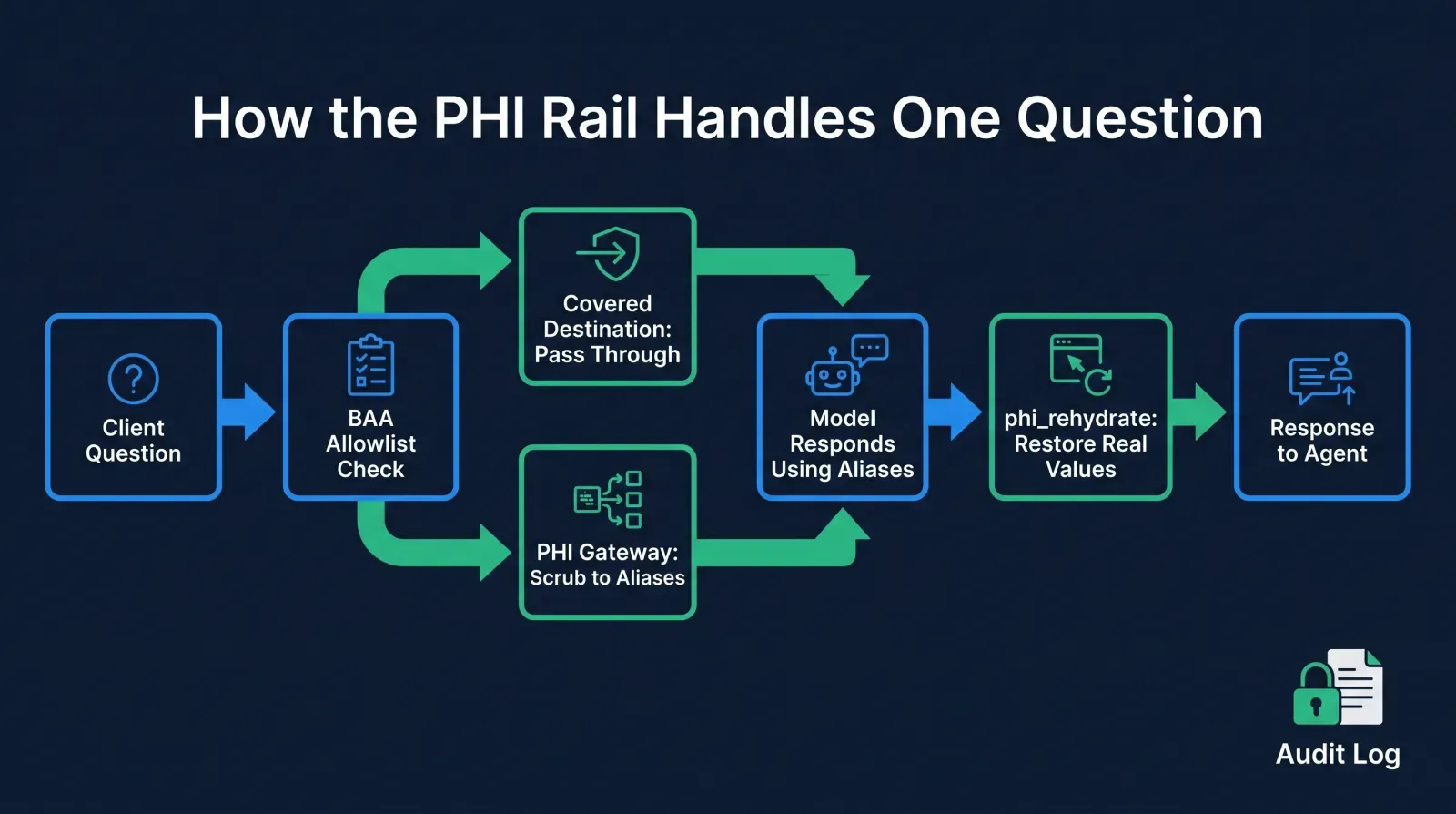
That’s the same discipline the manual method above teaches — strip identifiers before the question leaves your hands, keep a record of what happened, put the real values back only where they belong — running as infrastructure instead of a habit you have to remember under deadline. Ambrose’s tenant isolation adds a second layer on top: every read and write is scoped to the agency’s own tenant, documented in the platform’s architecture (Ambrose docs, Architecture), so one agency’s data doesn’t mix with another’s inside the same platform.
This doesn't make every question safe automatically
The PHI Rail is documented as a technical architecture, not a certification. Ambrose is described as HIPAA aware by default — not "HIPAA certified," because no software platform can be, and any vendor claiming otherwise is worth a second look. AI-generated outputs can still contain errors. Verify anything an AI tool produces, Ambrose included, before you send it to a client or act on it, the same way you'd double-check a junior team member's first draft.
What you get by joining
One Ambrose seat, including the PHI Rail described above, comes with a Tech Savvy Insurance membership: $97 a month, billed monthly, cancel anytime, founding rate locked in while the membership stays active. Alongside the seat: weekly Zoom calls with open Q&A and build-with-you sessions, 30+ hours of recorded training, Meta Ads and Google Ads training built for this industry specifically, pre-built AI templates and bot deployments, and a free annual in-person member workshop — plus an explicit no-recruiting rule, so asking a real compliance question doesn’t turn into a downline pitch.
The manual method above works whether you join or not
The de-identification checklist, the BAA question, the read-it-back-before-you-send habit — all of that is public information you can run today, on any tool, for free. Ambrose removes the part where you have to remember to do it correctly every single time; it doesn't gate the part where you learn what "correctly" means in the first place.
This is the kind of thing we work through on a Tuesday with Ambrose open on the screen — not a policy document you read once, but an actual walkthrough of what your team is currently pasting into what tools. If you’d rather run the manual checklist solo first and see where your own habits break down, that works too; everything above is genuinely enough to fix this on your own.
Compliance: what this touches, and what to check with your own program
Everything above describes the general HIPAA and GLBA framework, not a substitute for your agency’s specific compliance program. If any part of your book touches Medicare marketing specifically, remember that CMS’s Medicare Communications and Marketing Guidelines and the TPMO disclaimer requirements are separate obligations layered on top of everything in this article, and they apply regardless of which tool drafted the underlying copy. The NAIC’s Model Bulletin on the Use of Artificial Intelligence Systems by Insurers, adopted in December 2023 and adopted by a growing number of states since, sets the expectation that insurers and producers govern AI use with written policies, human oversight, and documentation, and that decisions or actions made or supported by AI still have to comply with all applicable insurance laws (NAIC, Insurance Topics: Artificial Intelligence). Confirm your own state’s current adoption status and your carrier’s specific AI-use policy directly — that detail moves, and this article isn’t the place to check it as of any one date.
The close
The rule here is short enough to actually remember under deadline: strip the identifier, keep the health or plan detail, read it back once before you send it. That’s free, it works on any AI tool you’ll ever use, and it’s the same habit whether you’re on ChatGPT, a CRM’s built-in assistant, or anything else that shows up on your desktop next year. If you’d rather have that discipline running automatically, with a security officer’s audit trail attached to every request, one Ambrose seat comes with a Tech Savvy membership, and it’s exactly the kind of setup the weekly build-with-you calls walk through: https://techsavvyinsurance.com/.
Before you rely on any figure in this article
Tech Savvy Insurance is a training and software community, not an insurance company, agency, or law firm, and does not provide insurance, legal, tax, or compliance advice. You are responsible for your own licensure and for complying with all applicable CMS, HIPAA, GLBA, state, and carrier regulations. Regulations, enforcement patterns, and vendor data-handling terms can change — confirm current requirements with your agency's compliance officer, your carrier, or qualified legal counsel before relying on any figure here. AI-generated outputs, including this article's, may contain errors — always verify. Results may vary.
Frequently asked questions
Sources
- Cyberhaven — 2026 AI Adoption & Risk Report (published Feb. 11, 2026) — cyberhaven.com
- HHS — Office for Civil Rights Settles HIPAA Investigation of MMG Fusion, LLC Breach Affecting 15 Million Individuals (March 5, 2026) — hhs.gov
- HHS — Office for Civil Rights Settles Four HIPAA Security Rule Ransomware Investigations (April 23, 2026) — hhs.gov
- HHS — HIPAA Enforcement Highlights (cumulative case and penalty totals) — hhs.gov
- HHS — Breach Notification Rule, Submitting Notice of a Breach to the Secretary — hhs.gov
- HHS — De-identification of Protected Health Information (Safe Harbor method, 45 CFR 164.514(b)(2)) — hhs.gov
- FTC — Gramm-Leach-Bliley Act, Safeguards Rule business guidance — ftc.gov
- NAIC — Insurance Topics: Artificial Intelligence (Model Bulletin) — content.naic.org
- Ambrose docs — arch-phi-rail — app.hiambrose.com
- Ambrose docs — What is Ambrose — app.hiambrose.com
- Ambrose docs — Architecture — app.hiambrose.com
Ready to put this into practice?
Join a private community of Health & Life insurance professionals using AI, Meta Ads, and automation to grow — without draining their bank account.
Join Tech Savvy — $97/month