
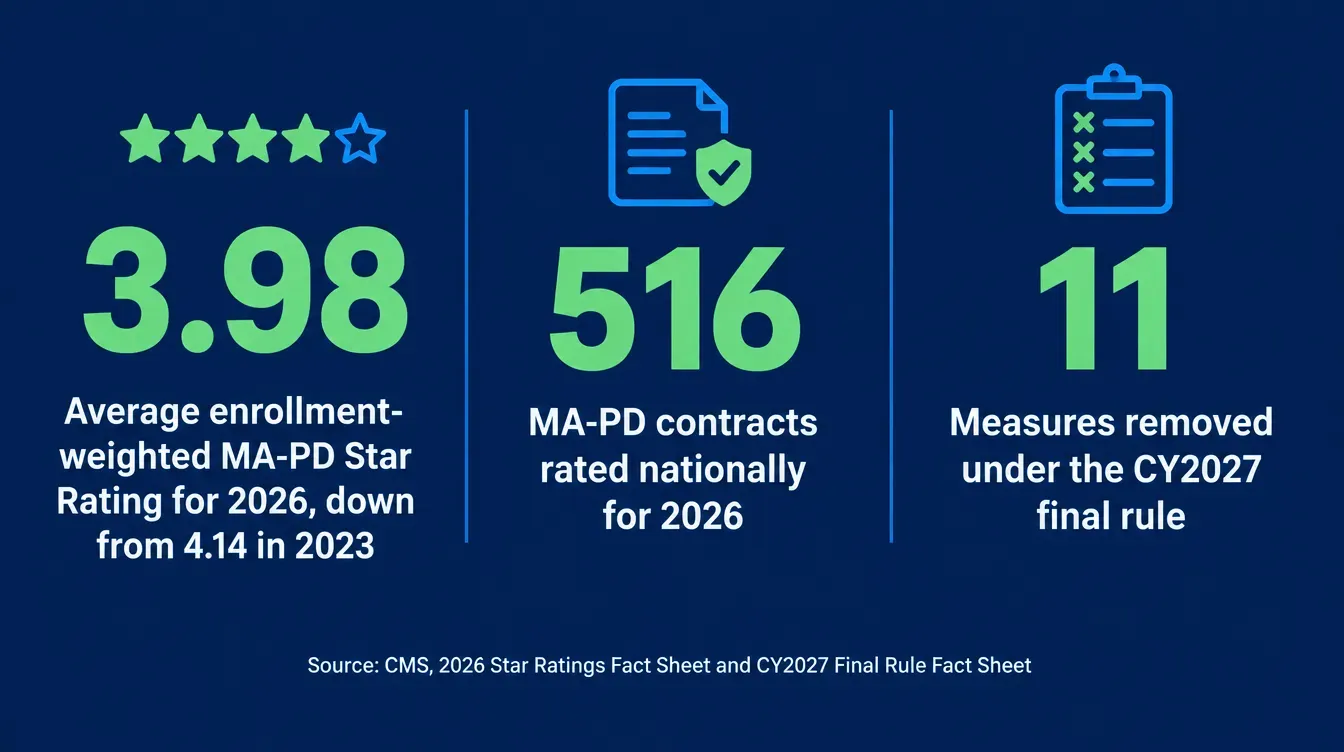
CMS’s own numbers answer the headline question directly: the enrollment-weighted average Medicare Advantage Star Rating fell from 4.14 in 2023 to 3.98 in 2026, and the measure set behind that number just changed again for 2027 (CMS, 2026 Medicare Advantage and Part D Star Ratings Fact Sheet, Nov. 18, 2025). If your agency’s blog, social posts, or client emails still cite last year’s rating, or a “top 5-star plans” list built without checking which contract actually earned which score, you’re not just stale — you may be publishing marketing content that doesn’t meet CMS’s own disclaimer rules. This article is the fix: the real data, the actual rule, and the manual method to get it right every time, plus where Ambrose’s medicare-watchdog spoke automates the check.
Key takeaways
- The enrollment-weighted average overall MA-PD Star Rating dropped from 4.14 (2023) to 4.07 (2024) to 3.95 (2025) before ticking up to 3.98 in 2026 — "ratings keep climbing" is not a claim you can make right now (CMS, 2026 Star Ratings Fact Sheet, Nov. 18, 2025).
- A Star Rating attaches to a contract (an H-number), not to each individually branded plan sold under it — 516 MA-PD contracts were rated for 2026, a different count than the number of shoppable plans (CMS, 2026 Star Ratings Fact Sheet, Nov. 18, 2025).
- CMS classifies content that addresses "measuring or ranking standards (for example, Star Ratings or plan comparisons)" as marketing, not simple communication, once paired with intent to draw attention to a plan — the same rule that governs a printed flyer governs a blog post (CMS, Medicare Communications and Marketing Guidelines, Feb. 9, 2022).
- The CY2027 final rule removes 11 administrative measures and adds a new Part C Depression Screening and Follow-Up measure, starting with the 2027 measurement year (CMS, CY2027 Final Rule Fact Sheet, Apr. 2, 2026).
- Ambrose's medicare-watchdog spoke is documented with a medicare_star_diff tool that compares Star Ratings year over year on federal data only, so a number gets checked against the current source before it's published (Ambrose docs, spoke-medicare-watchdog, fetched Sept. 2026).
This isn't the "what changed in the CY2027 rule" article
Our Medicare Advantage Star Ratings 2027 guide covers the full CY2027 final rule and what it costs your book from a commission and enrollment standpoint. This article is a narrower, different problem: how to write, publish, and keep updated any content — blog posts, comparison pages, social captions — that mentions Star Ratings at all, without it going stale or crossing into non-compliant marketing the moment CMS updates the numbers.
The pain: your “top-rated plans” post is already wrong
Walk through the actual failure mode. An agency publishes a blog post in November titled something like “Best Medicare Advantage Plans in [County] for 2026,” names three carriers, states each one’s star rating, and leaves the post live. Nobody revisits it. Twelve months later a prospective client — or worse, a CMS marketing reviewer, or a competitor’s compliance officer — pulls up that same post, checks the ratings against the current Medicare Plan Finder, and finds two of the three numbers no longer match. One plan’s rating moved. One of the carriers restructured which contract sells which plan in that county, so the H-number the rating actually belongs to isn’t the one implied by the post’s plan name.
This isn’t a hypothetical edge case. Between 2023 and 2026, the enrollment-weighted average overall Star Rating for MA-PD contracts moved from 4.14 to 4.07 to 3.95 and back up to 3.98 — a real, measurable swing every single year, not a rounding error (CMS, 2026 Star Ratings Fact Sheet, Nov. 18, 2025). A rating you published even one plan year ago is very likely no longer the current number. And a rating you copied from a carrier’s own marketing material, or generated by asking a general AI chatbot to “list the best Medicare Advantage plans in [county],” carries an even higher chance of being wrong, because a chatbot’s training data has a cutoff date and no live connection to what CMS published on Medicare Plan Finder this month.
The second, less obvious version of this pain point is a classification mistake, not a staleness mistake: writing about a “plan’s” Star Rating when the rating actually belongs to the contract behind several differently named plans. That distinction sounds pedantic until a prospect calls to ask why the “4.5-star plan” they read about on your site shows 3.5 stars on Medicare.gov — because your post named the wrong plan under the right (or wrong) contract.
Why this happens: the rating belongs to the contract, not the plan you’re thinking of
CMS doesn’t rate individual, consumer-facing plan names. It rates contracts — legal entities identified by an H-number, like H1290 or H5577 — and every plan benefit package (PBP) sold under that contract inherits the same overall rating (CMS, 2026 Star Ratings Fact Sheet, Nov. 18, 2025). A single carrier can sell an HMO, a PPO, and a special-needs plan variant under one contract in the same county, all carrying the exact same Star Rating, while a different contract from the same parent company, covering a different set of counties, carries a completely different score. CMS rated 516 MA-PD contracts nationally for 2026 — a number that has nothing to do with how many individually branded, marketed plans a beneficiary can actually browse on Medicare Plan Finder, which runs into the thousands (CMS, 2026 Star Ratings Fact Sheet, Nov. 18, 2025). Get the contract wrong, and you’ve attributed one product’s rating to a completely different one.
Layer onto that the fact that the measure set itself changes almost every year. For 2026, CMS cut the weight of patient experience and complaints measures from 4 to 2, added a brand-new Kidney Health Evaluation for Patients with Diabetes measure, and brought back two previously retired measures — Improving or Maintaining Physical Health and Improving or Maintaining Mental Health — at a weight of 1 for 2026, stepping up to a weight of 3 starting with 2027 (CMS, 2026 Star Ratings Fact Sheet, Nov. 18, 2025). A rating calculated under last year’s weighting scheme is not directly comparable to this year’s, even for the exact same contract, because the underlying formula moved. Writing “this plan’s rating went up two years running” without checking whether the measure set stayed constant across those years is a claim you often can’t actually support.
What it actually costs to get this wrong
The direct cost is reputational, and it hits exactly the trust a Star Ratings post is supposed to build. A prospect who checks your published number against Medicare Plan Finder and finds it wrong doesn’t conclude the number changed — they conclude your content can’t be trusted, and that conclusion extends to everything else on the page, including the parts that were accurate. Twenty-one contracts earned the High Performing Icon for 2026 — 18 MA-PD, one Section 1876 Cost contract, and two PDPs — and five of those twenty-one also earned it in 2025 (CMS, 2026 Star Ratings Fact Sheet, Nov. 18, 2025). Sixteen of this year’s high performers did not carry the distinction last year. A “perennially 5-star” claim about a plan that only just earned the distinction this cycle is the kind of error a careful reader, or a competitor, catches immediately.
There’s a quieter version of this same mistake in “consistently top-rated” claims. CMS also tracks contracts with a Low Performing Icon for consistently low-quality ratings — four MA-PD contracts carried that icon for 2026, down from six the year before (CMS, 2026 Star Ratings Fact Sheet, Nov. 18, 2025). A carrier’s own marketing rarely mentions when one of its contracts sits on that list, and content that repeats a carrier’s “award-winning” framing without independently checking both the High Performing and Low Performing Icon lists is repeating a curated half-truth instead of reporting the actual record. CMS’s data even breaks performance down by tax status: about 50% of non-profit MA-PD contracts earned four stars or higher for 2026, compared with 36% of for-profit contracts, and the pattern holds for standalone Part D plans too, at 28% versus 14% (CMS, 2026 Star Ratings Fact Sheet, Nov. 18, 2025). That’s a real, sourced, and genuinely useful data point for content comparing plan types or carriers honestly — far more defensible than an unsourced “our plans are top-rated” line.
The second cost is regulatory. CMS classifies content addressing “measuring or ranking standards (for example, Star Ratings or plan comparisons)” as marketing content — not neutral communication — the moment it’s paired with intent to draw a beneficiary’s attention to a plan or influence an enrollment decision (CMS, Medicare Communications and Marketing Guidelines, Feb. 9, 2022). Marketing materials that reference Star Ratings must carry the model disclaimer required at 42 CFR §§ 422.2267(e)(31) and 423.2267(e)(33), conveying that “every year, Medicare evaluates plans based on a 5-star rating system.” A blog post built to draw attention to a specific carrier’s plan and its rating, published without that disclaimer, is missing a requirement CMS spells out explicitly for exactly this kind of content.
Your published Star Rating is checkable against Medicare Plan Finder in ten seconds. Make sure it survives the check.
Mike MooreThe full manual method: how to write Star Ratings content that holds up
None of this requires software you have to buy. Here is the complete process, using only CMS’s own public files.
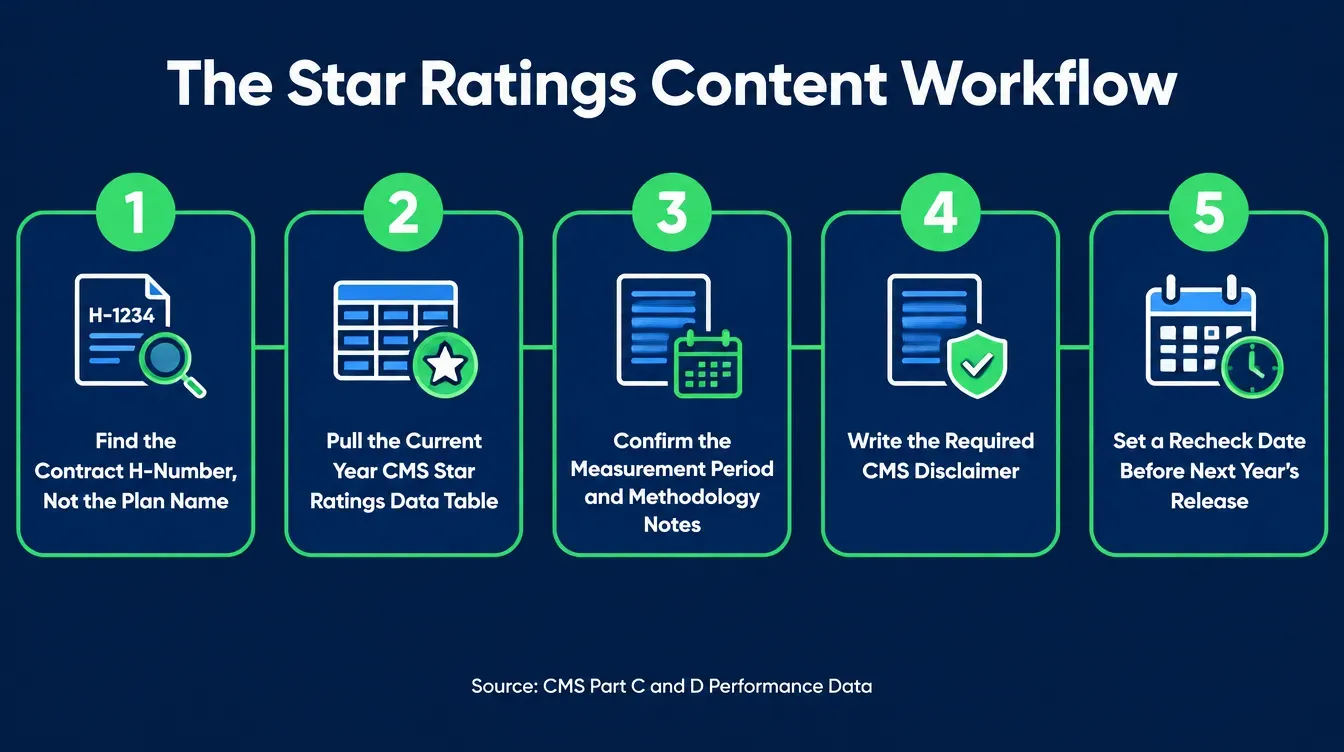
Step 1: Identify the contract, not just the plan’s marketing name
Before you write a single sentence, find the actual contract ID (the H-number, or S-number for standalone PDPs) behind the plan you’re discussing. Carriers frequently sell several differently branded plans off one contract, and the Star Rating you’re about to cite belongs to that contract — every plan under it shares the same score. Cross-check the plan’s own Summary of Benefits or Evidence of Coverage, which lists the contract number, or search Medicare Plan Finder directly by the plan’s name to confirm the H-number it resolves to.
Step 2: Pull the current year’s official CMS data table
Go to CMS’s Part C and D Performance Data page and download the current contract year’s Star Ratings data table and technical notes (CMS, Part C and D Performance Data). The page maintains archives back to 2007, so you can also pull prior-year files if you’re writing a year-over-year comparison — just confirm you’re comparing ratings calculated under the same measure set, since a jump from one year to the next can reflect a methodology change rather than a real performance shift.
Step 3: Confirm the measurement period and any methodology notes
Read the fact sheet’s methodology section for the year you’re citing. For 2026, that means knowing the patient experience and complaints weight dropped from 4 to 2, a new Kidney Health Evaluation for Patients with Diabetes measure was added, and two previously retired measures returned at a temporary lower weight (CMS, 2026 Star Ratings Fact Sheet, Nov. 18, 2025). State the plan year and measurement period explicitly in your content — “based on the 2026 Star Ratings, reflecting measurement periods largely in 2024” is a defensible sentence; “this plan is rated 4.5 stars” with no year attached is not.
| Year | Average overall rating | Total rated contracts |
|---|---|---|
| 2023 | 4.14 | 507 |
| 2024 | 4.07 | 545 |
| 2025 | 3.95 | 521 |
| 2026 | 3.98 | 516 |
Source: CMS, 2026 Medicare Advantage and Part D Star Ratings Fact Sheet, Nov. 18, 2025, Table 1.
Step 4: Write the required CMS disclaimer
If your content addresses ranking or comparison — which most Star Ratings content by definition does — include the model disclaimer content required at 42 CFR §§ 422.2267(e)(31) and 423.2267(e)(33): a statement conveying that every year, Medicare evaluates plans based on a 5-star rating system (CMS, Medicare Communications and Marketing Guidelines, Feb. 9, 2022). The guidelines allow this content in disclaimer form or worked into the body copy itself, so it doesn’t have to look like a legal footer — it just has to convey the required substance somewhere a reader will see it.
| Check | Why it matters |
|---|---|
| Contract ID confirmed, not just plan name | Multiple branded plans can share one rating; naming the wrong contract misattributes the score |
| Rating year and measurement period stated | A rating without a stated year is unfalsifiable and quickly wrong |
| Methodology change noted, if comparing years | A year-over-year "improvement" claim can reflect a measure-set change, not real performance |
| CMS Star Ratings disclaimer included | Required by 42 CFR §§ 422.2267(e)(31), 423.2267(e)(33) whenever ratings appear in marketing |
| Recheck date set before next year's release | CMS updates ratings annually on Plan Finder; content left unrevised goes stale on a predictable schedule |
A worked, illustrative disclaimer
This is a hypothetical example of how the model content can read in a blog post — not legal advice, and not a substitute for confirming your own carrier's and state's current requirements.
"Every year, Medicare evaluates plans based on a 5-star rating system. The rating below reflects [Contract H1234]'s 2026 overall Star Rating, published by CMS on Medicare Plan Finder on October 9, 2025, and covers performance measured largely during 2024. Star Ratings can change from one year to the next, and this page will be updated after CMS releases the following year's ratings."
Step 5: Set a recheck date, not a “set it and forget it” post
CMS’s 2026 ratings published on Medicare Plan Finder on October 9, 2025 (CMS, 2026 Star Ratings Fact Sheet, Nov. 18, 2025). Ratings update on an annual cycle, so put a calendar reminder on any Star Ratings content to revisit it within a few weeks of the next release — typically early October — rather than treating a published post as a finished, permanent asset.
Find the contract
The H-number behind the plan, not the branded marketing name.
Pull the current CMS file
Part C and D Performance Data page — the source, not a secondhand summary.
Confirm the methodology
Note any measure or weighting change before comparing across years.
Write the disclaimer
Required whenever content addresses ranking or comparison.
Set a recheck date
Ratings refresh annually — plan the revisit before you publish.
Everything above works whether you join anything or not. Run it on the next Star Ratings post you write — or let Ambrose run the year-over-year check for you.
What actually changed for 2027, and why it matters for content written now
CMS’s Contract Year 2027 Medicare Advantage and Part D final rule removes 11 measures focused on administrative processes from the Star Ratings calculation and adds a new Part C Depression Screening and Follow-Up measure, tracking the percentage of members screened for clinical depression using a standardized instrument and, if screened positive, given follow-up care within 30 days — starting with the 2027 measurement year and reflected in the 2029 Star Ratings (CMS, CY2027 Final Rule Fact Sheet, Apr. 2, 2026). That’s a multi-year runway before the new measure shows up in a published rating, which means content written today about “what’s coming” in Star Ratings needs to be explicit about which contract year and which measurement year a claim actually applies to — conflating the rule’s effective date with the year a resulting rating will publish is an easy, avoidable error.
This builds on the 2026 changes already noted above: the patient experience and complaints weight cut from 4 to 2, the new Kidney Health Evaluation for Patients with Diabetes measure, and the two returning measures at a stepped weight (CMS, 2026 Star Ratings Fact Sheet, Nov. 18, 2025). Two consecutive years of real methodology changes make “this plan has consistently improved” a much harder claim to actually support with data — consistency claims require the underlying yardstick to have stayed the same, and for 2026 and 2027 it hasn’t.
For content specifically, this means a “how Star Ratings work” explainer written and published today should say plainly that the measure set is not static: readers researching a plan for the 2027 plan year are looking at ratings still calculated under the 2026 methodology (the 2027 Star Ratings, reflecting the new measure changes, don’t publish until roughly October 2026 for the 2027 plan year, following CMS’s usual annual release pattern), while the depression screening measure’s actual effect on ratings won’t show up until 2029. Collapsing “the rule changed” and “the rating changed” into the same sentence is a fast way to publish something that’s technically inaccurate even though every individual fact in it is true.
How Ambrose’s medicare-watchdog spoke checks this before you publish
Ambrose OS, the platform included with a Tech Savvy membership, documents a spoke called medicare-watchdog specifically for this kind of ongoing federal-data monitoring. Per Ambrose’s own documentation, it’s built for “Scheduled MAPD / PDP / Med Supp intelligence — cost hikes, plan discontinuations, network changes, Star Ratings, rate filings,” running on federal data only, with no client identifiers crossing the wire (Ambrose docs, spoke-medicare-watchdog, fetched September 2026). The spoke ships four documented tools: medicare_scan_book (identifies risk signals across a book of business), medicare_check_plan (retrieves current plan status and cost information), medicare_star_diff (compares Star Ratings year over year), and medicare_rate_filing (accesses the latest rate filing data).
That medicare_star_diff tool is the direct answer to the staleness problem this article opened with: instead of trusting a screenshot from last October, or a number copied from a carrier’s own marketing page, you get a year-over-year comparison pulled from the current federal source at the moment you’re writing, not the moment you last checked. It runs on top of the same underlying data layer Ambrose’s documentation calls the Brain, described as fronting more than 25 federal and healthcare data sources including CMS (Ambrose docs, Glossary and Architecture, both fetched September 2026).
Manual recheck, once a year if you remember
- Download the current year's CMS data table and technical notes yourself
- Cross-reference the plan's contract ID against last year's file
- Read the fact sheet's methodology notes to catch measure changes
- No standing reminder unless you build one into your own calendar
- Every published post needs its own manual revisit
1 recheckper post, per year, if scheduled
medicare-watchdog's medicare_star_diff, on demand or scheduled
- Federal Star Ratings data compared year over year in one query
- Federal data only — no client identifiers cross the wire
- Same tool also flags cost hikes, discontinuations, and network changes
- Can run as a scheduled routine ahead of each year's Plan Finder release
- Still requires you to write the required disclaimer and confirm the contract
1 spokecovering ratings, rates, and network status together
If the real job is re-shopping an entire book against a new plan year rather than checking one contract for one blog post, that’s the broader use case our Medicare book re-shop guide covers using the same spoke. And if the content problem is really about anchoring any blog post to real, current federal data rather than generic AI output, our local ACA content guide walks through the same principle for marketplace plan data.
Ambrose’s medicare-watchdog spoke already runs this exact year-over-year check — one seat comes with the Tech Savvy membership, and that’s the fastest way to stop trusting last October’s screenshot.
Compliance: writing about Star Ratings is writing marketing content
Treat any post, page, or social caption that names a specific plan’s Star Rating as marketing content from the start, not communications you can draft casually. CMS’s own definitions make this explicit: content addressing “measuring or ranking standards (for example, Star Ratings or plan comparisons)” meets the content half of the marketing test, and combined with intent to draw a beneficiary’s attention to a plan, it’s marketing — subject to the same disclaimer, submission, and accuracy standards CMS applies to a printed flyer or a paid ad (CMS, Medicare Communications and Marketing Guidelines, Feb. 9, 2022). If you’re operating as a Third-Party Marketing Organization, the standard TPMO disclaimer obligation and CMS’s marketing rules apply on top of the Star Ratings-specific disclaimer covered above — confirm your own carrier’s and state’s current requirements before publishing.
If AI helped draft any part of the content — outlining the post, summarizing a technical notes PDF, or generating a first pass at the comparison table — the NAIC’s Model Bulletin on the Use of Artificial Intelligence Systems by Insurers, adopted December 2023, sets the expectation of a written governance program, human review before publication, and documentation available if a regulator asks (NAIC, Artificial Intelligence Model Bulletin & AI Principles). The tool that drafted a paragraph doesn’t change who’s accountable for whether the number in it is right.
Never paste a real client's plan or health details into a general AI tool to "check" a rating question
Confirming a public Star Rating for a piece of content is fine in any tool — the data is public. The moment the question becomes about a specific named client's specific plan and health situation, that's a different category of information. A platform documented as HIPAA-aware by default, with the PHI Rail aliasing identifiers before any non-BAA destination sees them, is a materially different destination than a consumer chatbot with no such controls.
What you get by joining
One Ambrose seat comes with a Tech Savvy Insurance membership: $97 a month, billed monthly, cancel anytime, founding rate locked in while the membership stays continuously active. Alongside the seat: weekly Zoom calls with open Q&A and build-with-you sessions, 30-plus hours of recorded training, Meta Ads and marketing training built for this industry, pre-built AI templates and bot deployments, and a free annual in-person member workshop — plus an explicit no-recruiting rule, so a question about a Star Ratings disclaimer doesn’t turn into someone else’s downline pitch.
Ambrose usage is separate from the $97 seat
The membership includes one Ambrose seat; usage inside Ambrose runs through its own credit ledger with spend caps, so cost stays visible instead of showing up as a surprise. See the full Spokes catalog for what else is available beyond medicare-watchdog.
Check your next Star Ratings claim against the real data
The contract-versus-plan distinction, the required disclaimer, and the five-step method above work whether you join anything or not. If you'd rather have medicare-watchdog run the year-over-year check automatically, one seat comes with the Tech Savvy membership.
Join Tech Savvy — $97/monthThe close
Everything above, the contract-ID check, the disclaimer requirement, and the five-step content method, works whether you ever join anything or not. That’s the point of writing it out in full. This is exactly the kind of question we work through on a Tuesday with Ambrose open on the screen: a real plan, a real county, checking what the current Star Ratings data actually says before it goes on the blog. $97 a month, cancel anytime, and nobody will pitch you a downline: https://techsavvyinsurance.com/.
Before you publish a Star Ratings claim
Tech Savvy Insurance is a training and software community, not an insurance company, agency, or law firm, and does not provide insurance, legal, tax, or compliance advice. You are responsible for your own licensure and for complying with all applicable CMS, HIPAA, state, and carrier regulations, including marketing submission, disclosure, and documentation requirements for any content that references a plan's Star Rating. AI-generated outputs may contain errors — always verify any rating against CMS's current, official data before publishing. Results may vary.
Frequently asked questions
Sources
- CMS — 2026 Medicare Advantage and Part D Star Ratings Fact Sheet (Nov. 18, 2025) — cms.gov
- CMS — Contract Year 2027 Medicare Advantage and Part D Final Rule Fact Sheet (Apr. 2, 2026) — cms.gov
- CMS — Medicare Communications and Marketing Guidelines (Feb. 9, 2022) — cms.gov
- CMS — Part C and D Performance Data — cms.gov
- NAIC — Artificial Intelligence (Model Bulletin & AI Principles) — content.naic.org
- Ambrose docs — Glossary (the Brain) — app.hiambrose.com
- Ambrose docs — Architecture — app.hiambrose.com
- Ambrose docs — Spokes catalog — app.hiambrose.com
- Ambrose docs — spoke-medicare-watchdog — app.hiambrose.com
- Ambrose docs — What Is Ambrose — app.hiambrose.com
Ready to put this into practice?
Join a private community of Health & Life insurance professionals using AI, Meta Ads, and automation to grow — without draining their bank account.
Join Tech Savvy — $97/month