
CMS’s Contract Year 2027 Medicare Advantage and Part D final rule, published April 2, 2026, removed 11 Star Ratings measures it judged too focused on administrative process to help a beneficiary tell one plan from another, kept the existing reward factor instead of adopting a new health-equity-weighted one, and — in a separate but related document four days later — raised its own baseline 2027 payment growth estimate from 0.09% to 2.48% between January and April. None of that changes the rating your client’s plan shows this AEP. All of it changes what that rating is worth by 2029, and reading it secondhand off three different FMO blog posts is exactly how you end up quoting a client the wrong number.
Key takeaways
- CMS's final rule (April 2, 2026) removed 11 Star Ratings measures, starting with the 2027 measurement year and first appearing in the 2029 Star Ratings — not this AEP's ratings.
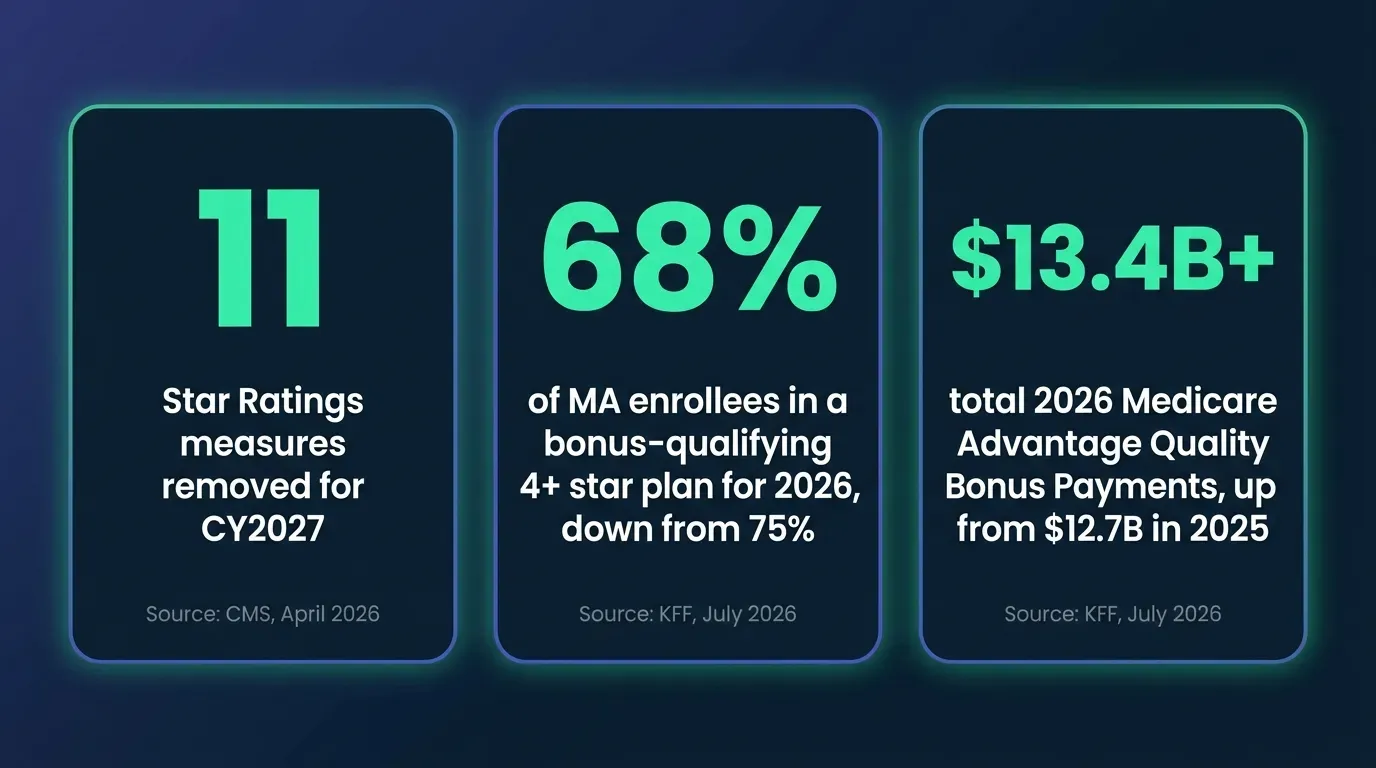
- Between the January 26, 2026 advance notice and the April 6, 2026 rate announcement, CMS's own baseline 2027 MA payment growth estimate moved from 0.09% (about $700 million) to 2.48% (over $13 billion) in ten weeks.
- The share of MA enrollees in a 4-star-or-better, bonus-qualifying plan fell to 68% for 2026, down from 75% in 2025, even as total Quality Bonus Payment spending rose to at least $13.4 billion (KFF, July 2026).
- CY2027 maximum agent/broker compensation rises to $725 initial / $363 renewal for Medicare Advantage and $130 initial / $65 renewal for Part D, per CMS's June 1, 2026 memo.
- Ambrose's Brain is documented as fronting more than 25 federal and healthcare data sources, including CMS, so you can ask a plain-English question and get an answer pointed at the actual federal document instead of a blog's paraphrase of it.
The pain: three blog posts, three different numbers
Here’s what actually happened while researching this article. A search for “how many Star Ratings measures did CMS cut for 2027” turned up one industry blog reporting 10, another reporting 11, and a wire-service headline implying the whole system got gutted. None of them were lying, exactly. They were each describing a different document, or rounding a number CMS itself changed between draft and final, and none of them told you which.
That’s the actual pain point, and it’s a specific one: you’re the person who has to say something accurate to a client or in a piece of content, and your source is a stack of FMO marketing emails that all summarized the same 100-plus-page rule in the fifteen minutes before their competitor’s newsletter went out. If you quote the wrong measure count, or tell a client their rating changed for a reason that’s actually two years out, you’re the one who sounds unreliable, not the blog you read it on.
This article covers the CY2027 methodology and payment rules, not your clients' current 2026 ratings
If you need the manual process for checking which of your current clients' plans changed rating or got discontinued for the plan year already in front of you, see our guide to re-shopping your Medicare book before AEP. This piece is about the rule CMS just finalized for the year after that, and what it means for how you read CMS's own documents going forward.
What actually changed, in two sentences
CMS’s Contract Year 2027 Medicare Advantage and Part D final rule finalized the removal of 11 Star Ratings measures, framed as measures focused on administrative processes where plans perform too similarly for the score to tell a beneficiary anything useful, effective with the 2027 measurement year and first visible in the 2029 Star Ratings (CMS, Contract Year 2027 Medicare Advantage and Part D Final Rule Fact Sheet, April 2, 2026). Under the current measure set, Medicare Advantage Prescription Drug (MA-PD) contracts are rated on up to 43 measures, MA-only contracts on up to 33, and standalone Part D plans on up to 12 — cutting 11 measures is a real reduction in the total scoring surface, not a rounding change.
CMS also declined to implement a new reward, previously called the Health Equity Index and re-proposed as the “Excellent Health Outcomes for All” reward, and instead kept the existing reward factor, which rewards contracts for consistently high performance across all enrollees on all measures, unchanged for 2027 (same source). That’s a second real decision, separate from the measure cuts, and it matters because it means the mechanism CMS uses to reward consistency didn’t get rebuilt around equity-weighted outcomes the way an earlier proposal floated.
| Contract type | Measures rated (up to) | What changed for CY2027 |
|---|---|---|
| MA-PD contracts | 43 | Loses several of the 11 removed measures that apply to both MA and Part D |
| MA-only contracts | 33 | Loses the six MA-specific measures removed |
| Standalone Part D plans | 12 | Loses the one Part D-specific measure removed |
Source: CMS, Contract Year 2027 Medicare Advantage and Part D Final Rule Fact Sheet, April 2, 2026.
Why the story got confusing before it reached you
This isn’t one document. It’s at least four, published across seven months by the same agency, each covering a different slice of the same contract year, and each with its own headline number that trade press tends to lift without noting which document it came from.
| Date | Document | Headline number it actually contains |
|---|---|---|
| Nov. 25, 2025 | CY2027 proposed rule | Proposed removing 12 Star Ratings measures; proposed adding a Part C Depression Screening and Follow-Up measure |
| Jan. 26, 2026 | CY2027 advance notice | Proposed baseline payment growth of 0.09% (about $700 million); 2.54% once estimated risk-score coding trend is included |
| Apr. 2, 2026 | CY2027 final rule | Finalized removal of 11 Star Ratings measures (one fewer than proposed); reward factor kept unchanged |
| Apr. 6, 2026 | CY2027 rate announcement (final) | Finalized baseline payment growth of 2.48% (over $13 billion); 4.98% once coding trend is included; effective growth rate 5.33% |
| Jun. 1, 2026 | CY2027 agent/broker compensation memo | National MA compensation: $725 initial / $363 renewal. Part D: $130 initial / $65 renewal |
Sources: CMS fact sheets and memo, dated as shown above; see full citation list at the end of this article.
Two things fall out of that table that explain most of the confusion you’ve probably run into.
First, the measure count moved between documents, on purpose, through the normal comment process. CMS’s proposed rule, published November 25, 2025, proposed cutting 12 measures. At least one commenter successfully argued to keep one of them — trade coverage attributes this to the diabetes eye-exam measure, though CMS’s own fact sheet doesn’t name the surviving measure — and the final rule cut 11. A source written off the proposed rule says 12. A source written off the final rule says 11. A source that split the 11 into six MA-only, one Part D-only, and three shared measures, then reported only one of those subtotals, produced the “10” you may have also seen. All three numbers are technically defensible depending on which document and which subset you’re reading. Only one of them, 11, is the actual final number.
Second, and more consequential for your AEP math, CMS’s own baseline payment-growth estimate for the same contract year moved from 0.09% in the January 26, 2026 advance notice to 2.48% in the April 6, 2026 final rate announcement — a swing of more than $12 billion in CMS’s own numbers, in ten weeks, on the same underlying rate calculation, before either figure accounts for the separate effect of coding-pattern trend. That’s not a media distortion. That’s what happened inside two CMS fact sheets you can read yourself.
What it costs: the money behind the stars
The reason a methodology change is worth your attention, and not just a policy-wonk curiosity, is that Star Ratings drive real payments to the plans your clients are enrolled in, and those payments are visibly shifting.
Medicare Advantage plans that earn 4 stars or higher get a Quality Bonus Payment: an additional 5 percentage points added to their county benchmark in most counties, or 10 percentage points in “double bonus” counties with historically high MA enrollment and low fee-for-service costs. Plans that are new to the market or have low enrollment get a smaller, 3.5-percentage-point boost regardless of rating (KFF, Medicare Advantage Quality Bonus Payments, July 1, 2026).
Sit those two KFF numbers next to each other and you get the actual story: fewer plans are qualifying for the bonus, and the total dollars flowing through the bonus program are still going up. That combination is exactly how a carrier ends up trimming the dental allowance or the OTC card in one county while the industry-wide bonus pool grows — the money isn’t spread evenly across every plan the way it might look from a single “MA spending is up” headline.
Share of MA enrollees in a bonus-qualifying (4+ star) plan, 2025 vs. 2026
Percentage of Medicare Advantage enrollees in a plan rated 4 stars or higher.
Source: KFF, Medicare Advantage Quality Bonus Payments, July 1, 2026.
The bonus pool didn't shrink. The share of plans standing inside it did. Those are two different numbers, and a client's benefits can be affected by either one without a headline about "record MA spending" telling you anything about which.
Mike MooreThe applicable percentage matters here too, and it’s more granular than a flat “you get the bonus or you don’t.” A plan’s actual bonus payment per enrollee equals the gap between its bonus-adjusted benchmark and what the benchmark would be with no bonus, multiplied by a percentage tied to the star tier — KFF cites 65% for 4-star plans and 70% for plans at 4.5 stars or higher as the applicable percentages used in the 2025 calculation (same source). A plan sitting right at 4.0 versus one at 4.5 isn’t just “both bonus-qualifying” — the dollar difference between those two tiers is real and it’s built into the formula, not a rounding artifact.
A worked example: what the compensation change means for a renewal book
The Star Ratings and bonus-payment mechanics move money at the carrier level. The compensation memo moves money directly into your business, and the math is simple enough to run against your own book right now.
| Compensation type | CY2026 | CY2027 | Change |
|---|---|---|---|
| MA initial enrollment | $694 | $725 | +$31 (+4.5%) |
| MA renewal | $347 | $363 | +$16 (+4.6%) |
| Part D (PDP) initial enrollment | $114 | $130 | +$16 (+14.0%) |
| Part D (PDP) renewal | $57 | $65 | +$8 (+14.0%) |
Sources: CMS memo, June 1, 2026 (CY2027) and CMS memo, June 18, 2025 (CY2026). Figures are maximum fair market value amounts, not guaranteed payouts — what you're actually paid depends on your specific upline agreement.
Run that against an illustrative solo book: 200 active Medicare Advantage clients in their renewal years. At the CY2026 renewal rate of $347, that book’s maximum renewal compensation pool is $69,400. At the CY2027 rate of $363, the same 200-client book’s maximum pool is $72,600 — a $3,200 increase from the rate change alone, before any new business, and before accounting for the fact that your actual contracted renewal rate with your upline is very likely below the CMS maximum.
Illustrative math, not a promise about your contract
These are CMS's maximum allowable fair-market-value figures, not what any specific FMO or carrier actually pays you. Your real renewal rate could be meaningfully below the CMS ceiling. Run the CY2027 number against your own contracted rate, not the national maximum, before you budget against it. Results may vary.
How to read the primary documents yourself
This is the part we’re not holding back. If you want to verify any CMS regulatory claim yourself, including the ones in this article, here’s the actual process, with no tool required beyond a browser and the patience to open a PDF.
Start at CMS Newsroom, not a blog
Go to cms.gov/newsroom/fact-sheets and search the contract year in question. Fact sheets are shorter than the full Federal Register rule and usually state the headline figures in the first two paragraphs.
Note the exact publication date
CMS publishes a proposed rule, an advance notice, a final rule, and a final rate announcement for the same contract year, months apart. Write down which document you're reading before you quote a number from it — the same topic gets different figures at each stage.
Check whether a figure is "proposed" or "final"
A proposed rule is a draft that changes through the comment process, as the Star Ratings measure count did between November and April. Never cite a proposed figure as if it's the outcome — say "proposed" explicitly, or wait for the final document.
Cross-reference the technical notes for methodology detail
Fact sheets summarize. The Star Ratings Technical Notes, published alongside the annual fact sheet, list the actual measures, weights, and cut points if you need the underlying detail rather than the headline.
Read the agent/broker compensation memo directly for pay rates
Search "CMS agent broker compensation [contract year] memo." It's a two-to-four-page PDF with a table of national and regional rates — no need to trust a secondhand recap for numbers this simple to verify.
When two sources disagree, the newest primary document wins
If a November proposed-rule figure and an April final-rule figure conflict, the final rule is the actual outcome. Don't average them or split the difference — one of them describes what didn't happen.
This method is genuinely slower than reading a summary — that's the trade-off
Reading four CMS fact sheets end to end, across a seven-month window, takes real time you don't have during a normal week of selling. That's not a reason to skip it when a number matters. It's the reason a scan that reads the primary sources for you and shows its work, rather than handing you an unsourced summary, is worth having.
How Ambrose’s Brain gets this right without the game of telephone
Ambrose OS, the platform included with a Tech Savvy membership, ships an internal service the documentation calls the Brain: “an internal service that fronts 25+ federal/healthcare data MCPs (CMS, NADAC, FDA, Federal Register, FEMA, …),” confirmed directly in Ambrose’s Glossary and System Architecture pages this session (Ambrose docs, Glossary; Ambrose docs, System architecture). That count is documented as “25+,” not a fixed number, and it’s grown before — treat it as accurate as of August 2026 and expect the catalog to be larger by the time you’re reading this, so check the current docs rather than assuming this article’s figure still holds.
What that means in practice: instead of Googling a policy question and reading whichever FMO blog ranks first, you ask the question in the same chat window you already use for other agency work, and the answer is sourced back to the federal document behind it, because that’s the data the Brain is actually reaching, not a paraphrase layer on top of it. If a plain-English answer says “11 measures were removed,” you can follow that straight to the CMS fact sheet in one step, the same way this article did, rather than reconciling three blog posts that each summarized a different draft.
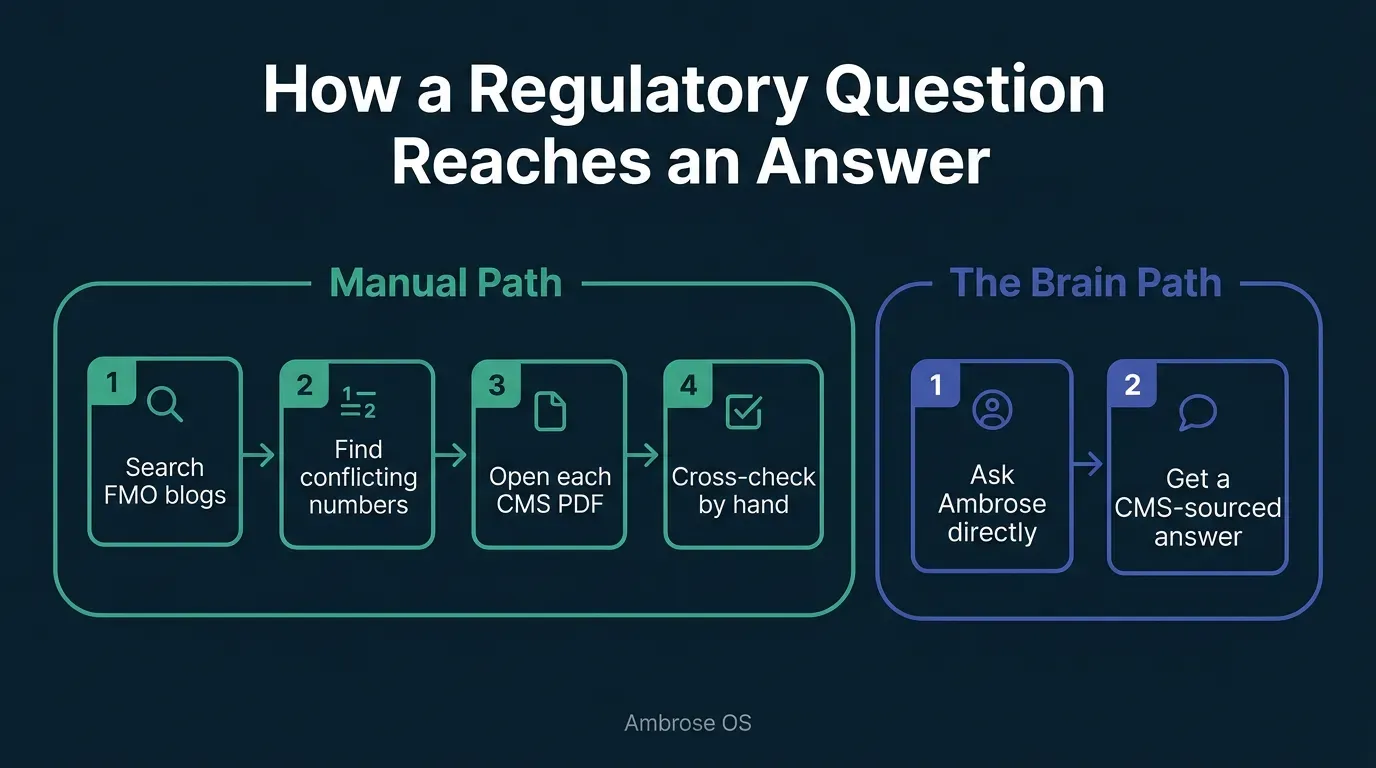
Be precise about what this is and isn’t. The Brain is a research and retrieval layer over primary federal data, documented as fronting sources like CMS, NADAC, FDA, and the Federal Register — it’s not a compliance officer and it doesn’t replace judgment about what to tell a specific client. Ambrose’s medicare-watchdog spoke, which we covered in detail in our guide to re-shopping your Medicare book, is the tool built specifically to scan your existing client contracts against current-year Star Ratings and plan data. The Brain is the tool for the question this article is actually about: what does the underlying federal rule say, and where’s the source, when the rule itself is what’s in question rather than a specific client’s plan.
One Ambrose seat comes with the $97/month membership
Ambrose usage runs through its own credit ledger with spend caps, billed separately from the $97 Tech Savvy membership fee, so cost stays visible instead of showing up as a surprise line item ([Ambrose docs, What is Ambrose](https://app.hiambrose.com/docs/what-is-ambrose)). The Brain is one piece of a larger catalog — see the full Spokes catalog for the rest of what ships with a seat.
The compliance layer this article sits inside
Everything above is regulatory and payment information, not marketing copy aimed at a beneficiary, but it’s still worth naming the two frameworks that govern how you use it once you’re in front of a client. If a conversation touches specific plan benefits, premiums, or a recommendation, CMS’s Medicare Communications and Marketing Guidelines still require the standard TPMO disclosure that you don’t represent every plan available in the service area, delivered before the marketing portion of the conversation, on top of the usual Scope of Appointment and call-recording obligations. Nothing in the CY2027 rule changes that requirement.
Separately, if you’re using any AI tool, including Ambrose, to help you read a regulation, draft a client explanation, or summarize a rule, the NAIC’s Model Bulletin on the Use of Artificial Intelligence Systems by Insurers, adopted December 4, 2023, sets the expectation that insurers and the producers acting for them maintain a written approach to how AI is used, keep a human reviewing what it produces before it reaches a consumer, document the process, and hold any vendor accountable for what its tool outputs (NAIC, Model Bulletin, December 4, 2023). A growing number of states have adopted the bulletin directly. Treat an AI-sourced summary, including anything in this article, as a starting point you verify against the primary document, not a final answer you repeat to a client unchecked.
What not to paste into a general-purpose AI tool
None of the research for this article required touching a single client record — it's all public federal rulemaking. If your own question does involve a specific client's plan, claims history, or health information, don't paste that into a general-purpose chatbot with no data agreement. That's exactly the gap Ambrose's PHI Rail is built for: it aliases the 18 HIPAA identifiers before anything reaches a non-BAA destination and re-hydrates them on the way back, so the underlying model never sees raw PHI (Ambrose docs, System architecture).
What about Medicare Supplement, PDP-only, and ACA books
The measure and payment changes covered here are specific to Medicare Advantage and Part D Star Ratings. If a meaningful part of your book is Medicare Supplement, the Star Ratings mechanism doesn’t apply at all — Med Supp plans are standardized by letter (Plan G, Plan N, and so on) and priced by the carrier’s own underwriting and rate filings, not a CMS quality score. A PDP-only book is affected by the Part D side of this rule (up to 12 measures rated, one of the 11 removed measures applies to Part D) and by the Part D compensation increase, but not by the Medicare Advantage Quality Bonus Payment mechanics, since standalone Part D plans don’t receive an MA-style bonus.
If you also write ACA marketplace business, none of this rule touches that market directly — the ACA marketplace runs its own quality-rating system (the Quality Rating System, distinct from MA/Part D Star Ratings) under separate CMS rulemaking. Don’t let a client conflate “my Medicare Advantage plan’s rating” with “my marketplace plan’s rating” — they’re graded by different systems, on different schedules, under different rules.
Building this into how you read CMS news going forward
The compressed version of everything above, useful the next time CMS drops a new fact sheet: identify which of the four annual document types you’re reading (proposed rule, advance notice, final rule, final rate announcement), note its publication date, and treat any number from the proposed rule or advance notice as provisional until the final version confirms or changes it. For 2027 specifically, the sequence ran November 25 (proposed rule), January 26 (advance notice), April 2 (final rule), April 6 (final rate announcement), and June 1 (compensation memo) — expect a similar cadence for CY2028, and expect trade coverage to occasionally blend the stages the same way it did this year.
The close
Everything above, the document trail, the measure-count math, the compensation table, works whether you ever join anything or not — verifying a CMS number yourself just takes longer than asking. If you’d rather ask the question once and get an answer sourced to the actual federal document instead of triangulating three FMO blog posts against each other, one Ambrose seat, including access to the Brain, comes with a Tech Savvy Insurance membership: $97 a month, cancel anytime, and the weekly build-with-you calls are where agents actually learn to ask it well: https://techsavvyinsurance.com/.
Before you repeat any figure in this article to a client
Tech Savvy Insurance is a training and software community, not an insurance company, agency, or law firm, and does not provide insurance, legal, tax, or compliance advice. You are responsible for your own licensure and for complying with all applicable CMS, HIPAA, state, and carrier regulations, including TPMO disclosure, Scope of Appointment, and call-recording requirements. AI-generated outputs, including any summary of a regulation, may contain errors — always verify against the current CMS documents before acting on or repeating a figure. Results may vary.
Frequently asked questions
Sources
- CMS — Contract Year 2027 Medicare Advantage and Part D Final Rule Fact Sheet (Apr. 2, 2026) — cms.gov
- CMS — Contract Year 2027 Medicare Advantage and Part D Proposed Rule Fact Sheet (Nov. 25, 2025) — cms.gov
- CMS — 2027 Medicare Advantage and Part D Advance Notice Fact Sheet (Jan. 26, 2026) — cms.gov
- CMS — 2027 Medicare Advantage and Part D Rate Announcement Fact Sheet (Apr. 6, 2026) — cms.gov
- KFF — Medicare Advantage Quality Bonus Payments (Jul. 1, 2026) — kff.org
- CMS memo — Contract Year 2027 Agent and Broker Compensation Rates (Jun. 1, 2026) — psmbrokerage.com
- CMS memo — Contract Year 2026 Agent and Broker Compensation Rates (Jun. 18, 2025) — ritterim.com
- NAIC — Model Bulletin: Use of Artificial Intelligence Systems by Insurers (Dec. 4, 2023) — content.naic.org
- Ambrose docs — Glossary (the Brain) — app.hiambrose.com
- Ambrose docs — System architecture — app.hiambrose.com
- Ambrose docs — What is Ambrose — app.hiambrose.com
Ready to put this into practice?
Join a private community of Health & Life insurance professionals using AI, Meta Ads, and automation to grow — without draining their bank account.
Join Tech Savvy — $97/month