
The Medicare Prescription Payment Plan is a federal program that lets any Part D enrollee spread their out-of-pocket drug costs into capped monthly bills instead of paying all at once at the pharmacy counter — it’s free, opt-in, available to anyone with Part D, and in its first full year it was used by about 1% of the people CMS’s own data say could have used it (Avalere Health, July 28, 2026). This AEP, you’re sitting across from Part D clients right now, and most of them have never heard of it, because nothing in CMS’s own agent training requirements tells you to bring it up.
Key takeaways
- The Medicare Prescription Payment Plan (sometimes called M3P or MPPP) requires every Part D plan sponsor to offer enrollees the option to pay out-of-pocket drug costs in monthly installments instead of all at once at the pharmacy (CMS, Final Part One and Part Two Guidance).
- CMS's own trigger for a mandatory pharmacy notice is a single prescription costing $600 or more at the point of sale — a threshold CMS confirmed was unchanged through its July 2024 Part Two Guidance, with nothing found this session revising it for 2026 or 2027.
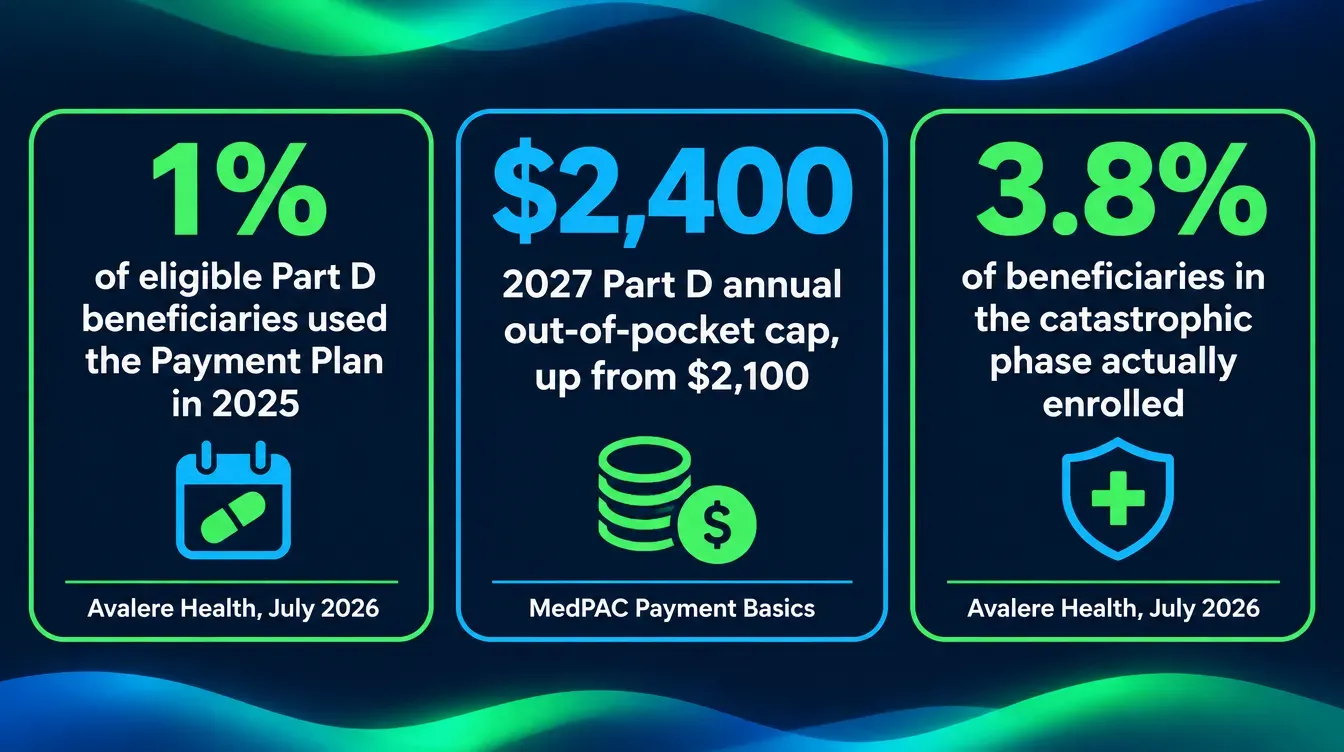
- In 2025, roughly 1% of the eligible, non-LIS population enrolled, and even among the 17% who reached the catastrophic phase (average $1,182 out-of-pocket), only 3.8% enrolled — about 205,000 people (Avalere Health, July 28, 2026).
- CMS's own 2027 Agent and Broker Training & Testing Guidelines do not list the Payment Plan as a required training topic, confirmed by this article's direct review of that document — which means raising it is entirely a judgment call you're making on your own.
- Ambrose's Routines can post a scheduled reminder to review high-cost Part D fills, and client-vault can log the conversation and attach documents — a workflow built from two documented pieces, not a dedicated alert (Ambrose docs, Routines and Spokes catalog).
The pain: a free cash-flow tool your clients don’t know exists
Picture the specific moment this matters. A client on a specialty drug for rheumatoid arthritis or a biologic for Crohn’s fills her prescription in the second week of January. Her plan’s standard deductible for 2027 is up to $700, and once she clears it, she’s paying 25% coinsurance on a drug that can run thousands of dollars a fill — meaning she could blow through a meaningful chunk of her $2,400 annual cap in that single January transaction (CMS, Announcement of CY 2027 MA Capitation Rates and Part C and Part D Payment Policies, Table V-2, April 6, 2026). She pays it. Nobody at the pharmacy counter is required to mention that she could have spread that bill over eleven remaining months instead of eating it in one.
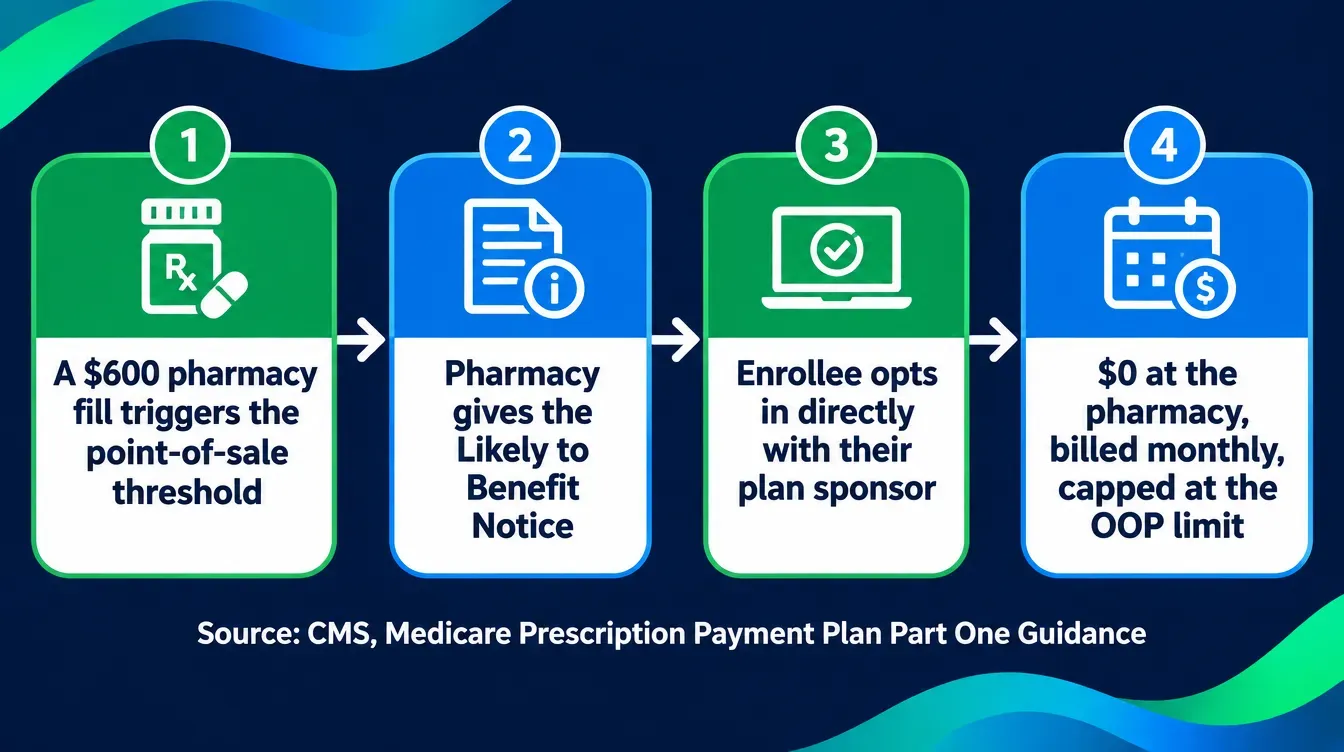
Here’s the part that should bother you more than it probably does: CMS actually built a notice for exactly this moment. If a single covered drug hits $600 or more at the point of sale and she hasn’t already opted in, her plan sponsor is required to instruct the pharmacy to hand her a Medicare Prescription Payment Plan Likely to Benefit Notice (CMS, Final Part One Guidance, February 2024). In theory, the system catches her. In practice, a notice handed across a pharmacy counter during a transaction, to someone who’s often stressed, in a hurry, or dealing with a new diagnosis, is a weak delivery mechanism — and the data backs that up. We’ll get to the number. It’s worse than you’d guess.
This isn't the same thing as the Part D out-of-pocket cap article
We've already covered the 2027 Part D deductible and out-of-pocket cap numbers in depth — what they are, who's affected, and how to check a specific client — in Medicare Part D Changes for 2027. This article is about a different, narrower thing: the opt-in payment plan that changes when a client pays what they owe under that cap, not the cap itself.
What the Medicare Prescription Payment Plan actually is
Strip away the acronyms and it’s a simple mechanism. Created under the Inflation Reduction Act of 2022 and live since January 1, 2025, the program requires every Medicare Part D plan sponsor — standalone PDPs and MA-PDs with drug coverage alike — to offer enrollees the option to pay their out-of-pocket prescription costs as capped monthly installments across the plan year, instead of the full amount at the pharmacy each time (CMS, Medicare Prescription Payment Plan Final Part One Guidance). Once someone opts in, they pay $0 at the pharmacy for covered Part D drugs. The plan sponsor bills them monthly for whatever cost sharing they’d otherwise owe, and pays the pharmacy in full under the normal Part D prompt-payment timeline. The pharmacy is never left holding the bag, and the client’s cash outlay gets smoothed instead of lump-summed.
CMS is explicit about one thing that trips people up: this program does not reduce total out-of-pocket costs. It’s not a discount, a subsidy, or a new benefit. It changes the shape of the payment curve, not its area. A client who would have paid $2,400 over the year pays $2,400 either way — the question is whether that’s one brutal January bill or roughly $200 a month starting whenever they opt in.
Enrollment works directly with the plan sponsor, not through you as a formality. An enrollee (or their legal representative) can opt in before the plan year starts or in any month during the year. Requests made before the plan year begins must be processed within 10 calendar days; requests made during the year, within 24 hours (CMS, Final Part One Guidance). Real-time, point-of-sale election wasn’t required when the program launched in 2025, and CMS said at the time it was “committed to exploring” that for future years — nothing found this session confirms it’s live for 2026 or 2027, so assume the 24-hour processing window is still the fastest path. Participants can opt out at any point; a missed monthly bill triggers a required two-month grace period before termination, and a sponsor cannot use a missed Payment Plan bill to terminate the underlying Part D coverage itself (Final Part One Guidance).
| Plan year | Standard deductible | Annual out-of-pocket threshold | Source |
|---|---|---|---|
| CY2025 | $590 | $2,000 | CMS, Fact Sheet: Final CY 2025 Part D Redesign Program Instructions |
| CY2026 | $615 | $2,100 | CMS, CY 2027 Rate Announcement, Table V-2 |
| CY2027 | $700 | $2,400 | CMS, CY 2027 Rate Announcement, Table V-2, April 6, 2026 |
Why it happens: nobody’s actually assigned to tell your client
This is the section worth sitting with, because the answer isn’t “agents are lazy” — it’s that the system genuinely doesn’t route this conversation to you.
Pull up CMS’s own 2027 Agent and Broker Training & Testing Guidelines, the document that spells out everything organizations must train and test their agents and brokers on annually under 42 CFR Parts 417, 422, and 423 (CMS.gov, 2027 Agent and Broker Training & Testing Guidelines). It covers Medicare Parts A through D, Medigap, enrollment and disenrollment procedures, marketing and communications rules, fraud, waste and abuse, special needs plans, PACE, Medicare Savings Programs — a genuinely exhaustive list. The Medicare Prescription Payment Plan isn’t on it. Not as a line item, not as a sub-bullet. We checked the full document this session, word for word, specifically for this article.
That’s not a drafting oversight; it tracks with how CMS structured the whole program. The identification duty — flagging who’s “likely to benefit” — sits with the Part D plan sponsor, triggered by pharmacy claims data at the point of sale. The notification duty sits with the pharmacy, which hands over a standardized Likely to Benefit Notice. The education-and-outreach duty, per CMS’s Final Part Two Guidance, sits with plan sponsors too: updating member ID card mailings, Evidence of Coverage documents, Annual Notice of Change letters, and plan websites (CMS, Final Part Two Guidance, July 2024). Nowhere in that chain is “the independent agent proactively raises this during an annual review” a required step. You’re not in the loop by design — you’re outside a loop that was built entirely between CMS, the plan sponsor, and the pharmacy.
The program has an identification system, a notification system, and an outreach system. None of the three involves you. That's exactly why the agents who bring it up anyway stand out.
Mike MooreAdd the structural reasons the $600 point-of-sale trigger alone isn’t enough, and the gap gets clearer. It only fires on a single prescription that crosses $600 in one transaction — a client whose costs build up gradually across several $150-$300 fills a month never trips it, even if their cumulative annual cost sharing would clearly benefit from smoothing. It fires at the counter, often mid-transaction, to someone who’s there to get medicine, not read a notice. And the notice itself is generic; it doesn’t do the math for the specific client standing there. CMS built a floor, not a conversation.
What it costs clients when nobody brings it up
The data on this is now in, and it’s a clean, sourced picture of a benefit nobody’s using. Avalere Health analyzed full-year 2025 Part D claims — the program’s first full year — for beneficiaries not receiving the Low-Income Subsidy and not enrolled in employer group waiver plans, the population CMS’s own guidance says is the actual target audience (Avalere Health, New Analysis Highlights Opportunities to Improve Medicare Prescription Payment Plan Uptake, July 28, 2026). The analysis was commissioned and funded by PhRMA, a pharmaceutical industry trade group with its own interest in highlighting affordability gaps; Avalere states it retained full editorial control over the methodology and findings, and the underlying CMS claims data is independently verifiable, so we’re treating the figures as usable while naming the funding source plainly, the same way we’d flag any industry-commissioned study.
Here’s what it found. Across the study population, roughly 1% — about 333,000 people — enrolled in the Payment Plan during 2025. Nearly 72% of the population, more than 22.7 million people, spent less than $120 total out-of-pocket for the year, so most people genuinely had no reason to enroll; the Payment Plan was never going to help someone with low, flat costs. But 17% of the population, about 5.4 million people, actually reached the catastrophic phase — CMS’s own highest-benefit tier, hit by spending the full annual out-of-pocket threshold — with average annual out-of-pocket spending of $1,182. Of that group, the people CMS’s own criteria say are the clearest candidates, only 3.8% enrolled in the Payment Plan: about 205,000 people, or 0.6% of the entire study population.
Run the actual cash-flow math on one of those catastrophic-phase clients. Say she hits that $1,182 average in a single January fill — not unusual for someone starting a new specialty drug early in the year. Paid at the counter, that’s $1,182 gone from one month’s budget. Spread across the eleven remaining months of the year under the Payment Plan, it’s roughly $107 a month. Same total cost, same $1,182 — but one version is a number that can genuinely strain a fixed-income household in a single week, and the other is a line item that fits inside a monthly budget. That’s the entire value proposition, and it costs the client nothing to access. It just has to occur to somebody to mention it.
Where the Payment Plan's target population actually ends up — CY2025
Share of the non-LIS, non-EGWP Part D population at each spending tier, and the share of each tier that enrolled
Source: Avalere Health, New Analysis Highlights Opportunities to Improve Medicare Prescription Payment Plan Uptake, July 28, 2026 (study commissioned by PhRMA; editorial control retained by Avalere).
How to find the right clients and have this conversation — the manual version
None of this needs a tool. It needs a habit and about ten minutes per client review.
Step 1: Ask the actual trigger question. During any Part D review — AEP, a new-diagnosis check-in, a mid-year call — ask directly: “Have you had any single prescription fill cost you $600 or more this year, or do you expect one coming up?” That’s CMS’s own threshold, and it’s a concrete, answerable question, not an abstract one about “high drug costs.”
Step 2: Check for the pattern CMS’s data says matters. A new specialty or biologic prescription, a client who mentions “I had to pay a lot for my refill this month,” or anyone managing a chronic condition with an expensive maintenance drug (certain insulins, oncology drugs, biologics for autoimmune conditions) is exactly the profile Avalere’s catastrophic-phase cohort describes. If they’re also receiving Extra Help, stop there — CMS says plainly that the Low-Income Subsidy is more advantageous than the Payment Plan, so don’t push it on someone who’s already better covered.
Step 3: Explain what it does and doesn’t do, in plain language. “This doesn’t lower what you pay for the year — it just lets you pay it in smaller monthly amounts instead of all at once at the pharmacy. It’s free to join, and you can opt out anytime.” That’s the whole pitch. No upsell, no plan comparison, nothing that touches CMS’s Medicare Communications and Marketing Guidelines, because you’re not describing a plan benefit — you’re describing a federal payment mechanism that exists independent of which plan they’re on.
Step 4: Point them to the actual opt-in path. You can’t enroll them — that has to happen directly with their plan sponsor, by phone, online through the plan’s member portal, or by mail, and most plans publish a specific Payment Plan election phone line separate from general customer service. Have that number ready before the call, pulled from the client’s specific plan’s member materials or website.
Step 5: Write it down. Note in the client’s file that you discussed it, whether they opted in or declined, and why. This is the single most valuable five minutes in this whole workflow, and it’s the one agents skip because it feels like paperwork for paperwork’s sake. It isn’t — it’s the difference between “I always bring this up” and a claim nobody can check.
A script that works on the phone or in person
"Quick thing I check with everyone this time of year — have you had a prescription that hit $600 or more in a single fill? There's a federal program that lets you spread that kind of cost into smaller monthly payments instead of paying it all at the counter. It doesn't change what you owe for the year, just when. Want me to pull up the number to enroll with your plan directly?"
A quick word on AI, PHI, and this specific conversation
If you’re using a general-purpose AI tool to help draft outreach messages or summarize which clients might benefit, treat a client’s drug list and cost history the same way you’d treat any other protected health information: it doesn’t belong in a consumer chatbot. The NAIC’s Model Bulletin on the Use of Artificial Intelligence Systems by Insurers, adopted December 2023, sets the baseline regulators increasingly expect — written policies, human oversight of AI-assisted output, and documentation you can produce on request (NAIC, Insurance Topics: Artificial Intelligence, Model Bulletin). A generic, client-less script like the one above carries zero PHI and is fine to draft with any tool. The moment you’re asking an AI tool to reason about a specific client’s specific prescriptions, you’ve crossed into exactly the territory our companion article on what not to paste into ChatGPT covers. This article’s figures are described as “HIPAA aware by default” where Ambrose is concerned, never “HIPAA certified” — verify any AI-assisted output before you act on it, and remember that results may vary from client to client.
Where Ambrose actually fits, and where it honestly doesn’t
Ambrose doesn’t have a button labeled “find my Payment Plan candidates,” and this article isn’t going to pretend it does. What it has, documented this session, is a genuine fit for the two parts of the manual workflow above that actually fall apart under real caseloads: remembering to ask the question on a schedule, and having a real place to put the answer.
Routines are scheduled prompts attached to an agent or a team, triggered on a standard five-field cron schedule, with an optional output sink currently documented as Slack, email, a GHL note, or a log entry only — Discord is not currently listed (Ambrose docs, Routines, fetched November 2026). A Routine set to fire monthly during AEP and quarterly the rest of the year, posting a Slack reminder like “review this month’s Part D clients for high-cost fills,” turns Step 1 and Step 2 above from something you have to remember into something that shows up whether you remember or not.
client-vault is documented as a client-facing enrollment and policy store with four confirmed tools: client_get (fetch a client record), client_list_policies (all policies for a client), client_add_document (attach a document — a PDF or image), and client_search (search within one client’s data) (Ambrose docs, Spokes catalog and spoke-client-vault page, fetched November 2026). That’s Step 5, the documentation step, with somewhere real to put it: log that you raised the Payment Plan, note the outcome, and attach anything the client shares, like a confirmation from their plan sponsor.
The five-step conversation from this article
- Ask the $600 trigger question at every Part D review
- Watch for the specialty-drug, new-diagnosis pattern
- Explain the plain-language version, no upsell
- Hand over the plan sponsor's actual enrollment number
- Write down that you asked, every time, at zero cost
A scheduled nudge and a real place to log it
- A Routine fires on a schedule, prompting the review in Slack
- client_search and client_list_policies surface who's due for a check-in
- client_add_document attaches any confirmation the client shares
- Comes with one Ambrose seat included in the Tech Savvy membership
The honest version of this section
Neither Routines nor client-vault reads pharmacy claims data to tell you who crossed the $600 threshold — that identification still happens on the sponsor and pharmacy side, outside Ambrose's reach, per the documentation reviewed this session. What Ambrose does is make sure the habit of asking and the record of having asked don't depend entirely on memory during the busiest eight weeks of your year.
Everything in the five-step version above works whether you ever touch Ambrose or join anything. It’s a question you add to an existing review, not a purchase.
What you get by joining
One Ambrose seat, including Routines and client-vault, comes with a Tech Savvy Insurance membership: $97 a month, billed monthly, cancel anytime, founding rate locked in while the membership stays active. Alongside the seat: weekly Zoom calls with open Q&A and build-with-you sessions, 30-plus hours of recorded training, Meta Ads and AI training built for this industry specifically, pre-built AI templates and bot deployments, and a free annual in-person member workshop. It’s also an explicit no-recruiting zone — you can ask a specific question about how to structure a Routine for your own book without ending up on someone’s downline pitch list, which is a real point of difference from most agent Facebook groups.
Ambrose usage runs separately from the $97 seat
The membership includes one Ambrose seat; usage inside Ambrose runs through its own credit ledger with spend caps, so cost stays visible instead of showing up as a surprise. See the full Spokes catalog for what else is available beyond Routines and client-vault.
Ask the $600 trigger question
CMS's own threshold, worked into an existing Part D review.
Skip Extra Help clients
CMS says LIS is more advantageous — don't push the Payment Plan on them.
Hand over the real opt-in number
Enrollment happens directly with the plan sponsor, not through you.
Log every conversation
The five minutes that turns "I always ask" into a real record.
Let a Routine remind you
A scheduled Slack nudge during the months that actually matter.
File it in client-vault
client_add_document holds the confirmation, attached to the right client.
Build the reminder before your next review cycle
The five-step conversation above works whether you ever join anything or not. If you'd rather have a Routine already reminding you and client-vault already holding the record, with people watching your screen while you set it up, one Ambrose seat comes with the Tech Savvy membership.
Join Tech Savvy — $97/monthThe close
CMS built a real, free, opt-in tool that could have genuinely helped the 5.4 million people who hit the catastrophic phase in 2025 — and 96.2% of them never used it, per the only sourced analysis of that first full year (Avalere Health, July 28, 2026). Nothing in your required training tells you to bring it up, which is exactly why doing it anyway is worth more than it looks like on paper. Add the $600 question to your next Part D review, write down the answer, and if you’d rather have a Routine already reminding you and client-vault already holding the record, that’s a Tuesday conversation in the Tech Savvy community. $97 a month, cancel anytime, and nobody will pitch you a downline: https://techsavvyinsurance.com/.
Before you rely on any figure in this article
Tech Savvy Insurance is a training and software community, not an insurance company, agency, or law firm, and does not provide insurance, legal, tax, or compliance advice. You are responsible for your own licensure and for complying with all applicable CMS marketing rules, your specific carrier and FMO contracts, state insurance department requirements, and HIPAA. The Avalere Health uptake analysis cited in this article was commissioned by PhRMA; Avalere states it retained full editorial control, and this article names the funding source so you can weigh it yourself. Regulations, program parameters, and plan-sponsor processes change — confirm current requirements directly with CMS, a client's specific plan sponsor, or qualified legal counsel before relying on any figure here. AI outputs may contain errors — always verify. Results may vary.
Frequently asked questions
Sources
- CMS — Medicare Prescription Payment Plan (program page) — cms.gov
- CMS — Medicare Prescription Payment Plan Final Part One Guidance (Fact Sheet, Feb. 2024) — cms.gov
- CMS — Medicare Prescription Payment Plan Final Part Two Guidance (Fact Sheet, July 2024) — cms.gov
- CMS — Announcement of CY 2027 MA Capitation Rates and Part C and Part D Payment Policies (Table V-2, April 6, 2026) — cms.gov
- CMS — Fact Sheet: Final CY 2025 Part D Redesign Program Instructions — cms.gov
- Medicare.gov — Prescription Payment Plan, Examples (2026 OOP maximum) — medicare.gov
- Avalere Health — New Analysis Highlights Opportunities to Improve Medicare Prescription Payment Plan Uptake (July 28, 2026) — avalerehealth.com
- CMS — 2027 Agent and Broker Training & Testing Guidelines (PDF) — cms.gov
- Ambrose docs — Routines — app.hiambrose.com
- Ambrose docs — Spokes catalog — app.hiambrose.com
Ready to put this into practice?
Join a private community of Health & Life insurance professionals using AI, Meta Ads, and automation to grow — without draining their bank account.
Join Tech Savvy — $97/month