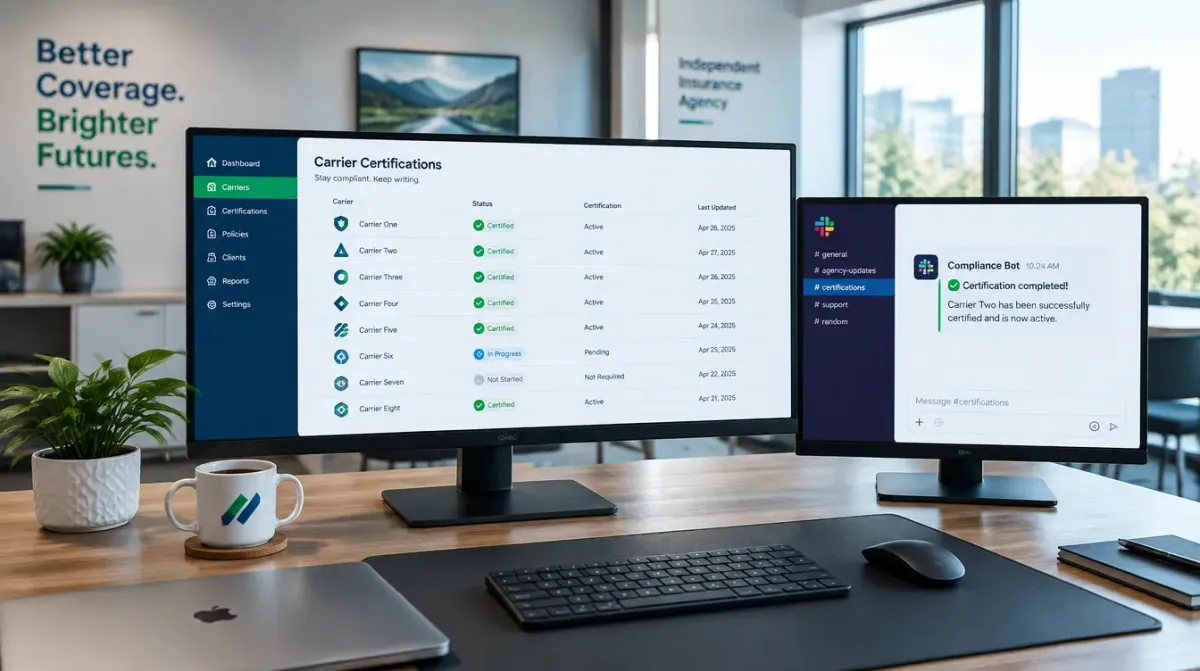
Your AHIP score transmits clean. That doesn’t mean you can sell for the carrier you just certified with. Passing a training exam and being flagged “ready to sell” by a specific carrier are two different checkboxes, filed in two different systems, and the second one has its own quiet cutoff that nobody centralizes for you. Multiply that across every carrier on your shelf and what you’re actually tracking before AEP 2026 isn’t one certification, it’s five to fifteen, each with its own portal, its own attestation, and its own deadline set ahead of the October 1 date when marketing a prospective plan year’s offerings first becomes legal (Cornell Law School, Legal Information Institute, 42 CFR 422.2263). One Ambrose seat, included with a Tech Savvy Insurance membership, can’t sit the exams for you. A Routine can check your own list on a schedule and post the gaps to Slack, and the File Library’s Vault can hold every completion certificate in one place instead of six different inboxes.
Key takeaways
- CMS requires each carrier, not a single universal body, to train and test its own agents and brokers annually and to keep "evidence of completion" on file (CMS.gov, 2027 Agent and Broker Training & Testing Guidelines).
- AHIP's Plan Year 2027 exam costs $175 and is a single exam whose score transmits to multiple carriers; NABIP's PY2027 certification costs $100 and is now accepted by "more than 80 Medicare carriers nationwide" (AHIP, MFWA Training; NABIP, PY2027 press release, June 22, 2026).
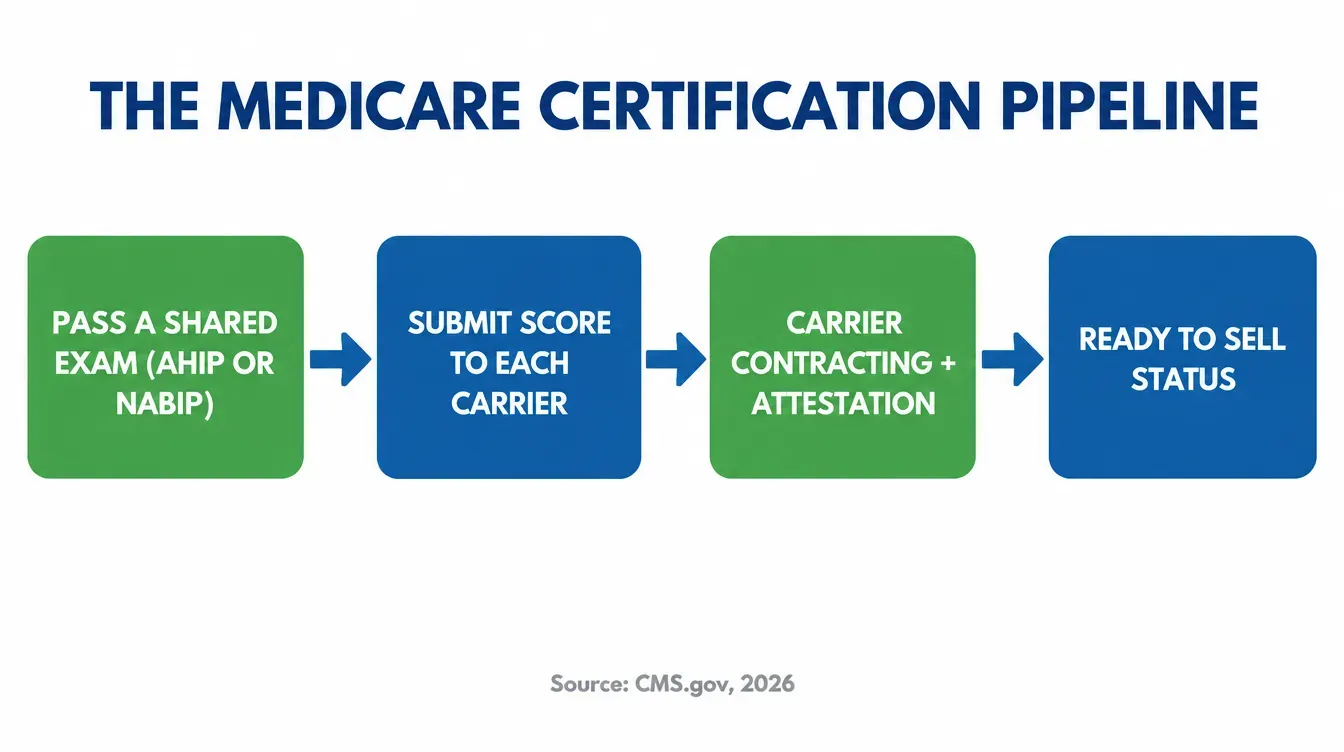
- Passing the exam is not the same as being "ready to sell." Each carrier still runs its own separate contracting, appointment, and attestation on top of it.
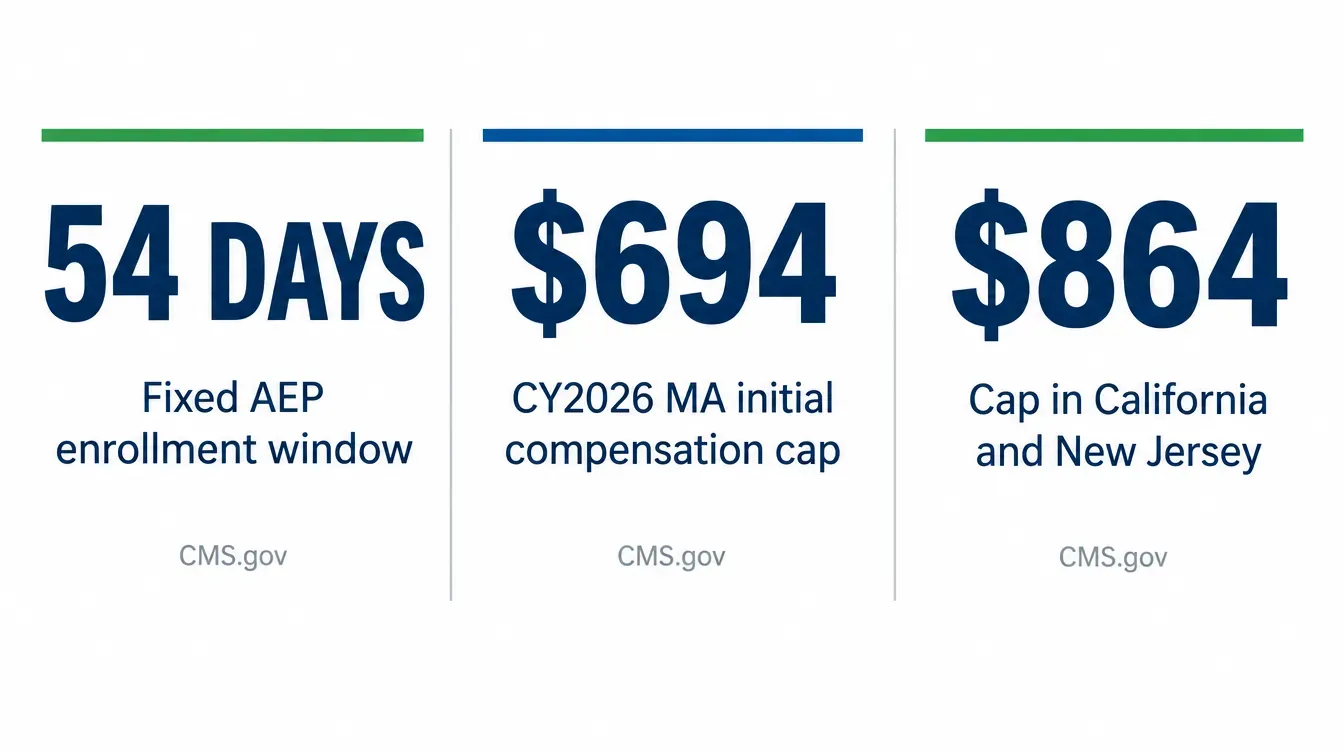
- AEP is a fixed 54-day window, October 15 through December 7 (CMS.gov; Medicare.gov). Every day a carrier lockout eats into that window is a day of that carrier's compensation, up to $694 per new enrollment nationally, you cannot earn (CMS.gov, Agent and Broker Compensation, CY2026 data).
- Ambrose can't sit an exam for you, but a Routine can check a tracked list of your own deadlines on a schedule and post to Slack, and the File Library's Vault holds completion certificates scoped to your agency (Ambrose docs, Routines / File Library).
What actually happens when a certification slips through
Here’s the version of this that catches agents mid-September, not the theoretical one. You passed AHIP back in July. You’ve been selling last year’s book all along, so you assume you’re set for AEP. Then a client asks about a plan from a carrier you haven’t actively marketed since spring, and when you log into that carrier’s agent portal to pull a quote, your status reads “not certified” or “pending appointment.” You passed the exam. You just never finished that specific carrier’s own contracting and attestation step, because you were focused on the two or three carriers you sell most and the portal for this one never sent a reminder that actually reached you.
It’s the second week of October. Marketing for the new plan year opened October 1. You call the carrier’s broker support line, and you’re told the certification cycle on their end takes anywhere from a few business days to two weeks to process, depending on volume, and volume is highest exactly when everyone else hits the same wall you did. Meanwhile every other carrier on your shelf is fine. You just can’t touch this one client’s best-fit option until the paperwork clears.
This isn't a compliance violation, and it isn't rare
Nothing about a lapsed carrier certification is illegal or reportable. It's an operational lockout that resolves itself once the paperwork clears. What makes it expensive is timing: it tends to surface exactly when a client is in front of you asking about a plan you can't currently sell, during the six busiest weeks of your calendar.
Why it happens: one CMS requirement, dozens of separate processes
This isn’t a single national deadline anyone missed. It’s the natural result of how CMS structures the requirement itself. CMS’s 2027 Agent and Broker Training & Testing Guidelines state plainly that “organizations,” meaning the Medicare Advantage, MA-PD, PDP, and Section 1876 cost plan carriers, “must ensure that all the agents and brokers (including employed, subcontracted, downstream, and/or delegated entities) that sell Medicare products on behalf of the organization are trained and tested annually on Medicare rules and regulations and on the specific benefits of the plan(s) their agents and brokers sell” (CMS.gov, 2027 Agent and Broker Training & Testing Guidelines). CMS sets the what. Each carrier decides the how, and the when.
That’s a deliberately decentralized design. CMS doesn’t run one national Medicare-agent exam; it tells every organization to run its own training and testing program, at minimum covering a defined list of topics from basic Medicare eligibility through enrollment periods, marketing rules, and agent compensation guidance, and to keep records available on request: “organizations must maintain information on their training and testing program and make this information available to CMS upon request. This includes tools, exams, policies and procedures, and evidence of completion” (CMS.gov, 2027 Agent and Broker Training & Testing Guidelines). Most carriers don’t build a proprietary exam from scratch. They accept a shared third-party option instead, most commonly AHIP’s Medicare + Fraud, Waste and Abuse training or NABIP’s Medicare, Medicare Products and FWA certification, because it’s cheaper than maintaining their own testing infrastructure and it satisfies the same CMS requirement.
That shared-exam convenience is exactly what hides the real complexity. Passing AHIP or NABIP tells CMS’s training-and-testing box is checked with whichever carriers accept that exam. It does not automatically contract you, appoint you, or attest you with any individual carrier. Each of those is a separate step, run on a separate timeline, inside a separate portal, and a carrier’s own internal deadline for finishing all of it is set well ahead of October 1, because the carrier needs processing time before that date, when marketing a prospective plan year’s offerings first becomes legal under 42 CFR 422.2263 (Cornell Law School, Legal Information Institute).
| Certification | Cost (PY2027) | Format | Carrier acceptance |
|---|---|---|---|
| AHIP Medicare + FWA Training | $175, same for members and non-members | Single exam; scores transmit to multiple carriers through one portal | "Join 100,000+ agents and brokers" who use it each year, per AHIP's own site |
| NABIP Medicare, Medicare Products & FWA Certification | $100, CE credit included in all 50 states and D.C. | Self-paced online course and exam | "More than 80 Medicare carriers nationwide," including UnitedHealthcare, Aetna, Elevance Health, and Humana |
Source: AHIP, Medicare + Fraud, Waste, and Abuse Training; NABIP, PY2027 Medicare Certification press release, June 22, 2026. Both fetched September 2026. Confirm acceptance with each individual carrier before relying on either exam alone.
Neither of these is a CMS product, and neither is mandatory by name. CMS requires training and testing; AHIP and NABIP are the two exams the industry has largely converged on to satisfy it, because building and maintaining your own per-carrier exam is expensive for the carrier and confusing for the agent. That convergence is genuinely useful. It’s also why so many agents assume one passing score means they’re covered everywhere, when what it actually means is that one box, out of several, is checked with whichever specific carriers accept that exam.
What CMS actually requires the training to cover
It helps to know what’s actually being tested, because “Medicare certification” sounds like one undifferentiated block and it isn’t. CMS’s 2027 Agent and Broker Training & Testing Guidelines lay out three broad topic areas every organization’s training and testing program has to address at minimum (CMS.gov, 2027 Agent and Broker Training & Testing Guidelines):
| Topic area | What it covers |
|---|---|
| 1. Medicare Basics | Parts A through D, eligibility and premiums, Medigap, PACE, Special Needs Plan types (D-SNP, I-SNP, C-SNP), out-of-pocket cost structures, and the Inflation Reduction Act changes to Part D, including the $2,000 annual cap on out-of-pocket drug costs and the elimination of the coverage gap phase |
| 2. Enrollment and Disenrollment | Enrollment mechanics, the Initial Coverage Election Period, the Annual Election Period, the Medicare Advantage Open Enrollment Period, and the full list of Special Election Periods, including the 5-Star SEP and the monthly dual/LIS SEP |
| 3. Marketing and Communications Requirements | Agent and broker responsibilities, prohibited marketing activities (cash or monetary rebates, unsolicited contact, health screenings at events), Scope of Appointment rules, required disclaimers including the TPMO disclaimer, and agent and broker compensation rules |
Source: CMS.gov, 2027 Agent and Broker Training & Testing Guidelines, fetched September 2026.
That third section is where the compensation rules this article cites actually live inside the guidelines themselves. CMS’s guidance also requires organizations to test agents and brokers “independently,” meaning you can’t split an exam with a colleague or have someone else sit it for you, and to keep “tools, exams, policies and procedures, and evidence of completion” on file (CMS.gov, 2027 Agent and Broker Training & Testing Guidelines). That recordkeeping requirement sits on the organization, not the individual agent, but it’s exactly why saving your own copy of every completion certificate, covered in the manual method below, protects you if a carrier’s own records ever come up short.
What it actually costs when a carrier locks you out mid-AEP
There’s no published figure for what a lapsed certification costs a specific agent, and this site won’t invent one; no carrier, CMS, or research firm publishes a per-incident dollar cost for a certification lockout, so any number here would fail the sourcing bar this site holds itself to. What can be sourced is the calendar, and the calendar is what actually drives the cost.
AEP runs “October 15 - December 7” every year under CMS’s own Medicare Open Enrollment materials, a fixed 54-day window confirmed on both CMS.gov and Medicare.gov (CMS.gov, Medicare Open Enrollment Partner Resources; Medicare.gov, Open Enrollment). That window does not extend because a certification took an extra week to clear. And the compensation at stake while you wait is a real, current, CMS-published number: the national standard initial compensation cap for a new Medicare Advantage enrollment for CY2026 is $694 per member, with $347 for a renewal, and organizations in Connecticut, the District of Columbia, and Pennsylvania can pay up to $781 initial, while California and New Jersey can pay up to $864, all drawn directly from CMS’s own CY2026 Agent Broker Compensation data file (CMS.gov, Agent and Broker Compensation, CY2026 data).
Run the math for illustration, not as a reported industry figure: a carrier lockout discovered on October 20, day six of AEP, and cleared two weeks later on November 3 costs you fourteen of your fifty-four selling days with that one carrier, exactly at the point in the season when new-to-Medicare clients and early shoppers are the most active. A lockout discovered in the final week of AEP may not clear before the window closes at all. Neither scenario is dramatic on its own. Multiplied across a book of clients who specifically wanted that carrier, it’s real, sourced, avoidable income sitting behind paperwork that could have been finished in August.
The lockout is per carrier, not per agent
Losing certification status with one carrier doesn't touch your ability to sell any other carrier on your shelf. That's exactly why it's easy to miss: everything looks fine until a specific client wants a specific plan from the one carrier where the paperwork never actually finished.
The full manual method: a certification tracker you can build in twenty minutes
None of this requires software, and it doesn’t require joining anything. It requires one list, kept honestly, checked on a schedule. Here’s the complete process, free of charge, same as every method on this site.
List every carrier you actually sell for, not the ones you meant to
Pull this from your commission statements or your agency's contract list, not memory. A carrier you sold two policies for last AEP still needs current-year certification if you plan to touch that book again.
For each carrier, confirm which exam it accepts
Check the carrier's own agent portal or broker support line, not a third-party blog, for whether it accepts AHIP, NABIP, or requires its own additional module on top of either one. Carrier acceptance changes yearly.
Log the carrier's own internal deadline, separately from CMS's dates
CMS's October 1 marketing start and October 15 AEP start are fixed and public (Cornell Law School, Legal Information Institute, 42 CFR 422.2263; CMS.gov, Medicare Open Enrollment Partner Resources). A carrier's internal cutoff to finish contracting and attestation is earlier, carrier-specific, and usually only stated inside that carrier's own portal or onboarding email. Write it down the day you find it.
Save the completion certificate the day you pass, not the week you need it
Download the PDF or screenshot the score confirmation immediately and file it somewhere you can find it under pressure. CMS requires organizations to keep "evidence of completion" available on request (CMS.gov, 2027 Agent and Broker Training & Testing Guidelines); you want your own copy for the same reason, and for your own records if a carrier's portal ever disputes your status.
Confirm "ready to sell" status directly, not by assuming a passing score covers it
Log into each carrier's own agent portal and look for an explicit certified or ready-to-sell flag. A passing exam score with an incomplete contract or attestation still shows as blocked. This is the single most-skipped step in the whole process.
Set two reminders per carrier, not one
One at two weeks before that carrier's internal deadline, one at three days before. A single reminder gets buried in an inbox during the busiest stretch of the year; two catches it before the second one goes off.
A spreadsheet is enough
Five columns: carrier name, exam accepted, carrier deadline, certificate saved (yes/no), ready-to-sell confirmed (yes/no). That's the entire tracker. The discipline is checking it weekly starting in August, not the tool it lives in.
Everything above works whether you ever join anything or not. Build the spreadsheet this week, or let Ambrose check it for you on a schedule.
Certification and continuing education are two different clocks
It’s worth separating these clearly, because agents mix them up under the same mental heading of “yearly Medicare paperwork.” Your state insurance license has its own continuing education requirement, on its own renewal cycle, set by your state’s Department of Insurance, and it exists whether or not you ever sell a Medicare product. Carrier certification is a separate, Medicare-specific requirement layered on top, tied to the plan year rather than your license renewal date.
The two do overlap in one useful way: both AHIP and NABIP build CE credit into their Medicare exams at no extra charge, with NABIP’s course “filed in all 50 states and Washington, D.C.” (NABIP, PY2027 Medicare Certification course page) and AHIP’s training available with CE credit “in all 50 states, D.C. and Puerto Rico” per its own site (AHIP, Medicare + Fraud, Waste, and Abuse Training). That means the exam you’re already taking to stay certified with your carriers can also chip away at your state CE requirement, but only if your state has approved that specific course for credit, which you confirm on the exam provider’s own state-status page, not by assuming the two automatically line up. Passing NABIP’s exam satisfies neither your license CE requirement nor a carrier’s certification requirement automatically in every state; check both boxes separately, even when one exam happens to cover both.
Where the manual method breaks down at scale
A solo agent selling for four or five carriers can hold this list in a spreadsheet and check it every Monday without much friction. It gets harder fast once you’re running a team, an FMO downline, or a book spread across eight or more carriers each with a different exam preference, a different portal, and a different internal deadline. At that scale, “check the spreadsheet weekly” competes with everything else AEP demands of a manager’s calendar, and it’s exactly the kind of recurring, low-drama task that gets skipped for three weeks running until someone discovers a lockout in front of a client.
The completion-certificate problem compounds the same way. One agent can keep five PDFs in a folder. An agency tracking certificates for a dozen agents across a dozen carriers each needs a shared place those documents actually land, instead of scattered across individual inboxes where nobody but the agent who saved it can find it again.
How Ambrose’s Routines and File Library fit into this
Ambrose OS, the platform included with a Tech Savvy membership, can’t sit an exam or contract with a carrier on your behalf. Be precise about that instead of overselling it. What it can do, confirmed in the current docs, is remove the two weak points in the manual method above: remembering to check the list, and finding the certificate again once it’s saved.
Routines are described in Ambrose’s own docs as “a scheduled prompt attached to an agent or a team,” run on standard five-field cron syntax, with an output sink of “Slack, email, GHL note, log only” (Ambrose docs, Routines). Point a weekly Routine at your own tracked list of carriers, exam status, and deadlines, and it checks in on that schedule and posts what’s still open to Slack, instead of the check depending on someone remembering to open the spreadsheet during the busiest stretch of the year. One real limit worth stating plainly: “a routine belongs to an agent, and an agent that is not Live is not in service” (Ambrose docs, Routines), so the agent running the Routine has to stay in Live status for the reminder to keep firing.
The File Library gives the agency a scoped file space, and its Vault section is described in the docs as holding exactly the kind of documents a certification tracker needs: “HealthSherpa CSVs, commission statements, carrier PDFs,” accessible only within your agency (Ambrose docs, File Library). Save a completion certificate there the day you earn it, and it’s retrievable by anyone on the team with access, not buried in one agent’s personal inbox.
| Manual step | Ambrose equivalent |
|---|---|
| Remember to check the certification list weekly | A Routine on a weekly cron schedule checks and posts status to Slack |
| Save completion certificates somewhere findable | File Library's Vault section, scoped to the agency, holds carrier PDFs |
| Pass the exam itself | Not possible, and not claimed. AHIP or NABIP is still on you. |
| Finish a carrier's own contracting and attestation | Not possible. That step lives entirely inside the carrier's own portal. |
This is two documented pieces assembled by you, not a shipped feature
There's no single "certification tracker" spoke in the current Ambrose docs, and this article isn't going to pretend there is one. A Routine and the File Library are both real, confirmed, and available today; putting them together into a certification workflow is something you set up, the same way you'd wire up any other recurring check.
Edge cases worth knowing before AEP
Employed and captive agents still need the training, even though the pay cap doesn’t apply to them. CMS’s guidelines cover “all the agents and brokers (including employed, subcontracted, downstream, and/or delegated entities)” on the training-and-testing side with no carve-out (CMS.gov, 2027 Agent and Broker Training & Testing Guidelines), while separately, an “employed agent (agent/broker who only sells for one plan/Part D sponsor)” is exempt from the compensation cap rules that apply to independent agents. Those are two different rules; don’t assume exemption from one means exemption from both.
A carrier’s own attestation step is often the actual bottleneck, not the exam. AHIP and NABIP both process exam scores quickly once you pass. The slower part is usually the carrier’s own processing of your attestation and appointment after the score arrives, which is exactly why a carrier’s internal deadline sits well ahead of when you’d assume you need to be done.
Referral fee arrangements have their own separate rulebook, distinct from certification, and vary by state on what’s legal for an unlicensed referral versus what counts as illegal rebating; that’s covered in depth in our insurance referral fees guide, not this one.
This article covers the training-and-certification pipeline only
It doesn't cover the October 1 to October 15 marketing-versus-enrollment window in depth, or how to re-shop a book once AEP opens. See our pre-AEP marketing rules guide and Medicare Advantage commission guide for those.
Compliance: the disclaimer, the AI rule, and what CMS actually checks
Marketing before October 1 is restricted regardless of certification status. Being fully certified with a carrier doesn’t change the fact that, under 42 CFR 422.2263, “Medicare Advantage organizations, and the agents marketing on their behalf, may begin marketing a prospective plan year’s offerings on October 1 of each year for the following contract year” (Cornell Law School, Legal Information Institute). A completed certification lets you sell once that window opens; it doesn’t move the window earlier.
If you use an AI tool to help build or check your own certification tracker, the NAIC’s AI Model Bulletin expectations still apply where your state has adopted it. Adopted at the NAIC’s 2023 Fall National Meeting, the bulletin calls for a written AI governance program “commensurate with an assessment of the risk,” including oversight of third-party AI tools (NAIC, Members Approve Model Bulletin). States adopt the bulletin individually and on their own timeline, so confirm your own state’s current status rather than assuming either full adoption or none.
A completion certificate isn't PHI, but be careful what else lands in the same folder
Your own exam score and completion certificate are personal to you, not client data, so they don't carry the same handling risk as an enrollment application or a Medicare Beneficiary Identifier. If your certification tracker starts pulling in commission statements or client-linked records alongside it, that's a different category. Ambrose's PHI Rail checks whether a destination is on the BAA allowlist and, if not, scrubs identifiers into typed aliases like PERSON_xxxx before anything leaves, then restores the real values in the response (Ambrose docs, Architecture / PHI Rail). That's HIPAA-aware by default, not HIPAA certified, and AI outputs can still contain errors, so verify anything it tells you about a specific certification status directly with the carrier before you act on it.
What you get by joining
One Ambrose seat, including the Routines and File Library this article describes, comes with a Tech Savvy Insurance membership: $97 a month, billed monthly, cancel anytime, founding rate locked in while the membership stays active. Alongside the seat: weekly Zoom calls with open Q&A and build-with-you sessions, 30+ hours of recorded training, Meta Ads and marketing training built for this industry, pre-built AI templates and bot deployments, and a free annual in-person member workshop, plus an explicit no-recruiting rule, so you can ask a real question about a carrier’s portal without ending up on someone’s downline pitch list.
Exam fees are separate from the membership
AHIP's $175 and NABIP's $100 exam fees go directly to AHIP or NABIP, not through Tech Savvy Insurance or Ambrose. The membership includes one Ambrose seat, whose usage runs through its own credit ledger with spend caps, so cost stays visible instead of showing up as a surprise. See the full Spokes catalog for what else is available beyond Routines and the File Library.
The close
Everything above, the five-column spreadsheet, the two reminders per carrier, saving the certificate the day you earn it, works whether you ever join anything or not. That’s the point of writing it out completely: a carrier lockout shouldn’t cost a client their best-fit plan because a certificate sat in an inbox nobody checked in three weeks. This is the kind of list we build together on a Tuesday call, with a Routine’s Slack output flagging the carrier that’s still open before AEP catches you with it. $97 a month, cancel anytime, and nobody will pitch you a downline: https://techsavvyinsurance.com/.
Before you rely on anything in this article
Tech Savvy Insurance is a training and software community, not an insurance company, agency, or law firm, and does not provide insurance, legal, tax, or compliance advice. You are responsible for your own licensure and for complying with all applicable CMS, HIPAA, state, and carrier rules, including certification, contracting, and marketing requirements. Confirm your certification and ready-to-sell status directly with each carrier. AI-generated outputs may contain errors — always verify. Results may vary.
Frequently asked questions
Sources
- CMS.gov — Medicare Open Enrollment Partner Resources (AEP dates) — cms.gov
- Medicare.gov — Open Enrollment (AEP dates, corroborating) — medicare.gov
- CMS.gov — 2027 Agent and Broker Training & Testing Guidelines (PDF) — cms.gov
- CMS.gov — Agent & Broker Compensation (CY2026 data) — cms.gov
- AHIP — Medicare + Fraud, Waste, and Abuse Training — ahip.org
- AHIP Medicare Training portal — ahipmedicaretraining.com
- NABIP — More Than 80 Medicare Carriers Accept NABIP's 2027 Medicare Certification (press release, June 22, 2026) — nabip.org
- NABIP — 2027 Medicare, Medicare Products and FWA Certification (course page) — nabiptraining.org
- Cornell Law School, Legal Information Institute — 42 CFR 422.2263 (marketing start date) — law.cornell.edu
- NAIC — Members Approve Model Bulletin on Use of AI by Insurers — content.naic.org
- Ambrose docs — Routines — app.hiambrose.com
- Ambrose docs — File Library — app.hiambrose.com
- Ambrose docs — Architecture (PHI Rail) — app.hiambrose.com
- Ambrose docs — Spokes — app.hiambrose.com
Ready to put this into practice?
Join a private community of Health & Life insurance professionals using AI, Meta Ads, and automation to grow — without draining their bank account.
Join Tech Savvy — $97/month