
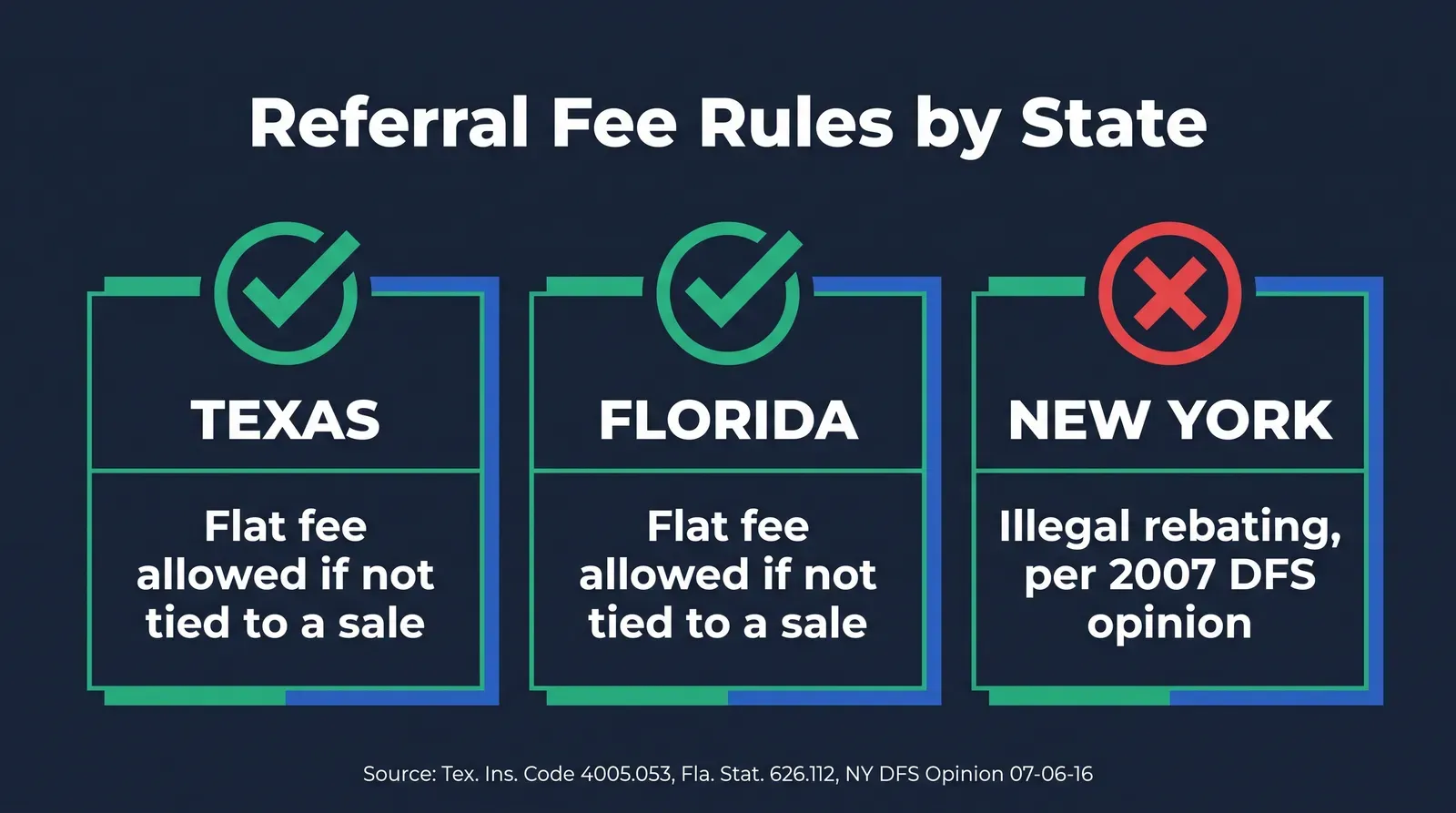
Yes, in most states, but only if the fee is a flat amount that doesn’t depend on whether the referred person actually buys a policy, and only if the person you’re paying doesn’t discuss coverage, recommend a plan, or otherwise act like a producer. Texas and Florida spell out exactly that condition in statute. New York’s own regulator has taken the position that a referral-fee arrangement violates state insurance law as illegal rebating, full stop. There is no single national answer, and the agent who assumes there is one is the agent who finds out the hard way.
Key takeaways
- Texas Insurance Code Section 4005.053(c) and Florida Statute 626.112(8) both allow referral fees to unlicensed people, but only if the fee is not contingent on a sale and the referral source doesn't discuss policy terms.
- New York's Department of Financial Services concluded in a 2007 opinion that a similar arrangement was illegal rebating and unlicensed activity under New York Insurance Law Sections 2116, 2324, and 4224.
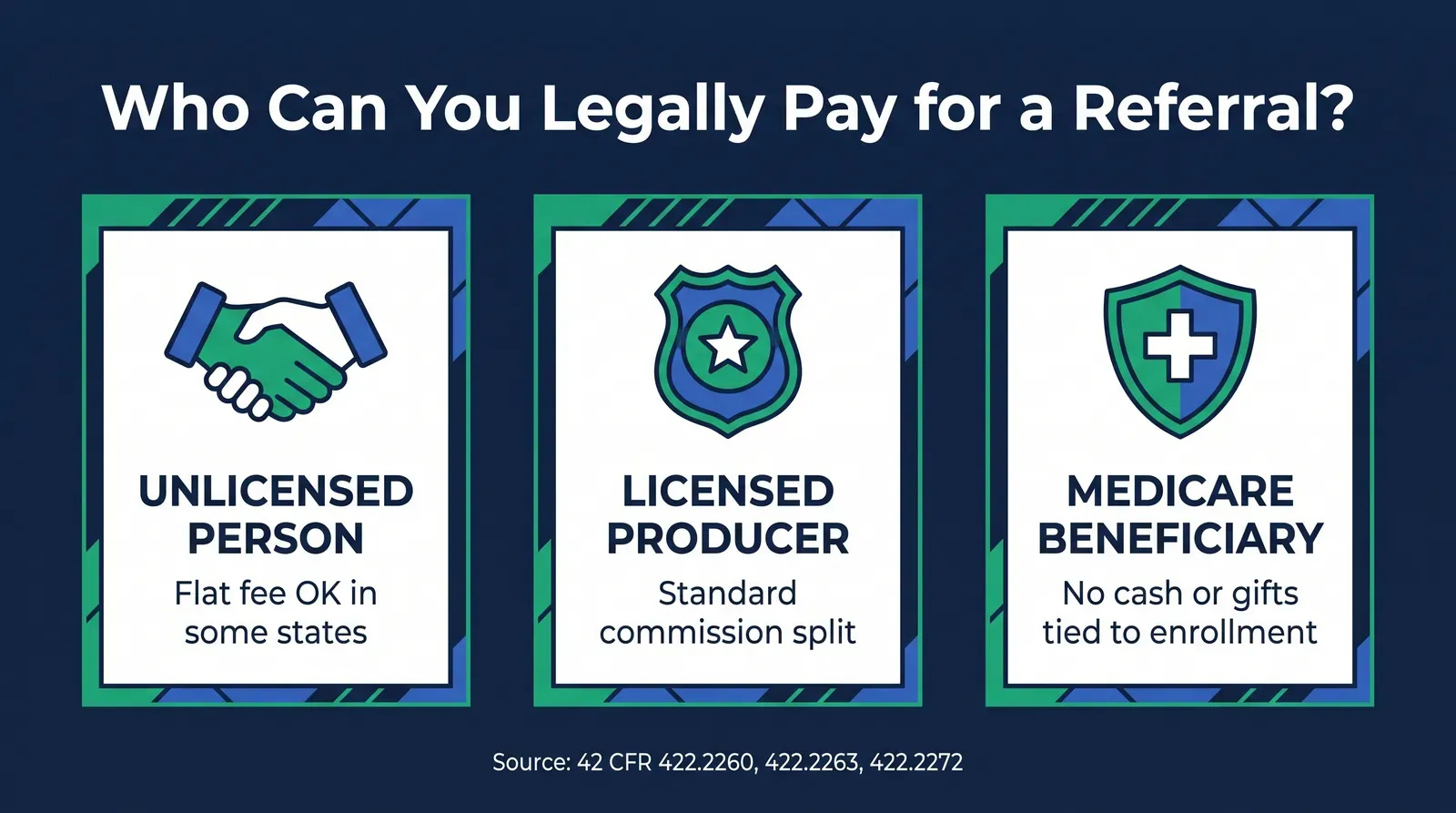
- CMS layers its own rule on top for Medicare business: TPMOs may not offer cash inducements to enroll, and may only employ state-licensed individuals as marketing representatives (42 CFR Sections 422.2263(b) and 422.2272(c)).
- A referral between two licensed producers, a commission split, sits in a different and generally more permissive category than paying an unlicensed person.
- Ambrose's lead-hunter spoke sidesteps the whole question for local-business prospecting: nobody gets paid for an introduction because you're finding the prospect yourself, using public business data only, with no consumer PHI involved (Ambrose docs, spoke-lead-hunter).
This is about who you can pay, not what you can text them
If your question is what you're allowed to text or call someone once they're already a lead in your system, that's covered separately in our TCPA Rules for Insurance Agents in 2026. This article is about the relationship one step earlier: whoever sent you that name in the first place, and whether you can hand them cash for it.
The referral you can’t decide alone
A real estate agent you’ve closed three deals with over coffee asks if you’ll pay her a finder’s fee for clients she sends your way. A client refers her neighbor and you want to send a $50 gift card as a thank-you. A P&C producer in your building wants to start routing his clients’ health questions to you, for a cut. Every one of these is a version of the same question: can you pay someone for sending you business, and if so, how much, and under what conditions?
The honest answer is that it depends entirely on two things: whether the person you’re paying holds an insurance producer license, and which state’s law governs the arrangement. Most agents have never looked this up. They’ve heard “finder’s fees are fine” from one colleague and “never pay for referrals, it’s rebating” from another, and both of those colleagues are describing something true, just in different states, for different categories of referral source. This article is the rulebook, state by state where it matters, plus what CMS adds on top when Medicare business is involved, plus the one workaround that skips the question entirely.
Why “just Venmo them fifty bucks” is riskier than it sounds
Every state licenses insurance producers for the same basic reason: someone advising a consumer on what coverage to buy, or negotiating the terms of a sale, is expected to know what they’re talking about and to be accountable to a regulator if they don’t. Paying an unlicensed person for a referral brushes right up against that line, because the payment itself can look like compensation for producing insurance business, which is the thing the license exists to gate.
Regulators generally split referral arrangements into two questions. First: is the person doing anything that looks like selling, soliciting, or negotiating insurance, discussing coverage options, recommending a plan, quoting a price? If yes, they need a license, and paying them without one is a straightforward unauthorized-practice problem regardless of how the payment is structured. Second, and this is where most of the actual legal variation lives: even for a pure, passive introduction, no coverage discussion at all, is the payment contingent on the referral turning into a sale?
That second question is where Texas, Florida, and New York land in genuinely different places, and it’s the one most agents have never actually had answered for their own state.
Three states, three different answers
| State | Can you pay an unlicensed referral source? | The condition | Source |
|---|---|---|---|
| Texas | Yes | Fee can't be contingent on the customer's purchase; referral source can't discuss policy terms or give advice | Tex. Ins. Code § 4005.053(c) |
| Florida | Yes | Fee to an unlicensed person "in any way dependent upon whether the referral results in the purchase" is prohibited; a flat, non-contingent fee is not | Fla. Stat. § 626.112(8) |
| New York | DFS has said no | A 2007 opinion found a referral-fee arrangement to be illegal rebating and unlicensed activity under state insurance law | NY DFS OGC Opinion No. 07-06-16 |
Texas’s rule is the cleanest example of the “passive introduction” model. Under Texas Insurance Code Section 4005.053, an agent may pay a fee to someone without a license for referring a customer who’s looking to buy insurance or wants advice on a policy, but the fee can’t be based on that customer’s actual purchase, and the referral itself can’t stray into discussing policy terms or giving an opinion on coverage. The moment either of those lines gets crossed, the “referral” starts to look like unlicensed solicitation, and the payment starts to look like a disguised commission.
Florida’s version, Section 626.112(8) of its insurance statute, is written almost as a mirror image: it doesn’t prohibit paying an unlicensed person for a referral, it prohibits paying them a fee “in any way dependent upon whether the referral results in the purchase of an insurance product.” Same underlying logic as Texas, expressed from the other direction. A flat $25 per introduction, paid the same whether the prospect buys or walks, is the shape of arrangement both statutes are describing as permissible.
New York doesn’t offer that same path. In OGC Opinion No. 07-06-16, dated June 18, 2007, the Department of Financial Services’ Office of General Counsel reviewed a proposed referral-fee program and concluded it violated New York Insurance Law, both as unlicensed activity under Section 2116, which bars paying “any money or give any other thing of value to any person…for or because of his or its acting in this state as an insurance broker” without a license, and as illegal rebating under Sections 2324 and 4224. The opinion is close to two decades old, but it remains the DFS’s stated position, and nothing since has published a contrary interpretation.
These three states are examples, not a complete map
This article covers Texas, Florida, and New York because they illustrate two genuinely different regulatory approaches, permissive-with-conditions and restrictive, not because they're the only states that matter. Every state licenses producers under its own insurance code, and referral-fee treatment varies from there. Confirm your own state's rule with your Department of Insurance before you structure any paid referral arrangement, even one that looks identical to the Texas or Florida model.
What it actually costs to get this wrong
The consequences aren’t abstract, and they land on both sides of the arrangement. The unlicensed person accepting money for what a regulator decides was soliciting or negotiating insurance can be charged with the unauthorized practice of insurance in their own right. The licensed agent who paid them is the one facing the insurance-law violation directly, illegal rebating, aiding unlicensed activity, or both, exactly as the New York opinion describes: a rebating violation under Sections 2324 and 4224, stacked on top of the unlicensed-activity finding under Section 2116.
That exposure sits alongside, not instead of, ordinary license discipline. A state Department of Insurance that finds a rebating or unlicensed-referral violation has the same toolkit available it uses for any other producer misconduct, and a violation tied to how you built your referral pipeline is not the kind of thing that only comes up once. If the arrangement is a standing program, a fixed monthly payment to a handful of real estate agents, say, rather than a one-time thank-you gift, every payment made under a non-compliant structure is its own instance of the same problem.
The colleague who told you "finder's fees are fine" and the one who told you "never pay for referrals" were both right. They were just describing different states.
Mike MooreWhen it’s actually simple: licensed producer to licensed producer
Not every referral relationship carries this risk. When both people already hold a producer license, insurance regulators generally treat the arrangement as a standard commission split rather than a payment to an outside party, because the whole point of the licensing framework, making sure whoever earns compensation for producing insurance business is accountable to a regulator, is already satisfied on both ends. A P&C agent who refers a client to a health specialist, or a Medicare-focused agent who sends a life insurance prospect to a colleague who works that line, is operating in a different and generally more permissive category than an agent paying an unlicensed real estate contact.
| Who refers you | What governs the payment | General risk level |
|---|---|---|
| A friend or client, no payment at all | Not a compensated referral; not the subject of these statutes | None |
| An unlicensed person, paid a flat fee per introduction | State producer-licensing and anti-rebating law | Varies sharply by state — confirm before paying |
| An unlicensed person, paid only when the referral buys | Same laws, and the specific structure most states flag | Highest — this is the pattern Texas, Florida, and New York all treat as a problem |
| Another licensed producer | Standard commission-sharing rules; usually a written split agreement | Lowest of the paid categories |
That said, “generally more permissive” isn’t “unregulated.” Most states still expect a licensed-to-licensed commission split to be disclosed and, in a lot of cases, documented in a written agreement between the two producers before the referral happens, not reconstructed afterward from memory once a carrier statement shows up wrong. Our guide to insurance commission reconciliation covers what to do when a split doesn’t show up the way you expected on a statement.
Medicare adds a second rulebook, and it governs a different party
Everything above is about your state’s producer-licensing and rebating law, and it governs who you can pay. If any part of the referral chain touches Medicare Advantage or Part D business, CMS adds a completely separate layer that governs a different question: what you, or anyone marketing on your behalf, can offer the beneficiary themselves.
CMS defines a Third-Party Marketing Organization broadly enough that it almost certainly includes you: “organizations and individuals, including independent agents and brokers, who are compensated to perform lead generation, marketing, sales, and enrollment related functions as a part of the chain of enrollment” (42 CFR § 422.2260). If a referral, paid or not, becomes part of how someone ends up enrolled in an MA or Part D plan, the TPMO framework applies to that enrollment regardless of what your state’s referral-fee statute says about the fee itself.
Two specific CMS requirements matter here. First, TPMOs “may not offer cash or other monetary rebates as an inducement for enrollment,” and gifts to beneficiaries are restricted to nominal value, distributed to similarly situated beneficiaries regardless of whether they enroll, and never in cash or a cash equivalent (42 CFR § 422.2263(b)). That rule targets what you can offer the beneficiary, not your referral source, but it’s the reason “we’ll knock $50 off if you sign up” can never be part of how a referred prospect gets closed, however that prospect reached you. Second, MA organizations must “employ as marketing representatives only individuals who are licensed by the State to conduct marketing activities” (42 CFR § 422.2272(c)) — a federal reinforcement of the same state licensing requirement your referral-fee statute is built around, specific to anyone actually performing marketing functions rather than making a bare introduction.
The TPMO disclaimer still applies
If you don't represent every Medicare plan available in a beneficiary's service area, CMS's Medicare Communications and Marketing Guidelines still require the standard TPMO disclosure across your marketing, websites, and calls, separately from anything in this article. Where a referral is part of the enrollment chain, that disclaimer obligation travels with it.
Put the two rulebooks together and the practical picture looks like this: your state law decides whether you can pay whoever sent you the referral. CMS decides what the beneficiary at the end of that chain can be offered, regardless of how they got there. Getting one right doesn’t clear the other.
The gift-card version: thanking a client is not the same as paying a stranger
Most of this article is about a standing, paid referral arrangement, a real estate agent, a P&C producer, a vendor, who sends you business on an ongoing basis. That’s a different situation from a client who refers their neighbor and gets a $25 gift card as a thank-you afterward, and it’s worth separating the two clearly, because agents routinely conflate them and end up either overcautious about something harmless or reckless about something that isn’t.
A one-off, unsolicited thank-you to a client after the fact, not promised in advance, not part of a program, not conditioned on future referrals, generally reads as a gift between two people who already have a relationship, not compensation for producing insurance business in the regulatory sense the statutes above are aimed at. The moment it becomes a standing offer, “refer someone and get $25,” advertised to clients as a program, it starts to take on the shape of the same referral-fee question this article covers, and the same state-by-state analysis applies. The test isn’t the dollar amount. It’s whether there’s a program, a promise made in advance, and a pattern of payment tied to referrals as a category of activity, versus a single spontaneous thank-you.
If the referred person is a Medicare beneficiary and the thank-you is connected in any way to their decision to enroll, rather than to the original client who referred them, the CMS gift rule from the section above applies directly: cash and cash-equivalent gift cards as an inducement to enroll are prohibited outright, and even a nominal non-cash item has to be offered without regard to whether the person actually enrolls (42 CFR § 422.2263(b)). A gift card handed to your existing client for the referral is a different question from anything offered to the new prospect to get them to sign.
The pattern is what changes the category, not the dollar figure
A $25 spontaneous thank-you and a $25 standing referral-program payment can be the identical dollar amount and land in completely different regulatory categories. If you find yourself budgeting for referral thank-yous as a recurring line item, you've built a program, even if nobody wrote that word down, and it's worth treating it like one.
Running the numbers on a real referral program
Here’s where the contingent-versus-flat distinction actually shows up in practice. Say you want to build a referral relationship with three real estate agents who each send you two or three prospects a month. A contingent structure, paying $150 only when a referral turns into a sold policy, feels efficient: you only pay for results. But that’s precisely the structure Texas, Florida, and every state modeled on the same logic treats as the problem, because tying the payment to the sale is what turns a referral fee into something that functions like an unlicensed commission.
The compliant version flips the math: a flat $25 to $50 per introduction, paid the same whether or not it converts, regardless of close rate. At three referral sources sending six to nine prospects a month combined, that’s roughly $150 to $450 a month in flat fees, a real, budgetable number, paid consistently, documented the same way every time. It costs more per referral that doesn’t close than a contingent structure would, and that’s the tradeoff: you’re paying for the state law to be on your side, not for pure efficiency. Agents who try to have both, a flat fee that quietly gets topped up with a bonus when a policy sells, are the ones who’ve reconstructed the exact contingent structure the statutes prohibit, just spread across two payments instead of one.
How to build a referral program that doesn’t need a lawyer on retainer
None of this is complicated once you know which questions to ask. Here’s the manual version, no tools required.
Call your state Department of Insurance before you pay anyone
Ask directly: can I pay an unlicensed person a flat referral fee, and what conditions apply? Most departments have a producer-licensing or market-conduct division that will answer this in a phone call or email. Texas and Florida's statutes are public and specific enough to quote back to a state representative if you want a second confirmation; don't assume your state matches either one without asking.
Structure the fee as flat and non-contingent
If your state allows paid referrals at all, the pattern both Texas and Florida describe as compliant is the same: a fixed dollar amount, paid the same whether the referred person buys or not, never a percentage of the sale or a bonus for a closed policy. Write the amount down. Don't leave it verbal or "case by case."
Put it in writing, every time
A short written agreement with each referral source, the flat fee, a statement that they won't discuss coverage or pricing, and a signature date, is the difference between "we had a documented, compliant arrangement" and having nothing to show a regulator who asks. This takes ten minutes per relationship and it's the single highest-value step on this list.
Build the licensed-to-licensed version first
Before you set up paid arrangements with unlicensed contacts, map out which licensed producers around you, a P&C agent, a life specialist, a Medicare-only colleague, would genuinely benefit from a two-way referral relationship. It's the lower-risk category, it's usually the higher-quality source, and it costs nothing but a conversation and a written split agreement to set up.
Keep a simple, dated log of every payment
A spreadsheet with the referral source's name, the date, the flat amount, and a note that the payment wasn't contingent on a sale is enough. If a Department of Insurance ever asks how your referral program works, a dated log that matches your written agreements is the difference between answering the question in one email and reconstructing months of arrangements from memory.
Do this before AEP, not during it
The 2026 Annual Enrollment Period runs October 15 through December 7 (CMS, Medicare Open Enrollment partner resources), the busiest referral-and-lead season of the year for Medicare agents. Getting a compliant referral structure in writing in September, before volume picks up and before a rushed verbal arrangement becomes the default, is a lot cheaper than untangling it in November.
Where Ambrose skips the question entirely
Everything above assumes you’re paying a human being to send you a prospect. There’s a version of prospecting that doesn’t involve paying anyone for an introduction at all, because you find the prospect yourself.
That’s the lead-hunter spoke inside Ambrose OS, the platform included with a Tech Savvy membership. Per Ambrose’s own documentation, it’s a free, production-ready spoke that runs three tools: hunter_gmaps_scrape, which pulls prospect contact information from Google Maps business listings; hunter_email_guess, which generates likely work email addresses from a name and a company domain; and hunter_verify, which confirms a candidate email is actually deliverable before you use it. The documentation is explicit that the spoke is “HIPAA-free: operates on public prospect business data only. No client PHI ever crosses the wire” (Ambrose docs, spoke-lead-hunter, fetched September 2026), and it builds in its own safety constraints, a Google-only export limit and a block on Microsoft-owned domains to avoid breaching their acceptable-use policy.
Read that scope carefully, because it’s deliberately narrow. This isn’t a way to source consumer Medicare or ACA leads, and it isn’t a replacement for a real estate agent relationship that’s already producing referrals for you. What it is: a way to build the local-business, small-group, and voluntary-benefits slice of your pipeline, business owners you’d want as clients or referral partners, without paying a single unlicensed person a single dollar for the introduction, because there’s no introduction being paid for. You found the prospect. The referral-fee question this entire article is about simply doesn’t come up.
Every spoke inside Ambrose is tagged by how it handles data, and lead-hunter’s “free” tier sits alongside spokes tagged “safe” (client and lead data stays local, never leaves the vault) and “scrubbed” (anything sent to a non-BAA destination gets its identifiers aliased first through the PHI Rail). Per the Ambrose spokes catalog, fetched this session, the platform ships 18 built-in spokes split evenly across those three tiers.
Ambrose's 18 built-in spokes, by data-exposure tier
Every spoke is tagged by how it handles data before it ever reaches an outside model.
Source: Ambrose docs, Spokes catalog, fetched September 2026. lead-hunter sits in the free tier because it never touches client or consumer data in the first place.
That tiering is the same architecture behind the PHI Rail: a “redact-then-rehydrate pipeline” that checks whether a destination is on the agency’s BAA allowlist and, if it isn’t, scrubs identifiers into typed aliases before anything leaves, then restores the real values in the response using the original hydration map (Ambrose docs, Architecture: PHI Rail, fetched September 2026). Lead-hunter doesn’t need that pipeline at all, because it was never built to touch anything the pipeline would need to protect.
What you get by joining
One Ambrose seat, lead-hunter included, comes with a Tech Savvy Insurance membership: $97 a month, billed monthly, cancel anytime, founding rate locked in while the membership stays active. Alongside the seat: weekly Zoom calls with open Q&A and build-with-you sessions, 30+ hours of recorded training, Meta Ads, AI, and marketing training built specifically for health and life agents, pre-built AI templates and bot deployments, and a free annual in-person member workshop. It’s also an explicit no-recruiting zone, which matters more than it sounds like it should for a topic like this one: you can ask a real question about whether your referral arrangement with a real estate contact is actually compliant without someone in the group pivoting the conversation into a downline pitch.
Ambrose usage runs separately from the $97 seat
The membership includes one Ambrose seat; usage inside Ambrose runs through its own credit ledger with spend caps, so cost stays visible instead of arriving as a surprise. See the full Spokes catalog for what's available beyond lead-hunter.
Compliance: what this touches, and what it doesn’t
Nothing in this article is legal advice, and referral-fee law is exactly the kind of area where a general article and your specific state’s rule can diverge in ways that matter. Confirm any referral arrangement, especially a standing paid program, directly with your state Department of Insurance before you rely on the Texas or Florida examples above as a template for your own state.
If Medicare business is anywhere in the referral chain, the TPMO framework and the 42 CFR Part 422 requirements covered above apply on top of your state’s rule, not instead of it, and the TPMO disclaimer obligation applies to your marketing regardless of how a given prospect reached you. If you’re using AI tools, Ambrose or otherwise, anywhere in how you track referral sources, draft outreach to prospects lead-hunter surfaces, or manage your pipeline, the NAIC’s Model Bulletin on the Use of Artificial Intelligence Systems by Insurers, adopted December 2023, sets the expectation a growing number of states have adopted: a written policy on how the tool is used, human oversight before anyone acts on its output, documentation you can produce if asked, and accountability that follows through to any vendor whose AI tool you rely on (NAIC, Insurance Topics: Artificial Intelligence). Ambrose is HIPAA-aware by default, not HIPAA certified — there’s no such thing as HIPAA certification for a software platform.
The close
Confirm your own state’s rule before you pay anyone for a referral, structure the fee flat and non-contingent if your state allows it at all, and put it in writing every time. That works whether you ever join anything or not. If you’d rather sidestep the referral-fee question completely for the local-business slice of your pipeline, Ambrose’s lead-hunter spoke does the public-data prospecting itself, and one seat comes with a Tech Savvy membership. The weekly build-with-you calls are where agents actually work through their own state’s rule with people who’ve done it: https://techsavvyinsurance.com/.
Before you rely on any figure in this article
Tech Savvy Insurance is a training and software community, not an insurance company, agency, or law firm, and does not provide insurance, legal, tax, or compliance advice. You are responsible for your own licensure and for complying with all applicable CMS, state insurance, HIPAA, and carrier regulations, including your specific state's referral-fee and anti-rebating statutes, which this article does not exhaustively cover. Regulations and legal interpretations can change — confirm current requirements directly with your state Department of Insurance, CMS, or qualified legal counsel before relying on any figure here. AI-generated outputs may contain errors — always verify. Results may vary.
Frequently asked questions
Sources
- Cornell Law School, Legal Information Institute — 42 CFR Section 422.2260 (TPMO definition) — law.cornell.edu
- Cornell Law School, Legal Information Institute — 42 CFR Section 422.2263 (gifts and inducements) — law.cornell.edu
- Cornell Law School, Legal Information Institute — 42 CFR Section 422.2272 (licensing of marketing representatives) — law.cornell.edu
- Texas Insurance Code Section 4005.053 (referral fees), via FindLaw — codes.findlaw.com
- Florida Statute 626.112, The Florida Senate (2025 Statutes) — flsenate.gov
- New York Department of Financial Services — OGC Opinion No. 07-06-16 (referral fees, June 18, 2007) — dfs.ny.gov
- NAIC — Insurance Topics: Artificial Intelligence (Model Bulletin background) — content.naic.org
- Ambrose docs — spoke-lead-hunter — app.hiambrose.com
- Ambrose docs — Spokes (catalog) — app.hiambrose.com
- Ambrose docs — Architecture: PHI Rail — app.hiambrose.com
- Ambrose docs — What is Ambrose — app.hiambrose.com
- CMS — Medicare Open Enrollment partner resources (2026 AEP dates) — cms.gov
Ready to put this into practice?
Join a private community of Health & Life insurance professionals using AI, Meta Ads, and automation to grow — without draining their bank account.
Join Tech Savvy — $97/month