
Insurance commission reconciliation is the practice of checking a carrier’s payment statement, line by line, against what your own policy records say you’re actually owed — and catching the gap before it becomes a write-off you never knew you took. Most agencies do it rarely or never, because it’s tedious and nothing forces you to. The honest starting point is a piece of research that has nothing to do with insurance: more than 90% of spreadsheets used for real business calculations contain at least one error, per research compiled by the European Spreadsheet Risk Interest Group (EuSpRIG). If your commission tracking lives in a spreadsheet, that’s not a hypothetical risk. It’s the base rate you’re already running.
Key takeaways
- Research compiled by EuSpRIG puts the share of spreadsheets used for business calculations that contain at least one error above 90%, citing underlying studies including Panko (2006) and Pryor (2004).
- CMS caps a 2026 Medicare Advantage renewal commission at $347 nationally per member per year — a single missed renewal line is worth that much every year the client stays enrolled (CMS, CY2026 Agent and Broker Compensation memo).
- One agency owner told AgencyBloc she found 14 unpaid Medicare Advantage policies in a single January review; another manages 4,000 policies across 30 carriers and 400 groups and reported saving 80 hours of manual commission calculation (AgencyBloc, published February 19, 2026).
- Independent agency organic growth slowed to a 6.2%–10.2% range in the Big "I" and Reagan Consulting's 2026 Best Practices Study, down from 8.7%–11.3% the year before — margin agencies can't afford to also lose to statement errors (IA Magazine, August 12, 2026).
- Ambrose's agencybloc spoke is a documented, live, bi-directional connector to AgencyBloc AMS+ that pulls policies and commissions into the agency's vault and can push flagged discrepancies back — paired with a scheduled Routine, it turns a manual monthly chore into a standing check (Ambrose docs, fetched August 2026).
This is about what a carrier actually paid you, not what it's allowed to pay
If you're trying to figure out whether a specific Medicare Advantage plan pays commission at all before you market it, that's a different question, covered in our guide to Medicare Advantage commission cuts. This article is about the payment that already happened — checking whether the carrier actually sent you what its own schedule says it owes.
What commission reconciliation actually is
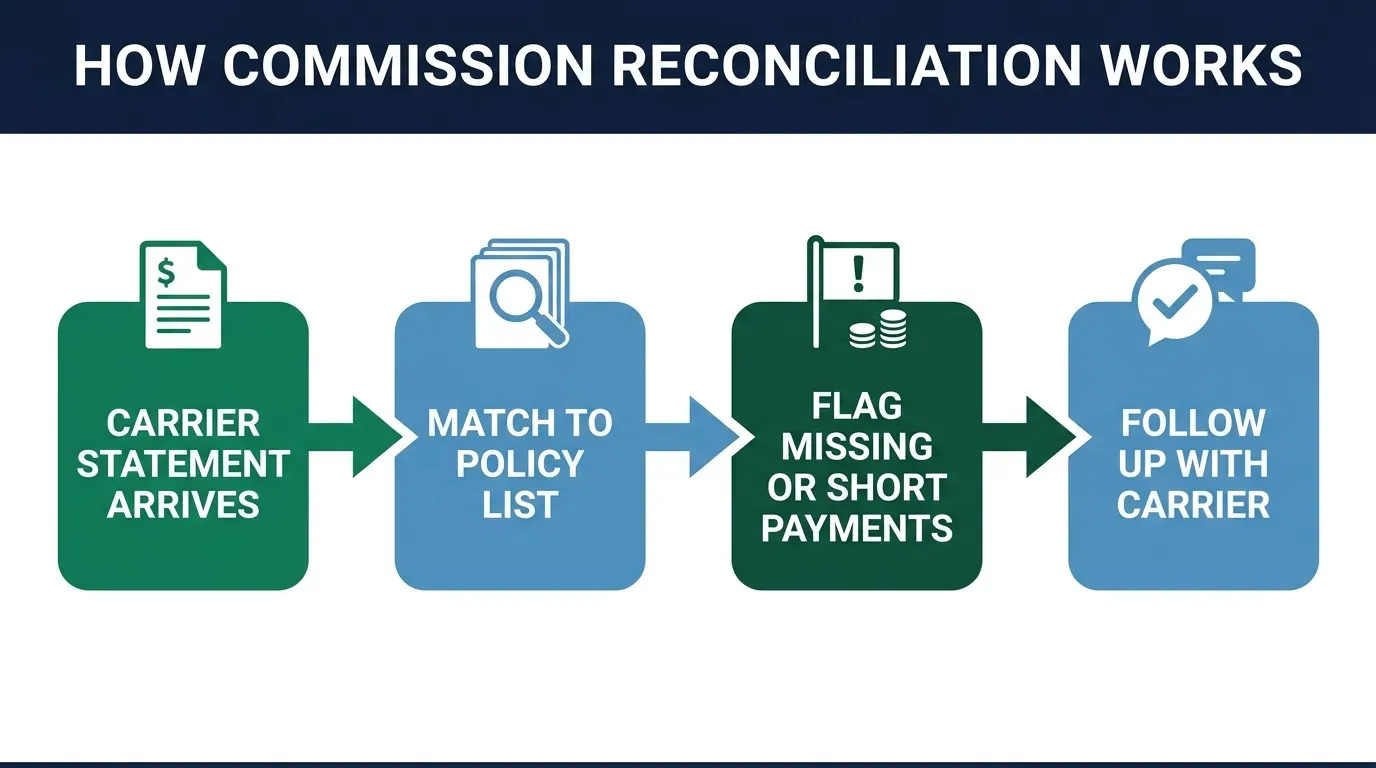
Commission reconciliation means taking the statement a carrier sends — usually monthly, sometimes weekly for high-volume relationships — and matching every line against your own record of who’s on the books, what they pay, and when they should renew. When a line matches, you move on. When it doesn’t, you have three possible reasons: the carrier made an error, your own records are wrong, or something changed (a cancellation, a plan switch, an agent-of-record change) that neither side updated cleanly. The job isn’t glamorous. It’s closer to bookkeeping than sales. But it’s the only mechanism that catches money a carrier owes you and simply didn’t send.
The term shows up most often attached to Medicare Advantage, because CMS publishes a public, fixed national compensation schedule that makes the math concrete: $694 for an initial 2026 enrollment, $347 for a renewal, with higher regional rates in Connecticut, Pennsylvania, D.C. ($781 initial / $391 renewal), California and New Jersey ($864 initial / $432 renewal) (CMS, Contract Year 2026 Agent and Broker Compensation memo; confirmed against PSM Brokerage’s June 2, 2026 rate summary). But reconciliation isn’t a Medicare-only discipline. Life insurance first-year and renewal commissions, ACA marketplace commissions, and Medicare Supplement commissions all run through carrier statements with the same failure modes — a missing line, a stale rate, an uncorrected chargeback. If you sell across multiple lines, you’re running this risk on all of them, not just the one with the public rate table.
| Region | CY2026 initial (max) | CY2026 renewal (max) |
|---|---|---|
| National | $694 | $347 |
| Connecticut, Pennsylvania, D.C. | $781 | $391 |
| California, New Jersey | $864 | $432 |
| Puerto Rico, U.S. Virgin Islands | $474 | $237 |
Source: CMS, Contract Year 2026 Agent and Broker Compensation memo, and PSM Brokerage's June 2, 2026 rate summary for initial rates. Renewal rates are calculated at 50% of the initial rate, the cap set by 42 C.F.R. § 422.2274. Figures are the maximum a carrier is permitted to pay, not a guarantee of what any specific carrier actually pays.
The pain: the statement looks fine until you actually check it
Here’s the version of this that plays out on a normal Tuesday. A carrier statement lands — a PDF or a CSV export, forty or four hundred rows of policy numbers, member names, and dollar amounts. You skim it, the total looks roughly right, and you move on to the next task on a day that already has too many. Nobody sits down and matches every row against a policy list, because that’s an hour or three you don’t have, and there’s no alarm that goes off when a line is simply missing.
That’s the actual failure mode. It’s not one dramatic error — it’s the absence of anyone checking, on a document that looks complete because you have no independent line to compare it against unless you build one. An agency owner who spoke with AgencyBloc described exactly this: sitting down to actually reconcile a statement against her policy list for the first time and finding 14 Medicare Advantage policies her agency had never been paid for, discovered in a single January review (AgencyBloc, published February 19, 2026). Fourteen policies, at up to $694 apiece for an initial enrollment or $347 for a renewal, is real money that had simply stopped showing up — not disputed, not flagged, just absent from a statement that otherwise looked normal.
Why carrier statements go wrong in the first place
Carriers process commissions at scale, across thousands of agents and millions of policies, through systems that weren’t built around any single agency’s book. A few specific, well-understood failure points account for most of what actually goes wrong:
A renewal that should have generated a payment simply doesn’t. The client stayed enrolled, nothing changed on your end, and the line that should appear on this month’s statement just isn’t there. This is the exact pattern the AgencyBloc case above describes — the absence of a line is much easier to miss than an obviously wrong number on a line that’s present.
A renewal pays at the prior year’s rate. CMS’s renewal cap moves year to year — $347 for CY2026, rising to $363 for CY2027 (CMS, Contract Year 2027 Agent and Broker Compensation memo, cited in our companion article on commission cuts). A carrier’s system that doesn’t update a client’s rate at the plan-year boundary will keep paying the old number, and the difference on a single policy is small enough that almost nobody notices it without a line-by-line check.
A cancellation or chargeback hits the carrier’s books and never makes it back to yours. This one runs in the opposite direction — you keep counting income on a policy that’s no longer active, which inflates your own projections until a chargeback line finally shows up and surprises you.
An agent-of-record change doesn’t fully propagate. A client moves to a new agent, the carrier’s system updates the servicing record but not the commission-payee record, or vice versa, and the wrong person keeps getting paid for a period before anyone catches it. Some states address this directly — Virginia’s insurance code, for instance, requires that “each insurer shall accept and honor each request by a policyholder for a change of insurance agent of record, which change shall be effective on the date of the next renewal of the policy” (Code of Virginia § 38.2-1812) — but the administrative lag between the legal change and the commission system catching up is exactly where reconciliation earns its keep.
None of these are fraud, and none of them require bad faith on the carrier’s side to happen constantly. They’re the ordinary output of a large system processing a lot of data, which is the same reason the spreadsheet error research matters here: whichever side of the transaction is tracking commissions in a spreadsheet is running the same base error rate as everyone else who’s ever built one.
What it actually costs, in numbers you can check
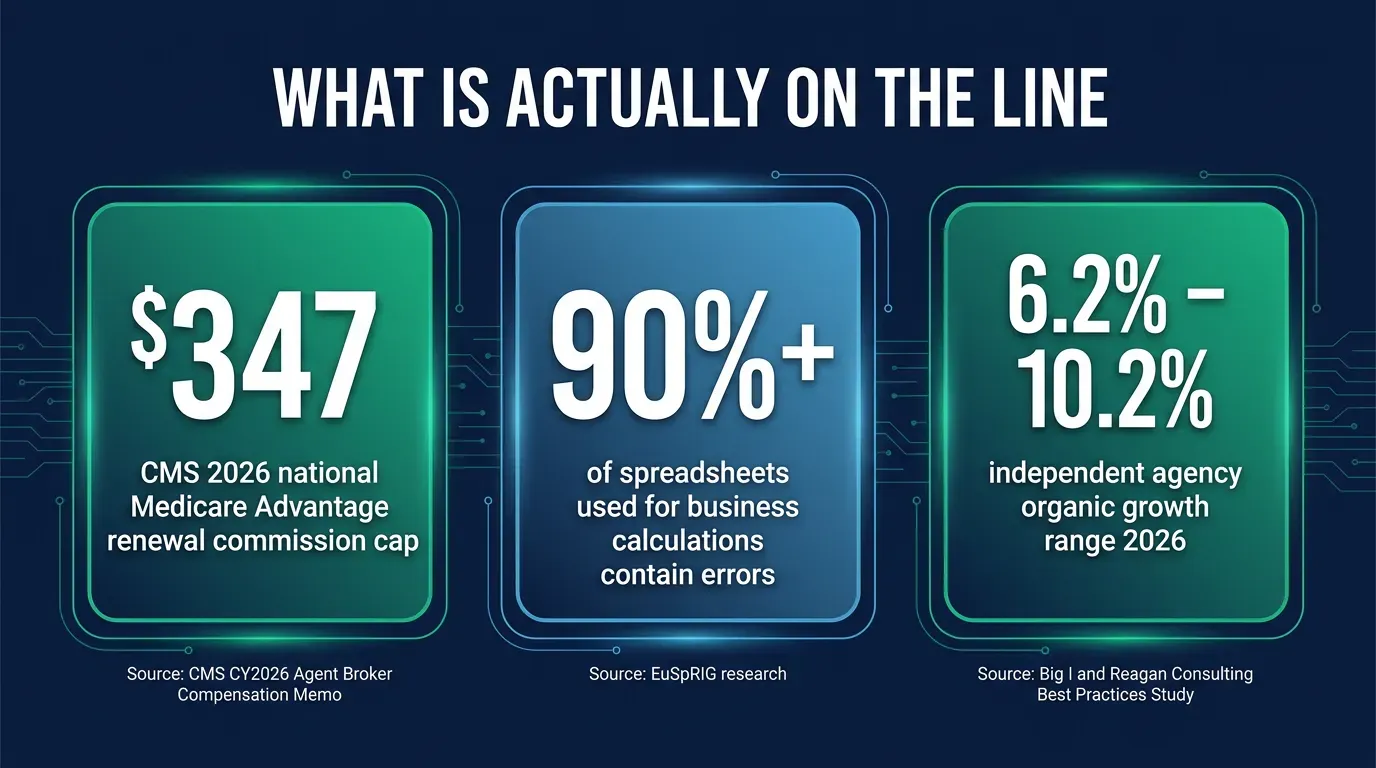
Run the math on one missed renewal line. A single Medicare Advantage client whose renewal silently drops off a carrier statement costs you up to $347 that year — and if nobody catches it, up to $347 again the next year, and the year after that, for as long as the client stays enrolled and nobody checks. Five years of one missed renewal line is up to $1,735 in compensation you were owed and never claimed, on a single policy, from a single clerical gap that never announced itself. Scale that across a book of a few hundred active clients across multiple carriers, and the fourteen-policy discovery one agency owner described to AgencyBloc stops looking unusual and starts looking like the ordinary outcome of nobody checking.
Independent agency organic growth, 2025 vs. 2026
The range across all agency revenue bands in the Big "I" and Reagan Consulting's annual Best Practices Study.
Source: Big "I" and Reagan Consulting, 2026 Best Practices Study, reported by IA Magazine (August 12, 2026).
That growth deceleration matters here for a specific reason: the same study put Pro Forma EBITDA margins for Best Practices agencies in a 23.2%–30.7% range across revenue categories, with the top-performing quartile under $1.25 million in revenue posting 42.5% (IA Magazine, August 12, 2026, reporting the Big “I” and Reagan Consulting’s own study). Margins in that range mean a chronic, unmonitored commission leak isn’t a rounding error against total revenue — it’s a direct hit against the actual profit line, in an environment where growth is already decelerating and every dollar of margin is doing more work than it did the year before.
Nobody sends you a memo when a carrier statement is missing a line. You only find out by checking, or you don't find out at all.
Mike MooreHow to reconcile commissions by hand, done completely
This is the part we’re not holding back. Here’s the real process, with zero tools and no membership required.
Build one master policy list, per carrier
A spreadsheet or a simple database with, at minimum: client name, policy or contract number, carrier, plan type, effective date, expected commission amount, and expected renewal date. If this doesn't already exist as a clean, current list, this is the actual prerequisite — you can't reconcile against a record you don't have.
Pull every carrier statement the moment it's issued
Most carriers post statements to a broker portal monthly. Don't let them stack up unopened — the longer a gap sits before you look at it, the more likely you've missed a carrier's own deadline for disputing an error.
Match every statement line to your master list, one by one
For each active policy on your master list, confirm it appears on the statement at the expected amount. This is the tedious part, and it's also the part that actually catches something — a summary total that looks approximately right tells you nothing about a single missing line.
Flag three categories separately: missing, short, and unexpected
Missing = a policy on your list that never appears on the statement. Short = it appears, but at less than the expected rate. Unexpected = a chargeback or cancellation on the statement you didn't already know about. Each category gets a different next step, so don't lump them into one generic "review later" pile.
Raise every flagged line with the carrier or your FMO, in writing, before their filing deadline
A dated email is enough of a record to start with. Ask specifically what happened on that policy number, not a general question about the statement — specificity gets a faster, more useful answer.
Update your master list immediately, whichever way the answer lands
If the carrier confirms an error and corrects it, note the resolution date. If your own record was wrong — a client actually did cancel and you hadn't updated it — fix your list. Either way, the list has to stay current or next month's reconciliation starts from a wrong baseline.
Do this monthly, not annually
Six steps, run every month against each carrier's own statement cycle, is a sustainable habit. Saving it for one big AEP-season catch-up means months of gaps compound before you look, and by then some carriers' own dispute-filing windows may already be closed on the earliest errors.
Where the manual process breaks down at scale
The six steps above are complete and they work — for one carrier, a hundred policies, and a spreadsheet you actually keep current. They get genuinely hard to sustain the moment your book crosses into multiple carriers, multiple product lines, and enough policy volume that a full line-by-line match takes real hours every single month. One AgencyBloc customer described managing 4,000 policies across 30 carriers for over 400 groups, and reported that the software saved her 80 hours she’d previously spent on manual commission calculations (AgencyBloc, published February 19, 2026). Eighty hours is two full work weeks — recovered, in her account, by replacing a manual process with a system built specifically to do the matching.
That’s the honest gap the manual method runs into: not that it’s wrong, but that it doesn’t scale linearly. Twice the policies isn’t twice the time — it’s more, because cross-referencing gets slower as the list grows and the odds of a transcription error in your own master list climb right alongside it, which loops right back to that EuSpRIG spreadsheet-error research. A system built to hold the two records — your policies and the carrier’s statements — and match them automatically is solving a structurally different problem than “try to be more careful.” If you’re weighing whether a dedicated AMS is worth adding to your stack at all, our lean insurance agency software budget breakdown covers where a tool like this fits against the rest of the line items.
How Ambrose’s agencybloc spoke and Routines automate the check
Ambrose OS, the platform included with a Tech Savvy membership, doesn’t calculate what a carrier owes you out of thin air — that number still has to come from your own policy data and the carrier’s own compensation schedule, the same as the manual process above. What it does do, per its own documentation, is remove the two most time-consuming parts of the manual process: keeping your policy and commission records in sync, and remembering to run the check on a schedule.
The mechanism is the agencybloc spoke, described in Ambrose’s own docs as a “bi-directional AgencyBloc AMS+ connector.” It reads individuals, groups, policies, activities, notes, and commissions directly from AgencyBloc into the agency’s private vault, and it can write Ambrose-generated notes, activities, and fields back to AgencyBloc — using idempotent trace headers so a re-run doesn’t create duplicate writes, with a kill-switch in settings to stop unintended writes entirely (Ambrose docs, spoke-agencybloc, fetched August 2026). In practice, that means the two lists you’d otherwise cross-reference by hand — your policy records and your commission history — already live in the same place Ambrose can query, instead of a spreadsheet you have to keep exporting and re-importing.
| Manual step | Ambrose mechanism |
|---|---|
| Keep a master policy list current | ab_policy_pull retrieves policies from AgencyBloc into the vault |
| Pull the carrier statement / commission data | The agencybloc spoke reads Commissions directly from AgencyBloc AMS+ |
| Match statement lines to the policy list by hand | A query against the synced vault data, asked in plain English instead of built as a spreadsheet formula |
| Log a flagged discrepancy for follow-up | ab_commission_push writes Ambrose-generated commission notes and records back to AgencyBloc |
| Remember to re-run the check every month | A Routine — a scheduled prompt on a cron schedule — with output posted to Slack, email, or a GHL note |
That last row is where the habit problem actually gets solved. A Routine is, in Ambrose’s own words, “a scheduled prompt attached to an agent or a team,” defined on a standard five-field cron schedule, with an optional output sink of “Slack, email, GHL note, log only” (Ambrose docs, Routines, fetched August 2026). Set one to run on the day after each carrier’s statement typically posts, ask it to compare the newest AgencyBloc commission data against your active policy list, and the “did anything come up short this month” question answers itself in a Slack message instead of a fresh block of hours on your calendar. If you’d rather route the question to a specific persona, Ambrose’s War Room includes a CFO seat — Casey Park, per the current roster — as one of the executive personas you can ask directly, alongside the Chief of Staff who triages which specialist should answer (Ambrose docs, War Room, fetched August 2026). We cover the full War Room roster and how the dispatch model works in our guide to Ambrose’s War Room for solo agency owners.
A synced connector doesn't replace the dispute conversation
Ambrose's agencybloc spoke and a scheduled Routine get you to "here's what doesn't match" faster and more reliably than a spreadsheet you re-check by hand. Actually disputing a short or missing payment with the carrier — the phone call or the written claim — is still a human conversation. What changes is how quickly you know there's a conversation to have.
What you get by joining
One Ambrose seat, including the agencybloc spoke and Routines, comes with a Tech Savvy Insurance membership: $97 a month, billed monthly, cancel anytime, founding rate locked in while the membership stays active. Alongside the seat: weekly Zoom calls with open Q&A and build-with-you sessions, 30+ hours of recorded training, AI and marketing training built for this industry, pre-built AI templates and bot deployments, and a free annual in-person member workshop. It’s also an explicit no-recruiting zone — you can ask a real question about a commission statement that doesn’t add up without ending up on someone’s downline pitch list, which is a genuine point of difference from most agent Facebook groups.
Ambrose usage runs separately from the $97 seat
The membership includes one Ambrose seat; usage inside Ambrose runs through its own credit ledger with spend caps, so cost stays visible instead of showing up as a surprise line item. See the full Spokes catalog for what else is available beyond agencybloc.
Compliance: what this touches, and what it doesn’t
Commission-sharing rules are a state matter, and they’re specific about who’s allowed to be paid. Most states restrict commission payment and sharing to appointed, licensed producers — Virginia’s version is explicit that “no insurer shall pay directly or indirectly any commission or other valuable consideration to any person for services as an agent or a surplus lines broker within this Commonwealth unless the person is then a duly appointed agent,” and that an agent may not “share his commissions or other compensation received or to be received by him on account of a transaction under his license with any person not also then licensed” (Code of Virginia § 38.2-1812). Confirm your own state’s producer licensing statute before assuming any specific figure or rule in this article applies where you’re licensed — this isn’t legal advice, and Tech Savvy Insurance isn’t a law firm.
This article is separate from Medicare marketing compliance. The TPMO disclaimer requirement and CMS’s marketing rules govern how you communicate with a beneficiary about a plan — they don’t govern back-office commission reconciliation, and reconciling a statement doesn’t change your TPMO disclaimer obligations one way or the other. If you’re also using AI tools as part of how you review commission or policy data, the NAIC’s Model Bulletin on the Use of Artificial Intelligence Systems by Insurers — adopted by the NAIC in December 2023, with individual states issuing their own versions since — sets the expectation regulators increasingly apply: a written policy on how the tool is used, human review before anyone acts on its output, and documentation if a regulator or carrier ever asks. And because a carrier statement is full of real client names and policy numbers, treat it the way you’d treat any document with protected health information attached — don’t paste it into a general-purpose AI tool without a signed BAA behind the destination. That’s precisely the gap Ambrose’s PHI Rail is built to close, aliasing identifiers before anything reaches a non-BAA destination and restoring them afterward (Ambrose docs, PHI Rail architecture, fetched August 2026).
The close
Everything above — the master policy list, the monthly match against each carrier’s statement, the written dispute, the habit of updating your own records the moment you learn something — works whether you ever join anything or not. That’s the point of writing it out completely. If you’d rather have the policy-and-commission side of this synced automatically, with a Routine surfacing what doesn’t match in Slack instead of a spreadsheet you re-check by hand, one Ambrose seat comes with a Tech Savvy membership, and the weekly build-with-you calls are where agents actually set up their first reconciliation Routine, on their own book, with people who’ve already done it: https://techsavvyinsurance.com/.
Before you rely on any figure in this article
Tech Savvy Insurance is a training and software community, not an insurance company, agency, or law firm, and does not provide insurance, legal, tax, or compliance advice. You are responsible for your own licensure and for complying with all applicable CMS, HIPAA, state, and carrier regulations, including your state's producer licensing and commission-sharing statutes. Commission rates, caps, and carrier practices can change — confirm current figures directly with your carrier, FMO, or state Department of Insurance before relying on any number here. AI-generated outputs may contain errors — always verify. Results may vary.
Frequently asked questions
Sources
- CMS — Contract Year 2026 Agent and Broker Compensation Rates, Referral/Finder's Fees, Submissions, and Training and Testing Requirements memo — ritterim.com
- PSM Brokerage — 2026 Medicare Advantage Broker Compensation Rates (June 2, 2026) — psmbrokerage.com
- EuSpRIG — Research and Best Practice (spreadsheet error research) — eusprig.org
- AgencyBloc — How Different Types of Agencies Use AgencyBloc to Process Commissions (published February 19, 2026) — agencybloc.com
- IA Magazine (Big "I") — Big 'I' and Reagan Consulting Release 2026 Best Practices Study Update (August 12, 2026) — iamagazine.com
- NAIC — Insurance Topics: Artificial Intelligence — content.naic.org
- Code of Virginia § 38.2-1812 — Payment and sharing of commissions — law.lis.virginia.gov
- Ambrose docs — Spoke: AgencyBloc — app.hiambrose.com
- Ambrose docs — Routines — app.hiambrose.com
- Ambrose docs — PHI Rail architecture — app.hiambrose.com
- Ambrose docs — War Room — app.hiambrose.com
- Ambrose docs — What is Ambrose — app.hiambrose.com
- 42 C.F.R. § 422.2274 — Renewal compensation capped at 50% of FMV, Cornell Law eCFR mirror — law.cornell.edu
Ready to put this into practice?
Join a private community of Health & Life insurance professionals using AI, Meta Ads, and automation to grow — without draining their bank account.
Join Tech Savvy — $97/month