A client calls to cancel the whole life policy you sold her mother three years ago and buy a bigger final expense policy from you instead. You’re happy. She’s happy. You’ve done this a hundred times and you know the pitch cold. What you might not have in front of you is the one piece of paper that turns this from a normal sale into a regulatory problem: the replacement notice. Every state requires one, in some form, the moment a new policy causes an existing one to lapse, shrink, or get cashed in, and most agents who’ve never been through a market conduct exam have no idea how specific the requirement actually is.
Key takeaways
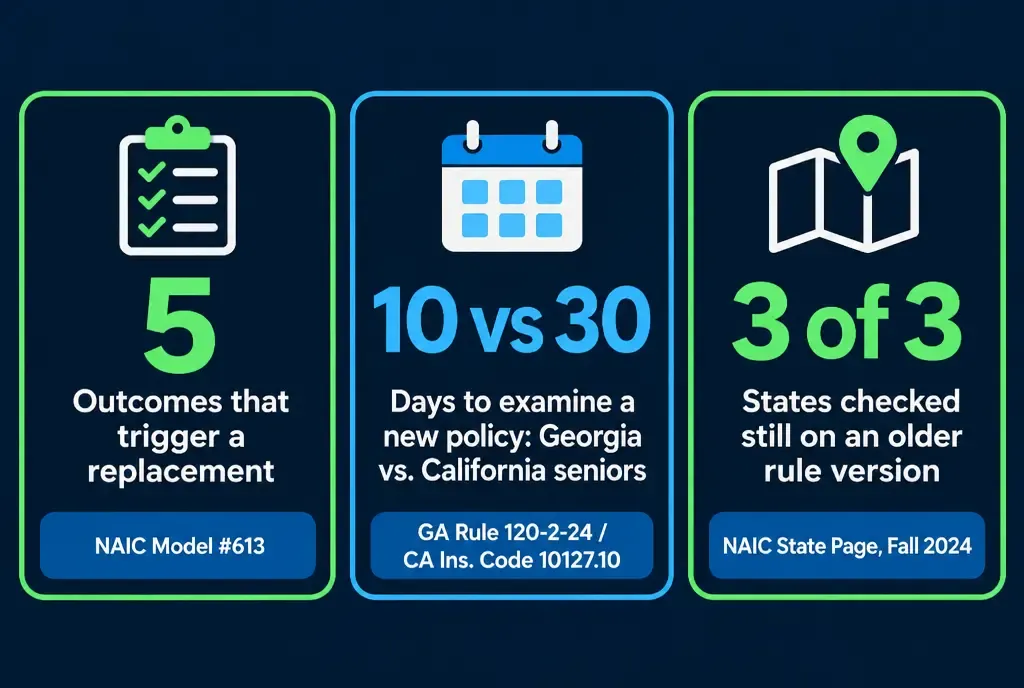
- NAIC's model defines "replacement" as five specific outcomes to an existing policy, not a vibe: lapsed, surrendered, reduced in value, amended to cut benefits, or used to finance the new premium (NAIC Model #613, Section 2(J)).
- Georgia gives a new individual policy a 10-day free look with a full premium refund; California requires a minimum 30-day free look for anyone 60 or older on life, annuity, long-term care, and Medicare Supplement policies (Georgia Rule 120-2-24, Exhibit A; Cal. Ins. Code § 10127.10(a),(g)).
- Georgia, Florida, and California are all listed under "Previous Version," not "Model Adoption," on NAIC's own Fall 2024 state-adoption chart for this regulation, meaning none of the three currently runs the 2015 national model text (NAIC, Model Regulation State Page, Fall 2024).
- A pattern of clients answering "no" to the replacement question and then replacing anyway is treated as evidence of your intent to violate the rule, per the model's own language, independent of any single transaction (NAIC Model #613, Section 8(B)).
- Ambrose's client-vault spoke can hold a client's policy list and attach the signed replacement notice as a document; it's documented as a per-client record store, not an automated compliance checker, and this article says so plainly (Ambrose docs, spoke-client-vault, fetched November 2026).
The pain: you know the pitch, you don’t know the paperwork
Ask ten agents who sell final expense or whole life to recite the replacement question verbatim, and most will paraphrase it. Ask them which state’s free-look period applies when the client moved from Georgia to Florida last year, and the room gets quiet. That’s the actual gap. The sales conversation — here’s what your mother’s old policy is worth, here’s what the new one covers, here’s why it’s a better fit now — is the part agents are good at, because it’s the part that gets practiced every week. The replacement notice is the part that only comes up when something goes wrong, which means most agents have never had a reason to get precise about it.
This is about swapping policies, not about buying leads
If your question is how to vet a lead vendor before you spend money on final expense leads, that's covered separately in our guide to vetting insurance lead vendors. This article is about the transaction after that: what happens on paper the moment a sale causes an existing policy to lapse, shrink, or get cashed in.
Here’s the mechanism that makes this a real, specific problem instead of a vague compliance worry. The National Association of Insurance Commissioners’ Life Insurance and Annuities Replacement Model Regulation, Model #613, defines “replacement” in Section 2(J) as a transaction where a new policy is purchased and the producer knows or should know that, as a result, an existing policy has been or will be:
- Lapsed, forfeited, surrendered or partially surrendered, assigned to the replacing insurer, or otherwise terminated;
- Converted to reduced paid-up insurance, continued as extended term insurance, or otherwise reduced in value by nonforfeiture benefits or other policy values;
- Amended to reduce benefits or the term coverage remains in force;
- Reissued with any reduction in cash value; or
- Used in a financed purchase — meaning money withdrawn, surrendered, or borrowed from the old policy’s values is used to pay premium on the new one (NAIC, Life Insurance and Annuities Replacement Model Regulation, 2015 edition, Section 2(J)).
That list matters because it closes the door on “I didn’t think of it as a replacement.” If any one of those five things happens because of your sale, the regulation applies. Not because you called it a replacement. Not because the client thinks of it that way. Because the mechanics of the transaction match one of five defined outcomes.
Why it happens: the rule asks a question most agents treat as a formality
The replacement rule isn’t complicated in structure. It asks one question at the application, and depending on the answer, triggers a specific sequence of notices and timeframes. Where agents get into trouble isn’t the complexity. It’s treating the question as a box to check rather than the trigger for an actual process.
Per Section 3 of the model regulation, “Duties of Producers,” here’s the actual sequence:
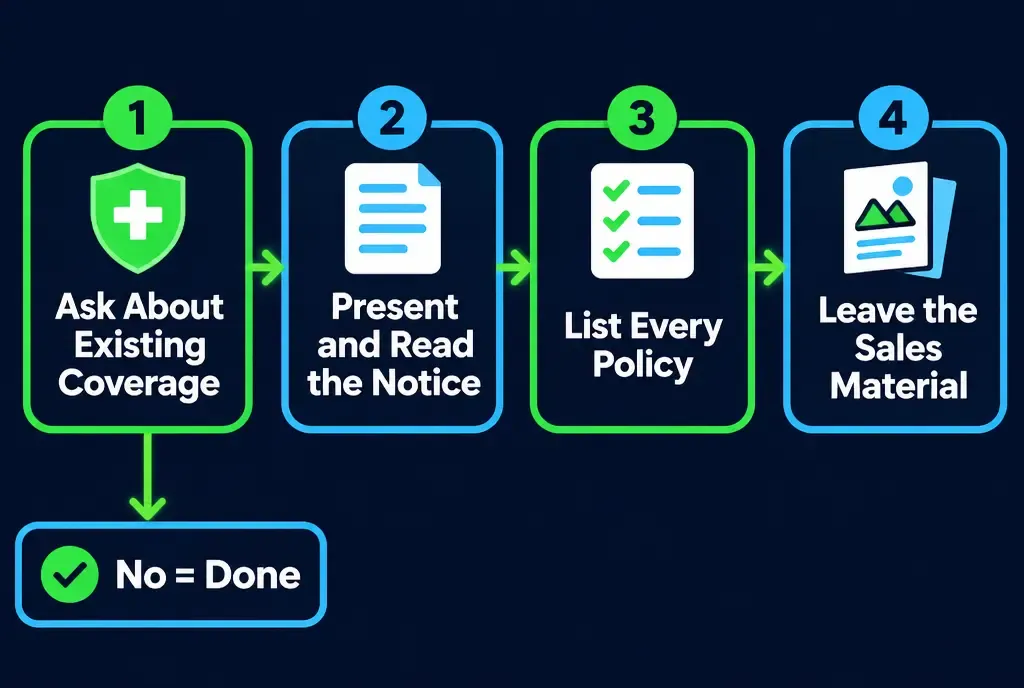
Step 1 — the existing-coverage question. The producer who takes the application has to submit a statement, signed by both the applicant and the producer, saying whether the applicant has existing policies or contracts. Answer “no,” and the producer’s replacement duties are done. Answer “yes,” and the next steps apply (NAIC Model #613, Section 3(A)).
Step 2 — present and read the notice. If the answer is “yes,” the producer has to present and read to the applicant, no later than at the time of taking the application, a notice regarding replacements, in the form in Appendix A or a substantially similar form the commissioner has approved. The notice has to be signed by both the applicant and the producer, attesting either that the producer read it aloud, or that the applicant specifically didn’t want it read aloud. The applicant keeps a copy (NAIC Model #613, Section 3(B)).
Step 3 — list every policy being touched. The notice has to list every life insurance policy or annuity being replaced, identified by insurer name, insured or annuitant, and policy number if you have it. It also has to state whether each one will actually be replaced or used as a source of financing for the new policy (NAIC Model #613, Section 3(C)).
Step 4 — leave the sales material. Whatever sales material was used in the replacement conversation — illustrations, brochures, anything presented to the client — a copy has to be left with the applicant at the time the application is completed (NAIC Model #613, Section 3(D)).
| Step | What's required | Source |
|---|---|---|
| 1. Ask the question | Signed statement: does the applicant have existing coverage? | NAIC #613 §3(A) |
| 2. Present the notice | Read aloud (or applicant waives), both parties sign, applicant keeps a copy | NAIC #613 §3(B) |
| 3. List the policies | Insurer, insured/annuitant, policy number for each policy touched | NAIC #613 §3(C) |
| 4. Leave the sales material | Copy of illustrations/brochures used, left with the applicant | NAIC #613 §3(D) |
Two more things happen after you walk out of that appointment, and they’re not yours to do, but you should know they exist because clients sometimes ask about them. The replacing insurer has to mail the notice and a copy of the communication to the existing insurer within a working-day window set by the state’s version of the rule, and the existing insurer then has a window of its own to send the policyholder a policy summary. In Georgia specifically, that existing-insurer window is ten working days, and the existing insurer has to keep copies of the notice and related communications on file, indexed by insurer, for three years or until its next regular examination by its home-state regulator, whichever is later (Georgia Comp. R. & Regs. 120-2-24, Rule .06(4)-(5)). Your state’s own version may set different windows. None of that is on you as the producer. What’s on you is Steps 1 through 4, done at the kitchen table, every time.
What it actually costs: the free look, and the pattern problem
There are two distinct costs here, and they’re not the same risk.
The free-look cost is the one you’ll actually see. If the client exercises their right to examine the new policy and returns it within the window, you get a full premium refund situation and, depending on your contract, a commission chargeback. That window is not the same everywhere, and this is where a lot of agents get a specific fact wrong without realizing it. Georgia’s rule gives the policyholder ten days to examine a new individual policy and return it for a full premium refund (Georgia Comp. R. & Regs. 120-2-24, Exhibit A). California requires a minimum of thirty days for anyone who is a “senior citizen” under its statute — defined as 60 years of age or older on the date of purchase — on life insurance, annuity, long-term care, and Medicare Supplement policies alike (Cal. Ins. Code § 10127.10(a), (g)). If most of your production is final expense sold to clients over 60, and you’re used to thinking in terms of a ten-day window because that’s what you learned in pre-licensing, you’re carrying a wrong number for a meaningful share of your book.
Free-look window: Georgia's general rule vs. California's senior-citizen rule
Both are real, current requirements — they just apply to different ages and different states
Sources: Georgia Comp. R. & Regs. 120-2-24, Exhibit A; Cal. Ins. Code § 10127.10(a),(g). Check your specific state's current rule; these two are examples, not a national standard.
The pattern cost is the one that doesn’t show up until it’s already a problem. The model regulation is explicit that a single client answering “no” to the replacement question and then replacing anyway isn’t automatically treated as your fault — people have the right to change their minds. But Section 8(B) states plainly that “patterns of such action by policy or contract owners of the same producer shall be deemed prima facie evidence of the producer’s knowledge that replacement was intended,” and that this pattern evidence extends to “intent to violate this regulation” (NAIC Model #613, Section 8(B)). In plain terms: one client saying “no” and replacing anyway is a coincidence. Several of your clients doing the same thing is, in the regulation’s own language, evidence against you, without the state needing to prove what you were thinking on any individual sale.
Section 8(A) separately lists specific things that count as violations of the state’s unfair trade practices “twisting” statute: deceptive or misleading sales material, failing to ask the replacement question at all, intentionally recording an answer incorrectly, advising an applicant to answer “no” specifically to avoid notifying the existing insurer, and advising a client to write directly to the company in a way that obscures who actually sold the replacement (NAIC Model #613, Section 8(A)). None of these require a dollar figure to matter to your license. A documented pattern across your book is the kind of thing a market conduct exam is built to find.
One client answering "no" and replacing anyway is a coincidence. A pattern of your clients doing it is, in the regulation's own words, evidence against you.
Mike MooreThe manual fix: build a replacement checklist you actually use at the table
This doesn’t require software. It requires treating four steps as mandatory instead of optional, and knowing your specific state’s numbers cold.
Step 1: Ask the existing-coverage question every single time, out loud, and get it signed
Don’t let this become a line you skim past on the application while you’re focused on the sale. The statement has to be signed by both the applicant and you. If the honest answer is “yes,” the rest of the process starts here — there’s no version of this where you find out later and retroactively fix it.
Step 2: Know your state’s actual replacement notice form, not a generic one
Carriers build their own version of the Appendix A notice into their application packet, and it’s commissioner-approved, not something you draft yourself. Pull the exact form your carrier uses for the state you’re writing in, and actually read it rather than reciting it from memory. The model allows the applicant to decline having it read aloud, but that decision belongs to the applicant, documented on the form — not assumed by you because the appointment is running long.
Step 3: List every policy being touched, with real identifiers
Insurer name, the insured or annuitant’s name, and the policy number if you have it. If the client doesn’t have the policy number handy, note what identifying information you do have (an application or receipt number works per the model) rather than leaving the line blank. And say explicitly on the form whether each existing policy is being replaced outright or used as a financing source for the new one — those are different declarations with different downstream effects.
Step 4: Know your state’s free-look window before the client asks
This is the step most agents skip because it feels like a detail for underwriting to handle later. It isn’t. If a client asks “how long do I have to change my mind,” you should be able to answer correctly for the specific state and the specific client’s age, not with a number you memorized in pre-licensing for a different state. Georgia: ten days, flat. California: thirty days minimum if the client is 60 or older, on life, annuity, long-term care, or Medicare Supplement coverage alike. Your state’s number is almost certainly different from both, and you look it up from the current rule text, not from what a trainer told you three years ago.
Your state's rule may be older than the national model
NAIC's own Fall 2024 state-adoption chart for this regulation lists Georgia's rule (120-2-24, 1972/2007), Florida's rule (69B-151.001 to .202, 1981/2018), and California's statute (Cal. Ins. Code §§ 10509 to 10509.9, 1990/2017) all under "Previous Version" — meaning none of the three has adopted the current 2015 NAIC model text (NAIC, Model Regulation State Page, Fall 2024). That doesn't make the state rule optional. It means the specific duties, timeframes, and form requirements you're bound by are whatever your state's own current regulation says, which can differ from the national model this article walks through. Pull your actual state's current citation before you finalize a script.
Everything above works whether you ever touch Ambrose or join anything. It’s a checklist and a habit, not a purchase.
Where Ambrose actually fits, and where it honestly doesn’t
Here’s the part worth being direct about. Ambrose, the platform included with a Tech Savvy membership, is not a tool that reads a signed replacement notice and tells you whether it’s valid, and this article isn’t going to pretend it is.
What it does have, per its own documentation, is a genuine fit for two specific pieces of this workflow. The client-vault spoke is documented as a “client-facing enrollment, policy, and document store,” indexed per client rather than book-wide, with four tools: client_get (fetch a single client record), client_list_policies (all policies for a client), client_add_document (attach a new document — PDF or image), and client_search (search within one client’s data) (Ambrose docs, spoke-client-vault, fetched November 2026). In practice, that means two concrete uses: pulling up client_list_policies before you ask the existing-coverage question, so you’re working from a real record instead of the client’s memory, and using client_add_document to attach the scanned, signed replacement notice to that client’s file the same day you take the application, instead of hoping a paper copy doesn’t get lost in a stack.
The second fit is the War Room. Ambrose’s nine-head executive roster includes a dedicated Compliance persona, Dr. Elena Reyes, alongside the CMO, COO, CFO, CRO, CCO, CTO, Research, and Ambrose herself as Chief of Staff (Ambrose docs, War Room, fetched November 2026). The War Room page doesn’t document an automated feature that reviews a replacement script or flags a missing signature — so this article isn’t going to claim one exists. What it is documented to do is give you a place to ask a specific compliance question in plain English and get routed to the right specialist, which is a genuinely different thing from a sales trainer’s general answer, and worth using exactly as that: a second opinion before a script goes out, not a pass/fail compliance engine.
The checklist from this article
- You ask the existing-coverage question out loud, every time, and get it signed
- You pull your carrier's exact Appendix A form for the state you're writing in
- The signed notice lives in a physical folder or a scanned PDF you file yourself
- Works today, in any state, at zero cost
One client record, one place to ask
- client_list_policies pulls the client's existing coverage before you ask
- client_add_document attaches the signed notice to that client's file the same day
- Dr. Elena Reyes (Compliance) in the War Room is one place to ask a specific state question
- Comes with one Ambrose seat included in the Tech Savvy membership
The honest version of this section
As documented this session, neither client-vault nor the War Room is a replacement-rule compliance checker. Client-vault stores and attaches documents; it doesn't validate that a signature is present or that a form matches your state's current version. The War Room routes a question to the right specialist; it doesn't audit a script against a regulation automatically. If a feature that specifically validates replacement paperwork against your state's rule matters to your agency, ask about it directly rather than assuming it exists because it would be a natural next step.
The AI governance angle: writing a policy for how you use any of this
If any part of your replacement workflow involves an AI tool summarizing a client’s policy history, drafting a replacement notice, or deciding which form version applies, that’s governance worth documenting, not just using. The NAIC’s Model Bulletin on the Use of Artificial Intelligence Systems by Insurers, adopted December 2023, sets the baseline expectation regulators increasingly apply: a written policy on how the tool is used, human oversight before anyone acts on its output, documentation you can produce if asked, and accountability that follows through to any vendor whose AI tool you rely on (NAIC, Insurance Topics: Artificial Intelligence, Model Bulletin, fetched November 2026). A replacement notice is exactly the kind of document where “the AI drafted it and I signed it without reading it” is not a defense if the form turns out to be wrong for the state.
Ambrose’s documentation describes the platform as “HIPAA compliant as a platform,” with the acting agency’s tenant ID resolved server-side from the session rather than from user or model input, and Postgres row-level security enforcing that every read and write stays scoped to that tenant (Ambrose docs, How client data is protected, fetched November 2026). That’s the same architecture discussed in our companion guide on what not to paste into a general AI tool — a client’s existing-policy details and a signed replacement notice both qualify as the kind of record that belongs in a system built around that isolation, not pasted into a general-purpose chatbot to “clean up” or summarize.
Does this apply if I only sell final expense, not big-ticket whole life?
Yes, and arguably it matters more. Final expense policies are smaller, which means the margin for a chargeback to actually hurt is thinner, and final expense buyers are disproportionately the exact age group California’s extended senior free-look rule targets. Take an illustrative, invented example: a $10,000 final expense sale that gets returned inside a 30-day senior free-look window is a meaningful commission hit relative to the size of the sale itself, in a way a $10,000 return against a $2 million whole life case wouldn’t be. If several of your final expense replacements get returned in the same quarter, that’s precisely the pattern Section 8(B) describes.
What if the client already canceled the old policy before telling me?
Walk through what actually happened before you assume you’re clear. If the client surrendered or let the old policy lapse on their own, without you knowing it was tied to a new sale you were presenting, that’s a different fact pattern than if you knew or should have known — the model’s own language turns on whether the producer “knows or should know” the old policy would be affected (NAIC Model #613, Section 2(J)). If you were in the room discussing both policies, “should have known” is a hard argument to win. Document what you actually knew and when, and if you’re unsure whether your specific situation triggers replacement duties, that’s a question worth asking directly rather than guessing.
What you get by joining
One Ambrose seat, including client-vault and the War Room, comes with a Tech Savvy Insurance membership: $97 a month, billed monthly, cancel anytime, founding rate locked in while the membership stays active. Alongside the seat: weekly Zoom calls with open Q&A and build-with-you sessions, 30-plus hours of recorded training, Meta Ads and AI training built for this industry specifically, pre-built AI templates and bot deployments, and a free annual in-person member workshop. It’s also an explicit no-recruiting zone — you can ask a real question about a replacement rule you’re not sure about without ending up on someone’s downline pitch list, which is a genuine point of difference from most agent Facebook groups.
Ambrose usage runs separately from the $97 seat
The membership includes one Ambrose seat; usage inside Ambrose runs through its own credit ledger with spend caps, so cost stays visible instead of showing up as a surprise. See the full Spokes catalog for what else is available beyond client-vault and the War Room.
Ask the existing-coverage question every time
Signed by both parties, no exceptions, no skimming past it.
Use your carrier's actual approved notice form
Not a generic script you're reciting from memory.
List every policy with real identifiers
Insurer, insured, policy number, or the closest identifier you have.
Know your state's actual free-look window
By age and product, not by what you memorized once for a different state.
File the signed notice the same day
client_add_document attaches it to the client's record, not a loose stack of paper.
Ask Compliance before the script goes out
Dr. Elena Reyes in the War Room — a second opinion, not an automatic pass/fail.
Get the paperwork right before the next swap
The checklist above works whether you ever join anything or not. If you'd rather have your client's existing policies and a place to file the signed notice already set up, with someone watching your screen while you do it, one Ambrose seat comes with the Tech Savvy membership.
Join Tech Savvy — $97/monthThe close
The sales conversation was never the risk. The four steps that happen after the client says yes are. Run the checklist this week on your next replacement, cold, from memory of the actual rule rather than a paraphrase — and if you want client-vault already holding the policy list and Dr. Elena Reyes one message away for the state question you’re not sure about, that’s what a Tuesday call in the Tech Savvy community looks like. $97 a month, cancel anytime, and nobody will pitch you a downline: https://techsavvyinsurance.com/.
Before you rely on any figure in this article
Tech Savvy Insurance is a training and software community, not an insurance company, agency, or law firm, and does not provide insurance, legal, tax, or compliance advice. You are responsible for your own licensure and for complying with all applicable NAIC model-based state regulations, CMS, HIPAA, and carrier rules, including your specific state's current replacement regulation, which may differ from the 2015 NAIC model text quoted here. Regulations and state adoptions change — confirm current requirements directly with your state Department of Insurance or qualified legal counsel before relying on any figure in this article. AI outputs, including any AI-assisted document handling, may contain errors — always verify. Results may vary.
Frequently asked questions
Sources
- NAIC — Life Insurance and Annuities Replacement Model Regulation (#613), 2015 edition — content.naic.org
- NAIC — Life Insurance and Annuities Replacement Model Regulation, State Page (Fall 2024) — content.naic.org
- Georgia Department of Insurance — Rule 120-2-24, Replacement of Life Insurance Policies — rules.sos.ga.gov
- California Insurance Code § 10127.10 — california.public.law
- California Department of Insurance — Informing Seniors About Life Insurance, Annuities, Long-Term Care and Medicare Supplement Coverage — insurance.ca.gov
- NAIC — Insurance Topics: Artificial Intelligence (Model Bulletin, adopted Dec. 2023) — content.naic.org
- Ambrose docs — spoke-client-vault — app.hiambrose.com
- Ambrose docs — War Room — app.hiambrose.com
- Ambrose docs — How client data is protected (PHI Rail) — app.hiambrose.com
- Ambrose docs — Spokes catalog — app.hiambrose.com
Ready to put this into practice?
Join a private community of Health & Life insurance professionals using AI, Meta Ads, and automation to grow — without draining their bank account.
Join Tech Savvy — $97/month