
A beneficiary designation audit is a scheduled check of every life and annuity policy in your book to confirm the named beneficiary is still correct: not blank, not defaulted to “estate,” not an ex-spouse nobody ever removed. The NAIC’s own Life Insurance Policy Locator Service has matched more than $16.99 billion in benefits to beneficiaries since 2016, precisely because that check doesn’t happen often enough. This article gives you the full manual audit, the two Supreme Court cases that decide who actually gets paid after a divorce, and what Ambrose’s agent-vault spoke does about it.
Key takeaways
- The NAIC's Life Insurance Policy Locator Service has matched $16,991,229,586 in life insurance and annuity benefits to beneficiaries since its November 2016 launch, through July 31, 2026 — up from $13.18 billion a year earlier and $10.12 billion the year before that (NAIC press releases, Sep. 2024, Sep. 2025, Sep. 2026).
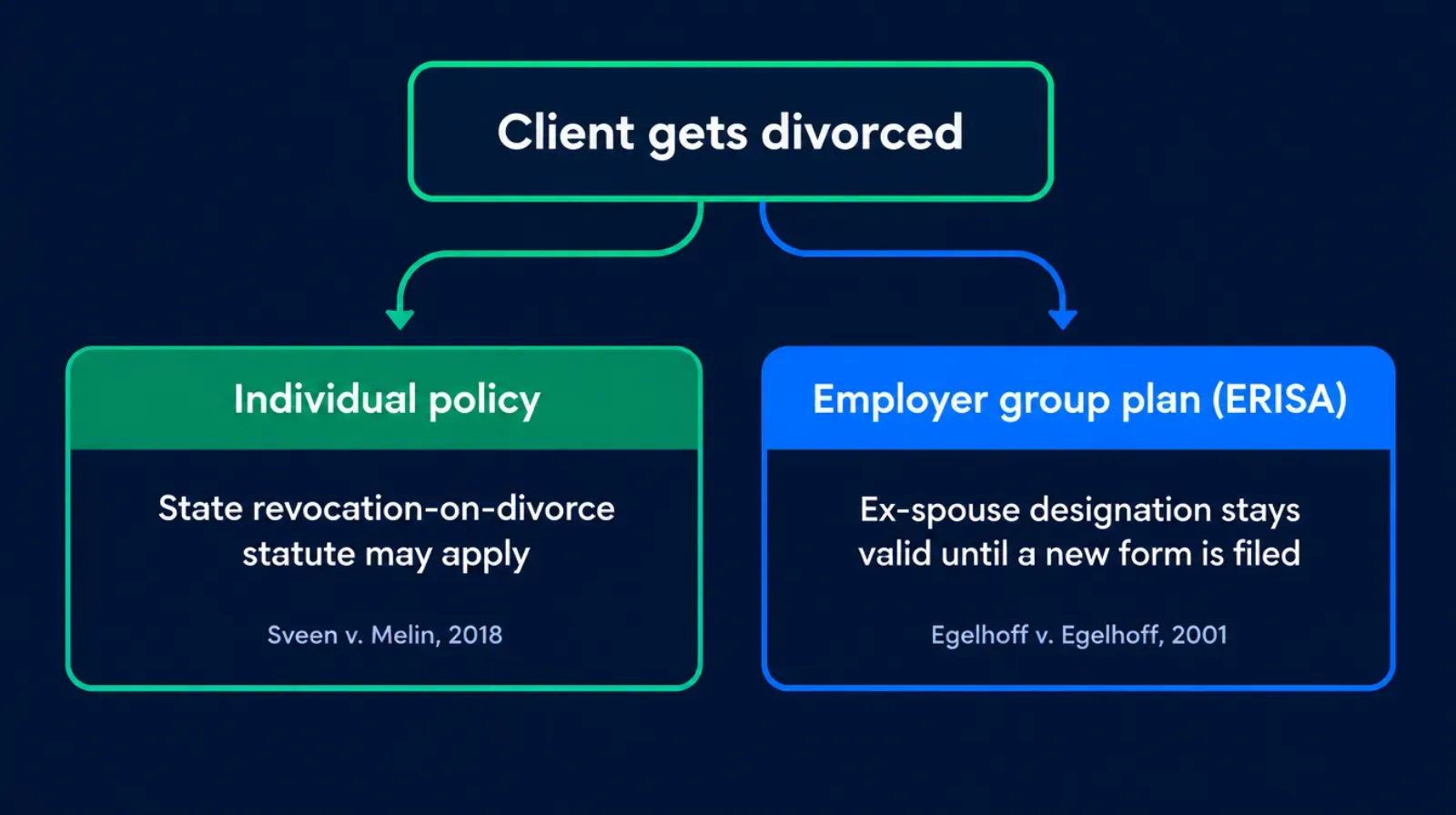
- Whether a divorce automatically removes an ex-spouse as beneficiary depends entirely on the policy type: 26 states have a revocation-on-divorce statute (Sveen v. Melin, 2018), but ERISA preempts those state statutes for employer-sponsored group life plans (Egelhoff v. Egelhoff, 2001). The same divorce can produce opposite outcomes on two different policies for the same client.
- Naming a minor directly as a beneficiary forces a court guardianship or conservatorship proceeding that "can cost thousands of dollars in expenses and may take several months to complete" before the money is released (Munich Re US Life).
- A five-point manual audit — beneficiary present, percentages add to 100%, no minors named directly, divorce-and-policy-type cross-check, contingent beneficiary on file — is fully usable with zero tools and no membership, and it's given away in full below.
- Ambrose's agent-vault spoke indexes CSV/PDF policy files and exposes vault_search, vault_get_client, vault_list_recent, and vault_classify_lob, so the same audit runs as a search query instead of a folder-by-folder review (Ambrose docs, spoke-agent-vault, fetched September 2026).
The pain: the form got filled out once, and nobody looked at it again
A client buys a $250,000 term policy in 2014. She’s engaged at the time, names her fiancé, and the agent who sold it moves on to the next appointment. She marries him. They have two kids. Eleven years later, she calls to add a rider and mentions, almost as an aside, that she and her husband divorced two years ago and she’s since remarried. Nobody asks the obvious next question: who’s still named on that 2014 policy? If nobody checks, the answer is her ex-husband, and depending on the state and the policy type, that designation might still be legally valid the day she dies.
This isn’t a hypothetical edge case. It’s the default outcome of how beneficiary forms actually work in this industry: filled out once, at the point of sale, under time pressure, and then filed away with no built-in trigger to ever look at them again. A mortgage gets refinanced and the paperwork gets re-reviewed. A car insurance policy gets a new quote every renewal. A life insurance beneficiary designation, once submitted, can sit untouched for decades — through marriages, divorces, deaths, new children, and estrangements — because nothing about the policy’s normal life cycle forces anyone to revisit it.
The scale of the resulting problem is not a guess. The NAIC’s Life Insurance Policy Locator Service, a free tool that lets consumers search for lost or forgotten life insurance and annuity policies, has matched more than $16.99 billion in benefits to beneficiaries since it launched in November 2016 (NAIC, press release, Sep. 3, 2026). That’s not $16.99 billion in policies that were never sold — it’s $16.99 billion that insurers already owed to real people, sitting unclaimed because nobody on either side of the transaction kept the contact and beneficiary information current enough for the payout to happen on its own.
Why it happens: nothing about a policy’s life cycle forces a re-check
Three mechanics stack on top of each other, and none of them are anyone’s fault in isolation.
First, the point of sale is the only moment the form gets attention. An agent walks a client through beneficiary designation once, during underwriting, when the relevant life facts are whatever’s true that day. After the policy is issued, there’s no renewal notice that says “please reconfirm your beneficiary,” the way there might be for a mailing address or a payment method. The form is treated as a one-time administrative task rather than a piece of information with a shelf life.
Second, life events don’t come with a beneficiary-update reminder attached. A divorce decree deals with property division, custody, and support. Updating a decades-old life insurance beneficiary form is rarely the divorce attorney’s job, and it’s not usually top of mind for a client who’s exhausted from the process itself. The same is true of a second marriage, a new child, or the death of a previously named beneficiary — each is a major life event that, on its own, changes nothing about the paperwork unless someone actively goes and changes it.
Third, and this is the part specific to insurance, the legal answer to “does the old designation still count” isn’t the same for every policy, which makes agents reluctant to bring it up at all. Twenty-six states have adopted a revocation-on-divorce statute modeled on the Uniform Probate Code, which automatically cancels an ex-spouse’s beneficiary status the moment a divorce is finalized (Sveen v. Melin, 584 U.S. ___ (2018)). But the U.S. Supreme Court ruled unanimously in Egelhoff v. Egelhoff, 532 U.S. 141 (2001), that ERISA preempts those state statutes for employer-sponsored group life plans — meaning a workplace policy governed by federal law can still pay an ex-spouse, because the state law that would have revoked the designation simply doesn’t apply to it. Most agents have never had to explain this distinction to a client, so most agents don’t bring it up, and the ambiguity becomes an excuse to leave the whole subject alone.
A form that gets filled out once and never looked at again isn't a beneficiary designation. It's a coin flip with a filing date.
Mike MooreWhat it costs: a decade of growth in a tool that shouldn’t need to exist
None of the figures below say a specific client’s policy will go unclaimed. They establish the scale of what happens across an entire industry when beneficiary and contact information isn’t kept current — and why the NAIC felt the need to build, and keep funding, a free national locator tool in the first place.
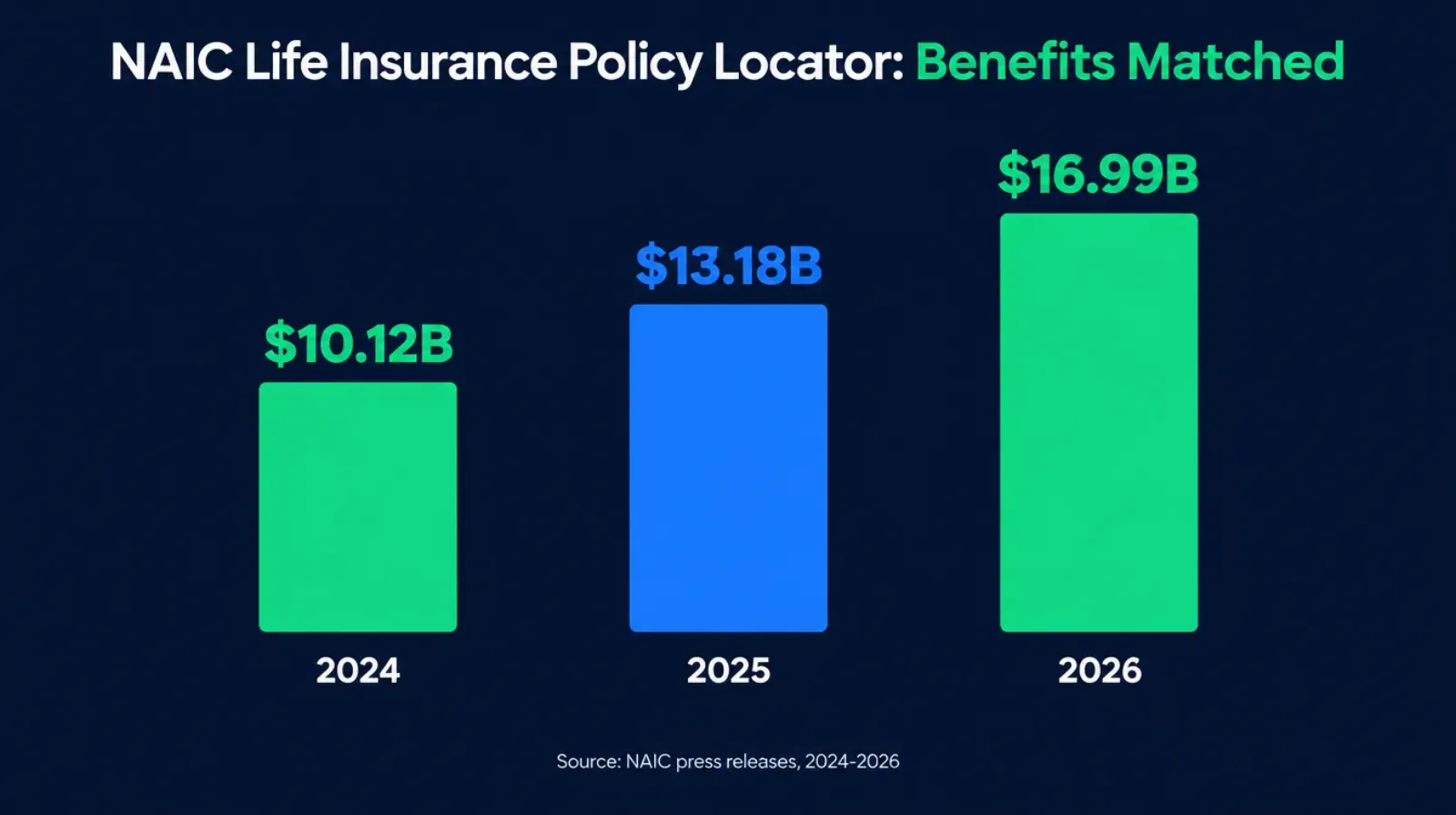
The NAIC Life Insurance Policy Locator Service: cumulative benefits matched to beneficiaries
Total dollars connected to consumers since the tool's November 2016 launch, as reported in each year's NAIC press release
Source: NAIC press releases, Sep. 25, 2024; Sep. 30, 2025; Sep. 3, 2026. Cumulative total since the Life Insurance Policy Locator Service's November 2016 launch, fetched September 2026.
That growth curve is good news for the consumers the tool eventually reaches. It’s also a direct measurement of how much money sits behind stale contact information and unreviewed beneficiary files industry-wide, every single year, before anyone thinks to search for it. Every dollar in that total represents a policy where either the insurer couldn’t find the beneficiary, or the beneficiary didn’t know to look — and in a meaningful share of those cases, the person who could have prevented it was the agent who sold the policy and never followed up.
Regulators noticed the same gap from the insurer’s side. A model act built to close it now requires carriers in adopting states to proactively compare their in-force policies against the Social Security Administration’s Death Master File rather than waiting for a claim to be filed. Rhode Island’s version, enacted in 2014 and effective January 1, 2016, requires insurers to run that comparison “on at least a semi-annual basis,” then complete a good-faith effort to confirm the death and locate the beneficiary “within ninety (90) days of a death master file match” (R.I. Gen. Laws Ch. 27-80). That’s the insurer-side half of the fix. The agent-side half — making sure the beneficiary information on file is actually current when that match happens — is what the rest of this article covers.
There’s a second, quieter cost that doesn’t show up in a locator tool’s press release: the interpleader lawsuit. When an insurer receives competing claims to the same death benefit — an ex-spouse who was never removed, a second spouse who assumed she was covered, adult children who thought they were named — the insurer’s standard response is to file an interpleader action, pay the disputed proceeds into the court, and let the claimants litigate it out among themselves. The insurer avoids liability either way. The family doesn’t. And if the agent is shown to have known about a relevant life event and never prompted a beneficiary review, that agent is the first call the losing side’s attorney makes next.
The manual audit: five checks, on every policy, no tools required
This works with a spreadsheet, a filing cabinet, or whatever CRM you already have. It doesn’t require new software, and it’s the same audit whether you run it by hand or eventually point a vault search at it.
Check 1: Is there a beneficiary on file at all?
Pull the actual application or the carrier’s confirmation page, not just what’s in your CRM’s notes field — CRMs get typos and stale copies; the carrier’s record is the one that pays the claim. If the field is blank, says “TBD,” or was never submitted, that policy defaults to paying the insured’s estate, which routes the payout through probate instead of directly to a person. That’s a fully preventable outcome, and it’s the single fastest fix on this list: get a signed, dated beneficiary form back from the client before anything else on this checklist.
Check 2: Do the percentages actually add up to 100%?
Multiple-beneficiary policies fail this check more often than agents expect. A client names three children at “40% / 40% / 40%,” or writes “split evenly” without specifying a method for an uneven number of shares, or updates one child’s percentage after a falling-out without touching the others. Any of these can turn a straightforward claim into a delayed one while the insurer sorts out what the client actually meant. Pull every multi-beneficiary policy and do the arithmetic by hand; it takes thirty seconds per policy and it’s the kind of error a client would never think to check themselves.
Check 3: Is a minor named directly, with no custodian arrangement?
This is the check most agents skip because it feels like someone else’s job — and it partly is, but flagging it is yours. Insurers cannot pay policy proceeds directly to a minor. If a policy names a child outright with no custodian or trust structure in place, the proceeds get held up in a court guardianship or conservatorship proceeding, which “can cost thousands of dollars in expenses and may take several months to complete in some jurisdictions” (Munich Re US Life, The Challenge of Minor Beneficiaries). The fix — naming an adult custodian under the Uniform Transfers to Minors Act, or setting up a trust for larger policies — is a legal and estate-planning decision that belongs with the client’s own attorney, not with you. Your job on this check is narrow and specific: find the policies with this problem and tell the client it exists.
Check 4: Cross-check the beneficiary against every divorce, and against the policy type
This is the check that requires knowing which kind of policy you’re looking at, because the same divorce produces different legal outcomes depending on the answer.
| Policy type | Governing law | Does a state revocation-on-divorce statute apply? | Controlling case |
|---|---|---|---|
| Individual policy bought directly by the client | State insurance and probate law | Yes, in the 26 states that have adopted one, unless the policy says otherwise | Sveen v. Melin, 584 U.S. ___ (2018) |
| Employer-sponsored group life plan | Federal ERISA law | No — ERISA preempts the state statute for these plans | Egelhoff v. Egelhoff, 532 U.S. 141 (2001) |
| Policy in a state with no revocation-on-divorce statute | State law (no relevant statute) | No — the original designation stands until the client files a new one | Not applicable; confirm the specific state |
Read that table again with a specific client in mind: someone with an individual term policy purchased directly from a carrier, and a separate group life policy through their employer, who gets divorced. In a revocation-on-divorce state, the individual policy might automatically drop the ex-spouse. The employer group policy, governed by ERISA, does not — Egelhoff is explicit that federal law preempts the state statute for that plan, “presumption against pre-emption in areas of traditional state regulation such as family law” notwithstanding. Same divorce, same client, two different legal outcomes on two different policies. This is exactly the kind of nuance that makes “just assume the state law handles it” a dangerous shortcut, and it’s why Check 4 has to be done policy-by-policy, not client-by-client.
This is not legal advice, and it shouldn't be treated as a substitute for it
Whether a specific policy in a specific state actually falls under a revocation-on-divorce statute, and what the exception language in that state's version of the law says, is a question for a licensed attorney reviewing the actual policy and decree. Your role in this audit is to flag the policies where a divorce happened and the beneficiary was never formally re-confirmed — not to make the legal determination yourself.
Check 5: Is there a contingent beneficiary on file?
If the named primary beneficiary predeceases the insured and no contingent beneficiary was ever added, the policy again defaults to the estate — the same probate outcome as Check 1, just triggered later. This check matters most on older policies, where the original beneficiary (often a spouse or parent) has a realistic chance of having died before the insured, especially on policies bought decades ago that never got revisited.
A test you can run this week
Pull ten policies from your book that are more than five years old. Run all five checks on each one. If you find even one blank field, one bad percentage split, or one ex-spouse still on file, that's not bad luck — that's the base rate for policies that haven't been touched since issue, and it's a strong signal the rest of your book has the same problem waiting in it.
Everything above works whether you ever touch Ambrose or join anything. It’s a checklist and a habit, not a purchase.
The call script that actually gets the form updated
Knowing a problem exists doesn’t fix it — the client still has to submit a new form, and most won’t do it unprompted. Use this exact framing on your next renewal or service call, for every policy over three years old:
“Before we wrap up, I want to do a quick check that takes thirty seconds: has anything changed since we set up your beneficiary on this policy — a marriage, a divorce, a new child, anyone passing away? I ask because it’s the one thing that quietly goes stale on people, and I’d rather catch it now than have your family deal with it during an already hard time.”
That phrasing does three things deliberately: it’s specific about what “changed” means instead of a vague “is everything still accurate,” it’s honest about why you’re asking instead of making it sound like a sales pitch, and it names the actual stakes without being morbid about it. Clients answer this question far more directly than they answer “any updates for me today?” — because the question itself tells them exactly what kind of update you’re looking for.
Does this apply to Medicare Advantage or Part D?
No — Medicare Advantage and Part D plans don't have a beneficiary designation in this sense; they're individual coverage that ends at death, not a death benefit paid to a named person. This audit applies to life insurance, annuities, and, in the ERISA sense described above, employer-sponsored group life plans. If you cross-sell life insurance into an existing Medicare book, this is exactly the kind of service touchpoint that opens that conversation naturally — our companion guide on cross-selling life insurance into a Medicare book covers the rest of that motion.
How Ambrose’s agent-vault turns this from a folder search into a query
The manual version above works. It also means opening individual policy files, one at a time, for every client in your book — realistic for ten policies during a slow week, unrealistic for a few hundred during AEP. Ambrose’s agent-vault spoke is documented as “the agency’s private book of business,” a CSV/PDF indexer with policy parsers and a file watcher, where files never leave the account (Ambrose docs, spoke-agent-vault, fetched September 2026). It indexes exactly the kind of records this audit needs: client lists and intake forms, carrier confirmation emails saved as PDF, HealthSherpa exports, and commission reports.
It exposes four tools. vault_search runs full-text and structured search across every indexed file — the tool that turns “find every policy where the beneficiary field is blank or says estate” from an afternoon of opening folders into one query. vault_get_client pulls a single client’s record joined across every CSV it appears in, so a client’s policy, intake form, and any carrier correspondence surface together instead of in three separate places. vault_list_recent shows what’s changed or been added lately, useful for spotting which files actually got updated after a life-event conversation versus which ones are still sitting untouched. vault_classify_lob auto-classifies each policy’s line of business — MAPD, PDP, Med Supp, ACA, Group, or ICHRA — which matters for exactly the reason Check 4 above matters: knowing whether you’re looking at an individual or a group-governed policy changes which legal framework applies.
Layer a Routine on top of that, and the audit stops being something you remember to run. Routines in Ambrose OS are documented as “a scheduled prompt attached to an agent or a team,” with the docs naming “nightly book checks” and a “renewal scan for clients requiring outreach” as two of the four core documented example use cases (Ambrose docs, Routines, fetched September 2026). A Routine can be set to run monthly against your agent-vault-connected agent with a prompt along the lines of “search the vault for policies with a blank beneficiary field, a beneficiary marked ‘estate,’ or a client file with a divorce or marriage note dated after the policy’s last beneficiary update — post the list to Slack.” That’s Check 1, part of Check 4, and the update-tracking half of Check 5, running on a schedule instead of waiting for you to remember.
The five-check system from this article
- Open each policy file by hand and run all five checks
- Ten older policies is a realistic sample for a slow week
- You remember to run it, or you don't
- Works today, in any filing system, at zero cost
The same checks, run as a search and a schedule
- vault_search finds every blank or "estate" beneficiary field in the indexed vault at once
- vault_get_client pulls a client's policy and correspondence together
- vault_classify_lob flags which legal framework applies before you check Egelhoff or Sveen
- A Routine runs the scan on a schedule and posts flagged policies to Slack
Be precise about what this is and isn’t. Agent-vault doesn’t know a client got divorced unless that fact is written down somewhere in the indexed files — a call note, an intake form update, a carrier letter. It doesn’t independently verify a state’s revocation-on-divorce statute or make the Egelhoff-versus-Sveen legal call for you; that judgment, and any legal advice a client needs, still belongs to a licensed attorney. What it does is take the exact same search a human would run by hand across a filing cabinet, and run it across every indexed file in the vault in the time it takes to type the question — which is the difference between auditing ten policies and auditing your whole book.
A compliance note on using AI for any part of this
If any part of your beneficiary review workflow touches a general-purpose AI tool — drafting a client email, summarizing a call, checking a policy file — treat that the same way you’d treat any other AI-assisted work touching client data. The NAIC’s Model Bulletin on the Use of Artificial Intelligence Systems by Insurers, adopted December 2023, “reminds insurers that decisions or actions made or supported by AI must comply with all applicable insurance laws and regulations” and “sets forth expectations as to how insurers will govern the use of AI” (NAIC, Insurance Topics: Artificial Intelligence). In practice, that flows down to agencies as an expectation of written policy, human review before anything gets acted on, and documentation you could produce if asked.
What not to paste into a general AI tool
A client's full policy number, Social Security number, date of birth, or health details from a life application are exactly the kind of information that shouldn't go into a general-purpose AI chat tool with no Business Associate Agreement in place. Ambrose's documented architecture routes protected health information only against model providers covered by a signed BAA, and every read and write carries the acting agency's ID resolved from the session, never from user or model input (Ambrose docs, arch-phi-rail, fetched September 2026). Our companion guide on what not to paste into ChatGPT covers this in full.
What you get by joining
One Ambrose seat comes with a Tech Savvy Insurance membership: $97 a month, billed monthly, cancel anytime, founding rate locked in while the membership stays active. That includes weekly Zoom calls with open Q&A and build-with-you sessions, 30-plus hours of recorded training, pre-built AI templates and bot deployments, Meta Ads and marketing training built for this industry specifically, and a free annual in-person member workshop — plus an explicit no-recruiting rule, so a question about setting up a vault search doesn’t turn into someone else’s downline pitch.
Ambrose usage is separate from the $97 seat
The membership includes one Ambrose seat; usage inside Ambrose runs through its own credit ledger with spend caps, so cost stays visible instead of showing up as a surprise. See the full Spokes catalog for what agent-vault sits alongside.
Confirm a beneficiary exists
Blank fields and forgotten forms default to the estate and a probate court.
Check the percentages
Multiple beneficiaries that don't add to 100% delay a real claim.
Flag minors named directly
A court guardianship proceeding can cost thousands and take months.
Cross-check divorce against policy type
ERISA group plans and individual policies follow different rules after a divorce.
Confirm a contingent beneficiary
Older policies are where a predeceased primary beneficiary is most likely.
Run it as a search, not a filing-cabinet crawl
vault_search and a monthly Routine turn ten policies a week into the whole book.
Stop finding out at claim time
The five-check audit above works whether you ever join anything or not. If you'd rather see vault_search and a monthly Routine set up on your own book, with someone watching your screen, one Ambrose seat comes with the Tech Savvy membership.
Join Tech Savvy — $97/monthThe close
The client from the opening story didn’t do anything wrong. She got married, then divorced, then remarried, and lived her life the way people do — the failure was entirely on the side of the paperwork, and specifically on the side of nobody ever asking her the one question that would have caught it. Run the five-check audit on ten of your oldest policies this week, whether or not you ever touch Ambrose. If you’d rather run it as a search across your whole book, with a room of agents who’ve already found their own version of this problem, that’s what a Tuesday call in the Tech Savvy community looks like. $97 a month, cancel anytime, and nobody will pitch you a downline: https://techsavvyinsurance.com/.
Before you run a beneficiary audit
Tech Savvy Insurance is a training and software community, not an insurance company, agency, or law firm, and does not provide insurance, legal, tax, or compliance advice. Whether a specific state's revocation-on-divorce statute applies to a specific policy, and how to structure a beneficiary designation for a minor, are legal questions for a client's own attorney. You are responsible for your own licensure and for complying with all applicable CMS, HIPAA, state, and carrier requirements. AI outputs may contain errors — always verify — and never paste a client's protected health information into a general-purpose AI tool without a Business Associate Agreement in place. Results may vary.
Frequently asked questions
Sources
- NAIC — Life Insurance Policy Locator Tool Helps Connect Consumers With More Than $10 Billion in Unclaimed Benefits (Sep. 25, 2024) — content.naic.org
- NAIC — Life Insurance Policy Locator Tool Helps Consumers Connect With More Than $13 Billion in Benefits (Sep. 30, 2025) — content.naic.org
- NAIC — Life Insurance Policy Locator Tool Helps Match Consumers With More Than $16 Billion in Lost and Unclaimed Benefits (Sep. 3, 2026) — content.naic.org
- Rhode Island General Laws, Chapter 27-80: Unclaimed Life Insurance Benefits Act (enacted Jun. 30, 2014, effective Jan. 1, 2016) — webserver.rilegislature.gov
- Egelhoff v. Egelhoff, 532 U.S. 141 (2001), Cornell Legal Information Institute — law.cornell.edu
- Sveen v. Melin, 584 U.S. ___ (2018), Cornell Legal Information Institute — law.cornell.edu
- Munich Re US Life — The Challenge of Minor Beneficiaries — munichre.com
- NAIC — Insurance Topics: Artificial Intelligence (Model Bulletin, adopted Dec. 2023) — content.naic.org
- Ambrose docs — spoke-agent-vault — app.hiambrose.com
- Ambrose docs — Routines — app.hiambrose.com
- Ambrose docs — Architecture: the PHI Rail — app.hiambrose.com
Ready to put this into practice?
Join a private community of Health & Life insurance professionals using AI, Meta Ads, and automation to grow — without draining their bank account.
Join Tech Savvy — $97/month