
Cross-selling life insurance to your Medicare book means finding clients who only carry a health line, MAPD, PDP, or Med Supp, and reaching out about life insurance through a fully separate appointment with its own Scope of Appointment (SOA), never inside the Medicare conversation itself. LIMRA conservatively estimates that 59% of American adults own life insurance (LIMRA, Oct. 22, 2024), which means a meaningful share of every Medicare-focused agent’s book likely has none. The reason most agents leave that alone isn’t lack of interest. It’s that the rule governing what you can say in a Medicare appointment is stricter than most agents remember, and getting it wrong carries real exposure.
Key takeaways
- 42 CFR 422.2264 bars marketing "non-health related products, such as annuities" beyond what's documented on the Scope of Appointment — life insurance sits in that same category, per carrier compliance guidance (Cornell Law eCFR; PacificSource Medicare FAQ).
- LIMRA conservatively estimates 59% of U.S. adults own life insurance, and a separate LIMRA/Life Happens survey found 42% of adults, about 102 million people, say they need or need more coverage (LIMRA, 2024).
- The fix is a genuinely separate appointment with its own SOA, not a broader conversation inside the Medicare meeting — the existing SOA's 12-month validity doesn't expand what it authorizes.
- Marketing violations under 42 CFR Part 422 Subpart V carry penalties up to $25,000 per determination, up to $100,000 for certain violations, and up to $15,000 per affected individual (42 CFR 422.760(c)).
- Ambrose's agent-vault spoke can tag your book by line of business with its vault_classify_lob tool, and channel-bridge and campaign-metrics can run and track a genuinely separate outreach (Ambrose docs).
This article covers cross-selling mechanics, not a Medicare marketing script
Everything below assumes you already understand the baseline TPMO disclaimer, Scope of Appointment, and call-recording obligations that apply to every Medicare sales conversation. If you need that refresher first, see our AI compliance guide or our pre-AEP marketing rules piece — this article is specifically about the line between a Medicare appointment and a life insurance appointment.
The pain: a book full of health clients you’ve never asked about life insurance
Here’s what this actually looks like for a working agent. You’ve built a book of 150, 300, maybe 600 active Medicare clients over a few AEPs. You know their plans, their premiums, sometimes their grandkids’ names. What you probably don’t know, because you’ve never systematically checked, is which of them have any life insurance at all.
Most Medicare-focused agents never ask, for a reason that sounds responsible on its face: the Medicare appointment feels like the wrong place to bring it up, and it is. So the life insurance question just never gets asked anywhere else either. The client renews every year, the relationship stays warm, and the life insurance conversation that could have happened in a completely separate, fully compliant meeting never gets scheduled because nobody built the list of who to schedule it with.
That’s not a hypothetical gap. LIMRA, the industry’s own research arm, conservatively estimates that 59% of American adults own some form of life insurance coverage, using a methodology that combines consumer-reported ownership with other LIMRA, industry, and government data rather than a single self-report survey (LIMRA, Oct. 22, 2024). Read that the other direction: a meaningful share of U.S. adults, and by extension a meaningful share of any book, carry no life insurance policy at all. A separate LIMRA study, conducted with Life Happens in January 2024 across roughly 5,000 adult financial decision-makers ages 18 to 75, found 42% of adults, about 102 million people, say they need or need more life insurance, and 37% say they intend to purchase coverage within the next 12 months (LIMRA, U.S. Life Insurance Need Gap Grows in 2024). The same study found four in ten middle-income Americans, roughly 50 million adults, acknowledge living with a life insurance coverage gap.
None of that data is Medicare-specific. It doesn’t need to be. It tells you the odds that any given client in a health-focused book has no life coverage, or not enough, are not small. What’s missing isn’t the need. It’s a compliant, deliberate process for finding out who has that need and reaching them somewhere other than the Medicare appointment where you’re legally barred from asking.
Why it happens: the rule is stricter than “just don’t push it”
The instinct a lot of agents have is that avoiding life insurance during a Medicare appointment is a matter of good judgment, something you handle by being tactful. It isn’t a judgment call. It’s a specific federal rule with a specific mechanism, and the mechanism is worth understanding precisely, because it also tells you exactly what you’re allowed to do instead.
The Scope of Appointment requirement lives at 42 CFR 422.2264. Before a personal marketing appointment, the plan or its agent must “agree upon and record the Scope of Appointment with the beneficiary,” in writing for an in-person appointment (Cornell Law, LII, 42 CFR 422.2264, current text). That form lists which health-related product types the beneficiary wants to discuss: Medicare Advantage, MA plus Rx, or standalone Part D. The regulation then draws a hard line around what happens once that appointment starts. The plan or agent may not “market any health care related product during a marketing appointment beyond the scope agreed upon,” and separately, may not “market non-health related products, such as annuities.”
Read those two restrictions side by side and the structure becomes clear. Health-related products beyond what’s on the SOA need a new SOA — that’s a documentation problem, solvable in the moment if the beneficiary asks and you’re willing to get the new form signed before continuing. Non-health-related products are a different category entirely. There’s no “get a new form and keep going” path for those. The regulation just says you can’t market them at that appointment, period.
| Product category | Can it come up in the same appointment? | What's required |
|---|---|---|
| The product type(s) initialed on the signed SOA | Yes | Nothing further — this is what the appointment was scoped for |
| A different health-related product not on the SOA (e.g., PDP during an MA-only appointment) | Only with a new SOA | Beneficiary must initiate the request; a new SOA covering that product must be signed before it's discussed |
| Non-health-related products (life insurance, annuities) | No, under any circumstance | A fully separate appointment, with its own SOA specific to that product |
Where does life insurance land in that table? The regulation’s own text names annuities as its example of a non-health-related product, but it doesn’t stop there in practice. Compliance guidance published by working Medicare Advantage carriers treats life insurance as belonging to the identical category. One regional carrier’s own agent-facing Scope of Appointment FAQ asks the question directly: “Can the agent market non-healthcare related products at the appointment?” and answers just as directly: “No. Non-healthcare products such as annuities or life insurance cannot be discussed during the meeting” (PacificSource Medicare, Scope of Appointment FAQ, question 25). That’s not a trade blog’s interpretation. It’s a carrier’s own internal compliance document, written for its own contracted agents, and it puts life insurance in the same sentence as annuities without hedging.
The rule isn't "don't push life insurance too hard." It's "this appointment cannot be the place life insurance gets discussed, full stop." Those are two very different instructions, and only one of them keeps you compliant.
Mike MooreOne more mechanic matters here: the 12-month clock. A signed SOA is valid for 12 months from the beneficiary’s signature date, which is genuinely useful — it means you don’t need a fresh form every time you talk to the same client about the same health products within that window (42 CFR 422.2264, current text). It’s also easy to misread as permission it doesn’t grant. That 12-month window covers the product types actually initialed on the form. It does not mean “anything, for a year.” A life insurance conversation still needs its own appointment and its own SOA, whether it happens the same afternoon or eleven months later.
What it costs when this goes wrong
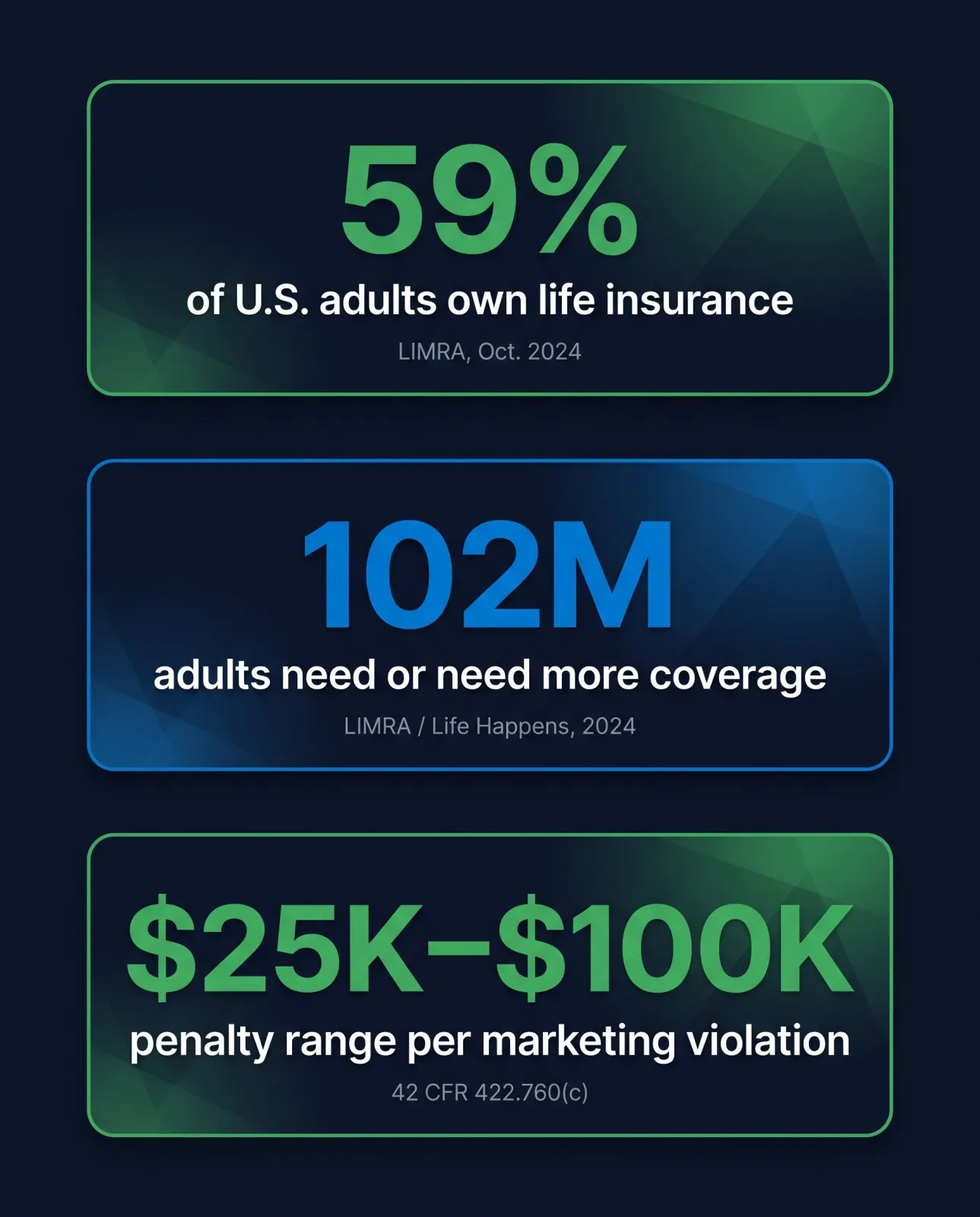
There are two costs here, and agents tend to only think about one of them. The first is the opportunity cost of never asking. If LIMRA’s national ownership estimate of 59% holds anywhere close to true across a Medicare-focused book, a meaningful share of every book’s clients have no life insurance at all, and roughly four in ten adults nationally say they need coverage they don’t have (LIMRA, Oct. 22, 2024; LIMRA/Life Happens, 2024). A book that never gets segmented and never gets a separate, compliant life insurance outreach is a book where that need just sits there, unaddressed, year after year, often until a client dies and a family finds out too late that there was nothing in place.
The second cost is the one that shows up if an agent tries to shortcut the two-appointment rule instead of respecting it. Civil money penalties for Medicare Advantage marketing violations, which cover improper cross-selling inside a scoped appointment, run up to $25,000 per determination, adjusted annually under 45 CFR part 102, with enhanced penalties reaching $100,000 for certain violation categories and up to $15,000 for each individual affected by the practice (42 CFR 422.760(c), Cornell Law eCFR mirror). Those figures apply to plan sponsors and their downstream entities, agents included, and they scale with how many beneficiaries were exposed to the improper marketing, not just whether one conversation crossed the line.
Put those two costs next to each other and the shape of the problem is clear: the risk isn’t in asking the life insurance question. It’s in asking it in the wrong room. Neither cost, the missed opportunity or the compliance exposure, requires guessing. Both are solved by the same fix: a genuinely separate process for identifying who to ask, and a genuinely separate appointment for asking them.
Life insurance ownership vs. stated need, U.S. adults
LIMRA's conservative ownership estimate against the share who say they need coverage.
Sources: LIMRA, New Life Insurance Ownership Data (Oct. 22, 2024); LIMRA/Life Happens, U.S. Life Insurance Need Gap Grows in 2024.
The compliant, manual two-appointment method
This is the part that works whether you ever use any software at all. It’s just a process, and every step of it is something you can run yourself, this week, with a spreadsheet and your CRM’s export function.
Export your full book with line-of-business tags
Pull every active client from your CRM or AMS along with what they hold: MAPD, PDP, Med Supp, ACA, group, ICHRA. If your CRM doesn't already tag this cleanly, this step alone is worth doing carefully — everything after it depends on the tag being accurate.
Cross-reference against any life insurance you already have on file
If you or a teammate ever wrote a life policy for a client, or if intake notes mention one, flag that client as already covered. You're building a list of the health-only clients, not everyone.
Build the "health-only, no known life coverage" segment
This is your outreach list. It's not a guess about who needs life insurance — it's a list of who you genuinely don't know the answer for, which is the honest and compliant place to start.
Reach that segment through a channel that isn't the Medicare appointment
Email, a mailed letter, or a separate outbound call that's clearly framed as being about life insurance, not Medicare, from the first sentence. Nothing about this outreach should reference or piggyback on the Medicare relationship as its opening.
Get a new, product-specific SOA before the life insurance appointment
For any client who responds, document a Scope of Appointment for that specific meeting, specific to life insurance. This is the form that protects you if anyone ever asks how that appointment came to happen.
Run the life insurance appointment as its own meeting
Different day is safest; different time on the same day, with a clear break and a new SOA, is the minimum. Nothing about the Medicare policy should reenter the conversation as the vehicle for introducing the new topic.
| Client | Health line(s) on file | Life insurance on file? | Outreach status |
|---|---|---|---|
| Example: D. Whitfield | MAPD | None found | Segment: send life insurance letter |
| Example: S. Nakamura | Med Supp + PDP | $50K term, written 2021 | Excluded — already covered |
| Example: B. Reyes | MAPD | Unknown | Segment: send life insurance letter |
If you're short on time, start with the newest clients
Clients you enrolled in the last 12 to 18 months are the ones you're least likely to already know the life insurance answer for. That's a smaller, higher-yield first pass than starting with your longest-tenured clients, where you may already have the information from years of conversations.
A worked example makes the scale concrete. Take an agent with 300 active Medicare clients, all health-only as far as the CRM shows.
| Line item | Figure |
|---|---|
| Active health-only Medicare clients | 300 |
| LIMRA's national life insurance ownership estimate | 59% |
| Illustrative share with no life coverage nationally | ~41% |
| Illustrative clients who may carry no life policy | ~120–125 |
Illustrative math, not a forecast for your specific book
LIMRA's 59% figure is a national estimate across all adults, not a Medicare-specific study, and your book's actual coverage rate will differ based on age, income, and region. Run the real check against your own client file rather than assuming the national percentage applies evenly. Results may vary.
Roughly 120 names isn’t a list you build once and forget. It’s a standing segment that grows every AEP as you write new Medicare business, which is exactly the kind of ongoing, repetitive tagging job that a manual spreadsheet process handles fine at 300 clients and starts to strain at 1,000.
What if the client brings it up first?
This is the scenario that trips up agents who otherwise know the rule. You’re mid-appointment, walking through Part D formulary changes, and the beneficiary asks, unprompted, “Do you also do life insurance?” It feels rude to deflect, and it feels like the client just handed you permission. Neither reaction changes what the regulation requires.
Compare this to what happens when a beneficiary asks about a different health product mid-appointment. Say a client on an MA-only SOA asks about a standalone Part D plan. That situation has a documented path: the agent gets the beneficiary to complete a new SOA reflecting the new product selection, and the new product can be discussed once that request is documented (PacificSource Medicare, Scope of Appointment FAQ, question 20). That path exists because Part D is still a health-related product — it’s a scope problem, not a category problem, and scope problems get fixed with paperwork in the room.
Life insurance doesn’t get that path. Because it’s a non-health-related product, there’s no version of “sign this addendum and we’ll continue” that applies. The same source that confirms life insurance sits in the non-health-related category is explicit that these products “cannot be discussed during the meeting” at all — not with a new form, not with a verbal disclaimer, not at the end after the Medicare business is wrapped up (PacificSource Medicare, Scope of Appointment FAQ, question 25). The compliant answer to “do you also do life insurance?” is some version of “I do, and I’d like to set up a separate time to talk about that specifically, so today stays focused on your Medicare plan.” Then you write the client’s name on the outreach list you built in the section above, and you follow the same two-appointment process for them that you’d follow for anyone else on that list.
The referral trap: a second way agents cross the same line
There’s a related mistake that isn’t about life insurance directly but ends in the same violation: using the Medicare appointment to collect referrals you plan to convert into life insurance prospects later. It’s an easy trap to fall into, because asking a happy client “who else should I talk to?” feels like ordinary relationship-building, not marketing.
The same category of carrier compliance guidance that governs non-health products also governs this directly. An agent cannot ask a beneficiary to have friends or family contact the agent, and cannot ask the beneficiary to hand over contact information for an unsolicited approach — the only compliant version is the beneficiary voluntarily giving the agent’s business card to someone else, who then reaches out on their own (PacificSource Medicare, Scope of Appointment FAQ, questions 26–27). Even if a beneficiary volunteers a friend’s name and number unprompted during the appointment, the agent still can’t call or email that referral directly. A business card handed to the beneficiary to pass along is the extent of it.
The practical takeaway is the same one that governs the life insurance question itself: the Medicare appointment is a closed loop. What starts there, plan discussion, enrollment, service questions, stays there. Anything that would extend the relationship into a new product or a new prospect, life insurance for the beneficiary or an introduction to someone else, has to happen through a channel and a process that starts outside that appointment, not as a natural extension of it.
Where the manual process breaks down at scale
The steps above are complete and genuinely compliant when followed. What they don’t solve is the maintenance problem. Every new Medicare client is another row that needs a line-of-business tag and a life insurance cross-check, every month, indefinitely. A book that’s growing is a segmentation task that never finishes, and the tagging itself doesn’t get any faster because last year’s list is already built.
That’s the specific gap, not a general “AI could help” observation: a fixed set of client records needs to be checked against a fixed question, on a recurring basis, and the checking itself is clerical, not judgment-based. That’s exactly the kind of task that benefits from being automated once and run on a schedule, freeing the actual judgment calls, who to prioritize, what to say, whether a given client is a fit, for a person.
How Ambrose’s agent-vault and channel-bridge spokes do this
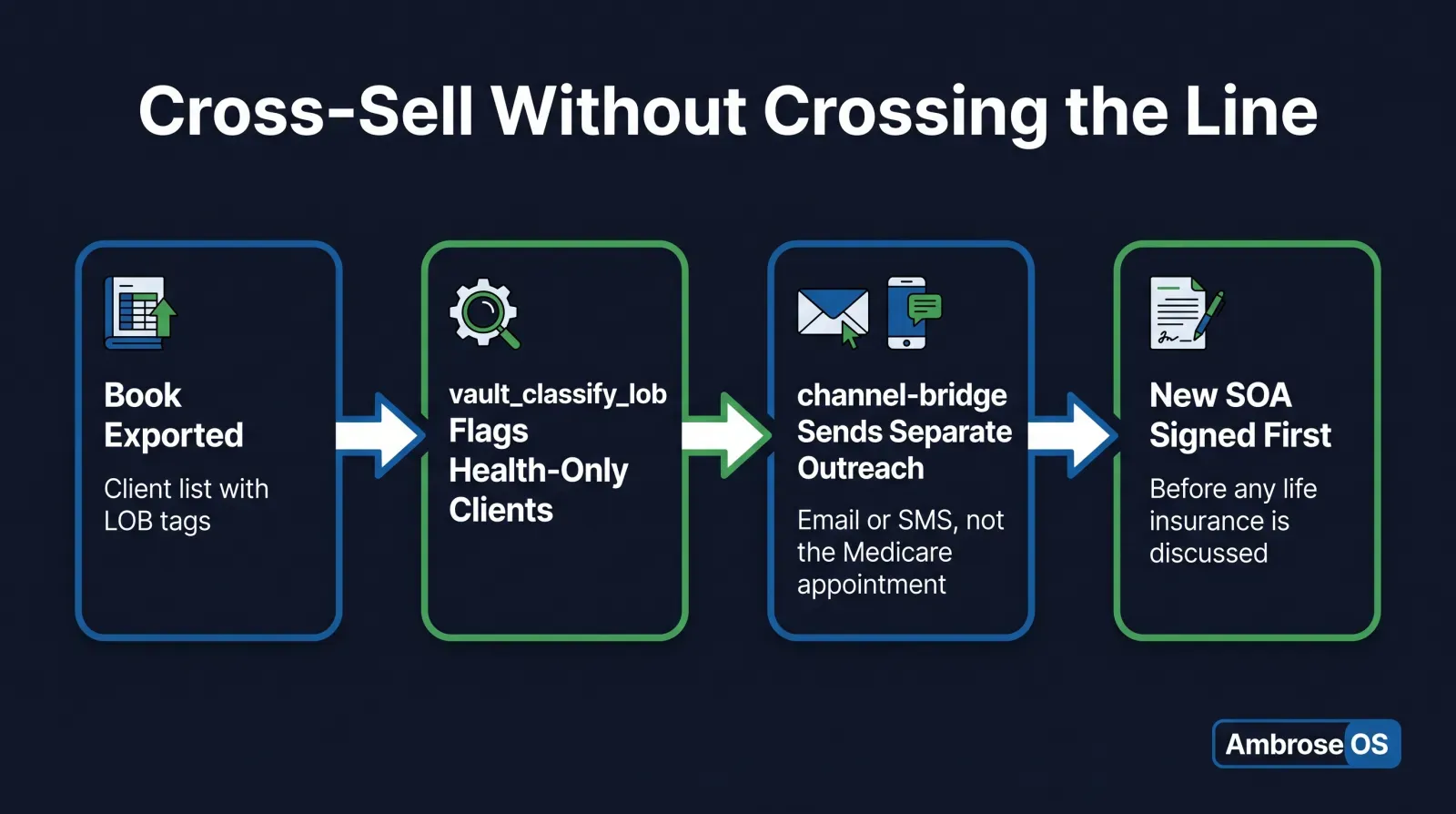
Ambrose OS, the platform included with a Tech Savvy membership, has a spoke built for exactly the book-wide question this process depends on. Per Ambrose’s documentation, agent-vault is a private repository for an agency’s book of business — it accepts HealthSherpa CSV exports, commission reports, client lists, and carrier PDFs, and indexes them for search, with “files live in your account. Queries that touch the vault flow through the PHI Rail” (Ambrose docs, spoke-agent-vault). Its four tools are vault_search, full-text and structured search across indexed files; vault_get_client, retrieving a client record by ID with cross-file joining; vault_list_recent, surfacing recently added or modified files; and vault_classify_lob, which automatically categorizes each record’s line of business across MAPD, PDP, Med Supp, ACA, Group, and ICHRA (Ambrose docs, Spokes). That classification tool is the mechanism that turns “which of my clients are health-only” from a manual tagging exercise into a query.
For the outreach itself, once a health-only segment exists, channel-bridge is documented as “the outbound dispatcher for email, SMS, and Telegram — the single place messages actually leave your account,” with two tools: bridge_send_email, routing through Gmail, a GHL conversation, or direct SMTP, and bridge_send_sms, routing through Twilio or a GHL conversation (Ambrose docs, spoke-channel-bridge). It operates in drafts mode by default, meaning nothing sends until a person approves it, and every outbound message body routes through the PHI Gateway unless its destination is on the agency’s BAA allowlist. Once a life insurance outreach is running, campaign-metrics tracks how it performs through three tools: metrics_campaign_summary for a high-level view of one campaign, metrics_recipient_engagement for per-recipient response data, and metrics_funnel_breakdown for stage-by-stage conversion, with per-recipient identifiers stripped before an LLM sees the engagement data and reintroduced only for an approved action list (Ambrose docs, spoke-campaign-metrics).
| Manual step | Ambrose equivalent |
|---|---|
| Export book and tag line of business by hand | vault_classify_lob tags MAPD, PDP, Med Supp, ACA, Group, and ICHRA automatically |
| Cross-reference against life policies already on file | vault_search / vault_get_client pull cross-file client history |
| Build the health-only outreach list | A query against the classified book, run through the PHI Rail |
| Send a separate life insurance outreach by hand | bridge_send_email / bridge_send_sms, drafts mode by default |
| Track who responded and booked an appointment | metrics_campaign_summary, metrics_recipient_engagement, metrics_funnel_breakdown |
None of that changes the underlying rule. Ambrose doesn’t decide when a Scope of Appointment is required, and it doesn’t sign one on your behalf. What it does is take the clerical half of the process, the tagging, the list-building, the sending, the tracking, off a spreadsheet and onto a schedule, so the compliance-sensitive half, the actual separate appointment and its SOA, is the only part still requiring your direct judgment.
A segmented list and an automated send don't replace the SOA
Every client who responds to a life insurance outreach still needs a genuinely separate appointment with its own Scope of Appointment before any specific life insurance product gets discussed. Tech Savvy Insurance is a training and software community, not a law firm, and this isn't legal or compliance advice — confirm current CMS Medicare Communications and Marketing Guidelines requirements, and your own state's rules if Med Supp is part of your book, before you run this process.
The NAIC’s Model Bulletin on the Use of Artificial Intelligence Systems by Insurers, adopted in December 2023, sets the general expectation that applies here too: a written policy on how an AI tool is used, human oversight of what it produces, and documentation of the process (NAIC, Artificial Intelligence). A classified book and a drafted outreach are inputs to a decision you’re still making — not a system deciding, on its own, who gets contacted and what they’re told.
Spreadsheet segmentation
- Export book, tag by line of business by hand
- Cross-reference against known life policies manually
- Send outreach through your existing email or mail tool
- Track responses in the same spreadsheet
agent-vault + channel-bridge + campaign-metrics
- vault_classify_lob tags the book automatically
- A single query surfaces the health-only segment
- bridge_send_email / bridge_send_sms draft the outreach, human-approved
- metrics_funnel_breakdown tracks the result
What you get by joining
One Ambrose seat, including agent-vault, channel-bridge, and campaign-metrics, comes with a Tech Savvy Insurance membership: $97 a month, billed monthly, cancel anytime, founding rate locked in while the membership stays active. Alongside the seat: weekly Zoom calls with open Q&A and build-with-you sessions, 30+ hours of recorded training, Meta Ads and marketing training built for this industry, pre-built AI templates and bot deployments, and a free annual in-person member workshop. It’s also an explicit no-recruiting zone — you can ask a real question about your book without ending up on someone’s downline pitch list, which is a genuine point of difference from most agent Facebook groups.
Ambrose usage is separate from the $97 seat
The membership includes one Ambrose seat; usage inside Ambrose runs through its own credit ledger with spend caps, so cost stays visible instead of appearing as a surprise line item ([Ambrose docs, What is Ambrose](https://app.hiambrose.com/docs/what-is-ambrose)). That's the same pricing shape across every Ambrose spoke, not something unique to agent-vault — see the full [Spokes catalog](https://app.hiambrose.com/docs/spokes) for what else is available.
Building this into your calendar, whether you automate it or not
This doesn’t need to be an AEP-season project — it works better spread across the year, since the outreach itself is deliberately outside the Medicare marketing calendar.
- Any month, but ideally right after AEP: Export the full book and get every client tagged by line of business, even if it’s a manual first pass.
- Ongoing, monthly or quarterly: Re-run the health-only check against new enrollments and any updated client notes, so the segment doesn’t go stale.
- Whenever a segment is built: Send the separate life insurance outreach through a channel and framing that makes clear from the first line it isn’t about Medicare.
- On response: Document a new, product-specific Scope of Appointment before any life insurance product gets discussed, and run that appointment as its own meeting.
The close
Everything above, the export, the manual line-of-business tagging, the separate outreach, the separate SOA, works whether you ever join anything or not. That’s the point of writing it out in full. If you’d rather have the tagging and the outreach run on a schedule instead of a spreadsheet you rebuild every quarter, with the response tracking already waiting when a client says yes, one Ambrose seat comes with a Tech Savvy membership, and the weekly build-with-you calls are where agents actually set up their first agent-vault query on their own book, with people who’ve already done it.
See what's already sitting in your book
Everything above, the segmentation, the two-appointment method, the tracking, works whether you join anything or not. If you'd rather have Ambrose's agent-vault tag the book and channel-bridge run the outreach, with people watching your screen while you set it up, one Ambrose seat comes with the Tech Savvy membership.
Join Tech Savvy — $97/monthBefore you contact anyone in your book
Tech Savvy Insurance is a training and software community, not an insurance company, agency, or law firm, and does not provide insurance, legal, tax, or compliance advice. You are responsible for your own licensure and for complying with all applicable CMS, HIPAA, state, and carrier regulations, including Scope of Appointment, TPMO disclaimer, and call-recording requirements for any Medicare-related conversation. AI-generated outputs, including any book segmentation or drafted outreach, may contain errors — always verify before acting on them. Results may vary.
Frequently asked questions
Sources
- LIMRA — New Life Insurance Ownership Data Suggests a Need for New Strategies to Engage Consumers (Oct. 22, 2024) — limra.com
- LIMRA — U.S. Life Insurance Need Gap Grows in 2024 (news release, with Life Happens) — limra.com
- Cornell Law, Legal Information Institute — 42 CFR 422.2264, current eCFR text — law.cornell.edu
- Cornell Law, Legal Information Institute — 42 CFR 422.760, current eCFR text — law.cornell.edu
- PacificSource Medicare — Scope of Appointment FAQ (agent/internal use) — medicare.pacificsource.com
- NAIC — Artificial Intelligence (Model Bulletin on the Use of AI Systems by Insurers, adopted Dec. 2023) — content.naic.org
- Ambrose docs — Spokes — app.hiambrose.com
- Ambrose docs — spoke-agent-vault — app.hiambrose.com
- Ambrose docs — spoke-client-vault — app.hiambrose.com
- Ambrose docs — spoke-campaign-metrics — app.hiambrose.com
- Ambrose docs — spoke-channel-bridge — app.hiambrose.com
- Ambrose docs — What is Ambrose — app.hiambrose.com
Ready to put this into practice?
Join a private community of Health & Life insurance professionals using AI, Meta Ads, and automation to grow — without draining their bank account.
Join Tech Savvy — $97/month