A complete annuity suitability file in 2026 has to show four things in writing: a consumer profile built from information the client actually gave you, a reasonable basis tying the specific annuity to that profile, a disclosure of your role and how you’re paid, and — if it’s a replacement — a side-by-side comparison of what the client is giving up against what they’re getting. Every state now enforces some version of that standard. Forty-nine states have adopted it by putting the NAIC’s 2020-revised Suitability in Annuity Transactions Model Regulation (#275) into their own code; New York enforces the same outcome through its own, older Regulation 187. If any one of those four pieces is missing from a file when a market conduct exam or an E&O claim asks for it, “the client seemed happy” isn’t a defense a regulator or a plaintiff’s attorney is going to accept.
Key takeaways
- 49 states have adopted the NAIC's 2020-revised best interest standard for annuities (Model #275) in substantially similar form; New Jersey was last, effective April 21, 2025 (NAIC, Summer 2025 state page; New Jersey Register, 57 N.J.R. 841).
- New York is the outlier: its own Regulation 187 (11 NYCRR 224), in effect for annuities since August 2019, predates and stands apart from the NAIC model, even though the practical outcome — a best interest standard — is the same.
- A complete file has four parts: a consumer profile, a documented reasonable basis, a role-and-compensation disclosure, and, for a replacement, a side-by-side comparison of surrender charges, new surrender periods, lost benefits, and fee changes.
- New York's own enforcement record shows what an incomplete replacement file has already cost carriers: a $240,000 penalty against National Integrity Life (2018), a $2.24 million penalty plus $3.4 million in restitution against Nationwide Life (2022), and roughly $29 million total across 13 life insurers to date (NY DFS, 2022 Consumer Protection and Financial Enforcement Annual Report).
- Ambrose doesn't fill out the file for you. Its Routines can check a book of business against a defined checklist on a schedule and post what's missing to Slack, and its client-vault and agent-vault spokes give the file one retrievable home instead of five scattered ones (Ambrose docs, Routines; Ambrose docs, Spokes).
The pain: the file gets asked for after you’ve forgotten what happened
Here’s the moment this article is actually about. A client from three years ago calls the state insurance department, or their kids do it for them after a rough statement arrives, and it turns into a market conduct exam or an E&O claim naming you and the carrier. Someone asks for the annuity suitability file: the consumer profile, the basis for the recommendation, the disclosure you gave about your role and your pay, and — because it was a replacement — the comparison showing what the client gave up. You go looking for it.
What you find is a CRM note that says “client wants more guaranteed income,” a paper suitability form the client signed that’s missing the second page, and your own memory of a conversation that felt thorough at the time but left no trace of what made this particular annuity the right one for this particular client. None of that is a suitability file. It’s a set of fragments that might add up to one if you got lucky, and an examiner or opposing counsel doesn’t have to prove you did something wrong — they just have to show the documentation that would prove you did something right isn’t there.
This isn’t a hypothetical. It’s the specific finding regulators have already made against carriers, in writing, more than once: that a producer or insurer “failed to obtain appropriate annuitization information” or “failed to disclose adequate suitability and annuitization information to contract holders” before a replacement went through (NY DFS, Consent Order, Nationwide Life Insurance Company, May 19, 2022). The file didn’t need to prove the recommendation was wrong. It needed to prove the work was done, and it couldn’t.
This is guidance, not legal or compliance advice
Tech Savvy Insurance is a training and software community, not a law firm, an insurance company, or an insurance agency. This article describes what public NAIC model law text, NAIC examiner guidance, and public state regulatory actions say, as of the dates cited. It is not legal or compliance advice about your specific book of business, your specific state's exact statute, or your carrier's specific requirements. Read the primary sources linked throughout, and confirm your own state's version and your carrier's own procedures with your compliance department or your own counsel before changing anything based on this article.
Why it happens: the sale takes ten minutes, the file lives in five places
Nobody sits down intending to skip the suitability file. It happens because the required pieces live in different systems, get captured at different moments, and nothing forces them into one place before the application gets submitted.
The consumer profile — age, income, financial situation and needs, financial experience, objectives, intended use, time horizon, existing assets, liquidity needs, liquid net worth, risk tolerance, and tax status — often gets captured piecemeal across a fact-finder call, a follow-up text, and whatever the client wrote on a paper application (NAIC, Market Regulation Handbook, Chapter 23, Supplemental Checklist for Marketing and Sales Standard #16). The reasonable-basis reasoning, the actual “why this annuity, for this client” logic, usually exists only in the producer’s head, because writing it down feels like extra work when the recommendation seems obviously right in the room. The role-and-compensation disclosure is a form (Model #275’s Appendix A, or your state’s equivalent) that gets signed and then filed somewhere that isn’t the same place as the profile. And if it’s a replacement, the side-by-side comparison — the one document that actually shows the client what they’re giving up — requires pulling numbers from the existing contract, which takes more effort than the rest of the file combined and is exactly the piece regulators have found missing most often.
Five pieces, four different moments, three different formats, and nothing connecting them into a single, retrievable client record. That’s not a compliance failure of intent. It’s a filing problem that never gets fixed because nothing forces it to get fixed until someone asks for the file.
The recommendation isn't the risk. The recommendation you can't reconstruct eighteen months later is the risk.
Mike MooreThis is now a 50-state problem, not a handful of states
For years, “best interest annuity rules” was a patchwork story — a few states had adopted the NAIC’s stricter 2020 standard, most hadn’t, and an agent working multiple states genuinely had to track which rule applied where. That’s over. As of the NAIC’s own Summer 2025 model law state page, 49 states have adopted the 2020-revised Model #275 in substantially similar form. New Jersey was the last: its rule, N.J.A.C. 11:4-59A, was adopted March 27, 2025, by Commissioner Justin Zimmerman and took effect April 21, 2025 (New Jersey Register, 57 N.J.R. 841). The American Council of Life Insurers marked that date with a direct statement: “With New Jersey’s action today, all 50 states have now adopted a best interest standard for annuity sales” (ACLI, Apr. 21, 2025).
That statement is true at the level of outcome, and it’s worth being precise about why it needs one footnote. The NAIC’s own state page doesn’t list New York under its “Model Adoption” column at all. New York’s citation — 11 NYCRR 224.0 to 224.9 — sits in the “Previous Version” column, because New York built its own best interest standard, Insurance Regulation 187, ahead of the NAIC’s 2020 revisions and never adopted the NAIC’s model text directly. Regulation 187 has required a best interest standard for annuity recommendations since August 1, 2019 (NY DFS, Regulation 187 guidance page). So every state has landed in the same place — a producer has to act in the client’s best interest and document it — by two different roads. If you write business in New York, the citation you work from is Regulation 187 and 11 NYCRR 224, not a generic Model #275 summary that assumes every state’s rule reads the same.
| Path | States | Basis | Source |
|---|---|---|---|
| Adopted NAIC Model #275 (2020 revision) | 49 states | State-specific statute or regulation adopting the model in substantially similar form; New Jersey last, effective Apr. 21, 2025 | NAIC, Summer 2025 state page (ST-275); N.J. Register, 57 N.J.R. 841 |
| Own, separate best interest standard | New York | Insurance Regulation 187 / 11 NYCRR 224, in effect for annuities since Aug. 1, 2019, predating the NAIC's 2020 model | NY DFS, Regulation 187 guidance page |
Why this matters for a documentation article rather than a licensing one: the four core obligations — care, disclosure, conflict of interest, and documentation — are consistent across nearly every version of this rule, because they all trace back to the same model language or the same underlying policy goal. Learn the structure once, and you’re not relearning it fifty times as you move between states. What does change state to state is the retention period, the exact form numbers, and small procedural details, so treat what follows as the shared spine and confirm your own state’s specific citation before you rely on it in front of an examiner.
What it actually costs when the file isn’t there
Individual agent-level fines for a single incomplete suitability file aren’t public in a way that lets us cite a reliable, sourced figure, and this article isn’t going to invent one. What is public, sourced, and directly on point is what happens at the carrier level when the same documentation gap shows up at scale, because New York’s Department of Financial Services has spent the better part of a decade investigating exactly this failure pattern in annuity replacements.
In 2018, DFS found that National Integrity Life Insurance Company “did not obtain information to determine the suitability of replacing deferred with immediate annuities” and failed to disclose adequate income-comparison information to contract holders between 2011 and 2016. The company paid a $240,000 civil monetary penalty plus restitution with interest to affected consumers (NY DFS, press release, Dec. 5, 2018). In 2021, DFS announced a settlement with New York Life Insurance & Annuity Corporation totaling approximately $10.9 million in restitution and penalties for the same category of violation (NY DFS, press release, Mar. 2, 2021). In 2022, DFS finalized a consent order with Nationwide Life Insurance Company: Nationwide paid $3.4 million in restitution and a $2,240,000 civil monetary penalty, after DFS found the company issued 1,280 replacement immediate annuity contracts during a January 2011 through December 2018 investigation period “without sufficient Annuitization information to determine suitability,” and failed to adequately train its agents and brokers to conduct proper suitability reviews or provide the required disclosures (NY DFS, Consent Order, Nationwide Life Insurance Company, May 19, 2022). Taken together, DFS’s own 2022 annual report states plainly: “the investigation has resulted in settlements with 13 life insurers, totaling approximately $29 million in restitution and penalties” (NY DFS, 2022 Consumer Protection and Financial Enforcement Annual Report).
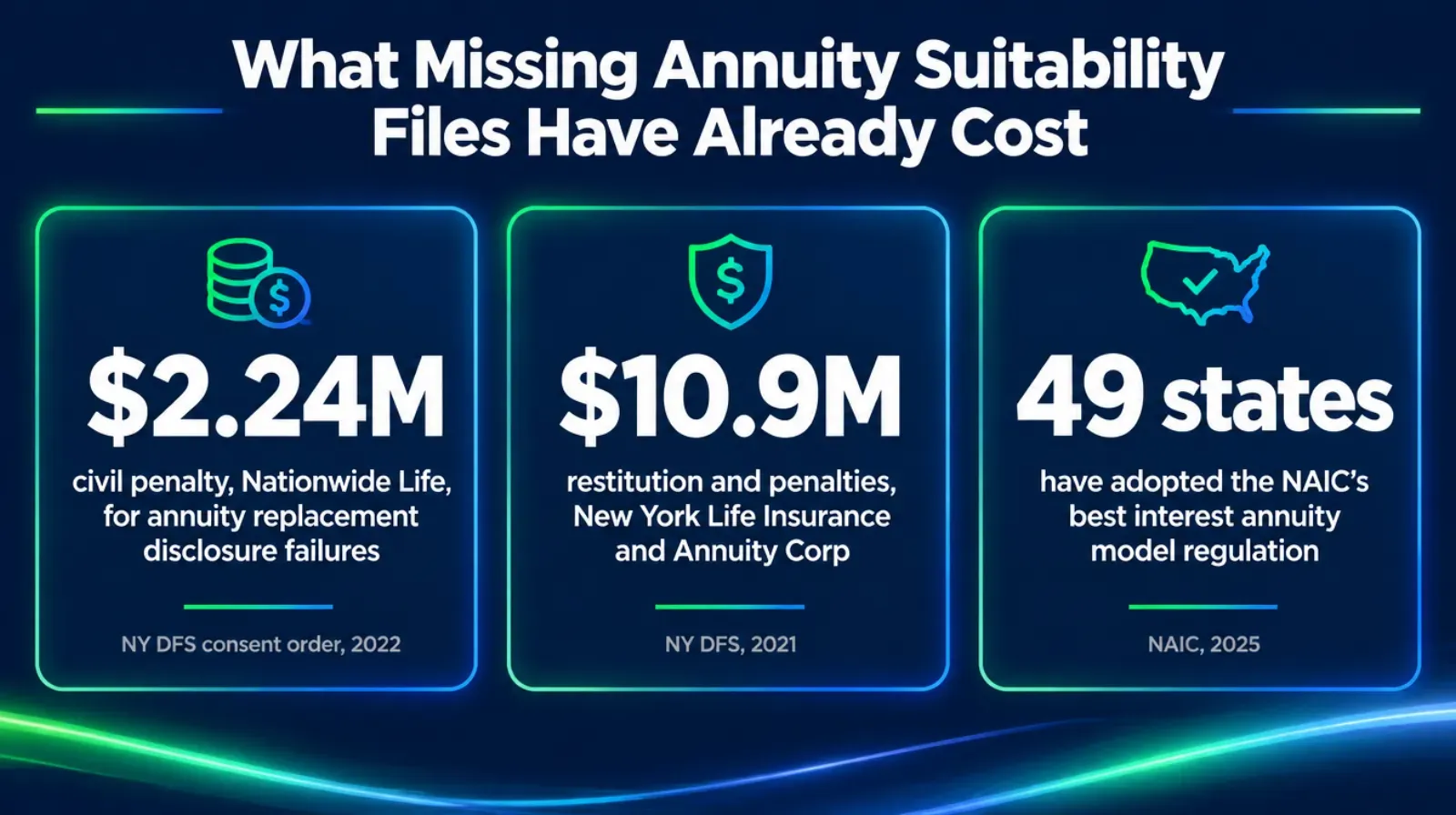
New York DFS settlements for deferred-to-immediate annuity replacement violations
Total restitution plus penalties, by case, same underlying finding each time: an incomplete replacement suitability file.
Source: NY DFS press release, Dec. 5, 2018 (National Integrity); NY DFS consent order, May 19, 2022, and NY DFS 2022 Consumer Protection and Financial Enforcement Annual Report (Nationwide: $2.24M penalty + $3.4M restitution); NY DFS press release, Mar. 2, 2021 (NYLIAC). Thirteen insurers total roughly $29 million to date, per the same 2022 DFS annual report.
Two things are worth being honest about here. First, this is New York’s enforcement record specifically, because New York has run a sustained, public, industry-wide investigation into deferred-to-immediate annuity replacements and publishes its results — it isn’t a national tally, and we found no equivalent nationwide aggregate figure that clears this site’s sourcing bar, so treat it as the clearest documented example rather than a national average. Second, these are actions against insurers, not against individual producers, because DFS’s consent orders name the carrier as the responsible party for supervising its distribution force. But the fact pattern in every one of these cases starts at the point of sale, with a producer who didn’t gather or disclose what the file needed, and an insurer whose supervision system didn’t catch it. Your own file is the thing that determines whether you’re the version of this story that gets caught in a routine review, or the one that doesn’t come up at all because the paperwork was right the first time.
Market conduct exams look at exactly this file
The NAIC's own examiner handbook instructs market conduct examiners to review policy and underwriting files to confirm the insurer's producer "has adequate written documentation of reasonable grounds for believing that the recommendation is suitable," and gives the commissioner authority to order corrective action against the insurer, the producer, a general agency, a contracting agency, or an independent agency (NAIC, Market Regulation Handbook, Chapter 23). This isn't a theoretical checklist. It's the literal document an examiner opens your file with.
Everything above works whether you ever join anything or not. Ambrose’s Routines, covered later in this article, don’t build the file for you. What they do is make sure the file you already know how to build doesn’t quietly go missing on the one client where it mattered.
What a complete suitability file contains for a straight annuity sale
Here’s the manual method, built directly from Model #275’s four obligations as reflected in the NAIC’s own examiner handbook (NAIC, Market Regulation Handbook, Chapter 23, Supplemental Checklists for Marketing and Sales Standards #16 and #17). None of this requires software. It requires doing these six things, in this order, every time.
Collect the consumer profile, completely, before you recommend anything
Age, annual income, financial situation and needs, financial experience, financial objectives, intended use of the annuity, financial time horizon, existing assets (including other investment and life insurance holdings), liquidity needs, liquid net worth, risk tolerance, and tax status. All twelve, in writing, in the client's own words where possible.
Write down the reasonable basis, not just the product name
A sentence or two connecting a specific field in the profile to a specific feature of the annuity: "client's stated objective is guaranteed lifetime income and her liquid net worth is sufficient to absorb the surrender schedule" is a reasonable basis. "Client wanted more guarantees" is not.
Disclose your role, your licenses, and how you're paid
A written disclosure covering the scope of your relationship with the client, which insurers you're authorized to sell for (one, a primary carrier plus others, or several equally), and the type of compensation you'll receive — commission, fee, or both — before the sale, on a form substantially similar to Model #275's Appendix A.
Identify and disclose material conflicts of interest
If you have an ownership interest in the insurer, a proprietary-product incentive, or anything else that could bias the recommendation, name it in writing and explain how you're managing it. Silence isn't neutral under this obligation — it's the gap an examiner is specifically trained to look for.
Get the acknowledgment forms signed when the client goes off-script
If a client refuses to give you profile information, get a signed statement acknowledging that refusal and that they understand the risk of proceeding without it. If they buy an annuity that isn't the one you recommended, get a signed statement acknowledging the transaction isn't based on your recommendation (Model #275 Appendices B and C, or your state's equivalent).
File everything in one place, the day of the sale
Profile, basis, disclosure, and any acknowledgments, in the same client record, dated the same day the recommendation was made — not reconstructed from memory the week a renewal or an inquiry comes in.
This is the whole method for a non-replacement sale
Twelve profile fields, one written basis sentence, one role-and-compensation disclosure, a conflict-of-interest check, and signed acknowledgments only if the client went off-script. None of it costs anything but the fifteen minutes it takes to write it down while the conversation is still fresh.
What a replacement adds on top of that
A replacement or exchange — swapping one annuity or life policy for another — carries everything above, plus one more document that regulators have specifically found missing in every enforcement action cited in this article: a side-by-side comparison of what the client is giving up against what they’re getting.
| Factor | What the file has to document |
|---|---|
| Surrender charge | Whether the consumer will incur a surrender charge on the contract being replaced, and its amount |
| New surrender period | Whether the replacement starts a new surrender period, and how long it runs |
| Lost benefits | Any death, living, or other contractual benefits the consumer gives up by replacing the existing contract |
| Fee and rider differences | Any increase in fees, investment advisory charges, or charges for riders and similar product enhancements |
| Prior replacement history | Whether the consumer has replaced or exchanged an annuity within the preceding 60 months |
| Income comparison (for deferred-to-immediate replacements) | A side-by-side of the guaranteed income available under the existing contract versus the proposed replacement — the exact comparison New York found missing in its Nationwide and National Integrity actions |
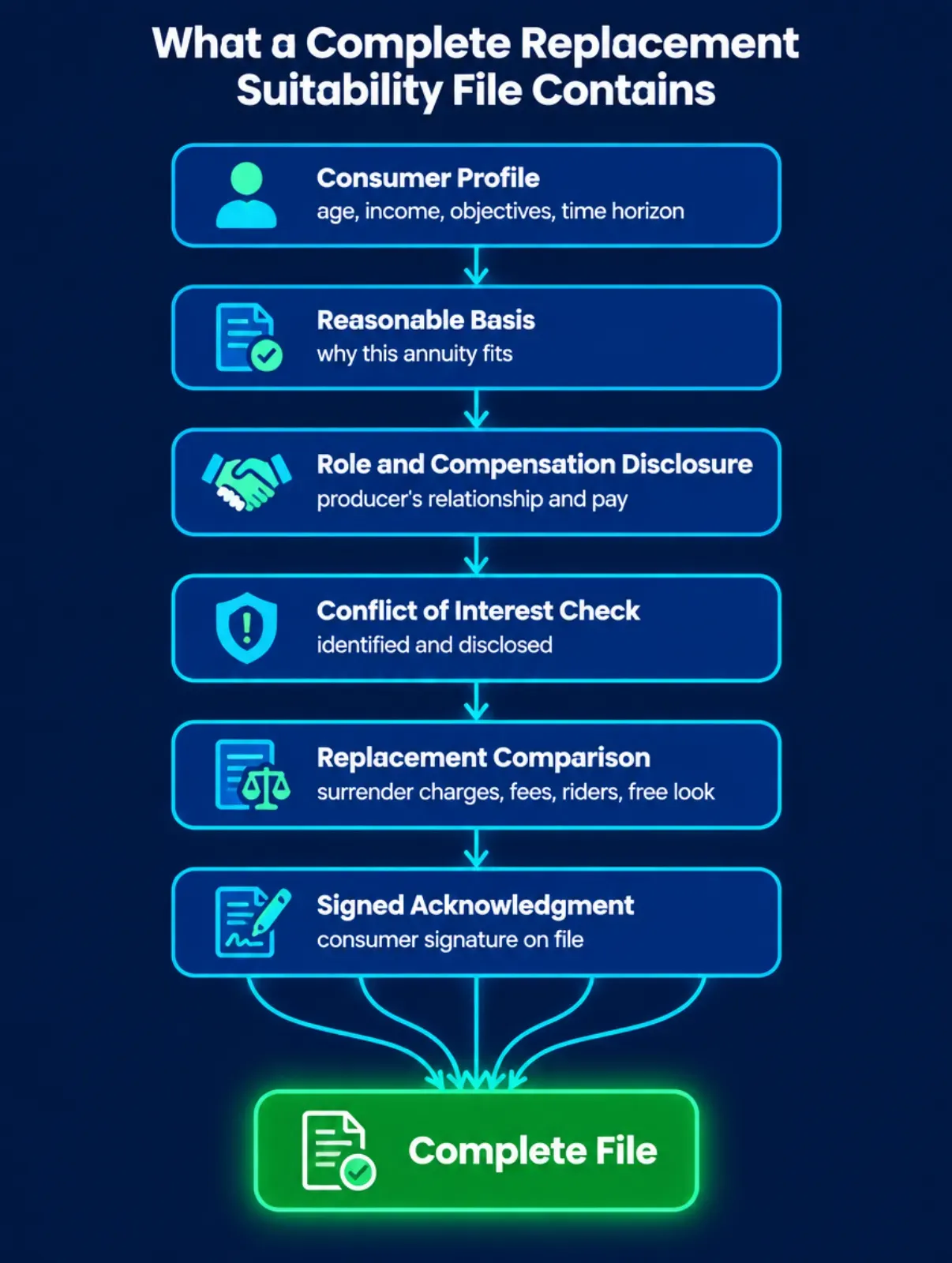
One more piece belongs in a replacement file even though its exact length isn’t set by Model #275 itself: the free-look period, the window during which the client can cancel the new contract and get their money back. Model #275 doesn’t set that number nationally — it’s set by each state’s own insurance code and varies by state and sometimes by product, so confirm your own state’s figure rather than assuming a single national standard, and put the specific number that applies to this client’s contract in the file rather than a general statement that one exists.
Reconstructed after the fact
- A signed application and a generic suitability form, nothing else
- No written comparison of surrender charges or lost benefits
- The "why" lives in the producer's memory, not the file
- Profile, disclosure, and comparison scattered across a CRM, a paper form, and an email
Built the day of the sale
- Twelve-field consumer profile, dated and complete
- Written reasonable basis tying profile to product
- Role, license, and compensation disclosure, signed
- Side-by-side replacement comparison with the specific numbers, filed the same day
This is where the recommendation you’re not going to hold back to make a sale actually is one: build the comparison table above into whatever form or spreadsheet you already use for a replacement, fill in the six rows before you submit the application, and you have the single document New York’s enforcement history shows most agencies are missing. That works with a blank spreadsheet and zero membership.
A plain client-profile template you can build today
If you want the whole thing in one reusable document, here’s the structure, field by field, straight from Model #275’s definition of “suitability information” as reflected in the NAIC’s examiner handbook (NAIC, Market Regulation Handbook, Chapter 23):
Section 1 — Consumer profile. Age. Annual income. Financial situation and needs, including the source of funds for this annuity. Financial experience. Financial objectives. Intended use of the annuity. Financial time horizon. Existing assets, including other investment and life insurance holdings. Liquidity needs. Liquid net worth. Risk tolerance. Tax status.
Section 2 — Recommendation and basis. The specific annuity recommended. The reasonable basis, written as a sentence connecting a Section 1 answer to a specific product feature. Whether the client would benefit from tax-deferred growth, annuitization, or a death or living benefit the product offers.
Section 3 — Disclosure. Scope and terms of your relationship with the client. Whether you’re licensed and authorized to sell fixed annuities, fixed indexed annuities, variable annuities, life insurance, mutual funds, stocks and bonds, or certificates of deposit. Which insurers you’re authorized, contracted, or appointed to sell for. The type of compensation you’ll receive.
Section 4 — Conflicts of interest. Any identified, with how you’re managing or disclosing each one. If none, a one-line statement that none were identified — not a blank field.
Section 5 — Replacement comparison (skip if this isn’t a replacement). The six-row table from the previous section, filled in with this client’s actual numbers.
Section 6 — Acknowledgments (only if applicable). Signed statement if the client refused to provide profile information. Signed statement if the client bought against your recommendation.
Build that as a form in whatever tool you already have — a Google Doc, a PDF form, a CRM custom object — and fill in all six sections the day of every annuity sale, not after. If you’d rather have this running as a scheduled check across your whole book instead of a manual habit per client, that’s what the next section covers.
Where Ambrose fits, and where it honestly doesn’t
Everything above works with a blank document and no membership. Where a platform helps isn’t writing the file — it’s making sure the file you already know how to build doesn’t quietly stop happening once the initial urgency of reading this article wears off, three months from now, on your fortieth annuity sale of the quarter.
Per Ambrose’s own documentation, a Routine is “a scheduled prompt attached to an agent or a team,” run on a cron schedule, that can be pointed at a defined task and produce output on its own without anyone remembering to trigger it (Ambrose docs, Routines). Output can go to Slack, email, a GHL note, or a log-only destination, and every run is logged with input, output, tool calls, tokens, latency, cost, and any errors, with the last 100 runs retrievable as a full transcript per routine (Ambrose docs, Routines; Ambrose docs, Routines: History & Logs). Applied here: a weekly Routine checks records in the book against the six-section structure above and posts a list to Slack of any client file missing a required element — the consumer profile, the written basis, the disclosure, or, for a replacement, the comparison. That’s the recurring compliance review that doesn’t happen manually because nobody remembers to do it, running whether you remember or not.
Ambrose’s client-vault spoke is documented as a “client-facing enrollment + policy store,” and its agent-vault spoke as the “agency’s private book of business” — both marked safe and local-only in Ambrose’s own spoke catalog, meaning data doesn’t leave the agency’s own environment (Ambrose docs, Spokes). Be precise about what that is and isn’t: neither spoke is a suitability-form generator, and neither one fills out the consumer profile, writes the reasonable basis, or builds the replacement comparison for you. What they give you is one retrievable home for the file instead of a CRM note, a paper form, and an email attachment living in three different places — which is the exact scattering problem this article opened with.
| Task | Doing it by hand | Running through Ambrose |
|---|---|---|
| Building the file | You fill out all six sections yourself, every time | Still you — no spoke drafts the profile or the recommendation |
| Storing the file | Scattered across a CRM note, a paper form, an email | One record in client-vault or agent-vault, local to the agency |
| Checking the book for gaps | Only if someone remembers to do a manual audit | A weekly Routine flags missing elements to Slack, logged every run |
Name the mechanism, not just "AI"
The specific thing worth naming here is a cron-scheduled Routine checking a defined list against records in client-vault or agent-vault, not a general claim that "AI keeps your files compliant." Nothing in Ambrose's documentation describes it drafting a suitability recommendation or replacing your own judgment about what's in a client's best interest — that stays yours, the same way it always has.
One more thing worth a single line, since this is a post about AI touching client-facing compliance work: if you use any AI tool, Ambrose or otherwise, anywhere in your annuity workflow, the NAIC’s Model Bulletin on the Use of Artificial Intelligence Systems sets a general expectation of written policies, human oversight, documentation of what the tool did, and accountability for the vendor’s role (NAIC, Insurance Topics: Artificial Intelligence). A Routine’s run log is exactly the kind of documentation that expectation is asking for — keep it, and keep a human reviewing what it flags before anyone acts on it.
This is the kind of thing we work through on a Tuesday with Ambrose open on the screen — building the actual Routine, not just talking about what one could do. $97 a month, cancel anytime, and nobody’s going to pitch you a downline while you’re trying to fix your file.
What you get by joining
One Ambrose seat, including the client-vault and agent-vault spokes and Routines referenced above, comes included with a Tech Savvy Insurance membership: $97 a month, billed monthly, cancel anytime, with the founding rate locked in while the membership stays active. Ambrose usage runs through its own credit ledger, so cost stays visible rather than becoming a surprise. Alongside the seat: weekly Zoom calls with open Q&A and build-with-you sessions, more than 30 hours of recorded training, Meta Ads, AI, and marketing training built for health and life agents specifically, pre-built AI templates and bot deployments, and a free annual in-person member workshop. It’s also an explicit no-recruiting zone — you can ask a real question about your own suitability file without ending up on someone’s downline pitch an hour later, which isn’t true of most agent Facebook groups.
Everything above — the twelve-field profile, the six-row replacement comparison, the four obligations — works whether you ever join anything or not. Run it by hand on your next annuity sale, replacement or not.
Build your first complete replacement file this week
Copy the six sections above into a document you'll actually reuse, and fill it in on your next annuity sale — no membership required. If you'd rather have a weekly Routine checking your whole book for the same gaps, with people helping you build it on a screen-share instead of alone, one Ambrose seat comes with the Tech Savvy membership.
Join Tech Savvy — $97/monthRelated reading: our full walkthrough of the DIME method for life insurance needs analysis, how to cross-sell life insurance into a Medicare book the same way you’d build an annuity file, and what’s changing on the liability side in AI E&O exclusions for insurance agents in 2026.
The close
Every state now expects a producer to document why an annuity recommendation was in the client’s best interest, and forty-nine of them are working from the same NAIC model text to say so. New York gets there through its own rule instead, but the destination is identical. The file that satisfies all of it isn’t complicated: a consumer profile, a written reasonable basis, a role-and-compensation disclosure, and, for a replacement, a side-by-side comparison of what the client gave up. Build that on your next sale, today, whether or not you ever join anything. If you’d rather have a Routine checking your whole book for the same four pieces every week, with a room of agents building theirs alongside you on a Tuesday call, one Ambrose seat comes with a Tech Savvy membership: https://techsavvyinsurance.com/.
Before you rely on any figure in this article
Tech Savvy Insurance is a training and software community, not an insurance company, agency, or law firm, and does not provide insurance, legal, tax, or compliance advice. Results may vary. You are responsible for your own licensure and for complying with your own state's exact annuity suitability and best interest regulation, NAIC guidance, and your carriers' own procedures, none of which this article can fully substitute for. State citations, retention periods, and form numbers change — confirm your own state's current rule and your carrier's own suitability form requirements directly before relying on anything here. AI-generated outputs may contain errors: always verify against the primary sources cited above.
Frequently asked questions
Sources
- NAIC — Model Laws, Regulations, Guidelines and Other Resources, Summer 2025, ST-275 (Suitability in Annuity Transactions Model Regulation, state page) — content.naic.org
- NAIC — Implementation of 2020 Revisions to Model #275 (state adoption map, status as of June 12, 2024) — content.naic.org
- NAIC — Annuity Suitability (A) Working Group (charges and resource links) — content.naic.org
- NAIC — Market Regulation Handbook, Chapter 23: Conducting the Life and Annuity Examination (revised Oct. 4, 2024) — content.naic.org
- American Council of Life Insurers — New Jersey Becomes 50th State to Adopt Enhanced Protections For Annuity Consumers (Apr. 21, 2025) — acli.com
- New Jersey Register — Adoption notice, N.J.A.C. 11:4-59A (57 N.J.R. 841, adopted Mar. 27, 2025, effective Apr. 21, 2025) — nj.gov
- New York Department of Financial Services — Regulation 187: Suitability and Best Interest in Life Insurance and Annuity Transactions — dfs.ny.gov
- New York DFS — Consent Order, Nationwide Life Insurance Company (May 19, 2022) — dfs.ny.gov
- New York DFS — 2022 Consumer Protection and Financial Enforcement Annual Report — dfs.ny.gov
- New York DFS — DFS Takes Action Against National Integrity Life Insurance Company (press release, Dec. 5, 2018) — dfs.ny.gov
- New York DFS — Superintendent Lacewell Announces New York Life Insurance & Annuity Corporation to Pay $10.9 Million (press release, Mar. 2, 2021) — dfs.ny.gov
- NAIC — Insurance Topics: Artificial Intelligence (Model Bulletin background) — content.naic.org
- Ambrose docs — Routines — app.hiambrose.com
- Ambrose docs — Routines: History & Logs — app.hiambrose.com
- Ambrose docs — Spokes (catalog) — app.hiambrose.com
- Ambrose docs — What is Ambrose — app.hiambrose.com
Ready to put this into practice?
Join a private community of Health & Life insurance professionals using AI, Meta Ads, and automation to grow — without draining their bank account.
Join Tech Savvy — $97/month