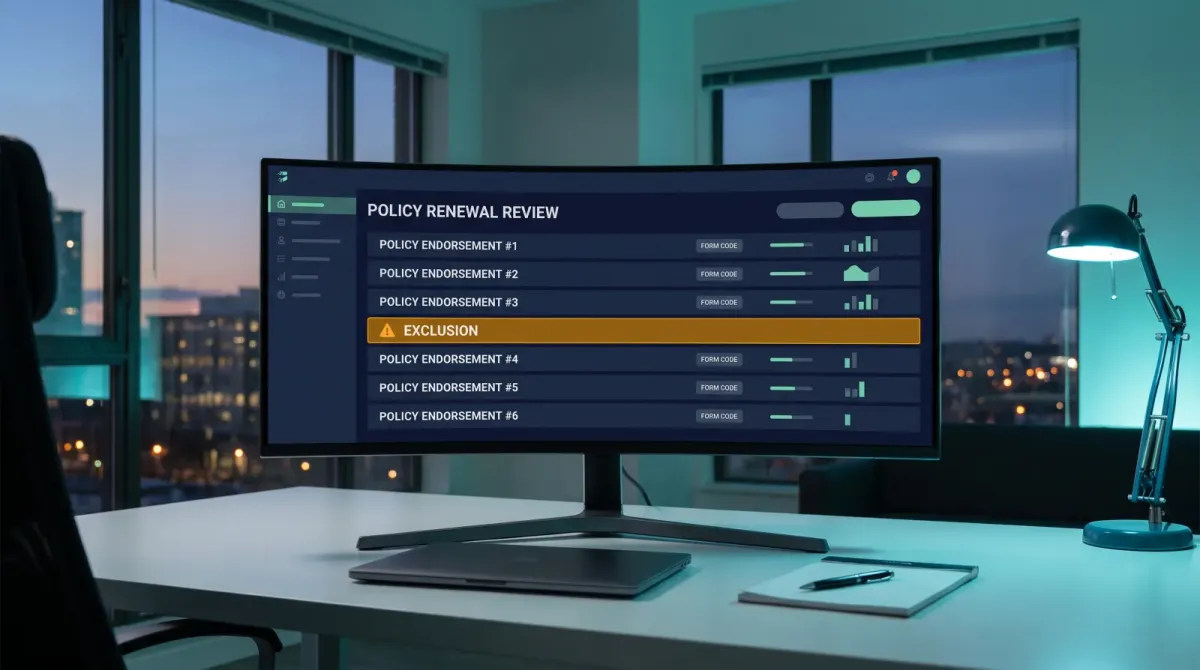
Yes, a growing number of insurance agents’ E&O, D&O, and general liability policies now carry, or soon will carry, exclusions written specifically to remove coverage for claims involving artificial intelligence. Verisk’s Insurance Services Office (ISO) made three generative AI exclusion endorsements available for commercial general liability policies effective January 2026, and carriers including W. R. Berkley have filed even broader “absolute” AI exclusions on their D&O, E&O, and fiduciary liability lines. Whether your own policy already has one is not something you can guess. It’s something you have to go read.
Key takeaways
- Verisk's ISO filed three generative AI exclusion endorsements for commercial general liability policies — CG 40 47, CG 40 48, and CG 35 08 — effective January 2026 (Independent Agent/Big I, Oct. 21, 2025).
- W. R. Berkley has gone further with an "absolute" AI exclusion built specifically for D&O, E&O, and fiduciary liability products, and Insurance Journal reports E&O and D&O are the lines seeing the most aggressive exclusion language industry-wide as of August 2026.
- The median E&O premium for insurance agents is $65 a month, or $781 a year, per Insureon — and an AI exclusion typically doesn't move that price. Your bill can stay flat while your actual coverage narrows.
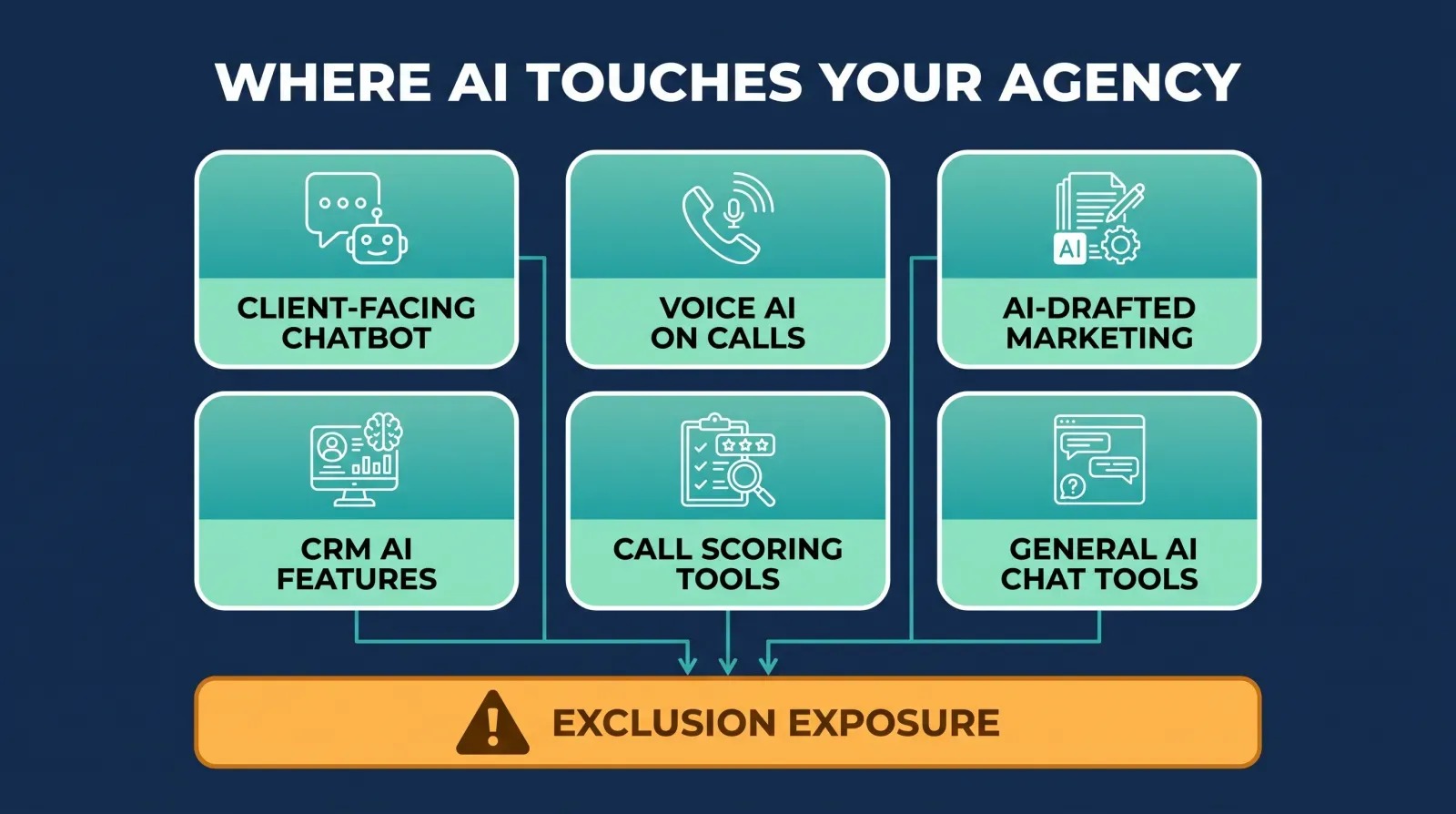
- "AI use" in these exclusions is written broadly enough to reach more than a client-facing chatbot: a custom GPT drafting marketing copy, a CRM's AI lead scoring, or a voice AI transcribing a sales call can all count.
- You can audit your own policy for this in about an hour with no tools beyond your declarations page and an email to your broker. Ambrose's PHI Rail and Routines logs, included with a Tech Savvy membership, generate part of the documentation trail automatically for anything already running through the platform.
The pain: you added AI to your agency, and now you’re not sure what’s still covered
You’ve got a quoting chatbot on your website, or you use a custom GPT to draft your Facebook posts, or your CRM’s voice AI transcribes and summarizes every sales call automatically. None of that felt like a decision that touched your insurance. It felt like a productivity upgrade.
Then you read a headline about carriers excluding AI from liability coverage, and a specific, uncomfortable question shows up: if that chatbot quotes a client wrong, or that AI-summarized call note gets something material wrong and a client acts on it, is your E&O actually going to pay a claim, or is there language in your renewal packet, the one you skimmed and signed, that already says no?
That question doesn’t have a generic answer. It has a specific one, sitting in your own policy’s endorsement schedule, and most agents have never opened that schedule looking for the words “artificial intelligence.”
Why it’s happening now: carriers started writing AI out of their forms in 2026
This isn’t a rumor moving through agent Facebook groups. It’s a documented shift in how standard insurance forms are built, and it happened on a specific timeline.
Verisk, the company behind the ISO forms that underpin most U.S. commercial policies, filed three new exclusionary endorsements for use with commercial general liability policies, effective January 2026: CG 40 47, which excludes bodily injury, property damage, and personal and advertising injury arising out of generative AI under both Coverage A and Coverage B; CG 40 48, the narrower version limited to Coverage B (personal and advertising injury); and CG 35 08, which applies the same exclusion to products and completed operations coverage (Independent Agent/Big “I”, Verisk to Roll Out New GL Exclusions for Generative AI Exposures, Oct. 21, 2025).
| Form | Coverage part | What it excludes |
|---|---|---|
| CG 40 47 | CGL, Coverage A & B | Bodily injury, property damage, personal and advertising injury arising out of generative AI |
| CG 40 48 | CGL, Coverage B only | Personal and advertising injury arising out of generative AI |
| CG 35 08 | Products / completed operations | Bodily injury and property damage arising out of generative AI, for products/completed-ops exposure |
Those three forms sit on general liability policies, not on the professional E&O coverage most agents actually rely on day to day. But the same instinct has moved into professional lines directly. W. R. Berkley has introduced what its own filed language calls an “absolute” AI exclusion, built specifically for its D&O, E&O, and fiduciary liability products. The endorsement excludes any claim “based upon, arising out of, or attributable to” the “actual or alleged use, deployment, or development of Artificial Intelligence,” and it’s written to reach further than a single bad chatbot answer: the filed language also excludes claims tied to an insured’s “failure to identify or detect content or communications created through a third party’s use of Artificial Intelligence,” and to “inadequate or deficient policies, practices, procedures, or training relating to Artificial Intelligence” (National Law Review/Hunton Andrews Kurth, The Continued Proliferation of AI Exclusions, May 28, 2025).
Insurance Journal’s reporting from August 2026 puts the direction plainly: E&O and D&O are the two lines where the industry expects the most aggressive AI exclusion adoption, as insurers treat AI liability as a risk that’s become, in one attorney’s words, close to omnipresent across client-facing work (Insurance Journal, Insurer Interest in AI Coverage Exclusions Growing as Risk Becomes Omnipresent, Aug. 17, 2026). None of this means every E&O policy sold to an insurance agent in 2026 already carries one of these endorsements. It means the forms exist, they’re filed, and adoption is actively spreading carrier by carrier and state by state, which is exactly the kind of change that shows up quietly in a renewal packet rather than as a phone call from your broker.
The CGL forms and the E&O exclusions are not the same thing
CG 40 47, CG 40 48, and CG 35 08 are commercial general liability forms. Your professional E&O policy is a separate coverage part, and it's being addressed separately, carrier by carrier, the way Berkley has done. Don't assume that because your GL policy doesn't mention AI, your E&O doesn't either, or vice versa. Check both, and your D&O and fiduciary liability policies too if you carry them.
From “silent AI” to a named exclusion: why this is happening on this specific timeline
Before any of the named forms above existed, most policies simply didn’t mention AI at all, and that silence cut in the policyholder’s favor. Law firm Fenwick & West describes the earlier state of the market as “silent AI” coverage: a claim touching AI-assisted work was implicitly covered under an existing cyber or tech E&O policy for the simple reason that it wasn’t specifically excluded (Fenwick & West, The End of “Silent AI”? Emerging AI Exclusions, Coverage Fragmentation, and Practical Implications for Policyholders, June 15, 2026). No exclusion named AI, so absent some other reason to deny the claim, coverage held by default.
That’s the exact condition the ISO forms and the Berkley “absolute” exclusion were built to end. Once a named exclusion exists and a carrier attaches it to your policy, the silence that used to protect you is gone, and the claim now has to fit inside what’s left rather than falling through a gap nobody thought to close. Fenwick’s own warning is worth repeating directly: this erosion is often quiet rather than obvious, arriving through “revised definitions, carve-backs, or underwriting changes” as much as through one conspicuously labeled endorsement, which is exactly why a keyword search across your full endorsement schedule, not just a scan for a form titled “AI Exclusion,” is the right way to check.
What this costs: the premium doesn’t move, the coverage does
Here’s the number that makes this concrete instead of abstract. Insureon, which sells small-business insurance and reports pricing data from its own book, puts the median cost of E&O coverage for insurance agents, brokers, and other insurance professionals at $65 a month, or $781 a year, based on customers carrying $1 million per-occurrence and $1 million aggregate limits with a $1,000 deductible (Insureon, Insurance Cost for Insurance Agents: Errors and Omissions and More, updated June 23, 2025).
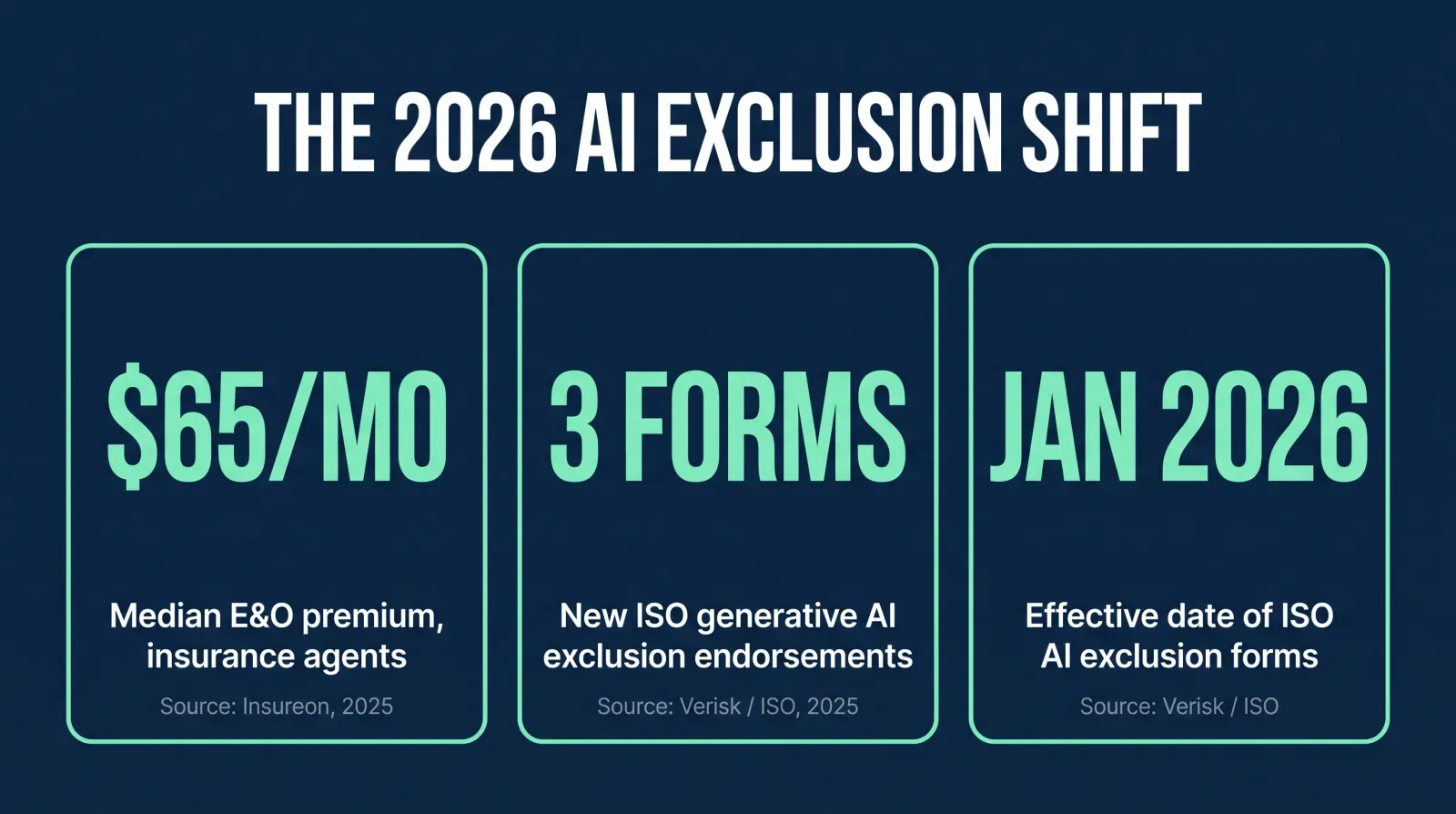
Sit with what that means. Your renewal invoice can arrive at almost exactly the same number you paid last year, and the policy behind it can be materially different, because an exclusion endorsement doesn’t usually move the premium the way adding or dropping a coverage limit does. It’s a change to what’s covered, not to what’s charged. That’s precisely why this is easy to miss: the one number agents actually check at renewal, the total due, tells you nothing about whether an AI exclusion was added.
And if the exclusion applies, there’s no partial payout to fall back on. An excluded claim isn’t a claim your carrier pays less of. It’s a claim your carrier pays none of, which means the $781 a year you spent on E&O bought you nothing for that specific incident, and every dollar of defense and any settlement or judgment comes out of the agency directly.
The premium tells you what you paid. It doesn't tell you what changed. The only place that shows up is the endorsement schedule, and almost nobody reads that page closely at renewal.
Mike MooreWhat actually counts as “AI use” in your agency
This is where agents underestimate their own exposure. “AI” in these exclusions isn’t limited to a branded chatbot widget on your homepage. Read Berkley’s filed language again: it reaches “use, deployment, or development” of AI, a failure to “identify or detect content…created through a third party’s use of Artificial Intelligence,” and “inadequate or deficient policies, practices, procedures, or training relating to Artificial Intelligence.” That’s written broadly on purpose.
Client-facing quoting or chat tools
A chatbot or AI quoting widget on your website or landing page, answering plan or pricing questions directly.
Voice AI on sales or service calls
A voice AI that answers calls, qualifies leads, or transcribes and summarizes a call your CRM stores as the record of what was said.
AI-drafted marketing and content
A custom GPT or general-purpose AI tool drafting ad copy, blog posts, or plan-comparison content a client or prospect reads.
AI features baked into your CRM
Lead scoring, next-best-action suggestions, or auto-generated follow-up messages your CRM runs without you explicitly "choosing AI" each time.
Call scoring and coaching tools
Any tool that transcribes, scores, or tags a recorded sales or service call for compliance or coaching purposes.
General-purpose chat tools for client questions
Pasting a client's situation into ChatGPT, Claude, or Gemini to draft an answer you then send, even if you edit it first.
If any one of those six is part of how your agency actually works, the honest answer to “do I use AI in my business” is yes, and the exclusion language in the current generation of forms is written to reach that answer, not just the narrower one.
If your E&O comes through your FMO or upline instead of a broker you chose
A lot of captive and FMO-affiliated agents never shopped their own E&O in the first place. It came bundled with the contract: the FMO or IMO arranges a group E&O program, the agent pays into it or gets it as a production perk, and the actual policy document lives in a portal the agent has never opened. That arrangement doesn’t make the AI exclusion question go away. It just moves who you need to ask.
If you’re in that position, the audit still applies, but step four changes: instead of emailing your own broker, you’re asking your FMO’s compliance or contracting contact for the same three things, the current declarations page, the full endorsement schedule, and a written answer on whether an AI-related exclusion is present or scheduled. Group E&O programs renew on their own timeline, often annually across the entire downline at once, and a change that gets added to the master policy applies to every agent under it whether or not any individual agent was told. Don’t assume “my upline would have said something.” Ask for the document.
This also matters if you use more than one E&O source, for example a group policy through an FMO for your Medicare business and a separately purchased policy for life or ACA work you write outside that contract. Each policy has its own endorsement schedule, and an exclusion on one doesn’t tell you anything about the other. Run the search on all of them.
The manual method: audit your own policy for AI language, free, this week
Here’s the part we’re not going to hold back to make a sale. You don’t need software, a broker relationship upgrade, or a membership to run this. You need your policy documents and about an hour.
Pull your full declarations page and endorsement schedule
Not the summary your broker emailed you. The actual PDF packet, every endorsement listed by form number, for your E&O and, if you carry them, your GL, D&O, and fiduciary liability policies.
Search the document for the right terms
Use your PDF reader's search function for "artificial intelligence," "AI," "generative," and "machine learning." Exclusions don't all share one label — some are named forms like CG 40 47, others are carrier-specific endorsement titles with different wording entirely.
List every AI touchpoint your agency actually has
Use the six categories above as a checklist. Write down every tool, who uses it, and what it touches: marketing copy, client conversations, quotes, or call records.
Send your broker one specific email
Ask directly: does my current E&O, GL, and D&O (if applicable) contain any AI-related exclusion endorsement, and if not, is one scheduled to be added at my next renewal? Ask for the answer in writing, not a verbal "you should be fine."
If there's an exclusion, ask what it would take to buy it back
Some carriers offer the ability to buy back AI coverage as a separate endorsement, usually at additional cost. Ask specifically whether that option exists for your policy and what it costs, rather than assuming it doesn't exist because your broker didn't mention it.
Write down your own AI use policy, even a short one
A half-page document: which tools you use, for what, and who reviews AI output before it reaches a client. This is the artifact a state examiner, a carrier, or your own defense counsel would want to see if a claim ever touched AI use.
What most agents do at renewal
Glance at the total premium, confirm it's roughly the same as last year, sign the renewal, and move on. The endorsement schedule, often a dozen or more pages of form numbers, goes unread.
What a one-hour audit looks like
Full endorsement list pulled and searched for AI-related terms, every AI touchpoint in the agency listed against it, one written question sent to the broker, and a short internal AI-use policy on file — before the next renewal, not after a claim.
A worked example: two agencies, the same renewal, two different outcomes
Take two solo agents, each paying roughly the Insureon median for E&O, each running a website quoting chatbot and a custom GPT for marketing copy.
| Step | Agent A: skipped the review | Agent B: ran the audit |
|---|---|---|
| Renewal premium | $781, unchanged from prior year | $781, unchanged from prior year |
| Endorsement schedule reviewed? | No — signed on the total due | Yes — searched for AI-related terms |
| Result of the review | Unknown — finds out only if a claim is denied | Confirmed no AI exclusion present this cycle; broker flagged one is likely at next renewal |
| Documentation on file | None | Written broker confirmation, one-page AI-use policy, list of AI touchpoints |
Illustrative example, not a claim about either agent's actual outcome
This is a worked comparison to make the audit concrete, not a description of a real claim or a guarantee of any specific coverage decision. Whether a given claim would be covered depends entirely on your actual policy language, your state, and the facts of the claim. Results may vary.
Agent A and Agent B pay the exact same premium. Only one of them knows what they’re actually holding.
Where the manual process breaks down: it’s not a one-time check
The audit above is a snapshot. The problem is that both sides of the equation keep moving. Carriers are actively expanding AI exclusion adoption across more lines and more states through 2026, so a clean result this renewal doesn’t mean a clean result next renewal. And your own AI footprint keeps growing too: agents add a new tool every few months, often without anyone deciding “we are now an AI-using business,” it just accumulates one subscription at a time.
That means the real fix isn’t a single afternoon of searching PDFs. It’s a habit: re-run the endorsement search every renewal, and keep the AI-touchpoint list current every time a new tool gets added, not once a year when you remember. That’s exactly the kind of recurring, easy-to-skip task that quietly stops happening once the initial urgency wears off, which is the gap the next section is about.
How Ambrose helps you build the paper trail, without replacing your broker conversation
None of what follows is insurance advice, and it doesn’t tell you whether your policy has an AI exclusion. Only your broker and your actual policy language can answer that. What Ambrose OS, the AI platform included with a Tech Savvy Insurance membership, does address is the documentation side: if an AI tool touched a piece of client-facing work, can you actually show what it did and when.
Per Ambrose’s own architecture documentation, the PHI Rail runs a redact-then-rehydrate pipeline on anything routed through the platform that touches client identifiers: a detection chain checks known vault contacts first, then regex patterns, then Presidio NER, then an insurance-specific dictionary, and replaces anything it flags with a typed alias like PERSON_xxxx or EMAIL_xxxx before the request reaches a destination outside the agency’s BAA allowlist, then splices the real values back into the response afterward. Every scrub event gets logged, timestamp, source, and identifier count, and the log explicitly never stores the underlying values themselves (Ambrose docs, PHI Rail architecture). That log doesn’t answer an insurance-coverage question. It answers a different one an examiner, a carrier, or your own defense counsel might ask: what happened, and is there a record.
Routines, Ambrose’s scheduling layer, add the same kind of paper trail to recurring work. A routine runs on a cron schedule against a named agent or team with a defined prompt body, and its run history is tracked and retrievable through the platform, with output routed to Slack, email, a GHL note, or a log-only destination depending on how it’s configured (Ambrose docs, Routines). If your agency’s AI touchpoint is a scheduled process, a weekly re-shop scan, a follow-up sequence, rather than a one-off chat, the run log itself becomes part of your documentation of what the AI did and on what schedule.
And for the judgment call in the middle, whether a specific new AI tool or workflow needs a written policy before you turn it on, the War Room’s Compliance persona, listed in Ambrose’s documented roster as Dr. Elena Reyes alongside eight other executive personas including a CFO, COO, and CMO, exists specifically to be the seat most solo agencies skip under time pressure (Ambrose docs, War Room). Asking that persona “should I have a written policy before I turn on this voice AI tool” doesn’t replace your compliance program. It’s a fast first pass that produces a written answer you can keep, instead of a decision that happened in your head and left no trace.
| Documentation need | Doing it by hand | Running through Ambrose |
|---|---|---|
| Record of when client data reached an outside AI tool | Manual log you have to remember to update | PHI Rail scrub-event log: timestamp, source, identifier count, automatic |
| History of a recurring AI process | Whatever notes you happened to keep | Routine run history, tracked and retrievable |
| A written answer on a compliance judgment call | A conversation nobody wrote down | A War Room Compliance-persona answer you can save |
This documents AI use. It doesn't change your coverage.
Nothing here adds AI coverage back to an excluded policy, and nothing here substitutes for the broker conversation and the endorsement review above. It builds the record that a documentation-focused compliance program, or a claim, would ask you to produce — a separate, still-necessary piece of the same problem.
What you get by joining
One Ambrose seat, PHI Rail, Routines, and the full nine-persona War Room included, comes with a Tech Savvy Insurance membership: $97 a month, billed monthly, cancel anytime, founding rate locked in while the membership stays active. Alongside the seat: weekly Zoom calls with open Q&A and build-with-you sessions, 30-plus hours of recorded training, Meta Ads, AI, and marketing training built for health and life agents specifically, pre-built AI templates and bot deployments, and a free annual in-person member workshop. It’s an explicit no-recruiting zone, worth naming here specifically, because “is my coverage actually holding up” is exactly the kind of question that gets waved away in a group built around selling you something else.
Everything in the audit and the checklist above works whether you ever join anything or not. Run it this week, on your own policy, before your next renewal lands.
Check your own coverage before your next renewal
Pull your endorsement schedule and run the search this week — no membership required. If you'd rather have the documentation side running automatically for anything routed through Ambrose, with people watching your screen while you set it up, one seat comes with the Tech Savvy membership.
Join Tech Savvy — $97/monthCompliance: what this touches, and what it doesn’t
Nothing in this article is insurance, legal, tax, or compliance advice, and nothing here tells you whether your specific policy covers a specific claim. Only your broker, your carrier, and your actual policy language can answer that, and coverage disputes ultimately turn on facts and wording this article can’t see. If your agency’s AI use touches Medicare marketing in any way, a TPMO disclaimer obligation and CMS’s Medicare Communications and Marketing Guidelines apply on top of, and separately from, anything covered here (CMS, Medicare Communications and Marketing Guidelines). Where AI is used anywhere in your marketing, sales, or client-facing workflow, the NAIC’s Model Bulletin on the Use of Artificial Intelligence Systems by Insurers, adopted in December 2023, sets governance expectations around documentation and oversight that a growing number of state insurance departments have adopted or referenced, and that a written AI-use policy like the one described above is built to satisfy (NAIC, Insurance Topics: Artificial Intelligence). Ambrose is HIPAA-aware by default, not HIPAA certified, since there is no such thing as HIPAA certification for a software platform; the PHI Rail’s identifier-aliasing design is one part of that posture, not a substitute for your own agency’s HIPAA program.
The close
Pull your declarations page this week. Search it for “artificial intelligence” and “AI.” Send your broker one written question. That’s the entire audit, it costs nothing, and it’s the only way to actually know what you’re holding instead of assuming your renewal invoice would have told you if something changed. It wouldn’t have. If you’d rather have the documentation side of this running automatically for anything routed through an AI platform, one Ambrose seat comes with a Tech Savvy membership, and the weekly build-with-you calls are where agents work through their own policy questions with people who’ve actually read one of these endorsement schedules: https://techsavvyinsurance.com/.
Before you rely on any figure in this article
Tech Savvy Insurance is a training and software community, not an insurance company, agency, or law firm, and does not provide insurance, legal, tax, or compliance advice. You are responsible for your own licensure and for complying with all applicable CMS, state insurance, HIPAA, NAIC, and carrier regulations, and for reviewing your own E&O, GL, D&O, and fiduciary liability policies with your own broker and carrier. Endorsement forms, state adoption, and carrier practices change — confirm current policy language directly with your broker or carrier before relying on any figure here. AI-generated outputs may contain errors: always verify. Results may vary.
Frequently asked questions
Sources
- Independent Agent (Big "I" Virtual University) — Verisk to Roll Out New General Liability Exclusions for Generative AI Exposures — independentagent.com
- National Law Review / Hunton Andrews Kurth — The Continued Proliferation of AI Exclusions — natlawreview.com
- Insurance Journal — Insurer Interest in AI Coverage Exclusions Growing as Risk Becomes Omnipresent — insurancejournal.com
- Fenwick & West LLP — The End of 'Silent AI'? Emerging AI Exclusions, Coverage Fragmentation, and Practical Implications for Policyholders — fenwick.com
- Insureon — Insurance Cost for Insurance Agents: Errors and Omissions (E&O) and More — insureon.com
- NAIC — Insurance Topics: Artificial Intelligence (Model Bulletin) — content.naic.org
- CMS — Medicare Communications and Marketing Guidelines — cms.gov
- Ambrose docs — PHI Rail architecture — app.hiambrose.com
- Ambrose docs — Routines — app.hiambrose.com
- Ambrose docs — War Room — app.hiambrose.com
- Ambrose docs — Spokes (catalog) — app.hiambrose.com
- Ambrose docs — What is Ambrose — app.hiambrose.com
Ready to put this into practice?
Join a private community of Health & Life insurance professionals using AI, Meta Ads, and automation to grow — without draining their bank account.
Join Tech Savvy — $97/month