
You posted a Facebook update about your Medicare Advantage book last AEP, your compliance officer flagged it two weeks later, and you still don’t fully understand why that post needed CMS review when the reminder letter you mailed the same week didn’t. Here’s the actual answer: CMS splits everything you create into two buckets, “communications” and “marketing,” using a specific two-part test — an intent standard and a content standard — and a piece of content only lands in the marketing bucket if it meets both. Miss the content standard and a promotional-sounding message is still, technically, a communication. Hit both standards and a flyer that never mentions a plan name by number is still marketing. The line isn’t about tone or how salesy something feels. It’s about two defined, checkable conditions, and this article walks through exactly what they are.
Key takeaways
- Marketing is a subset of communications. To count as marketing, a piece must meet BOTH an intent standard (draws attention to a plan, influences a plan choice, or influences someone to stay enrolled) AND a content standard (addresses benefits, premiums, cost sharing, Star Ratings/plan comparisons, or rewards and incentives) (CMS, MCMG, Feb. 9, 2022).
- CMS's own worked examples show the line is strict: a flyer announcing a new plan with a phone number is a communication; a billboard with the same intent plus a "$0 premium" line is marketing.
- A single phone call can start as a communication and become marketing mid-conversation — CMS requires the plan to follow the rules for each portion of that call separately.
- Marketing aimed at generating leads is generally prohibited during the Open Enrollment Period (OEP), with specific named exceptions (CMS, MCMG, § 422.2263(b)(7)).
- A submitted marketing material isn't usable for 5 days under File & Use, or up to 45 days under standard review — and using one too early, or one later found noncompliant, can trigger "intermediate sanctions and/or civil money penalties" (CMS, MCMG, Introduction).
- Ambrose's War Room includes a dedicated Compliance persona, and every model call that touches protected health information runs only through a BAA-covered provider with a logged audit trail — a documented review layer for exactly this kind of judgment call (Ambrose docs, War Room and How client data is protected, confirmed November 2026).
The test CMS actually uses
Forget “does this feel like marketing.” CMS’s own manual, the Medicare Communications and Marketing Guidelines (MCMG), opens its definitions section with the regulatory language at 42 CFR §§ 422.2260 and 423.2260, and it’s more mechanical than most agents expect.
Communications means activities and the use of materials created or administered by a plan or any downstream entity — which includes you, if you’re producing content as part of selling or servicing a Medicare Advantage or Part D plan — to provide information to current and prospective enrollees. Every piece of content you make for a current or prospective enrollee starts out, by default, as a communication.
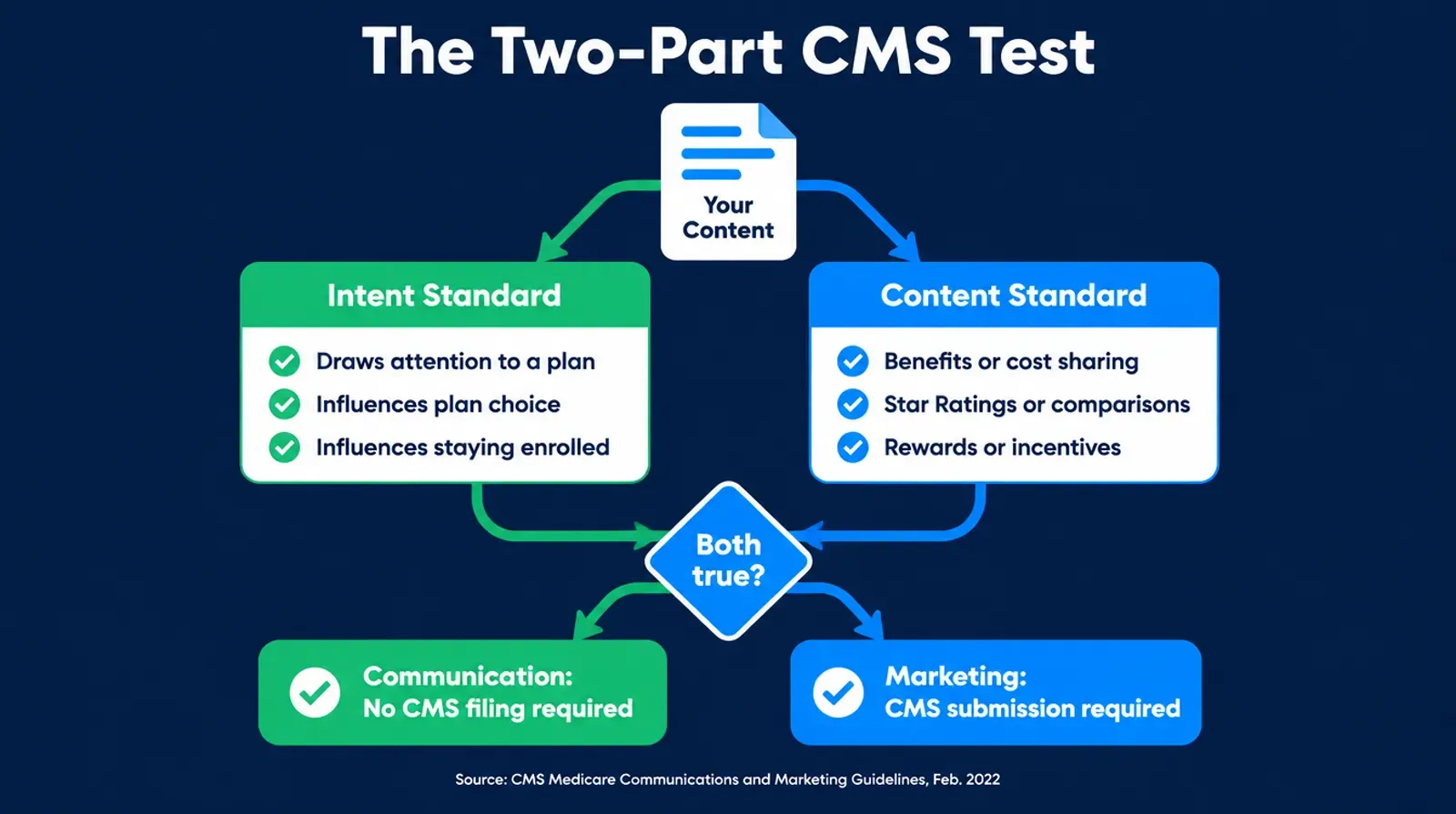
Marketing is a subset of that category. To cross from communication into marketing, a piece of content has to meet both of two standards at the same time:
- The intent standard. The material or activity is intended to draw a beneficiary’s attention to a plan or plans, influence a beneficiary’s decision-making process when selecting a plan, or influence a beneficiary’s decision to stay enrolled in a plan (retention-based marketing). CMS doesn’t take your word for your intent, either — it looks at “objective information including, but not limited to, the audience, timing, and other context of the activity or material,” and your stated intent “will be reviewed but not solely relied upon” (CMS, MCMG, Feb. 9, 2022, Definitions).
- The content standard. The material or activity addresses the plan’s benefits, benefit structure, premiums, or cost sharing; measuring or ranking standards such as Star Ratings or plan comparisons; or rewards and incentives as defined under 42 CFR § 422.134(a).
Both standards have to be true at once. A piece that’s clearly trying to get attention but never touches a plan’s benefits, cost, or rating isn’t marketing under this test — it’s a communication, even if everyone in the room would call it an ad.
Four examples, straight from CMS’s own manual
CMS doesn’t leave this abstract. The MCMG includes four worked examples, almost built for exactly the confusion that gets agents flagged. Here they are, with CMS’s own reasoning:
| The piece | Classification | CMS's reasoning |
|---|---|---|
| A flyer reads "Swell Health is now offering Medicare Advantage coverage in Nowhere County. Call 1-800-BE-SWELL for more information." | Communication | Intent to draw attention is present, but there's no marketing content — no benefit, premium, or cost-sharing detail |
| A billboard reads "Swell Health Offers $0 Premium Plans in Nowhere County" | Marketing | Same intent as the flyer, plus content that mentions a zero-dollar premium — both standards are met |
| A letter reminds current enrollees to get a flu shot, mentioning "$0 copay at a network pharmacy" | Communication | Cost sharing is mentioned, but the intent is to encourage a flu shot, not to steer plan selection or retention, and it went only to current enrollees |
| A third-party TV ad: "Call us to hear about plans that can provide hearing and dental benefits, zero-dollar monthly premiums, and can even lower your Medicare Part B costs" | Marketing | No specific plan is named, but intent to draw a beneficiary toward an MA plan is clear, and the content addresses premium and benefit information |
Notice the pattern: the flu-shot letter proves content alone doesn’t make something marketing — it mentions a dollar figure and is still a communication, because the intent isn’t to move someone’s plan decision. The flyer proves intent alone doesn’t make something marketing either — it’s clearly trying to get a reader’s attention, and it’s still a communication, because it never touches benefits or cost. You need both standards in the same piece before the marketing rules, and the submission requirement that comes with them, apply.
Even CMS’s own required paperwork gets sorted this way
Agent-created content isn’t the only thing that gets this classification. CMS designates its own required materials — the documents every plan has to send on a fixed schedule — as either marketing or communications too, and the two sit right next to each other on the calendar. The Annual Notice of Change (ANOC), which every current enrollee must receive by September 30 each year, is itself classified as marketing under 42 CFR § 422.2267(e)(3) (CMS, MCMG, Feb. 9, 2022). The Evidence of Coverage (EOC), covering the same plan year and often mailed around the same time, is classified as a communication.
Why the split? The ANOC’s whole job is to tell an enrollee what’s changing about their plan’s benefits, premiums, and cost sharing for the coming year — which is the content standard, combined with the clear intent of influencing whether that enrollee stays enrolled or shops elsewhere during AEP. That’s both standards, met by design. The EOC is a dense reference document describing what the plan covers; it’s informational by nature rather than built to move a decision, so it lands as a communication even though it’s packed with benefit and cost detail. Same mailing season, same enrollee, two different classifications, because the test is about intent and content together, not about length or how official a document looks.
This matters practically because of a detail buried in the submission rules: the required websites, EOC, Summary of Benefits, and similar CMS-designated documents each carry their own specific submission mechanics, replacement rules, and translation requirements — and a plan “may enclose additional benefit/plan operation materials with CMS Required Materials unless prohibited” in the instructions for that specific document (CMS, MCMG, Feb. 9, 2022, § 422.2267(e)). In plain terms: stapling your own flyer to an EOC mailing doesn’t inherit the EOC’s communication status. Whatever you added gets evaluated against the two-part test on its own.
Why “communications” isn’t a free pass
Some agents hear “communications materials generally don’t require CMS submission” and treat that bucket as a loophole — write it as a “communication” and skip the hassle entirely. That’s a mistake on two levels.
First, the classification isn’t yours to decide by relabeling. CMS determines intent using “objective information” about your actual audience, timing, and context, explicitly not limited to what you call the piece or claim your intent was. Calling a $0-premium billboard a “community update” doesn’t change what it is under the test.
Second, communications materials still carry real requirements — they’re just different ones. Under the General Communications Materials rules, if a communications activity starts moving toward a marketing activity (say, a service call where the beneficiary starts asking about other plans), the plan has to make that transition clear and get the beneficiary’s consent before transferring them to a sales or enrollment representative. And whenever a communications activity or material includes the plan’s name, it has to include the plan type too, at least on first mention (CMS, MCMG, Feb. 9, 2022, § 422.2262(a)). “Communication” doesn’t mean “unregulated.” It means a different, narrower set of rules applies.
The moment a phone call crosses the line
CMS’s manual makes a point most agents don’t expect: the classification isn’t fixed to the piece of content, it’s fixed to the moment. “Materials are static in nature, whereas activities are more dynamic,” the guidelines note. “Interactions with a beneficiary could begin as a communication activity but become a marketing activity.” CMS’s own example: an enrollee calls customer service with a question about their current coverage. Mid-call, they ask about other plan options. At that exact point, the call moves from communications to marketing, and the plan “must comply with all applicable requirements for each type of activity during the relevant portion of the interaction” (CMS, MCMG, Feb. 9, 2022, Definitions).
Practically, that means a licensed agent fielding a routine service call needs a clean way to flag, in their own head and in their notes, the moment a caller pivots from “I have a question about my current plan” to “tell me about my other options.” It’s also exactly why a clear, spoken transfer disclosure before handing someone to a sales conversation isn’t bureaucratic theater — it’s the dividing line CMS itself drew.
The flu-shot letter and the billboard use almost the same words about cost. One's a communication and one's marketing, because CMS is testing your intent, not your vocabulary.
Mike MooreThe Open Enrollment Period makes this stricter, not looser
The classification test gets an extra layer of restriction during the Open Enrollment Period (OEP), the window roughly January through March when eligible enrollees can make one additional plan change. Under 42 CFR § 422.2263(b)(7), marketing aimed at generating interest or leads during the OEP is generally prohibited when a plan is “knowingly targeting” OEP-eligible individuals. CMS defines “knowingly” by looking at both the recipient and the content: if a message specifically calls out the OEP, that’s knowing targeting. If a plan already knows someone made their AEP decision and sends them unsolicited marketing anyway — even without mentioning the OEP by name — that also counts as knowing targeting.
The rule carves out specific exceptions, and knowing them matters because they’re narrower than agents often assume:
- Responding to a beneficiary who proactively reaches out asking for help during the OEP — their request makes the response solicited, not unsolicited.
- Marketing to dual-eligible and Low-Income Subsidy (LIS) beneficiaries, who can generally make a plan change about once a calendar quarter during the first nine months of the year.
- Marketing a 5-Star plan, since beneficiaries can enroll in a 5-Star plan at any time using the 5-Star SEP.
- Mailing age-in materials — content aimed at people turning 65 — as long as it addresses only their Initial Coverage Election Period and doesn’t reference the OEP, and the plan has no way of knowing the person already made an enrollment decision.
CMS’s own example of what’s still prohibited is blunt: a generic “not happy with your plan, change now” message sent broadly during the OEP is exactly the kind of lead-generation marketing the rule is written to stop. If your agency runs any kind of year-round retargeting or re-engagement campaign, check whether it’s still live in January through March, and whether its targeting logic actually excludes people who already made their AEP choice.
What it costs to get the classification wrong
Two different costs sit on either side of this line, and agents tend to underweight both.
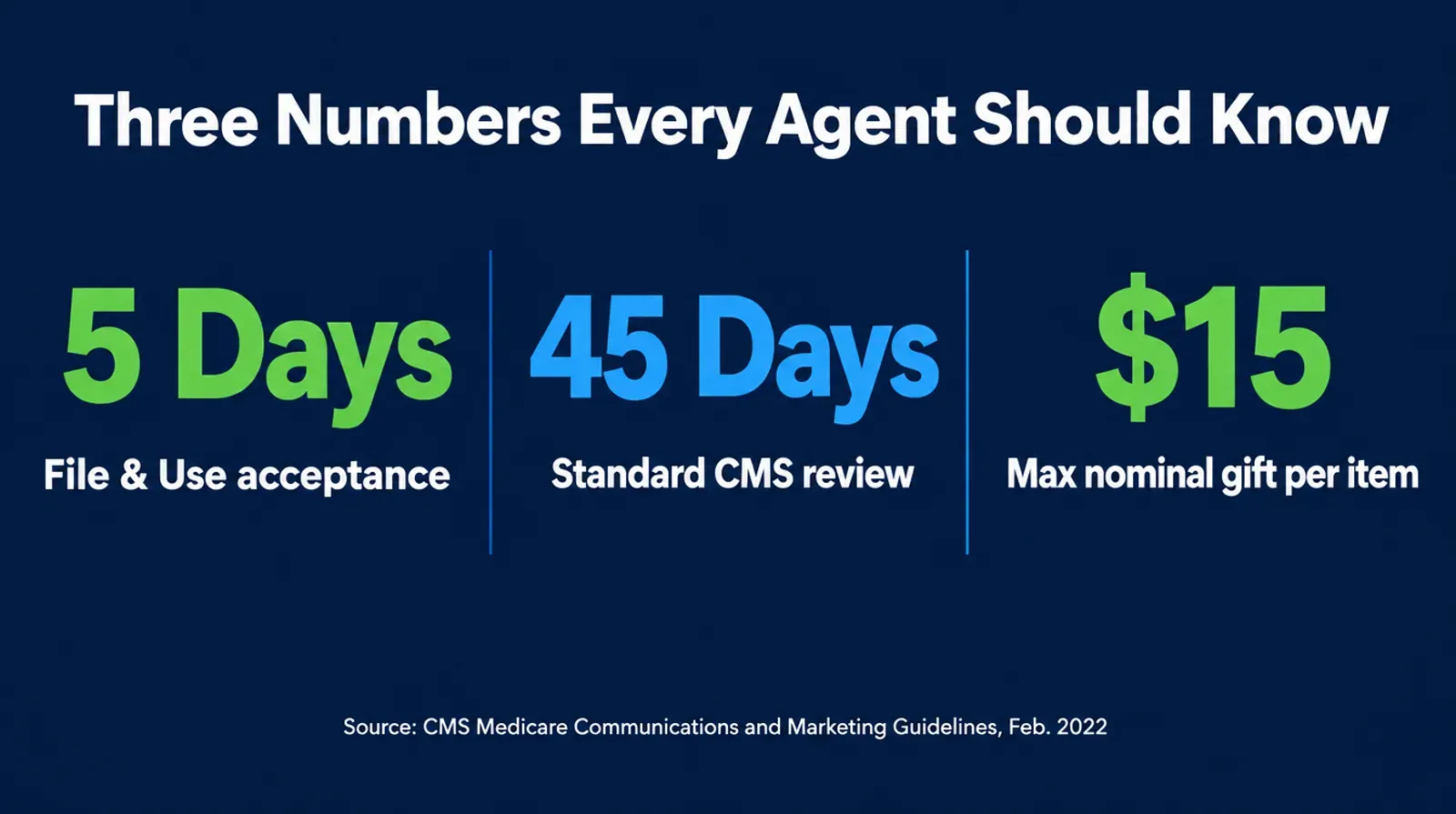
Classify a communication as marketing, and you lose time you didn’t need to lose. A material correctly submitted under File & Use isn’t usable until CMS considers it “accepted” — five calendar days after submission. Under standard review, the timeline runs up to 45 days (CMS, MCMG, Feb. 9, 2022, §§ 422.2261(a), (d)). During AEP, when every week of a seven-week enrollment window matters, routing a piece through a 45-day review it never actually needed is a real, avoidable cost.
Classify marketing as a communication, and you’ve created real exposure. CMS’s own introduction is direct about the consequence: using a material before it’s accepted, or a material later found “out of compliance with the applicable requirements,” can trigger compliance or enforcement action, “including, but not limited to, intermediate sanctions and/or civil money penalties” (CMS, MCMG, Feb. 9, 2022, Introduction). CMS doesn’t publish a single flat dollar figure that applies to every marketing misclassification — penalty amounts are calculated case by case under CMS’s own methodology — so the honest number to hold onto isn’t a specific fine, it’s the review timeline you skip at your own risk.
CMS material review timelines
How long a submitted marketing material takes to become usable
Source: CMS, Medicare Communications and Marketing Guidelines, Feb. 9, 2022, §§ 422.2261(a), (d).
There’s a related dollar figure worth knowing even though it’s not a penalty: the nominal gift limit. CMS’s marketing rules prohibit offering beneficiaries a gift tied to marketing unless it’s of “nominal value,” and CMS adopts HHS OIG’s interpretation of that term — no more than $15 per item or $75 in the aggregate, per person, per year, and never in cash or a cash-equivalent like a general-purpose gift card (CMS, MCMG, Feb. 9, 2022, § 422.2263(b)(2), citing 85 Fed. Reg. 77,684, 77,789-90 and 81 Fed. Reg. 88,368, 88,393 n.19). A Visa gift card at your next educational event crosses that line. A Starbucks card, limited to one category of purchase, does not.
A content checklist: five things agents actually produce, classified
Here’s the method agents ask for most — not the abstract test, but how it lands on the exact content a working agent produces in a normal week. Run each of these against the two-part test yourself before you post, mail, or print anything.
| What you made | Intent standard? | Content standard? | Likely classification |
|---|---|---|---|
| Facebook post: "I'm now licensed to help with Medicare Advantage in [county] — message me with questions" | Yes — draws attention to you as a resource | No — no benefit, premium, or rating detail | Communication |
| Facebook post: "Plans in [county] starting at $0/month with dental and vision included" | Yes | Yes — premium and benefit detail | Marketing |
| Email to current enrollees only: "Reminder — your annual wellness visit is covered at $0 copay" | No — purpose is a wellness reminder, not a plan-selection nudge | Yes — mentions cost sharing | Communication (per CMS's own flu-shot-letter example) |
| Yard sign: "Ask me about Medicare — [your name], [phone number]" | Yes | No — no benefit or cost detail | Communication |
| LinkedIn post comparing two plans' Star Ratings to argue one is the stronger choice | Yes — intended to influence a plan comparison | Yes — Star Ratings are explicitly named in the content standard | Marketing |
This is the manual version, and it’s genuinely useful on its own — you can run every piece of content you create through this five-row pattern before it goes anywhere, with no tool beyond this article. What it doesn’t give you is a second set of eyes doing that check on every single post before it ships, every week, forever. That’s the part that gets automated.
Where AI quietly creates this exact problem
Here’s the trap specific to 2026: ask a general-purpose AI tool to “write me a quick social post about my Medicare book” and the draft that comes back will often volunteer a $0 premium, a benefit detail, or a Star Rating comparison on its own — not because the model is trying to make your content noncompliant, but because that’s the kind of specific, concrete detail that makes a social post read as persuasive. The model has no concept of CMS’s content standard. It’s optimizing for “sounds good,” and “sounds good” and “meets the content standard for marketing” overlap constantly.
That’s precisely the kind of AI governance gap the NAIC’s Model Bulletin on the Use of Artificial Intelligence Systems by Insurers is built around: a written program for the responsible use of AI, with documented human oversight, is the expectation, not a nice-to-have (NAIC, Model Bulletin, adopted December 4, 2023 — we cover the full checklist in our NAIC AI Model Bulletin guide). Reading every AI-drafted line against the two-part test above, before it posts, is a one-minute habit that closes most of this gap by itself. And if any of that drafting touches a specific client’s health information rather than generic marketing copy, that’s a separate and more serious risk — covered in full in our guide to what not to paste into ChatGPT.
Who actually files it, and what changed for 2027
Worth saying plainly: most independent agents don’t submit anything to CMS’s Health Plan Management System (HPMS) directly. Carriers and FMOs hold the HPMS access tied to their CMS contract, and agent-created material — what CMS calls a “Plan-Created Material” when it isn’t one of CMS’s own required documents — typically runs through the carrier’s or FMO’s own review and submission process before it’s used (CMS, MCMG, Feb. 9, 2022, § 422.2261). If you’re building your own landing page, flyer, or ad copy rather than using carrier-provided templates, that’s the process to confirm before anything goes live, every single time, because it sits on top of the classification question, not in place of it.
One more thing worth knowing if you build your own outreach: CMS’s Contract Year 2027 Medicare Advantage and Part D final rule, issued April 2, 2026, removed restrictions on “the time and manner” limits governing when and how beneficiaries can talk with licensed agents and brokers (CMS, CY2027 MA and Part D Final Rule Fact Sheet, April 2, 2026). That loosens one specific constraint on agent-beneficiary contact — it does not touch the marketing-versus-communications test itself, which is unchanged. More contact flexibility makes it more important, not less, to know which of your messages are communications and which have crossed into marketing.
This is the Medicare Advantage and Part D test specifically
Everything above comes from 42 CFR §§ 422.2260-422.2267 and the parallel Part D sections at 423.2260-423.2267. ACA Marketplace agent and broker conduct runs under its own separate framework at 45 CFR, with different advertising and conduct requirements. Don't apply this exact two-part test to Marketplace materials without checking the Marketplace-specific rule first.
How Ambrose’s War Room handles the judgment call
Everything above is the manual version, and it works with nothing beyond this article open in a second tab. Here’s what changes with the platform included in a Tech Savvy membership, confirmed directly against its own documentation this week.
The hardest part of this whole topic isn’t knowing the rule — it’s having someone to ask when a specific piece of content sits in a gray zone, at 9pm, the night before you planned to post it. Ambrose’s War Room is documented as a single chat surface with a fixed executive roster, and one of the nine named personas is specifically a Compliance head, Dr. Elena Reyes, alongside a CMO, COO, CFO, CRO, CTO, CCO, a Research persona, and Ambrose itself acting as Chief of Staff (Ambrose docs, The War Room, fetched November 2026). You type the actual post you’re about to publish, Ambrose routes the question to the Compliance persona, and you get a second opinion before it goes out instead of a compliance flag two weeks after it already did.
The data-handling layer underneath that matters just as much if the content you’re drafting touches anything specific to a real client. Ambrose’s own documentation states it is “HIPAA compliant” as a platform, and that protected health information — a client’s name, date of birth, or plan details — only runs against model providers under a signed Business Associate Agreement, specifically Claude through Amazon Bedrock in U.S. regions (Ambrose docs, How client data is protected, fetched November 2026). Tenant isolation is enforced underneath the application layer too: the acting agency ID is “resolved from the session on the server and never from user or model input,” with Postgres row-level security enforcing the same boundary, so one agency’s data can’t leak into another’s session (Ambrose docs, How client data is protected, fetched November 2026). And every model call is logged — model, provider, tokens, cost, latency — with any action that writes back to a CRM requiring an explicit Allow, Deny, or Always Allow approval, which is a documented, timestamped record of exactly the human-oversight step the NAIC bulletin expects (Ambrose docs, How client data is protected, fetched November 2026).
Underneath the War Room sits the Brain, which is the part that keeps any Ambrose-assisted content grounded in a real number instead of a model’s best guess: it’s documented as covering “33 federal and health data sources and 205 live tools,” including the CMS Medicare landscape and HealthCare.gov marketplace data (Ambrose docs, What is Ambrose, fetched November 2026 — these counts move as sources are added, and were confirmed current as of this fetch). If a Star Rating or a premium figure is going into a piece of content, that’s the layer that should be producing it, not a model recalling a number from training.
What this doesn't replace
The War Room's Compliance persona is a documented, useful second opinion — it is not a substitute for your carrier's or FMO's own required HPMS submission process when a piece genuinely meets both standards and needs CMS review. Treat it as a fast check before you write, not the filing itself.
What you get by joining
One Ambrose seat comes with a Tech Savvy Insurance membership: $97 a month, billed monthly, cancel anytime, founding rate locked in while the membership stays active. Alongside the seat: weekly Zoom calls with open Q&A and build-with-you sessions, 30+ hours of recorded training updated monthly, Meta Ads and AI training built for this industry specifically, pre-built AI templates and bot deployments, and a free annual in-person member workshop — with an explicit no-recruiting rule, so asking a real compliance question doesn’t turn into a downline pitch.
Everything above works whether you join anything or not
The two-part test, the five-row content checklist, and the OEP exceptions are usable today with nothing beyond this article. What Ambrose adds is a Compliance persona you can ask before something posts, not instead of your own judgment or your carrier's submission process.
The close
The agents who get flagged aren’t usually the ones trying to cut corners — they’re the ones who never learned there’s a specific, two-part test instead of a vibe. Run your next post through the intent standard and the content standard before it goes anywhere, and you’ll catch most of what would otherwise come back as a compliance note weeks later. If you’d rather have a Compliance persona read it with you before it ships, that’s what the membership is for: https://techsavvyinsurance.com/.
Compliance note
This article explains CMS’s own marketing-versus-communications test as published in CMS’s Medicare Communications and Marketing Guidelines; it is general information, not insurance, legal, tax, or compliance advice, and not a substitute for your carrier’s or FMO’s own required submission process. Tech Savvy Insurance is a training and software community, not an insurance company, agency, or law firm. You are responsible for your own licensure and for complying with all applicable CMS, HIPAA, state, and carrier regulations. Ambrose is HIPAA compliant as a platform, per its own documentation — not “HIPAA certified,” a designation that does not exist for software. AI-generated outputs, including any AI-drafted marketing copy, may contain errors or omissions that create compliance exposure — always verify against the standards in this article before anything goes out. Results may vary.
Frequently asked questions
Sources
- CMS — Medicare Communications and Marketing Guidelines (MCMG), dated Feb. 9, 2022 (current manual as of CMS's Managed Care Marketing page, last updated Sept. 10, 2024) — cms.gov
- Cornell Law School Legal Information Institute — 42 CFR § 422.2260, Definitions — law.cornell.edu
- CMS — Medicare Marketing Guidelines (landing page for the MCMG and prior versions) — cms.gov
- CMS — Contract Year 2027 Medicare Advantage and Part D Final Rule, Fact Sheet (issued April 2, 2026) — cms.gov
- Ambrose docs — What is Ambrose — app.hiambrose.com
- Ambrose docs — The War Room — app.hiambrose.com
- Ambrose docs — How client data is protected — app.hiambrose.com
- NAIC — Insurance Topics: Artificial Intelligence (Model Bulletin overview) — content.naic.org
Ready to put this into practice?
Join a private community of Health & Life insurance professionals using AI, Meta Ads, and automation to grow — without draining their bank account.
Join Tech Savvy — $97/month