
Yes, a general AI tool can give you a wrong Medicare number and sound exactly as sure of itself as when it’s right — there’s no tone-of-voice tell, because a language model doesn’t actually know the difference between a fact it learned and a plausible-sounding guess it generated to fill the gap. The 2026 standard Part B premium is $202.90 a month. If you asked a model that question with nothing but its training behind it, depending on when that training ended, you could just as easily get $185.00 — last year’s number, delivered with this year’s confidence. This article walks through exactly why that happens, a real premium figure you can use to test any AI tool you’re using right now, the manual method for checking any Medicare plan fact by hand before it reaches a client, and what Ambrose’s Brain does differently.
Key takeaways
- A general-purpose AI model answers from a fixed training snapshot by default. It has no built-in way to know its own cutoff is behind the current plan year, and it doesn't hedge differently when it's guessing versus when it's quoting something real.
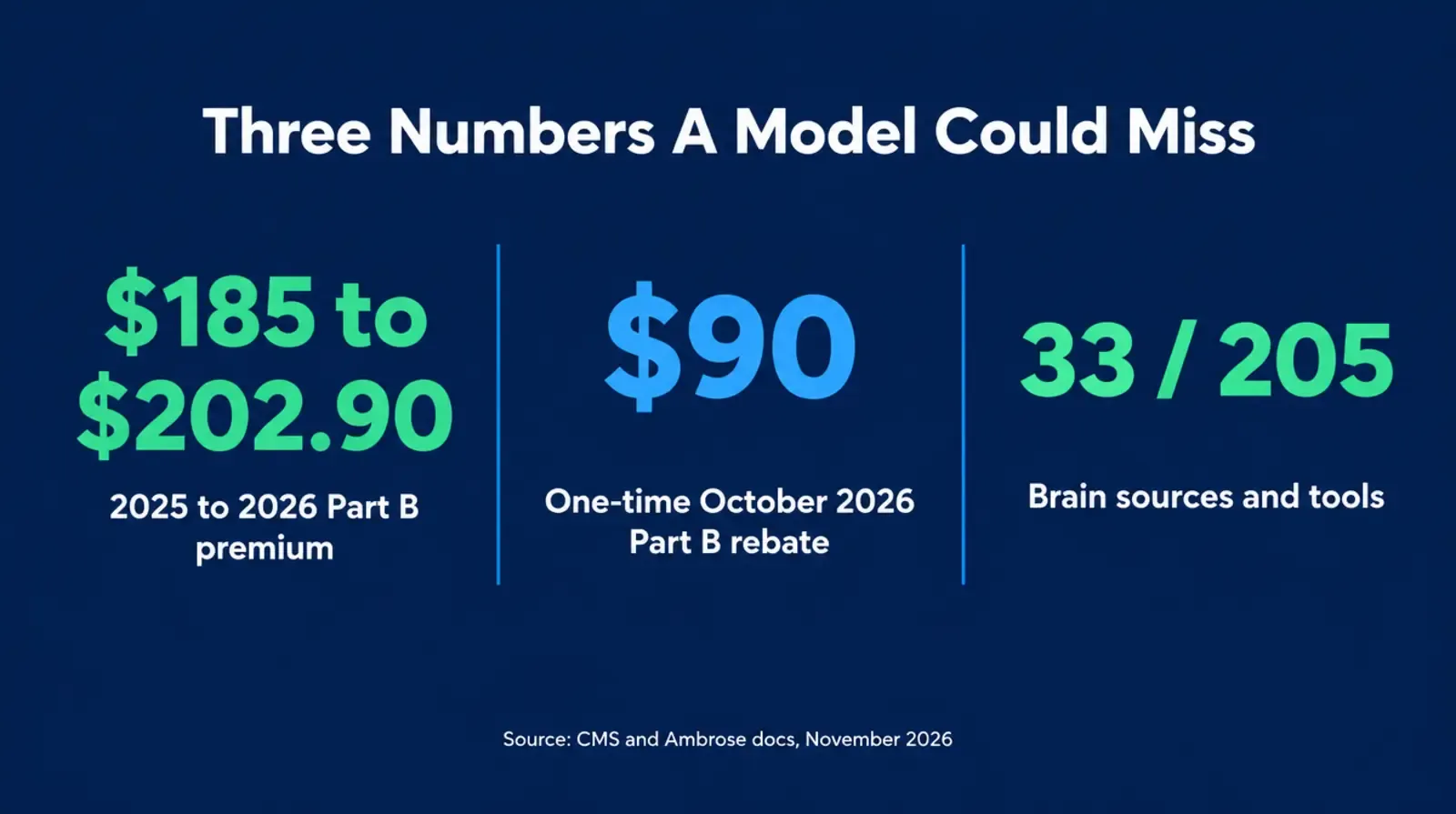
- The 2026 standard Medicare Part B premium is $202.90/month (up from $185.00 in 2025), and the 2026 deductible is $283 (up from $257) — CMS, released Nov. 14, 2025. Test any AI tool you use against this one number today.
- CMS announced a one-time $90 Part B premium rebate in October 2026, for roughly 20.8 million Original Medicare beneficiaries, excluding Medicare Advantage enrollees and anyone on Medicaid premium assistance or paying IRMAA (CMS FAQ, Oct. 3, 2026). A model trained before this was announced cannot know it exists — not partially, not fuzzily, not at all.
- Every category of Medicare plan fact an agent repeats to a client — premiums, Star Ratings, formulary tier, network status, plan availability — has a specific, free, CMS-run place to verify it by hand before you say it out loud.
- Ambrose's Brain is documented as a service fronting 33 federal and health data sources and 205 live tools, meant to answer plan questions by querying a current source rather than recalling a number from training (Ambrose docs, What is Ambrose, fetched Nov. 4, 2026).
The pain: a confident wrong number is worse than no answer
Here’s the specific moment this article is about. You’re on a call, or typing a quick follow-up, and a client asks something like “didn’t I hear Medicare premiums are going up a lot this year?” or “is it true everybody’s getting a rebate check?” You open a general AI tool because it’s faster than digging through a CMS PDF, type the question, and get back a clean, specific, well-formatted answer. It reads like it knows what it’s talking about. Most of the time, for a stable fact, it does.
The problem is the other times, and there’s no visible difference between the two. A model that’s confidently right and a model that’s confidently wrong produce the same kind of sentence — complete, specific, reasonable-sounding — because generating fluent text is the one thing the model is actually built to do well. Being current isn’t a separate skill it also has. If the true number changed after the point where its training data was collected, the model doesn’t know that happened, and it won’t tell you it doesn’t know. It will give you its best pattern-matched guess and phrase it exactly like a fact.
This isn’t a hypothetical. This article itself was written by an AI model with a stated training cutoff of January 2026. If you’d asked that same model, using nothing but what it learned in training, about a Medicare development CMS announced in October 2026 — the $90 Part B rebate described below — it would have no information about it at all, because the event happened nine months after its training data stopped. Not a vague answer. Not a hedge. Potentially a flat, confident “no such rebate exists,” because as far as its training data is concerned, that’s true.
Why it happens: no retrieval, no self-awareness about dates
Three mechanical things combine to produce this specific failure, and all three are worth knowing because they tell you exactly when to be suspicious.
First, training has a cutoff, and the model has no internal clock. A language model’s knowledge comes from text collected up to some date, then the training process stops. From that point forward, the model doesn’t know what day it actually is unless something in the conversation tells it, and it doesn’t automatically flag “this answer might be stale” the way a careful human would when asked about something outside their expertise. Ask it today’s Medicare premium and, absent a live search tool bolted on, it answers from whatever premium figure showed up most often in its training data — which, depending on exactly when that data was collected, might be this year’s number, might be last year’s, and the model has no reliable way to tell you which.
Second, the model is optimizing for a plausible-sounding answer, not a verified one. Under the hood, a model generates its response one likely-next-word at a time based on patterns in its training data. For a question like “what’s the Medicare Part B premium,” the training data almost certainly contains several different correct answers from several different years, because this is a figure CMS updates annually and the internet writes about every year. The model doesn’t have a single ground-truth number tagged “this is the current one” — it has a cloud of plausible numbers from different years, and it picks something from that cloud that fits the sentence. Nothing in that process distinguishes “the actual current figure” from “a figure that was once current.”
Third, and this is the one agents underweight the most: the model’s confidence in its phrasing has nothing to do with its accuracy. A model doesn’t get quieter or hedgier when it’s extrapolating versus when it’s recalling something well-documented. You can’t listen for uncertainty in the tone, because there usually isn’t any to hear. The complete, well-punctuated, specific-sounding sentence is the model’s normal register for both a correct answer and a wrong one.
A model that's confidently right and a model that's confidently wrong write the same kind of sentence. The tone gives you nothing to go on.
Mike MooreA real number to test this on today
Here’s a fact you can use right now, with a real agent’s client in mind, to check any AI tool you’re actually using.
The 2026 standard Medicare Part B monthly premium is $202.90, up $17.90 from $185.00 in 2025 — a 9.7% increase. The 2026 annual Part B deductible is $283, up $26 from $257 in 2025. CMS released both figures on November 14, 2025, attributing the increase to “projected price changes and assumed utilization increases that are consistent with historical experience.” At the top end, a beneficiary in the highest income-related tier pays a total monthly premium of $689.90 in 2026, made up of the $202.90 standard premium plus a $487.00 income-related adjustment (CMS, 2026 Medicare Parts A & B Premiums and Deductibles Fact Sheet, released Nov. 14, 2025).
Standard Part B monthly premium, 2025 vs. 2026
The number worth testing any AI tool against today
Source: CMS, 2026 Medicare Parts A & B Premiums and Deductibles Fact Sheet, released Nov. 14, 2025.
Now layer in something a January-2026-trained model has no way to know at all. On October 3, 2026, CMS published an FAQ announcing a one-time $90 Premium Rebate for Part B, funded through the Medicare Improvement Fund (created by Sec. 7002 of the Supplemental Appropriations Act of 2008). CMS states the eligible population as “20.8 million Americans in Original Medicare Part B” who live in the U.S., aren’t receiving Medicaid premium assistance, and aren’t paying an income-related (IRMAA) surcharge. CMS is explicit that Medicare Advantage enrollees are excluded: “Beneficiaries enrolled in Medicare Advantage are not eligible” (CMS, Medicare Improvement Fund Premium Rebate FAQ, dated Oct. 3, 2026).
That rebate didn’t exist as a concept anywhere in a model’s training data if that training ended before October 2026 — not as an outdated figure, not as a half-remembered rumor, not at all. If a client asks an AI tool whether they qualify for “that $90 Medicare thing,” a model relying purely on its training will either say it has no information (the honest, correct response) or, worse, generate something plausible-sounding about a rebate it has no actual knowledge of. Either way, you now have a documented reason not to let a general AI tool answer that specific question unsupervised: the rebate is real, it has real eligibility exclusions that matter (a Medicare Advantage client does not qualify), and getting that wrong in front of a client is the kind of mistake that erodes trust fast.
This isn't about one bad AI tool
Every general-purpose model has a training cutoff, including the one that wrote this sentence. The question isn't "which AI is more accurate," it's "does this answer come from a live, current source, or from a frozen snapshot of the internet." That question has an answer for every tool, every time, and it's worth asking before you repeat a specific figure to a client.
The same problem shows up with Star Ratings and provider directories, not just premiums
Premiums are the easiest example because CMS publishes one clean number every year, but the exact same mechanism breaks three other categories agents get asked about constantly.
Star Ratings reset annually, and the reset date matters. CMS recalculates and republishes Medicare Advantage and Part D Star Ratings on its own yearly cycle, ahead of the Annual Enrollment Period, using updated plan-performance data. A model’s training snapshot captured whatever ratings existed at the time it was collected — if that snapshot predates the most recent reset, any specific star figure it gives you for a specific plan is, at best, a stale number dressed up as current, and at worst a different plan’s rating entirely, misattributed with full confidence. The fix is the same one used throughout this article: check the specific plan’s current rating on Medicare’s own Plan Finder rather than asking a general AI tool to recall it.
Provider directories move constantly, and CMS has been tightening the rules around exactly this. We’ve covered separately how an inaccurate provider directory can trigger a special enrollment period for an affected beneficiary, and how CMS now expects Medicare Advantage plans to keep CY2027 directory data accurate on Plan Finder or risk losing their enrollment button entirely — see our guide to the provider-directory SEP for the full detail. None of that volatility is something a language model’s training snapshot can track. “Is Dr. Martinez still in-network for this plan” is a question with an answer that can change mid-year, and it’s exactly the kind of specific, narrow, frequently-changing fact a model is most likely to get wrong while sounding completely sure of itself.
Plan availability by county changes every plan year too. A plan that existed in a county last year can exit, merge, or get renamed before the next AEP. Asking a general AI tool “which plans are available in [county] this year” is asking it to recall something that’s re-published annually and was almost certainly different at some point during its training window. Medicare’s Plan Finder, searchable by ZIP code, is built to answer exactly this question against the current plan year — a model’s memory is not.
The pattern across all three: anything CMS re-publishes on an annual or more frequent cycle is a bad candidate for “ask a general AI tool from memory” and a good candidate for “check the live, current source,” every single time, regardless of how confident the answer sounds.
What it costs to get this wrong
Two different costs sit on either side of a wrong Medicare number, and neither is abstract.
The compliance cost. CMS’s own marketing and communications rules require that anything an agent says about a plan’s benefits, costs, or ratings be accurate — misstating a premium, a Star Rating, or a benefit detail to a prospective enrollee is exactly the kind of content-standard issue our CMS marketing vs. communications guide covers, and it gets more serious, not less, if the wrong number came from a tool rather than from the agent’s own knowledge. The NAIC’s Model Bulletin on the Use of Artificial Intelligence Systems by Insurers, adopted in December 2023, sets the expectation that a licensed insurer maintain a written program for AI governance with documented testing and human oversight — a model confidently repeating a stale number to a client is precisely the failure mode that kind of oversight exists to catch before it reaches the client, not after (NAIC, Model Bulletin, adopted December 2023).
The trust cost. A client who catches you — or your AI tool — quoting last year’s premium, or denying a rebate that’s real, doesn’t experience that as a minor rounding error. They experience it as “my agent didn’t know,” at the exact moment they were counting on you to know. The Big “I” Agents Council for Technology’s 2026 Tech Trends Report found that 22% of independent agencies named “inaccurate outputs” as a top concern about using AI, second only to data privacy and compliance risk at 24% (Big “I” ACT, 2026 Tech Trends Report, reported Feb. 19, 2026). That’s not a hypothetical fear agencies have — it’s the single most commonly named practical risk of the tool category this article is about.
The manual method: how to check any Medicare plan fact by hand
Here’s the complete, free method. None of it requires Ambrose, a subscription, or anything beyond the browser you already have open.
For premiums and deductibles: CMS publishes the official current-year Part A and Part B premiums and deductibles as a fact sheet on cms.gov/newsroom every fall for the coming plan year. Bookmark the current year’s page and check the exact dollar figure against it before repeating it — don’t trust a number from memory, your own or a model’s, once the plan year has turned over.
For plan-specific benefits, premiums, and Star Ratings: Medicare’s own Plan Finder at medicare.gov/plan-compare pulls directly from CMS’s current plan-year data, searchable by ZIP code. This is the single best free source for “what does this specific plan actually cost and cover this year” — it’s the same underlying data CMS requires plans to keep accurate for Plan Finder display, and it updates on CMS’s own schedule rather than a training cutoff.
For a specific drug’s coverage and cost: check the plan’s CMS-filed formulary and the Part D pricing files directly rather than asking any AI tool to recall a specific drug’s tier or copay from memory. Our drug cost lookup guide walks through matching a client’s exact drug (by NDC) against a plan’s formulary and cost-sharing files step by step — the same manual discipline applies to any plan-specific benefit question, not just drugs.
For “did something change recently” questions: this is the category a model’s training cutoff hurts the most, because recency is exactly what a frozen snapshot can’t have. CMS’s own newsroom (cms.gov/newsroom) posts dated fact sheets and FAQs for every major change — the $90 rebate above is a fact sheet, not a news article, and CMS dates every one of them. If a client asks about something they “heard about,” find CMS’s own dated page on it before answering, rather than asking a general AI tool whether it’s aware of something that may postdate its training entirely.
| What you're checking | Where to verify it | Why AI alone is risky here |
|---|---|---|
| Current standard premium or deductible | CMS's annual Parts A & B fact sheet, cms.gov/newsroom | Resets every year; a model may recall any past year's figure with equal confidence |
| A specific plan's benefits, premium, or Star Rating | Medicare Plan Finder, medicare.gov/plan-compare | Plan-specific data changes every plan year and isn't something a general model was trained on in detail |
| A drug's exact coverage tier or cost | The plan's CMS-filed formulary and Part D pricing files | Thousands of drugs across dozens of plans; far too specific for reliable recall |
| "Did CMS just announce something new" | CMS newsroom fact sheets and FAQs, dated | By definition postdates a training cutoff if it's genuinely recent |
| A client's specific situation (income, enrollment history) | The client's own documents and your carrier's system — never a general AI prompt with their identifiers in it | Different risk category entirely: this is a HIPAA question, not an accuracy question |
A worked example, start to finish: say a client tells you they heard their premium “went up almost $20.” Before confirming that to them, open CMS’s current-year fact sheet directly rather than trusting memory or a quick AI answer. For 2026, that fact sheet shows the standard premium moved from $185.00 to $202.90 — an increase of $17.90, which rounds to “almost $20” and confirms what the client heard (CMS, 2026 Medicare Parts A & B Premiums and Deductibles Fact Sheet, released Nov. 14, 2025). That’s the whole method: find the dated, named CMS source, read the specific figure off it, and only then repeat it. It takes longer than typing a question into a chat window. It also means you’re never the one holding a wrong number when a client checks it themselves.
This is the full manual version, and it’s genuinely enough on its own — every row above is a free, official source you can check in a few minutes, with no AI tool involved at all if you’d rather not use one. What it doesn’t give you is a single place to ask a plan question in plain English and get an answer that’s already grounded in these sources, with the source attached, instead of doing five separate lookups yourself every time.
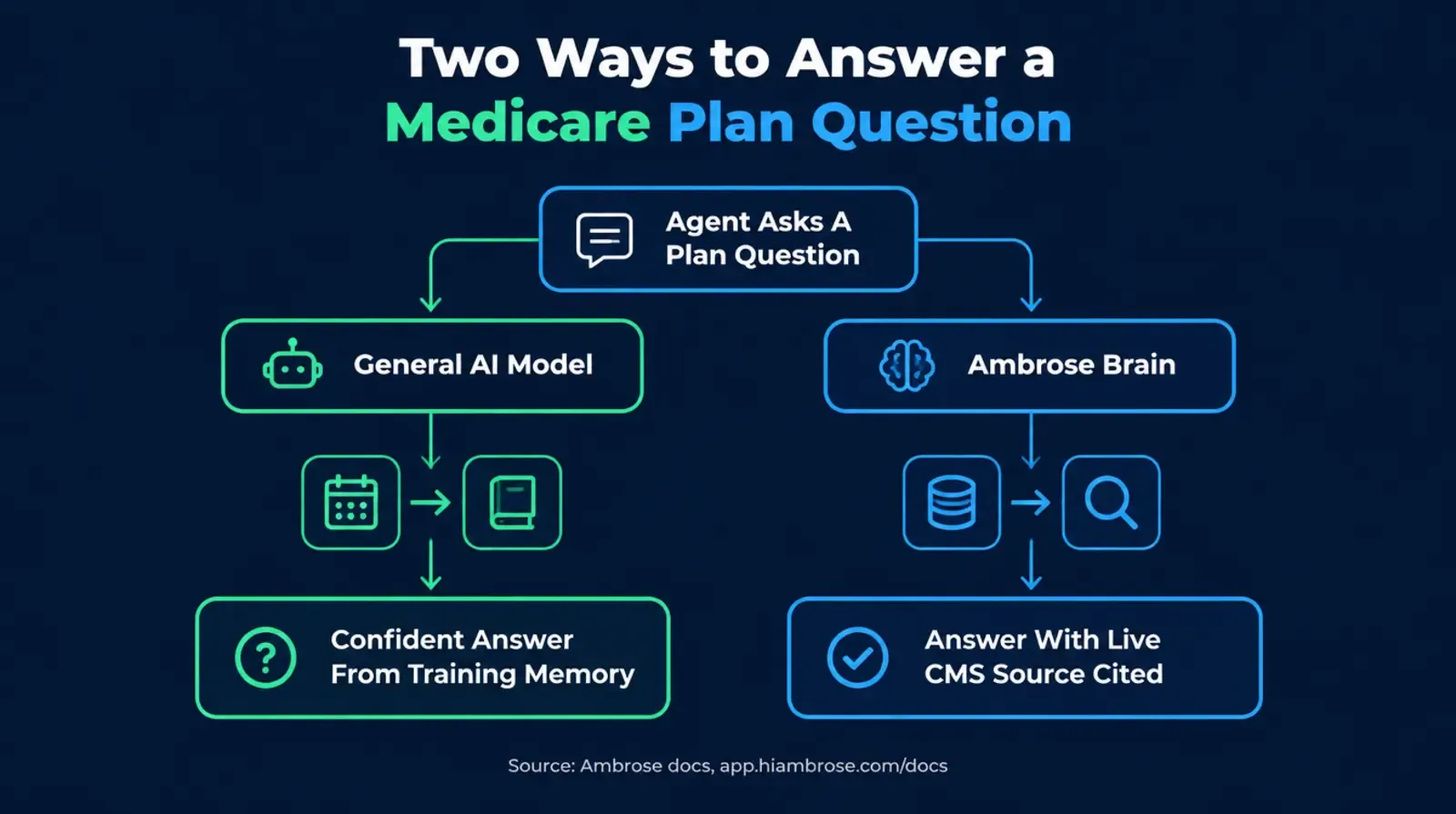
How Ambrose’s Brain handles the same question
Everything above works with nothing but a browser open. Here’s what’s documented to change with the platform included in a Tech Savvy membership.
Ambrose’s own documentation describes the Brain as a data service fronting 33 federal and health data sources and 205 live tools (Ambrose docs, What is Ambrose, fetched Nov. 4, 2026 — these counts move as sources are added, so treat them as a snapshot, not a permanent figure, and re-verify before repeating them yourself). The structural difference from a general-purpose chatbot isn’t that Ambrose is “smarter” about Medicare — it’s that a plan question routed through the Brain is meant to be answered by querying a current source at the moment of the question, with that source attached to the answer, rather than by a model generating its best guess from a frozen training snapshot. That’s the same distinction this whole article has been drawing between “recalled” and “retrieved,” applied to the actual product.
The documentation names healthcare-db specifically as one of the Brain’s sources — described as a read-only database built from CMS public-use files — alongside sources covering CMS’s own Medicare and marketplace programs (Ambrose docs, What is Ambrose, fetched Nov. 4, 2026). If a premium, a plan attribute, or a benefit detail is the kind of thing CMS publishes as structured public data, that’s the layer built to answer it with the source behind the number, instead of a model’s best recollection.
This matters most for exactly the scenario in this article: a number that changed recently. A live source reflects CMS’s current fact sheet the day it’s queried. A language model’s training reflects whatever was true whenever its data collection stopped — and has no way to update itself about an October 2026 rebate, a November 2025 premium reset, or anything else that happened after that point, no matter how many times you ask it.
What this doesn't replace
A source-grounded answer is a dramatically better starting point than a guess, and it is not a substitute for your own review before a number reaches a client, or for your carrier's required disclosures. Ambrose's documentation itself notes that AI-generated outputs may contain errors. Treat a cited answer as "verified against a real source as of this moment," not as "guaranteed correct indefinitely."
What you get by joining
One Ambrose seat comes with a Tech Savvy Insurance membership: $97 a month, billed monthly, cancel anytime, founding rate locked in while the membership stays active. Alongside the seat: weekly Zoom calls with open Q&A and build-with-you sessions, 30+ hours of recorded training updated monthly, Meta Ads and AI training built for this industry specifically, pre-built AI templates and bot deployments, and a free annual in-person member workshop — with an explicit no-recruiting rule, so asking a real plan question doesn’t turn into a downline pitch.
A source, not just an answer
The Brain is built to query current CMS and healthcare data, not recall a number from a training snapshot.
One place to ask
A plan question in plain English, routed to a live source, instead of five separate manual lookups every time.
A room that's done this before
Weekly calls and 30+ hours of recordings from agents already running this, not a vendor demo.
Everything above works whether you join anything or not
The 2026 premium and rebate figures, the manual verification method, and the test for whether an AI answer is current are all usable today with nothing beyond this article. What Ambrose adds is a way to ask the question once and get an answer that's already checked against a live source.
The close
The agents who get burned by this aren’t the ones who never use AI — they’re the ones who never asked themselves whether a specific answer came from a live source or a frozen one. Test any AI tool you’re using against the $202.90 premium figure above today. If it’s right, good, keep an eye on it anyway. If it’s wrong, you just found out the safe way, before a client did. And if you’d rather have a plan question answered from a source that’s cited every time, that’s what the membership includes: https://techsavvyinsurance.com/.
Compliance note
This article explains a general limitation of AI language models and verifies specific 2026 Medicare premium, deductible, and rebate figures against CMS’s own published fact sheets; it is general information, not insurance, legal, tax, or compliance advice. Tech Savvy Insurance is a training and software community, not an insurance company, agency, or law firm. You are responsible for your own licensure and for complying with all applicable CMS, HIPAA, state, and carrier regulations, including CMS’s marketing and communications rules and the NAIC AI Model Bulletin’s expectations for written AI governance. Ambrose is HIPAA compliant as a platform, per its own documentation — not “HIPAA certified,” a designation that does not exist for software. AI-generated outputs, including Ambrose’s, may contain errors — always verify a specific figure against its primary source before it reaches a client. Results may vary.
Frequently asked questions
Sources
- CMS — 2026 Medicare Parts A & B Premiums and Deductibles Fact Sheet (released Nov. 14, 2025) — cms.gov
- CMS — Medicare Improvement Fund Premium Rebate: Frequently Asked Questions (dated Oct. 3, 2026) — cms.gov
- Big "I" Agents Council for Technology — 2026 Tech Trends Report coverage (independentagent.com, Feb. 19, 2026) — independentagent.com
- Ambrose docs — What is Ambrose — app.hiambrose.com
- Medicare Plan Finder — official plan comparison tool — medicare.gov
- NAIC — Model Bulletin on the Use of Artificial Intelligence Systems by Insurers (adopted December 2023) — content.naic.org
Ready to put this into practice?
Join a private community of Health & Life insurance professionals using AI, Meta Ads, and automation to grow — without draining their bank account.
Join Tech Savvy — $97/month