
A client’s income estimate used to come with a safety net. If it turned out too low and the marketplace paid out more premium tax credit than they actually qualified for, the IRS capped how much of that gap they had to repay — a few hundred dollars for a modest household, more for a higher-income one, but never the whole thing. Starting with tax year 2026, that net is gone. Section 71305 of the One, Big, Beautiful Bill Act removed the repayment cap in the Internal Revenue Code outright, for every taxable year beginning after December 31, 2025, and the IRS’s proposed regulations published October 15, 2026 exist to write that already-enacted change into the actual tax regulations your clients’ preparers will follow. This isn’t a “maybe” sitting in a comment period. It’s current law, and it changes what a loose income estimate costs a client this year.
Key takeaways
- The excess advance premium tax credit (APTC) repayment cap is eliminated for taxable years beginning after December 31, 2025 — tax year 2026 forward — under Section 71305 of the OBBBA (Public Law 119-21, enacted July 4, 2025).
- This is already law, not a pending proposal. The IRS's October 15, 2026 proposed rule, REG-101576-26 (91 FR 65494), conforms the Treasury regulations to the statute; it doesn't create the change.
- IRS Fact Sheet 2025-10 confirms it in plain language: for tax years after 2025, "there is no repayment cap and the total difference will be subtracted from your refund or added to your balance due."
- The broader proposed rule also adds eligible-alien exclusions, a Medicaid community-engagement interaction, and a coverage-month verification requirement that starts for taxable years after December 31, 2027 — none of which touch 2027-plan-year enrollment right now.
- Treasury and the IRS estimate the proposed regulations could affect about 15.6 million individuals enrolled in Exchange coverage, including 13.5 million potentially eligible to claim the credit, and project roughly 3.7 million returns will include a repayment of excess APTC in 2028.
- Comments on REG-101576-26 are due November 30, 2026, with a telephonic public hearing scheduled for December 8, 2026.
What actually changed, and why “proposed rule” is the wrong frame for the part that matters
Start with the distinction that gets lost every time a regulatory headline uses the word “proposed.” The One, Big, Beautiful Bill Act — Public Law 119-21, 139 Stat. 72, sections 71119 and 71301 through 71305, signed into law July 4, 2025 — already amended Internal Revenue Code section 36B, the statute that governs the premium tax credit. Section 71305 of that law is one sentence with enormous consequences: it removes section 36B(f)(2)(B), the subsection that had capped how much excess advance credit a lower- or middle-income household had to repay. That repeal took effect, by the statute’s own terms, for taxable years beginning after December 31, 2025 (Federal Register, document 2026-21056, 91 FR 65494–65503).
What the IRS published on October 15, 2026 is a notice of proposed rulemaking, docket REG-101576-26, that amends the Treasury Income Tax Regulations under 26 CFR Part 1 to match that already-enacted statute. The rule’s own preamble is explicit about the mechanism: “Section 71305 of the OBBBA removed the section 36B(f)(2)(B) repayment limitation for taxable years beginning after December 31, 2025. Thus, for taxable years beginning after December 31, 2025, a taxpayer’s tax liability for the taxable year of the coverage is increased by the full amount of the excess APTC” (Federal Register, document 2026-21056, 91 FR 65497). The proposed regulation text itself, found later in the same document, “would revise § 1.36B-4(a)(3) to reflect the OBBBA amendment to section 36B(f)(2)(B), which eliminates the limitation on the amount of excess APTC that a taxpayer is required to repay for taxable years beginning after December 31, 2025. Consequently, when reconciling APTC on a taxpayer’s Federal income tax return for such taxable year, the full amount by which APTC exceeds PTC allowed under section 36B increases the taxpayer’s tax liability for that taxable year” (91 FR 65500).
So when you see “IRS proposes new premium tax credit rule” in a headline, read it as regulatory housekeeping on a change that already happened in the tax code, not as something still up for a vote. The parts of REG-101576-26 that are genuinely still proposals — the eligible-alien exclusions, the Medicaid community-engagement interaction, the coverage-month verification requirement — are covered further down in this article, each with its own, later applicability date. The repayment cap is not one of those. It applies to tax year 2026 regardless of what happens to the rest of this rulemaking.
The one sentence to remember
If a client's final 2026 household income comes in higher than the estimate the Marketplace used to calculate their advance payments, every dollar of the resulting overpayment becomes tax owed when they file in 2027 — not a capped portion of it. That's true today. It doesn't wait on a comment period.
How the repayment cap used to work, and what disappears with it
To see what’s actually being removed, it helps to walk through how reconciliation has worked for years. When a household enrolls in a Marketplace plan, the Exchange estimates their premium tax credit for the year based on projected household income, family size, and the benchmark plan in their area, and the household decides how much of that estimated credit to take in advance, paid directly to the insurer to lower the monthly premium. At tax time, Form 8962 reconciles that estimate against the household’s actual, as-filed income. If the actual credit the household qualifies for is less than what was paid in advance — because income came in higher than projected, a dependent moved out, or a marriage changed the household size — the difference is “excess advance payment of the premium tax credit,” and under the law as it stood through 2025, that excess doesn’t automatically become a dollar-for-dollar tax bill.
IRS Fact Sheet 2025-10 describes the mechanism in its own words: “The credit is ‘refundable’ because, if the amount of the credit is more than the amount of your tax liability, you will receive the difference as a refund. If you owe no tax, you can get the full amount of the credit as a refund. However, if advance credit payments were made to your insurance company and your actual allowable credit on your return is less than your advance credit payments, the difference (called excess advance payment of the PTC), subject to repayment caps, will be subtracted from your refund or added to your balance due” (IRS, Fact Sheet 2025-10, December 2025, updated Dec. 23, 2025). That repayment cap scaled with household income as a percentage of the federal poverty line and with filing status, through a table published annually in the Form 8962 instructions — lower-income households had a lower dollar ceiling on what they owed back, and the cap disappeared entirely above 400% of the federal poverty line, where unlimited repayment already applied under the old rule.
Here’s the sentence that matters for every return your clients file starting next tax season. The same Fact Sheet continues: “For tax years before 2026 (other than 2020), if your allowable credit is less than your advance credit payments, a repayment cap may limit the amount of the excess advance payment of the PTC that is subtracted from your refund or added to your balance due. However, for tax years after 2025, if your allowable credit is less than your advance credit payments, there is no repayment cap and the total difference will be subtracted from your refund or added to your balance due” (IRS, Fact Sheet 2025-10). Two independent primary sources — the IRS’s own FAQ and the Treasury/IRS proposed rule’s preamble — describe the identical mechanism and the identical effective date, which is as confirmed as a tax-law change gets before the regulations are finalized.
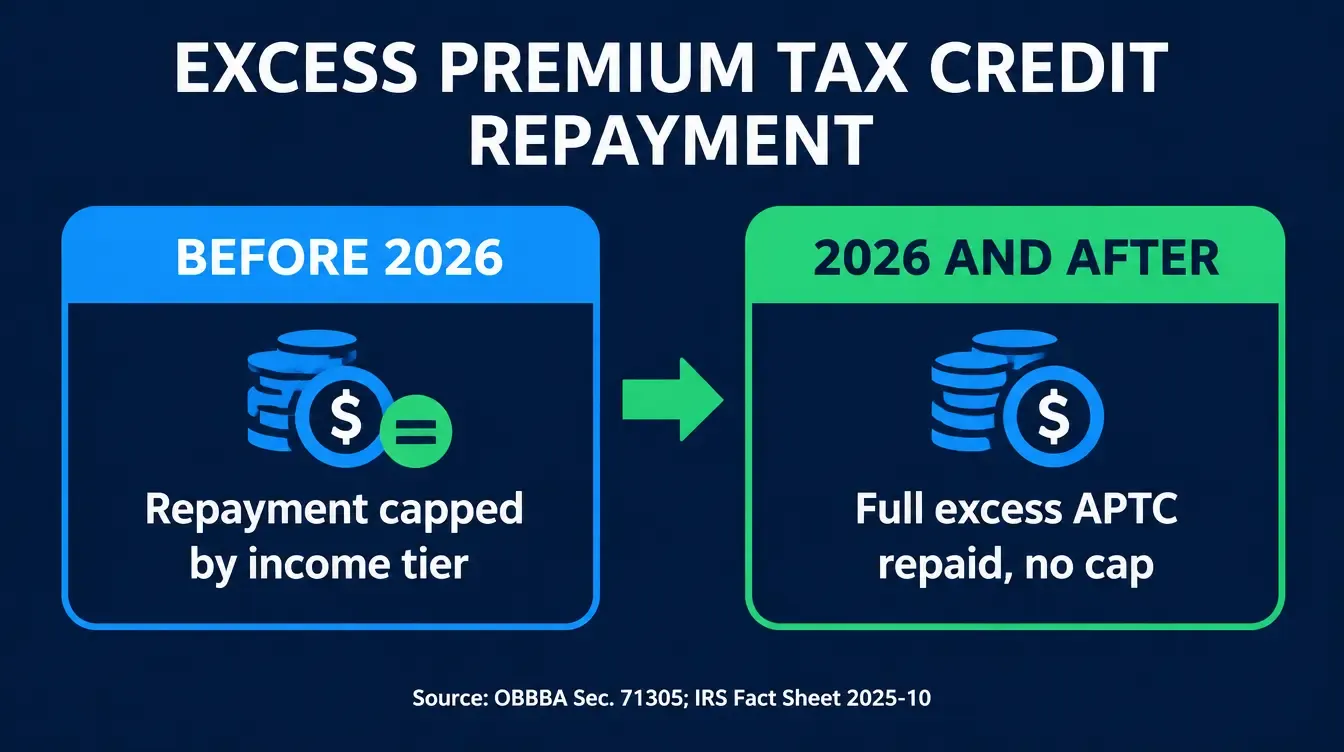
| Tax year | Repayment treatment | Return filed |
|---|---|---|
| 2025 and earlier (except 2020) | Excess APTC repayment capped by income tier and filing status | This coming filing season, early 2026 |
| 2020 | Excess APTC did not affect tax liability at all (a one-year pandemic-era exception) | Already filed |
| 2026 and later | No cap — the full excess APTC increases tax liability | First affected return: early 2027 |
A worked example, so the mechanism is concrete
This is an illustrative example to show how the math works, not a statistic about any real household — treat the numbers as placeholders for the method, not as a benchmark. Say a single client enrolls for 2026 coverage and the Marketplace, based on a projected household income, calculates a $450-per-month advance premium tax credit, or $5,400 for the year if it runs the full twelve months. Midway through the year the client picks up substantial freelance income they didn’t report to the Exchange. When they file their 2026 return in early 2027, Form 8962 recalculates their actual allowable credit based on their real, higher income, and it comes out to $3,200 for the year instead of $5,400 — an excess advance payment of $2,200.
Under the rule that applied through tax year 2025, that client’s repayment might have been capped well below $2,200, depending on where their income landed relative to the federal poverty line for their household size. Under the rule that applies to their 2026 return, there is no cap. The full $2,200 gap becomes additional tax owed, due with the rest of their return. Nothing about the premium tax credit calculation itself changed — Form 8962 still reconciles the same way, the benchmark plan still works the same way — only the ceiling on what the client pays back when the original estimate was too low.
The manual check: how to run this for every client before it becomes a tax-season surprise
None of what follows needs anything beyond a client’s own Marketplace account, a pay stub or two, and a Form 8962 you already know how to read. This is the full method, not a teaser for a tool.
Pull the household income estimate currently on file
Log into the client's HealthCare.gov account (or your state-based Exchange) and find the projected annual household income used to calculate their current advance payments. This is the number the whole calculation hangs on, and for a client enrolled months ago, it's often stale.
Compare it against where income is actually tracking
Ask about anything that moved the number since enrollment: a raise, a second job, a bonus, a lump-sum retirement or Social Security distribution, realized capital gains, debt cancellation income, or a change in household size through marriage, divorce, or a dependent moving out. IRS Fact Sheet 2025-10 lists these as the exact categories that commonly shift a household's actual Premium Tax Credit away from the Marketplace's original estimate.
Report a significant change to the Exchange now, not at tax time
If the new number is materially higher, have the client report the change to the Marketplace before year-end. That adjusts their advance payments going forward and shrinks the gap Form 8962 will have to reconcile, instead of letting a full year of excess accumulate under a rule that no longer caps the payback.
Estimate the exposure with Form 8962's own method
Run the actual projected year-end income through the same benchmark-plan and applicable-percentage calculation the Exchange used at enrollment, the way Form 8962 does it at filing. The gap between that recalculated credit and the advance payments already received is the number that, for 2026 forward, has no ceiling on it.
Flag it for every 2027-coverage application you write this Open Enrollment
A loose income estimate at enrollment used to be a minor annoyance capped by the old rule. Starting with coverage written this Open Enrollment for the 2027 plan year, that same loose estimate carries into a tax year where the cap is already gone. Build the income-verification step into your enrollment checklist now, not as a January afterthought.
Where this is not tax advice
This is the method for flagging risk and prompting a client to report an income change to the Exchange — it is not a tax return calculation. For an actual Form 8962 computation on a specific household, point the client to a CPA or enrolled agent. Your job here is catching the problem early enough that reporting the change actually helps.
Everything above works whether you join anything or not. Run it by hand on your current book this week, or bring a specific client’s numbers to one of the weekly build-with-you Zooms and have someone who has already built this check into their workflow walk through it with you.
The scale of who this touches
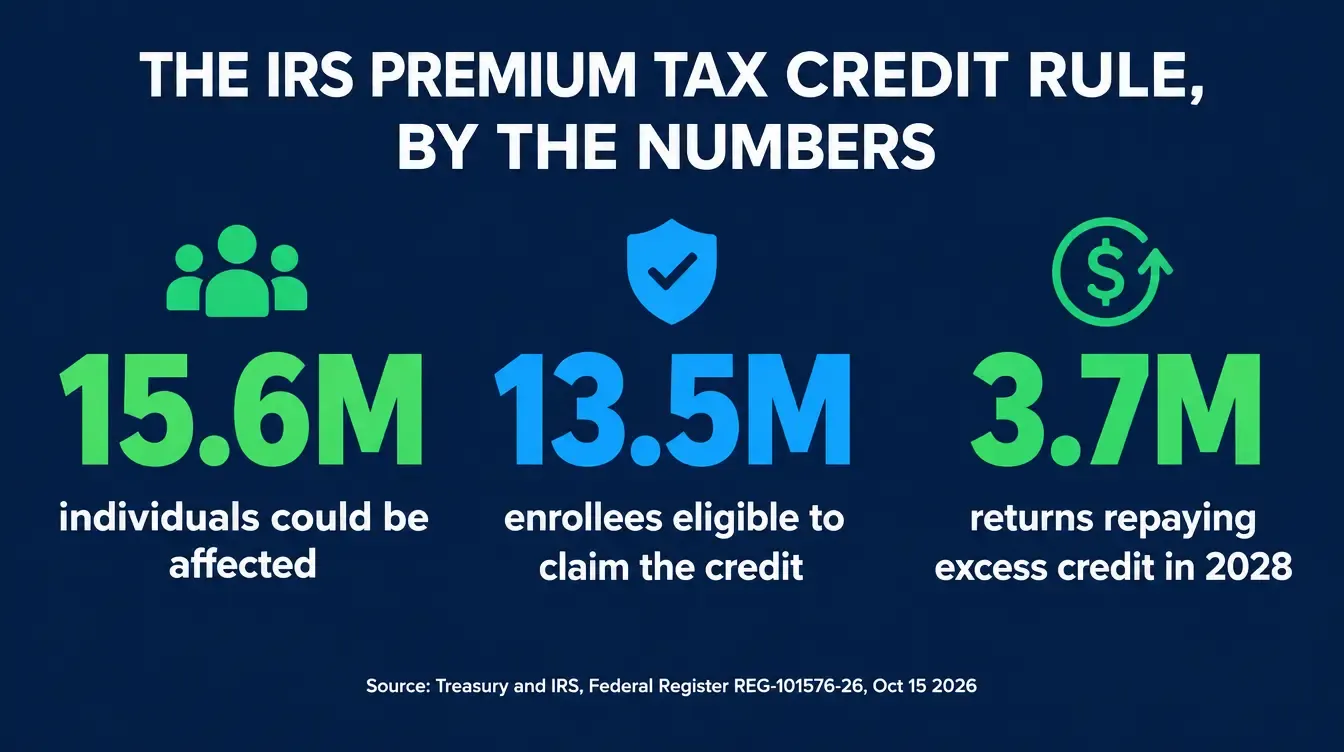
Those figures come directly from the “Affected Entities and Taxpayers” and “Elimination of Excess APTC Repayment Limitations” sections of the rule’s own economic analysis: “The proposed regulations are expected to affect about 15.6 million total individuals enrolled in Exchange coverage, including 13.5 million enrollees potentially eligible to claim PTC,” and separately, “The Treasury Department and the IRS estimate that, in 2028, approximately 3.7 million returns will include a repayment of excess APTC” (Federal Register, document 2026-21056, 91 FR 65502–65503). Treasury and the IRS are the agencies that produced these estimates, so this is a single, load-bearing primary source rather than two independent ones — worth saying plainly, since the sourcing standard this site holds itself to calls for flagging exactly that. Trade coverage of the same rule, including Journal of Accountancy’s October 15, 2026 writeup, reports the identical 3.7 million figure, attributed to the same Treasury and IRS estimate rather than to independent modeling of its own (Journal of Accountancy, Oct. 15, 2026).
What else is actually in the proposed rule
The repayment cap removal is the part that’s already locked in. The rest of REG-101576-26 is a genuine notice of proposed rulemaking, meaning it can still change before it’s finalized, and each piece carries its own applicability date that’s worth separating from the headline.
| Provision | What it would do | Proposed applicability |
|---|---|---|
| Eligible-alien exclusion | Excludes aliens who are lawfully present but not "eligible aliens" under amended section 36B(e)(2)(B) from the premium tax credit computation for coverage attributable to them | Taxable years beginning after December 31, 2026 |
| Medicaid community-engagement interaction | Treats an individual who fails a new Social Security Act community-engagement requirement as deemed eligible for Medicaid, and therefore ineligible for the PTC, for the months that treatment applies | Taxable years beginning after December 31, 2027 (tied to the Social Security Act requirement's own start) |
| Coverage-month verification requirement | A month would not count as a PTC coverage month unless the Exchange verifies the applicable enrollment information — income, family size, citizenship or lawful presence, and other coverage eligibility | Taxable years beginning after December 31, 2027 |
| Family-size SEP verification waiver | Would let the Secretary waive the new verification requirement for an individual enrolling through a special enrollment period triggered by a change in family size — newborn, adoption, marriage, divorce, or a dependent's death | Tied to the same post-2027 verification requirement it's an exception to |
| Form 1095-A reporting changes | Requires Exchanges to exclude, from reported enrollment and benchmark premiums, the portion allocable to individuals who are not lawfully present or are lawfully present non-eligible aliens | Taxable years beginning after December 31, 2026 |
None of the verification or eligible-alien provisions change anything about the 2027 plan-year enrollments agents are writing during this Open Enrollment. They don’t take effect until taxable years beginning after December 31, 2026 or 2027, and even then, the coverage-month verification piece depends on parallel implementation regulations the rule says Treasury and the IRS expect from the Department of Health and Human Services, since HHS runs the actual Exchange eligibility and enrollment systems the verification would run through (Federal Register, document 2026-21056, 91 FR 65502). The family-size SEP waiver is worth knowing about if you work a lot of newborn and marriage SEPs specifically: the rule’s own economic analysis estimates roughly 50,000 families with newborns benefit from the proposed waiver each year, that about 0.3% of Exchange plans receiving APTC include a newborn during the plan year, and that the average monthly APTC associated with that newborn coverage is approximately $222 (91 FR 65503) — concrete numbers, but ones describing a future rule’s projected effect, not something that changes how you handle a newborn SEP today.
The comment period is real, and it's open
Electronic or written comments on REG-101576-26 are due by November 30, 2026, filed through the Federal eRulemaking Portal at regulations.gov under docket IRS-2026-1420. Treasury and the IRS have scheduled a telephonic public hearing for December 8, 2026 at 10 a.m. ET; a request to speak, with an outline of the topics to be discussed, is also due by November 30, and a request simply to attend is due by 5 p.m. ET on December 4, 2026 ([Federal Register, document 2026-21056, 91 FR 65494](https://www.govinfo.gov/content/pkg/FR-2026-10-15/pdf/2026-21056.pdf)). The repayment cap won't be affected by anything that comes out of this comment process — it's statute, not regulation — but the verification and eligible-alien provisions genuinely could shift before they're finalized.
How this connects to the 400% FPL subsidy cliff
This article is about what happens when a household’s income estimate turns out to be too low relative to reality — the repayment side of the equation. There’s a separate, related question about who qualifies for a premium tax credit at all once household income crosses 400% of the federal poverty line, which we’ve covered in full in our piece on the 2026 ACA subsidy cliff. IRS Fact Sheet 2025-10 confirms the same underlying timeline independently: “For tax years 2021 through 2025, Congress temporarily expanded eligibility for the Premium Tax Credit by eliminating the requirement that a taxpayer’s household income may not be more than 400 percent of the federal poverty line” (IRS, Fact Sheet 2025-10) — language that, read against the standard 100-to-400%-FPL eligibility window the same fact sheet describes, points to that expansion not carrying into 2026. A client can be caught by both changes at once: priced out of the credit entirely if their income lands above 400% FPL, or on the hook for the full excess advance payment with no cap if it lands anywhere below that line and came in higher than projected. Run the income check in this article alongside the subsidy-cliff check in that one — they’re using the same household income number for two different purposes.
How Ambrose helps with the number-checking, and where it doesn’t yet
Everything in the method above is a discipline you can run with a spreadsheet and a client’s Marketplace login. Where a tool actually helps is pulling a live, sourced number instead of eyeballing one, and catching book-wide risk at plan-year transition instead of reviewing every client file by hand.
Ambrose’s documented data layer, the Brain, currently covers 33 federal and health data sources and 205 live tools, confirmed on Ambrose’s own “What is Ambrose?” documentation page as of this writing (Ambrose docs, What is Ambrose?). Inside that layer, the marketplace-finder spoke is the piece that touches this article’s topic directly: it’s documented as a free-posture spoke offering live ACA Marketplace plan search backed by healthcare.gov, including a marketplace_subsidy_estimate tool that returns an APTC estimate for a household (Ambrose docs, marketplace-finder spoke). Instead of a stale back-of-envelope estimate from enrollment day, that’s a live pull against current Marketplace data, which is the right starting point for the income-recheck method described above — a documented, sourced estimate to compare against the client’s actual projected year-end income, rather than a number nobody has looked at since open enrollment.
The aca-watchdog spoke is the other piece worth naming, and it’s worth being precise about what it’s documented to do and what it isn’t. It’s a free-posture, scheduled spoke described as covering “cost hikes, carrier exits, benefit cuts, and plan-year transitions,” with three documented tools: aca_scan_book, which scans the agency’s ACA book for risk signals; aca_check_carrier_status, which checks a carrier’s status; and aca_plan_year_diff, which compares a plan ID year over year, posting actionable findings to Ambrose Notifications (Ambrose docs, aca-watchdog spoke). That’s genuinely useful for catching carrier exits and benefit changes across a whole book at plan-year transition. What the documented tool list does not describe is a function that recalculates an individual client’s uncapped repayment exposure under the rule covered in this article — that specific check is still the agent’s manual job today, using the method above, not something aca-watchdog is documented to automate yet.
| Part of the problem | What actually addresses it |
|---|---|
| Getting a live, sourced APTC estimate instead of a stale guess | The Brain's marketplace-finder spoke and its marketplace_subsidy_estimate tool |
| Flagging carrier exits, cost hikes, and benefit cuts across a whole book at plan-year transition | The aca-watchdog spoke's aca_scan_book and aca_plan_year_diff tools |
| Recalculating one client's specific uncapped repayment exposure for 2026 | The manual Form 8962 method above — not yet a documented Ambrose tool |
What you get
One Ambrose seat, including the marketplace-finder and aca-watchdog spokes described above, comes with a Tech Savvy Insurance membership: $97 a month, billed monthly, cancel anytime, founding rate locked in while the membership stays active. Alongside the seat: weekly Zoom calls with open Q&A and build-with-you sessions, 30+ hours of recorded training, Meta Ads, AI, and marketing training built for this industry, pre-built AI templates and bot deployments, and a free annual in-person member workshop — an explicit no-recruiting zone, which means you can ask a real question about a client's repayment exposure without ending up on anyone's downline pitch list.
Everything above works whether you ever join anything or not. Run the manual check on your book this week. If you’d rather have a live subsidy estimate pulled up next to a client’s file while you’re on the phone with them, that’s the kind of thing we work through together on a Tuesday call: https://techsavvyinsurance.com/.
What not to paste into a general AI tool about this
A client’s reconciliation problem usually comes packaged with exactly the kind of detail that shouldn’t go into a general-purpose AI tool without a signed Business Associate Agreement: their actual income figures, their household composition, their enrollment history, and sometimes health information tied to why a dependent moved on or off a plan. Drafting generic client-facing language about the repayment cap change with a consumer AI tool is fine. Pasting a real client’s Form 8962 numbers, their Marketplace account details, or their actual household income into that same tool is not — that’s protected information leaving your control with no accountability on the other end for how it’s stored or used.
The NAIC’s Model Bulletin on the Use of Artificial Intelligence Systems by Insurers, adopted in December 2023, sets expectations in this exact area: it establishes “expectations as to how insurers will govern the use of AI” and requires that AI-made or AI-supported decisions “comply with all applicable insurance laws and regulations,” while noting that “human oversight remains an important part of insurance decision-making” (NAIC, Insurance Topics: Artificial Intelligence). The bulletin doesn’t spell out a specific documentation checklist for an individual agent on this page, but the direction is the same one carried into most state adoptions of it: a written sense of how AI gets used in your practice, a human reviewing anything that reaches a client, and a record you could produce if a carrier or regulator asked how a determination was made. Ambrose’s architecture is built around the same boundary — HIPAA-aware by default, not HIPAA certified, with protected health information handled under a signed Business Associate Agreement rather than sent to a general consumer AI tool.
Compliance: what this article covers, and what it doesn’t
Nothing in this article is tax, legal, or insurance advice. The repayment cap removal, the proposed verification requirements, and the proposed eligible-alien and Medicaid-interaction provisions are described here as of October 2026, based on the Federal Register text and the IRS’s own Fact Sheet 2025-10, and tax regulations can be finalized with changes from what’s proposed. A client’s actual Form 8962 reconciliation is a tax-return calculation that belongs with a CPA or enrolled agent, not with an insurance producer. If you also market Medicare Advantage or Part D coverage, this article doesn’t touch the TPMO disclaimer or CMS marketing rules that apply to that separate line of business — see our guide on Medicare sales call scripts for 2027 for those. Confirm your own agency’s specific obligations with CMS guidance where it applies, a qualified tax professional for reconciliation questions, and your state Department of Insurance for anything touching your producer license.
The close
The headline writes itself as “IRS proposes new premium tax credit rule,” and that framing buries the part that actually matters: the repayment cap is already gone, by statute, for every 2026 tax return your clients will file next year. The proposed rule published October 15, 2026 just catches the regulations up to a law that’s already in effect. Pull your book, compare each client’s income estimate against where they’re actually tracking, and report the changes that need reporting before this becomes a January surprise instead of an October fix. That’s a free afternoon with a spreadsheet, whether you ever join anything or not. If you’d rather run the subsidy estimate live, with Ambrose open on the screen and someone who’s done this before watching with you, one seat comes with a Tech Savvy membership: https://buy.stripe.com/8x2cN63OE6dO2yCdv2g3600.
Run the income check on your book before Open Enrollment closes
Pull every client's Marketplace income estimate, compare it to where their year is actually tracking, and report the changes that matter — the five-step method above is the whole thing, no membership required. If you'd rather have a live APTC estimate pulled up next to the client file, one Ambrose seat comes with the Tech Savvy membership.
Join Tech Savvy — $97/monthRelated reading: our breakdown of the 2026 ACA subsidy cliff for the eligibility side of this same income number, how to re-shop your ACA book before Open Enrollment, our ICHRA playbook for the employer-side affordability math, and what happens to a client’s ACA subsidy when they turn 65.
Before you rely on any figure in this article
Tech Savvy Insurance is a training and software community, not an insurance company, agency, or law firm, and does not provide insurance, legal, tax, or compliance advice. You are responsible for your own licensure and for complying with all applicable CMS, IRS, HIPAA, state, and carrier regulations. Regulations and proposed rules can change before finalization — confirm current requirements directly with the IRS, your state Department of Insurance, or a qualified tax professional before relying on any figure here. AI-generated outputs may contain errors — always verify. Results may vary.
Frequently asked questions
Sources
- Federal Register — Premium Tax Credit, proposed rule and notice of public hearing (document 2026-21056, 91 FR 65494), full text — govinfo.gov
- Federal Register — Premium Tax Credit (document 2026-21056), official document page with docket, comment deadline and hearing date — federalregister.gov
- IRS — Fact Sheet 2025-10, Updates to Questions and Answers about the Premium Tax Credit (December 2025, updated Dec. 23, 2025) — irs.gov
- IRS.gov — Premium Tax Credit: Claiming the credit and reconciling advance credit payments — irs.gov
- Journal of Accountancy — IRS proposes regulations implementing premium tax credit changes (Oct. 15, 2026) — journalofaccountancy.com
- NAIC — Insurance Topics: Artificial Intelligence (Model Bulletin background) — content.naic.org
- Ambrose docs — What is Ambrose? (the Brain: data source and tool counts) — app.hiambrose.com
- Ambrose docs — marketplace-finder spoke (live healthcare.gov plan search and APTC subsidy estimator) — app.hiambrose.com
- Ambrose docs — aca-watchdog spoke (scheduled ACA marketplace intelligence) — app.hiambrose.com
Ready to put this into practice?
Join a private community of Health & Life insurance professionals using AI, Meta Ads, and automation to grow — without draining their bank account.
Join Tech Savvy — $97/month