A small-business owner calls and says they’re dropping their group health plan for an ICHRA next year, and asks what it means for their eleven employees. If your first instinct is to refer that out because you “don’t do group,” you just handed away eleven individual-market clients. An Individual Coverage HRA doesn’t turn those employees into a group case. It turns every one of them into exactly the individual ACA shopper you already know how to help, with a tax-free employer allowance attached and a special enrollment period that lets them buy right now. The catch is one number, updated every year, that decides whether each employee should take the allowance or waive it and claim a subsidy instead. Get that number wrong for a client and you cost them real money at tax time. Get it right across a whole roster, fast, and you’ve turned one phone call into a book.
Key takeaways
- An ICHRA reimburses employees for buying individual health insurance, the same ACA marketplace and off-exchange policies a licensed health agent already sells. It was created by the 2019 tri-agency final rule and has been available for plan years beginning on or after January 1, 2020.
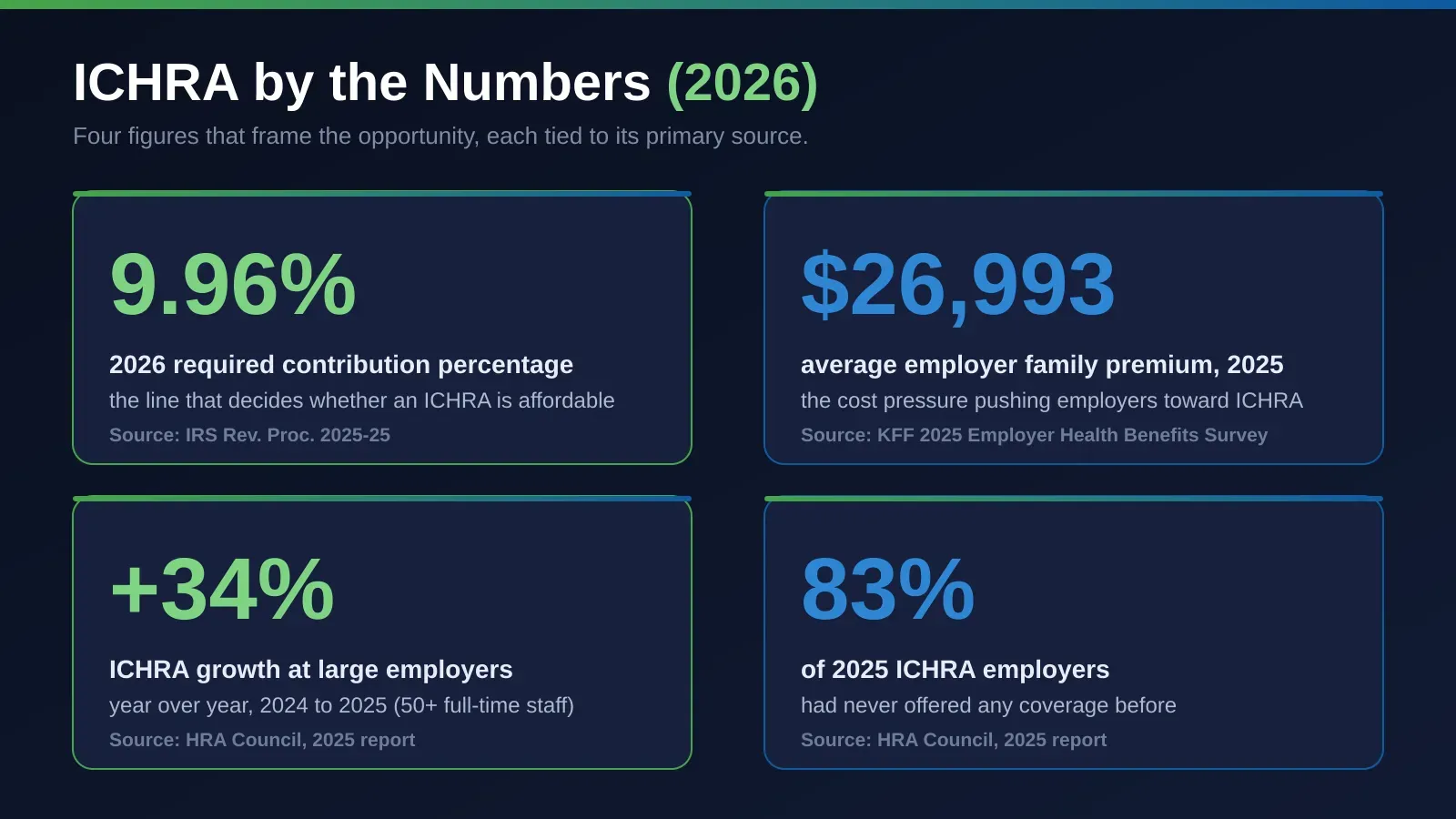
- The whole game is the affordability test. For 2026, an ICHRA is "affordable" if the employee's leftover cost after the allowance is at or below 9.96% of household income (IRS Rev. Proc. 2025-25). Affordable ICHRA means no premium tax credit. Unaffordable means the employee can opt out and claim the subsidy instead.
- An employee can take the ICHRA or a marketplace subsidy, never both in the same month. Getting this wrong triggers a repayment at tax time.
- Newly gaining access to an ICHRA opens a marketplace special enrollment period, generally 60 days before it takes effect (45 CFR 155.420), so employees can enroll outside annual open enrollment.
- Adoption is climbing: ICHRA use among employers with 50+ full-time staff rose 34% year over year in the HRA Council's 2025 report, and 83% of employers offering one in 2025 had not offered any coverage before.
This is an individual-market opportunity, not a group one
The reflex to treat "employer switching health benefits" as a group case is the single most expensive misread here. The employees end up in individual policies you already write. If you also work ACA subsidy cases, our ACA subsidy cliff guide covers the income math that sits right next to the ICHRA affordability math below.
What an ICHRA actually is, in plain terms
An Individual Coverage Health Reimbursement Arrangement is an employer benefit. Instead of the employer buying a single group plan that everyone shares, the employer sets aside a fixed monthly amount, an allowance, for each employee. The employee goes and buys their own individual health insurance policy, and the allowance reimburses them for the premium, tax-free. The policy belongs to the employee, not the employer. If the employee leaves, the policy goes with them.
It’s a real, permanent part of the federal framework, not a pilot. The tri-agency final rule that created ICHRAs, issued jointly by the Departments of Treasury, Labor, and Health and Human Services, became effective August 19, 2019 and generally applies for plan years beginning on or after January 1, 2020 (Federal Register, 2019 final rule). The operating rules live at 26 CFR 54.9802-4, which spells out what an ICHRA has to do to be valid: the employer must require that every covered participant and dependent is actually enrolled in individual health insurance coverage for each month they’re covered by the HRA, must offer it on the same terms to everyone in a given class of employees, and must give employees written notice of the arrangement, generally at least 90 calendar days before the plan year begins (Cornell LII, 26 CFR § 54.9802-4).
That enrollment requirement is the part that matters to you. An ICHRA legally cannot pay out unless the employee holds a qualifying individual policy. Someone has to help that employee choose and enroll in the right one. That someone is a licensed health agent.
The one-sentence version
An employer moving to an ICHRA is an employer sending you a roster of people who now have to buy individual coverage, with money in hand to pay for it. The question isn't whether there's business here. It's whether you can quote the whole roster before someone else does.
Why employers are actually making the switch
You don’t need to sell the employer on the concept. The group renewal is doing that for you. The average annual premium for employer-sponsored family coverage hit $26,993 in 2025, with single coverage averaging $9,325, according to the KFF Employer Health Benefits Survey, an annual survey of employers that is the standard reference for this data (KFF, 2025 Employer Health Benefits Survey). Workers themselves contributed an average of $6,850 toward family coverage and $1,440 toward single coverage in that same survey. For a small employer watching that family number climb every renewal with no control over where it lands, a fixed, predictable allowance they set themselves is an obvious pressure valve.
The adoption data has caught up with the logic. The HRA Council, a trade group whose members administer these arrangements, aggregates data from 15 member organizations for its annual report. Its 2025 report found ICHRA adoption among applicable large employers, those with 50 or more full-time employees, up 34% year over year from 2024 to 2025, and small-business adoption up 52% among the Council’s founding members across the 2020 to 2025 window (HRA Council, 2025 report).
The number that should get an agent’s attention, though, is a different one from that same report: 83% of employers offering an ICHRA or QSEHRA in 2025 had not previously offered any coverage at all. That means most ICHRA business isn’t converting existing group members who already had a policy. It’s net-new people entering the individual market for the first time, who have never had an agent, and who now need one.
ICHRA adoption growth, 2024 to 2025
Year-over-year growth in employers offering an ICHRA, by segment.
Source: HRA Council, 2025 ICHRA & QSEHRA report, aggregating data from 15 member organizations. The 52% figure is measured among the Council's founding members over 2020 to 2025.
The one number that decides everything: the 2026 affordability test
Here’s where most of the money is won or lost, and where most agents guess instead of calculating. Whether an employee should accept the ICHRA or waive it comes down to a single test called affordability, and for 2026 that test runs on a specific percentage: 9.96%.
That figure is the required contribution percentage set by IRS Rev. Proc. 2025-25, published in Internal Revenue Bulletin 2025-32. Its exact language: “For plan years beginning in calendar year 2026, the Required Contribution Percentage for purposes of § 36B(c)(2)(C)(i)(II) and § 1.36B-2(c)(3)(v)(C) is 9.96%” (IRS, Rev. Proc. 2025-25). That percentage matters because the higher it is, the easier it is for an ICHRA to clear the affordability bar, which in turn makes it more likely the employee is locked out of a subsidy.
The affordability rule itself lives at 26 CFR 1.36B-2. In the regulation’s words, an ICHRA “is affordable for a month if the employee’s required HRA contribution … for the month does not exceed 1/12 of the product of the employee’s household income for the taxable year and the required contribution percentage” (Cornell LII, 26 CFR § 1.36B-2). And the “required HRA contribution” is defined in that same regulation as “the excess of the monthly premium for the lowest cost silver plan for self-only coverage of the employee offered in the Exchange for the rating area in which the employee resides, over the monthly self-only HRA … amount.”
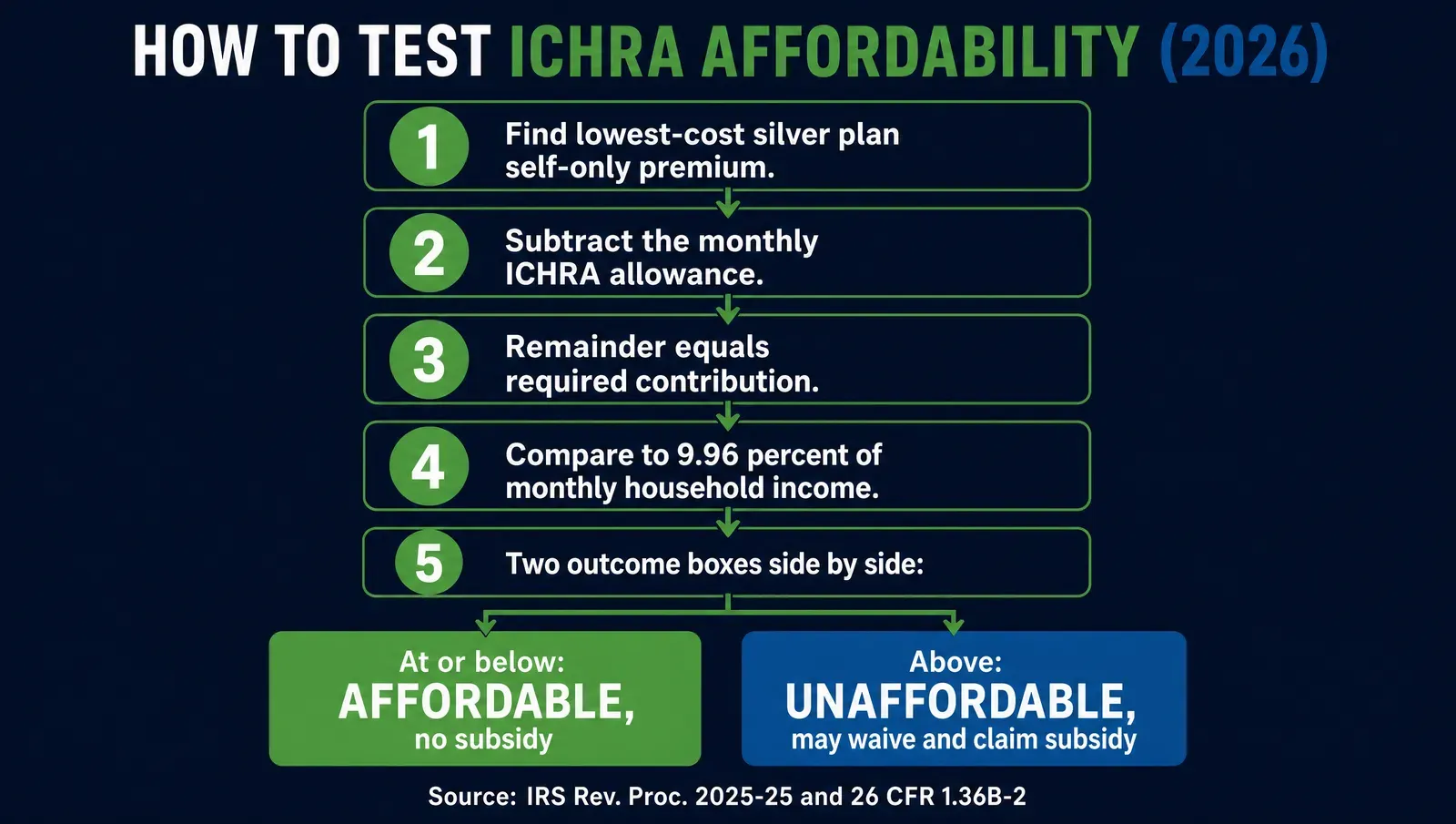
Unpack that into something you can actually run:
- Find the monthly premium of the lowest cost silver plan (LCSP) for self-only coverage in the employee’s rating area.
- Subtract the monthly ICHRA allowance the employer is offering that employee.
- Whatever’s left is the employee’s “required HRA contribution.”
- Compare it to 9.96% of the employee’s monthly household income (household income for the year, divided by 12).
- If the leftover is at or below that threshold, the ICHRA is affordable. If it’s above, it’s unaffordable.
A worked example, both directions
Numbers make this concrete. Say an employee earns $50,000 in household income for the year. The lowest cost silver self-only plan in their rating area runs $500 a month. The employer offers a $400 monthly ICHRA allowance.
- Required HRA contribution: $500 − $400 = $100 a month.
- Affordability threshold: 9.96% × $50,000 = $4,980 a year, or $415 a month.
- $100 is below $415, so the ICHRA is affordable. This employee cannot claim a premium tax credit, and doesn’t need one, because the allowance covers most of the premium.
Now flip one input. Same employee, same $50,000, same $500 silver plan, but the employer only offers a $50 monthly allowance.
- Required HRA contribution: $500 − $50 = $450 a month.
- Threshold is still $415 a month.
- $450 is above $415, so the ICHRA is unaffordable. This employee may opt out of the ICHRA and instead claim a premium tax credit on the marketplace.
Two employees at the same company, same income, same available silver plan, and the right answer is different for each because the allowance is different. That’s the calculation an agent runs. It’s not hard math, but it has to be done per employee, with the correct LCSP for each person’s rating area, and the answer flips a client between “take the allowance” and “waive it and take the subsidy.”
| Input | Scenario A | Scenario B |
|---|---|---|
| Household income | $50,000 | $50,000 |
| Lowest cost silver plan, self-only, monthly | $500 | $500 |
| Monthly ICHRA allowance | $400 | $50 |
| Required HRA contribution (LCSP − allowance) | $100 | $450 |
| 9.96% monthly threshold | $415 | $415 |
| Result | Affordable — no subsidy allowed | Unaffordable — may waive and claim subsidy |
Household income, not wages, and it's the taxpayer's number
The affordability test uses household income for the taxable year, which is a tax concept the employee's return determines, not the gross wage on their pay stub. There are employer safe harbors that let an ICHRA sponsor substitute other measures for the affordability determination, but the premium tax credit eligibility on the employee's side is decided on actual household income. When you're advising the employee, be clear that your affordability estimate depends on their income projection, and that a mid-year income change can move them across the line. This is tax territory, so tell clients to confirm with their own tax preparer.
The subsidy trap that costs an employee thousands
This is the part that turns a routine enrollment into a problem the client blames you for a year later. The rule at 26 CFR 1.36B-2 is blunt: if an employee is offered an ICHRA that is affordable, they are not allowed a premium tax credit, whether or not they actually accept the ICHRA. And if the ICHRA is unaffordable, they may opt out and waive it, and then claim the credit (Cornell LII, 26 CFR § 1.36B-2). It’s one or the other, never both, in a given month.
Picture the failure mode. An employee is offered an affordable ICHRA. They don’t fully understand it, so they go to the marketplace on their own, don’t mention the ICHRA offer on the application, and get advance premium tax credits applied to lower their monthly premium. They’ve now taken a subsidy they weren’t eligible for, because the affordable ICHRA offer disqualified them. At tax time, that advance credit gets reconciled on their return, and they owe it back. The person who set them up to enroll, or who should have caught it, is the agent.
The opt-out is the pressure release, but it’s tightly bounded. Under 26 CFR 54.9802-4, a participant who’s otherwise eligible for the ICHRA must be allowed to opt out and waive future reimbursements “once, and only once, with respect to each plan year” (Cornell LII, 26 CFR § 54.9802-4). So the decision to waive in order to chase a subsidy is a real, per-year, one-shot choice, and it only pays off if the ICHRA was genuinely unaffordable, because a waived-but-affordable ICHRA still blocks the credit. Your affordability calculation is what tells the client whether waiving even helps.
Nobody calls their agent a year later to say the enrollment went fine. They call when they owe the IRS back a subsidy they were told they qualified for.
Mike MooreThe 60-day window most employees don’t know they have
There’s a timing gift buried in this that helps you close. An employee doesn’t have to wait for the annual open enrollment period to buy the individual policy their ICHRA reimburses. Under 45 CFR 155.420, newly gaining access to an individual coverage HRA is a triggering event for a marketplace special enrollment period (Cornell LII, 45 CFR § 155.420).
The window has a specific shape. The qualified individual generally has 60 days before the ICHRA takes effect to select a qualified health plan. If the ICHRA wasn’t required to give the employee the standard notice at least 90 days before the plan year, the window becomes 60 days before or after the triggering event. In plain terms: when an employer stands up an ICHRA effective, say, January 1, the employees can shop and enroll in December through that SEP, and if notice timing was short, the window can stretch on both sides of the effective date.
That means ICHRA business isn’t locked to the annual open enrollment calendar. An employer can decide in March to launch an ICHRA in May, and every employee gets a special enrollment period to buy coverage then. For an agent, that’s individual enrollments spread across the whole year, not just a fourth-quarter crush.
Practical move: confirm the notice date first
The first question to ask the employer or the ICHRA administrator is when the required 90-day notice went out, because that date sets the exact SEP window your employees are working inside. Get it in writing. If the notice was late, your employees have a wider before-and-after window, which is useful to know, but you don't want to be reconstructing it from memory when someone's SEP is about to close.
The manual method: quoting an ICHRA roster by hand
None of this requires a platform. If you want to work an ICHRA case with nothing but a browser and a spreadsheet, here’s the honest, complete process. This is the part we don’t hold back.
Get the census and the allowance schedule
From the employer or ICHRA administrator: each employee's ZIP code, age, household size, a household income estimate, and the monthly allowance assigned to their class. Classes can vary allowance by age and family size, so confirm which class each person is in. This is a spreadsheet full of identifiers, so handle it accordingly, more on that below.
Pull the lowest cost silver plan for each rating area
For each employee, look up the self-only lowest cost silver plan premium in their rating area on the marketplace. Employees in different counties can sit in different rating areas with different LCSP figures, so you can't reuse one number across the roster. This is the single most tedious step done by hand.
Run the affordability test per person
LCSP self-only premium minus the monthly allowance equals the required contribution. Compare it to 9.96% of that employee's monthly household income. Mark each person affordable or unaffordable. This is the column that decides everyone's path.
Split the roster into two lists
Affordable employees: the ICHRA is the play, and no subsidy is available, so quote them the best individual plan for their needs and let the allowance do the work. Unaffordable employees: model both paths, take the ICHRA or waive it and claim the premium tax credit, and show them which nets out better.
Confirm the SEP window and enroll
Check the 90-day notice date, confirm each employee's special enrollment window under 45 CFR 155.420, and enroll them in the individual policy. For anyone claiming a subsidy on the marketplace, make sure the ICHRA offer is reported correctly on the application so the credit is calculated right.
Document what you told each person
Write down the affordability result and the recommendation for every employee. If a client's income shifts and their subsidy gets reconciled next year, your notes on what was affordable at enrollment, and what you advised, are what protect you.
Run that for eleven employees and it’s an afternoon. Run it for a 60-person employer, then three more employers that signed up the same quarter, and step 2 alone, pulling the correct lowest cost silver plan for every rating area, becomes the bottleneck that makes agents quietly stop chasing ICHRA business. The math is easy. The lookups, repeated per person per rating area and re-run every time an allowance or a plan year changes, are what don’t scale by hand.
Where Ambrose does the tedious part
Here’s the contrast that earns the pitch. Everything in the manual method above is real and you can do all of it yourself. What you can’t easily do by hand is run it across dozens of employees, in different rating areas, fast enough to quote the roster before the employer’s HR contact loses momentum. That’s the specific job the tooling exists for.
Two of Ambrose’s spokes map directly onto the two slow steps. Per Ambrose’s live spoke catalog, plan-quoter is documented as handling “ICHRA + Medicare + ACA quoting,” and marketplace-finder is documented as “Live healthcare.gov plan search + subsidies” (Ambrose docs, Spokes catalog). In plain use: marketplace-finder is what pulls the live plan and subsidy data, the lowest cost silver plan lookups you’d otherwise do one rating area at a time, and plan-quoter is the piece built to run ICHRA and ACA quoting on top of that data. Instead of opening the marketplace 60 times, you ask once, per roster.
The affordability math itself, the 9.96% test, is arithmetic, and Ambrose’s agents are defined in editable markdown that hot-reloads, so the rule an agent applies is written in plain English and updates when the number does (Ambrose docs, What is Ambrose). When the IRS publishes the 2027 percentage next summer, you change a sentence, not a codebase.
Then there’s the census. An ICHRA roster is a spreadsheet tying named people to income, ages, ZIP codes, and plan choices, which is exactly the kind of data you should not paste into a general-purpose AI tool that hasn’t signed a Business Associate Agreement with you. This is what Ambrose’s PHI Rail is built for. Per Ambrose’s architecture documentation, PHI Rail runs a redact-then-rehydrate pipeline: it swaps real identifiers for typed aliases before anything reaches a non-BAA destination, then splices the real values back in for systems that are BAA-covered (Ambrose docs, PHI Rail). The phi-gateway spoke that does the scrubbing is listed in the catalog with a “safe” HIPAA posture, meaning it’s designed to keep raw identifiers local rather than shipping them to an outside model (Ambrose docs, Spokes catalog).
| Part of the job | By hand | What Ambrose uses |
|---|---|---|
| Look up the lowest cost silver plan per rating area | Open the marketplace once per employee | marketplace-finder (live healthcare.gov search) |
| Quote ICHRA and ACA options for each person | Manual plan comparison, per employee | plan-quoter (ICHRA + Medicare + ACA quoting) |
| Apply the 9.96% affordability test | Spreadsheet formula, re-checked yearly | Plain-English agent logic that hot-reloads when the rule changes |
| Handle the census without leaking PHI | Keep it out of any AI tool entirely | PHI Rail + phi-gateway spoke (alias before non-BAA destinations) |
To be straight about the boundary: Ambrose doesn’t administer the ICHRA itself, that’s the employer’s ICHRA administrator, and it isn’t a tax advisor. What it does, confirmed in its live catalog, is pull the live plan and subsidy data and run the quoting across a roster instead of one shopper at a time, with a PHI handling layer built in. If you’re already doing ICHRA work by hand, that’s the difference between quoting eleven employees and quoting the next four employers who call.
What you get by joining
One Ambrose seat, including plan-quoter, marketplace-finder, and the PHI Rail with its phi-gateway spoke, comes with a Tech Savvy Insurance membership: $97 a month, billed monthly, cancel anytime, founding rate locked in while the membership stays active. Alongside the seat: weekly Zoom calls with open Q&A and build-with-you sessions, where working an actual ICHRA roster on screen is exactly the kind of thing agents bring; 30+ hours of recorded training; Meta Ads, AI, and marketing training built for this industry; pre-built AI templates and bot deployments; and a free annual in-person member workshop. It’s also an explicit no-recruiting zone, so you can ask a real question about an ICHRA affordability edge case without ending up on someone’s downline pitch.
Ambrose usage runs separately from the $97 seat
The membership includes one Ambrose seat; usage inside Ambrose runs through its own credit ledger with spend caps, so cost stays visible instead of arriving as a surprise. The full Spokes catalog lists what's available beyond what's covered here. Results may vary.
Compliance: what this touches, and what it doesn’t
ICHRA sits at the intersection of tax law, ACA rules, and state insurance licensing, and none of this article is legal, tax, or compliance advice. The affordability determination and premium tax credit eligibility are tax questions decided on the employee’s actual household income and return; tell clients to confirm their own numbers with a tax preparer. Licensing and appointment requirements for helping employees enroll vary by state, so confirm what your state and your carriers require before you market ICHRA services.
If you use any AI tool in this workflow, the NAIC’s Model Bulletin on the Use of Artificial Intelligence Systems by Insurers, adopted by NAIC membership in December 2023, sets the expectation regulators increasingly apply: decisions or actions supported by AI must comply with applicable insurance laws, insurers need governance around how the tools are used, and documentation has to be available if a state department of insurance asks for it, and that accountability can’t be delegated to a vendor (NAIC, Insurance Topics: Artificial Intelligence). Practically, that means a human licensed agent stays responsible for every affordability call and every enrollment, AI in the loop or not, and an ICHRA census full of PHI belongs in a tool built to handle it, not a general chatbot. Ambrose is HIPAA-aware by default, not HIPAA certified, because there’s no such thing as HIPAA certification for a software platform, and any vendor claiming otherwise is worth a second look. AI outputs can contain errors; always verify before you advise a client.
The close
An ICHRA turns one employer’s decision into a roster of individual clients, each of whom needs the affordability test run, the right plan quoted, and the subsidy question answered correctly, on a special enrollment clock. The math is 9.96% of household income against the leftover after the allowance, and you can run every bit of it by hand, this week, whether you join anything or not. What the manual version can’t do is keep up when four employers call the same quarter. If you’d rather quote the whole roster with marketplace-finder and plan-quoter pulling the live data, and see how PHI Rail keeps the census safe, one Ambrose seat comes with a Tech Savvy membership, and the weekly build-with-you calls are where agents set this up on their own book: https://techsavvyinsurance.com/.
Before you rely on any figure in this article
Tech Savvy Insurance is a training and software community, not an insurance company, agency, or law firm, and does not provide insurance, legal, tax, or compliance advice. You are responsible for your own licensure and for complying with all applicable CMS, HIPAA, IRS, state, and carrier regulations. Regulations and enforcement priorities can change, and tax outcomes depend on an individual's own return, so confirm current requirements directly with the IRS, your state Department of Insurance, or qualified legal and tax counsel before relying on any figure here. AI-generated outputs may contain errors, always verify. Results may vary.
Frequently asked questions
Sources
- IRS — Rev. Proc. 2025-25, Internal Revenue Bulletin 2025-32 (2026 required contribution percentage, 9.96%) — irs.gov
- Cornell Law School, Legal Information Institute — 26 CFR § 54.9802-4 (Individual Coverage HRA requirements) — law.cornell.edu
- Cornell Law School, Legal Information Institute — 26 CFR § 1.36B-2 (ICHRA affordability and premium tax credit eligibility) — law.cornell.edu
- Cornell Law School, Legal Information Institute — 45 CFR § 155.420 (special enrollment periods, ICHRA triggering event) — law.cornell.edu
- KFF — 2025 Employer Health Benefits Survey (average premiums and worker contributions) — kff.org
- HRA Council — New Data Shows Continued Expansion of Health Reimbursement Arrangements (2025 ICHRA & QSEHRA report) — prnewswire.com
- Federal Register — Health Reimbursement Arrangements and Other Account-Based Group Health Plans (2019 final rule creating ICHRA), full text — federalregister.gov
- NAIC — Insurance Topics: Artificial Intelligence (Model Bulletin background) — content.naic.org
- Ambrose docs — Spokes (catalog) — app.hiambrose.com
- Ambrose docs — Architecture: PHI Rail — app.hiambrose.com
- Ambrose docs — What is Ambrose — app.hiambrose.com
Ready to put this into practice?
Join a private community of Health & Life insurance professionals using AI, Meta Ads, and automation to grow — without draining their bank account.
Join Tech Savvy — $97/month