
Re-shopping your ACA book before Open Enrollment 2027 means checking every client’s current carrier and plan against what’s changing for the new plan year, before a rate letter or a carrier-exit notice does it for you. Going into 2027, ACA Marketplace insurers are proposing a median 15% premium increase across all 50 states and DC, the second straight year of a double-digit median hike, and six carriers are exiting the Marketplace entirely, a combined shift affecting roughly 650,000 people across a third of states (KFF, August 4, 2026; Georgetown CCF, June 30, 2026). If a slice of your book falls into either group and you find out from the client instead of a scan, you’ve already lost the conversation.
Key takeaways
- ACA insurers are proposing a median 15% premium increase for 2027 nationwide, up from 14% in an earlier read of the same filings a month prior (KFF, August and July 2026).
- Six carriers, including Cigna, CareSource, and PacificSource, are exiting ACA Marketplaces for 2027, affecting roughly 650,000 people across a third of states (Georgetown CCF, June 2026).
- The average number of Marketplace issuers per state fell from 9.6 to 9.0 between 2025 and 2026, the first decline since 2018, and single-issuer counties nearly doubled, from 93 to 165 (KFF, June 2026).
- Open Enrollment for 2027 coverage runs November 1, 2026 through January 15, 2027 in most states, after a federal court blocked a rule that would have shortened it (MNsure, August 2026).
- Ambrose's aca-watchdog spoke runs this exact carrier-and-plan check on a schedule, on public federal and marketplace data, through three documented tools (Ambrose docs).
What “re-shopping the ACA book” actually means
Re-shopping a book of business is the annual process of checking every existing client’s current plan against what’s changing for the new plan year, before the client finds out on their own. For an ACA Marketplace book that means pulling each client’s carrier, plan ID, and county, then checking three things against the new plan year: is the carrier still offering plans in that county at all, did the premium or subsidy math change enough to matter, and did the plan’s network or formulary shift for a client who depends on a specific provider or drug.
It isn’t the same task as writing new business. New business is finding people who need a plan. Re-shopping is confirming that the people who already trusted you with one still have the right plan a year later, without waiting for them to ask first.
This article covers the manual process and the Ambrose mechanism, not a Marketplace sales script
Everything below assumes you already understand the current CMS Marketplace marketing and disclosure requirements. If you need a refresher on the income side of ACA eligibility specifically, see our subsidy cliff guide — this piece is about finding who needs a new plan, not what to say once you reach them.
The pain: your client learns about it from a rate letter, not from you
Here’s the version of this that actually happens. A client opens a renewal notice in October and sees their premium jumped $60 a month, or worse, a letter from their carrier says the company isn’t offering Marketplace plans in their county next year and they’ve been auto-mapped to a replacement they’ve never heard of. They don’t call to ask your opinion. They call already upset, holding a letter that makes it look like you weren’t paying attention, because from where they’re sitting, you weren’t.
That’s a real opening for someone else. Open Enrollment is the one stretch of the year every Marketplace household gets marketing mail, ads, and calls from agents they’ve never met, timed to exactly the moment a rate letter or exit notice creates the confusion. A client who has to figure out on their own that something changed is a client actively being marketed to, by someone else, at that exact moment.
The frustrating part is that the information to prevent this exists before the client’s letter ever arrives. Insurers file proposed rates months ahead of the plan year. Carriers announce market exits to their state regulators well before a member sees a notice. The data was public. Nobody checked it against your specific book in time to act on it.
Why it happens now, on a compressed and shifting 2027 calendar
This isn’t a rare event you can’t plan around, but 2027 carries an extra wrinkle worth knowing before you build your calendar around last year’s assumptions. Earlier in 2026, CMS finalized the 2027 Notice of Benefit and Payment Parameters, a rule that included provisions restricting the timing and length of the Open Enrollment Period, along with new pre-enrollment verification and income-documentation requirements. A federal court enjoined eight provisions of that rule on July 16, 2026, and CMS issued implementation guidance on July 22, 2026 reinstating advance premium tax credit processing protections and the automatic 60-day extension to resolve income-data inconsistencies, for both the 2026 and 2027 plan years (American Hospital Association, July 23, 2026).
The practical result, confirmed directly by Minnesota’s state-based Marketplace: Open Enrollment for 2027 coverage runs the standard window, not a shortened one.
| Date | What happens |
|---|---|
| July–September 2026 | Insurers finalize 2027 rate filings with state regulators; carrier exit announcements continue to post |
| November 1, 2026 | Open Enrollment Period opens for 2027 coverage in most states |
| December 15, 2026 | Enroll by this date for coverage to start January 1, 2027 |
| December 16, 2026 – January 15, 2027 | Selections in this window start coverage February 1, 2027 |
| January 15, 2027 | Open Enrollment Period closes in most states |
Source: MNsure, 2027 Open Enrollment Dates Have Changed, August 7, 2026. Idaho, Connecticut, and Massachusetts run their own state-based exchange calendars and may open earlier — confirm your specific state's dates before advising a client.
Look at what that timeline means for a book with any exposure to a carrier that’s exiting. Rate filings and exit decisions are effectively locked in by the time OEP opens on November 1. If your first look at your book’s carrier mix happens after that date, you’re running the same check every other agent in the country is running, at the same time, on the same compressed six-and-a-half-week window between November 1 and December 15.
What else changed in the 2027 rule that touches your re-shop workflow
The Open Enrollment dates weren’t the only piece of the 2027 Notice of Benefit and Payment Parameters worth knowing before you start calling clients. Two other provisions matter directly to a re-shop workflow, and neither one was among the eight the court blocked.
CMS finalized a pre-enrollment Special Enrollment Period (SEP) verification requirement for exchanges on the federal platform, applying to at least 75% of new SEP enrollments, effective for 2027 (McDermott+ Consulting, May 21, 2026). That matters for re-shopping specifically because your book isn’t only clients renewing during OEP — it includes anyone your scan flags mid-year for a qualifying-event SEP, a job loss, a move, a marriage, whose plan needs replacing outside the November-to-January window. Expect more of those enrollments to require supporting documentation before they process, and build the extra step into your timeline instead of assuming an SEP moves as fast as it used to.
Separately, CMS finalized new documentation standards requiring agents, brokers, and web-brokers to provide marketing materials to CMS on request, along with added examples of prohibited marketing practices. That piece was finalized for 2028, not 2027, specifically delayed to reduce the near-term compliance burden (McDermott+ Consulting, May 21, 2026). It doesn’t bind this OEP, but it’s worth knowing it’s coming, especially if your agency is building out call scripts or ad creative you intend to keep running past this cycle.
Put together with the injunction: the timing rule got blocked, the SEP verification rule didn’t, and the marketing documentation rule was already delayed on its own schedule. None of those three moved in the same direction, which is exactly why “I read a headline about the 2027 rule” is a worse starting point than checking what actually applies to your specific workflow this cycle.
What it actually costs when nobody checks
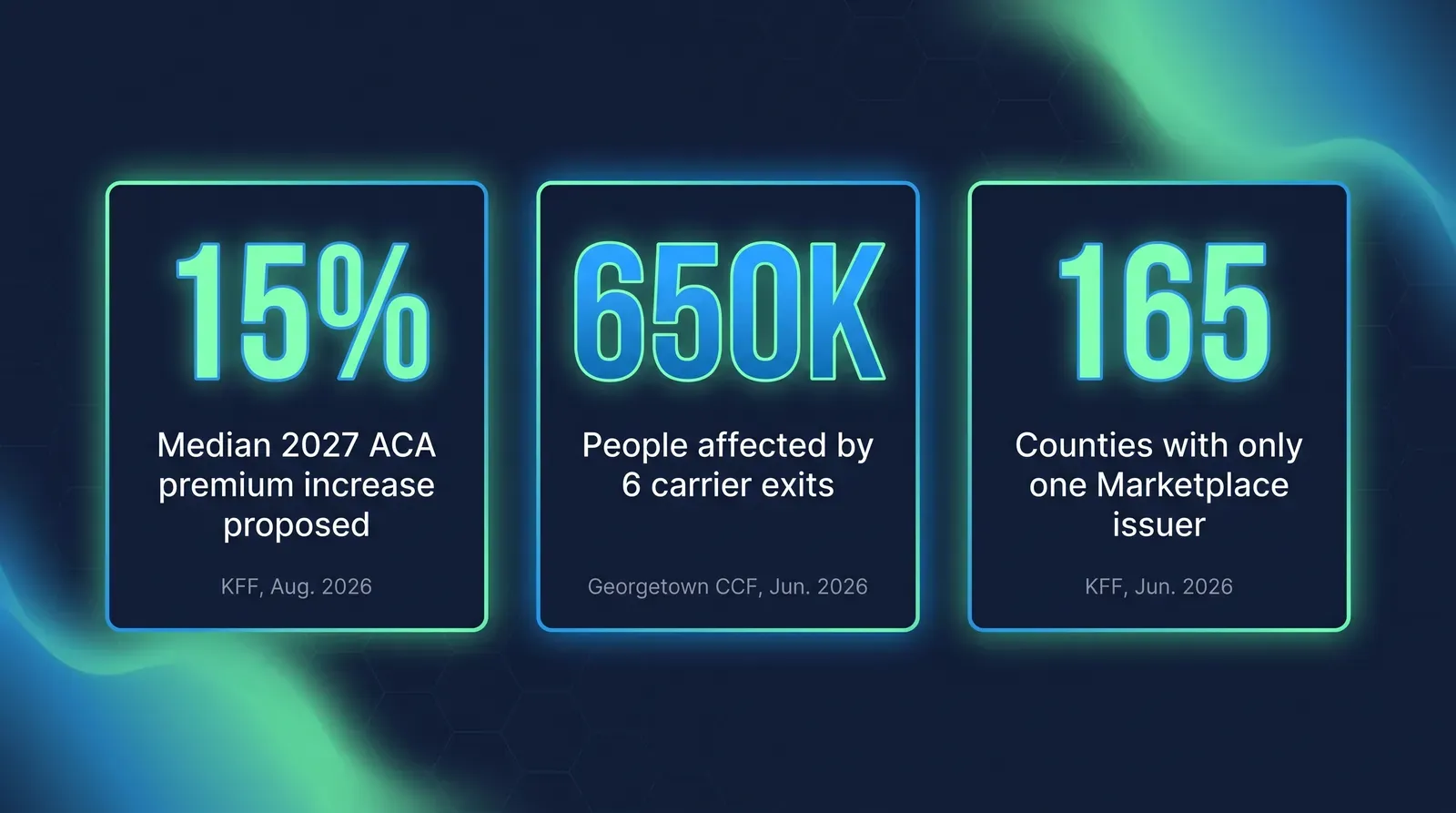
The premium side alone is a two-year climb, not a one-year blip. Insurers are proposing a median 15% premium increase for 2027, across rate filings now in from all 50 states and DC, marking the second consecutive year of a double-digit median increase (KFF, August 4, 2026). An earlier snapshot of the same filing cycle, 77 insurers across 16 states and DC as of July 8, 2026, put the median at 14%, with most increases falling between 10% and 20% and 20 insurers requesting more than 20% (KFF, July 8, 2026). Insurers attribute the increases to rising medical costs, the expiration of the enhanced premium tax credits at the end of December 2025, and a sicker risk pool left behind as healthier enrollees exited the market in 2026. A separate 8-state sample from Georgetown’s Center for Children and Families, examining actuarial memoranda behind 40 individual rate filings, found statewide average increases ranging from 6.5% in Vermont to 22.4% in Washington (Georgetown CCF, June 30, 2026). These are proposed filings, not final approved rates — state regulators can still adjust them before OEP opens, which is exactly why a per-client, per-carrier check matters more than trusting the national median.
Competition is shrinking at the same time premiums are climbing, which compounds the problem for a client whose carrier both raises rates and leaves the county. The average number of insurers offering Marketplace plans fell from 9.6 per state in 2025 to 9.0 in 2026, the first year-over-year decline since 2018, and CVS Aetna exited the Marketplace entirely after having offered plans in 17 states. Counties with only one issuer nearly doubled, from 93 in 2025 to 165 in 2026 (KFF, June 11, 2026, updated June 22, 2026). Going into 2027, that trend continues: six insurers, Cigna, CareSource, PacificSource, Baylor Scott and White, Providence Health, and Mending (formerly Taro Health), are exiting Marketplaces for the coming plan year, a shift Georgetown’s researchers estimate affects roughly 650,000 people across a third of states (Georgetown CCF, June 30, 2026).
Average ACA Marketplace issuers per state, 2025 vs. 2026
First year-over-year decline in average issuer count since 2018.
Source: KFF, How Has Insurer Participation in the ACA Marketplaces Changed in 2026?, June 11, 2026 (updated June 22, 2026).
A carrier that raises its rate is a conversation. A carrier that leaves the county is a different client's plan entirely, and you don't get to choose which one shows up in your book this year.
Mike MooreA worked example: what these numbers look like against your own book
The national figures are easy to read past as background noise, so run them against a real book. Take a solo agent with 120 active ACA clients, a reasonable size after a few years of steady AEP and OEP production.
| Line item | Figure |
|---|---|
| Active ACA clients | 120 |
| National median proposed premium increase, 2027 | 15% |
| Share of states with at least one 2027 carrier exit (roughly a third) | ~33% |
| Illustrative clients in an affected state needing a carrier-status check | ~40 |
Illustrative math, not a forecast for your specific book
The national figures are averages across carriers and states; your book's actual exposure depends on which carriers and counties your clients are concentrated in. Run the real check against your own client list rather than assuming a national percentage applies evenly. Results may vary.
Forty clients needing at least a carrier-status check isn’t a rounding error in a solo book. It’s a real outreach list, built either through an afternoon of manual lookups against public rate-filing and exit data, or through a scan that runs on a schedule. The math doesn’t change based on which method you use. What changes is how many hours it costs to build the list, and whether it’s built before November 1 or you’re still building it while also trying to work OEP.
The manual re-shop process, done completely by hand
This is the part we’re not going to hold back to make a sale. If you want to run this entirely by hand, with no software beyond a spreadsheet and a browser, here’s the actual process.
Export your book with carrier, plan ID, and county
Pull every active ACA client from your CRM or AMS with their current carrier, specific plan (or metal tier and plan name), and county. Without carrier and county, you can't reliably check whether that specific plan is still being offered next year.
Cross-reference each carrier against confirmed 2027 exits
KFF and Georgetown's CCF both track confirmed 2027 Marketplace exits by carrier and state. Check every distinct carrier in your book against that list before assuming renewal.
Pull your state's rate filing database for surviving carriers
State Departments of Insurance publish approved and proposed rate filings, typically searchable through the state's rate review or SERFF-based portal. Confirm the specific plan's approved 2027 rate, not just the statewide average.
Re-check subsidy eligibility for anyone near the income edge
A premium increase changes the dollar amount of a client's premium tax credit even when their income doesn't move. For anyone whose household income sits near the 400% federal poverty level line, re-run the subsidy math — see our subsidy cliff guide for the full method.
Find the assigned replacement plan for anyone whose carrier exited
When a carrier exits a county, the Marketplace typically auto-maps affected members to a similar plan from a remaining carrier, unless the member picks their own during OEP. Confirm what that mapped plan actually is before assuming it's a fit — network and formulary can differ meaningfully from the client's prior plan.
Build one prioritized outreach list
Sort into three tiers: carrier exited (must re-enroll, contact first), same carrier with a material rate or subsidy change (contact second), and stable (a shorter, lower-priority check-in).
| Client | Current carrier / county | 2027 status | Action needed |
|---|---|---|---|
| Example: D. Reyes | Cigna / Maricopa Co., AZ | Carrier exiting Marketplace | Priority outreach, needs new plan before Dec. 15 |
| Example: T. Nguyen | Remaining carrier, same county | Renewed, premium up ~15% | Contact to re-run subsidy math, confirm still a fit |
| Example: A. Whitfield | Remaining carrier, same county | Renewed, no material change | Short check-in, no urgency |
For a book of even a hundred active ACA clients, that’s a hundred individual carrier-and-county checks against exit lists, rate filing data, and subsidy math, done before the same November 1 opening every agent in the country is racing toward. It’s genuinely doable by hand. It’s also genuinely a lot of hours in the exact weeks you should be having client conversations instead of running spreadsheet lookups.
Do the highest-risk slice first if you're short on time
If you can't get through the whole book by hand before OEP opens, prioritize the categories most likely to have moved: any client on one of the six exiting carriers, anyone in a county KFF flags as single-issuer (less room to switch without leaving the Marketplace network entirely), and anyone near the 400% FPL subsidy line. That's a smaller, higher-yield list than starting alphabetically.
Where the manual process breaks down at scale
The manual method above is complete and it works. It also doesn’t scale the way a growing ACA book needs it to. Every client added to your book is another carrier-and-county check, every year, on the same compressed six-and-a-half-week window, and the lookup itself doesn’t get any faster because you have more clients this year than last.
That’s the actual gap, and it isn’t hypothetical. Rate filings, carrier exit announcements, and subsidy parameters are all public data, tracked by researchers and regulators on a fixed timeline every year. A book of ACA clients is a fixed list of carrier-county pairs. Checking a fixed list against a changing dataset, on a schedule, every year, is exactly the kind of task that doesn’t need a human doing the lookup by hand — it needs the lookup automated, and the human spending the freed-up hours on the calls the scan surfaces.
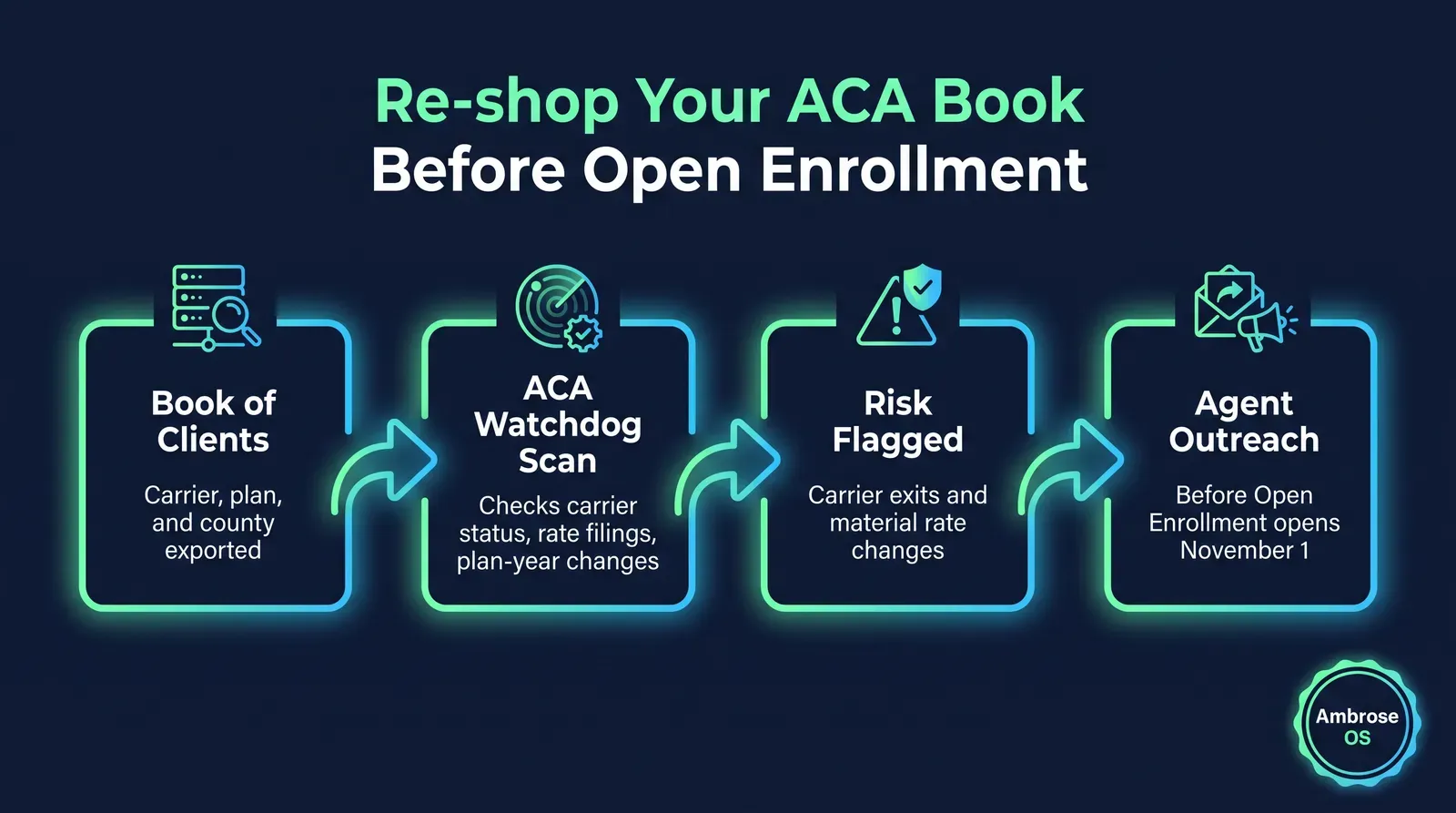
How aca-watchdog and marketplace-finder do this automatically
Ambrose OS, the platform included with a Tech Savvy membership, ships a spoke built for exactly this job. According to Ambrose’s documentation, aca-watchdog delivers “scheduled monitoring of ACA marketplace conditions,” tracking “cost hikes, carrier exits, benefit cuts, plan-year transitions,” through three tools: aca_scan_book, which scans the agency’s ACA book for risk signals; aca_check_carrier_status, a status check on a specific carrier; and aca_plan_year_diff, a year-over-year diff for a plan ID (Ambrose docs, spoke-aca-watchdog). It’s documented at the “free” tier, running on public marketplace data rather than client PHI, and it’s listed as live rather than a beta feature. Findings post to Ambrose Notifications automatically, with anything unresolved surfacing in a watchdog widget on the agency dashboard.
Once a scan flags a client who needs a new plan, marketplace-finder is the tool that does the research. It’s documented as a live, healthcare.gov-backed connector with 11 tools, including marketplace_plan_search, marketplace_subsidy_estimate, marketplace_county_by_zip, and marketplace_crosswalk, which maps a discontinued plan to comparable available options (Ambrose docs, spoke-marketplace). Between the two spokes, one flags who needs attention and the other does the replacement-plan legwork, the same two steps the manual checklist above walks through by hand.
| Manual step | aca-watchdog / marketplace-finder equivalent |
|---|---|
| Export book with carrier, plan, and county | aca_scan_book reads the book directly, on a schedule |
| Cross-reference carriers against confirmed exits by hand | aca_check_carrier_status checks a specific carrier automatically |
| Pull state rate filing data for surviving carriers | aca_plan_year_diff compares a plan year over year |
| Search for a replacement plan by hand | marketplace_plan_search / marketplace_crosswalk |
| Re-run subsidy math manually | marketplace_subsidy_estimate |
| Build a prioritized spreadsheet by hand | Flagged risk signals post to Ambrose Notifications and the dashboard widget |
Run aca-watchdog as a scheduled Ambrose routine and it does the same lookup the manual checklist above walks through, just on the full book, every time, without the lookup itself eating the weeks between the first rate filings and OEP opening. That’s the actual pitch: not “AI does your job,” but “the specific, repetitive check you just read the manual version of runs on a schedule instead of a deadline.”
A scan finds who to call. It doesn't replace the compliant call itself
Neither spoke gives advice or contacts a client on your behalf — it surfaces a risk signal so you know who needs a conversation. Once you're reaching out about a specific plan or premium, the normal Marketplace marketing and disclosure rules still apply, including the agent and broker standards CMS finalized (and courts partially blocked) in the 2027 Notice of Benefit and Payment Parameters. Tech Savvy Insurance is a training and software community, not a law firm, and this isn't legal or compliance advice — confirm current CMS Marketplace marketing requirements before you place the call.
The NAIC’s AI Model Bulletin expectations apply here too, the same way they apply to any AI-assisted process touching an insurance decision: a written policy on how the tool is used, a human reviewing what it flags before anyone acts on it, and documentation of the process if a regulator or carrier ever asks. A watchdog scan that flags a carrier exit is an input to your judgment, not a replacement for it — you’re still the one deciding what to say and confirming the client’s best interest before you make the call.
What about the subsidy side, separate from the carrier side
Carrier exits and rate increases are one axis of re-shopping. Subsidy eligibility is a separate one, and a client can be affected by it even if their carrier didn’t change at all. The enhanced premium tax credits expired December 31, 2025, and for 2026 and 2027 the standard rule is back in force: a household above 400% of the federal poverty level for its size gets no premium tax credit at all, not a reduced one. We cover the full manual income-check process, with the 2026 income thresholds by household size, in our subsidy cliff guide — treat that check as a second pass on top of the carrier-and-plan check this article walks through, not a substitute for it. A client whose carrier renewed and whose plan looks stable can still see their out-of-pocket premium jump because of where their household income landed, entirely independent of anything the carrier did.
What you get by joining
One Ambrose seat, including aca-watchdog and marketplace-finder, comes with a Tech Savvy Insurance membership: $97 a month, billed monthly, cancel anytime, founding rate locked in while the membership stays active. Alongside the seat: weekly Zoom calls with open Q&A and build-with-you sessions, 30+ hours of recorded training, Meta Ads and marketing training built for this industry, pre-built AI templates and bot deployments, and a free annual in-person member workshop. It’s also an explicit no-recruiting zone — you can ask a real question about your book without ending up on someone’s downline pitch list, which is a real point of difference from most agent Facebook groups.
Ambrose usage is separate from the $97 seat
The membership includes one Ambrose seat; usage inside Ambrose runs through its own credit ledger with spend caps, so cost stays visible instead of appearing as a surprise line item ([Ambrose docs, What is Ambrose](https://app.hiambrose.com/docs/what-is-ambrose)). Ambrose's Brain, the internal service the platform's data-driven spokes sit alongside, fronts more than 25 federal and healthcare data sources ([Ambrose docs, Glossary](https://app.hiambrose.com/docs/glossary)), and the full spoke catalog runs to 18 tool servers total — see the [Spokes catalog](https://app.hiambrose.com/docs/spokes) for what else is available beyond the two covered here.
Building this into your OEP calendar, whether you automate it or not
Whether you run this by hand this year or set up a scheduled scan, the calendar doesn’t move. Anchor your own process to the same dates carriers and regulators anchor theirs to:
- Now through late September: Pull your book and confirm every client’s carrier, plan, and county are current and accurate. A re-shop is only as good as the list feeding it.
- October, as final rates and exits confirm: Run the check, manual or scheduled, and start building your prioritized outreach list before November 1.
- November 1: OEP opens. If your list isn’t built by now, you’re behind the competing mail and marketing your clients are about to receive.
- November 1 – December 15: Work the priority list first — carrier exits, then material rate or subsidy changes, then stable check-ins — keeping every enrollment-related call inside the required marketing and disclosure framework, and get anyone who needs January 1 coverage enrolled before the deadline.
- December 16 – January 15: A second, shorter window remains for anyone not yet reached, with coverage starting February 1 instead of January 1.
The close
Everything above, the carrier-exit cross-reference, the rate-filing check, the subsidy re-run, works whether you ever join anything or not — that’s the point of writing it out in full. If you’d rather have that same lookup run on a schedule instead of a deadline, with the results waiting in a dashboard widget instead of a spreadsheet you built at midnight, one Ambrose seat comes with a Tech Savvy membership, and the weekly build-with-you calls are where agents actually set up their first watchdog routine, on their own book, with people who’ve already done it: https://techsavvyinsurance.com/.
Before you contact anyone in your book
Tech Savvy Insurance is a training and software community, not an insurance company, agency, or law firm, and does not provide insurance, legal, tax, or compliance advice. You are responsible for your own licensure and for complying with all applicable CMS, state, and carrier Marketplace marketing and disclosure requirements. AI-generated outputs, including any watchdog scan result, may contain errors — always verify against current CMS and state data before acting on it. Results may vary.
Frequently asked questions
Sources
- KFF — ACA Marketplace Insurers Are Proposing a Median Premium Increase of About 15% in 2027 (Aug. 4, 2026) — kff.org
- KFF — In Preliminary Rate Filings, ACA Marketplace Insurers Largely Propose Double-Digit Premium Increase for 2027 (Jul. 8, 2026) — kff.org
- KFF — How Has Insurer Participation in the ACA Marketplaces Changed in 2026? (Jun. 11, 2026, updated Jun. 22, 2026) — kff.org
- Georgetown University CCF — Early Signals Suggest a Second Year of Double-Digit Marketplace Premium Increases (Jun. 30, 2026) — ccf.georgetown.edu
- MNsure — 2027 Open Enrollment Dates Have Changed (Aug. 7, 2026) — mnsure.org
- American Hospital Association — CMS Issues Implementation Guidance Following Federal Court Injunction Involving 2027 Notice of Benefit and Payment Parameters (Jul. 23, 2026) — aha.org
- McDermott+ Consulting — The Final Course: The 2027 Notice of Benefit and Payment Parameters Is Served (May 21, 2026) — mcdermottplus.com
- Ambrose docs — spoke-aca-watchdog — app.hiambrose.com
- Ambrose docs — spoke-marketplace (marketplace-finder) — app.hiambrose.com
- Ambrose docs — Spokes — app.hiambrose.com
- Ambrose docs — Glossary (the Brain) — app.hiambrose.com
- Ambrose docs — What is Ambrose — app.hiambrose.com
Ready to put this into practice?
Join a private community of Health & Life insurance professionals using AI, Meta Ads, and automation to grow — without draining their bank account.
Join Tech Savvy — $97/month