
A proposed CMS rule published October 27, 2026 would stop Exchanges from paying a premium tax credit or cost-sharing reduction to anyone whose income, citizenship, residency, or other-coverage information can’t be verified — and it would make every enrollee come back once a year, starting August 1, 2027, to confirm that information again before the next plan year. Nothing changes for 2027 plan year applications. The first plan year this touches is 2028, and the rule is still a proposal with an open comment period. But the clock that matters to you starts now, because the manual chase this creates — tracking which clients have an unresolved data matching issue and which deadline they’re up against — isn’t new. CMS already runs a version of it, and this proposed rule makes it bigger, annual, and tied directly to whether your client’s subsidy keeps flowing.
Key takeaways
- CMS's proposed rule (CMS-9873-P, RIN 0938-AW03, Federal Register document 2026-21891) would bar Exchanges from paying APTC or CSRs to applicants with an unresolved data matching issue for citizenship, residency, non-employer coverage, income/family size, or employer-sponsored coverage, by amending 45 CFR 155.315(f)(4)(ii).
- It implements a new Internal Revenue Code requirement, 26 U.S.C. 36B(c)(5), added by section 71303 of Public Law 119-21 — the same law the IRS calls the One, Big, Beautiful Bill Act and this CMS rule calls the Working Families Tax Cut (WFTC) legislation. The requirement applies to tax years beginning after December 31, 2027.
- A new annual pre-Open Enrollment verification period, proposed at 45 CFR 155.410(h), would run every year from August 1 until each Exchange's OEP begins. The first one opens August 1, 2027, for plan year 2028.
- Currently enrolled clients would need to confirm income, family size, citizenship status, coverage eligibility, and residence between August 1 and December 31 of the year before the plan year, or risk being re-enrolled without financial assistance under proposed changes to 45 CFR 155.335.
- Comments on the proposed rule are due within 30 days of the October 27, 2026 publication date, filed at regulations.gov under docket CMS-2026-3367.
- This is separate from periodic data matching (PDM), the existing twice-a-year check for dual enrollment and death that agents already deal with — the new rule adds a bigger, annual layer on top of it.
What CMS actually proposed
CMS’s proposed rule, filed under CMS-9873-P and RIN 0938-AW03, amends 45 CFR Part 155 to implement new verification requirements the agency says come from “section 71303 of Pub. L. 119-21 (July 4, 2025), which we refer to as the Working Families Tax Cut (WFTC) legislation” (CMS, proposed rule CMS-9873-P, Federal Register document 2026-21891). That’s the same public law the IRS calls the One, Big, Beautiful Bill Act in its own parallel rulemaking on the premium tax credit — two agencies, two separate proposed rules, one underlying statute. We covered the IRS side of that statute, including the repayment cap change, in our piece on the ACA premium tax credit repayment cap; this article is about the CMS/Exchange operational side of the same requirement.
The core mechanism is a change to how Exchanges handle what CMS calls a data matching issue, or DMI — the agency’s term for when information on a Marketplace application doesn’t match what a trusted data source (the IRS, Social Security, DHS, and others) shows on file. Today, an applicant with a DMI generally still gets APTC and CSRs while the issue is open, during what CMS calls an “inconsistency period,” as long as they’re otherwise eligible based on what they put on the application. The proposed rule would end that for five specific categories. CMS proposes to amend 45 CFR 155.315(f)(4)(ii) so that Exchanges “would not be able to authorize payment for advance payments of the premium tax credit (APTC) and cost-sharing reductions (CSRs) for applicants who have data matching issues (DMIs)” in these areas, until the DMI is resolved — unless the household qualifies for a special enrollment period under 45 CFR 155.420(d)(2)(i) or (ii) (CMS, proposed rule CMS-9873-P):
| Category | Where it's defined today | Current inconsistency period |
|---|---|---|
| Citizenship or lawful presence status | 45 CFR 155.315(c) | 95 days from the eligibility notice |
| Place of residence | 45 CFR 155.315(d) | Not separately specified in the proposed rule; CMS proposes to keep the existing residency verification requirements as-is and seeks comment on strengthening them |
| Non-employer minimum essential coverage (e.g., Medicare, Medicaid) | 45 CFR 155.320(b) | 90 days from the eligibility notice |
| Household income, family size, eligible noncitizen status | 45 CFR 155.320(c)(3) | 90 days from the eligibility notice |
| Employer-sponsored coverage | 45 CFR 155.320(d) | 90 days from the eligibility notice |
That 90-day-general, 95-day-citizenship split isn’t new; it’s the existing inconsistency-period rule CMS describes in the proposed rule’s own background section, tracing back to how the agency interpreted section 1411(e) of the Affordable Care Act in the 2012 Exchange Establishment Rule (CMS, proposed rule CMS-9873-P, Section II.A). What’s new is tying the outcome of that period directly to whether APTC and CSRs flow at all for those five categories, instead of letting the applicant receive assistance during the window while the issue gets sorted out.
A consumer can still enroll without a subsidy
CMS's own fact sheet is explicit that an open DMI in these categories wouldn't end a consumer's ability to enroll — just their ability to get financial assistance while it's open. "Consumers may still enroll in Marketplace coverage without financial assistance while verification is pending" (CMS, Fact Sheet, Exchange Pre-Eligibility Verification Proposed Rule CMS-9873-P). For most clients at typical Marketplace income levels, paying full freight instead of a subsidized rate for weeks or months is still a real financial hit — it just isn't a coverage gap.
The legal chain: one sentence in a 2025 tax law becomes a 2028 verification rule
Section 71303(a) of the WFTC legislation adds new paragraph 36B(c)(5) to the Internal Revenue Code, effective for tax years beginning after December 31, 2027. Starting January 1, 2028, a month generally isn’t a “coverage month” for premium tax credit purposes unless an Exchange “verifies,” using “applicable enrollment information that shall be provided or verified by the applicant,” the enrollee’s eligibility to enroll in a qualified health plan and, where relevant, for APTC for that month (CMS, proposed rule CMS-9873-P, Section II.A, citing 26 U.S.C. 36B(c)(5)(A)). The statute spells out exactly what “applicable enrollment information” means: household income and family size, whether the enrollee is an eligible alien, health coverage status or eligibility, place of residence, and anything else Treasury and HHS determine necessary. Two built-in protections are worth knowing: a consumer can’t be found ineligible to enroll solely for failing to meet this verification requirement for a given month, and Treasury can waive the requirement for someone enrolling through a special enrollment period tied to a change in family size — a newborn, an adoption, a marriage.
Section 71303(b) adds a second lever. It amends the Code’s definition of a qualified health plan, for purposes of the premium tax credit, to exclude any plan “enrolled in through an Exchange that does not provide a process through which any consumer may verify their household income and eligibility for QHP enrollment for the following plan year.” That process has to be in place no later than August 1, 2027, and by August 1 of every year after that, for current enrollees seeking APTC for plan year 2028 and beyond to stay eligible (CMS, proposed rule CMS-9873-P, Section II.A). That’s the statutory root of the pre-Open Enrollment verification window covered next — it isn’t a CMS invention, it’s CMS building the Exchange-side plumbing the 2025 tax law already requires.
The new verification calendar
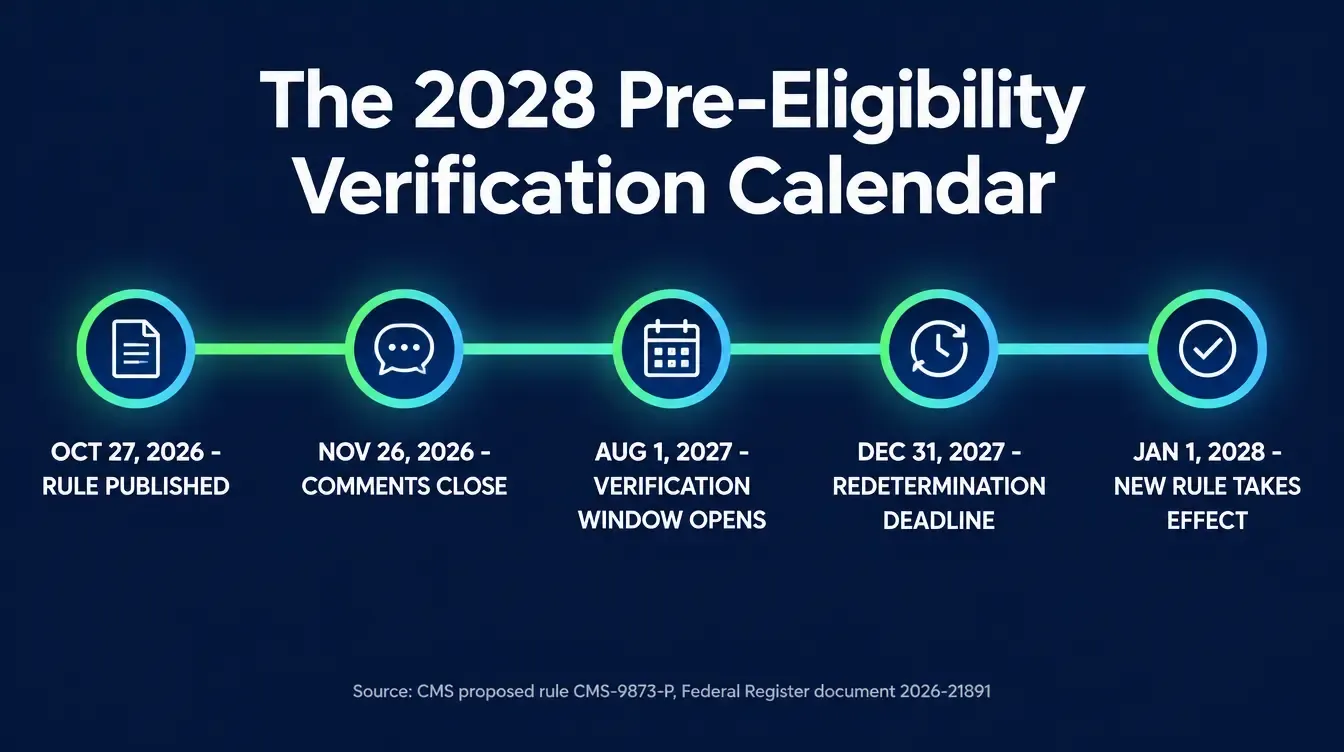
CMS’s proposed rule translates that statute into a specific annual sequence. The centerpiece is a new section, proposed 45 CFR 155.410(h), requiring every Exchange to run a pre-Open Enrollment (pre-OE) verification period each year, starting August 1 and continuing until that Exchange’s Open Enrollment Period begins, during which enrollees can provide eligibility information for the coming plan year and the Exchange has to attempt to verify it (CMS, proposed rule CMS-9873-P). A second, related change, to 45 CFR 155.335, governs what happens to someone who’s already enrolled: CMS proposes that an Exchange may not redetermine an enrollee eligible for APTC and CSRs for the next plan year unless the enrollee or their application filer provides or confirms household income and family size, citizenship or eligible noncitizen status, eligibility for other coverage, and place of residence — and that confirmation has to land on or after August 1 and no later than December 31 of the year before the plan year it covers.
| Date | What happens |
|---|---|
| October 27, 2026 | Proposed rule CMS-9873-P published in the Federal Register |
| ~November 26, 2026 | 30-day public comment period closes (30 days after the October 27 publication date, per the rule's own comment window) |
| August 1, 2027 | Statutory deadline for every Exchange to have an income/eligibility verification process operating (26 U.S.C. 36B(c)(3)(A)(ii)); first annual pre-OE verification window opens (proposed 45 CFR 155.410(h)) |
| August 1 – December 31, 2027 | Window for currently enrolled clients to provide or confirm income, family size, citizenship status, other-coverage eligibility, and residence for plan year 2028 (proposed 45 CFR 155.335) |
| January 1, 2028 | New coverage-month verification requirement takes effect (26 U.S.C. 36B(c)(5)(A)); first plan year subject to the new rule |
CMS proposes new effective-date rules alongside this, too. If a consumer “pends” a plan selection during Open Enrollment or an SEP while a DMI resolves, and CMS resolves all of a consumer’s relevant DMIs by the 15th of the month following their originally scheduled coverage date, they keep that original effective date. Resolve it later in that same month, and the effective date becomes the first of the month of resolution. Resolve it after that, and it pushes to the first of the following month (proposed 45 CFR 155.410(f)(5), 155.420(b)(6)). CMS is also proposing a new section, 155.400(i), requiring Exchanges to let applicants and enrollees pend a plan selection so coverage only becomes effective once APTC and CSR eligibility is actually determined — which keeps a client from getting billed full price for a plan they technically selected before their subsidy was confirmed.
Why this happens: the mechanism behind a data matching issue
A DMI isn’t a judgment call by a caseworker. It’s what happens when the number or status a consumer puts on a Marketplace application doesn’t match what an automated check against a trusted data source returns — the IRS for income, the Social Security Administration or DHS for citizenship and immigration status, a state Medicaid agency for other coverage. CMS describes the mechanism plainly: “Exchanges check trusted data sources to determine if application information is reasonably compatible with information from those data sources. In cases where the information is not reasonably compatible or data is unavailable, generally the applicant will receive notification of a data matching issue” (CMS, proposed rule CMS-9873-P, Section II.A). The applicant then has the 90-or-95-day inconsistency period to submit documentation and resolve it.
Agents already deal with a cousin of this process: periodic data matching, or PDM. It’s an existing, separate check CMS runs twice a year on everyone currently enrolled with financial assistance, looking only at dual enrollment in Medicare or Medicaid/CHIP and at death — not income, citizenship, or residency. CMS’s own guide for agents and brokers, updated June 2026, lays it out: “If consumers do not take action when they receive a PDM notice, the Marketplace will end financial assistance or coverage after 30 days” (CMS, Agents and Brokers Guide to Marketplace Periodic Data Matching, updated June 2026). That 30-day scramble, twice a year, for a narrow set of checks, is the version of this problem agents already know. The pre-eligibility verification proposed rule is the same basic shape — an automated check, a notice, a clock, a consequence for silence — applied to five broader categories, run annually instead of twice yearly, and tied to whether the subsidy itself keeps flowing rather than just to Medicare/Medicaid dual enrollment.
What it costs when this goes unresolved
The dollar stakes here aren’t abstract. CMS’s own Plan Year 2026 fact sheet says tax credits are “projected to cover 91% of the lowest cost plan premium in 2026 for eligible enrollees,” with the average Marketplace premium after tax credits projected at $50 per month for that lowest-cost plan (CMS, Fact Sheet, Plan Year 2026 Marketplace Plans and Prices, October 30, 2025). If a client’s DMI goes unresolved in one of the five categories this rule covers, that 91% coverage doesn’t shrink — it disappears for that household until the issue clears. A client paying roughly $50 a month is suddenly paying close to the full premium, not a reduced one, for every month the DMI sits open.
CMS has also shown it will act on exactly this kind of verification failure at scale. In the same March 2026 press release reporting 23.1 million total 2026 Marketplace enrollees, the agency said it “ended advance payment of the premium tax credit (APTC) or coverage for nearly 1.5 million people” found to be ineligible for financial assistance or enrolled without authorization on HealthCare.gov during 2025 (CMS, Press Release, Exchange Coverage Remains Near Record High as 23.1 Million Enroll for 2026, March 27, 2026). The same release notes that 46% of 2026 enrollees had household incomes between 100 and 150% of the federal poverty level, “with the vast majority receiving financial assistance” — exactly the income band where a 90-day income DMI, or a full year without a subsidy, lands hardest.
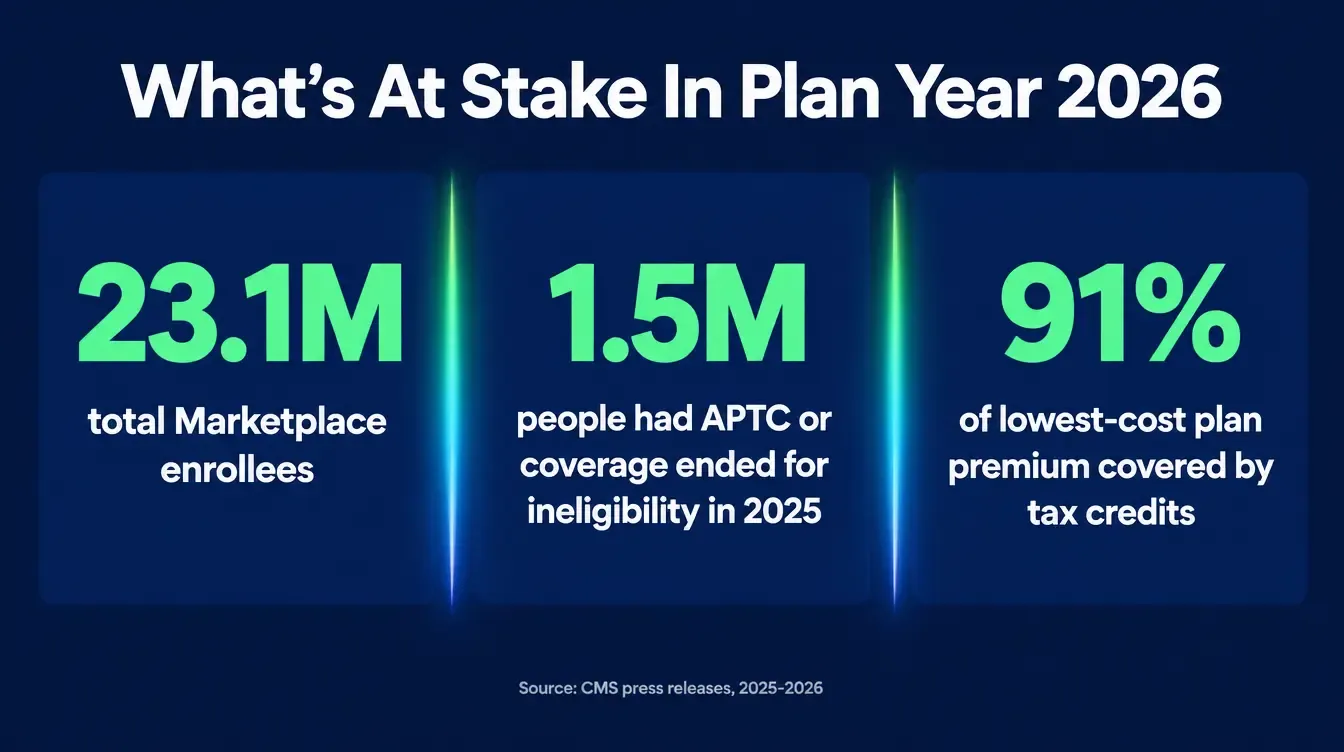
Put those together and the shape of the risk is clear: CMS is already enforcing verification aggressively on the existing rules, enrollment is concentrated in income bands where the subsidy is most of the premium, and this proposed rule adds a fifth category (residency) and an annual, calendar-driven recheck on top of what’s enforced today. Results may vary by household and by how quickly a DMI gets resolved, but the direction isn’t in question.
The manual method: how to keep a client’s subsidy from lapsing
None of this requires a tool. It requires a calendar and a habit, and it’s the same discipline whether the rule finalizes as proposed or changes first.
Pull every client's current DMI status
Log into each client's HealthCare.gov account (or your state-based Exchange) and check for any open data matching issue. The eligibility notice states the category — income, citizenship, residency, or coverage — and the exact day the inconsistency period closes. Write that date down per client, not per batch.
Sort by deadline, not by alphabet
Build a simple list ordered by the soonest-closing inconsistency period. A 95-day citizenship DMI opened in September closes in December; a 90-day income DMI opened the same week closes a few days earlier. The point of this step is catching the client whose window closes next week, not reviewing your book in whatever order the CRM happens to list it.
Know exactly which document clears which issue
A pay stub, a recent tax return, or a letter from an employer generally resolves an income DMI. A green card, naturalization certificate, or valid passport resolves a citizenship DMI. A lease, utility bill, or driver's license tied to the client's current address is the kind of document that supports a residency check. Tell the client specifically what to send — "proof of income" gets a confused reply; "your two most recent pay stubs" gets a document back the same day.
Upload through the client's Marketplace account, and confirm receipt
Documents go in through the client's HealthCare.gov account (or mailed to the address on the eligibility notice). After upload, check back in a few days for a status change rather than assuming it processed. A document that uploaded but didn't attach to the right application is a common, quiet failure mode.
Build the August 1 check-in into your calendar now
If this rule finalizes as proposed, every client with APTC or CSRs will need to confirm income, citizenship, coverage, and residency between August 1 and December 31, 2027, for 2028 coverage. That's a book-wide outreach push, not a one-off. Put a recurring calendar block on August 1 each year — starting 2027 — to begin that sweep, the same way you already treat the start of AEP.
What not to paste into a general AI tool here
A client's DMI resolution involves Social Security numbers, immigration documents, pay stubs, and proof of address — sensitive personal and financial information that shouldn't go into a consumer AI chatbot with no accountability on the other end for how it's stored. Drafting a generic reminder message about the August 1 verification window is fine with any tool. Pasting a real client's income figures, immigration status, or Social Security number into one is not. The NAIC's Model Bulletin on the Use of Artificial Intelligence Systems by Insurers sets the general expectation here: written governance, human oversight, and a record of how an AI-assisted decision was made (our guide to the NAIC AI Model Bulletin covers the documentation checklist in full).
Everything above works whether you join anything or not. Run it on your current ACA book this week — most agents have at least a few clients sitting on an open DMI they haven’t flagged yet.
How Ambrose handles the chasing
The manual method above is a discipline. Where Ambrose actually helps is turning “check every client’s DMI status by hand, on a date you have to remember” into a scheduled job that runs itself and tells you what needs attention.
Ambrose’s data layer, the Brain, currently documents 33 federal and health data sources and 205 live tools, confirmed on Ambrose’s own “What is Ambrose?” page as of this writing, with its stated operating rule being “never invent a number” (Ambrose docs, What is Ambrose?). The piece that fits this specific problem is a Routine: documented as “a scheduled prompt attached to an agent or a team,” set on a standard five-field cron schedule, with an optional output destination of Slack, email, a GHL note, or log only (Ambrose docs, Routines). Point a routine at an agent with access to client-vault — documented as the “client-facing enrollment + policy store” spoke — and write the prompt to pull every ACA client’s DMI deadline and flag anyone whose window closes inside the next 15 days (Ambrose docs, Spokes overview). Schedule it daily, point the output at Slack, and the list that used to require opening every client’s HealthCare.gov account by hand shows up in the channel your team already reads.
Being precise about what that is and isn’t: the filtering logic — “15 days before deadline,” “unresolved DMI only,” whatever rule you want — lives in the prompt you write for the routine, not in a built-in DMI-tracking button. Ambrose doesn’t currently document a purpose-built “DMI tracker” feature; what it documents is a general scheduling and prompt framework flexible enough to build one yourself, reading from the agency’s own book of business in client-vault. That’s a real difference from a packaged compliance tool, and it’s worth saying plainly instead of implying otherwise. What it buys you is the same question — “which of my clients needs a document chased down before a deadline” — answered on a schedule instead of only when you remember to ask it.
| Part of the problem | What actually addresses it |
|---|---|
| Checking each client's DMI status on HealthCare.gov | Still a manual login per client today — not a documented Ambrose spoke |
| Flagging which clients have a deadline closing soon, on a schedule, without you asking | A Routine built on an agent with client-vault access, output to Slack |
| Keeping the agency's book of business and client records in one private store | The client-vault spoke (client-facing enrollment + policy store) and agent-vault (the agency's private book of business) |
What you get
One Ambrose seat, including the Brain and the client-vault and agent-vault spokes described above, comes with a Tech Savvy Insurance membership: $97 a month, billed monthly, cancel anytime, founding rate locked in while the membership stays active. Alongside the seat: weekly Zoom calls with open Q&A and build-with-you sessions, 30+ hours of recorded training, Meta Ads, AI, and marketing training built for this industry, pre-built AI templates and bot deployments, and a free annual in-person member workshop — an explicit no-recruiting zone, so you can ask a real question about a client's DMI without ending up on anyone's downline pitch list.
What’s still just a proposal, and how to comment
It’s worth repeating because it’s easy to lose in a rule this detailed: none of this is final, and none of it changes 2027 plan year enrollment. CMS Administrator Dr. Mehmet Oz framed the agency’s reasoning plainly in the press release announcing the proposal: “Federal subsidies should only go to eligible Americans, not to fraudsters gaming the system.” Treasury Secretary Scott Bessent added that the changes close “eligibility loopholes” so premium tax credits “go to eligible Americans” (CMS, Press Release, October 23, 2026). CMS is genuinely asking for input in a few specific places: how to strengthen residency verification without relying primarily on self-attestation, how to strengthen family size verification, and whether consumers who apply for Medicaid or CHIP during the new pre-OE window should also qualify for the existing Medicaid-denial special enrollment period.
How to actually submit a comment
Comments are due within 30 days of the October 27, 2026 Federal Register publication, filed electronically at regulations.gov under docket CMS-2026-3367, by mail to CMS, Attention: CMS-9873-P, P.O. Box 8016, Baltimore, MD 21244-8016, or by express/overnight mail to CMS, Attention: CMS-9873-P, Mail Stop C4-26-05, 7500 Security Boulevard, Baltimore, MD 21244-1850 ([CMS, proposed rule CMS-9873-P](https://public-inspection.federalregister.gov/2026-21891.pdf)). If your agency has a specific operational concern about the residency verification question CMS is asking about, that's exactly the kind of practical detail a front-line agent sees and a policy office might not.
Compliance: what this article covers, and what it doesn’t
Nothing in this article is insurance, legal, or tax advice. CMS-9873-P is a proposed rule, published October 27, 2026, and CMS can finalize it with changes, delay it, or decline to finalize it after reviewing comments. Every CFR citation and date here reflects the proposed text as filed; confirm the current status of any provision with CMS directly before advising a client, since a proposed rule is not enforceable law. This article covers the ACA Marketplace side of verification; it doesn’t touch Medicare Advantage or Part D marketing rules, which carry their own TPMO disclaimer and CMS marketing requirements covered in our guide to Medicare sales call scripts for 2027. If you use AI tools to help manage client outreach around this rule, keep Social Security numbers, immigration documents, and income figures out of any tool without a signed Business Associate Agreement — see the NAIC AI Model Bulletin guidance linked above for what a written policy should cover.
The close
This proposed rule doesn’t change anything you’re doing today. What it does is put a hard date — August 1, 2027 — on a habit every ACA agent should already have: knowing which clients have an open data matching issue and which deadline they’re racing. Build that habit now, on the existing 90/95-day inconsistency periods, and the annual version this rule adds in 2027 is just a bigger version of a list you already keep. Run the manual method above on your book this week. If you’d rather have that list generated for you on a schedule, with someone who’s already built the routine walking you through it, one Ambrose seat comes with a Tech Savvy membership.
Check your ACA book for open data matching issues this week
Pull every client's DMI status, sort by deadline, and send the exact document that clears it — the five-step method above is the whole thing, no membership required. If you'd rather have that list built and scheduled for you, one Ambrose seat comes with the Tech Savvy membership.
Join Tech Savvy — $97/monthRelated reading: our breakdown of the IRS side of this same verification requirement and the repayment cap, the 400% FPL subsidy cliff income check, how to re-shop your ACA book before Open Enrollment, and what happens to an ACA subsidy when a client turns 65.
Before you rely on any figure in this article
Tech Savvy Insurance is a training and software community, not an insurance company, agency, or law firm, and does not provide insurance, legal, tax, or compliance advice. You are responsible for your own licensure and for complying with all applicable CMS, IRS, HIPAA, state, and carrier regulations. This article describes a proposed rule as of October 2026; proposed rules can change before finalization. Confirm current requirements directly with CMS, your state Department of Insurance, or a qualified attorney before relying on any figure here. AI-generated outputs may contain errors — always verify. Results may vary.
Frequently asked questions
Sources
- Federal Register — Patient Protection and Affordable Care Act, Exchange Pre-Eligibility Verification, proposed rule (CMS-9873-P, RIN 0938-AW03, document 2026-21891), full text as filed for public inspection — public-inspection.federalregister.gov
- Federal Register — Exchange Pre-Eligibility Verification, official document page — federalregister.gov
- CMS — Fact Sheet, Exchange Pre-Eligibility Verification Proposed Rule CMS-9873-P — cms.gov
- CMS — Press Release, CMS Proposes New Verification Requirements to Implement Law That Combats Exchange Fraud and Protects Taxpayers (October 23, 2026) — cms.gov
- CMS — Press Release, Exchange Coverage Remains Near Record High as 23.1 Million Enroll for 2026 (March 27, 2026) — cms.gov
- CMS — Fact Sheet, Plan Year 2026 Marketplace Plans and Prices (October 30, 2025) — cms.gov
- CMS — Agents and Brokers Guide to Marketplace Periodic Data Matching (updated June 2026) — cms.gov
- Ambrose docs — What is Ambrose? (tenant model, the Brain's data source and tool counts, PHI handling) — app.hiambrose.com
- Ambrose docs — Routines (scheduling, output destinations) — app.hiambrose.com
- Ambrose docs — Spokes overview (client-vault, agent-vault) — app.hiambrose.com
Ready to put this into practice?
Join a private community of Health & Life insurance professionals using AI, Meta Ads, and automation to grow — without draining their bank account.
Join Tech Savvy — $97/month