The NAIC Insurance Data Security Model Law (#668) requires insurers, insurance agents, and other state-licensed entities to build a written information security program, investigate breaches, and notify their state insurance commissioner within 72 hours of one — and as of the NAIC’s own August 2025 count, 27 states plus Puerto Rico have already written it into law. Most independent agents have never heard of it, because it doesn’t market itself the way a CMS marketing rule does. There’s no AEP deadline attached to it, no certification exam, nothing that shows up on a carrier’s annual checklist. It just sits in your state’s insurance code, applying to you whether you’ve read it or not.
Key takeaways
- The NAIC Insurance Data Security Model Law (#668), adopted by the NAIC in October 2017, applies to "insurers, insurance agents, and other entities licensed by the state department of insurance" once a state enacts it (NAIC, Model Law MO-668, Section 2).
- 27 states plus Puerto Rico — 28 jurisdictions total — had adopted it as of the NAIC's Government Affairs Brief dated August 2025, up from 11 states in the NAIC's June 2020 brief.
- Section 9 exempts agencies with fewer than 10 employees, HIPAA-compliant licensees with a filed written certification, and agents already covered by their appointing carrier's or agency's program — but only from Section 4, not from the breach-investigation and notification sections.
- Section 6 sets a 72-hour clock to notify the state insurance commissioner once a Cybersecurity Event is determined to have occurred and meets specific triggers, with a growing list of required details in every follow-up report.
- Ambrose's own architecture documentation confirms a BAA-gated model provider, agency-scoped tenant isolation, an audit trail with an approval gate, and a phi-gateway spoke that pseudonymizes "the 18 HIPAA identifiers" — real technical safeguards, not a substitute for the written program Section 4 actually requires.
The pain: a law you’re already subject to and have never read
Here’s how this usually surfaces. An agent renews their E&O, reads the exclusions carefully after last year’s scare about AI-related gaps, feels good about it, and moves on. Nobody mentions that the state they’re licensed in passed its own version of the NAIC Insurance Data Security Model Law two or three years ago, that it explicitly names “insurance agents” as covered parties, and that it comes with its own commissioner-notification clock that runs independently of anything CMS, HIPAA, or an E&O carrier requires.
This is guidance, not legal or compliance advice
Tech Savvy Insurance is a training and software community, not a law firm, an insurance company, or an insurance agency, and nothing here is insurance, legal, tax, or compliance advice. This article describes what the NAIC's own published model law text and government affairs briefs say, as of the dates cited, and what one state regulator's own press release says about a real enforcement action. Confirm whether and how your specific state has adopted this model with your state's department of insurance, and confirm your obligations with your own compliance department, carrier, or counsel before acting on anything here.
This isn’t a hypothetical gap. The model law was written specifically because state insurance regulators watched several major insurer data breaches happen with no uniform data-security floor underneath the industry, and it names individual agents as covered parties in its very first substantive sentence, not as an afterthought (NAIC, Model Law MO-668, Section 2). If your state adopted it, you’re covered by it right now, whether or not anyone at your FMO, your carrier, or your last CE course ever mentioned it.
What the model law actually says
The NAIC adopted the Insurance Data Security Model Law in October 2017, following roughly two years of drafting after a wave of large insurer data breaches pushed state regulators to build a common security floor (NAIC, Government Affairs Brief, August 2025). The model’s own definitions section is unambiguous about who it reaches: “Licensee” means “any Person licensed, authorized to operate, or registered, or required to be licensed, authorized, or registered pursuant to the insurance laws of this State” (NAIC, Model Law MO-668, Section 3). A licensed individual producer is a Person licensed under a state’s insurance laws. That’s you, not just the carrier whose products you sell.
Once a state enacts its own version of the model — and the specific text can vary state to state, since a model law is a template legislatures adapt, not a self-executing federal statute — three obligations follow for a covered Licensee:
- Section 4 requires developing, implementing, and maintaining “a comprehensive written Information Security Program based on the Licensee’s Risk Assessment,” sized to the Licensee’s own size, complexity, and the sensitivity of the Nonpublic Information it holds (NAIC, Model Law MO-668, Section 4(A)).
- Section 5 requires investigating a Cybersecurity Event when one is discovered.
- Section 6 requires notifying the state insurance commissioner of a Cybersecurity Event that meets specific triggers, within 72 hours of determining it occurred.
A licensed agent is a "Person licensed... pursuant to the insurance laws of this State." The model law isn't describing your carrier. It's describing you.
Mike MooreThe model doesn’t create a private right of action — a client can’t sue you directly under this specific law for a violation of it — and it doesn’t limit whatever private right of action already exists under other law (NAIC, Model Law MO-668, Section 2(B)). What it does give your state’s insurance commissioner is real teeth: the power to examine and investigate a Licensee’s compliance and the authority to order remediation of anything deficient found during that examination (NAIC, Government Affairs Brief, August 2025).
Are you actually exempt? Read Section 9 before you assume
This is the section most agents get wrong in both directions — some assume they’re covered by a carrier’s program when they’re not, and some assume they need their own written program when a real exemption already covers them. The model law’s Section 9 lists three specific exceptions, and only the first two get discussed much online.
| Exemption | Exact condition | Who this actually covers |
|---|---|---|
| Small Licensee | "A Licensee with fewer than ten employees, including any independent contractors" (Section 9(A)(1)) | Most solo and small independent agencies — but only exempts Section 4, not Sections 5 and 6 |
| HIPAA-compliant Licensee | Maintains an Information Security Program under HIPAA and "submits a written statement certifying its compliance with the same" (Section 9(A)(2)) | Agencies that have actually filed the written certification — not agencies that are simply "careful" with PHI |
| Covered agent of another Licensee | An "employee, agent, representative or designee" of a Licensee, who is also a Licensee, "to the extent that" they're "covered by the Information Security Program of the other Licensee" (Section 9(A)(3)) | Captive and appointed agents genuinely operating inside a carrier's or upline agency's own written program — not an independent agency running its own separate systems |
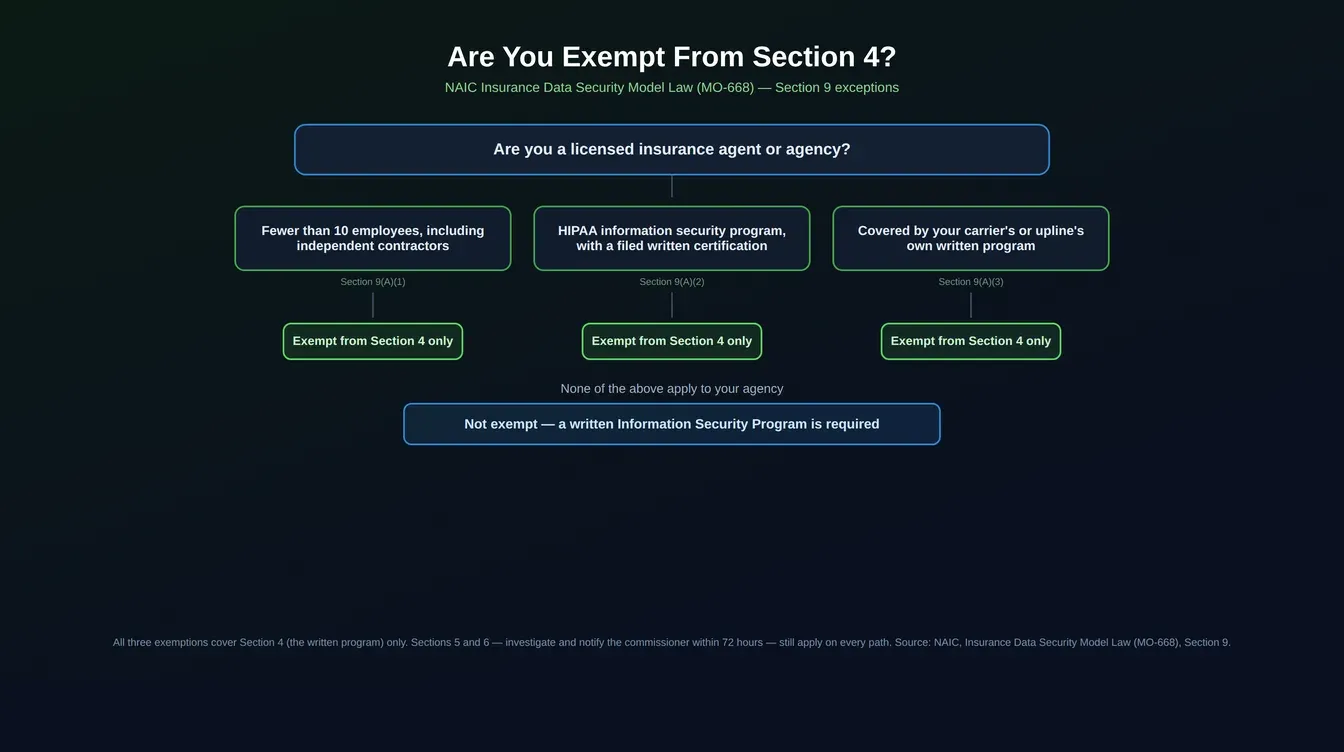
Three things about this table matter more than the exemptions themselves. First, all three exemptions apply to Section 4 only — the written-program requirement. None of them touch Section 5 (investigate a Cybersecurity Event) or Section 6 (notify the commissioner within 72 hours). A two-person agency exempt from ever writing a formal Information Security Program still has to investigate a breach and still has the same 72-hour clock as a national carrier.
Second, the third exemption is conditional on actual coverage, not on titles. “Agent of a Licensee” doesn’t mean “anyone who holds an insurance license and works with a bigger company.” It means your work is genuinely covered by that other Licensee’s own written Information Security Program — their CRM, their vendor contracts, their risk assessment. The moment you run your own separate CRM, your own separate lead vendor relationships, and your own separate AI tools that the carrier’s program was never written to cover, you’re very likely back to being the responsible Licensee for whatever isn’t covered.
Third, if an agency stops qualifying for any exemption — it hires its tenth employee, say — Section 9(B) gives it 180 days to come into compliance, not zero (NAIC, Model Law MO-668, Section 9(B)). That’s a real grace period, and it’s worth knowing the number instead of guessing at it.
What most agents assume
"I have fewer than 10 employees, so none of this applies to me," or "I sell for [Carrier], so their compliance department has this handled."
What Section 9 actually says
The small-Licensee exemption only removes the written-program requirement — the breach investigation and 72-hour notice rules still apply. The carrier-coverage exemption only holds for the systems and data that carrier's program actually covers, not for your own separate CRM, quoting tools, or AI stack.
If Section 4 applies to you, here’s what it actually asks for
For a Licensee that isn’t exempt — a multi-person independent agency running its own systems is the clearest case — Section 4 doesn’t ask for a specific vendor, a specific software purchase, or a specific certification. It asks for a written program built around a real risk assessment, with four objectives named directly in the text: protect the confidentiality and security of Nonpublic Information and the Information System that holds it; protect against threats and hazards to that information; protect against unauthorized access and minimize harm to any consumer; and define, and periodically reevaluate, a retention and destruction schedule for that information (NAIC, Model Law MO-668, Section 4(B)).
The risk assessment itself has specific, checkable components under Section 4(C):
Designate a responsible person
One or more employees, an affiliate, or an outside vendor acting on the Licensee's behalf, formally responsible for the Information Security Program. For a small agency, this can be the owner — the requirement is that someone is named, not that it's a dedicated hire.
Identify foreseeable threats
Internal and external threats that could result in unauthorized access, disclosure, misuse, alteration, or destruction of Nonpublic Information — including threats sitting with third-party service providers who touch that data, not just your own systems.
Assess likelihood and damage
How likely each threat is, and how much damage it could do, weighted by how sensitive the information actually is. A spreadsheet of prospect names and phone numbers is a different risk than a spreadsheet with plan type, diagnosis-adjacent condition tags, and income data attached.
Assess your current safeguards
Employee training, information-systems design and disposal practices, and your ability to detect, prevent, and respond to an intrusion or systems failure — evaluated as they actually exist today, not as you'd like them to be.
Implement safeguards and reassess annually
Put controls in place to manage the threats you identified, and reassess the effectiveness of those controls' "key controls, systems, and procedures" no less than once a year (Section 4(C)(5)).
Manage third-party service providers
The model phases in oversight of vendors that touch your Nonpublic Information — your CRM vendor, your lead vendor, and any AI tool you've connected to client data all fall inside this category, whether or not you've ever thought of them as "vendors" in a security sense.
None of this requires a specific product. A one-page document naming who’s responsible, what threats you considered, what you already have in place, and when you’ll review it again is a real Information Security Program in the sense the statute means, provided it’s actually written down and actually reflects what you do.
The 72-hour clock, and what has to be in the notice
Section 6 is the part with the least room for interpretation, because it’s built around a specific number: notify the commissioner “as promptly as possible but in no event later than 72 hours from a determination that a Cybersecurity Event has occurred” (NAIC, Model Law MO-668, Section 6(A)). That clock only starts once you’ve made a determination — not the instant something suspicious happens — but once you’ve made it, the countdown is real and doesn’t extend for a weekend or a slow IT vendor.
The obligation is triggered when either of two conditions is met:
| Trigger | Condition |
|---|---|
| Home-state trigger | The state is the Licensee's state of domicile (insurers) or home state (producers), as defined under that state's Producer Licensing Model Act |
| Consumer-impact trigger | The Licensee reasonably believes 250 or more state residents' Nonpublic Information is involved, and either another law already requires notifying a government or regulatory body, or the event has a reasonable likelihood of materially harming a resident or a material part of the Licensee's own operations |
Once notified, the reporting duty doesn’t end with one email. Section 6(B) requires as much of a growing list of details as possible, in electronic form as the commissioner directs, with “a continuing obligation to update and supplement” the notice as more is learned: the date of the event, how the information was exposed or stolen, how it was discovered, whether it’s been recovered, the identity of the source if known, whether law enforcement has been notified, the specific types of information taken, how long the system was compromised, and a running best estimate of the total number of state residents affected (NAIC, Model Law MO-668, Section 6(B)).
The clock starts at "determination," which is a judgment call worth making carefully
"We didn't know for sure yet" isn't a defense once you've actually made the determination — but delaying that determination past the point a reasonable review would have made it is exactly the kind of gap a commissioner's examination is built to find. Have a plan for who makes that call and how fast, before you ever need it.
Which states have adopted it
A model law only has legal force once a state legislature actually enacts it — the NAIC drafts the template, but each state writes and passes its own version, sometimes with local variations. As of the NAIC’s own Government Affairs Brief dated August 2025, 28 jurisdictions had implemented Model Act #668.
State adoption of the NAIC Insurance Data Security Model Law
Adoption nearly tripled between June 2020 and August 2025, per the NAIC's own briefs.
Source: NAIC, State Legislative Brief (June 2020) and Government Affairs Brief (August 2025), The NAIC Insurance Data Security Model Law.
| State | Adopted (Aug. 2025) | State | Adopted (Aug. 2025) |
|---|---|---|---|
| Alabama | Yes | Montana | No |
| Alaska | Yes | Nebraska | No |
| Arizona | No | Nevada | No |
| Arkansas | No | New Hampshire | Yes |
| California | No | New Jersey | No |
| Colorado | No | New Mexico | No |
| Connecticut | Yes | New York | No (own regulation, 23 NYCRR 500) |
| Delaware | Yes | North Carolina | No |
| Florida | No | North Dakota | Yes |
| Georgia | No | Ohio | Yes |
| Hawaii | Yes | Oklahoma | Yes |
| Idaho | No | Oregon | No |
| Illinois | Yes | Pennsylvania | Yes |
| Indiana | Yes | Rhode Island | Yes |
| Iowa | Yes | South Carolina | Yes |
| Kansas | No | South Dakota | No |
| Kentucky | Yes | Tennessee | Yes |
| Louisiana | Yes | Texas | No |
| Maine | Yes | Utah | No |
| Maryland | Yes | Vermont | Yes |
| Massachusetts | No | Virginia | Yes |
| Michigan | Yes | Washington | No |
| Minnesota | Yes | West Virginia | No |
| Mississippi | Yes | Wisconsin | Yes |
| Missouri | Yes | Wyoming | No |
| D.C. | No | Puerto Rico | Yes |
If your state shows “No” here, that’s not necessarily the end of the story — the NAIC’s April 2026 tracker map shows continued movement, and several “No” states have introduced versions of the model that haven’t passed yet. It’s also not a reason to skip the rest of this article: general cybersecurity practice, HIPAA obligations, and your own carrier contracts likely require most of the same things regardless of whether your specific state has enacted this exact model.
What it costs when a real regulator finds a real gap
New York never adopted the NAIC model law — it has run its own, earlier cybersecurity regulation for financial services and insurers, 23 NYCRR Part 500, since 2017. The two frameworks aren’t the same law, but they’re built around the identical core idea: a written cybersecurity program, and real penalties when a regulator finds one that exists on paper but not in practice. On October 14, 2025, New York’s Department of Financial Services announced it had secured more than $19 million in combined penalties from eight auto insurance companies over a set of 2021 data breaches that exposed driver’s license numbers and dates of birth (New York DFS, press release, Oct. 14, 2025).
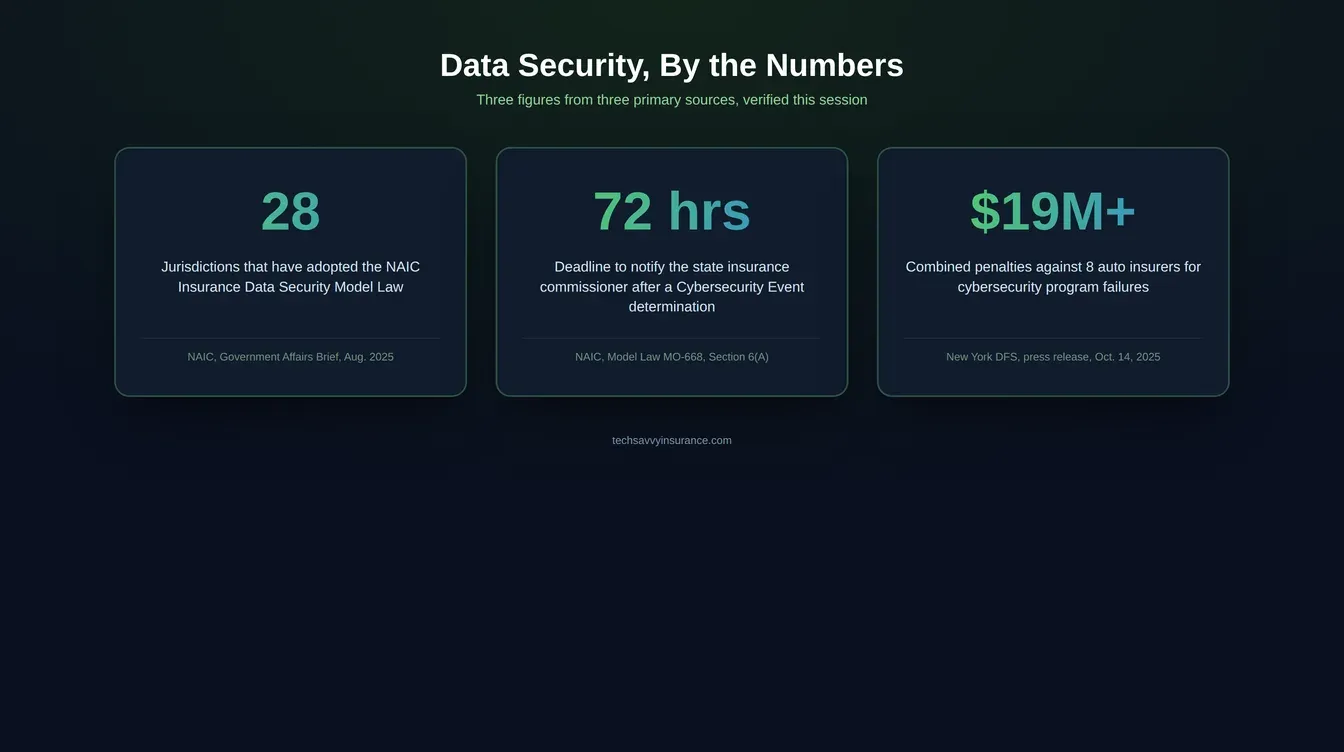
DFS’s own account of what went wrong is the part worth reading closely, because none of it describes some exotic hacking operation. The companies “did not comply with DFS’s cybersecurity regulation, which requires them to implement policies, procedures, and controls designed to protect consumer data” — specifically, inadequate controls on “public-facing web applications and agent portals” let unauthorized parties reach consumer data, and two of the eight companies were separately cited for failing to report the events to DFS on time (New York DFS, press release, Oct. 14, 2025). “Agent portals” is the detail worth sitting with. The gap wasn’t in some back-office mainframe nobody touches — it was in the exact kind of consumer-facing, agent-facing web tooling an independent agency runs every day. A written program with an actual review cadence is what’s supposed to catch a gap like that before a regulator does.
The manual fix: build a real Information Security Program this week
None of the following requires software, a vendor, or a membership. It requires an afternoon and a willingness to write down what you already do — and what you don’t.
Check your exemption status first, in writing
Count your employees and independent contractors. If you're under 10, note the Section 9(A)(1) exemption and the date you checked. If you believe you're covered under a carrier's program, get that carrier's compliance department to confirm in writing exactly which systems and data their program covers — verbally assuming coverage is the single most common mistake here.
Name one person responsible
For a small agency, this is usually the owner. Write the name down, with the date. Section 4(C)(1) asks for a designation, not a dedicated security hire.
List every system that touches Nonpublic Information
Your CRM, your quoting tool, your email platform, your lead vendor's portal, any spreadsheet with client SSNs, dates of birth, or plan and health details, and any AI tool you've pasted client information into. Most agents have never actually listed this in one place.
Write down what could go wrong with each one
A stolen laptop with an unencrypted spreadsheet. A lead vendor with weak security on their own end. An employee forwarding a client list to a personal email account. A general-purpose AI tool storing a pasted client roster on a server you don't control. This is your Risk Assessment — it doesn't need to be exhaustive on day one, it needs to be honest.
Write down what you already do about each one
Password policy, who has access to what, whether laptops are encrypted, whether you have a rule against pasting client data into consumer AI tools. Where the honest answer is "nothing yet," write that down too — a program that acknowledges a gap and a fix date is worth more in an examination than silence.
Put a review date on the calendar, not just in the document
Section 4(C)(5) asks for reassessment "no less than annually." Put a recurring calendar reminder now, for one year from today, to reopen this document and update it — new tools, new vendors, and new AI use cases all change what the risk assessment should say.
That’s the whole program at a starting level: a named responsible person, a system inventory, a threat list, a safeguards list, and a review date, all in one written document. It won’t be a polished consultant-built policy on day one, and it doesn’t need to be — it needs to exist, be accurate, and get revisited.
Do the AI-tool inventory line first
Of everything on this list, the AI-tool line is the one agencies most often leave blank, because it's the newest category and doesn't feel like "a system" the way a CRM does. If anyone at your agency has ever pasted a client name, date of birth, or plan detail into ChatGPT, a general-purpose transcription tool, or any AI assistant without a signed Business Associate Agreement, that's a real line item in your risk assessment, not a footnote.
Where AI adds a new version of this exact problem
Section 4’s third-party service provider language was written years before generative AI tools were something a solo agent used daily, but it reaches them cleanly: any vendor that touches your Nonpublic Information, including an AI tool, falls inside the risk assessment and oversight the model asks for. A consumer AI chatbot with no Business Associate Agreement and no enterprise data controls is exactly the kind of third-party exposure Section 4(C)(2) has in mind when it names threats “accessible to, or held by, Third-Party Service Providers.”
We’ve written the general version of this risk in detail in What Not to Paste Into ChatGPT. The specific overlap with this law is worth naming directly: a written Information Security Program that never mentions AI tools at all isn’t a complete risk assessment anymore, and an agency’s GoHighLevel setup deserves the same scrutiny — see our breakdown of what your AI can and can’t see inside a HIPAA-enabled GoHighLevel sub-account for a concrete example of a vendor boundary most agents assume is airtight and haven’t actually checked.
Where Ambrose’s architecture closes a real technical gap, and where it doesn’t
Nothing in what follows makes an agency compliant with Section 4. That has to be said plainly, because the temptation to imply otherwise is exactly the kind of overclaim that makes a compliance article useless. Section 4 asks for a written, agency-specific document with a named responsible person and an annual review — a governance exercise, not a technology purchase.
What a platform’s architecture can do is remove some of the technical gaps a written program is supposed to catch in the first place — the same kind of gap DFS found in those “agent portals.” Per Ambrose’s own documentation, fetched this session: Ambrose OS is built as an agentic AI operating system for insurance agencies, where “your book of business lives in an encrypted vault scoped to your agency,” with “every read and write” carrying the agency’s own id, “enforced in the application and in the database” (Ambrose docs, What is Ambrose). Protected health information “only runs against model providers covered by a signed Business Associate Agreement” — Claude, through Amazon Bedrock, in U.S. regions (Ambrose docs, What is Ambrose). Every action an agent takes is logged, and anything that writes to a connected CRM “waits for your approval with Allow, Deny, or Always Allow” before it happens (Ambrose docs, What is Ambrose).
Two specific spokes matter for this exact law. The agent-vault spoke is documented as the “agency’s private book of business,” with a HIPAA posture marked “safe” — data stays local to the tenant and PHI is permitted inside it (Ambrose docs, Spokes). The phi-gateway spoke is documented as a “PHI scrubber + re-hydrator,” also marked “safe” (Ambrose docs, Spokes), and Ambrose’s architecture page names it more specifically as a “pseudonymization proxy” that “scrubs the 18 HIPAA identifiers” before “re-hydrat[ing] on response” (Ambrose docs, Architecture) — meaning identifying details are stripped out before data reaches a destination and restored only for an authorized response, rather than sitting exposed in a request to a third party by default.
| Task | Doing it by hand | Running through Ambrose |
|---|---|---|
| Writing the Information Security Program itself | You do this — nobody automates the governance document | Still your call; nothing on the platform drafts or files this for you |
| Keeping client data siloed by agency | Depends on your CRM's own access controls, checked manually | Every read and write carries the agency id, enforced in the application and the database |
| Stopping PHI from reaching a non-BAA AI tool | Relies on every team member remembering the rule every time | PHI only reaches model providers under a signed BAA; the phi-gateway spoke pseudonymizes the 18 HIPAA identifiers before data moves |
| Proving what happened, during an examination | Whatever screenshots, emails, or exports you happen to still have | Every agent action is logged; CRM writes require explicit approval |
Name the mechanism, not "AI compliance"
The specific, checkable things here are the phi-gateway spoke's pseudonymization of the 18 HIPAA identifiers, agency-scoped tenant isolation enforced at the database layer, and a logged approval gate on CRM writes — all per Ambrose's own documentation, fetched this session. None of it is a certification, and none of it writes Section 4's document for you.
Everything in the manual section above works whether you ever look at Ambrose or not — write the program, name the responsible person, list your systems, put the review date on the calendar. Ambrose’s seat is worth mentioning here specifically because the technical gaps it closes — an AI tool with no BAA sitting in your stack, client data with no agency-level isolation, no log of who touched what — are exactly the kind of “we didn’t think to write that down” gaps a commissioner’s examination exists to find.
This is the kind of thing we walk through on a Tuesday call with Ambrose open on the screen — building the actual system inventory, checking which tools in it have a BAA and which don’t, and watching the phi-gateway spoke alias a real client record before it ever reaches a model. $97 a month, cancel anytime, and nobody’s going to pitch you a downline while you’re doing it.
What you get by joining
One Ambrose seat, including the agency-scoped vault, the audit trail and approval gate, and the phi-gateway spoke referenced above, comes included with a Tech Savvy Insurance membership: $97 a month, billed monthly, cancel anytime, with the founding rate locked in while the membership stays active. Ambrose usage runs through its own credit ledger, so cost stays visible instead of becoming a surprise later. Alongside the seat: weekly Zoom calls with open Q&A and build-with-you sessions, more than 30 hours of recorded training, Meta Ads and marketing training built for health and life agents specifically, pre-built AI templates and bot deployments, and a free annual in-person member workshop. It’s also an explicit no-recruiting zone — you can ask a real question about a state cybersecurity rule without getting DM’d about a downline an hour later, which isn’t true of most agent Facebook groups.
Write your Information Security Program this week
Check your exemption status, name a responsible person, and list every system that touches client data — no membership required, and the six-step method above is the whole thing. If you'd rather build it with your AI stack open on a screen-share, checking each tool against a BAA line by line, one Ambrose seat comes with the Tech Savvy membership.
Join Tech Savvy — $97/monthRelated reading: our full guide on what not to paste into ChatGPT for the AI side of this same risk assessment, what your AI can and can’t see inside a HIPAA-enabled GoHighLevel sub-account for one specific vendor boundary worth checking, and our broader NAIC, CMS, and state AI compliance landscape if the AI Model Bulletin side of NAIC’s work is new to you too.
The close
This law didn’t get written to catch agents doing something wrong. It got written because state regulators watched large insurers lose consumer data with no consistent floor underneath the industry, and it named individual agents as covered parties from the first sentence. Whether your state has enacted it yet or not, the underlying exercise — know your exemption status, name a responsible person, list your systems, write down your gaps, put a review date on the calendar — is worth an afternoon regardless. Do it before an examination or a breach makes you do it under pressure, not after.
Before you rely on any figure in this article
Tech Savvy Insurance is a training and software community, not an insurance company, agency, or law firm, and does not provide insurance, legal, tax, or compliance advice. Results may vary. You are responsible for confirming your own state's specific version of this law, your own licensure obligations, and your compliance with HIPAA, CMS marketing rules where applicable, and your carrier agreements — none of which this article can fully substitute for. State adoption changes over time; confirm current status with your own state's department of insurance before relying on the table above. AI-generated outputs, including anything drafted by an AI tool for your own compliance documents, may contain errors: always verify.
Frequently asked questions
Sources
- NAIC — Insurance Data Security Model Law (MO-668), full text — content.naic.org
- NAIC — Government Affairs Brief: The NAIC Insurance Data Security Model Law (August 2025) — content.naic.org
- NAIC — State Legislative Brief: The NAIC Insurance Data Security Model Law (June 2020) — content.naic.org
- NAIC — Implementation of Model Act #668, Insurance Data Security Model Law (map, status as of April 1, 2026) — content.naic.org
- New York Department of Financial Services — DFS Secures More than $19 Million from Auto Insurance Companies over Data Breaches (Oct. 14, 2025) — dfs.ny.gov
- Ambrose docs — What is Ambrose — app.hiambrose.com
- Ambrose docs — Spokes (catalog) — app.hiambrose.com
- Ambrose docs — Architecture — app.hiambrose.com
Ready to put this into practice?
Join a private community of Health & Life insurance professionals using AI, Meta Ads, and automation to grow — without draining their bank account.
Join Tech Savvy — $97/month