
A Meta lead form for insurance needs two things most agents only build one of: a privacy policy link that satisfies Meta’s own Lead Ad Terms, and a separate, specific written consent statement that satisfies the FCC’s TCPA rule for the calls and texts that follow. Meta checks the first. Nobody checks the second until a plaintiff’s attorney does. The exact wording for both is below, sourced from Meta’s own terms and the federal regulations themselves, not from a vendor’s guess at what “should” be compliant.
Key takeaways
- Meta's Lead Ad Terms make the advertiser, not Meta, responsible for "securing all necessary permissions and providing all disclosures" on a lead form (Meta, Lead Ad Terms).
- A checkbox that only says "I agree to be contacted" does not meet the FCC's definition of prior express written consent, which requires naming the contact method, the phone number, and that signing is optional (47 CFR 64.1200(f)(9)).
- TCPA violations carry statutory damages of $500 per violation, or up to $1,500 if a court finds the violation willful or knowing — per call or text, not per lawsuit (47 U.S.C. § 227(b)(3)).
- Meta's Financial Products and Services input replaced the former Credit category on January 14, 2025, with its documentation stating the designation became required January 21, 2025 — either way, insurance ads lose lookalike audiences, saved audiences, and detailed-targeting exclusions under it (Meta for Developers, Special Ad Category documentation).
- Ambrose's shared approval queue and the lead-memory spoke's per-lead dossier give you a review step and a record — they don't replace a compliance read of the actual wording (Ambrose docs, What Is Ambrose; Ambrose docs, Spokes catalog).
The pain: the checkbox that felt like enough
You built the Instant Form in Ads Manager the way the template suggested: name, phone, email, a checkbox that says “I agree to receive communications,” and a Submit button. It ran. Leads came in. Nobody from Meta flagged anything, because Meta wasn’t checking what you think it was checking — Meta’s review cares whether you have a privacy policy linked and whether the form content itself violates ad standards, not whether your consent language would survive a TCPA demand letter.
Then six weeks later a text-blast follow-up sequence goes out to that lead list, somebody’s number turns out to be on a reassigned cell, and a demand letter shows up citing a federal statute you half-remember from a compliance webinar two years ago. The form looked fine. It passed Meta’s review. It still wasn’t the thing the FCC actually requires before you can autodial or text that number. That gap, between “the form submitted without errors” and “the form created real legal consent,” is where this article lives.
Why it happens: two different reviewers checking two different things
Meta’s review process and the FCC’s consent requirement are not the same gate, and nothing in the Ads Manager workflow tells you that. Meta’s Lead Ad Terms spell out what Meta actually expects from you as the advertiser: you must “ensure that each Lead Generation Feature includes all disclosures and choice mechanisms,” and you’re “responsible for securing all necessary permissions and providing all disclosures” the collection requires (Meta, Lead Ad Terms). Read that again — Meta is telling you that the disclosures are your job, not theirs. Meta’s own system checks that a privacy policy link exists and that the form doesn’t violate Advertising Standards. It does not check whether your consent checkbox text would hold up as “prior express written consent” under the TCPA, because that’s a federal telecom regulation Meta’s ad-review system was never built to enforce.
The FCC’s rule lives in a completely different place: 47 CFR 64.1200(f)(9), the definition of prior express written consent for autodialed or prerecorded marketing calls and texts. The regulation requires an agreement “in writing, bearing the signature of the person called” that clearly authorizes the seller “to deliver or cause to be delivered to the person called advertisements or telemarketing messages… using an automatic telephone dialing system or an artificial or prerecorded voice,” states “the telephone number to which the signatory authorizes such advertisements or telemarketing messages to be delivered,” and includes a “clear and conspicuous disclosure” that signing is not required “as a condition of purchasing any property, goods, or services” (47 CFR 64.1200(f)(9), via Cornell Law’s eCFR mirror). None of that is implied by “I agree to be contacted.” All of it has to be spelled out.
If you’re planning to follow up with a prerecorded voicemail drop specifically, there’s a third layer: the FTC’s Telemarketing Sales Rule, 16 CFR 310.4(b)(1)(v), which separately requires an express written agreement obtained “only after a clear and conspicuous disclosure that the purpose of the agreement is to authorize the seller to place prerecorded calls,” that “evidences the willingness of the recipient… to receive calls… by or on behalf of a specific seller,” and includes the person’s phone number and signature (16 CFR 310.4(b)(1)(v), via Cornell Law’s eCFR mirror). Note the word “specific” — a generic agreement to hear from “insurance companies” or “partners” doesn’t satisfy this. It has to name the seller.
Three regulators, three separate requirements, one checkbox most agents built once and never revisited.
What it costs when the consent text is wrong
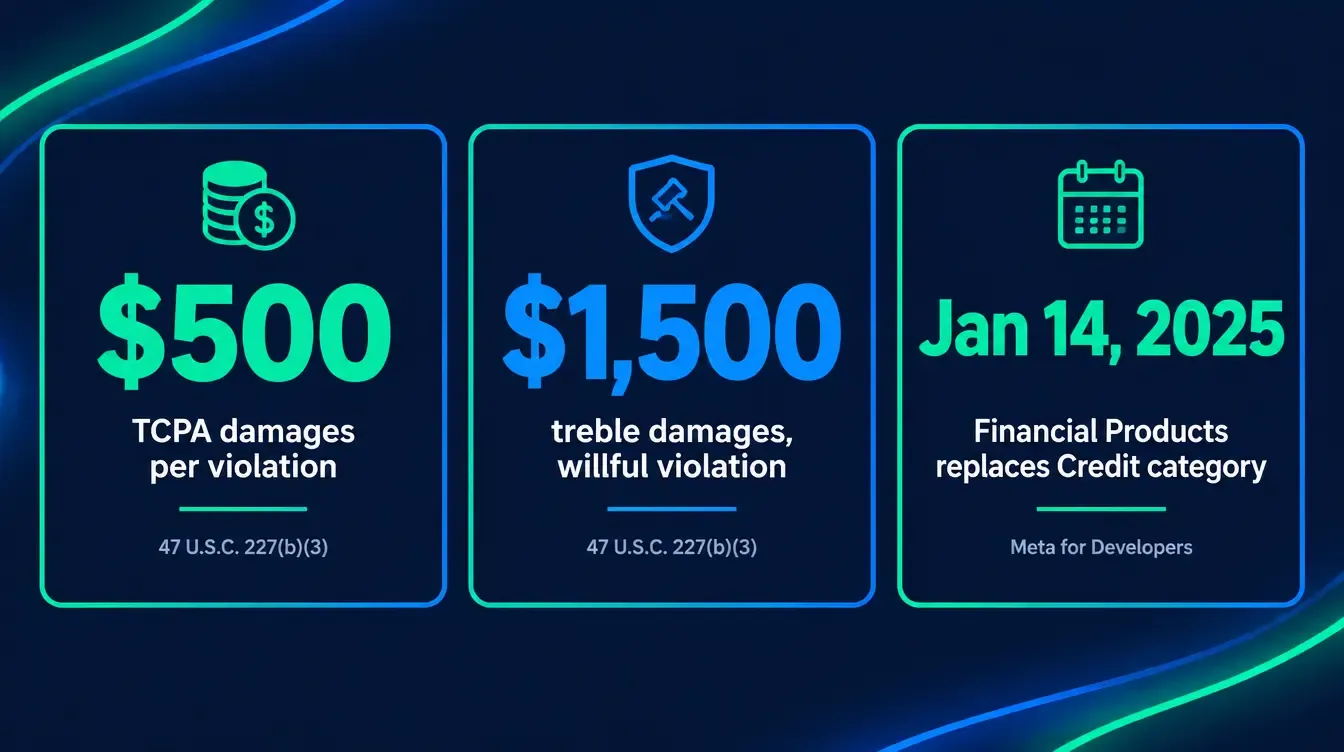
These figures don’t predict what any specific agent will owe — nobody can tell you that from a blog post, and anyone who does is guessing. What they establish is the scale of the exposure per contact, not per campaign. Under the TCPA’s private right of action, a consumer can recover “$500 in damages for each such violation, whichever is greater” than actual monetary loss, and if the court finds the violation “willfully or knowingly” committed, it may “increase the amount of the award to an amount equal to not more than 3 times the amount available” — $1,500 at the $500 baseline (47 U.S.C. § 227(b)(3), via Cornell Law’s U.S. Code). Each call and each text is its own violation. A follow-up sequence of four texts to a list where the consent record doesn’t actually cover texting isn’t one exposure, it’s potentially four, multiplied by however many leads were on that list with the same bad checkbox behind them.
The checkbox either names the method, the number, and the seller — or it's four sentences short of being consent at all.
Mike MooreThere’s also a structural reason this trap is easy to fall into right now. A separate FCC rule that would have required a lead buyer to get individual, one-to-one consent from every company a shared lead would hear from — instead of one blanket agreement covering a list of partners — was vacated by a federal appeals court before it ever took effect. The Eleventh Circuit “struck down the Rule” on January 24, 2025, in Insurance Marketing Coalition, Ltd. v. FCC, No. 24-10277 (National Consumer Law Center, case summary, citing the Jan. 24, 2025 decision). That vacatur is good news if you buy shared leads — it means you’re not required to prove a separate consent record per company. It is not a green light on consent quality generally. The underlying FTC rule still requires that any agreement “evidences the willingness of the recipient of the call to receive calls… by or on behalf of a specific seller” (16 CFR 310.4(b)(1)(v)(iii), via Cornell Law’s eCFR mirror) — a lead source that names ten categories of companies instead of naming you is still a weak file, vacatur or not.
The full method: building a lead form that satisfies both reviewers
This is the complete manual process. It costs nothing and needs no tools beyond your Meta Business Manager login and a document you can edit.
Step 1: The privacy policy link Meta actually requires
Every Lead Ad with an Instant Form needs a linked privacy policy, and Meta’s terms make clear that maintaining it and honoring it is on you: the agreement requires you to honor “any consents or additional terms and conditions agreed to by the Meta user (including any privacy policy you link to),” and you must have “appropriate technical and organizational measures to protect Lead Generation Data” once you receive it (Meta, Lead Ad Terms). Two more terms worth knowing before you build the form: you “may not sell Lead Generation Data under any circumstances,” and if you use the data “for any purpose other than to provide the service associated with the call-to-action” of the ad, you need to obtain consent for that separately (Meta, Lead Ad Terms). If your plan is “capture the lead for this quote request, then also add them to a general newsletter,” that second use needs its own disclosed consent — it isn’t automatically covered by the first checkbox.
Your privacy policy doesn’t need to be insurance-specific if you already have one, but it does need to actually describe what this form collects and how you use it. A generic boilerplate policy that never mentions phone numbers, Meta, or marketing contact doesn’t cover a lead form that collects a phone number specifically so you can call it.
Step 2: The consent statement that actually names what it authorizes
This is the piece most forms are missing. Based directly on what 47 CFR 64.1200(f)(9) and 16 CFR 310.4(b)(1)(v) require an agreement to contain, here is a template consent statement built from those exact elements — not polished marketing copy, deliberately explicit:
Consent statement template — adapt the bracketed fields, verify with your own counsel
"By checking this box, I agree that [Agent/Agency Legal Name] may contact me at the phone number I provided above by call, text message, and/or prerecorded voice message, including through the use of automated dialing technology, to discuss [Medicare/ACA/life insurance] products and services. I understand this consent is not required as a condition of purchasing any product or service, that message and data rates may apply, and that I can revoke this consent at any time by replying STOP or by contacting [Agent/Agency Name] directly at [phone/email]. My electronic submission of this form serves as my signature to this agreement."
Run that template against the regulatory checklist and every required element is present on purpose: it names the specific seller (your legal name, not “our partners”), it names the contact methods (call, text, prerecorded voice), it names the exact number being authorized (the one just entered above the checkbox), it discloses that consent isn’t a purchase condition, and the final sentence addresses the signature requirement, which the rule explicitly allows in electronic form “to the extent that such form of signature is recognized as a valid signature” under federal or state law (47 CFR 64.1200(f)(9)(ii), via Cornell Law’s eCFR mirror).
This is a template, not a legal opinion on your specific form. State consent and recording laws vary, and your own counsel or compliance reviewer should sign off on the final wording before it goes live — that review step matters more than any single word choice.
Step 3: Make the checkbox opt-in, not pre-checked
The FTC’s rule requires the agreement be obtained “without requiring, directly or indirectly, that the agreement be executed as a condition of purchasing any good or service” (16 CFR 310.4(b)(1)(v)(ii), via Cornell Law’s eCFR mirror). A pre-checked box the lead has to actively uncheck to opt out reads as exactly the kind of indirect pressure that clause is written against — build it unchecked, and require the lead to actively check it.
Step 4: Don’t let one checkbox cover methods you haven’t disclosed
If your consent statement says “call and text” but your actual follow-up plan includes a prerecorded voicemail drop sequence, you’re using a method the lead never specifically authorized. The FTC’s rule requires the agreement disclose “that the purpose of the agreement is to authorize the seller to place prerecorded calls” (16 CFR 310.4(b)(1)(v)(i), via Cornell Law’s eCFR mirror) — if prerecorded voice is part of your workflow, it has to be named, not assumed to be covered by “contact me.”
| Required element | Source | Common mistake |
|---|---|---|
| Names the specific seller | 16 CFR 310.4(b)(1)(v)(iii) | "Our partners" or "companies like us" instead of your legal name |
| Names the contact method (call/text/prerecorded) | 47 CFR 64.1200(f)(9) | "Contact me" with no method named |
| States the phone number covered | 47 CFR 64.1200(f)(9) | Consent text detached from the phone field it authorizes |
| Discloses signing is not a purchase condition | 47 CFR 64.1200(f)(9)(i); 16 CFR 310.4(b)(1)(v)(ii) | Omitted entirely, or box pre-checked by default |
| Signature (electronic is acceptable) | 47 CFR 64.1200(f)(9)(ii) | No statement that form submission constitutes a signature |
| Linked, specific privacy policy | Meta, Lead Ad Terms | Generic site-wide policy that never mentions this form's data use |
Source: 47 CFR 64.1200(f)(9) and 16 CFR 310.4(b)(1)(v), via Cornell Law's eCFR mirror; Meta, Lead Ad Terms. Fetched October 2026.
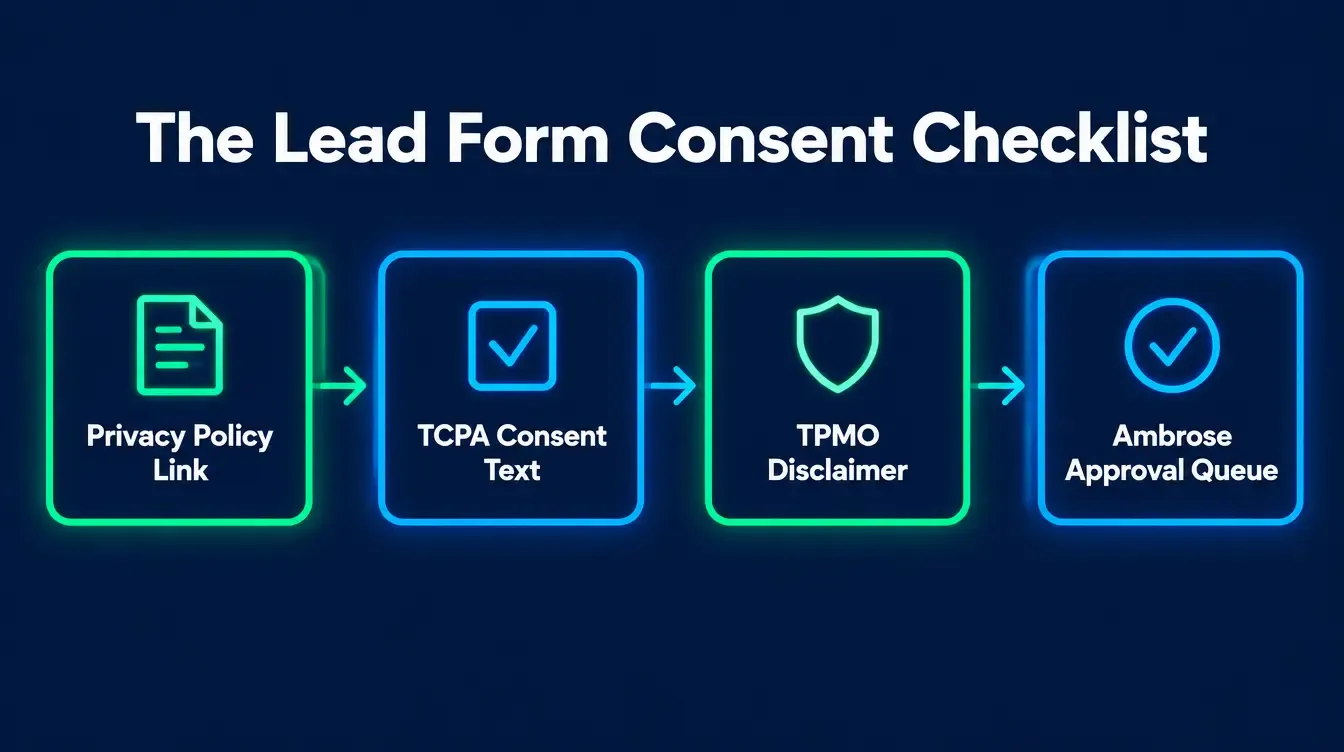
Step 5: Layer in the TPMO disclaimer if the form touches Medicare
If the ad or the landing page behind the form discusses specific Medicare Advantage or Part D plan benefits, premiums, or cost-sharing, you’re acting as a Third-Party Marketing Organization and the CMS TPMO disclaimer requirement applies — a separate obligation from both the privacy policy and the consent statement above, with its own exact wording and timing rules. We cover that wording channel by channel, including the current CY2027 timing change, in a dedicated article (see the TPMO Disclaimer 2027 post linked below). Don’t try to fold the TPMO disclaimer into the consent checkbox text — keep them as two distinct, separately labeled disclosures on the page.
Step 6: Check the account-level targeting rules too
Separate from the consent text itself, insurance ads fall under Meta’s Financial Products and Services Special Ad Category — Meta’s documentation shows the new input replacing the former Credit category on January 14, 2025, with the designation stated as required starting January 21, 2025 (Meta for Developers, Special Ad Category documentation). That classification removes lookalike audiences, saved audiences, and detailed-targeting exclusions, and Meta’s Financial and Insurance Products and Services policy separately requires that ads for insurance target people “18 years or older” and that advertisers “comply with disclosure requirements set by law” and may need to “verify their business and/or individual identity” (Meta, Financial and Insurance Products and Services Policy, Transparency Center). This is a different gate from the consent text — getting the checkbox right doesn’t exempt the campaign from the targeting and licensing rules, and getting the targeting right doesn’t exempt the checkbox from the TCPA. Our companion article on why Meta rejects insurance ads walks through the targeting side in full; this one is specifically about the words on the form itself.
A form that submits successfully isn't a form that's compliant
Meta's review checks Meta's own Advertising Standards and confirms a privacy policy link exists. It does not check whether your consent statement meets the FCC's or FTC's definition of prior express written consent. A lead form can run for months without a single Meta rejection and still generate a list of phone numbers you don't have proper consent to autodial or text. Treat the two checks as separate, because Meta's system does.
Link a specific privacy policy
Not boilerplate — one that actually names this form's data and Meta's role in delivering it.
Write the full consent statement
Name yourself, the method, the number, and that it's optional — not "I agree to be contacted."
Leave the box unchecked by default
Opt-in, not opt-out — pre-checking reads as a condition of submitting the form.
Name every method you'll actually use
If prerecorded voicemail drops are part of the plan, the consent text has to say so.
Add the TPMO disclaimer separately
For Medicare forms — its own labeled disclosure, not folded into the consent checkbox.
Confirm the Special Ad Category is set
A targeting-level requirement, independent of the consent text itself.
Everything above works whether you join anything or not. Open your live lead form right now, read the checkbox text out loud, and check it against the six-row table above.
Buying leads vs. running your own form: the consent question changes
Everything above assumes the lead filled out a form you built. A lot of agents also work shared or aggregated leads bought from a vendor, and the consent question there is different, not smaller. The vendor’s intake form is the one that had to capture compliant consent, and you weren’t in the room when it happened — you’re relying entirely on their record.
| Question | Your own lead form | Purchased or shared lead |
|---|---|---|
| Who built the consent text | You — fully in your control | The vendor or lead aggregator |
| Does it name you specifically as a seller | Yes, by design (see Step 2) | Verify — the FTC's rule requires consent evidence a specific seller "by or on behalf of," not a category of companies (16 CFR 310.4(b)(1)(v)(iii)) |
| What you can inspect before calling | The exact form text, timestamped | Only what the vendor discloses — ask for the actual consent language and the capture timestamp, not just a "TCPA compliant" label |
| Who's exposed if the consent is bad | You, and only you | You, even though you didn't write the form — a court doesn't care that you bought the list in good faith |
A vendor labeling a list “TCPA compliant” isn’t a safe harbor. Ask for the actual consent language the lead agreed to and the date it was captured before you ever dial. If a vendor won’t produce that, treat the list the same way you’d treat a lead form missing elements from the Step 4 table — because from a consent standpoint, that’s exactly what it might be. Our companion guide on vetting an insurance lead vendor walks through that screening process in full.
What the consent text can’t fix: reassigned numbers and revocation
A perfect consent statement still only covers one thing: the person who actually typed that phone number into your form and checked the box. Cell numbers get reassigned to new subscribers, and a written agreement from the original lead doesn’t transfer to whoever has that number now. There’s no checkbox wording that solves this — the practical fix is a habit, not a sentence: before a number you haven’t contacted in a while gets added to a new autodialed or text sequence, a quick check for signs the number’s changed hands (a new name on caller ID, a “wrong number” reply, a disconnected-and-reassigned signal) is worth the sixty seconds it takes.
Revocation works the same way — it has to be honored the moment it happens, by whatever method the lead uses to make it, not just the “reply STOP” channel named in your consent text. If someone says “stop calling me” on a live call, that’s a revocation, full stop, regardless of what the written agreement said about texting specifically. The federal rules around how a business can structure its revocation process have been moving — our dedicated TCPA rules article tracks the current state of the FCC’s revocation requirements in full, including the designated-method and “revoke all” provisions working through the rulemaking process right now. The point for a lead form specifically: build the consent text to make opting out easy and unambiguous, and treat every channel a lead uses to say stop as valid, not just the one you expected.
If you’re already running leads on the old checkbox text
Don’t tear down the campaign. First, pull your current consent statement and score it against the table in Step 4 above — most forms are missing two or three elements, not all six. Second, update the live form’s text going forward; this fixes consent for every new lead from this point on, but it doesn’t retroactively create consent for leads already captured under the old wording. Third, for the existing list, treat it the way you’d treat an aged list with uncertain consent: a reconfirmation message that discloses the method and asks for an affirmative response is a more defensible path than continuing to autodial or text numbers under consent language that was missing required elements, especially a list you plan to run a multi-touch Medicare or ACA follow-up sequence against. A reconfirmation doesn’t need to be complicated — a single message naming yourself, the method, and asking for a clear yes is more defensible than silence read as consent: “This is [Name] with [Agency]. I’d like to text you about [Medicare/ACA/life] options — reply YES to confirm or STOP to opt out.” Log the replies the same way you’d log any consent record, with a date.
How Ambrose fits into this, and what it doesn’t do
Be specific about the actual boundary here, because overstating it is exactly the kind of claim that erodes trust in a compliance-adjacent article: no tool, Ambrose included, gives legal sign-off on your consent language. The regulatory judgment calls — whether a specific sentence satisfies your state’s rules on top of the federal baseline, whether a particular follow-up cadence counts as one violation or several — are legal questions for your own counsel or compliance reviewer, not a product feature.
What’s documented is narrower and still useful. Every agent and team inside Ambrose shares one contact history and one approval queue (Ambrose docs, What Is Ambrose) — the same review mechanism this site’s TPMO disclaimer article describes for call scripts and messages can sit in front of a lead form’s consent and privacy text too, so the wording gets a second set of eyes before it goes live instead of running untouched for months because nobody thought to recheck it. And once a lead comes in, the lead-memory spoke keeps a per-lead dossier (Ambrose docs, Spokes catalog) — not a legal record of what consent language was live at the moment of submission, which isn’t a confirmed feature of that spoke today, but a place the lead’s history lives instead of being scattered across a CRM export, a spreadsheet, and someone’s memory. If a consent question comes up on a specific lead six months from now, having one place to look beats reconstructing the timeline from three systems.
The honest version of this section
Writing a compliant consent statement and reviewing it is a human-plus-checklist job right now, membership or not — the template and table above are the actual method. What the community adds isn't a tool that certifies your wording; it's people who've had their own forms reviewed and can tell you what a compliance reviewer actually flags before a plaintiff's attorney does.
What you get by joining
One Ambrose seat comes with a Tech Savvy Insurance membership: $97 a month, billed monthly, cancel anytime, founding rate locked in while the membership stays active. Alongside the seat: weekly Zoom calls with open Q&A and build-with-you sessions, 30-plus hours of recorded training, Meta Ads and marketing training built for this industry specifically, pre-built AI templates and bot deployments, and a free annual in-person member workshop — plus an explicit no-recruiting rule, so a question about a consent checkbox doesn’t turn into someone else’s downline pitch.
Ambrose usage is separate from the $97 seat
The membership includes one Ambrose seat; usage inside Ambrose runs through its own credit ledger with spend caps, so cost stays visible instead of showing up as a surprise. See the full Spokes catalog for what lead-memory sits alongside.
Fix the checkbox before the next campaign, not after a demand letter
The template and table above work whether you ever join anything or not. If you'd rather have a second set of eyes on your actual form — and a room that's had this exact conversation before — one Ambrose seat comes with the Tech Savvy membership.
Join Tech Savvy — $97/monthThe close
The consent statement template, the six-row checklist, and the privacy policy requirements above work whether you join anything or not — go update your live form this week. This is exactly the kind of line-by-line review the community works through on a Tuesday call: someone pastes their actual checkbox text, and the room points at what’s missing before it becomes a demand letter instead of after. $97 a month, cancel anytime, and nobody will pitch you a downline: https://techsavvyinsurance.com/.
Before you publish a lead form
Tech Savvy Insurance is a training and software community, not an insurance company, agency, or law firm, and does not provide insurance, legal, tax, or compliance advice. The consent language in this article is a template built from the text of 47 CFR 64.1200 and 16 CFR 310.4 — it is not a legal opinion on your specific form, and you are responsible for your own licensure and for complying with all applicable CMS, FCC, FTC, state, carrier, and platform rules, including the TPMO disclaimer where it applies. Have your own counsel or compliance reviewer sign off on your final wording. AI-drafted consent or privacy text may contain errors — always verify. Results may vary.
Frequently asked questions
Sources
- Meta — Lead Ad Terms — facebook.com
- Meta — Financial and Insurance Products and Services Policy (Transparency Center) — transparency.meta.com
- Meta for Developers — Special Ad Category Documentation — developers.facebook.com
- Cornell Law School, Legal Information Institute — 47 CFR 64.1200(f)(9), Prior Express Written Consent (eCFR mirror) — law.cornell.edu
- Cornell Law School, Legal Information Institute — 16 CFR 310.4, Telemarketing Sales Rule (eCFR mirror) — law.cornell.edu
- Cornell Law School, Legal Information Institute — 47 U.S.C. § 227(b)(3), TCPA Private Right of Action — law.cornell.edu
- National Consumer Law Center — Insurance Marketing Coalition, Ltd. v. FCC, No. 24-10277 (11th Cir., Jan. 24, 2025) — nclc.org
- NAIC — Insurance Topics: Artificial Intelligence (Model Bulletin) — content.naic.org
- Ambrose docs — What Is Ambrose — app.hiambrose.com
- Ambrose docs — Spokes catalog — app.hiambrose.com
Ready to put this into practice?
Join a private community of Health & Life insurance professionals using AI, Meta Ads, and automation to grow — without draining their bank account.
Join Tech Savvy — $97/month