
A client calls you in week two of AEP. They joined a Medicare Advantage plan the day they turned 65 last March, hated the network, and want out — back to Original Medicare with a Medigap plan behind it. You tell them “no problem, you’re guaranteed issue, nobody can turn you down.” That sentence is sometimes true, sometimes true but about to expire, and sometimes flatly wrong depending on one thing: the exact date their Medicare Advantage coverage ends, measured against a 60-day-before, 63-day-after window that most agents have never actually counted out on a calendar.
A Medigap guaranteed issue right exists when federal law or your state’s own rules require an insurer to sell you a Medigap policy, cover your pre-existing conditions, and not charge you more for your health — and it only applies in specific, time-limited situations, the biggest one being the Medicare Advantage “trial right.” Outside those windows, the carrier can medically underwrite the application, which means it can ask health questions and legally deny the policy or charge more based on the answers. Get the window wrong and you’ve told a client they have a right they don’t have, right before a carrier’s underwriter tells them the same thing in writing.
Key takeaways
- There are two separate Medicare Advantage "trial rights," and agents routinely conflate them: first-timer-at-65 switching back within 12 months, and Medigap-holder-tried-MA switching back within 12 months.
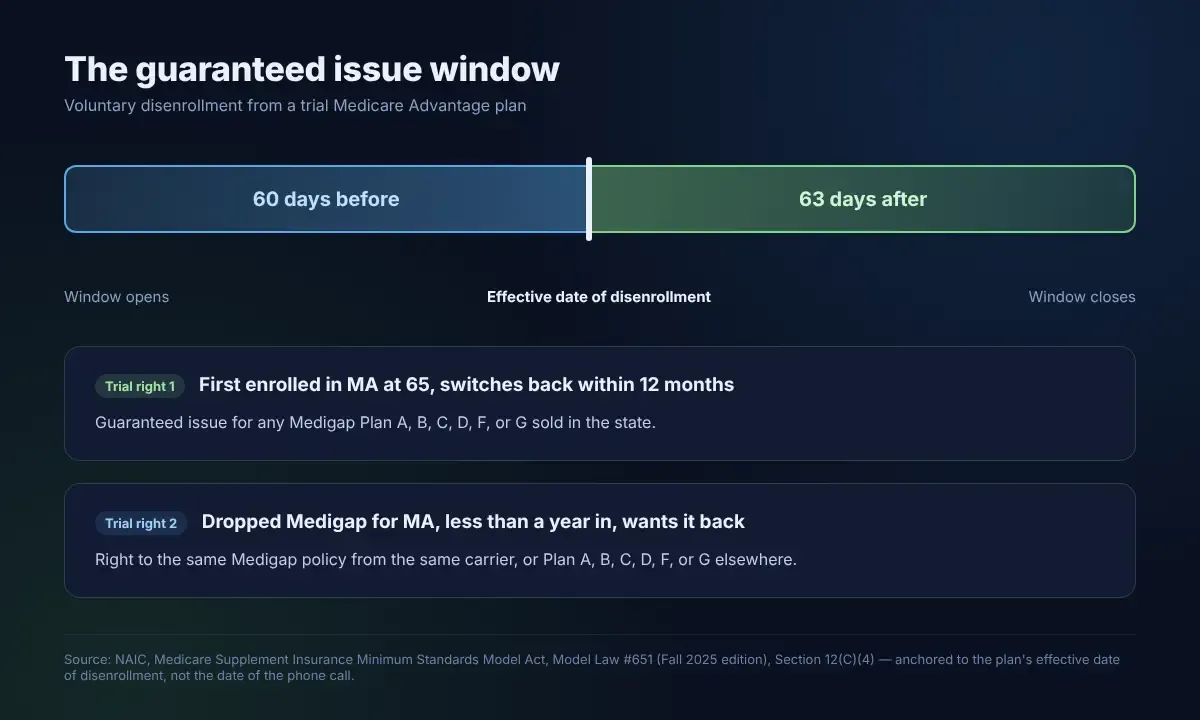
- The standard guaranteed issue window for a voluntary disenrollment runs 60 days before the effective date of disenrollment to 63 days after it — not 63 days from the phone call (NAIC Model Law #651).
- If the trial MA plan is involuntarily terminated within 12 months, a same-day re-enrollment in another MA plan can still count as the "initial" enrollment for trial-right purposes.
- 90% of Medicare Advantage enrollees 65+ — about 22.4 million people as of 2022 — have no guaranteed issue protection beyond their initial trial period, per KFF.
- Massachusetts, Minnesota, and Wisconsin have their own guaranteed-issue frameworks with differently standardized plans; separately, five states (CT, NY, MA, ME, and now MN) extend guaranteed issue beyond the federal list, with Minnesota's new age 65-70 window effective August 1, 2026.
- Before you tell a client they're guaranteed issue, verify the exact trigger and the exact date against the primary source — not against what you remember from last AEP.
What a Medigap guaranteed issue right actually means
Guaranteed issue rights, which the official CMS/NAIC consumer guide also calls “Medigap protections,” are your right to buy certain Medigap policies in limited situations outside your Medigap Open Enrollment Period. In those situations, an insurance company must sell you a policy, must cover all your pre-existing health conditions, and can’t charge you more for a policy because of past or present health problems (CMS & NAIC, Choosing a Medigap Policy, 2026 edition, Section 3).
That’s the whole deal, and it’s the opposite of what happens the rest of the time. Outside a guaranteed issue window — and outside the one-time, six-month Medigap Open Enrollment Period that starts the month someone turns 65 and enrolls in Part B — a carrier selling Medigap in most states is free to medically underwrite the application. Medical underwriting means the carrier can ask about diagnoses, medications, and treatment history, and can use the answers to deny the application entirely, approve it with a higher premium, or in some states apply a waiting period for a pre-existing condition. The guide itself lists this as a factor that affects what a Medigap policy costs: “Uses medical underwriting or charges a different premium when you don’t have a guaranteed issue right or aren’t in a Medigap Open Enrollment Period” (CMS & NAIC, 2026 edition, p.13).
So “guaranteed issue” isn’t a general Medigap feature. It’s a specific legal trigger tied to a specific event, and the trigger has to actually be true for the specific client in front of you, on the specific date you’re having the conversation.
This is a compliance article about a coverage rule, not legal advice
Tech Savvy Insurance is a training and software community, not an insurance company, agency, or law firm, and nothing here is insurance, legal, tax, or compliance advice. Confirm every client's specific situation against the primary sources cited below and your own state's requirements before you tell them what they're entitled to.
The trial right is actually two different rights
This is where most of the confusion starts. Agents talk about “the trial right” like it’s one thing. The CMS/NAIC guide’s guaranteed issue table lists it as two separate rows, with two different starting points, and they get conflated constantly because both involve a client leaving a Medicare Advantage plan within a year.
Scenario 1: first-timer at 65 who tries MA, then switches to Original Medicare
Your client joined a Medicare Advantage Plan or a Program of All-Inclusive Care for the Elderly (PACE) the first time they were eligible for Medicare Part A at 65. Within the first year of that enrollment, they decide they want to switch to Original Medicare instead. They have a guaranteed issue right to buy any Medigap Plan A, B, C, D, F, or G sold by an insurance company in their state (plans C and F only if they were eligible for Medicare before January 1, 2020). This is the classic “trial right” agents mean when they say the phrase, and the guide flags it with a parenthetical “(Trial right)” right in the table (CMS & NAIC, 2026 edition, p.18).
Scenario 2: had Medigap, tried MA, wants the old coverage back
Different client, different story. This one had a Medigap policy already, dropped it to join a Medicare Advantage plan (or a Medicare SELECT policy) for the first time, has been in that plan less than a year, and now wants to go back. This client has the right to the same Medigap policy they had before, from the same insurance company, if that company still sells it. If it’s not available anymore, they can buy Plan A, B, C, D, F, or G from any insurance company in their state. The guide also marks this row “(Trial right)” (CMS & NAIC, 2026 edition, p.18).
Notice what’s different: Scenario 1 is about someone’s very first Medicare enrollment going sideways. Scenario 2 is about someone who already had Medigap, took a detour through Medicare Advantage, and wants their old coverage restored. Mixing these up matters because the “right to buy” is different — Scenario 2 gives a preference back to the original policy — and because the underlying facts you have to confirm (was this really their first-ever MA enrollment? did they have Medigap immediately before?) are different questions with different documentation.
| You have a guaranteed issue right if | You have the right to buy | You must apply |
|---|---|---|
| You have an MA plan and it's leaving Medicare, stops serving your area, you move out of the service area, or the network changes significantly — and you switch to Original Medicare | Plan A, B, C*, D*, F*, or G* sold in your state | 60 days before coverage ends, or by the termination date, or no more than 63 days after coverage ends |
| You joined an MA plan or PACE at 65, your first time eligible for Part A, and within the first year you switch to Original Medicare (Trial right) | Any Medigap policy sold in your state | 60 days before coverage ends, or no more than 63 days after; rights may extend 12 more months in certain circumstances |
| You dropped a Medigap policy to try an MA plan for the first time, less than a year ago, and want it back (Trial right) | Your old Medigap policy if still sold, otherwise Plan A, B, C*, D*, F*, or G* | 60 days before coverage ends, or no more than 63 days after; rights may extend 12 more months in certain circumstances |
| You leave an MA plan, or drop a Medigap policy, because the company broke the rules or misled you | Plan A, B, C*, D*, F*, or G* sold in your state | No more than 63 days after your coverage ends |
*Plans C and F are closed to anyone newly eligible for Medicare on or after January 1, 2020; those consumers get Plan D or G instead. Source: CMS & NAIC, Choosing a Medigap Policy, 2026 edition, Section 3, pp.17–18.
The 63-day clock: where agents actually get the date wrong
Here’s the mechanical detail that trips people up, and it comes straight from the model statute, not the consumer-facing summary. NAIC Model Law #651, the Medicare Supplement Insurance Minimum Standards Model Act that states adopt into their own insurance codes, spells out the guaranteed issue time periods in Section 12(C). For an individual who disenrolls voluntarily — which covers both Medicare Advantage trial-right scenarios above — “the guaranteed issue period begins on the date that is sixty (60) days before the effective date of the disenrollment and ends on the date that is sixty-three (63) days after the effective date” (NAIC, Model Law #651, Fall 2025 edition, Section 12(C)(4)).
Read that again slowly, because the common mistake is counting 63 days from the day the client calls you, frustrated, to complain about their plan. That’s not the anchor. The anchor is the effective date of disenrollment — the date on the carrier’s own termination notice, which can land weeks before or after the actual phone call. A client who calls you in late September already decided to leave in August is closer to the edge of their window than the calendar on your desk suggests. A client who’s still inside their MA plan and planning to leave effective January 1 is actually already inside their 60-day “before” window and can apply for Medigap right now, before the MA coverage even ends — which matters during AEP, when you’d otherwise tell them to wait.
Worked example: a client’s Medicare Advantage termination notice states an effective disenrollment date of November 30. Under the voluntary-disenrollment formula, their guaranteed issue window opens October 1 (60 days before November 30) and closes February 1 (63 days after November 30). If that same client calls you on December 15 asking whether it’s “too late,” the honest answer is no — they’re about five weeks into a roughly four-month window — but if they call you on March 1, the window already closed a month earlier, and the conversation changes completely to what their other options are.
Involuntary disenrollment uses a different formula
Section 12(C)(2) of the model law sets a different clock for involuntary terminations (the plan leaving Medicare, leaving the area, or a significant network change): the window begins on the date the individual receives the termination notice and runs 63 days past the date coverage actually ends — not 60 days before. Don't apply the voluntary-disenrollment math to an involuntary termination; confirm which trigger row actually applies before you count anything.
The edge case almost nobody checks: an interrupted trial period
This is the detail that separates an agent who read the consumer guide from one who read the actual model statute. Section 12(D) of NAIC Model Law #651, titled “Extended Medigap Access for Interrupted Trial Periods,” covers what happens when a client’s trial Medicare Advantage enrollment doesn’t end because the client chose to leave — it ends because the plan itself folded, left the county, or was otherwise involuntarily terminated, within that first 12 months.
The provision says that if the enrollment “is involuntarily terminated within the first twelve (12) months of enrollment, and who, without an intervening enrollment, enrolls with another such organization or provider, the subsequent enrollment shall be deemed to be an initial enrollment” for trial-right purposes (NAIC, Model Law #651, Section 12(D)(1)). In plain terms: if your client’s first MA plan pulls out of their county in month seven, and they immediately enroll in a different MA plan without a gap, the clock on their trial right doesn’t necessarily restart from zero and it doesn’t necessarily burn out either — the new enrollment can still count as the original “first-time” enrollment for figuring out whether they’re still inside a trial-right window later.
That re-deeming isn’t unlimited, though. Section 12(D)(3) caps it: no enrollment can be deemed an “initial enrollment” under this interrupted-trial provision more than two years after the date the client first enrolled with the original plan (NAIC, Model Law #651, Section 12(D)(3)). A client who’s been bounced between exiting Medicare Advantage plans for three years running has aged out of this particular fix, even if each individual transition was involuntary and gap-free.
Most agents have never read this section, because it doesn’t appear in the consumer-facing CMS/NAIC guide — it’s only in the model statute itself. It matters every single AEP, because plan exits and service-area reductions are exactly the kind of event that puts a client into this interrupted-trial situation without anyone involved realizing there’s a specific rule for it.
The other guaranteed issue triggers worth knowing cold
The trial rights get the attention, but the federal minimum guaranteed issue list covers more ground than just Medicare Advantage. A client also gets a guaranteed issue right if: their Medicare Advantage plan is leaving Medicare entirely, stops offering care in their area, or they move out of its service area, and they switch to Original Medicare; they have Original Medicare plus an employer group health plan (including retiree or COBRA coverage) that’s ending; they have a Medicare SELECT policy and move out of its service area; their Medigap insurer goes bankrupt or insolvent; or they leave a plan or drop a policy because the company didn’t follow the rules or misled them (CMS & NAIC, 2026 edition, Section 3, pp.17–18). Every one of these has its own version of the 60-day/63-day math, and the “misled you” trigger in particular is worth remembering, because it’s the one that can rescue a client who’s otherwise outside every other window.
Why the state matters more than the federal rule does
Everything above is the federal floor — the minimum every state has to provide. States can, and several do, provide more. The CMS/NAIC guide specifically calls out that “if you live in Massachusetts, Minnesota, or Wisconsin, you have guaranteed issue rights to buy a Medigap policy, but the Medigap policies are different” from the standard lettered plans sold elsewhere (2026 edition, p.15; plan details in Section 7, pp.33–36). That’s a real, named, federally-documented fact about those three states specifically.
Separate from that, a 2024 KFF analysis of state insurance regulations found that beyond the federal minimum trigger list, four states require insurers to offer continuous or annual guaranteed issue Medigap to all beneficiaries 65 and older: Connecticut and New York require continuous guaranteed issue year-round, Massachusetts requires an annual guaranteed issue window (February 1 through March 31), and Maine requires a one-month annual window limited to Plan A (KFF, Freed et al., October 18, 2024). There’s a fifth, newer, and narrower one worth flagging because of its timing: Minnesota enacted its own annual guaranteed issue period, limited to ages 65 to 70, that took effect August 1, 2026 — about ten weeks before this article was written (KFF, October 18, 2024, describing the then-upcoming law). It only runs once, during the October 15 to December 7 Medicare open enrollment window, and insurers are allowed to surcharge applicants who use it, which is the rate-up schedule covered in the cost section below. The other 36 states hold both agents and clients to the federal minimum described above — meaning for the vast majority of your book, the trigger list in the table earlier in this article is the entire menu, full stop.
| Category | States | What it adds beyond the federal list |
|---|---|---|
| Continuous guaranteed issue | Connecticut, New York | Insurers must issue a Medigap policy to an eligible applicant at any time, year-round, not just during a triggering event |
| Annual guaranteed issue window | Massachusetts | A guaranteed issue window every year, February 1 through March 31, regardless of a triggering event |
| Limited annual window | Maine | A one-month annual guaranteed issue window, limited to Plan A only |
| Narrow age-banded window (new) | Minnesota | An annual guaranteed issue period for ages 65 to 70 only, usable once, Oct. 15 to Dec. 7, with insurers permitted to surcharge the applicant; effective August 1, 2026 |
| Federal minimum only | The remaining 36 states | Nothing beyond the trigger list in the CMS/NAIC guide; outside a listed trigger, medical underwriting applies |
That overlap is worth sitting with for a second: Massachusetts and Minnesota each show up on both lists, but for different reasons. The CMS/NAIC guide’s note about Massachusetts and Minnesota is about differently standardized plan design; KFF’s finding about Massachusetts is about its separate annual guaranteed-issue window open to all beneficiaries 65+, while KFF’s finding about Minnesota is a narrower, newer, age-banded window that didn’t exist when the CMS/NAIC guide’s “different plan design” note was written. Wisconsin appears in the federal guide’s “different plan design” group but not in the “extra guaranteed issue” group at all. Treating “MA, MN, WI” and “CT, NY, MA, ME, MN” as interchangeable is exactly the kind of mix-up that gets an agent confidently wrong in front of a client. It’s also a different rule entirely from the Medigap-to-Medigap birthday rule, which lets an existing Medigap holder switch to an equal-or-lesser plan once a year in states that have one — that’s about moving between Medigap plans, not about a guaranteed issue right to buy Medigap after Medicare Advantage.
Always check the state, not just the federal list
Before you tell a client what their rights are, confirm whether their state adds anything to the federal minimum. The NAIC maintains a directory of every state insurance department, and the CMS/NAIC guide points to it directly for exactly this reason. A client's State Health Insurance Assistance Program (SHIP) can also confirm state-specific rights; find the number at shiphelp.org.
What it actually costs to get this wrong
The number that should change how carefully you handle this: KFF’s analysis found that 90% of Medicare Advantage enrollees age 65 and older — about 22.4 million people as of 2022 — have no guaranteed issue protection for a Medigap policy beyond their initial trial period (KFF, Freed, Ochieng, Cubanski & Neuman, October 18, 2024). That’s not a niche edge case. It’s the default outcome for the large majority of the Medicare Advantage population once their trial window closes. If an agent tells a client “don’t worry, you can always switch to Medigap later” without that caveat, nine times out of ten, “later” means medical underwriting, not guaranteed issue.
And underwriting outcomes aren’t binary approve-or-deny in every state. Minnesota’s new age 65-70 guaranteed issue window, effective August 1, 2026, isn’t free of cost the way Connecticut’s or New York’s continuous guaranteed issue is: insurers are permitted to charge applicants who use it 15% more than the standard community rate starting in 2026, rising 5 percentage points a year through 2030, when the maximum penalty reaches 35%, in effect for the life of the policy (KFF, October 18, 2024, describing Minnesota’s then-upcoming 2026 law). As a hypothetical, not a quoted rate: run that surcharge schedule on a $180/month Plan G premium and a Minnesota client using this new window isn’t getting the same deal as a Connecticut client using continuous guaranteed issue — they could be looking at an extra $27 a month in year one, climbing toward an extra $63 a month by 2030, just for using the new path at all.
A trial right that expires unused isn't a missed discount. It's the difference between a client who gets any Medigap policy they want and a client who finds out, in writing, exactly which of their conditions the underwriter doesn't like.
— What the 90% figure means for the client sitting across from you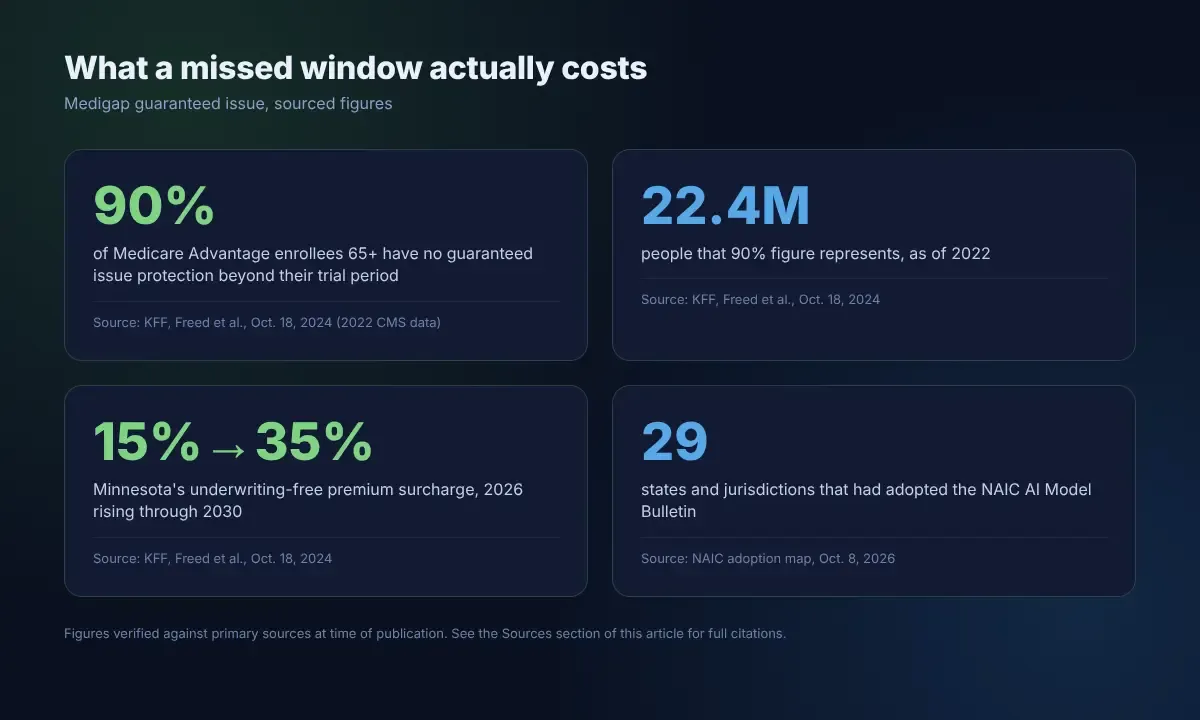
How to verify eligibility before you say the words "guaranteed issue"
None of this requires software. It requires five steps, done in order, every time, before you make a promise to a client:
- Identify the exact trigger. Is this client’s situation actually one of the rows in the guaranteed issue table above — plan leaving Medicare, service-area move, network change, trial right scenario 1, trial right scenario 2, insurer insolvency, or misled/rules violation? If it doesn’t match a row, there’s no federal guaranteed issue right, full stop, regardless of how unhappy the client is with their plan.
- Get the actual effective date, not the complaint date. Pull the carrier’s termination notice or disenrollment confirmation. That document has the effective date of disenrollment, and that date — not today’s date, not the date of your call — is the anchor for every deadline calculation.
- Apply the right formula. Voluntary disenrollment: 60 days before the effective date to 63 days after. Involuntary disenrollment: from the date the notice was received to 63 days after coverage ends. Don’t use one formula for the other.
- Check the interrupted-trial exception. If the client’s first MA enrollment ended because the plan pulled out, not because the client chose to leave, and they re-enrolled without a gap, check whether Section 12(D)‘s extended-access provision applies before assuming the trial right is gone.
- Check the state. Confirm whether the client’s state adds anything beyond the federal list, using the NAIC’s state insurance department directory or the client’s SHIP contact. A client in Connecticut or New York has options a client in Ohio simply doesn’t.
That’s the entire manual process, and it works with nothing but the CMS/NAIC guide, a copy of the model statute (or your state’s enacted version of it), and the carrier’s own termination paperwork. If you can do steps one through five by hand for one client, you can do them for every client in your book who’s inside a Medicare Advantage trial window right now, during this exact AEP — the same way you’d work through re-shopping your Medicare book before AEP for plan changes generally, just with guaranteed issue dates instead of benefit changes as the thing you’re checking.
Where Ambrose fits: a second opinion instead of a solo guess
The honest problem with the five-step process above isn’t that it’s hard — it’s that most agents run it alone, from memory, at the end of a long AEP day, without anyone checking the work. That’s the gap the War Room inside Ambrose, the platform included with a Tech Savvy membership, is built for. The War Room, covered in more depth in our guide to an AI executive team for agencies, is a fixed roster of nine personas — a Chief of Staff plus CMO, COO, CTO, CFO, CRO, CCO, Research, and a dedicated Compliance persona, Dr. Elena Reyes. You type the question in plain English, the Chief of Staff reads it and routes it to the right head, and that head can dispatch its own sub-specialists for deeper work (Ambrose docs, War Room).
Instead of being the only person in the room deciding whether a specific client’s disenrollment date puts them inside or outside a 63-day window, you ask the room: “Client disenrolled from [plan] effective [date], first MA enrollment at 65, wants Medigap — what’s their guaranteed issue status and window?” The Compliance persona is the one built to take that question, and because every read and write inside Ambrose carries “the acting agency id, resolved from the session on the server and never from user or model input,” with “Postgres row level security” enforcing it underneath, so a prompt can’t talk its way into another agency’s rows — you’re not sending the question into a general-purpose tool with no accountability for getting it right (Ambrose docs, PHI Rail architecture, per-agency isolation). That’s the comparison that matters: the manual five-step process above works, and it’s genuinely usable without joining anything — but running it by yourself, uncross-checked, on a deadline, during AEP is exactly where a second set of eyes earns its seat.
What Ambrose does not do here
Ambrose doesn't replace reading the primary source, and this article's War Room example is a compliance second opinion, not an automated eligibility calculator — we haven't confirmed a dedicated trial-right date tool in the current Ambrose docs, so we're not claiming one exists. The value is a documented second check on your own math, run inside your agency's own tenant, not a black box verdict.
What not to paste into a general AI tool to answer this
Agents are already using AI to sanity-check questions like this, and the instinct is fine — the method is where it goes wrong. Asking ChatGPT or a similar consumer AI tool “what is a Medigap trial right” is no different than asking it to define a term; nothing identifiable about a client is involved. The problem starts the moment you paste in a specific client’s enrollment dates, diagnoses, or plan history to get a determination, because that’s protected health information going to a destination with no Business Associate Agreement and no accountability for the answer it gives back.
The NAIC’s AI Model Bulletin, adopted by 29 jurisdictions as of October 8, 2026 with four more states applying insurance-specific AI regulation or guidance on top of that (NAIC, implementation map, status as of October 8, 2026), sets the expectation that flows down to agencies even where it isn’t yet formally adopted: a written policy on how AI gets used, human review of AI output before it reaches a client decision, and documentation you could produce if a carrier or regulator asked how a determination was made. Applying that same discipline here means verifying the rule against the primary source yourself, and keeping any client-specific PHI out of a tool that isn’t built to hold it. Ambrose’s architecture is built specifically for this: the phi-gateway spoke scrubs the HIPAA identifiers out of a payload before it goes anywhere, checks whether the destination is on a Business Associate Agreement allowlist, and re-hydrates the real values only on the way back into your own session — documented as a “PHI scrubber + re-hydrator” with phi_scrub, phi_check_baa, and phi_rehydrate as its actual tools (Ambrose docs, spoke-phi-gateway). Separately, the PHI Rail “only runs against model providers covered by a signed Business Associate Agreement” — in practice, the docs say, that’s Claude running through Amazon Bedrock in US regions (Ambrose docs, PHI Rail architecture) — two confirmed layers, not a marketing line.
The TPMO note, if this comes up mid-sales-call
If this guaranteed issue conversation happens inside what CMS classifies as a marketing or sales appointment — discussing specific Medicare Advantage, Part D, or Medicare Supplement plan benefits with the intent to sell — the standard Third-Party Marketing Organization (TPMO) disclaimer and the CMS Medicare Communications and Marketing Guidelines still apply, exactly as they would for any other part of that call. Nothing about the guaranteed issue analysis changes those requirements, and nothing about using AI to help you think through the rule changes them either. Always verify your current disclosure language and call-recording obligations against the live CMS guidelines rather than this article, since marketing rules are revised on their own schedule.
What you get
A Tech Savvy membership is $97 a month, billed monthly, cancel anytime, with the founding rate locked in while the membership stays active. It includes weekly Zoom calls, more than 30 hours of recorded training on Meta Ads, AI, marketing, and sales, pre-built AI templates and bot deployments, a free annual in-person member workshop, and one Ambrose seat — the platform behind the War Room example above. It’s also an explicit no-recruiting-zone: no downline pitches, no “build your team” messaging, which is not the norm in agent Facebook groups and Medicare mastermind communities, and it’s worth saying plainly because most groups you’ll get invited to aren’t run that way.
Run the math on your own book before the window closes
One Ambrose seat, with a War Room that can take a second pass on a specific client's dates, comes with a Tech Savvy membership. Results may vary — the seat gets you a tool and a room of people, not a guarantee.
Join Tech Savvy — $97/monthEverything in the five-step manual process above works whether you join anything or not. Pull the CMS/NAIC guide, pull the model statute section for your state, check the termination date, count the window, check the state list. That’s the whole job, done right, for free. If you’d rather have a documented second opinion on your own math before AEP ends, that’s what the seat and the room are for — and nobody’s going to pitch you a downline while you’re asking.
Frequently asked questions
Sources
- CMS & NAIC — Choosing a Medigap Policy: A Guide to Health Insurance for People with Medicare (2026 edition) — medicare.gov
- NAIC — Medicare Supplement Insurance Minimum Standards Model Act (Model Law #651, Fall 2025 edition) — content.naic.org
- KFF — Medigap May Be Elusive for Medicare Beneficiaries with Pre-Existing Conditions (Freed, Ochieng, Cubanski, Neuman; October 18, 2024) — kff.org
- NAIC — State Insurance Departments directory — content.naic.org
- NAIC — Implementation of the AI Model Bulletin, state adoption map (status as of October 8, 2026) — content.naic.org
- Ambrose docs — War Room — app.hiambrose.com
- Ambrose docs — spoke-phi-gateway (PHI scrubber and re-hydrator) — app.hiambrose.com
- Ambrose docs — PHI Rail architecture (per-agency isolation, BAA-covered model routing) — app.hiambrose.com
Ready to put this into practice?
Join a private community of Health & Life insurance professionals using AI, Meta Ads, and automation to grow — without draining their bank account.
Join Tech Savvy — $97/month