
A client’s Medigap Plan G bill lands 18% higher than last year, they call you furious, and you both hit the same wall: outside a narrow list of situations, an insurer can ask health questions before it’ll sell that client a cheaper policy, and a bad answer means a decline or a higher price. The birthday rule is the one thing that reliably gets around that wall, and it works in roughly 20 states, on a window tied to the client’s own birthday, not a fixed calendar date like AEP. Miss it, and the client is stuck with the increase until next year, or forced into full medical underwriting to leave.
Key takeaways
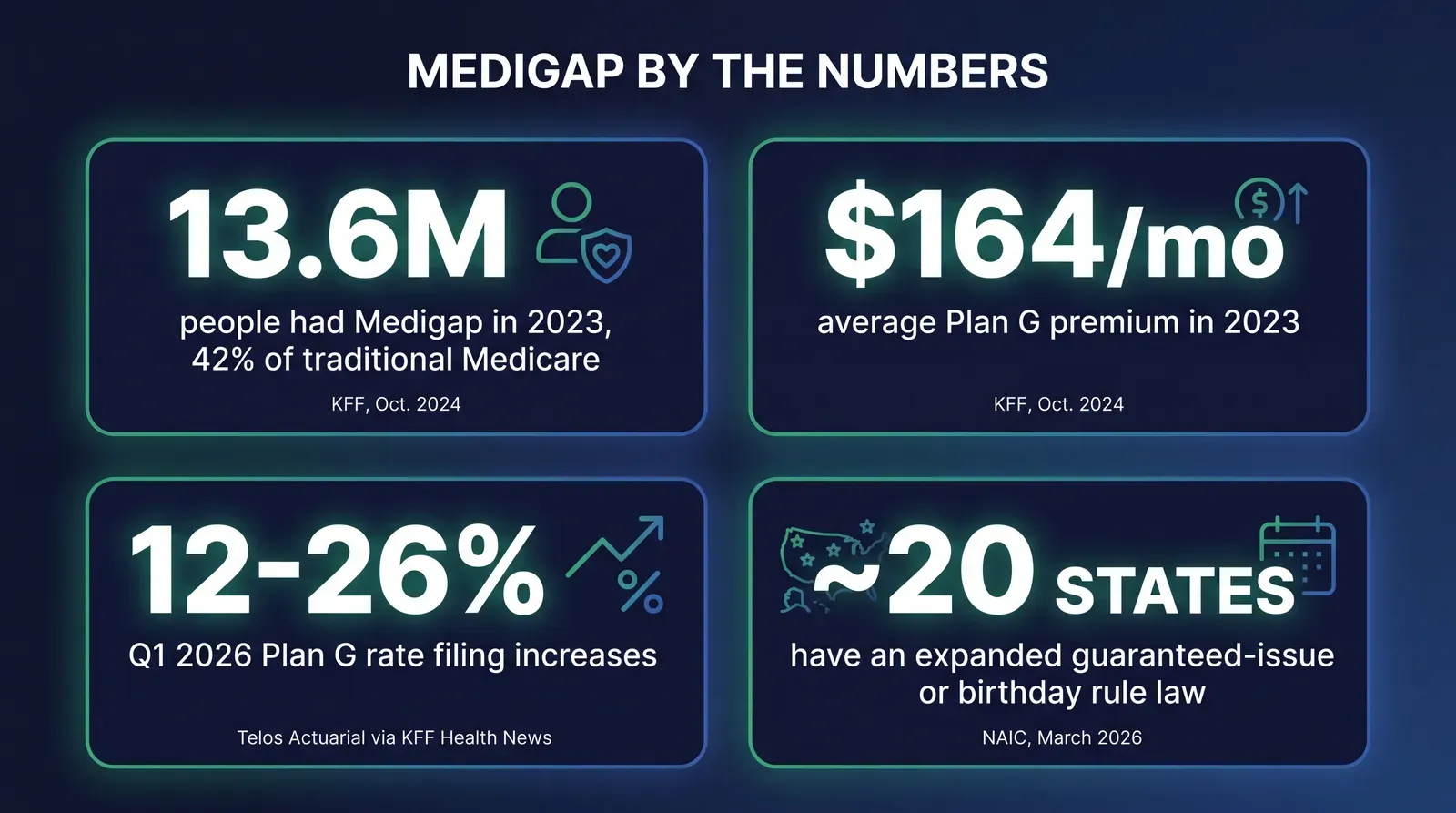
- The Medigap birthday rule is a state-law right that lets an existing policyholder switch to an equal-or-lesser Medigap plan on a window tied to their birthday, with no medical underwriting. It exists in about 20 states as of March 2026, per NAIC Senior Issues Task Force materials.
- Two states confirmed directly from primary sources here: Oregon (30 days before to 30 days after the birthday) and California (60 days or more from the birthday).
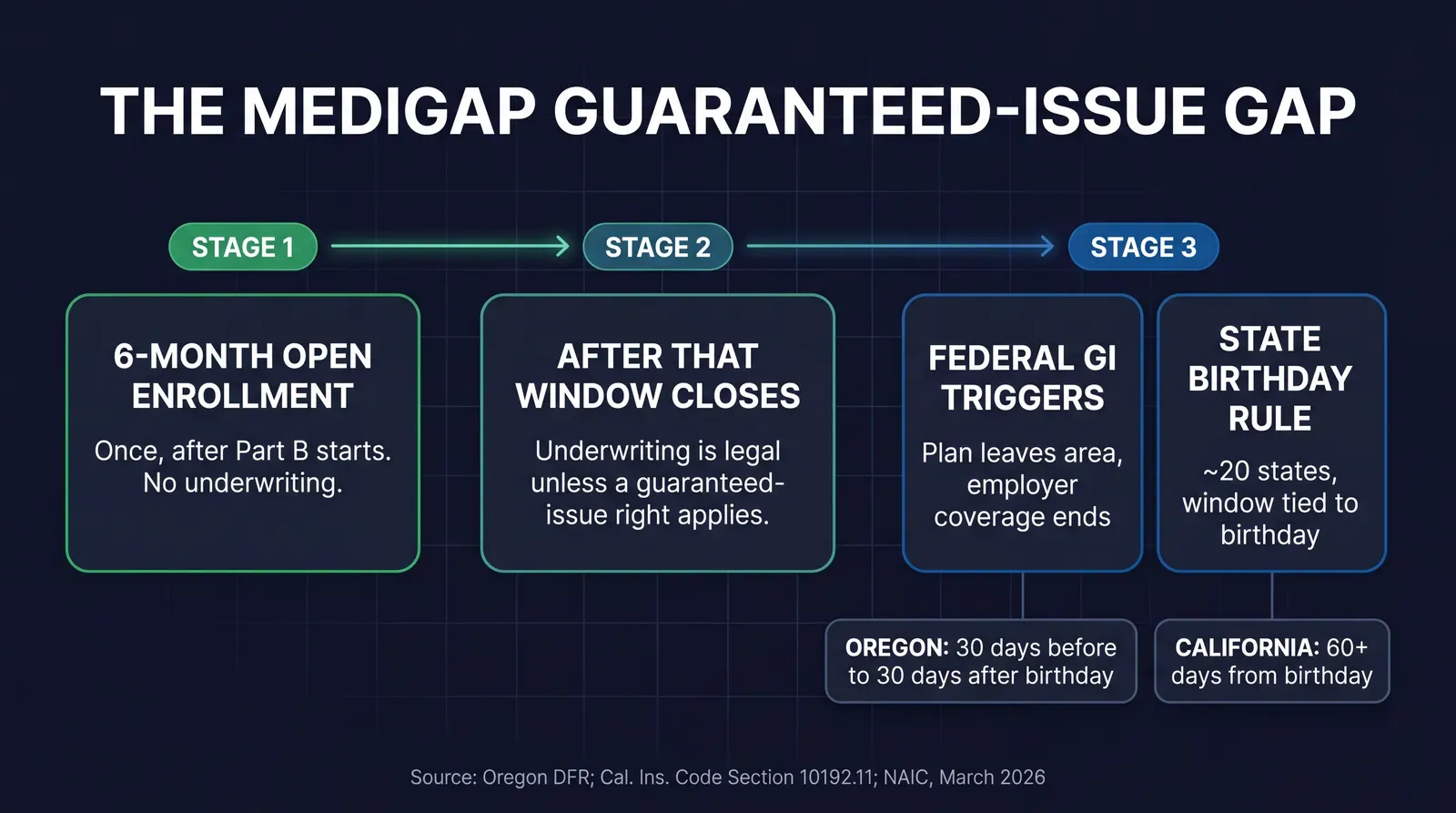
- Federal law only guarantees Medigap issue once — the six-month Open Enrollment Period after Part B starts — plus specific triggering events. Outside those, underwriting is legal.
- Q1 2026 Medigap Plan G rate filings from Aetna, Blue Cross Blue Shield, Cigna, Humana, Mutual of Omaha, and UnitedHealthcare ranged from just over 12% to more than 26%, per Telos Actuarial data reported by KFF Health News.
- Broader guaranteed-issue expansion has a real cost: California's own legislative analyst estimated a proposed statewide 90-day annual window would raise average premiums 14% to 33% through adverse selection.
This is written for the agent, not the client
Everything below is the mechanism and the method, not a sales script. It's for a licensed agent deciding whether, and when, a specific client actually has this right. If you also run a Medicare book through AEP, our book re-shop guide covers the broader plan-change scan this pairs with.
Why a Medigap client can be stuck with a bad renewal
Here’s the situation that catches agents off guard almost every year. A client has had the same Medigap Plan G for six years. The carrier files a rate increase, DFS or the state’s insurance department approves it, and the client’s premium jumps double digits at renewal. The client, reasonably, asks you to find something cheaper. You run a quote with a different carrier at a lower rate for the same Plan G. The client applies. The new carrier asks health questions, and now their controlled diabetes or their knee replacement two years ago is a reason to decline the application or price it higher than the quote you showed them.
That’s not a glitch. It’s the default rule. Unlike Medicare Advantage or Part D, which have Medicare’s Annual Enrollment Period running every October 15 through December 7 under 42 CFR § 422.62(a)(2)(iii), Medigap doesn’t get an annual do-over for the general public. Once a client is past their initial enrollment window, insurers are legally allowed to medically underwrite a new Medigap application, and can decline it or price it based on health status, unless the client falls into one of a specific list of protected situations.
Most agents know this in the abstract. Far fewer can tell you, on the spot, whether a specific client in a specific state actually has a way around it this year. That gap is what this article closes.
The federal floor: what every Medigap client is guaranteed, no matter the state
Start with what’s true everywhere, because it’s the baseline you’re working around, not the whole answer. Federal law guarantees a Medigap applicant the right to buy any Medigap policy sold in their state, with no health questions, during a single six-month Medigap Open Enrollment Period that begins the first day of the month they’re both 65 or older and enrolled in Medicare Part B. That’s existing federal law, as summarized in the California Legislature’s own 2025 nonpartisan bill analysis: “the period of open enrollment for Medicare Supplemental Insurance occurs during the 6-month period beginning with the first day of the month in which a beneficiary first enrolls for benefits under Medicare Part B” (California Health Benefits Review Program, SB 242 analysis, April 20, 2025).
Once that window closes, federal law still protects a specific, named list of situations under “guaranteed issue rights,” sometimes called Medigap protections. The 2025 official Medicare.gov guide to choosing a Medigap policy lays these out exactly:
| You have this right if… | You can buy… | Window to apply |
|---|---|---|
| Your Medicare Advantage Plan leaves Medicare, stops serving your area, or you move out of its service area (and you switch to Original Medicare) | Plan A, B, C*, D*, F*, or G* sold in your state | 60 days before coverage ends to 63 days after |
| Your employer group health plan (including retiree or COBRA) that pays after Medicare is ending | Plan A, B, C*, D*, F*, or G* sold in your state | No more than 63 days after the latest of: coverage-end date, notice date, or claim-denial date |
| You joined a Medicare Advantage Plan or PACE at 65 and switch back to Original Medicare within your first year (trial right) | Any Medigap policy sold by an insurer in your state | 60 days before coverage ends to 63 days after |
| You dropped a Medigap policy to try Medicare Advantage for the first time and switch back within a year (trial right) | Your former Medigap policy, if still sold; otherwise Plan A, B, C*, D*, F*, or G* | 60 days before coverage ends to 63 days after |
| Your Medigap insurer goes bankrupt, or your coverage ends through no fault of your own | Plan A, B, C*, D*, F*, or G* sold in your state | No more than 63 days after coverage ends |
*Plans C and F are closed to anyone newly eligible for Medicare on or after January 1, 2020; people who qualify for a guaranteed-issue right and were eligible before that date can still buy them. (Medicare.gov, Choosing a Medigap Policy, 2025 official guide.)
None of those rows cover “my premium went up and I found a cheaper option.” A rate increase alone is never a federal guaranteed-issue trigger. That’s the entire reason the birthday rule matters: it’s the one mechanism built specifically for the situation federal law leaves uncovered.
Why underwriting is even legal here, when it isn’t for AEP-style plans
This trips up agents who came up selling Medicare Advantage, where nobody gets medically underwritten for a plan change during AEP. Medigap works on a completely different chassis. An MA or Part D plan is guaranteed renewable and community-rated within its own enrollment rules, so a carrier can’t refuse to keep an existing member or charge them more for being sick. A Medigap policy is also guaranteed renewable, meaning the carrier that already issued it can’t drop that client or single them out for a rate hike based on their claims — but that protection only covers the policy the client already has. It does nothing for a client trying to get a new policy, with a new carrier, once their initial issue window has closed. That’s a fresh underwriting decision, and outside a guaranteed-issue right, the carrier is allowed to treat it like any other new application: ask health questions, decline it, or price it higher.
That distinction is the whole reason a client can be simultaneously protected on their current policy and stuck on it. Their existing carrier can’t cancel them or single them out for the increase. Nobody else has to take them at standard rates unless a specific right applies. The birthday rule is a state legislature deciding to override that default for a narrow annual window, and nothing more — which is also why it only ever allows equal-or-lesser benefits. Letting someone upgrade without underwriting would invite exactly the “wait until I’m sick, then buy richer coverage” behavior insurers price against.
The patchwork: why some clients have a way out and most don’t
Any additional open enrollment or guaranteed issuance beyond the federal floor is entirely a matter of state law, and states have not moved together. According to National Association of Insurance Commissioners Senior Issues Task Force agenda materials dated March 18, 2026, “about 20 states have expanded guaranteed issuance” of Medigap coverage through some form of continuous or recurring right, separate from a related but distinct protection where “about 33 states require Medigap insurers to offer and issue coverage to persons under age 65” (NAIC, Senior Issues Task Force agenda materials, March 18, 2026). Those are two different things: the birthday rule is about existing policyholders switching plans; the under-65 requirement is about whether someone who qualifies for Medicare early, through disability or ESRD, can buy a Medigap policy at all before turning 65.
The same NAIC materials note that a handful of states, including Connecticut, Massachusetts, Maine, New York, Rhode Island, and Vermont, take a different and broader approach: continuous or annual guaranteed issue for essentially all traditional Medicare beneficiaries 65 and older, not a narrow birthday-tied window. If you work a book with clients in any of those six states, the practical question isn’t “does the birthday rule apply,” it’s closer to “when can this client not switch,” which is a different conversation entirely and outside the scope of what this article verifies.
For the roughly 20 birthday-rule-style states, this article confirmed the specifics of exactly two directly from primary sources, and recommends you do the same for any other state before advising a client:
| State | Window | What's allowed | Primary source |
|---|---|---|---|
| Oregon | 30 days before the birthday to 30 days after | Same plan type or lesser benefits, guaranteed regardless of health; applies only to Medigap policies issued after January 1, 1990 | Oregon Division of Financial Regulation, Birthday Rule fact sheet, March 2023 |
| California | 60 days or more, commencing with the birthday | Any Medigap policy offering benefits equal to or lesser than the client's current coverage | California Insurance Code § 10192.11 |
Other states commonly named in industry lists as having some version of a birthday rule include Illinois, Nevada, Idaho, Louisiana, Oklahoma, Kentucky, Maryland, Utah, Virginia, Wyoming, West Virginia, and Delaware, with more added through active legislation most years, and California’s own legislature has separately debated going further with a broader 90-day annual guaranteed-issue window on top of its existing birthday rule (more on that in the next section). This article is not going to publish specific day-counts, carrier-only restrictions, or age caps for any state beyond Oregon and California, because those details weren’t independently confirmed against a primary source this session, and Medigap state law changes through active legislation almost every year. The one universal step: before you tell a client they have this right, confirm it directly with that state’s Department of Insurance or the local State Health Insurance Assistance Program at shiphelp.org, both of which the official Medicare.gov guide itself points to for state-specific rights (Medicare.gov, Choosing a Medigap Policy, 2025 official guide).
Don't cancel the old policy before the new one is issued
Oregon's own guidance is blunt about this: don't cancel the current Medigap policy until the new one is actually issued. A client may need to pay two premiums for one month to guarantee a clean handoff instead of a coverage gap ([Oregon Division of Financial Regulation, Birthday Rule fact sheet](https://shiba.oregon.gov/Documents/4845-ins-birthday-rule-2023.pdf), March 2023). The same logic applies wherever a birthday rule exists, even in states this article didn't independently verify.
What it actually costs to leave the birthday rule narrow
It’s worth understanding why more states haven’t simply opened this up further, because the answer isn’t inertia, it’s an actual, quantified tradeoff, and it’s useful context the next time a client asks why their state doesn’t have a better rule.
California’s own legislature commissioned exactly this analysis, twice. In 2024, the California Health Benefits Review Program analyzed a proposed bill that would have added a full annual 90-day guaranteed-issue window on top of the existing birthday rule, alongside a ban on age-based pricing. Its finding: average Medicare Supplement premiums in California would rise from $239.03 to $319.04 per member per month, a 33% increase, while overall enrollment in Medicare Supplement policies would fall about 9%, from roughly 1,131,751 to 1,027,251 people (California Health Benefits Review Program, analysis of SB 1236, April 16, 2024). The mechanism is adverse selection: opening the door wider draws in higher-cost, higher-need new enrollees who’d been locked out or medically underwritten before, while healthier, lower-cost people become more likely to drop coverage and wait until they need it, since they can now get back in without underwriting later.
A year later, the same body analyzed a scaled-back version, a 90-day annual window starting each January 1, layered on top of the birthday rule rather than replacing it. That estimate: premiums up $40 a month, a 14% increase, with enrollment ticking down about 1%, or 6,400 people (California Health Benefits Review Program, analysis of SB 242, April 20, 2025).
The birthday rule protects the client in front of you. A broader annual guaranteed-issue window protects more clients, and every actuary's model says it also raises what all of them pay to get there.
Mike MooreThat tension is also showing up in the market right now, independent of any legislative proposal. Early 2026 rate filings for Plan G, the most commonly purchased Medigap plan, ranged from just over 12% to more than 26% across filings from Aetna, Blue Cross Blue Shield, Cigna, Humana, Mutual of Omaha, and UnitedHealthcare, according to Nebraska-based actuarial consulting firm Telos Actuarial, as reported by KFF Health News (“Medigap Premiums Leap, and Consumers Have Few Alternatives,” 2026). For a client paying the 2023 national average Plan G premium of $164 a month (KFF, Key Facts About Medigap, October 2024), a 20% increase alone is roughly $33 more every month, or close to $400 a year, for identical coverage. That’s the real dollar figure behind the phone call you’re about to get.
A worked example, with real numbers
Take a California client on Plan G who’s carried the same policy since 2021, born June 12, currently paying the 2023 national average of $164 a month (KFF, Key Facts About Medigap, October 2024). Their carrier files a 20% increase inside the 12% to 26% range reported for Q1 2026 filings (KFF Health News, citing Telos Actuarial). New premium: about $197 a month, or roughly $394 more a year than before.
Under California Insurance Code § 10192.11, this client has an annual open enrollment period of 60 days or more, commencing with their birthday, June 12. That gives them a window running from June 12 through at least mid-August to apply for a different company’s Plan G, or a lesser plan like Plan N, without health questions. If a competing carrier is quoting Plan G at $172 a month instead of the new $197, switching saves roughly $25 a month, about $300 a year, for the identical standardized benefit — because Plan G is Plan G, regardless of which company sells it; only the price and the customer service differ. If that same client lived in Oregon instead, born June 12, their window would be May 13 through July 12: 30 days before the birthday to 30 days after, per the Oregon Division of Financial Regulation’s fact sheet, and they’d need to apply for a plan issued after January 1, 1990, in the same or lesser benefit tier.
Either way, the number that makes this worth a phone call isn’t abstract. It’s the actual gap between what the client is about to start paying and what an equal plan costs elsewhere, multiplied by however many years they’d otherwise keep paying the difference.
What to do when a client’s state doesn’t have a birthday rule
Most don’t, and it’s worth being straight with a client about that instead of promising a right that isn’t there. A few honest options remain, none of them requiring a fabricated capability:
- Check whether a federal guaranteed-issue trigger actually applies. The table above covers more situations than agents often remember, particularly the trial rights for someone who tried Medicare Advantage and wants back into Medigap within a year.
- Ask the client’s current carrier about an internal plan-letter change. Moving to a different plan letter with the same carrier is a separate conversation from switching carriers, and some insurers handle it with lighter underwriting than a brand-new application elsewhere — but this varies by company and isn’t guaranteed by any law described in this article. Confirm directly with that carrier.
- Compare against Medicare Advantage honestly, without steering. For some clients, especially those who’d fail underwriting everywhere, a Medicare Advantage plan with no medical underwriting at all is a legitimate option to walk through during their own Annual Enrollment Period, October 15 through December 7 (42 CFR § 422.62(a)(2)(iii)) — with the tradeoff of a network instead of any-provider access under Original Medicare, clearly explained, not glossed over.
- Watch for a change in the client’s own coverage that creates a new federal trigger, like an employer plan ending or a Medicare Advantage plan leaving their county, and be ready to act inside that specific window when it happens.
None of these require underwriting to get around. They require knowing which lever actually exists for that specific client, in that specific state, this year.
How to run the birthday-rule check by hand, for one client or a whole book
None of this requires anything beyond public information and a calendar. Here’s the complete method.
Confirm the client's plan and issue date
Pull the current Medigap plan letter (G, N, F, and so on), the issue year (1990-series, 2010-series, or 2020-series matters, because replacement eligibility differs by series), and the client's state of residence. This determines what they can switch into, not just whether they can switch.
Check that state's actual law, this year
Don't rely on a listicle, including this one, for any state beyond what's independently sourced here. Call the state Department of Insurance or the SHIP office (shiphelp.org has the directory) and confirm: does a birthday rule or similar right exist, what's the window, is it same-carrier-only or any-carrier, and is there an age cap.
Calculate the actual window for this client's birthday
In Oregon, that's 30 days before to 30 days after. In California, 60 days or more starting on the birthday. Mark the exact calendar dates for this specific client, not a general rule of thumb, since a mid-month application can shift the effective date.
Shop equal-or-lesser plans only
Quote the same plan letter with a different carrier, or a plan with equal or lesser benefits. Upgrading isn't available through this right in any state confirmed here.
Apply, but don't cancel the old policy yet
Submit the new application inside the window. Wait for the new policy to actually be issued before canceling the old one, even if it means a one-month overlap in premium.
Log the date and re-flag it for next year
The birthday rule is annual and recurring. Note it in the client's file with next year's exact window dates, because this is a check that has to repeat every year, for every eligible client, indefinitely.
That last step is where the manual version breaks down at any real scale. Checking one client’s birthday window by hand takes a few minutes. Tracking it correctly, every year, for every Medigap client across a book of dozens or hundreds of people, each with a different birthday and possibly a different state’s rule, is a full-time bookkeeping job nobody actually has time for, which is exactly why most of these windows quietly close unused.
Where Ambrose does the tedious part
Everything above is real, and you can run every step of it by hand with a phone and a spreadsheet. What doesn’t scale by hand is doing it for an entire book, every year, without a client’s window silently passing while you’re focused on AEP.
Per Ambrose’s own spoke catalog, medicare-watchdog runs “scheduled MAPD / PDP / Med Supp intelligence — cost hikes, plan discontinuations, network changes, Star Ratings, rate filings” (Ambrose docs, Spokes catalog). It’s documented at a “free” HIPAA posture, meaning it works from federal data only and no client identifier has to cross the wire for the scan itself to run, and its medicare_rate_filing tool specifically retrieves the latest rate filing for a plan (Ambrose docs, spoke-medicare-watchdog). That’s the rate-increase signal, the part that tells you a client’s premium just jumped and by how much.
It’s honest to be specific about the boundary here: Ambrose’s spoke catalog does not currently document a dedicated “birthday rule tracker” feature, and this article isn’t going to claim one exists. What closes that gap is a general capability, not a birthday-specific one: Ambrose Routines run on a cron schedule, five fields for minute, hour, day, month, and day of week, targeting a specific agent or team with a defined prompt, and can post results to Slack, email, a GHL note, or a log, on repeat (Ambrose docs, Routines). A routine built around your book’s client birthdays, running medicare_rate_filing and medicare_scan_book against each client’s record a set number of days before their birthday, and posting the result to Slack, is the honest combination: a documented rate-monitoring spoke plus a documented general-purpose scheduler, not a single pre-built feature.
| Part of the job | By hand | What Ambrose provides |
|---|---|---|
| Track a client's current premium and any rate filing | Check the ANOC and carrier notices manually, per client | medicare_rate_filing (medicare-watchdog spoke) |
| Scan the whole book for plan or rating changes | Cross-reference each contract by hand, every year | medicare_scan_book (medicare-watchdog spoke) |
| Remember each client's specific birthday window | A calendar reminder or spreadsheet, maintained by a human | A scheduled Routine, cron-timed per client, posting to Slack |
| Keep client health and identity data out of a non-BAA AI tool | Manually strip names before pasting anything into a general AI tool | PHI Rail (redact-then-rehydrate before any non-BAA destination) |
A scan finds who to call. It doesn't replace the compliant call itself
A rate-filing alert or a scheduled routine surfaces a reason to reach out — it doesn't authorize the outreach itself. Once you're discussing specific plan benefits with a client, the normal CMS marketing rules still apply: a valid Scope of Appointment, the TPMO disclaimer, and a recorded, retained line for any sales-related call. Tech Savvy Insurance is a training and software community, not a law firm, and this isn't legal or compliance advice — confirm current CMS Medicare Communications and Marketing Guidelines requirements before you place the call.
The NAIC’s Model Bulletin on the Use of Artificial Intelligence Systems by Insurers sets the same expectation here it sets everywhere else AI touches an insurance decision: a written policy on how the tool is used, human review before anyone acts on what it flags, and documentation available if a regulator asks. A routine that surfaces a birthday-window client is an input to your judgment, not a replacement for it. AI outputs may contain errors; verify the plan letter, the window dates, and the state’s current law yourself before you act on any of it, and remember that Ambrose is HIPAA-aware by default, not HIPAA certified, since no such certification exists for a software platform.
What you get by joining
One Ambrose seat, including medicare-watchdog and the Routines scheduler, comes with a Tech Savvy Insurance membership: $97 a month, billed monthly, cancel anytime, founding rate locked in while the membership stays active. Alongside the seat: weekly Zoom calls with open Q&A and build-with-you sessions, 30+ hours of recorded training, Meta Ads, AI, and marketing training built for this industry, pre-built AI templates and bot deployments, and a free annual in-person member workshop. It’s also an explicit no-recruiting zone — you can ask a real question about a client’s birthday-rule window without ending up on someone’s downline pitch list, which is a genuine point of difference from most agent Facebook groups.
Ambrose usage is separate from the $97 seat
The membership includes one Ambrose seat; usage inside Ambrose runs through its own credit ledger with spend caps, so cost stays visible instead of showing up as a surprise line item (Ambrose docs, What is Ambrose). See the full Spokes catalog for what else is available beyond what's covered here.
The close
Results may vary, and nothing here is a guarantee of what any specific client will save. What’s verified is this: the birthday rule is real, it exists in roughly 20 states, it’s tied to a date most agents don’t track systematically, and a client stuck with a 2026 rate increase has no idea it might apply to them unless you tell them. Run the check by hand this week for your Medigap clients in Oregon or California, the two states confirmed here, and call your state’s Department of Insurance for anywhere else in your book. If you’d rather have that check run on a schedule instead of a memory, one Ambrose seat comes with a Tech Savvy Insurance membership, and the weekly build-with-you calls are where agents actually set a routine like this up on their own book: https://techsavvyinsurance.com/.
Frequently asked questions
Sources
- 42 CFR § 422.62(a)(2)(iii) — Medicare Advantage Annual Election Period dates — law.cornell.edu
- Oregon Division of Financial Regulation — When Can You Switch Medigap Plans: Birthday Rule Fact Sheet (March 2023) — shiba.oregon.gov
- California Insurance Code § 10192.11 — annual open enrollment period — leginfo.legislature.ca.gov
- NAIC — Senior Issues Task Force agenda materials, "Expanding Guaranteed Issuance of Medigap Insurance Policies" (March 18, 2026) — content.naic.org
- California Health Benefits Review Program — SB 242, Medicare Supplement Coverage: Open Enrollment Periods (April 20, 2025) — content.naic.org
- Medicare.gov — Choosing a Medigap Policy (2025 official guide, guaranteed-issue rights table) — content.naic.org
- KFF — Key Facts About Medigap Enrollment and Premiums for Medicare Beneficiaries (October 18, 2024) — kff.org
- KFF Health News — Medigap Premiums Leap, and Consumers Have Few Alternatives (2026) — kffhealthnews.org
- Ambrose docs — Spokes (catalog) — app.hiambrose.com
- Ambrose docs — spoke-medicare-watchdog — app.hiambrose.com
- Ambrose docs — Routines — app.hiambrose.com
- Ambrose docs — Architecture: PHI Rail — app.hiambrose.com
- Ambrose docs — What is Ambrose — app.hiambrose.com
Ready to put this into practice?
Join a private community of Health & Life insurance professionals using AI, Meta Ads, and automation to grow — without draining their bank account.
Join Tech Savvy — $97/month