
A Special Election Period is any window outside the Annual Enrollment Period (Oct. 15-Dec. 7) or the Medicare Advantage Open Enrollment Period (Jan. 1-Mar. 31) when a specific, CMS-defined life event lets a beneficiary join, switch, or drop Medicare Advantage or Part D coverage. As of this year, CMS’s own consumer guide documents more than a dozen distinct SEP categories, and the one most agents actually touch, the Dual/LIS SEP, got rebuilt from a single quarterly window into two separate monthly SEPs effective January 1, 2025 (CMS, Understanding Medicare Advantage & Medicare Drug Plan Enrollment Periods; CMS, Dual/LIS SEP Updates for CY2025). It’s September. AEP starts October 15. And right now is exactly when the SEP conversations pile up, because it’s the month clients call about a move, a lost job, a new diagnosis, or a Medicaid redetermination that just came through the mail, and you have to decide on the spot whether what they’re describing is actually a qualifying event.
Key takeaways
- CMS's own consumer guide (Product No. 11219) documents more than a dozen distinct SEP categories, each with its own trigger, window length, and allowed plan changes — there is no single universal SEP.
- Effective January 1, 2025, the old quarterly Dual/LIS SEP was replaced with a monthly SEP limited to standalone Part D plans, plus a separate new Integrated Care SEP for full-benefit duals moving to an aligned D-SNP, under 42 CFR 423.38(c)(4) (CMS memorandum, Oct. 29, 2024).
- The chronic condition SEP has no fixed window — a beneficiary can join a qualifying C-SNP anytime, but the SEP is spent the moment they enroll (CMS, Product No. 11219, p. 9).
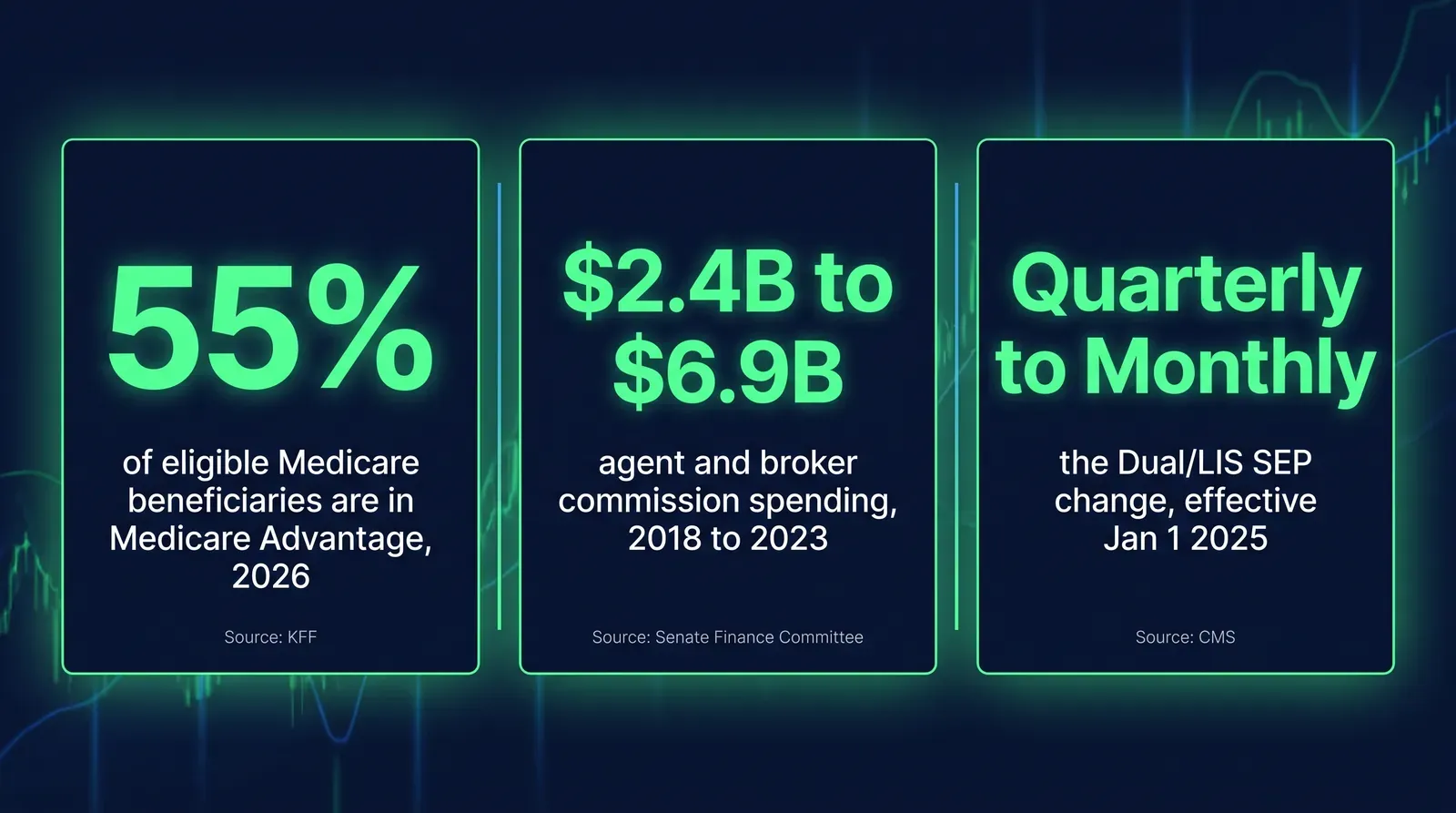
- Agent and broker fee and commission spending grew from $2.4 billion to $6.9 billion between 2018 and 2023, a 19% compound annual growth rate, a financial backdrop the Senate Finance Committee ties directly to aggressive enrollment tactics (Senate Finance Committee, March 2025).
- In 2026, 55% of eligible Medicare beneficiaries, 35.2 million of 64.2 million, are enrolled in Medicare Advantage, and 85% of this year's net MA growth landed in Special Needs Plans specifically (KFF, June 2026).
- The TPMO disclaimer at 42 CFR 422.2267(e)(41) still applies the moment an SEP-triggered outreach turns into a plan-benefit discussion, exactly as it does during AEP.
The pain: a client tells you something changed, and you have thirty seconds to know if that’s a SEP
Here’s the call. A client says her Medicaid renewed but the coverage type changed. Another says he just moved in with his daughter two counties over. A third mentions, almost as an aside, that he was just diagnosed with something that sounds like it might qualify for a Chronic Care SNP. None of them called to ask about their Medicare plan. You’re the one who has to recognize, in real time, whether what they just told you opens a door.
Get it right and you’ve just found a legitimate reason to help someone before AEP even opens. Get it wrong in either direction and you have a problem. Miss a real SEP and a client sits in the wrong plan for months, possibly paying more or losing access to a provider, because nobody told them they had an option. Call something a SEP when it isn’t, and you’ve enrolled someone under an election type code CMS didn’t actually authorize for that situation, which is the kind of thing that surfaces later as a rejected transaction or a compliance question you don’t want to be answering after the fact.
The confusion isn’t really about the well-known SEPs. Every agent who’s been through an AEP knows about moving and losing employer coverage. The trouble is the SEPs that changed recently, the ones with narrow eligibility carve-outs, and the ones that get used once and then vanish. That’s where the actual risk lives, and it’s exactly where CMS made its biggest change in years.
Why this matters most in the six weeks before AEP
You don’t have to wait for October 15 to act on a real SEP, and that’s the point most agents miss in September specifically. If a client’s Medicaid status changed in August, the Dual/LIS SEP or the Integrated Care SEP is available to them right now, this month, independent of the AEP calendar entirely. Sitting on it until AEP opens isn’t more compliant; it’s just slower for the client, and it stacks an SEP-eligible conversation on top of an already-compressed AEP workload for no regulatory reason.
The reverse mistake also happens in this exact window: a plan’s Annual Notice of Change lands in a client’s mailbox by September 30, the deadline CMS sets for plans to notify current enrollees of formulary, benefit, and premium changes for the coming year (CMS, Guide to Consumer Mailings, as of Nov. 2025), the client calls confused about a benefit change, and the agent treats that call as if it automatically opens a SEP. It doesn’t. An ANOC notice, by itself, isn’t a qualifying event under any category CMS documents in its own SEP guide. What it can do is prompt a conversation that leads you to discover an actual qualifying event underneath it, a genuine move, a genuine coverage loss, but the ANOC itself isn’t the trigger. Conflating “the client is confused and called me” with “the client has a SEP” is one of the more common errors this time of year, precisely because so much genuine SEP activity is also happening in the same six-week stretch.
The Integrated Care SEP: new, narrow, and easy to confuse with the Dual/LIS SEP
The Integrated Care SEP is the other half of the January 2025 restructuring, and it’s the one agents are most likely to skip past entirely, because it’s brand new and it only applies to a specific slice of the dual-eligible population: full-benefit duals moving into a D-SNP that’s aligned with their Medicaid managed care plan. It doesn’t help a partial-benefit dual, and it doesn’t help a full-benefit dual who wants to move to a Medicare Advantage plan that isn’t a D-SNP at all.
That alignment question, whether a given D-SNP’s parent organization actually matches the client’s Medicaid MCO, is its own research problem, and it’s the subject of a separate rule, 42 CFR 422.514(h), phasing in starting 2027. The short version for this article: before you use the Integrated Care SEP to move a client into a specific D-SNP, confirm that D-SNP is actually the aligned one for their Medicaid plan, not just any D-SNP that happens to be available in their county. Using the SEP correctly and picking the wrong D-SNP are two different failure modes, and this SEP makes both possible in the same conversation.
Why it’s confusing: CMS rebuilt the highest-volume SEP into two different ones
For most of the last decade, dually eligible and other LIS beneficiaries had one tool: the quarterly Dual/LIS SEP. It let them enroll in or disenroll from a Medicare Advantage or Part D plan once per calendar quarter, for the first three quarters of the year, and it could not be used in the fourth quarter at all (CMS, Dual/LIS SEP Updates for CY2025). It was broad, it was simple to explain, and agents built muscle memory around it.
That SEP stopped existing on January 1, 2025. CMS finalized changes to the Dual/LIS SEP at 42 CFR 423.38(c)(4), replacing the quarterly window with a one-time-per-month SEP, and simultaneously splitting the underlying eligibility into two separate elections depending on what the client is actually trying to do. The plan-year election code changed too: plans now submit “Q-DUAL/LIS MN SEP” instead of the old “L” code, which was discontinued for any effective date of January 1, 2025 or later (CMS memorandum, Oct. 29, 2024). If you learned the Dual/LIS SEP before 2025 and haven’t specifically re-learned it since, what you know is out of date, not just simplified.
Below is CMS’s own catalog of Special Enrollment Periods, drawn directly from its consumer guide, condensed to the categories that come up most in an agent’s actual week. This is not exhaustive; CMS states in the same document that “this publication doesn’t include every situation.” Treat it as the reference to start from, not the final word on an edge case.
| If this describes the client | Window | What it allows |
|---|---|---|
| Moved outside the plan's service area | Starts the month before the move (if reported in advance) or the month reported (if after), plus 2 full months | Switch MA or Part D plans, or return to Original Medicare |
| Moved back to the U.S. from abroad | 2 full months after the month of the move | Join an MA or Part D plan |
| Lives in, or recently left, an institution (nursing home, rehab hospital) | As long as they live there, plus 2 full months after leaving | Join, switch, or drop MA/Part D coverage |
| Released from incarceration | 2 full months after the month of release | Join an MA or Part D plan |
| Lost Medicaid or Extra Help eligibility | 3 full months from the loss, or from notification, whichever is later | Join, switch, or drop MA/Part D coverage |
| Left employer or union coverage | 2 full months after coverage ends | Join an MA or Part D plan |
| Involuntarily lost other creditable drug coverage | 2 full months after the loss or notification, whichever is later | Join an MA plan with drug coverage, or a standalone Part D plan |
| Dual eligible or LIS eligible (revised 2025) | Once per calendar month, year-round | Enroll in, or switch between, standalone Part D plans only |
| Full-benefit dual, electing an aligned D-SNP | Any month | Enroll in a D-SNP aligned with their Medicaid managed care plan |
| Plan gets a 5-star overall rating | One time, Dec. 8 of the prior year through Nov. 30 of the plan year | Join the 5-star plan |
| In a plan rated below 3 stars for 3 straight years | Any time while enrolled in the low-performing plan | Switch to a different MA or Part D plan |
| Severe or disabling chronic condition, qualifying C-SNP available | Any time — ends the moment they enroll | Join the Chronic Care SNP serving that condition |
| Plan contract terminates or isn't renewed | 2 months before through 1 month after the contract ends (varies by scenario) | Switch to a new MA or Part D plan |
Source: CMS, Understanding Medicare Advantage & Medicare Drug Plan Enrollment Periods, Product No. 11219, and CMS, Dual/LIS SEP Updates for CY2025 (accessed this session). This table condenses CMS's full list; several less-common SEPs, including SPAP-related SEPs and federal-employee-error SEPs, aren't shown here. Verify an edge case directly against the source document before acting on it.
The Dual/LIS split, in the detail that actually matters
The distinction agents get wrong most often isn’t whether a dual-eligible or LIS client has a SEP available. Nearly all of them do, essentially year-round now. It’s which SEP applies to which plan change.
Before 2025, one SEP covered both moves: switch Part D plans, or switch Medicare Advantage plans, on the same quarterly cadence. After January 1, 2025, those two actions split into two different elections with two different rules:
| Through Dec. 31, 2024 | From Jan. 1, 2025 | |
|---|---|---|
| Frequency | Once per calendar quarter, Q1-Q3 only | Once per calendar month, year-round |
| Standalone Part D plan changes | Allowed under the quarterly SEP | Allowed under the new monthly Dual/LIS SEP |
| MA-only or MA-PD plan changes | Allowed under the quarterly SEP | Not permitted under the Dual/LIS SEP at all — a separate Integrated Care SEP covers a full-benefit dual electing an aligned D-SNP specifically |
| Election type code | "L" | "Q-DUAL/LIS MN SEP" (OEC reason code "DEP") |
| Exclusion | Not specified for at-risk beneficiaries | Not available to anyone identified as an "at-risk beneficiary" or "potential at-risk beneficiary" under 42 CFR 423.100 |
Source: CMS, Dual/LIS Special Enrollment Period Updates for Contract Year 2025, memorandum dated Oct. 29, 2024, describing changes finalized at 42 CFR 423.38(c)(4).
Read that middle row again, because it’s the one that trips people up. A client who is dual eligible and wants to switch from one Medicare Advantage plan to a different one cannot use the Dual/LIS SEP to do it, full stop, regardless of how often they’ve used that SEP for Part D changes in the past. If the goal is a different MA plan and the client isn’t specifically moving to an aligned D-SNP, the Dual/LIS SEP is the wrong tool, even though it’s the SEP most agents reach for reflexively when they see “dual eligible” on a client’s file.
"At-risk beneficiary" is a real exclusion, not boilerplate
CMS's memo is explicit: an individual identified as an "at-risk beneficiary" or "potential at-risk beneficiary" under 42 CFR 423.100, generally someone flagged under a plan's drug management program for opioid or other controlled substance misuse risk, is not eligible for the revised Dual/LIS SEP at all. If a client's plan has ever mentioned a drug management program to them, confirm their status before assuming this SEP applies.
What it costs when this goes wrong
There’s no single published fine schedule for an agent who mis-codes a SEP, and this article isn’t legal advice about your personal exposure. What is documented is the environment this happens inside, and it’s not a small one.
Medicare Advantage now covers 35.2 million of the 64.2 million Medicare beneficiaries with both Part A and Part B, 55% of everyone eligible, as of 2026, and the program added 1.1 million enrollees over the prior year, a 3% increase (KFF, Medicare Advantage in 2026). KFF’s own analysis of that growth found something specific: 85% of the net increase in MA enrollment between 2025 and 2026, across every plan type, landed in Special Needs Plans, and nearly 8.2 million beneficiaries are now in an SNP, 78% of them in a D-SNP. That’s not a coincidence. It’s the population this article is about, concentrating fast in the plan types with the narrowest, most recently rewritten enrollment rules.
The financial pressure behind that growth is documented too. The Senate Finance Committee’s Democratic staff, in a report released March 2025 under Ranking Member Ron Wyden, found that spending on “agents and brokers fees and commissions” reported by insurers grew from $2.4 billion to $6.9 billion between 2018 and 2023, a 19% compound annual growth rate, nearly triple the 7% CAGR of direct sales salaries and benefits over the same period (Senate Finance Committee, March 2025). The same report documents CMS rules requiring lead generators to obtain prior express written, “one-to-one” consent before contacting a consumer about a specific product, rules the Committee says exist because of exactly the enrollment-steering pattern this article is warning against: TPMOs and lead generators contacting dual-eligible beneficiaries with financial incentives that reward switching, not necessarily accuracy.
Reported agent and broker fee and commission spending, 2018 vs. 2023
Insurer-reported spending nearly tripled in five years — a 19% compound annual growth rate.
Source: Senate Finance Committee, Pushing Medicare Advantage on Seniors: Unraveling the Complex Network of Marketing Middlemen, March 2025.
Separately, HHS’s Office of Inspector General has an active study, announced July 15, 2025, examining complaints beneficiaries reported to CMS from 2020 through 2024 about Medicare Advantage marketing, specifically looking at “the actions taken by agents and brokers that led to the complaints and the incentive structures that encourage brokers to change individuals’ enrollments” (HHS OIG, work plan project OEI-02-25-00340). That study hasn’t published findings as of this article, so there’s no completed figure to cite from it yet, but its existence tells you this is an active federal focus area, not a settled one.
None of that is about a specific agent getting caught mis-coding one SEP. It’s the backdrop your individual decisions sit inside: a fast-growing, narrowly-regulated segment of the book, real financial incentive to switch people, and a federal government actively studying whether that switching is happening on legitimate grounds. Documenting the SEP correctly, every time, is how you stay entirely outside that story.
The manual method: how to check and document a SEP by hand, no tool required
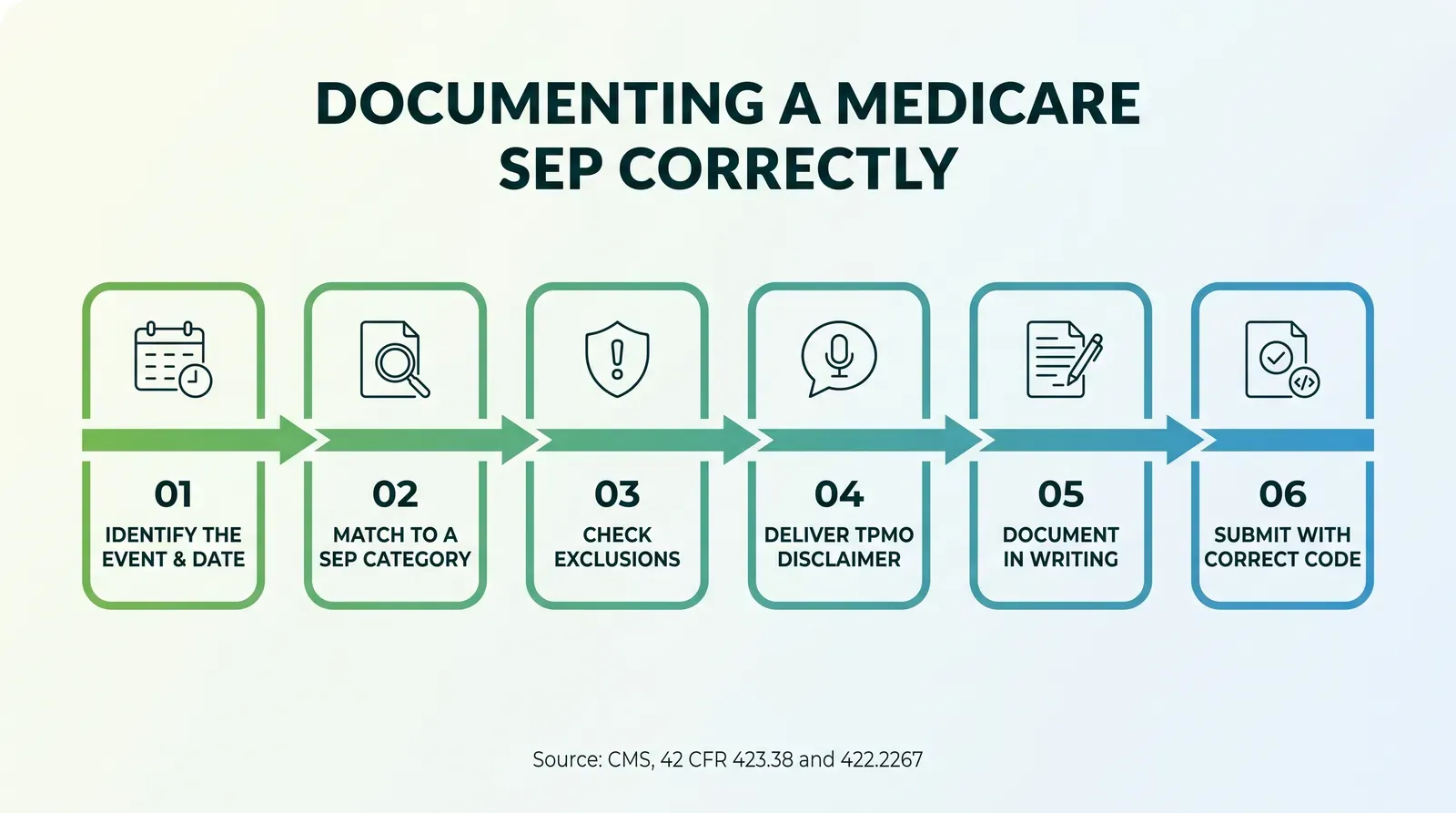
This is the actual process, and it works whether or not you ever use anything beyond a phone and a notepad.
Get the triggering event in the client's own words, and the date
Not "I think I might qualify for something," but the specific fact: "I moved on July 12," "My Medicaid renewal letter came dated August 3," "I was diagnosed with [condition] on this date." The date is what determines the window, not the day the client happened to mention it to you.
Match the event to a specific SEP category, not a vibe
Use CMS's own guide, not a general impression of "dual eligible people can switch anytime." Confirm which of the distinct categories in the table above actually fits: is this a move, a coverage loss, a Dual/LIS election, or the Integrated Care SEP? Two of those look similar and allow completely different plan changes.
Check exclusions before you proceed
For the Dual/LIS SEP specifically, confirm the client isn't an "at-risk" or "potential at-risk" beneficiary under 42 CFR 423.100. For the chronic condition SEP, confirm they haven't already used it this benefit year, since it's a one-time election, not a recurring window.
Deliver the TPMO disclaimer before any benefit discussion
If the conversation is moving from "you have an option" into discussing specific plans, the disclaimer required at 42 CFR 422.2267(e)(41) has to be conveyed verbally before that discussion starts, exactly as it would during AEP.
Document the event, the date, and the SEP category in writing
Write it down somewhere durable, your CRM notes, an enrollment file, not just memory. If the enrollment is ever questioned, the record that matters is what you documented at the time, not what you remember months later.
Submit with the correct election type code
For the Dual/LIS SEP specifically, that's now "Q-DUAL/LIS MN SEP," not the discontinued "L" code. Using the wrong or outdated code is exactly the kind of technical error that gets a transaction rejected or flagged for correction.
The SEP itself usually isn't the hard part. Writing down what actually happened, and when, before you submit the enrollment, is the step that protects you six months later.
Mike MooreWhere Ambrose actually helps, and where it’s still on you
Ambrose OS, the platform included with a Tech Savvy membership, doesn’t ship a single tool that looks up a specific client’s SEP eligibility today. That capability isn’t documented, so this article isn’t going to describe it as if it exists. What it does document, and what actually maps onto the workflow above, is Routines: a scheduled prompt attached to an agent or team, running on a cron schedule, with output that can post to Slack, email, GHL notes, or logs (Ambrose docs, Routines). The docs give a specific, on-point example: a weekly scan for “clients renewing in next 45 days who haven’t received a touch,” and a separate daily “watchdog” pattern that runs automated compliance scans and posts alerts to Slack.
That’s the honest fit. You can build a Routine that runs weekly against your own book, checking for the same kind of status changes this article is about, prompted to summarize which clients have flagged CRM notes about a recent move, coverage change, or new diagnosis that hasn’t been reviewed yet, and post that list to Slack before it goes stale. The Routine doesn’t replace the judgment call in step 2 above (which specific SEP category actually applies) or step 3 (exclusions); it replaces the part where that review quietly doesn’t happen because nobody remembered to run it during a busy pre-AEP week.
The second piece is the War Room, a chat interface where you ask a question and it’s routed to the right specialist, including a documented Compliance persona, Dr. Elena Reyes, with responses that include a collapsible tool-call timeline showing every action taken to produce the answer (Ambrose docs, War Room). Before you submit an enrollment under a SEP you’re not fully certain about, asking the War Room to walk through the eligibility logic against a described client situation, and getting a “why this answer” trail you can save alongside your own documentation, is a materially better audit record than a decision made silently in your head.
SEP check and documentation
- Manually review your book or CRM notes for status changes worth a SEP check
- Cross-reference each event against CMS's own SEP catalog by hand
- Write your own documentation of the event, date, and category
- Remember to run this review consistently, especially in a busy pre-AEP week
Routines + War Room + PHI Rail
- A scheduled Routine surfaces flagged status changes automatically, on a cadence you set
- The War Room's Compliance persona walks through the eligibility question with a saved reasoning trail
- Matching the event to the correct SEP category and confirming exclusions is still your judgment call
- PHI Rail aliases client identifiers before anything reaches a non-BAA destination if you're logging findings inside Ambrose
One Ambrose seat comes with the $97/month membership
Ambrose fronts an internal service the docs describe as connecting to "25+ federal/healthcare data MCPs," and runs on its own credit ledger with configurable spend caps, billed separately from the Tech Savvy membership fee ([Ambrose docs, Glossary](https://app.hiambrose.com/docs/glossary)). Routines and the War Room are two pieces of a larger catalog — see the full Spokes catalog for the rest of what ships with a seat.
Everything above works whether you ever join anything or not. If you’d rather have a Routine already scanning your book for these status changes while you handle the category-matching judgment call yourself, that’s exactly the kind of thing we build together on a Tuesday call, screen open, no downline pitch attached.
What you get
A Tech Savvy Insurance membership is $97 a month, billed monthly, cancel anytime, with the founding rate locked in while the membership stays active. It includes one Ambrose AI seat (the platform above — Ambrose usage runs on its own credit system, separate from the membership fee), weekly Zoom calls with open Q&A and build-with-you sessions, 30+ hours of recorded training on AI, Meta Ads, and marketing/sales, pre-built AI templates and bot deployments, and a free annual in-person member workshop. It’s an explicit no-recruiting zone — you can ask a real question about a client’s SEP situation without ending up on someone’s downline list. Join here: https://buy.stripe.com/8x2cN63OE6dO2yCdv2g3600.
See what your book is telling you before AEP does
The SEP catalog, the documentation checklist, the exact 2025 Dual/LIS split, everything above works whether you join anything or not. If you'd rather have a Routine already flagging the status changes worth a second look, one Ambrose seat comes with the Tech Savvy membership.
Join Tech Savvy — $97/monthThe compliance layer this sits inside
Everything above is regulatory information about enrollment mechanics, not marketing copy aimed at a beneficiary, but two frameworks still govern how you act on it. Any conversation that moves from acknowledging a life event into discussing specific plan benefits, premiums, or a recommendation to enroll or switch is a marketing communication under CMS’s Medicare Communications and Marketing Guidelines, and the TPMO disclaimer at 42 CFR 422.2267(e)(41) has to be conveyed before that discussion, whether the call happens in September or during AEP itself. Scope of Appointment and call-recording obligations apply the same way they always do.
Separately, if you use any AI tool, including Ambrose, to help research a SEP question or draft a client explanation, the NAIC’s Model Bulletin on the Use of Artificial Intelligence Systems by Insurers, adopted December 4, 2023, sets the expectation that insurers and the producers acting for them maintain a written approach to AI use, keep a human reviewing what it produces before it reaches a consumer, document the process, and hold any vendor accountable for its tool’s output (NAIC, Model Bulletin, Dec. 4, 2023). Treat everything in this article, including the regulatory citations, as a starting point you verify against the current eCFR and CMS documents before repeating a specific figure to a client — regulations get amended, and the text quoted here reflects what was live on the date this article was researched.
What not to paste into a general-purpose AI tool
Researching the SEP rules themselves required nothing but public federal text. Applying them to a specific client is different — you're handling a name next to a Medicaid status, a chronic diagnosis, or a move, which is protected health information. Don't paste that combination into a general-purpose chatbot with no Business Associate Agreement with your agency. Ambrose's PHI Rail aliases identifiers before anything reaches a non-BAA destination and re-hydrates them on the way back, so the underlying model never sees raw PHI (Ambrose docs, Architecture: PHI Rail).
The close
Nothing above requires a membership to act on. Pull the client conversations you’ve had this month, check each one against CMS’s own SEP catalog, document what you find, and you’ll walk into AEP with a book you actually understand instead of one you’re guessing about. If you’d rather have a Routine already surfacing those flagged status changes, with people on a call helping you build it instead of guessing at cron syntax alone, one Ambrose seat comes with a Tech Savvy Insurance membership: $97 a month, cancel anytime, no downline pitch: https://techsavvyinsurance.com/.
Before you act on anything in this article
Tech Savvy Insurance is a training and software community, not an insurance company, agency, or law firm, and does not provide insurance, legal, tax, or compliance advice. You are responsible for your own licensure and for complying with all applicable CMS, HIPAA, state, and carrier regulations, including TPMO disclosure, Scope of Appointment, and call-recording requirements. AI-generated outputs, including any summary of a regulation in this article, may contain errors — always verify against the current CMS and eCFR documents before acting on or repeating a figure to a client. Results may vary.
Frequently asked questions
Sources
- CMS — Understanding Medicare Advantage & Medicare Drug Plan Enrollment Periods (Product No. 11219) — cms.gov
- CMS — Dual/LIS Special Enrollment Period Updates for Contract Year 2025 (memorandum, Oct. 29, 2024) — cms.gov
- eCFR — 42 CFR 422.2267(e)(41), TPMO disclaimer requirement (current version) — ecfr.gov
- KFF — Medicare Advantage in 2026: Enrollment Update and Key Trends (June 5, 2026, updated July 1, 2026) — kff.org
- Senate Finance Committee — Pushing Medicare Advantage on Seniors: Unraveling the Complex Network of Marketing Middlemen (March 2025) — finance.senate.gov
- HHS OIG — Misleading Marketing Practices in Medicare Advantage (work plan project OEI-02-25-00340) — oig.hhs.gov
- CMS — Guide to Consumer Mailings from CMS, Social Security, and Plans in 2025/2026 (as of Nov. 2025) — cms.gov
- NAIC — Model Bulletin: Use of Artificial Intelligence Systems by Insurers (Dec. 4, 2023) — content.naic.org
- Ambrose docs — Routines — app.hiambrose.com
- Ambrose docs — War Room — app.hiambrose.com
- Ambrose docs — Spokes catalog — app.hiambrose.com
- Ambrose docs — Architecture: PHI Rail — app.hiambrose.com
- Ambrose docs — Glossary — app.hiambrose.com
Ready to put this into practice?
Join a private community of Health & Life insurance professionals using AI, Meta Ads, and automation to grow — without draining their bank account.
Join Tech Savvy — $97/month