
Beginning in 2027, a federal regulation most agents have never had a reason to open, 42 CFR 422.514(h), starts restricting how many D-SNPs a Medicare Advantage organization can offer in a service area it shares with its own affiliated Medicaid plan, and who can newly enroll in the ones that remain. If any part of your book is dual-eligible clients, this is the rule that decides whether the D-SNP you enrolled someone in last AEP is still one your carrier can keep selling to new members two AEPs from now. It doesn’t touch Medicare Supplement or ACA business at all, and it doesn’t disenroll anyone automatically in 2027 — but it changes what “the right D-SNP” means for a client, and it does it on a clock that’s already running.
Key takeaways
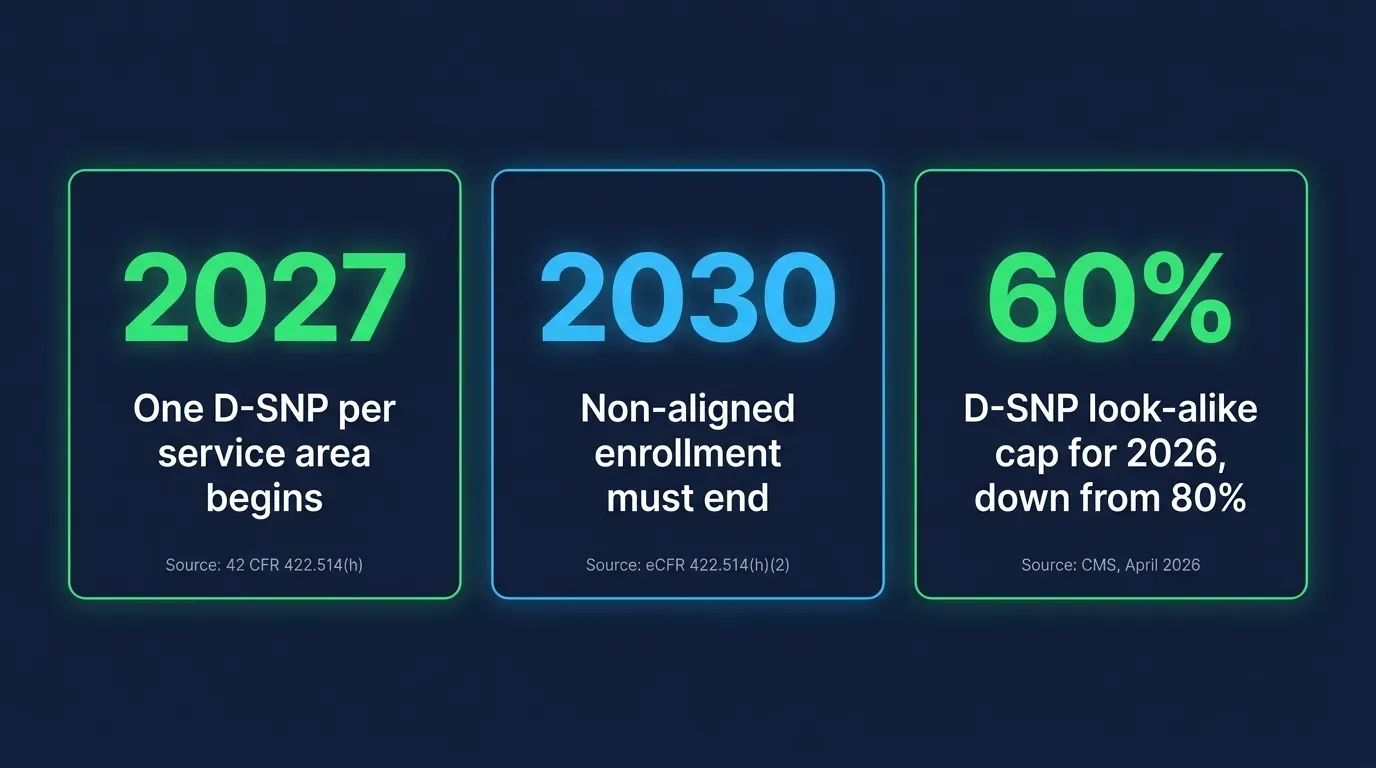
- 42 CFR 422.514(h), effective 2027, generally limits an MA organization to one D-SNP per service area where it shares a parent company with an affiliated Medicaid MCO, and caps new D-SNP enrollment to members enrolled in, or enrolling in, that MCO (eCFR, current version).
- Beginning in 2030, those same D-SNPs can only continue to cover aligned members — not just limit new enrollment (eCFR, 422.514(h)(2)).
- Separately, CMS lowered the D-SNP look-alike enrollment threshold from 80% to 70% in 2025, and to 60% in 2026, a distinct but related enforcement lever against plans that behave like D-SNPs without meeting the integration requirements (CMS, CY2025 Final Rule Fact Sheet, Apr. 4, 2024).
- As of 2023, 5.2 million dual-eligible individuals were enrolled in a D-SNP nationally: 57% in coordination-only plans, 35% in HIDE SNPs, 8% in FIDE SNPs (KFF, Feb. 9, 2024) — a different classification from aligned/non-aligned, and one this article is careful not to conflate with it.
- Ambrose's medicare-watchdog spoke scans a book for plan discontinuations, network changes, and rate filings from federal data — it is not documented as flagging D-SNP alignment status specifically, so that check is still a manual one, covered step by step below.
The pain: a plan you sold in good faith might not survive its own carrier’s restructuring
Here’s the actual situation. You have dual-eligible clients on your book. Some are in a D-SNP tied to the same parent company as their state Medicaid managed care plan. Some are in a D-SNP that has nothing to do with their Medicaid MCO — maybe it had better supplemental benefits, maybe it was what was available when you enrolled them, maybe their Medicaid MCO changed since. You’ve never had a reason to sort your book by that distinction, because until now, nothing forced the question.
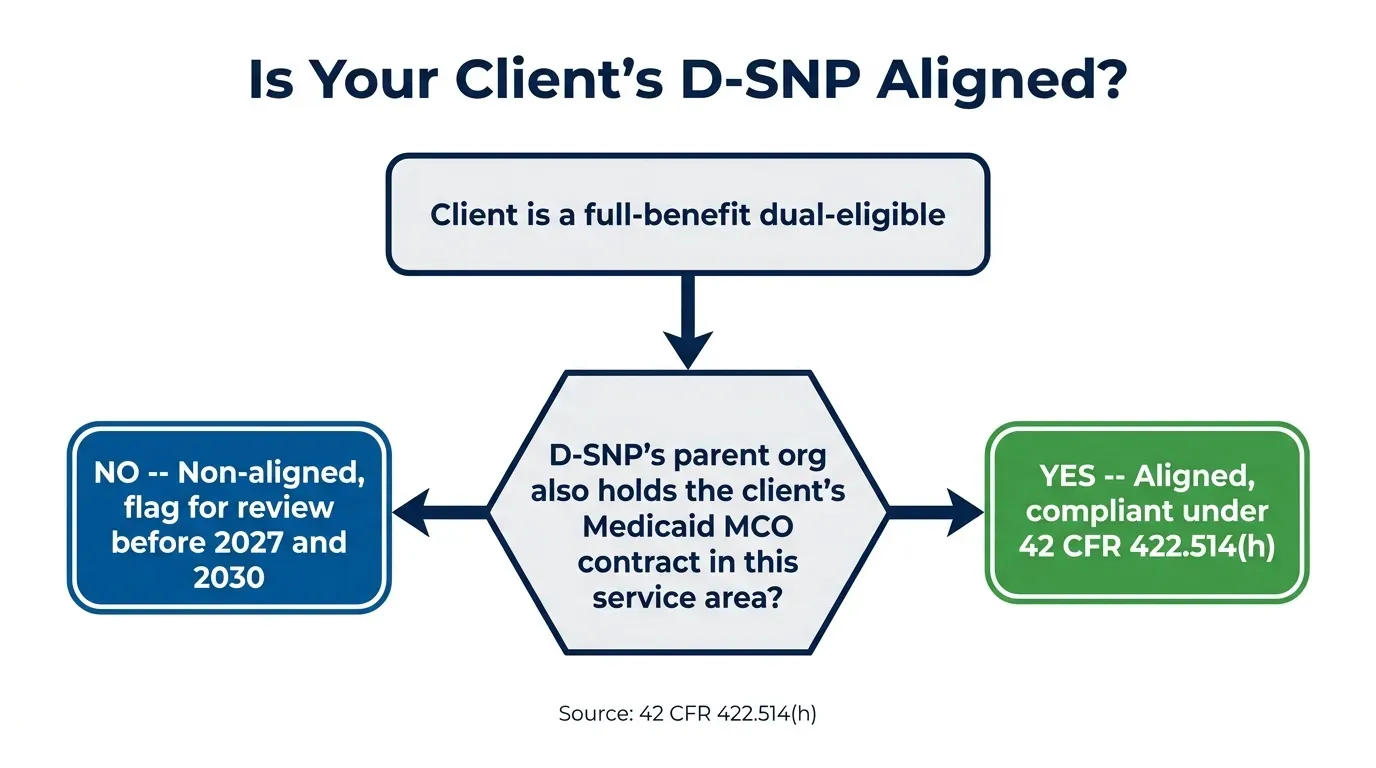
That changes with 42 CFR 422.514(h). It doesn’t ask whether the D-SNP is a good plan. It asks whether the D-SNP’s enrollment is aligned with the client’s Medicaid coverage, and starting in 2027, an MA organization that also runs the client’s Medicaid MCO in that service area generally can’t keep selling a second, non-aligned D-SNP option there, and can’t add new non-aligned members to the ones it keeps. You didn’t do anything wrong by enrolling a client in a non-aligned plan before this rule mattered. But if you don’t know which of your clients that describes, you’re going to find out from a plan termination notice instead of from your own book review, and that’s a worse way to have the conversation with a client who trusted you to see it coming.
Why it’s happening: CMS is trying to stop duals from being spread across plans that don’t talk to Medicaid
CMS didn’t write this rule to make your job harder. Its own fact sheet for the Contract Year 2025 Medicare Advantage and Part D final rule (CMS-4205-F), which is where these provisions originate, frames the goal directly: “increasing the percentage of dually eligible Medicare Advantage enrollees who are in affiliated Medicaid managed care plans, as opposed to Medicare Advantage plans that differ from the enrollee’s Medicaid plan,” in order to expand access to integrated materials, unified appeal processes across Medicare and Medicaid, and continued Medicare services during an appeal (CMS, CY2025 Final Rule Fact Sheet, Apr. 4, 2024).
The mechanism is enrollment restriction, not benefit design. CMS isn’t telling carriers what a D-SNP has to cover differently. It’s telling MA organizations that share a parent company with a Medicaid MCO that they can’t keep running parallel D-SNPs in the same territory that don’t feed into that same Medicaid relationship — because every non-aligned D-SNP is a place a dual-eligible member’s Medicare and Medicaid benefits can end up managed by two organizations that don’t coordinate, which is the exact fragmentation CMS has been trying to reduce since D-SNPs were permanently authorized under the Bipartisan Budget Act of 2018.
| Integration type | Share of D-SNP enrollees | What it means |
|---|---|---|
| Coordination-only (CO) | 57% | Required minimum coordination between Medicare and Medicaid, not a fully integrated plan |
| Highly Integrated Dual Eligible (HIDE) SNP | 35% | Capitated Medicaid contract covering most or all of the Medicare service area |
| Fully Integrated Dual Eligible (FIDE) SNP | 8% | Single entity manages both Medicare and Medicaid benefits under one integrated plan |
Source: KFF, 10 Things to Know About Medicare Advantage D-SNPs, Feb. 9, 2024 (2023 enrollment data). Note: this integration-type breakdown is a different classification from the aligned/non-aligned enrollment status this article is about — a coordination-only plan can be either aligned or non-aligned, and KFF doesn't publish a single national figure for how many current enrollees sit in a non-aligned plan specifically, which is exactly why this has to be checked plan by plan.
The compliance timeline, in the order it actually bites
Four separate dates matter here, and they come from two different rulemakings, which is part of why this gets confusing if you only skim a headline.
| Effective | What changes | Source |
|---|---|---|
| Jan. 1, 2025 | Quarterly Dual/LIS SEP sunsets, replaced by a monthly Dual/LIS SEP (standalone PDP) and a new Integrated Care SEP letting full-benefit duals elect an aligned D-SNP any month | CMS, D-SNPs page |
| 2025 | D-SNP look-alike enrollment threshold lowered from 80% to 70% | CMS, CY2025 Final Rule Fact Sheet |
| 2026 | Look-alike threshold lowered again, to 60%; D-SNP PPO out-of-network cost-sharing limits for specific services begin | CMS, CY2025 Final Rule Fact Sheet |
| 2027 | One D-SNP per service area where the MA org shares a parent with an affiliated Medicaid MCO; new enrollment in that D-SNP limited to aligned individuals | eCFR, 422.514(h)(1) |
| 2030 | Those D-SNPs may only continue to cover aligned members — the restriction extends from new enrollment to continuing coverage | eCFR, 422.514(h)(2) |
D-SNP look-alike enrollment threshold, by contract year
The maximum share of dual-eligible enrollment a non-D-SNP plan can carry before CMS classifies it as a look-alike and applies D-SNP contracting standards.
Source: CMS, Contract Year 2025 Medicare Advantage and Part D Final Rule Fact Sheet (CMS-4205-F), Apr. 4, 2024.
The look-alike threshold and the 422.514(h) alignment rule are two different enforcement levers aimed at the same underlying problem: Medicare Advantage plans that carry a lot of dual-eligible members without actually functioning as a properly integrated D-SNP. The threshold drop is already in force, tightening every year since 2025. The alignment rule is the one with the harder deadline still ahead of you.
The exceptions in 422.514(h)(3) are real and worth reading before you assume the worst
The one-D-SNP rule isn't absolute. CMS carved out room for a state that differentiates D-SNP enrollment by age group or explicit Medicaid eligibility group, for organizations running a matched HMO/PPO D-SNP pair where both stop taking new non-aligned members, for states that don't mandate Medicaid managed care for all full-benefit duals (letting a fee-for-service-only D-SNP continue), and for U.S. territories without Medicare Savings Programs. If a client's plan looks like it should be restricted and isn't, one of these carve-outs may be why — check the specific plan's contract situation before telling a client their plan is going away (eCFR, 422.514(h)(3)).
What it costs if you miss this
The direct cost isn’t a fine against you personally — this is a carrier-level contracting rule, not an agent conduct rule. The cost is downstream and it’s about your book’s stability and your credibility with clients.
Picture a straightforward version of the exposure. Say your upline’s MA organization also runs the Medicaid MCO in your state, and today it offers three D-SNP benefit packages in your county: one built around a large hospital network, one with a richer OTC card, and one that’s the historically aligned option. Under 422.514(h)(1), beginning in 2027, that organization can generally keep only one of those three open to new full-benefit dual enrollment in that county (absent one of the (h)(3) exceptions). If you’ve been steering clients toward the richer-OTC-card option because it converts better in a sales conversation, and that’s not the one that survives as the surviving aligned plan, every client you put there is now sitting in a plan that can’t take new same-type enrollment going forward — and by 2030, under (h)(2), a non-aligned enrollee in that specific plan type isn’t guaranteed continuing coverage in it either.
That’s not a hypothetical fine. It’s a service problem that lands on your desk as a stack of plan-change conversations you didn’t schedule, at a time CMS didn’t choose around your calendar. The agents who avoid that are the ones who know today which of their dual-eligible clients sit in a non-aligned plan, so the move happens as a proactive re-shop conversation on their own timeline, inside a normal SEP window, instead of a reactive scramble after a termination notice.
This is genuinely more work than checking a Star Rating
A Star Rating is one number on one CMS page. D-SNP alignment status requires cross-referencing three separate facts per client: which D-SNP they're in, what parent organization runs it, and which Medicaid MCO they're actually enrolled in. There's no single public tool that hands you that answer for a specific client. That's the honest tradeoff of doing this by hand, covered next.
How to check your book by hand — the free method, no tool required
This is the part we’re not gating behind anything. Here’s the actual process.
Pull your dual-eligible client list
Export or filter your book for clients you know or believe are full-benefit dual eligible — CMS-D-SNP-enrolled clients, or anyone you've flagged as Medicaid + Medicare in your CRM notes.
Note each client's D-SNP and its parent organization
Pull the carrier and specific plan name for each client's current D-SNP. Check the carrier's own site or call the plan if the parent company isn't obvious from the plan name alone — many D-SNPs are marketed under a sub-brand that doesn't match the parent org.
Find out which Medicaid MCO the client is actually enrolled in
Ask the client directly, or check their Medicaid ID card, or call your state's Medicaid managed care enrollment line. In states with mandatory Medicaid MCO enrollment, this is usually a single plan name you can compare directly against the D-SNP's parent org.
Cross-reference against CMS's own published lists
CMS publishes a "CY 2026 Integrated D-SNPs List" and a "List of Contract Year 2026 D-SNP Look-Alikes," both spreadsheets, on its D-SNPs page, along with its own FAQ document for § 422.514(h) if you want CMS's own worked scenarios. Check whether the specific plan appears, and how it's classified, before you draw a conclusion from the plan's marketing name alone.
Flag the mismatches
Any client whose D-SNP's parent organization doesn't match their Medicaid MCO is a non-aligned enrollment. That's the group this rule is aimed at — not because anything is wrong with them today, but because they're the ones a 2027 or 2030 restriction could eventually touch.
Use the Integrated Care SEP to move them proactively
Since Jan. 1, 2025, a new Integrated Care SEP lets a full-benefit dual eligible individual elect an aligned D-SNP in any month, not just during AEP, when doing so aligns coverage with their Medicaid MCO ([CMS, D-SNPs page](https://www.cms.gov/medicare/medicaid-coordination/about/dsnps)). That means you don't have to wait for AEP to fix a mismatch you've already found.
Nothing about this check requires software. It requires a spreadsheet, a phone call per client, and the patience to do it before AEP instead of after a termination letter does it for you.
Mike MooreWhere Ambrose’s medicare-watchdog spoke actually helps, and where it doesn’t yet
Ambrose OS, the platform included with a Tech Savvy membership, ships a spoke documented as medicare-watchdog: “Scheduled MAPD/PDP/Med Supp intelligence,” using federal data only, with no client identifiers crossing the wire, and cross-referencing your vault book against CMS data internally (Ambrose docs, medicare-watchdog). Its documented tools are medicare_scan_book (scans your book for risk signals — cost increases, plan discontinuations, network changes, Star Rating changes, and rate filings), medicare_check_plan, medicare_star_diff, and medicare_rate_filing.
Here’s the honest boundary. If a client’s non-aligned D-SNP gets discontinued or restructured as a downstream effect of 422.514(h), medicare_scan_book would very likely surface that the same way it surfaces any plan discontinuation or rate filing change — that’s squarely inside what it’s documented to do. What it is not documented to do, as of this article, is flag a client’s D-SNP as “aligned” or “non-aligned” today, before a discontinuation happens. That specific cross-check, plan parent organization against Medicaid MCO enrollment, is the six-step manual process above, and it stays manual until (if) that capability shows up in the docs. We’re not going to describe a feature that isn’t there just because it would make a better pitch.
Book alignment check
- Export the dual-eligible segment of your book by hand
- Call each carrier or check plan documents for parent org
- Ask each client, or check their Medicaid card, for their MCO
- Cross-reference against CMS's Integrated D-SNP and Look-Alike lists yourself
medicare-watchdog + PHI Rail
- medicare_scan_book flags discontinuations, network and rate changes automatically
- medicare_check_plan pulls current status/costs for a specific plan in seconds
- Alignment status itself is still your manual check — not yet a documented capability
- PHI Rail aliases client identifiers if you're logging findings inside Ambrose
One Ambrose seat comes with the $97/month membership
Ambrose runs on a prepaid credit system with configurable daily/weekly/monthly spend caps, billed separately from the $97 Tech Savvy membership fee, so cost stays visible instead of a surprise line item ([Ambrose docs, Billing & usage](https://app.hiambrose.com/docs/settings-billing)). medicare-watchdog is one spoke in a larger catalog — see the full Spokes catalog for the rest of what ships with a seat.
Everything above works whether you ever join anything or not. If you’d rather run this book review with Ambrose’s medicare-watchdog already scanning for the discontinuations and rate changes while you handle the alignment cross-check by hand, that’s exactly the kind of thing we work through on a Tuesday call, with the screen open, no downline pitch attached.
What you get
A Tech Savvy Insurance membership is $97 a month, billed monthly, cancel anytime, with the founding rate locked in while the membership stays active. It includes one Ambrose AI seat (the platform above — Ambrose usage itself runs on its own credit system, separate from the membership fee), weekly Zoom calls with open Q&A and build-with-you sessions, 30+ hours of recorded training on AI, Meta Ads, and marketing/sales, pre-built AI templates and bot deployments, and a free annual in-person member workshop. It’s also an explicit no-recruiting zone — you can ask a real question about your book without getting DM’d about a downline. Join here: https://buy.stripe.com/8x2cN63OE6dO2yCdv2g3600.
The compliance layer this sits inside
Everything above is regulatory information about plan structure, not marketing copy aimed at a beneficiary — but two frameworks still apply to how you use it. If a conversation with a client touches specific plan benefits, premiums, or a recommendation to switch, CMS’s Medicare Communications and Marketing Guidelines still require the standard TPMO disclosure that you don’t represent every plan available in the service area, delivered before the marketing portion of the conversation, alongside the usual Scope of Appointment and call-recording obligations. Nothing in 422.514(h) changes those requirements.
Separately, if you use any AI tool, including Ambrose, to help research a regulation like this one or draft a client explanation, the NAIC’s Model Bulletin on the Use of Artificial Intelligence Systems by Insurers, adopted December 4, 2023, sets the expectation that insurers and the producers acting for them maintain a written approach to AI use, keep a human reviewing what it produces before it reaches a consumer, document the process, and hold any vendor accountable for what its tool outputs (NAIC, Model Bulletin, Dec. 4, 2023). Treat everything in this article, including the regulatory citations, as a starting point you verify against the current eCFR and CMS documents before repeating a specific figure to a client — regulations get amended, and the eCFR text quoted here reflects what was live on the date this article was researched.
What not to paste into a general-purpose AI tool
Researching this rule itself required nothing but public federal text. Applying it to your own book is different — you'll be handling client names next to dual-eligible status and Medicaid enrollment, which is protected health information. Don't paste that combination into a general-purpose chatbot with no Business Associate Agreement with your agency. Ambrose's [PHI Rail](https://app.hiambrose.com/docs/arch-phi-rail) aliases identifiers before anything reaches a non-BAA destination and re-hydrates them on the way back, so the underlying model never sees raw PHI (Ambrose docs, System architecture).
What about the rest of your book
This rule is specific to D-SNPs. If a client is on a standard Medicare Advantage plan with no D-SNP designation, 422.514(h) doesn’t apply to them regardless of dual-eligible status, because the restriction is about D-SNP enrollment specifically, not about dual eligibility generally. Medicare Supplement clients are entirely outside this rule — Medigap isn’t Medicare Advantage, and CMS’s MA enrollment regulations don’t reach it. If you also write ACA marketplace business, that market runs under its own separate CMS rulemaking and isn’t touched by this regulation either. The only clients this affects are full-benefit dual eligible individuals currently enrolled, or being considered for enrollment, in a D-SNP whose parent organization also runs an affiliated Medicaid MCO in the same service area.
The close
Nothing above requires a membership to act on. Pull your dual-eligible list, make the calls, check CMS’s own published lists, and you’ll know exactly where you stand before AEP conversations start. If you’d rather have Ambrose’s medicare-watchdog already watching your book for the discontinuations and rate changes this rule will eventually cause, with people on a call helping you build the workflow instead of guessing at it alone, one Ambrose seat comes with a Tech Savvy Insurance membership: $97 a month, cancel anytime, no downline pitch: https://techsavvyinsurance.com/.
Before you act on anything in this article
Tech Savvy Insurance is a training and software community, not an insurance company, agency, or law firm, and does not provide insurance, legal, tax, or compliance advice. You are responsible for your own licensure and for complying with all applicable CMS, HIPAA, state, and carrier regulations, including TPMO disclosure, Scope of Appointment, and call-recording requirements. AI-generated outputs, including any summary of a regulation in this article, may contain errors — always verify against the current CMS and eCFR documents before acting on or repeating a figure to a client. Results may vary.
Frequently asked questions
Sources
- eCFR — 42 CFR 422.514, Enrollment requirements (current, subsection (h)) — ecfr.gov
- CMS — D-SNPs: Integration & Unified Appeals & Grievance Requirements (page last modified Aug. 14, 2026) — cms.gov
- CMS — Contract Year 2025 Medicare Advantage and Part D Final Rule Fact Sheet (CMS-4205-F, Apr. 4, 2024) — cms.gov
- CMS — Frequently Asked Questions (FAQs) and Enrollment Scenarios for § 422.514(h) — cms.gov
- KFF — 10 Things to Know About Medicare Advantage Dual-Eligible Special Needs Plans (D-SNPs) (Feb. 9, 2024) — kff.org
- NAIC — Model Bulletin: Use of Artificial Intelligence Systems by Insurers (Dec. 4, 2023) — content.naic.org
- Ambrose docs — medicare-watchdog spoke — app.hiambrose.com
- Ambrose docs — System architecture (PHI Rail) — app.hiambrose.com
- Ambrose docs — What is Ambrose — app.hiambrose.com
- Ambrose docs — Billing & usage — app.hiambrose.com
Ready to put this into practice?
Join a private community of Health & Life insurance professionals using AI, Meta Ads, and automation to grow — without draining their bank account.
Join Tech Savvy — $97/month