
For three AEPs running, “never collect an SOA at an educational event” and “wait 48 hours no matter what” got drilled into every compliance script in the business. As of October 1, 2026, both of those are gone. CMS’s Contract Year 2027 final rule eliminates the 12-hour gap between an educational and a marketing event at the same location, eliminates the 48-hour wait between a signed Scope of Appointment and the sales appointment, and eliminates the ban on collecting SOA forms at educational events — three separate prohibitions, all finalized as proposed, all effective for the AEP running right now (CMS, Supporting Statement Part A for CMS-10837, discussing final rule CMS-4212-F, 91 FR 17384, published April 6, 2026).
Key takeaways
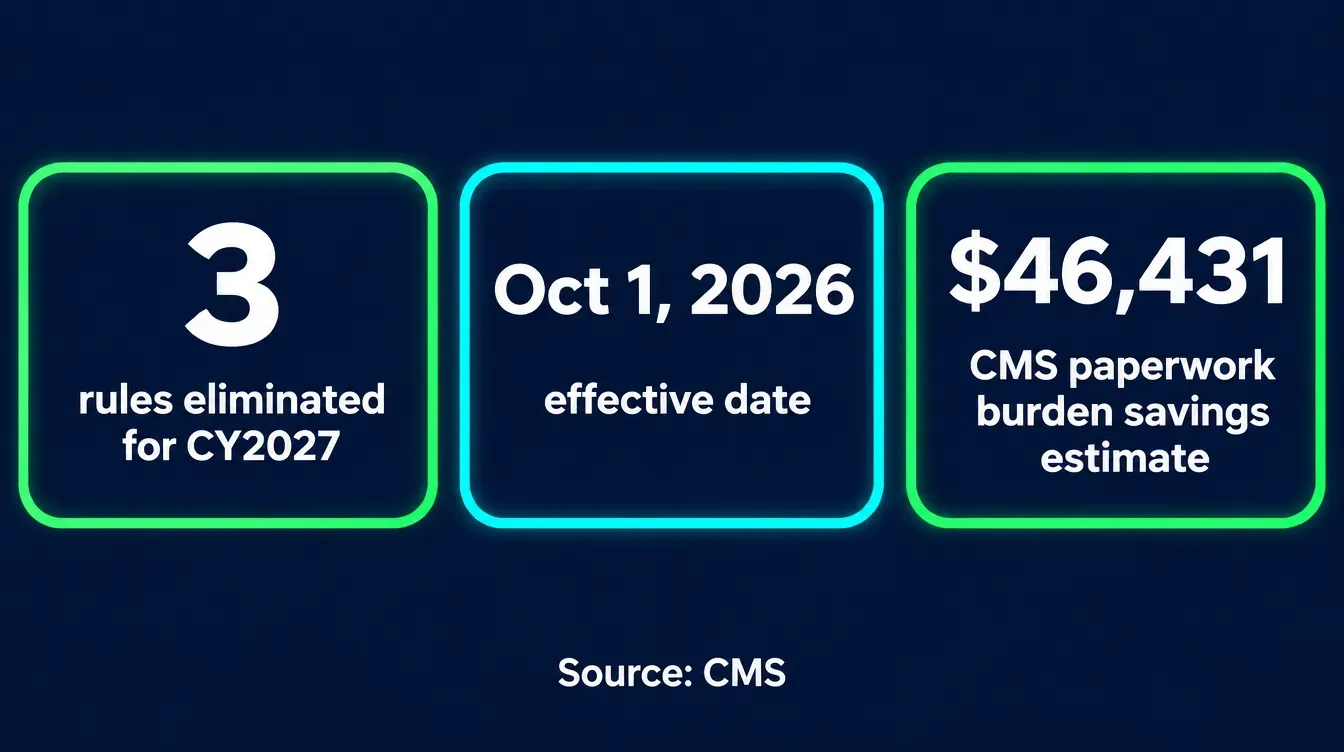
- CMS's CY2027 final rule (CMS-4212-F, RIN 0938-AV63, published in the Federal Register April 6, 2026) eliminates three "time and manner" restrictions on beneficiary outreach, effective for CY2027 marketing materials beginning October 1, 2026 (CMS, CY2027 marketing regulations slide deck, Center for Medicare, DSCM).
- You can again collect Scope of Appointment forms at educational events, move straight into a marketing event at the same location without a 12-hour gap, and schedule the personal appointment any time after the SOA is signed — no more federal 48-hour floor (same source).
- The back-to-back event format is explicitly conditioned on "appropriate beneficiary notification and opportunity to leave," and you still can't market a specific plan's benefits during the educational portion itself (CMS, CY2027 marketing regulations slide deck).
- These same three changes are projected by CMS's own economic analysis to remove 2,091 responses, 523 hours, and $46,431 in industry-wide paperwork burden — a real number from the agency's own Paperwork Reduction Act filing, not an estimate we generated (CMS-10837 Supporting Statement Part A).
- Ambrose's Routines can post a scheduled reminder to Slack, email, a GHL note, or a log entry, and client-vault can hold the signed SOA you now collect on-site — documented as a record-and-reminder mechanism, not an automated rule checker (Ambrose docs, Routines and Spokes catalog, fetched November 2026).
The pain: your event script is three years out of date, mid-AEP
Walk into most agencies’ seminar binders right now and you’ll find a script built around 2023’s rules: ask people to leave before you say anything about a specific plan, never put an SOA form on the table during the educational portion, and if someone wants to book a one-on-one, tell them you’ll call in two days once the 48-hour clock runs out. That script was correct. It was also replaced, on paper, back in April, and it changed in practice on October 1 — two weeks before this AEP started.
The agents actually affected aren’t the ones ignoring compliance. They’re the careful ones, the ones who trained their team hard enough on the old rule that nobody in the room thinks to question it anymore. A seminar organizer who’s run forty of these events the old way doesn’t go looking for a reason the format just got more flexible. They keep doing the thing that used to be required, because it still feels like the safe option, and in the meantime a prospect who wanted to sign an SOA on the spot gets told to wait for a callback that no longer has to happen.
This is about the event format, not the disclaimer or the recording rule
The same CY2027 rule package also updated the TPMO disclaimer and call-recording retention. Those have their own dedicated articles — TPMO Disclaimer 2027 and Medicare Call Recording Retention in 2027 — because they're separate operational rules with their own mechanics. This article is specifically about what you can now do with an educational event, a Scope of Appointment, and a follow-up appointment.
Why it happened: CMS reversed its own 2023 reversal
This isn’t a new rule appearing out of nowhere. It’s the third move in a regulatory back-and-forth that’s been running since 2023, and understanding the sequence is what makes the current rule make sense instead of feeling arbitrary.
In its April 12, 2023 final rule (CMS-4201-F, RIN 0938-AU96, 88 FR 22120), CMS reinstated a set of restrictions after a prior easing of the rules had produced an increase in marketing-related complaints. Per CMS’s own account of that rule, published in its Paperwork Reduction Act filing for the regulation, the agency reinstated “the prohibition on sales presentations following educational events,” reinstated “the prohibition on distribution and collection of Scope of Appointment and Business Reply Cards by agents at educational events” (modified to still let agents make business reply cards available, just not SOAs), and reinstated “the prohibition on conducting a sales/marketing or enrollment meeting with a beneficiary before 48 hours after the beneficiary’s initial consent to the meeting” — with carve-outs for beneficiaries who lacked transportation to come back, walk-ins who wanted to review plans immediately, and cases where the 48-hour wait would push someone’s enrollment into a new month (CMS, Supporting Statement Part A for CMS-10837).
Three years later, in its April 6, 2026 final rule (CMS-4212-F, RIN 0938-AV63, 91 FR 17384, also listed jointly with a companion rule as CMS-4208-F3/CMS-4212-F in CMS’s own newsroom fact sheet for the broader Contract Year 2027 package), CMS undid exactly those three provisions, describing the changes as designed “to improve the plan decision making process by creating a more convenient, beneficiary-friendly outreach experience and to reduce burden on beneficiaries, plans, and agents/brokers” and explicitly tying them to Executive Order 14192, “Unleashing Prosperity Through Deregulation,” signed January 31, 2025 (CMS, Supporting Statement Part A for CMS-10837). The proposed version of this rule (CMS-4212-P, RIN 0938-AV63) had published for comment on November 28, 2025 (90 FR 54894); CMS finalized all three provisions exactly as proposed, with no modifications.
The educational-event rule, four regulatory moves in four years
Each bar marks a Federal Register action; the rule tightened in 2023 and loosened again for CY2027
Source: CMS, Supporting Statement Part A for CMS-10837 (OMB 0938-1442), discussing CMS-4201-F (88 FR 22120) and CMS-4212-P/CMS-4212-F (90 FR 54894; 91 FR 17384).
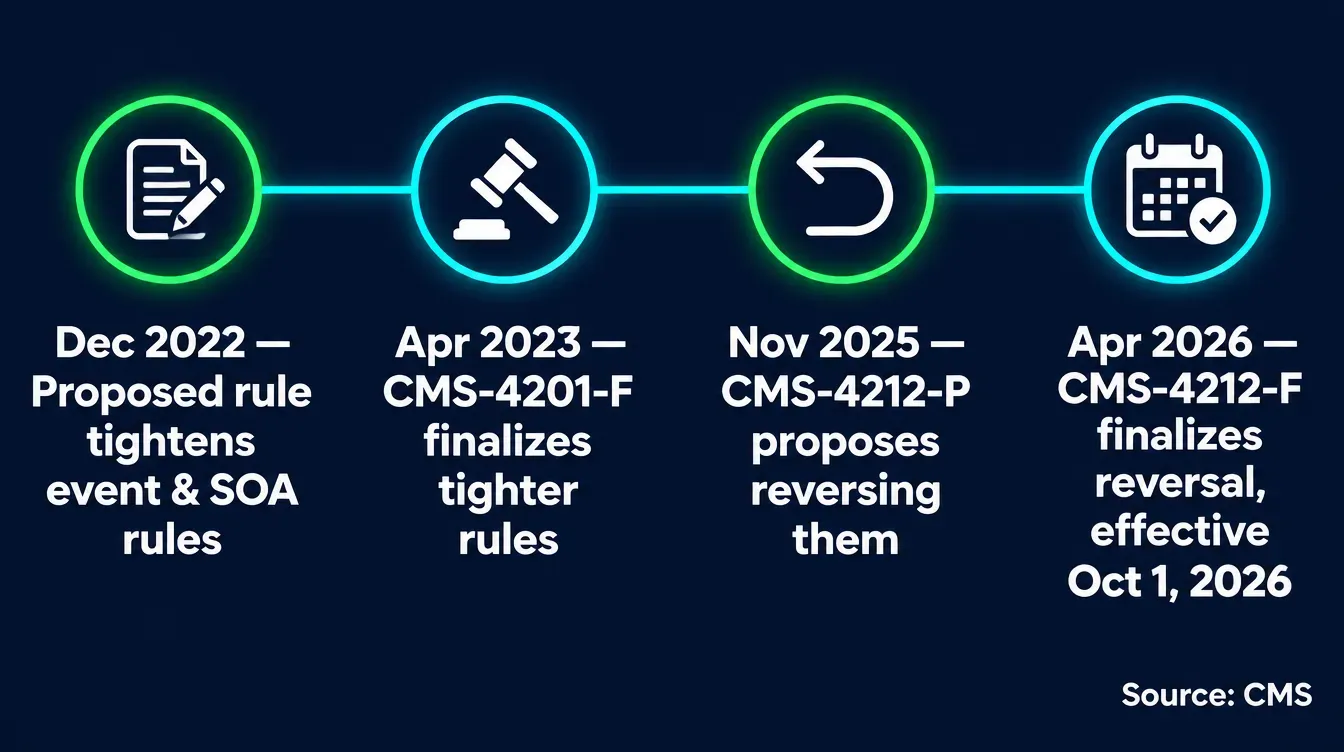
The practical lesson sits right there in the shape of the timeline: this exact rule has moved in both directions within a single presidential term. Whatever script you build today, build it so it’s easy to update again, because the federal floor on this specific question has already reversed itself once.
What exactly changed, rule by rule
Here’s the full six-item package CMS finalized for CY2027 marketing and communications materials, applicable starting October 1, 2026 (CMS, CY2027 marketing regulations slide deck, Center for Medicare, DSCM). The three in bold are the ones this article is about; the other three have their own coverage linked below.
| Change | What it does | Citation |
|---|---|---|
| Notice of Availability | Removed the duplicate requirement to send a language-assistance notice; HHS OCR already requires a similar one | §§422.2267(e)(31), 423.2267(e)(33) |
| Educational-to-marketing events | No more 12-hour gap at the same location, with notification and an opportunity to leave | §§422.2264(c), 423.2264(c) |
| Scope of Appointment timing | No more 48-hour wait between SOA completion and the personal appointment | §§422.2264(c)(3)(i), 423.2264(c)(3)(i) |
| SOA collection at educational events | No longer prohibited — agents can collect signed SOAs on-site | §§422.2264(c)(1)(ii)(D), 423.2264(c)(1)(ii)(D) |
| Advertising superlatives | Supporting documentation no longer required to accompany superlative claims unless CMS requests it | §§422.2262(a)(1)(i)–(ii), 423.2262(a)(1)(i)–(ii) |
| TPMO disclaimer | SHIP reference removed; verbal disclaimer required before benefits are discussed, not within the first minute | §§422.2267(e)(41), 423.2267(e)(41) |
Call-recording retention and the Mid-Year Supplemental Benefits Notice were part of the same broader rule but fall under different sections and aren’t part of this six-item marketing/communications list in CMS’s own framing; we cover call-recording retention separately since it’s an operational records question with its own timeline.
What still applies — read the condition, not just the green light
The part of this that’s easy to skim past is the condition CMS attached to the back-to-back format. The agency’s own language permits plans to hold marketing events “directly following educational events in the same location, provided there is appropriate beneficiary notification and opportunity to leave” (CMS, CY2027 marketing regulations slide deck). That’s not boilerplate. It’s the actual boundary of what’s allowed.
In practice, that means three things that didn’t change:
- No plan-specific marketing during the educational portion. The underlying distinction between an educational event (general information about Medicare, no specific plan pitch) and a marketing event (specific plan benefits, enrollment forms, a sales pitch) is still the operative line. What changed is how soon a marketing event can follow an educational one at the same address — not what’s allowed to happen inside the educational portion itself.
- You have to actually tell people the format is changing. “Opportunity to leave” implies a real announcement — something closer to “that’s the end of the educational portion; if you’d like to stay and hear about specific plans, you’re welcome to, and if you’d rather go, now’s the time” than a silent transition where the same slide deck keeps running.
- A real chance to leave, not a token one. If people are physically boxed into a seating arrangement, or the marketing portion starts before anyone’s had a moment to actually get up, that’s not the condition CMS described.
The condition is the deregulation. An event that skips the notification and the chance to leave isn't the kind of event CMS just loosened the rules for — it's just an undocumented marketing event.
Mike MooreWhat it costs to get this wrong — in both directions
There are two different ways to lose here, and they’re opposite mistakes.
Staying too conservative costs you signed business. If your team is still telling prospects “we can’t take your SOA here, we’ll call you in 48 hours,” you’re manufacturing friction that CMS specifically removed. Every SOA that goes home unsigned because of a rule that no longer exists is a prospect who has two more days to think it over, get a call from a competing agent, or simply forget to call back.
Skipping the notification costs you the protection the rule gives you. The whole point of the back-to-back format being newly allowed is that it comes with a condition attached. An event that moves from education to marketing with no clear announcement and no real chance to leave isn’t operating under the deregulated rule CMS just finalized — it’s just a marketing event that never filed as one, with whatever consequences that carries under your plan sponsor’s existing marketing-material review process.
The scale of what changed is also worth sitting with for a second, straight from CMS’s own numbers. In its Paperwork Reduction Act filing for this exact set of three changes, CMS’s own economic analysis projects the elimination removes 2,091 responses, 523 hours, and $46,431 in paperwork burden industry-wide, based on CMS’s standard business-operations-specialist wage estimate of $90.36 an hour, built from Bureau of Labor Statistics wage data for May 2025 (CMS, Supporting Statement Part A for CMS-10837). That’s a federal agency’s own estimate of how much friction it just took out of this specific process across every Medicare Advantage organization and Part D sponsor filing under it — not a number this article generated, and not a one-agent figure, but a useful sense of how seriously CMS itself treats this as a real operational change, not a minor technical tweak.
The manual fix: rewrite your event script in four moves, free, right now
None of this requires software, and the whole point of this section is that it works whether you ever touch Ambrose or not.
Move 1: Put the SOA back on the table at educational events
If your seminar binder still says “no SOA forms visible during the educational portion,” that instruction is from a rule that no longer exists for CY2027. You can make SOA forms available and collect signed ones at the educational event itself. What hasn’t changed: you still can’t discuss a specific plan’s benefits before that SOA is signed and the format has clearly shifted to the marketing portion.
Move 2: Drop the 48-hour callback script
If a prospect signs an SOA and wants to talk about specific plans right then, there’s no federal requirement to make them wait two days. Check your own carrier and FMO contracts first — several carriers kept stricter internal timing requirements even while the federal 48-hour floor was in effect, and nothing in the CY2027 rule forces a carrier to loosen its own contract terms. If your contract is silent or has already been updated, you can move straight into the conversation.
Move 3: Write an actual transition announcement, and use it every time
Draft one sentence you say out loud at every event, verbatim, something close to: “That’s the end of the general Medicare information — if you’d like to stay and hear about specific plans available in this area, you’re welcome to, and if you’d rather head out, now’s a good time.” Say it the same way every time, train everyone on your team who runs events to say it the same way, and don’t skip it because the room feels friendly and nobody’s reaching for their coat.
Move 4: Give people room to actually leave
Don’t schedule the marketing portion to start the second the educational slide deck ends. Build in even sixty seconds of a real pause — people standing up, moving toward the door, getting a coffee — before the pitch starts. “Opportunity to leave” is doing real work in CMS’s own language; treat it as an actual pause in the event, not a rhetorical offer.
Check your carrier contract before you assume the federal floor is the whole story
CMS eliminated the federal 48-hour SOA wait and the federal 12-hour event gap. Your specific carrier contracts, and any state-level marketing rules that go further than the federal floor, are separate questions, and a carrier can still require its own waiting period or its own event-format rules even where CMS no longer does. Pull your current carrier compliance guide before rolling out a new event script, not after.
Everything above works whether you ever touch Ambrose or join anything. It’s a script rewrite and a habit change, not a purchase.
Where Ambrose actually fits, and where it honestly doesn’t
Here’s the direct version. Ambrose isn’t a tool that listens to your seminar and tells you whether the transition announcement was clear enough, and this article isn’t going to pretend it is.
What it does have, per its own current documentation, is a genuine fit for the two unglamorous parts of this workflow that actually get skipped: remembering to log that you gave the notification, and having somewhere real to put the SOA you just collected on-site. Routines are scheduled prompts attached to an agent or a team, run on a standard cron schedule, with an optional output sink — the documentation currently lists Slack, email, a GHL note, or just a log entry, and it’s worth being precise here: it does not currently list Discord as an output option, even though an earlier description of this capability did (Ambrose docs, Routines, fetched November 2026). In practice, that means a routine that fires after your event’s scheduled end time, posting a short “did you log the transition notification for today’s seminar?” reminder to your team’s Slack channel, with the actual confirmation becoming a timestamped record rather than something that lives in one organizer’s memory.
The second fit is client-vault, documented as a client-facing enrollment and policy store (Ambrose docs, Spokes catalog, fetched November 2026). It’s a reasonable place to attach the signed SOA the same day you collect it at the event, instead of carrying a folder of paper back to the office and scanning it a week later when half the forms have gone missing.
The script rewrite from this article
- SOA forms are back on the table at educational events, collected on-site
- One verbatim transition announcement, said the same way every time
- A real pause before the marketing portion starts, not a rhetorical offer
- Works today, in any state, at zero cost
A scheduled reminder and a real place to file the form
- A Routine fires after each event, prompting the team to log the transition notification
- The confirmation posts to Slack as a timestamped record
- client-vault holds the signed SOA you collected on-site, attached to that client's record the same day
- Comes with one Ambrose seat included in the Tech Savvy membership
The honest version of this section
As documented this session, Ambrose doesn't audit your seminar for compliance in real time, and it doesn't know on its own whether your team actually said the transition line out loud. Routines remind and record on a schedule you set; client-vault stores and attaches documents you give it. Neither replaces the judgment call of whether a specific event's format matches CMS's condition — that's still yours to make, every time.
A quick word on AI and your event materials
If you’re using a general-purpose AI tool to draft the new transition announcement, your updated seminar slides, or a summary of which clients attended which event, treat that the same way you’d treat any other marketing material rewrite: someone reviews it before it goes out, and you keep a record of that review. The NAIC’s Model Bulletin on the Use of Artificial Intelligence Systems by Insurers, adopted December 2023, sets the expectation regulators increasingly apply to AI-assisted work generally — a written policy, human oversight before anyone acts on the output, and documentation you can produce if asked (NAIC, Insurance Topics: Artificial Intelligence, Model Bulletin). Don’t paste a specific attendee list or a specific client’s existing coverage details into a general-purpose chatbot to “clean up” your notes from an event — that’s exactly the kind of information our companion guide on what not to paste into ChatGPT walks through, and it’s a different question from drafting a generic transition script, which carries no client-specific data at all.
Does this change anything about who can attend an educational event?
No. CMS’s CY2027 rule is about the sequencing and timing between an educational event and a marketing event, and about Scope of Appointment mechanics — it doesn’t touch who’s eligible to attend an educational seminar in the first place, and it doesn’t change any state-level venue or notice requirements that might separately apply to public events. If your state has its own rules about educational-event advertising or venue disclosures, those sit on top of the federal floor this article covers, not in place of it.
What if my carrier hasn’t updated its own compliance guide yet?
Ask directly rather than assuming either answer. CMS’s federal floor changed for CY2027 marketing materials as of October 1, 2026, but a carrier’s own compliance manual, FMO script library, or marketing-material review process is a separate document that it controls, and some organizations take longer to update internal guidance than the federal rule itself takes to go into effect. Running an event under the old, more conservative script isn’t a violation of anything — CMS’s changes are permissions, not requirements — so if you’re not sure your carrier has caught up, the conservative version is still a legal fallback while you confirm.
What you get by joining
One Ambrose seat, including Routines and client-vault, comes with a Tech Savvy Insurance membership: $97 a month, billed monthly, cancel anytime, founding rate locked in while the membership stays active. Alongside the seat: weekly Zoom calls with open Q&A and build-with-you sessions, 30-plus hours of recorded training, Meta Ads and AI training built for this industry specifically, pre-built AI templates and bot deployments, and a free annual in-person member workshop. It’s also an explicit no-recruiting zone — you can ask a specific question about whether your seminar format actually qualifies for the new rule without ending up on someone’s downline pitch list, which is a genuine point of difference from most agent Facebook groups.
Ambrose usage runs separately from the $97 seat
The membership includes one Ambrose seat; usage inside Ambrose runs through its own credit ledger with spend caps, so cost stays visible instead of showing up as a surprise. See the full Spokes catalog for what else is available beyond Routines and client-vault.
Collect SOAs at the educational event itself
No longer prohibited — bring the forms, collect signatures on-site.
Drop the 48-hour callback script
Check your carrier contract first, then move straight into the conversation.
Say the same transition line every time
One verbatim announcement, trained across your whole team.
Build in a real pause before marketing starts
An actual opportunity to leave, not a rhetorical offer.
Let a Routine remind your team to log it
A scheduled nudge posted to Slack, not a step everyone trusts memory for.
File the on-site SOA the same day
client-vault holds it, attached to the right client's record.
Get your event script current before your next seminar
The four moves above work whether you ever join anything or not. If you'd rather have a Routine already reminding your team and client-vault already holding the forms, with people watching your screen while you set it up, one Ambrose seat comes with the Tech Savvy membership.
Join Tech Savvy — $97/monthThe close
Three restrictions that were law for three straight AEPs are gone for this one, and the agents who haven’t updated their event script are leaving signed SOAs on the table for no reason. Rewrite the transition line this week, say it the same way at your next seminar, and if you want a Routine already reminding your team and client-vault already holding the forms, that’s what a Tuesday call in the Tech Savvy community looks like. $97 a month, cancel anytime, and nobody will pitch you a downline: https://techsavvyinsurance.com/.
Before you rely on any figure in this article
Tech Savvy Insurance is a training and software community, not an insurance company, agency, or law firm, and does not provide insurance, legal, tax, or compliance advice. You are responsible for your own licensure and for complying with all applicable CMS marketing rules, your specific carrier and FMO contracts, state insurance department requirements, HIPAA, and the current CY2027 TPMO disclaimer obligations covered in our companion article. Regulations and carrier guidance change — confirm current requirements directly with your carrier's compliance department or qualified legal counsel before relying on any figure in this article. AI outputs, including any AI-assisted drafting of event scripts or materials, may contain errors — always verify. Results may vary.
Frequently asked questions
Sources
- CMS — CY2027 Changes to the Medicare Advantage Organization and Medicare Drug Plan Sponsors Marketing Regulations (slide deck, Center for Medicare, DSCM) — cms.gov
- CMS — Supporting Statement Part A, Communications and Marketing Provisions (CMS-10837, OMB 0938-1442) — cms.gov
- CMS — Newsroom Fact Sheet: Contract Year 2027 Medicare Advantage and Part D Final Rule — cms.gov
- Ambrose docs — Routines — app.hiambrose.com
- Ambrose docs — Spokes catalog — app.hiambrose.com
Ready to put this into practice?
Join a private community of Health & Life insurance professionals using AI, Meta Ads, and automation to grow — without draining their bank account.
Join Tech Savvy — $97/month