
Short answer: build an objection taxonomy, score calls against it every week, and review two or three calls per agent in a short, structured session — because CMS already requires you to record every Medicare marketing, sales, and enrollment call in its entirety, which means the raw material for coaching is sitting in your call vendor’s archive right now, untouched. Everything below is the manual version of that system, what it costs when nobody builds it, and what Ambrose’s documented call intelligence pipeline automates once the manual version stops scaling.
Key takeaways
- 42 CFR §§ 422.2274(g) and 423.2274(g) require every Medicare marketing, sales, and enrollment call to be recorded in its entirety — the audio already exists, whether or not anyone reviews it for coaching (CMS, 2026 Agent and Broker Training & Testing Guidelines).
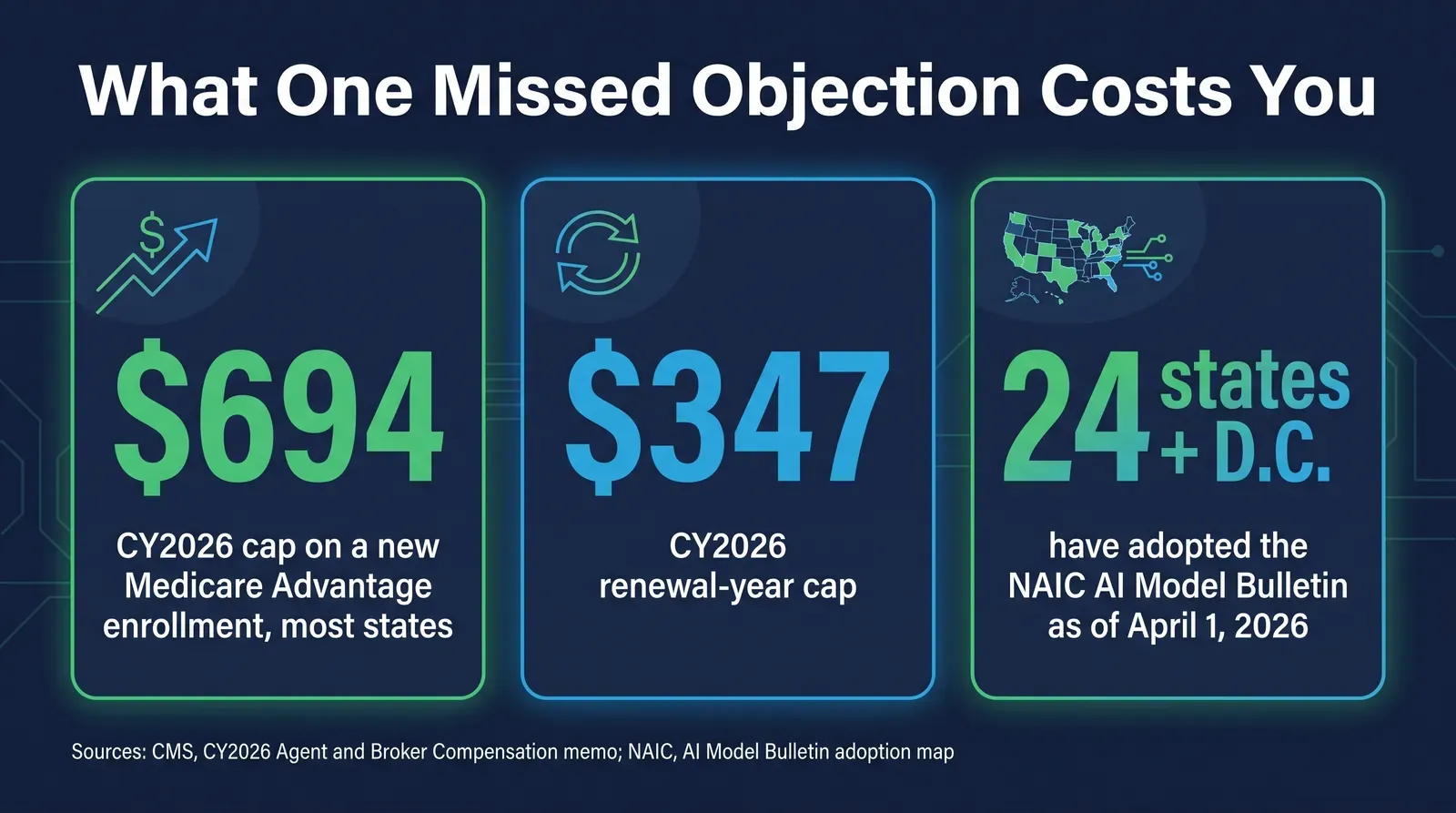
- CMS set the CY2026 fair market value compensation cap at $694 for a new Medicare Advantage enrollment in most states, $347 for a renewal — the real dollar ceiling on what a single lost call is worth (CMS, Contract Year 2026 Agent and Broker Compensation Rates memo, June 18, 2025).
- As of April 1, 2026, 24 states plus D.C. have adopted the NAIC's AI Model Bulletin, which expects written policy and human oversight before an AI-generated call score drives a real decision (NAIC, Implementation map).
- An objection taxonomy — a fixed set of tags like price, timing, and network fit — turns forty agents' worth of vague pushback into something you can actually count and coach against.
- A weekly 30-minute review of two or three calls per agent is small enough to actually happen; the real limit on manual coaching isn't willingness, it's how many calls one person can listen to.
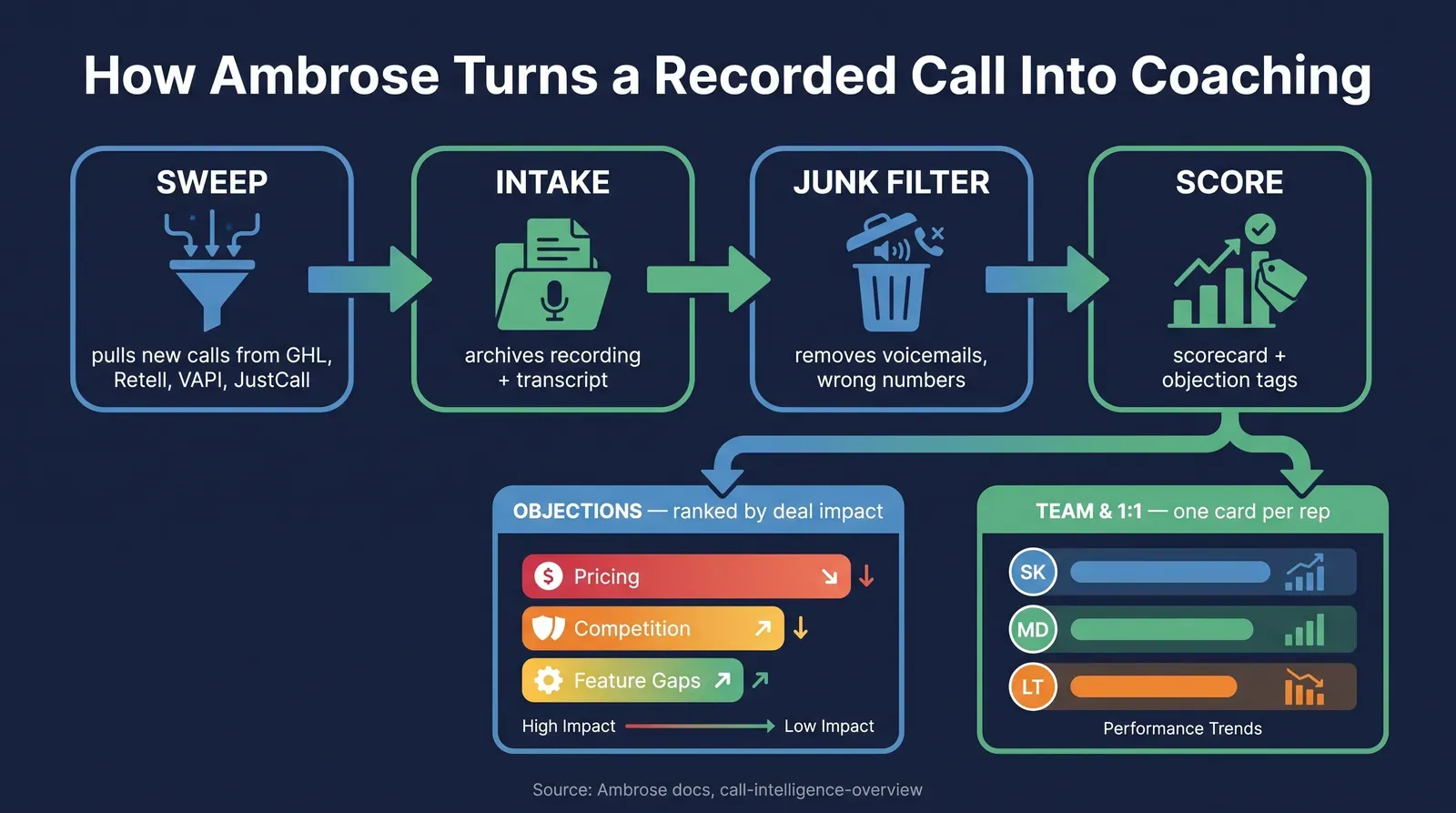
- Ambrose's documented Call Intelligence pipeline sweeps, transcribes, filters, and scores calls against your own scorecard and taxonomy automatically, then surfaces objections ranked by deal impact and one card per rep (Ambrose docs, call-intelligence-overview; call-objections-team).
The coaching gap nobody talks about
A new agent gets a script, a login, and a live phone line. Nobody sits with them for the first ten calls, because nobody has ten spare hours that week — the agency owner is on a carrier call, the sales manager is running the pipeline meeting, and the new hire is on their own the moment the first prospect picks up. When a call goes sideways, the only evidence anyone has is the close rate at the end of the month. Was it the rate objection they fumbled? The “let me talk to my husband” they didn’t know how to handle? The moment they went quiet when a prospect asked about a specific provider network? Nobody knows, because nobody listened.
This isn’t a training problem in the usual sense — most agencies do run an onboarding script, a certification test, a shadow day. It’s a feedback problem. Training happens once, up front. Coaching is supposed to happen every week, on real calls, with specifics. And specifics are exactly what falls off first when a manager’s calendar fills up, because reviewing calls by hand takes real, uninterrupted time that a growing agency rarely has lying around.
The frustrating part is that the raw material for real coaching already exists. If your team sells Medicare Advantage, Medicare Supplement, or Part D plans, federal law already requires every one of those sales calls to be recorded. That’s not a nice-to-have compliance feature some vendor upsold you on — it’s baked into 42 CFR §§ 422.2274(g) and 423.2274(g), and CMS’s own 2026 Agent and Broker Training & Testing Guidelines list “requirement to record all marketing, sales, and enrollment calls, including those calls made by TPMOs that work on organization’s behalf” as a required training topic every agent and broker has to be tested on (CMS, 2026 Agent and Broker Training & Testing Guidelines). The recording isn’t optional. What happens to it after the call ends usually is.
Why managers can’t coach at scale by hand
Manual call review isn’t a discipline problem — it’s a math problem. A sales manager running six agents, each taking twenty calls a day, is looking at well over five hundred calls a week. Listening to even a handful of full calls per agent, taking notes, and preparing specific feedback is genuinely a multi-hour task, and that’s before the manager’s own selling, hiring, and carrier-relationship work. Ride-along coaching — sitting next to a new agent and listening live — works for the first five or six hires. It doesn’t survive a team doubling in size, because there’s exactly one manager and twice as many live calls happening at once.
So the calls get recorded, because CMS requires it, and then they get archived, because that satisfies the retention requirement — and that’s usually where the process stops. The recording exists to answer an auditor’s question, not a coaching question. Nobody goes back in unless a complaint forces them to. That’s the gap: the compliance obligation and the coaching opportunity are sitting on the exact same audio file, and most agencies only ever use it for the first one.
This is a Medicare-specific mandate, not a universal one
The recording requirement in 42 CFR §§ 422.2274(g) and 423.2274(g) applies to Medicare marketing, sales, and enrollment calls specifically. If your book includes ACA marketplace or life insurance business, check your own state's rules and your carrier or FMO's requirements — some layer on their own recording or retention expectations for those lines, but it isn't the same federal mandate discussed in this article.
What a missed objection actually costs
Every call that ends in “I’ll think about it” and never comes back isn’t just an awkward moment — it’s a specific number. CMS recalculates the fair market value (FMV) compensation cap every contract year under 42 CFR §§ 422.2274(d) and 423.2274(d), and for CY2026 it set the ceiling at $694 for an initial Medicare Advantage enrollment in most states, with renewal-year compensation capped at half that, $347. The cap runs higher in a handful of states with historically higher costs: $781 initial / $391 renewal in Connecticut, Pennsylvania, and D.C.; $864 initial / $432 renewal in California and New Jersey; $474 initial / $237 renewal in Puerto Rico and the U.S. Virgin Islands (CMS, Contract Year 2026 Agent and Broker Compensation Rates memo, June 18, 2025).
| Region | Initial year (max) | Renewal years (max) |
|---|---|---|
| National (most states) | $694 | $347 |
| Connecticut, Pennsylvania, D.C. | $781 | $391 |
| California, New Jersey | $864 | $432 |
| Puerto Rico, U.S. Virgin Islands | $474 | $237 |
Put a real number next to a real pattern and the case for coaching stops being abstract. If a rep is consistently losing calls at the same point — a rate objection they answer defensively instead of with a real comparison, a network question they can’t answer without putting the prospect on hold — that’s not one lost sale, it’s a repeatable leak, worth up to $694 in commission per occurrence in most states, every single time it happens uncorrected. A manager who can point to that pattern in a specific call, not a vague monthly close-rate number, is coaching against something the agent can actually fix on the next call.
Build your own objection taxonomy by hand
None of what follows requires software. It requires a spreadsheet and the discipline to fill it in the same way every week.
Start by picking a short, fixed list of objection categories — six to twelve, no more, or the taxonomy gets too granular to spot a pattern in. A workable starting set for Medicare and ACA sales looks like this:
| Category | What it sounds like | What's actually being asked |
|---|---|---|
| Price / premium | "That's more than I'm paying now." | Show the total cost picture, not just the premium line. |
| Timing | "Let me think about it and call you back." | Usually a deadline or urgency question, not a real "no." |
| Spousal / third-party approval | "I need to talk to my husband first." | Whether the decision-maker was actually on the call. |
| Network / provider fit | "Is my doctor in this plan?" | A specific, checkable fact the agent should have ready. |
| Trust in switching | "I've had my plan for years, why change now?" | What's genuinely different and better, in plain terms. |
| Loyalty to current agent | "I already have someone who handles this." | Whether the current agent has actually reviewed this year's plan changes. |
| Confusion / overwhelm | "There are just too many options." | A narrower recommendation, not more choices. |
Tag every call — won or lost — with one primary category, in a column next to the date, the rep, and the outcome. After a few weeks, sort by category and look at win rate per category, not just objection frequency. A category that comes up rarely but never converts is a bigger problem than one that comes up constantly but usually gets handled — frequency alone is misleading; what costs deals is what matters.
Don't force a call into a category that doesn't fit
The first few weeks, you'll hit objections that don't cleanly match your starter list. Add a category rather than jamming it into the closest existing one — a taxonomy that gets stretched to fit everything stops telling you anything specific. Review and prune the list every quarter; a tag nobody's used in two months isn't earning its place.
Run a manual weekly call review
Once you’re tagging calls, the review structure itself should be small enough to actually survive a busy month. A workable format: one 30-minute session per agent per week, built around two or three calls picked from that week — ideally one win and one loss in the same objection category, so the comparison is direct. Walk through what the agent did well first, name one specific thing to change, and set a concrete goal tied to the next five calls, not a vague “do better.” Write the goal down. Check it at the next session before picking new calls.
This is deliberately smaller than a full call audit. The point isn’t exhaustive coverage — it’s a specific, repeatable habit that happens every single week, because a thorough review that only happens when there’s time left over stops happening the moment the agency gets busy, which is exactly when coaching matters most.
Pick calls from the taxonomy, not at random
Choose one call from the rep's most common objection category and one from wherever their win rate is lowest. Random sampling tells you less than a deliberate pull from the pattern you already logged.
Name one fix, not five
An agent walking away with one specific, practiced change is more likely to actually change than one handed a list. Save the rest for next week.
Set a goal against the next five calls
"Answer the network question before the prospect has to ask twice, on your next five calls" is checkable. "Handle objections better" isn't.
Log the session, not just the score
A one-line note — date, category discussed, goal set — turns four weeks of sessions into a record you can actually compare, instead of four disconnected conversations.
This works at five or six agents. It gets genuinely hard to sustain by hand somewhere past ten, simply because the manager doing the tagging, the picking, and the sessions is also running the agency — which is the exact bottleneck the next section is about.
The compliance layer you can’t skip
Recording the call is only step one of what CMS expects. Organizations and any TPMO operating on their behalf must also train and test their agents and brokers annually on Medicare rules, plan benefits, and marketing regulations, and keep records of that training program available for CMS to review on request (CMS, 2026 Agent and Broker Training & Testing Guidelines). A coaching system built on top of your recorded calls is a natural way to demonstrate that ongoing training is actually happening, not just a certificate from onboarding sitting in a file.
If any part of your coaching workflow involves an AI tool scoring calls, flagging objections, or generating a scorecard, that’s an AI system touching your sales process — and the regulatory ground under that has shifted fast. As of April 1, 2026, the NAIC map of Model Bulletin adoption shows 24 states plus D.C. have formally adopted the Model Bulletin on the Use of Artificial Intelligence Systems by Insurers, with California, Colorado, New York, and Texas operating their own separate insurance-specific AI guidance (NAIC, Implementation of NAIC Model Bulletin map). The expectation across those frameworks is consistent: written policy, human oversight, and documentation before an AI-generated output drives a real decision about a person — in this case, a rep’s coaching or performance record.
A call score is a coaching input, not a verdict
Treat an AI-generated call score the way you'd treat a first-draft performance review: a starting point a manager reads, checks against the actual recording, and applies judgment to — not a number that goes straight into a personnel file unreviewed. That's the human-oversight expectation the NAIC bulletin describes, and it's good practice independent of any specific state's adoption status.
There’s also a PHI question worth naming directly, since Medicare sales calls routinely include health information tied to a name — a diagnosis, a plan enrollment, sometimes a Medicare Beneficiary Identifier. If a call-scoring tool or the vendor behind it processes that information, the same Business Associate Agreement question applies as it does to any AI tool touching PHI: does your agency have a signed BAA with that specific vendor, covering that specific feature. This site walks through that check in detail in a separate article — What Not to Paste Into ChatGPT: An Agent’s HIPAA Guide — and the same logic applies here: confirm the agreement before real client data flows through any scoring tool, including one built into your call-recording vendor.
How Ambrose turns the calls you already record into a coaching system
This is the exact gap Ambrose’s documented Call Intelligence feature is built to close — not a separate call-recording product, but a layer that runs on the calls your agency is already capturing. According to Ambrose’s own documentation, the pipeline runs in four steps: Sweep, which locates calls newer than the previous run from connected sources like GHL, Retell, VAPI, or JustCall; Intake, which archives the recording and gets a transcript — using the provider’s own transcript when Retell, VAPI, or JustCall already returns one, and falling back to transcription only when no usable transcript exists; Junk Filter, which removes voicemails, no-answers, and wrong numbers before anything gets scored; and Score, which evaluates the conversation against the scorecard template matching that call type and tags the objections it heard (Ambrose docs, call-intelligence-overview).
The scoring itself runs against your agency’s own configuration, not a generic one-size-fits-all rubric. The documentation describes four default scorecard templates — Medicare closing, appointment setting, ACA enrollment, and a general methodology scorecard for everything else — with the analyzer picking whichever matches the call type automatically. The objection taxonomy starts with fourteen predefined tags, and when the analyzer hears something that doesn’t fit any of them, it proposes a new tag rather than forcing a wrong match (Ambrose docs, call-intelligence-config). Both live in your agency’s vault as editable configuration files — once you’ve customized them, “it is your agency’s own copy — platform updates never overwrite it,” per the same documentation — which means the taxonomy you started by hand in a spreadsheet earlier in this article is exactly the kind of thing you’d import as a starting point rather than rebuild from scratch.
The output is where the manual weekly-review process above stops being manager-dependent. The Objections view ranks tags by deal impact — stalled or lost deals — instead of raw frequency, which is the same “what actually costs deals, not what comes up most” principle this article’s taxonomy section describes, just computed automatically across every tagged call instead of a spreadsheet a manager sorts by hand. The Team & 1:1 view gives one card per rep: call volume, average score, goal-met rate, most common objection, and any compliance incidents — documented as designed so a manager can “walk into a one-to-one already knowing what to fix” (Ambrose docs, call-objections-team). The documentation is also honest about a real limit worth repeating here: three analyzed calls isn’t a pattern, for Ambrose or for a human reviewer — the system flags low sample sizes rather than presenting thin data as a confident trend.
On the compliance side, every recording, transcript, and analysis is written to the agency’s vault at a documented path, with the underlying audio always archived even when a transcript already exists — “an analysis that was not written to the vault did not happen,” as the documentation puts it (Ambrose docs, call-intelligence-overview) — which is the same kind of audit trail a state insurance department or CMS reviewer would expect to see behind an agency’s training and coaching program.
The manual version above still works if you don't use Ambrose at all
The taxonomy, the weekly review structure, the focus on deal-impact over frequency — none of it requires a platform. What Ambrose removes is the ceiling on how many calls one manager can personally listen to and tag every week. If your team is small enough that a spreadsheet still works, it's genuinely fine to keep using one.
What you get by joining
One Ambrose seat — including the Call Intelligence pipeline described above — comes with a Tech Savvy Insurance membership: $97 a month, billed monthly, cancel anytime, founding rate locked in while the membership stays active. Alongside the seat: weekly Zoom calls with open Q&A and build-with-you sessions, 30+ hours of recorded training, Meta Ads and AI training built for this industry specifically, pre-built AI templates and bot deployments, and a free annual in-person member workshop — plus an explicit no-recruiting rule, so setting up your agency’s own scorecard on a Tuesday call doesn’t turn into a downline pitch.
Ambrose usage runs through its own credit ledger separate from the $97 membership fee, so it’s worth understanding what a real coaching workload costs before assuming it’s unlimited — that’s exactly the kind of setup question the weekly calls are built to walk through with you, screen open, before you commit your whole team’s calls to it.
See what your recorded calls are already telling you
Everything above — the taxonomy, the weekly review, the deal-impact framing — works whether you join anything or not. If you'd rather have it running automatically on calls you're already recording, with a manager's card ready for every 1:1, one Ambrose seat comes with the Tech Savvy membership.
Join Tech Savvy — $97/monthSources and the fine print
Every figure in this article is traceable to a primary source fetched and confirmed live during the session this article was written: CMS’s own 2026 Agent and Broker Training & Testing Guidelines and its Contract Year 2026 Agent and Broker Compensation Rates memorandum, and the NAIC’s own Model Bulletin adoption map. The full list, with links, is in the Sources section below.
Before you rely on any figure in this article
Tech Savvy Insurance is a training and software community, not an insurance company, agency, or law firm, and does not provide insurance, legal, tax, or compliance advice. You are responsible for your own licensure and for complying with all applicable CMS, HIPAA, NAIC, state, and carrier regulations. Compensation caps, state AI-bulletin adoption, and recording requirements change — confirm current requirements with your agency's compliance officer, your carrier, or qualified legal counsel before relying on any figure here. AI-generated outputs, including any call score, may contain errors: always verify before it drives a real decision. Results may vary.
Frequently asked questions
Sources
- CMS — 2026 Agent and Broker Training & Testing Guidelines — cms.gov
- CMS — Contract Year 2026 Agent and Broker Compensation Rates, Referral/Finder's Fees, Submissions, and Training and Testing Requirements memo (June 18, 2025) — ritterim.com
- NAIC — Implementation of NAIC Model Bulletin: Use of Artificial Intelligence Systems by Insurers (status as of April 1, 2026) — content.naic.org
- Ambrose docs — Call Intelligence overview — app.hiambrose.com
- Ambrose docs — Objections & Team / 1:1 — app.hiambrose.com
- Ambrose docs — Scorecards & objection taxonomy config — app.hiambrose.com
- Ambrose docs — What is Ambrose — app.hiambrose.com
Ready to put this into practice?
Join a private community of Health & Life insurance professionals using AI, Meta Ads, and automation to grow — without draining their bank account.
Join Tech Savvy — $97/month