
CMS finalized a rule that lets HHS demand your ACA marketing materials on request, for monitoring, audit, or enforcement purposes, effective since July 20, 2026 — and a federal court that stayed eight other pieces of the same rule left this one standing. If you can’t produce the ad, the landing page, or the script HHS asks about, inside whatever window the request gives you, you’re not dealing with a hypothetical anymore. You’re dealing with a documented gap during the exact season — the 2027 Open Enrollment Period, open now through January 15, 2027 — when CMS has made clear it’s looking.
Key takeaways
- CMS's 2027 Notice of Benefit and Payment Parameters (CMS-9883-F) requires agents, brokers, and web-brokers to provide marketing materials to HHS on request, codified at 45 CFR 155.220(j)(3), effective July 20, 2026 (CMS, Fact Sheet; Federal Register, FR Doc. 2026-10050).
- A federal court stayed eight other provisions of this same rule in July 2026 — the marketing-documentation and consent-form requirements were not among them, per CMS's own published list (CMS CCIIO, Statement Regarding the City of Columbus v. Kennedy, July 31, 2026).
- A separate, new consumer consent form requirement (155.220(j)(2)(ii)-(iii), 155.335(j)) is already finalized but delayed — you must use it starting with plan years beginning on or after January 1, 2028 (CMS, Fact Sheet).
- This is a different rule from the September 2026 registration moratorium and the CMS-9884-F termination standard we already covered — see The ACA Broker Moratorium for that one.
- Ambrose can't reconstruct a marketing material you never saved, but agent-vault plus a scheduled Routine can build the archive habit this rule now requires, going forward.
What changed: CMS can now ask for your marketing materials, by name
CMS’s 2027 Notice of Benefit and Payment Parameters is the kind of rule that mostly talks about issuers, risk adjustment, and plan design — hundreds of pages, most of them nowhere near your day-to-day. Buried inside it is a provision that talks directly to you. CMS’s own fact sheet for the final rule states plainly that the agency is “finalizing requirements for timely production of marketing materials” and that the purpose is explicit: “for monitoring, audit, and enforcement purposes” (CMS, Fact Sheet: HHS Notice of Benefit and Payment Parameters for 2027 Final Rule). Read that sentence the way a compliance reviewer would. It doesn’t say CMS might ask. It says the production requirement exists because CMS intends to monitor, audit, and enforce — three different activities, three different reasons your file might get a request.
The rule also tightens the definition of what you can’t say while you’re marketing. CMS’s fact sheet lists specific prohibited practices it finalized alongside the production requirement: “providing cash, monetary rebates, or cash equivalents to induce consumers to enroll,” “falsely asserting or suggesting that consumers will always qualify for zero-dollar insurance or zero-dollar premiums,” and “miscommunicating enrollment timelines and deadlines.” Those three examples aren’t abstractions. They’re close to word-for-word versions of ad copy that’s been running on Meta and Google for ACA leads for years — “zero-dollar plans,” countdown-style enrollment deadlines, gift-card-for-a-quote offers. If your current creative touches any of those three lanes, this rule is not background reading.
Put the two pieces together and the practical shift is this: it’s no longer enough to not say a prohibited thing. You now need to be able to show, on request, exactly what you did say, when, and where — because the rule assumes HHS will ask, and gives it the authority to.
This isn't the broker moratorium article
If you read our ACA Broker Moratorium piece, you already know CMS paused new agent and broker registration on the Federally-facilitated Exchanges in September 2026 and lowered the evidentiary bar for terminating an existing agreement. That's a different rule (CMS-9884-F and a separate interim final rule, Federal Register Doc. 2026-19493) solving a different problem: who gets to register, and how CMS proves a violation once it finds one. This article is about an earlier piece of the puzzle — what CMS requires you to keep, so there's something to review in the first place.
Why this is happening now: a crackdown with the marketing layer built in
This provision didn’t appear in isolation. CMS has spent 2026 treating ACA agent and broker conduct as its central enforcement story for the Marketplace, and the marketing-documentation requirement is the piece that makes the rest of that story auditable going forward. The registration moratorium, the lowered termination standard, and a wave of publicized enrollment cancellations tied to broker misconduct all landed in the same stretch of months — we covered the registration and termination pieces in depth already, so we won’t re-run those numbers here. What matters for this article is the throughline: CMS built an enforcement apparatus first, then built the paperwork requirement that feeds it.
That sequencing explains something agents keep getting backwards. The production requirement isn’t really a new restriction on what you can run — Meta and Google already police most of the same prohibited-practice categories through their own ad policies, which is why “zero-dollar plan” creative has been getting rejected on Meta long before this rule existed. What’s new is that the record of what you ran is now something a federal regulator can compel, separate from whatever the ad platform itself retains or deletes. An account suspension doesn’t delete CMS’s interest in what that account published while it was live.
Meta's ad policy already tells you what not to say. This rule is about whether you can prove, months later, exactly what you did say — and Meta's ad library isn't going to do that job for you once a campaign ends.
Mike MooreThere’s also a litigation wrinkle worth understanding, because it’s easy to assume “the courts blocked the 2027 rule” covers everything in it. It doesn’t. On July 16, 2026, the U.S. District Court for the District of Maryland stayed a specific, named list of provisions from this same rule in City of Columbus v. Kennedy. CMS published exactly what was stayed in a July 31, 2026 statement: the failure-to-file-and-reconcile policy, two income-verification provisions, the SEP-verification rollback, out-of-pocket limit expansions for bronze and catastrophic plans, catastrophic-plan eligibility expansion, provider-access review flexibilities for certain Federally-facilitated Exchange states, network-adequacy relaxation for state-based exchanges, a non-network QHP addition, and the elimination of standardized plan requirements (CMS, Statement Regarding the City of Columbus v. Kennedy, July 31, 2026). That’s a long, specific list — and the marketing-materials production requirement and the consent-form requirement, both sitting in 155.220(j), are not on it. Litigation over other parts of this rule is still live. The part that affects your marketing file is not currently part of that fight.
The rule itself: who it covers, what it requires, and when
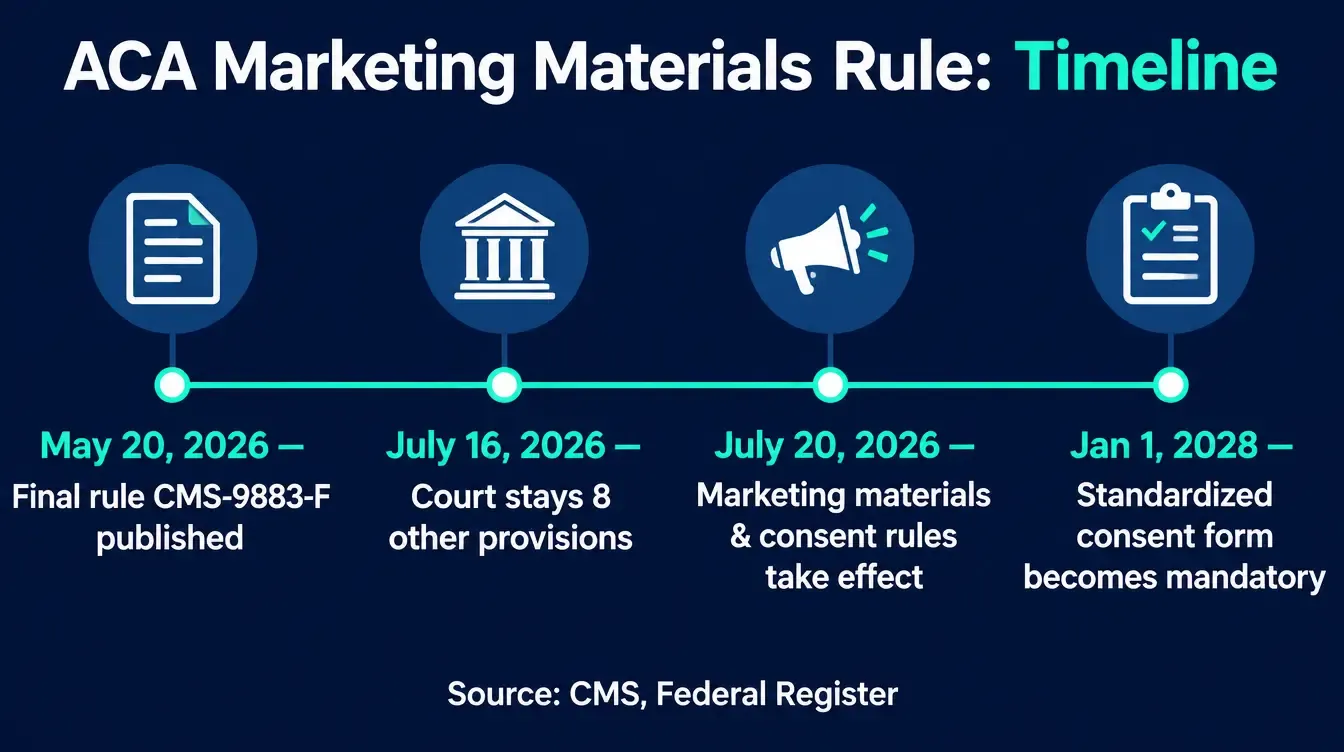
The production requirement lives at 45 CFR 155.220(j)(3), added by CMS-9883-F — officially “Patient Protection and Affordable Care Act; HHS Notice of Benefit and Payment Parameters for 2027; and Basic Health Program” — published in the Federal Register on May 20, 2026 as FR Doc. 2026-10050, at 91 FR 29526 (Federal Register via GovInfo). The rule took effect July 20, 2026, per CMS’s own fact sheet. The companion consent-form requirement sits at 155.220(j)(2)(ii) and (iii), with a related provision at 155.335(j).
Both provisions apply to the same population: agents, brokers, and web-brokers who help consumers with Marketplace enrollment. CMS’s fact sheet language doesn’t carve out an exemption for state-based exchange states the way the separate registration moratorium explicitly did — these are general Part 155 standards, not FFE-specific ones. If you work a state-run exchange and want certainty on your specific state’s posture, that’s a question for your state exchange’s own agent materials, not an assumption either way.
| Requirement | CFR section | Effective / compliance date | Stayed by Columbus II? |
|---|---|---|---|
| Produce marketing materials to HHS on request | 45 CFR 155.220(j)(3) | July 20, 2026 | No — in effect |
| Use HHS-approved consumer consent form | 45 CFR 155.220(j)(2)(ii)-(iii) | Plan years beginning on or after Jan. 1, 2028 | No — finalized, compliance date delayed |
| Use HHS-approved eligibility application review process | 45 CFR 155.335(j) | Plan years beginning on or after Jan. 1, 2028 | No — finalized, compliance date delayed |
| Prohibited marketing practices (cash inducements, false zero-dollar claims, timeline miscommunication) | 45 CFR 155.220(j) (conduct standards) | July 20, 2026 | No — in effect |
| Standardized plan requirement, separate Part 155/156 provisions | 45 CFR 155.20, 155.205(b)(1), 155.220(c)(3)(i)(H), 156.201, 156.202, 156.265(b)(3)(iv) | Scheduled July 20, 2026 | Yes — stayed July 16, 2026 |
That last row is in the table deliberately — it’s the kind of provision agents sometimes assume is in the same bucket as the marketing rules simply because it’s in the same final rule. It isn’t. Treat each provision in this rule on its own citation, not by what else shipped alongside it.
What counts as a “marketing material” you need to be able to produce
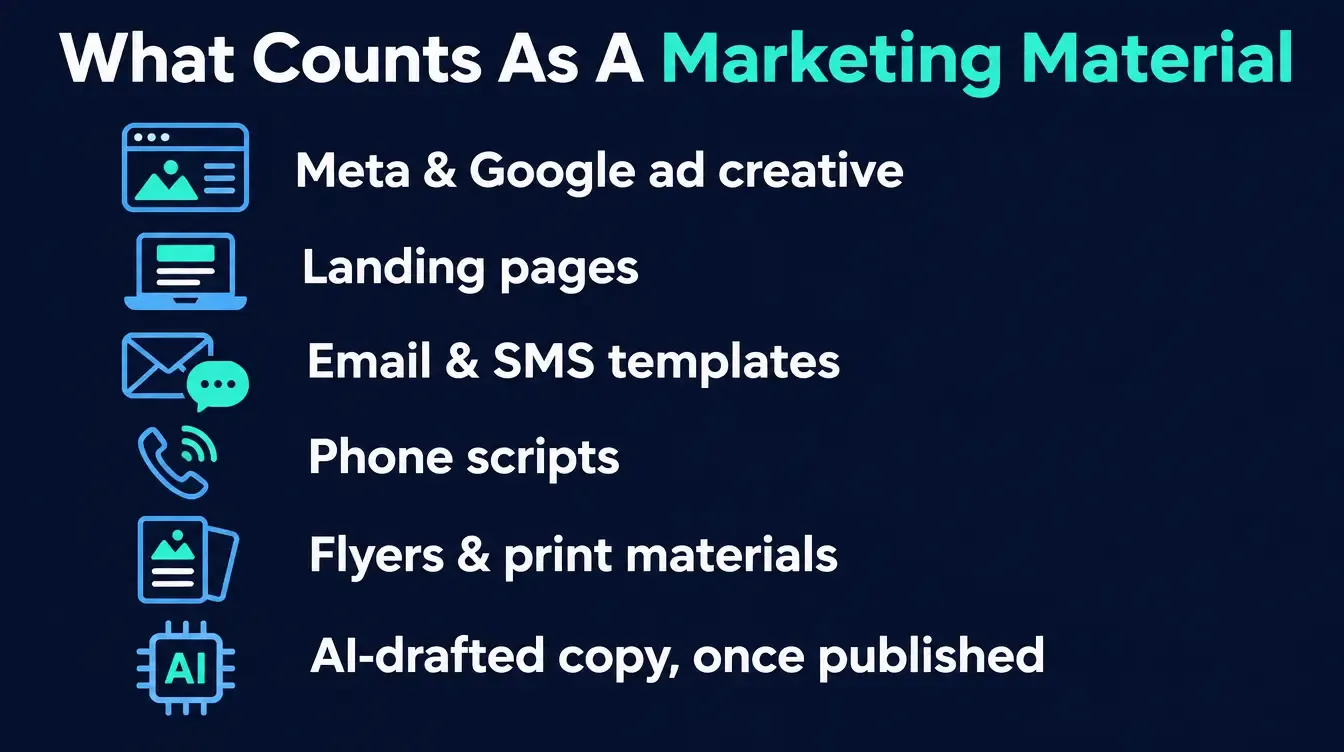
CMS doesn’t hand you a line-item checklist, and that’s the part that trips agents up. Read the rule’s own framing — it’s built around the prohibited-practice categories, not a closed list of document types. In practice, that means anything that reached a consumer with your name, your agency’s name, or your Marketplace agreement attached to it is fair game: your Meta and Google ad creative, including every variant you ran in a campaign; your landing pages, current and past versions; email and SMS templates used for ACA prospecting; your phone script, if you work one; printed flyers or door hangers; and video or audio ad scripts, including the voiceover text if you used a synthetic voice tool.
That last category deserves its own sentence, because it’s the one agents most often miss. If you used ChatGPT, a custom GPT, or any other general-purpose AI tool to draft ad copy, a landing page, or a script, that draft is still your marketing material once you published it — the rule doesn’t care what tool wrote the first version. It cares what a consumer saw. If you can’t locate the final published version because it only ever lived inside a chat thread that scrolled away, “an AI wrote it and I don’t have the file anymore” is not a position you want to be in when CMS asks. The same logic that applies to protecting client data when you use general AI tools — covered in our What Not to Paste Into ChatGPT article — applies here in reverse: it’s not what you put into the tool that’s the risk, it’s failing to pull the output back out into a file you actually keep.
This also connects to AI governance more broadly. If your agency uses AI to draft, review, or approve marketing content, the NAIC’s AI Model Bulletin sets out the expectation that insurers and producers maintain written AI governance, including documentation of what a tool produced and how a human reviewed it before it went live — we cover that expectation in full in NAIC AI Model Bulletin in 2026. The two obligations reinforce each other: document the AI’s role in producing the material, and keep the material itself, because either one might get asked for separately.
"I deleted the campaign" is not the same as "I don't have the file"
Pausing or deleting a Meta or Google campaign removes it from your ad account, not from existence. Export your ad creative, headlines, and landing page copy before you archive or delete anything in Ads Manager — once a campaign is gone, pulling the exact copy and image back out of the platform gets harder, and in some cases isn't possible at all.
The new consent form: not due yet, but already locked in
Separately from the production requirement, CMS finalized a standardized consumer consent form and eligibility application review process that HHS itself will create and approve, replacing whatever consent documentation format your agency currently uses. The fact sheet is specific about the delay: “Agents, brokers, and web-brokers must use this form for enrollments for plan years beginning on or after January 1, 2028” (CMS, Fact Sheet: HHS Notice of Benefit and Payment Parameters for 2027 Final Rule). For the 2027 Open Enrollment Period running right now, through January 15, 2027, you’re not required to switch yet.
Two things make that delay less comfortable than it sounds. First, the requirement itself is already finalized and, per the Columbus II stay list, not currently in legal limbo — the 2028 date is a compliance deadline CMS chose, not a placeholder awaiting a court’s blessing. Second, CMS doesn’t appear to have published the form itself yet, which means agencies can’t actually start building it into their workflow today even if they wanted to get ahead of it. The honest plan for this one is to watch for CMS’s release of the actual form template over the course of 2027, and build in time to swap your current consent process before the January 1, 2028 plan year starts — not to treat it as a 2026 problem.
What it costs to get this wrong
We’re not going to hand you a dollar figure for a missed production request, because none of the sources cited here publish one, and the sourcing standard on this site means we delete a number rather than guess at it. What we can tell you, sourced: CMS didn’t build this production requirement in a vacuum. The same chapter of Part 155 is where CMS, starting September 22, 2026, lowered the standard for terminating an agent’s or broker’s Exchange agreement for cause to a preponderance of the evidence — “preponderance of the evidence means proof by evidence that, compared with evidence opposing it,” “leads to the conclusion that the fact at issue is more likely true than not” (Cornell Law School, Legal Information Institute, 45 CFR 155.20, current text; see also our ACA Broker Moratorium coverage). A monitoring request you can’t answer, inside an enforcement environment built around a “more likely than not” standard, isn’t neutral. It’s exactly the kind of gap that standard exists to resolve against you, not for you.
There’s a second, quieter cost that has nothing to do with CMS at all: the time cost of scrambling. If a request lands and your marketing history lives across six months of Meta campaigns, a Canva account, a few email drafts, and whatever a past VA happened to save to their own laptop, “producing” it isn’t a five-minute task. It’s an afternoon of reconstruction, done under a deadline you didn’t set, for a request you can’t negotiate the timing of.
For context, here’s where this rule sits against the 2027 Open Enrollment Period calendar you’re already working inside:
| Date | What happens | Source |
|---|---|---|
| November 1, 2026 | 2027 Open Enrollment Period begins on HealthCare.gov | HealthCare.gov, Dates & Deadlines |
| December 15, 2026 | Last day to enroll or change plans for coverage starting January 1, 2027 | HealthCare.gov, Dates & Deadlines |
| January 1, 2027 | Coverage starts for enrollments completed by December 15 | HealthCare.gov, Dates & Deadlines |
| January 15, 2027 | 2027 Open Enrollment Period ends | HealthCare.gov, Dates & Deadlines |
| January 1, 2028 plan year | Standardized HHS consent form becomes mandatory for new enrollments | CMS, Fact Sheet: HHS Notice of Benefit and Payment Parameters for 2027 Final Rule |
Build your own marketing material log — the manual version
None of this requires software. It requires a habit, applied consistently, starting with whatever you’re running right now.
Step 1: Pick one folder, one naming convention, and stick to it. Cloud storage you already have — Google Drive, Dropbox, whatever your agency uses — works fine. Create a single top-level folder for marketing materials, subfoldered by month and by channel (Meta, Google, email, print). Name each file with the date it went live and a short description: 2026-11-ichra-landing-v2.pdf, not final final v3.pdf.
Step 2: Export before you pause or delete. Every time you pause or end a campaign on Meta or Google, export the final creative, the exact headline and body copy text, and a screenshot of the live ad as a consumer would have seen it, including the landing page it pointed to. Do this before you touch the delete button, not after.
Step 3: Save the script, not just “the idea.” If you work from a phone script, keep the actual document you read from, dated, with a note of which version was active during which weeks. If you update it mid-season, save the old version instead of overwriting it.
Step 4: Treat AI drafts the same as any other draft. If a tool wrote the first version of an ad, an email, or a script, save the final, published version as its own file the moment you publish it — don’t rely on being able to find it again inside a chat history. Note in the filename or a short log that AI assisted in drafting it, and who reviewed it before it went live, which does double duty for NAIC AI Model Bulletin documentation expectations.
Step 5: Review new copy against the three prohibited categories before it runs. Before anything goes live, check it against CMS’s own list: no cash or cash-equivalent inducements to enroll, no “always zero-dollar” claims, and no fuzzy enrollment deadline language. Keep a one-line note of who reviewed it and when.
Step 6: Set a quarterly reminder to audit your own folder. Once a quarter, open the folder and confirm every live campaign and script is actually represented in it. The gap you’re looking for is the campaign that ran for three weeks and never got exported anywhere.
A five-minute test worth running today
Pick your current, live ACA ad campaign. Try to produce, right now, the exact headline, body copy, and landing page text a consumer is seeing, plus a dated note of who wrote it and who approved it. If you can't assemble that in under five minutes, that's the gap this rule is asking you to close.
How Ambrose already fits — and where it honestly doesn’t
Ambrose can’t hand HHS a file you never saved, and nothing in its documentation claims otherwise. What it can do is turn Steps 1, 2, and 6 above from things you have to remember into things that happen on a schedule.
agent-vault is documented as the agency’s private file store, holding HealthSherpa exports, commission reports, client lists, intake forms, carrier emails, and — per its own page — “anything else you want Ambrose to query” (Ambrose docs, spoke-agent-vault). Files stay in your account; the page states “files never leave the account” and that vault search “resolves in-process,” with only a summarized answer returning to the model. Four tools are documented: vault_search (full-text and structured search across indexed files), vault_get_client, vault_list_recent (recently changed or added files), and vault_classify_lob. Save your exported ad creative and landing page PDFs into the vault the way you’d save any other agency document, and vault_search turns “find every landing page I ran in October” from a folder-digging exercise into a question you can ask.
A Routine is a scheduled prompt attached to an agent or a team, run on a standard cron schedule, with an output sink documented as Slack, email, a GHL note, or a log entry (Ambrose docs, Routines). A weekly Routine that posts a Slack reminder — “export and archive this week’s live ad creative and landing pages before anything rotates off the ad account” — closes the exact gap Step 2 depends on you remembering by hand, every single week, during the busiest months of the year.
The War Room’s Compliance persona, Dr. Elena Reyes, is one of the fixed roster of executive personas documented on the War Room page (Ambrose docs, War Room). Before a new piece of marketing copy goes live, asking her to check the draft against the three documented prohibited-practice categories — cash inducements, false zero-dollar claims, deadline miscommunication — gives Step 5 above a second set of eyes that doesn’t depend on whoever happens to be free that afternoon.
The six-step log from this article
- One folder, one naming convention, every channel
- Export creative and landing pages before pausing or deleting
- Save every script version, dated
- Treat AI drafts as files to keep, not chat history to trust
- Review new copy against the prohibited-practice list before launch
- Quarterly audit of the whole folder
A scheduled habit and a reviewer on call
- agent-vault stores and indexes the exported files
- vault_search answers "find every ad I ran in October" directly
- A weekly Routine reminds you to archive before anything rotates off
- Dr. Elena Reyes (Compliance) reviews new copy before launch
- Comes with one Ambrose seat included in the Tech Savvy membership
The honest version of this section
The agent-vault documentation doesn't describe version history or a formal audit-trail feature — vault_list_recent surfaces recently changed files, but the page doesn't explain how granular that history is. What Ambrose gives you is a searchable place to put what you've already decided to keep, plus a scheduled nudge to actually keep it — not a compliance archive with built-in versioning. Verify any AI-assisted output before you act on it, and confirm your own documentation practices satisfy your specific FMO or carrier's requirements, not just this article.
Everything in the six-step manual version above works whether you ever touch Ambrose or join anything. It’s a filing habit, not a purchase.
What you get by joining
One Ambrose seat, including agent-vault and Routines, comes with a Tech Savvy Insurance membership: $97 a month, billed monthly, cancel anytime, founding rate locked in while the membership stays active. Alongside the seat: weekly Zoom calls with open Q&A and build-with-you sessions, 30-plus hours of recorded training, Meta Ads and AI training built for this industry specifically, pre-built AI templates and bot deployments, and a free annual in-person member workshop. It’s also an explicit no-recruiting zone — you can ask a specific question about setting up a weekly archive Routine without ending up on someone’s downline pitch list, which is a real point of difference from most agent Facebook groups.
Ambrose usage runs separately from the $97 seat
The membership includes one Ambrose seat; usage inside Ambrose runs through its own credit ledger with spend caps, so cost stays visible instead of showing up as a surprise. See the full Spokes catalog for what else is available beyond agent-vault and Routines.
One folder, one naming convention
Start today, even before anything else on this list is in place.
Export before you delete
Pull the exact creative and landing page copy out of the ad platform while it's still live.
Keep every script version, dated
Including anything an AI tool helped draft — save the published version as a file.
Review against the three prohibited categories
Cash inducements, false zero-dollar claims, deadline miscommunication.
Let a Routine remind you weekly
A scheduled Slack nudge to archive before anything rotates off your ad account.
Ask the Compliance persona before launch
A second set of eyes on new copy, inside the War Room.
Build the archive habit before the next request, not after
The six-step version above works whether you ever join anything or not. If you'd rather have agent-vault already indexing your files and a Routine already reminding you, with people watching your screen while you set it up, one Ambrose seat comes with the Tech Savvy membership.
Join Tech Savvy — $97/monthThe close
CMS spent 2026 building an enforcement apparatus around ACA agent and broker conduct, and the marketing-materials production requirement is the piece that makes the rest of it auditable — a federal court stayed eight other provisions of this same rule in July 2026, and this wasn’t one of them. If you can produce, right now, the exact ad copy, landing page, and script a consumer saw this week, plus who wrote and approved it, you’re already ahead of most of your market. If you can’t, that’s a folder you can start building today, before the 2027 Open Enrollment Period closes on January 15. If you’d rather have agent-vault already holding it and a Routine already reminding you, that’s a Tuesday conversation in the Tech Savvy community: $97 a month, cancel anytime, and nobody will pitch you a downline. https://techsavvyinsurance.com/
Before you rely on any figure in this article
Tech Savvy Insurance is a training and software community, not an insurance company, agency, or law firm, and does not provide insurance, legal, tax, or compliance advice. You are responsible for your own licensure and for complying with all applicable CMS marketing rules, your specific carrier and FMO contracts, state insurance department requirements, and HIPAA. This rule and its litigation status can change; confirm current requirements directly with CMS, your state exchange, or qualified legal counsel before relying on any figure here. AI outputs may contain errors — always verify. Results may vary.
Frequently asked questions
Sources
- CMS — Fact Sheet: HHS Notice of Benefit and Payment Parameters for 2027 Final Rule — cms.gov
- Federal Register via GovInfo — Patient Protection and Affordable Care Act; HHS Notice of Benefit and Payment Parameters for 2027; and Basic Health Program (Final Rule, CMS-9883-F, FR Doc. 2026-10050, 91 FR 29526, May 20, 2026) — govinfo.gov
- CMS CCIIO — Statement Regarding the City of Columbus v. Kennedy, No. 1:26-cv-02215 (July 31, 2026) — cms.gov
- KFF — 9 Things to Watch for the 2027 ACA Open Enrollment Period — kff.org
- HealthCare.gov — Dates & Deadlines — healthcare.gov
- Cornell Law School, Legal Information Institute — 45 CFR 155.20 (current text) — law.cornell.edu
- Ambrose docs — spoke-agent-vault — app.hiambrose.com
- Ambrose docs — War Room — app.hiambrose.com
- Ambrose docs — Routines — app.hiambrose.com
Ready to put this into practice?
Join a private community of Health & Life insurance professionals using AI, Meta Ads, and automation to grow — without draining their bank account.
Join Tech Savvy — $97/month