
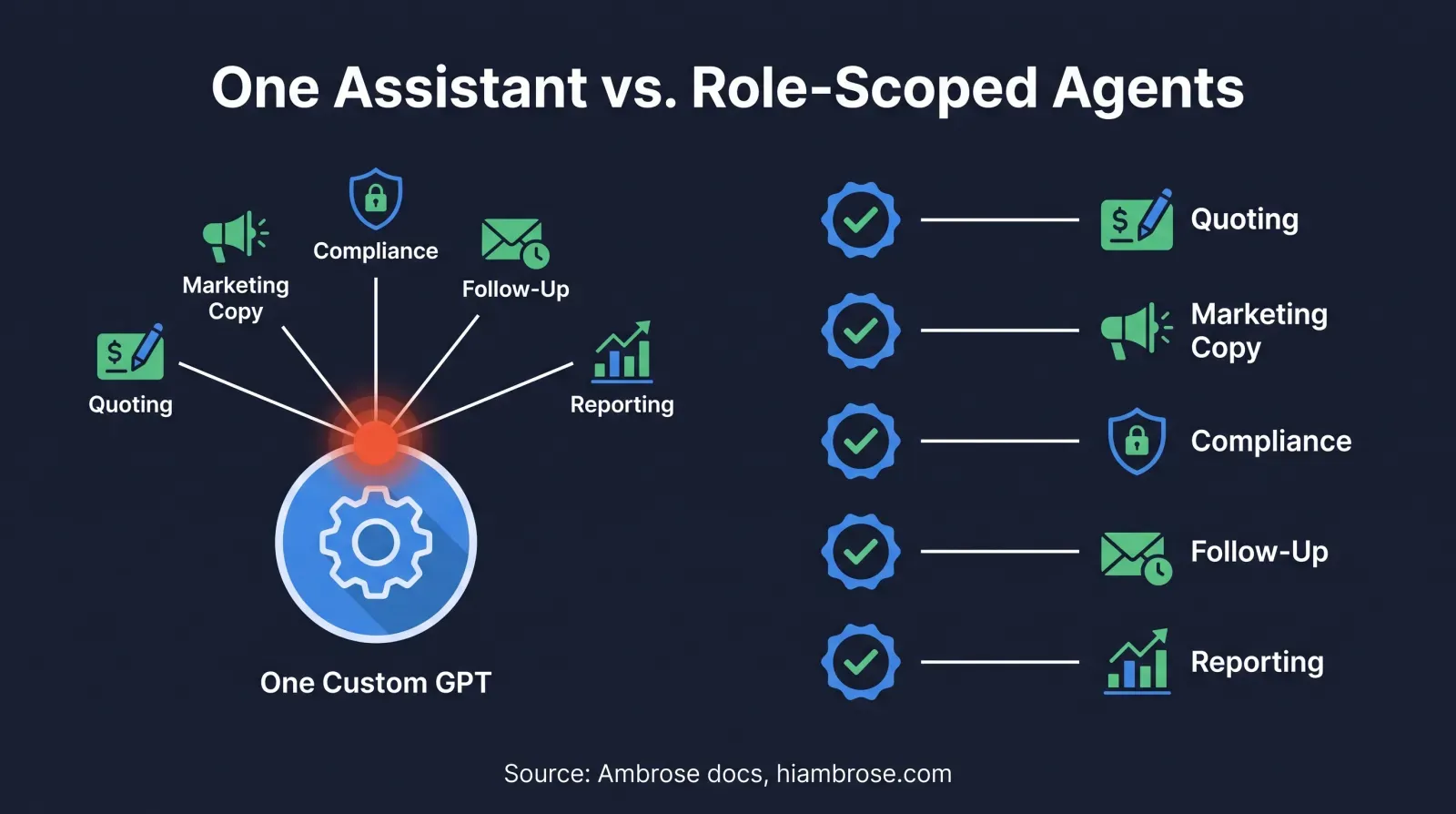
A custom GPT for insurance agents fails for a specific, fixable reason: it’s built as one assistant handling every job at once, and the moment you switch it between quoting help, marketing copy, and a compliance question in the same thread, its instructions start losing to the conversation itself. That’s not a “better prompt” problem. It’s an architecture problem — one identity trying to do five jobs — and it’s fixable by hand in an afternoon, or automatically if you run role-scoped agents instead of one do-everything thread.
Key takeaways
- 45% of independent agencies use ChatGPT or another public LLM, but only 8.5% describe AI as embedded in daily workflows — most of that 45% is one informal, unscoped thread (Big "I", ACT Tech Trends Report 2025-2026).
- Custom GPT instructions don't automatically persist across a long conversation. OpenAI's own developer docs confirm instructions used on prior turns aren't carried forward unless an application re-supplies them (OpenAI, Prompt Engineering guide) — the mechanism behind "it forgot who it's supposed to be."
- The manual fix costs nothing but an afternoon: one narrow instruction block per job, never mixed in the same thread. The full worksheet is below, and it works with or without a membership.
- Ambrose OS defines an agent the same way the manual fix does — "one identity + one voice + one memory + one set of capabilities" — except identity, personality, memory, and notes live in markdown files where "save = live, no deploys" (Ambrose docs, Agents; What is Ambrose).
- The NAIC Model Bulletin on insurers' use of AI, adopted December 4, 2023 and adopted by 24 states as of March 2025, expects a written program, human oversight, documentation, and vendor accountability wherever AI touches a regulated insurance practice (NAIC; Quarles).

Why your custom GPT stops sounding like itself by the third topic
You set it up right the first time. You told it to write in your voice, to never quote a specific premium, to add your standard disclaimer, to sound like a Medicare-savvy advisor and not a generic assistant. For the first few messages that morning, it does exactly that.
By the afternoon, after you’ve bounced it between “write me a Facebook post about the AEP deadline,” “help me compare two Part D formularies for a client,” and “does this intake script violate the 48-hour SOA rule,” something’s off. It drops the disclaimer. It quotes a premium range it shouldn’t. It writes marketing copy in a flatter, more generic voice than the one you configured. You didn’t change anything. The thread got long, and somewhere in there your instructions stopped winning.
This is the single most common complaint in the threads agents and other professionals leave about custom GPTs: the configuration that worked great on day one gets less reliable the longer and more varied a single conversation runs. It’s common enough that OpenAI’s own community forum has entire threads asking why custom instructions get ignored partway through a session, and outside guidance on the problem consistently lands on the same root cause — the model treats your initial configuration as one more thing to weigh against everything that’s happened since, not as a standing rule.
Why one AI persona can’t do five different jobs well
Here’s the mechanism, stated plainly: instructions and conversation history occupy the same limited space, and neither one gets a permanent, protected slot. OpenAI’s own developer documentation confirms a version of this problem directly: when an application manages conversation state with the previous_response_id parameter, “the instructions used on previous turns will not be present in the context” on later turns (OpenAI, Prompt Engineering guide) — meaning an application has to actively resupply instructions on each turn, or they simply aren’t there anymore. That’s a statement about the API specifically, but it points at the underlying truth that also shapes the consumer product: nothing about “instructions” makes them permanently sticky by default. They’re context, competing with more context, and the model has to keep re-weighing all of it as the thread grows.
Now stack five different jobs into that one thread. Quoting help needs precision and caution around specific numbers. Marketing copy needs a looser, more persuasive voice. A compliance question needs your instructions to be at their most rigid, not their most flexible. Follow-up drafting needs client-specific detail the other three jobs never touch. Every time you switch between them, you’re asking the same configuration to be simultaneously careful, persuasive, rigid, and personal — and asking it to remember all four modes at once, on top of remembering not to quote a premium three topics ago.
This is exactly the failure mode Tech Savvy Insurance’s own research into what actually helps agents keeps landing on: one assistant cannot do everything well. A prompt that does five jobs does all five worse than five prompts that each do one. It’s not a smarter-prompt problem. It’s a scope problem.
It’s also not unique to ChatGPT. Anthropic’s Claude has a similar “Projects” feature with its own persistent instructions field, and Google’s Gemini has “Gems.” Both work the same underlying way: a configuration you write once, sitting at the top of a context window that keeps filling up with everything that happens after. Nothing about a different vendor’s branding changes the mechanism. If you’ve standardized on Claude or Gemini instead of ChatGPT, everything in this article, the diagnosis and the fix, still applies. The failure is architectural, not brand-specific.
There’s a second, quieter version of this problem that shows up at multi-producer agencies: several producers sharing one login to one custom GPT. Now the instructions aren’t just competing with topic switches, they’re competing with different people’s phrasing, different levels of prompt literacy, and different assumptions about what the assistant is “supposed” to do. One producer’s habit of pasting long, messy context at the start of a thread degrades the persona for the next producer who opens a fresh chat expecting it to behave the way it did last week. If your agency shares one AI login across several people, the scoping problem in this article gets worse, not better, because you’ve added human inconsistency on top of the thread-length problem.
What running one all-purpose chatbot actually costs your agency
Here’s the scale of it. The Big “I” Agents Council for Technology’s Tech Trends Report, covering 2025-2026, found that 45% of independent agencies surveyed use ChatGPT or another public large language model (Independent Insurance Agents & Brokers of America, ACT Tech Trends Report). The same report found 30.7% of agencies aren’t using AI at all, 32.8% describe themselves as “just experimenting,” and only 8.5% have AI “embedded in daily workflows.”
Put those numbers next to each other and the gap is the story: 45% are using a public chatbot, but only 8.5% have gotten to the point of it being a real embedded workflow. The overwhelming majority of that 45% is somebody’s one unscoped thread — exactly the setup this article is about, and exactly the setup most likely to drift, misfire on a compliance-sensitive answer, or quietly stop sounding like the brand it was configured for.
Where independent agencies actually stand on AI, 2025-2026
Share of agencies surveyed, by stage of AI adoption
Source: Independent Insurance Agents & Brokers of America (Big "I"), Agents Council for Technology (ACT) Tech Trends Report, 2025-2026. These three categories don't sum to 100%; the report's remaining respondents fall into other maturity stages not broken out here.
The dollar cost is harder to pin down industry-wide, and we’re not going to invent a precision figure the data doesn’t support. What’s fair to show is a worked example using a real, sourced wage rate, so the math is checkable rather than asserted. The U.S. Bureau of Labor Statistics puts the median hourly wage for insurance sales agents at $29.94 as of May 2025 (U.S. BLS, Occupational Outlook Handbook: Insurance Sales Agents). If a producer spends even fifteen extra minutes a day re-explaining context, re-pasting a dropped instruction, or fixing an off-voice piece of copy because one thread is juggling five jobs, that’s a quarter hour at $29.94, or about $7.49 a day. Across roughly 230 working days a year, that’s approximately $1,722 per producer, in time alone, before counting the cost of a compliance-sensitive answer that goes out wrong. This is an illustrative calculation built on a real wage figure, not a claimed industry-wide average — your own number depends on your own team’s actual habits, which is exactly why the audit in the next section starts with counting, not assuming.
One source for the 45% figure
We looked for a second, independent survey measuring the specific share of individual insurance agents (not carriers, not the broader small-business population) using ChatGPT or a public LLM, and didn't find one that asks the same question with a comparable methodology this session. The 45% figure above rests on the Big "I" ACT Tech Trends Report alone. Treat it as directionally solid — it's a trade association surveying its own membership — but not as a number two independent bodies have separately confirmed.
The manual fix: split one chatbot into role-scoped assistants
None of what follows requires a membership, a developer, or a platform. It requires an afternoon and a document. Here’s the complete method.
List every distinct job you're asking one thread to do
Be specific. Not "AI stuff" — the actual jobs: quoting help and plan comparison, marketing copy, compliance Q&A, follow-up drafting, production or commission report summaries. Most agents find they're running four or five genuinely different jobs through one window.
Write one narrow instruction block per job
One identity, one voice, one job, mirroring the same scoping principle Ambrose builds in natively (more on that below). A compliance-Q&A prompt should say what it is, what it must never do (quote a premium, give a definitive legal answer), and what tone it uses — and nothing about marketing copy at all.
Build one Custom GPT per job, or keep a canonical prompt document
If your ChatGPT plan supports building Custom GPTs, make one per job — each gets its own instructions field, isolated from the others by design. If it doesn't, keep every prompt block in one shared document, one section per job, and paste only the relevant block into a fresh thread. Never carry a thread across jobs.
Start a new thread for every job switch, every time
This is the rule that actually fixes the drift. The moment you're done with quoting help and want marketing copy, close the thread and open a new one with the marketing prompt. A long-running thread that jumps topics is exactly the setup that erodes instructions the fastest.
Test each persona against a fixed set of questions before trusting it
Write five questions you already know the right answer to per job — a premium question the quoting assistant should decline to answer specifically, a disclaimer check for the marketing assistant. Run them fresh, without warming the thread up first. If it fails cold, it isn't ready.
Re-test after any model update, on a recurring schedule
Model providers update the underlying model without asking you. A prompt that passed your test in March isn't guaranteed to pass it in September. Put a quarterly reminder on the calendar to re-run the same five questions per persona.
| Column | What to enter | Why it matters |
|---|---|---|
| Persona name | A short label, e.g. "Quoting Helper," "Compliance Check" | Makes it obvious which prompt block belongs to which job at a glance |
| The one job it does | One sentence, no "and also" | If the sentence needs an "and," the job isn't scoped narrowly enough yet |
| What it must never do | The specific guardrail: never quote a premium, never give a legal opinion, never skip the disclaimer | This is the line that erodes first in a mixed thread — write it down explicitly |
| Voice notes | Two or three adjectives, plus one real example sentence in the right voice | A concrete example anchors tone better than an abstract instruction does |
| Test questions (5) | Fixed questions with known-correct answers, run cold every time | Turns "does it still work" into a checkable pass/fail instead of a feeling |
| Last tested | A date | If the honest answer is "before the last model update," retest before you trust it again |
What it usually looks like
- One long conversation handling quoting, marketing, compliance, and follow-up
- Instructions that held up this morning and drifted by this afternoon
- A dropped disclaimer or an off-voice piece of copy nobody catches until a client does
- No fixed test questions, so "is it still working" is a guess
- Compliance-sensitive answers coming from the same thread as loose marketing brainstorming
One personadoing five jobs, badly, by the third topic switch
What it looks like after one pass
- One narrow instruction block per job, never mixed in the same thread
- A fresh thread for every job switch, so nothing erodes across topics
- Five cold-test questions per persona, checked on a quarterly schedule
- A compliance-review prompt isolated from marketing brainstorming entirely
- The same underlying subscription — no new tool required
Same toolscoped the way a working assistant actually needs to be
The tell that a thread has drifted
If you catch yourself re-typing "remember, you never quote a specific premium" mid-conversation, the thread has already drifted — you're patching the symptom instead of fixing the scope. That's the signal to close it and start the right persona fresh, not to keep adding reminders to a thread that's already carrying too much.
A concrete example: three prompts, side by side
Abstract advice is easy to nod along with and hard to actually use. Here’s what “one narrow instruction block per job” looks like written out, condensed from the kind of prompt library an agent would actually keep in a shared document. These are starting points to adapt, not something to paste verbatim without reading your own compliance obligations first.
Quoting Helper. “You help a licensed Medicare and ACA agent think through plan comparisons and coverage questions. You never state a specific premium, copay, or dollar benefit figure as fact — always tell the agent to confirm current numbers against the carrier’s official materials or the plan finder before quoting a client. You write in short, direct sentences, agent-to-agent, not client-facing. If asked to draft anything client-facing, say that’s outside this persona and suggest the Marketing Copy prompt instead.”
Marketing Copy. “You write marketing copy for a licensed health and life insurance agent’s Meta Ads, email, and social posts. Your voice is warm, direct, and never uses income claims, guarantees, or urgency language like ‘limited time’ unless the agent explicitly confirms a real deadline. Every piece of copy touching Medicare must include a reminder to the agent that a TPMO disclaimer is required separately, based on the current CMS Medicare Communications and Marketing Guidelines. You do not answer coverage or compliance questions — redirect those to the appropriate prompt.”
Compliance Check. “You review agent-drafted marketing and client communications for obvious compliance red flags: missing disclaimers, income or outcome guarantees, cold-call references, or claims that sound like a specific carrier endorsement. You are not a substitute for the agency’s actual compliance officer or legal counsel, and you say so on every response. You never draft new marketing copy — you only review what’s given to you and flag concerns in plain language.”
Notice what each one refuses to do as much as what it does. That refusal line, “that’s outside this persona,” is doing real work: it’s the guardrail that keeps a thread from drifting into a job it wasn’t built for, which is the exact failure this whole article is about. Write that line into every prompt you build.
How Ambrose builds this without an API console
Everything above works, and it’s genuinely worth doing whether or not you ever look at a platform. There’s also a version of this that’s built into the architecture from the start, for anyone with an Ambrose seat.
Per Ambrose’s own documentation, an agent in Ambrose is “the canonical AI persona unit… One agent = one identity + one voice + one memory + one set of capabilities” (Ambrose docs, Agents) — the exact scoping principle the manual worksheet above builds by hand, just enforced by the platform instead of by discipline. Identity, personality, memory, and notes for that agent live in markdown files, and per Ambrose’s What is Ambrose page, “Save = live. No deploys” — an edit takes effect the moment you save it, with no build step and no waiting on anyone else (Ambrose docs, What is Ambrose).
That’s the same “one narrow prompt per job” idea from the manual method, but with two things a hand-built prompt library doesn’t have. First, each agent carries an allowed_spokes list that gates exactly which tools it’s permitted to reach (Ambrose docs, Agents) — real access control, not just a written instruction hoping to be followed. A general chatbot thread has no equivalent; whatever you’ve pasted into it is all the “scoping” it has. Second, when a job needs more than a conversational persona, Ambrose has a separate structure for it: a team, which Ambrose’s documentation describes as a “role config” bundling a prompt, tool access, scheduled routines, and — where the job needs it — a GoHighLevel workflow webhook (Ambrose docs, Teams). Notably, that webhook capability moved to teams specifically; per the same documentation, agents had it removed as of May 7, 2026, which is exactly the kind of “which one do I actually need for this job” distinction Ambrose’s docs spell out plainly: you need a GHL workflow webhook, you use a team.
| What you need | One custom GPT, unscoped | An Ambrose agent |
|---|---|---|
| Scope per persona | Whatever you remembered to write in the instructions field | One identity, one voice, one memory, one set of capabilities, by design (Ambrose docs, Agents) |
| Tool access | Whatever's pasted into the thread; no enforced boundary | An `allowed_spokes` list gating exactly which spokes it can reach |
| Editing behavior | Edit the instructions field, hope the next long thread doesn't erode it | Edit a markdown file; "Save = live. No deploys" (Ambrose docs, What is Ambrose) |
| A recurring, automated job | Not built for it — you're the trigger, every time | A team can run on a schedule and post results to Slack via a routine |
| Client-facing workflow trigger | Nothing native | A team's GHL workflow webhook, if the job needs one (Ambrose docs, Teams) |
Nothing here means the manual worksheet stops mattering once you’re running Ambrose — anything that lives outside it, a personal writing habit, a one-off brainstorm, still benefits from the same “one job per thread” discipline. What Ambrose changes is the default: instead of remembering to scope every prompt yourself, the platform’s unit of work already is one agent, one job.
One Ambrose seat comes with a Tech Savvy membership
You don't need to build an agents-vs-teams decision tree alone. That's exactly what the weekly build-with-you Zoom calls are for — setting up your first role-scoped agent next to people who've already done it. See the full Agents documentation and Teams documentation for the complete picture.
Compliance: what changes when your AI answers touch clients
Splitting one chatbot into role-scoped prompts doesn’t change your underlying compliance obligations — it just makes them easier to enforce, because a compliance-scoped prompt isn’t sharing a thread with loose marketing brainstorming anymore.
Where any AI tool touches your marketing, sales, or client-facing workflow, the NAIC’s Model Bulletin on the Use of Artificial Intelligence Systems by Insurers sets governance expectations that a growing number of states have adopted. The bulletin was adopted at the NAIC’s 2023 Fall National Meeting on December 4, 2023, and as of March 2025, 24 states had adopted it with little or no material changes (NAIC, NAIC Members Approve Model Bulletin on Use of AI by Insurers; Quarles, Nearly Half of States Have Now Adopted NAIC Model Bulletin on Insurers’ Use of AI). It expects a written AI program commensurate with risk, human oversight, documentation a state examiner could request, and accountability that extends to any third-party AI vendor you rely on — a role-scoped prompt library with dated, tested versions is exactly the kind of documentation that program should be able to point to.
If a job you’re scoping touches Medicare marketing specifically, a TPMO disclaimer obligation and CMS’s Medicare Communications and Marketing Guidelines apply on top of anything covered here, regardless of which AI tool drafts the copy. And regardless of how narrowly a prompt is scoped, never paste real client PHI into a general-purpose consumer chatbot that isn’t covered by a business associate agreement — that’s the full subject of our companion guide, What Not to Paste Into ChatGPT: An Agent’s HIPAA Guide. Ambrose is HIPAA-aware by default, not HIPAA certified, since no such certification exists for a software platform; its PHI Rail aliases identifiers before any non-BAA destination sees them, which is a different mechanism than “be careful what you type.”
What you get by joining
One Ambrose seat, agents and teams included, comes with a Tech Savvy Insurance membership: $97 a month, billed monthly, cancel anytime, founding rate locked in while the membership stays active. Alongside the seat: weekly Zoom calls with open Q&A and build-with-you sessions, 30-plus hours of recorded training, Meta Ads, AI, and marketing training built specifically for health and life agents, pre-built AI templates and bot deployments, and a free annual in-person member workshop. It’s an explicit no-recruiting zone — worth naming here specifically, because “how do I actually set this up” is exactly the kind of question that gets brushed aside in a group built around selling you something else.
Everything above, the worksheet, the worked example, the full manual method, works whether you ever join anything or not. Ambrose is the version of it that ships already scoped, and the weekly build-with-you calls are where agents actually set up their first agent next to people who’ve done it.
Stop running everything through one thread
Build the worksheet above this week, on your own, no membership required. If you'd rather have that scoping built in from the start, one Ambrose seat comes with the Tech Savvy membership.
Join Tech Savvy — $97/month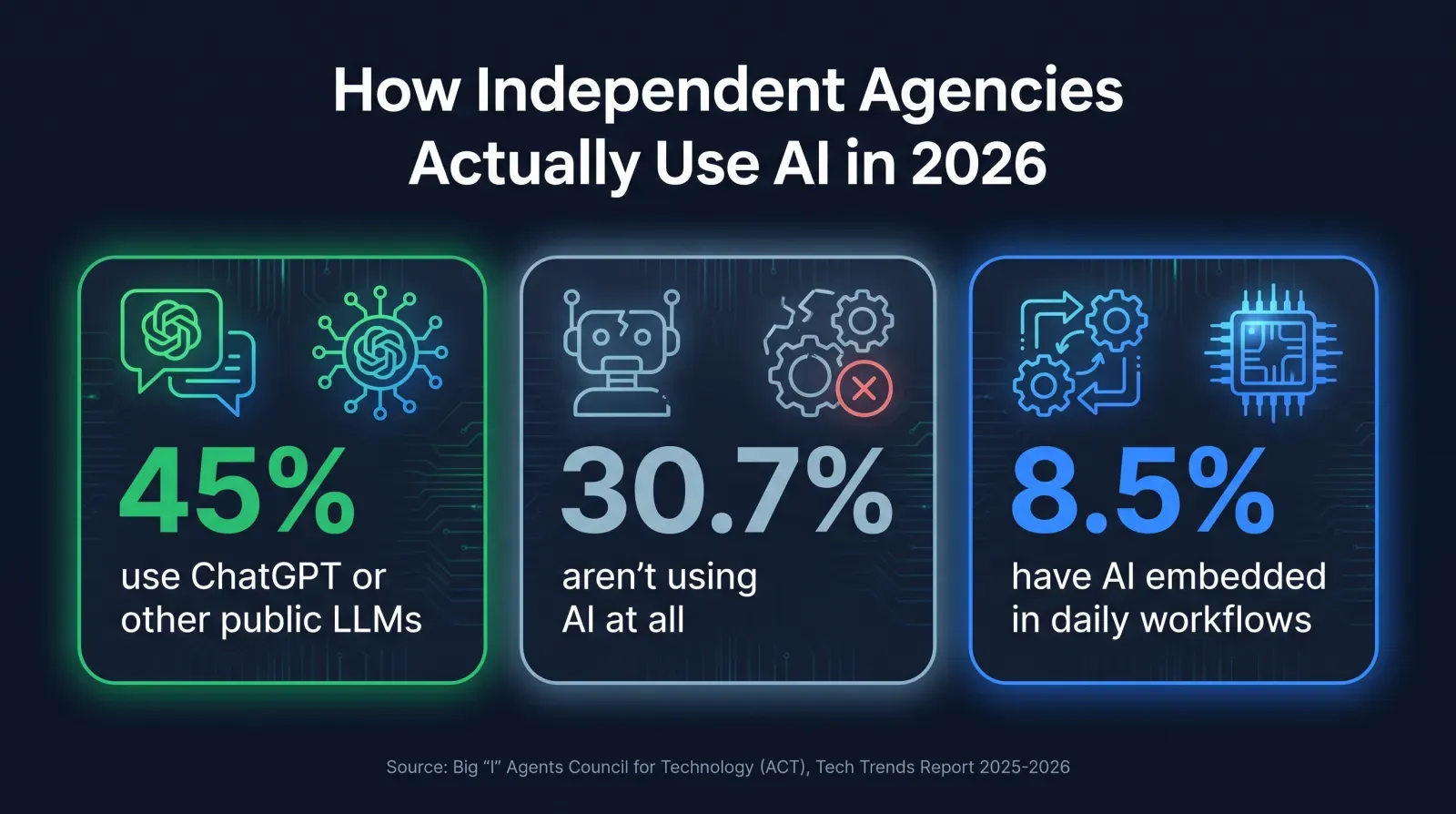
The close
Pick one job your custom GPT currently shares a thread with three or four others, and give it its own prompt this week — its own document section or its own Custom GPT, its own five test questions, its own fresh thread every time. That works whether you join anything or not, and it’s the fastest way to stop the drift you’ve probably already noticed but haven’t named. If you’d rather have that scoping built into the platform from day one, with people watching your screen while you set up your first agent, one Ambrose seat comes with a Tech Savvy membership: https://techsavvyinsurance.com/.
Before you rely on any figure in this article
Tech Savvy Insurance is a training and software community, not an insurance company, agency, or law firm, and does not provide insurance, legal, tax, or compliance advice. You are responsible for your own licensure and for complying with all applicable CMS, state insurance, HIPAA, and carrier regulations. Regulations and vendor documentation can change — confirm current requirements and figures directly with the cited sources, your state Department of Insurance, or qualified counsel before relying on any figure here. AI-generated outputs may contain errors — always verify. Results may vary.
Frequently asked questions
Sources
- Independent Insurance Agents & Brokers of America (Big "I") — ACT Tech Trends Report: Key Insights for 2025-2026 — independentagent.com
- U.S. Bureau of Labor Statistics — Occupational Outlook Handbook: Insurance Sales Agents — bls.gov
- NAIC — NAIC Members Approve Model Bulletin on Use of AI by Insurers — content.naic.org
- Quarles — Nearly Half of States Have Now Adopted NAIC Model Bulletin on Insurers' Use of AI — quarles.com
- OpenAI — Prompt Engineering Guide — developers.openai.com
- NAIC — Insurance Topics: Artificial Intelligence — content.naic.org
- Ambrose docs — What is Ambrose — app.hiambrose.com
- Ambrose docs — Agents — app.hiambrose.com
- Ambrose docs — Teams — app.hiambrose.com
Ready to put this into practice?
Join a private community of Health & Life insurance professionals using AI, Meta Ads, and automation to grow — without draining their bank account.
Join Tech Savvy — $97/month