
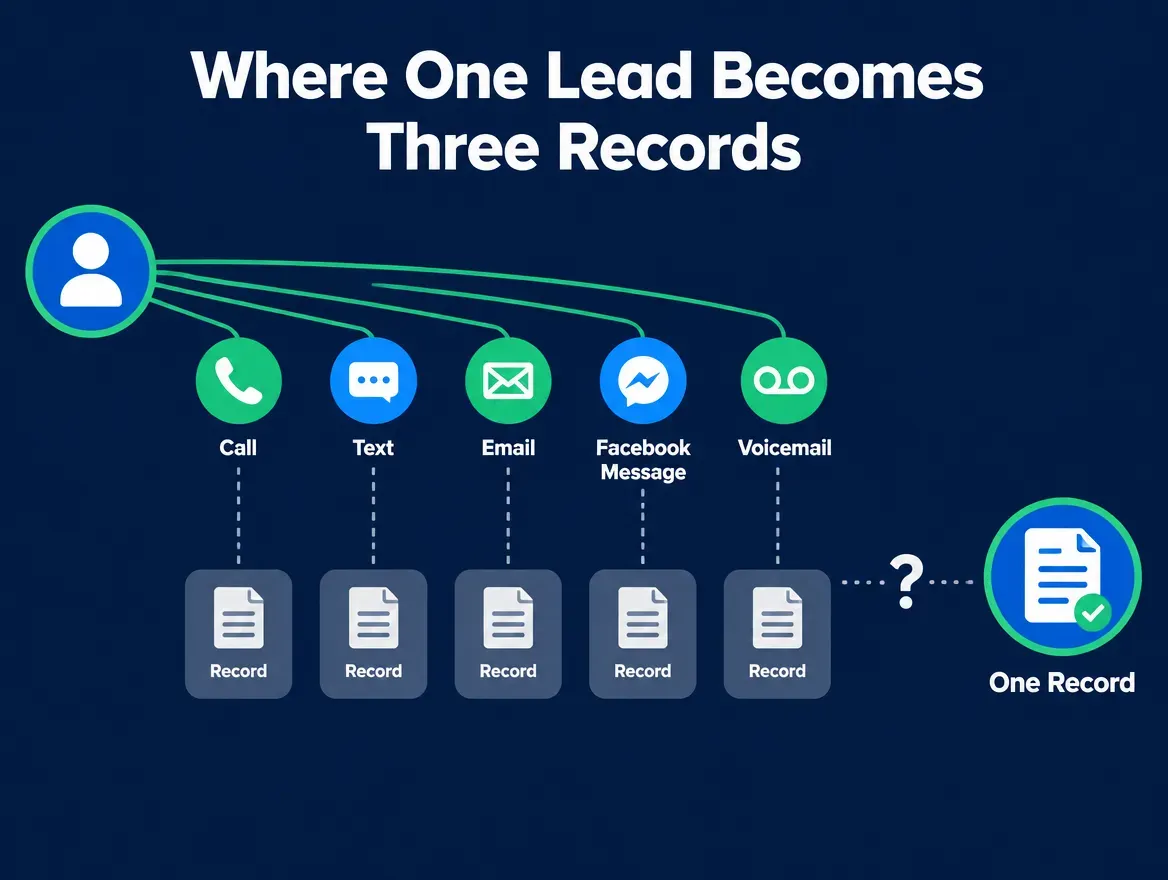
A lead you texted on Tuesday emails your office inbox on Thursday, using a different name for herself than the one on the lead form, asking a follow-up question about a plan you quoted her over the phone. Nobody who reads that email knows any of that history, because the text thread lives in your dialer app, the phone call lives in nobody’s notes, and the email just landed in a shared inbox three people check at different times of day. That’s cross-channel lead fragmentation: a real conversation, broken across tools that don’t talk to each other, and it’s the specific reason a lead who’s actually still interested gets treated like a cold contact — or gets two different answers from two different people on your team.
Key takeaways
- 93% of consumers experience some degree of context loss when a conversation moves between channels, and 44% say they "almost always" have to repeat themselves to a new person or channel (Glance, October 2025, 600 U.S. consumers).
- 74% of consumers find it frustrating to have to tell their story over again to a different agent or channel — a separate, independently run survey landing on the same conclusion (Zendesk, CX Trends 2026, June 2025, 11,297 respondents across 22 countries).
- Over a third of consumers say they'd rather work with an AI agent than a person specifically to avoid repeating themselves — the frustration isn't with automation, it's with having to start over (Salesforce, 7th Edition State of the AI Connected Customer, July-August 2024).
- The TPMO disclaimer already has to be delivered electronically on whatever channel you actually use with a lead — email, chat, or other electronic means — and that's existing law, not a new 2027 requirement (42 C.F.R. § 422.2267(e)(41)(iii)).
- Ambrose's channel-bridge spoke dispatches outbound email, SMS, and Telegram from one place, and its lead-memory spoke logs any event — including one a human reports by hand from a call or a Facebook message — to a single per-lead dossier (Ambrose docs, fetched September 2026).
This isn't about follow-up cadence or attribution
This article isn't about how many touches to send or which touch deserves credit for a conversion — our guides to building an AI follow-up system and follow-up attribution cover those. This one is narrower and comes before either of those questions: can you even see the whole conversation with a lead when it happens across five different apps? If the answer is no, cadence and attribution are both built on an incomplete record.
What cross-channel fragmentation actually looks like
Here’s the version of this that happens in a normal agency during a normal week, let alone AEP. A lead comes in from a Meta lead form with a phone number and an email address. Day one, an agent calls — no answer — and follows up with a text: “Hi, this is Sarah from [agency], following up on your Medicare quote request. What’s a good time to talk?” The lead doesn’t reply to the text. Two days later, that same lead sends an email to the agency’s general inbox — a different email address than the one on the lead form, because she typed her personal Gmail into the web form but is emailing from her work account — asking whether the plan covers a specific drug. Whoever opens that email has no idea it’s the same person who got the text, because nothing connects the two. A third team member, checking the office voicemail the same afternoon, finds a message from her, again from a third phone number, asking the same drug question because she never got a reply to the email.
At that point, you have three separate records of the same person asking a question that’s already been asked twice, spread across a dialer’s SMS log, a shared email inbox, and a voicemail box, and the honest answer to “did we already reply to her?” is: nobody actually knows. This isn’t a hypothetical edge case. It’s what happens by default any time a lead has more than one way to reach you and uses more than one of them — which, per the data later in this article, describes most leads, most of the time.
The Facebook variant of this is its own special case worth naming directly, because it’s extremely common in this industry: a lead fills out a Facebook lead form, and separately messages your agency’s Facebook Page directly, asking a question before the form-based follow-up ever reaches her. Meta’s own tools treat the lead form submission and the Page’s Messenger inbox as two different surfaces inside Meta Business Suite, and neither one pushes into your CRM automatically unless you’ve specifically built or bought that connection. An agent working the CRM sees a lead. A different person, or the same person on a different day, sees a Messenger conversation. Neither one knows about the other unless someone happens to notice both.
Why this happens: your tools were never built to share one lead ID
The mechanism isn’t complicated, and it isn’t anyone’s fault in particular — it’s what happens when four or five specialized tools each do their one job well and none of them was designed with the others in mind. Your dialer knows about calls and texts made through it. Your CRM knows about whatever gets manually logged or automatically synced into it. Your email client knows about email. Facebook Business Suite knows about Facebook. A shared office voicemail box knows about voicemails, and only if someone listens to them and writes down what was said.
Each of those systems assigns its own internal identifier to “this contact” — a phone number in the dialer, an email address in the inbox, a Page-scoped user ID in Messenger — and none of those identifiers match each other by default. A lead who gives you a work email, a personal cell number, and messages your Facebook Page all in the same week looks, to your tools, like three unrelated contacts, because from each tool’s narrow point of view, that’s exactly what the data shows. Nothing forces those three records back together unless a human notices the overlap and manually merges it, which requires first noticing it — and noticing requires someone to be looking at all three inboxes at once, which almost never happens on purpose.
What it actually costs
The consumer-research side of this isn’t insurance-specific, but it’s consistent enough across independent studies that it’s worth treating as close to settled. Two separately run, separately fielded surveys — one from Glance and one from Zendesk, using different methodologies and different respondent pools — land on the same basic finding from different angles: most people notice, and are bothered by, having to repeat themselves when a conversation crosses channels or hands off to someone new.
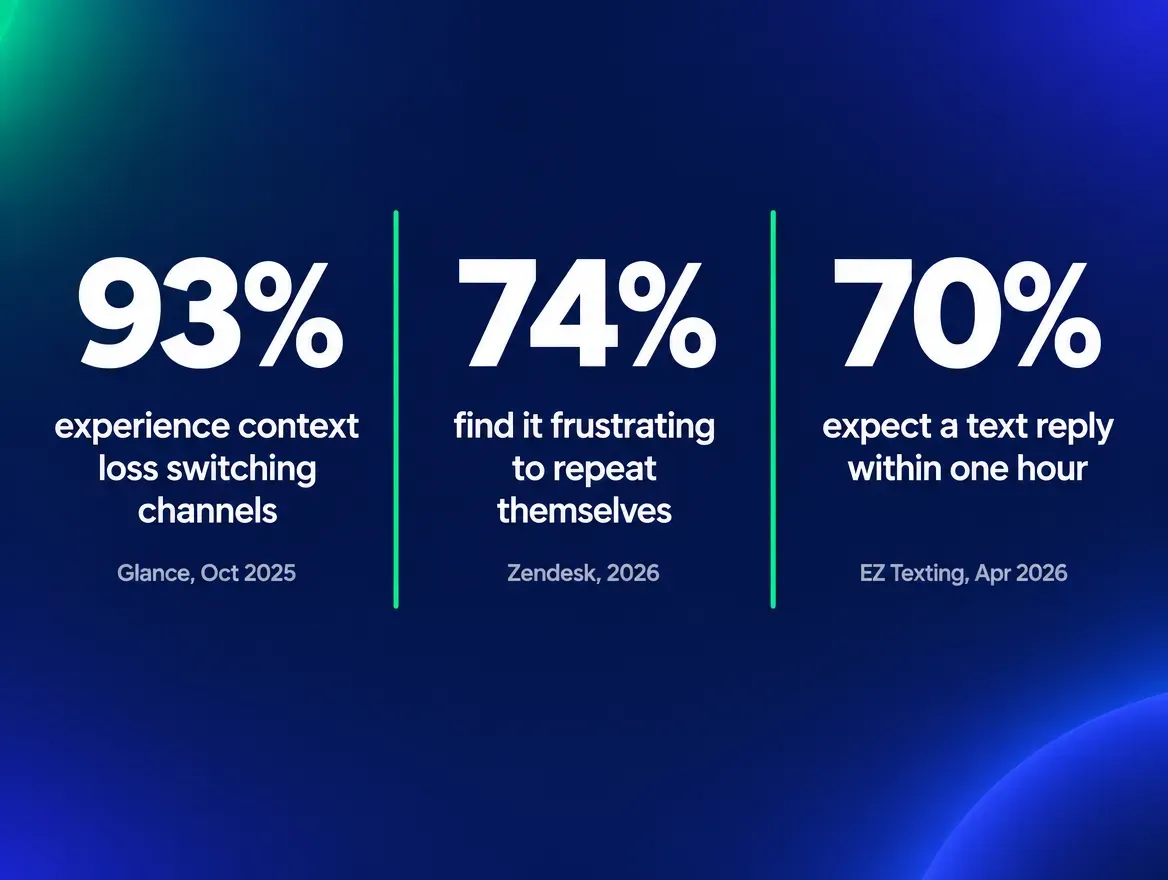
Read those numbers together and a pattern shows up that matters specifically for insurance follow-up. Glance’s survey found that 44% of consumers “almost always” have to repeat themselves across channels, with another 49% saying it happens “sometimes” — only 7% rarely or never experience it (Glance, October 2025). Zendesk’s independently fielded report puts a number on how that feels: 74% call it frustrating, from a survey of 11,297 consumer and business respondents across 22 countries run in June 2025 (Zendesk, CX Trends 2026). That’s not one vendor’s marketing claim — it’s two different organizations, using two different survey instruments, arriving at compatible conclusions about the same underlying behavior.
It would be easy to read that and assume the fix is “reduce channels” or “push everyone toward one app.” The data says the opposite is closer to true. Salesforce’s State of the AI Connected Customer report — a YouGov double-blind survey of 15,015 consumers across 18 countries, fielded July-August 2024 — found that over a third of consumers say they’d rather work with an AI agent than a person specifically to avoid repeating themselves (Salesforce, 7th Edition, July-August 2024). People aren’t rejecting automation or multiple channels; they’re rejecting the experience of having to re-explain themselves because nobody kept track. The problem isn’t that a lead texted, then emailed, then called. The problem is that nothing on your end remembered that she’d already told you the drug she was asking about.
Nobody's upset that you have five channels. They're upset that channel four doesn't know what happened on channel two.
Mike MooreThere’s an internal cost too, and it isn’t just about the lead’s experience. Salesforce’s separately run State of Service report — a survey of over 5,500 service professionals fielded December 2023-January 2024 — found that 58% of agents at underperforming service organizations report toggling between multiple screens or systems to find the information they need, compared to 36% at high-performing organizations (Salesforce, 6th Edition, published September 2024). That’s your team’s time, spent hunting for context that should already be sitting in one place, on every single lead that touches more than one channel.
| Channel | Where the record lives | What it knows about the other channels |
|---|---|---|
| Call | Dialer call log, or nowhere if unlogged | Nothing, unless manually noted |
| Text (SMS) | Dialer or texting platform thread | Nothing, unless the platform is the same as the call log |
| Shared or personal inbox | Nothing; matched only by email address, which may differ from the lead form | |
| Facebook Messenger | Meta Business Suite inbox | Nothing; matched by Page-scoped ID, not phone or email |
| Office voicemail | Shared voicemail box | Nothing, and disappears entirely if no one transcribes it |
What most agencies run instead of one record
Five inboxes, no shared thread
- A lead's call, text, email, and DM history live in four different tools
- Whoever answers a channel has no idea what happened on the others
- The same question gets asked, and answered, twice
- Nobody can say with confidence "we already replied to her"
- A compliance disclosure sent on one channel isn't visible from another
4-5 disconnected logsper lead who uses more than one channel
One dossier, tagged by channel
- Every touch — regardless of channel — lands in the same per-lead record
- Anyone who opens the record sees the full sequence, in order
- A reply on a new channel gets matched to the existing thread, not treated as new
- You can search "who replied but hasn't been followed up" across every channel at once
- Disclosure and consent history travels with the lead, not the channel
1 dossierregardless of how many channels a lead uses
How to build a unified lead record by hand
None of this requires software you don’t already have. It requires a habit, a single shared artifact, and someone whose job includes checking every inbox on a schedule. Here’s the complete method.
Build one shared lead log with every identifier a lead might use
A spreadsheet or a CRM custom-field set with columns for name, every known phone number, every known email address, and a Facebook name or profile link if applicable. This is the matching key you'll use to connect a reply that shows up under a different identifier than the original lead-form submission.
Name a channel-monitor, and rotate the job during AEP
One person's job, for a defined block of the day, is to sweep every inbox — the shared email box, the Facebook Page inbox, the office voicemail, the dialer's text thread — and check each new contact against the lead log for a match on any identifier, not just the obvious one.
Log every touch to the lead's row, not a separate channel log
When a match is found, the event gets written into that lead's row in the shared log: date, channel, and a one-line summary of what was asked or said. The point isn't a full transcript — it's enough that the next person who opens that row knows what's already been covered.
Reply on the same channel the lead used, every time
If she emailed, reply by email. If she texted, reply by text. Answering a text with a phone call, or an email with a text, is a common shortcut that breaks the thread from the lead's side too — now she has to go looking for your reply on a channel she wasn't using.
Track disclosure delivery per channel, not per lead
If your process sends the TPMO disclaimer on first contact, that has to happen again on any new electronic channel a lead introduces — a check box per channel per lead, not one check box for the whole relationship. This is the compliance habit the next section explains in more detail.
Run a daily sweep for stale replies
Once a day, scan the shared log for any row with a logged reply and no logged response back within your target window. During AEP, that window should be hours, not days — a lead who replied and got silence for two days has usually moved on to whichever agent responded first.
This scales down to a solo agent fine
A solo agent doesn't need a rotating monitor role — you're the monitor. What doesn't change is the habit: check every inbox on a schedule, log every touch to one place regardless of which app it happened in, and reply on the channel the lead used. The failure mode for a solo agent isn't usually "too many people, no coordination" — it's "I forgot to check the Facebook Page inbox for three days during AEP because the dialer was ringing constantly."
Everything above works whether you ever join anything or not. Go run it by hand, or let Ambrose run the parts of it that can be automated.
Where the manual version breaks down at scale
The six-step process above is complete and it works — for one agent, or a small team running a modest lead volume. It gets genuinely hard to sustain the moment volume climbs, which is exactly when it matters most: during AEP, when the same team is fielding more leads on more channels in a compressed window, and the channel-monitor role turns into someone’s full-time, thankless second job.
There’s a privacy problem that gets worse with scale too. The shared lead log has names, phone numbers, email addresses, and health-plan questions sitting in the same rows. If anyone on the team pastes a chunk of that log into a general-purpose AI tool to help draft replies faster during a busy week — an understandable shortcut when the inbox is overflowing — that’s lead PHI going to a destination that almost certainly isn’t covered by a signed BAA.
How Ambrose’s channel-bridge and lead-memory spokes automate this
Ambrose OS, the platform included with a Tech Savvy membership, has two spokes built for exactly this problem, and it’s worth naming what each one actually does rather than treating “AI” as one undifferentiated fix.
channel-bridge is documented as the outbound email, SMS, and Telegram dispatcher — “the single place messages actually leave your account,” in the platform’s own words (Ambrose docs, spoke-channel-bridge, fetched September 2026). It reaches email through Gmail, a GoHighLevel conversation, or direct SMTP; SMS through Twilio or a GoHighLevel conversation; and Telegram directly. It ships in drafts mode by default — a human reviews and sends, and you only flip a given agent or team to auto-send after watching its drafts for a few days — which matters for a compliance-sensitive industry where you want a person seeing what goes out before it goes out. Its data-handling tier is “scrubbed”: outbound message bodies route through the PHI Gateway before anything reaches a destination outside the agency’s own BAA-covered systems, and identifiers are re-hydrated on the way back.
lead-memory is the per-lead dossier store, and this is the piece that actually solves cross-channel fragmentation as a concept, not just as an email/SMS/Telegram convenience. Its lead_get_dossier tool pulls a lead’s history, and its lead_log_event tool adds an entry to that lead’s timeline — and critically, that tool doesn’t care whether the event came from channel-bridge automatically or from a person typing in “she called the office at 2pm and asked about drug coverage” after hanging up the phone. Its lead_search tool lets you query across the whole book by tag, channel, or status — the automatic version of the daily stale-reply sweep in the manual method above. lead-memory’s data-handling tier is “safe”: local-only, data never leaves the box, PHI allowed.
Put together, the honest version of what this buys you is: channel-bridge automates the outbound side for three specific channels, with a human in the loop by default; lead-memory gives you the one place every channel’s events land, including the two channels — phone calls and Facebook Messenger — that nothing in the current spoke catalog dispatches through directly, and still have to be logged by a person. That’s a real, current capability, not a promise that every channel is automated end to end.
| Manual step | Ambrose equivalent |
|---|---|
| Sweep email, SMS, and Telegram from separate apps | channel-bridge dispatches and tracks all three from one place, drafts-mode by default |
| Log every touch to one shared row per lead | lead_log_event writes any event — automated or manually reported — to the lead's dossier |
| Open the log to see a lead's full history before replying | lead_get_dossier returns the full cross-channel history in one call |
| Manually log a phone call or Facebook DM outcome | Still manual — logged via lead_log_event into the same dossier as everything else |
| Daily sweep for stale replies across every channel | lead_search queries by tag, channel, or status across the whole book |
| Keep raw lead data out of a general AI tool | channel-bridge routes through the PHI Gateway; lead-memory is local-only and never leaves the tenant |
Response-time expectations by channel
Different channels run on different clocks — which is exactly why a lead who switches channels can feel ignored even when you're following your normal cadence.
Sources: EZ Texting, 2026 Consumer Texting Behavior Report, April 2026 (n=959). Sprout Social, "about three-quarters of consumers expect a response within 24 hours or sooner," 2025 Sprout Social Index.
Ambrose’s channel-bridge and lead-memory already do this — one seat comes with the membership, and that’s the fastest way to stop losing the thread the moment a lead switches channels on you.
This doesn't fix a sequence that isn't converting at all
A unified record tells you what happened. It doesn't fix a follow-up cadence that's too slow or too thin to begin with. If your overall response time is the deeper problem, our guide to speed-to-lead covers that specifically.
Compliance: the disclosure rule already follows the lead across channels
This is the part worth getting exactly right, because the common version of this story — that a new CY2027 rule newly requires the TPMO disclaimer on email and chat — isn’t accurate, and it’s worth being precise about what actually changed.
The electronic-channel disclosure requirement already existed. TPMOs must electronically convey the required disclaimer “when communicating with a beneficiary through email, online chat, or other electronic means of communication” (42 C.F.R. § 422.2267(e)(41)(iii), via Cornell Law’s eCFR mirror). That isn’t new for contract year 2027 — it’s existing regulatory text. What that means practically: if you communicate with a lead by email or text at all, the disclaimer obligation already travels with you onto that channel, and a cross-channel record is what lets you actually prove, channel by channel, that it went out.
What’s actually changed is the timing trigger for the verbal disclaimer on a live call. The current rule requires the disclaimer to be “verbally conveyed during sales calls prior to the discussion of any benefits” (42 C.F.R. § 422.2267(e)(41)(ii), via Cornell Law’s eCFR mirror) — a sequence-based trigger, not a clock-based one tied to the first minute of the call. That’s a narrower, more precise change than “the disclaimer rules for email and chat are new” — the electronic-channel rule in the paragraph above was never in question; what moved is exactly when the spoken version has to land on a call.
If AI drafts or routes any part of your cross-channel replies, the NAIC’s AI Model Bulletin expectations apply. Adopted December 4, 2023, it calls for a written, documented program governing how AI is used across the business, including marketing, with human oversight and documentation an examiner could ask to see (NAIC, adopted Dec. 4, 2023). States adopt the bulletin individually and adoption is ongoing, so check your state Department of Insurance for its current status. “We use an AI tool to help answer texts faster” is not, on its own, a policy — the bulletin expects you to be able to describe how that tool is used, reviewed, and accounted for.
Don't paste a cross-channel lead log into a general AI tool
A unified lead record is, by design, a concentration of exactly the information you don't want landing somewhere without a signed BAA — names, contact details, and health-plan questions from multiple channels in one place. Ambrose's channel-bridge routes outbound content through the PHI Gateway, which scrubs the 18 HIPAA identifiers before anything reaches a non-BAA destination and re-hydrates them on the way back ([Ambrose docs, Architecture](https://app.hiambrose.com/docs/architecture), fetched September 2026) — described as HIPAA-aware by default, not HIPAA certified. AI outputs may still contain errors; always verify before anything reaches a client.
AEP 2026 runs October 15 through December 7, with any plan change taking effect January 1 (Medicare.gov, Medicare Open Enrollment). That’s the exact window when lead volume, channel-switching, and disclosure obligations all peak at once — which is why getting one unified record in place now, rather than in the middle of it, is worth the setup time.
What you get by joining
One Ambrose seat, including the channel-bridge and lead-memory spokes, comes with a Tech Savvy Insurance membership: $97 a month, billed monthly, cancel anytime, founding rate locked in while the membership stays active. Alongside the seat: weekly Zoom calls with open Q&A and build-with-you sessions, 30+ hours of recorded training, Meta Ads and marketing training built for this industry, pre-built AI templates and bot deployments, and a free annual in-person member workshop — plus an explicit no-recruiting rule, so you can ask a real question about your lead log without ending up on someone’s downline pitch list.
Ambrose usage is separate from the $97 seat
The membership includes one Ambrose seat; usage inside Ambrose runs through its own credit ledger with spend caps, so cost stays visible instead of showing up as a surprise. See the full Spokes catalog for what else is available beyond channel-bridge and lead-memory.
The close
Everything above — the shared lead log, the channel-monitor role, the daily stale-reply sweep — works whether you ever join anything or not. That’s the point of writing it out completely. This is the kind of thing we work through on a Tuesday with Ambrose open on the screen: pulling a lead’s dossier and watching a channel-bridge draft come in from a text that shows up already knowing about the email from three days earlier. $97 a month, cancel anytime, and nobody will pitch you a downline: https://techsavvyinsurance.com/.
Before you change anything about your follow-up process
Tech Savvy Insurance is a training and software community, not an insurance company, agency, or law firm, and does not provide insurance, legal, tax, or compliance advice. You are responsible for your own licensure and for complying with all applicable CMS, HIPAA, TCPA, state, and carrier regulations, including disclosure requirements on every channel you use with a lead. AI-generated outputs may contain errors — always verify. Results may vary.
Frequently asked questions
Sources
- Glance CX — Customer Support Survey: Why Omnichannel Doesn't Feel Seamless — glance.cx
- Zendesk — CX Trends 2026 (live report) — cxtrends.zendesk.com
- Zendesk Newsroom — Contextual Intelligence Becomes the New Standard for CX in 2026 — zendesk.com
- Salesforce — 7th Edition, State of the AI Connected Customer — salesforce.com
- Salesforce — 6th Edition, State of Service Report — salesforce.com
- Sprout Social — Social Media Customer Service Statistics — sproutsocial.com
- Sprout Social — The 2025 Sprout Social Index, methodology — sproutsocial.com
- EZ Texting — 2026 Consumer Texting Behavior Report — eztexting.com
- 42 CFR 422.2267 — TPMO disclaimer, electronic communications and verbal call timing (Cornell Law eCFR mirror) — law.cornell.edu
- NAIC — Model Bulletin on the Use of AI Systems by Insurers (adopted Dec. 4, 2023) — content.naic.org
- Medicare.gov — Medicare Open Enrollment (AEP dates) — medicare.gov
- Ambrose docs — channel-bridge spoke — app.hiambrose.com
- Ambrose docs — lead-memory spoke — app.hiambrose.com
- Ambrose docs — Architecture (PHI Gateway) — app.hiambrose.com
Ready to put this into practice?
Join a private community of Health & Life insurance professionals using AI, Meta Ads, and automation to grow — without draining their bank account.
Join Tech Savvy — $97/month