
CMS proposed a rule on November 16, 2026, called CRUSH — Comprehensive Regulations to Uncover Suspicious Healthcare — and buried inside its program-integrity overhaul of Medicare, Medicaid, and the ACA Marketplace are four changes that would hit licensed agents and brokers directly: a new felony and debarment bar on Marketplace participation, a much lower bar for suspending your Exchange agreement, a tougher termination standard, and a flat ban on accessing Marketplace systems from outside the United States, VPNs included. It is a proposed rule, not a final one, and public comments are due January 19, 2027. None of it is law yet. All of it is worth understanding now, because the comment period is the only window where an agent’s objection or question has any formal standing before this becomes enforceable.
Key takeaways
- CMS's CRUSH proposed rule (CMS-6098-P, released Nov. 16, 2026) would restrict Marketplace access for agents and brokers with certain felony convictions or current debarment/exclusion from federally funded healthcare programs — a bar that doesn't exist today.
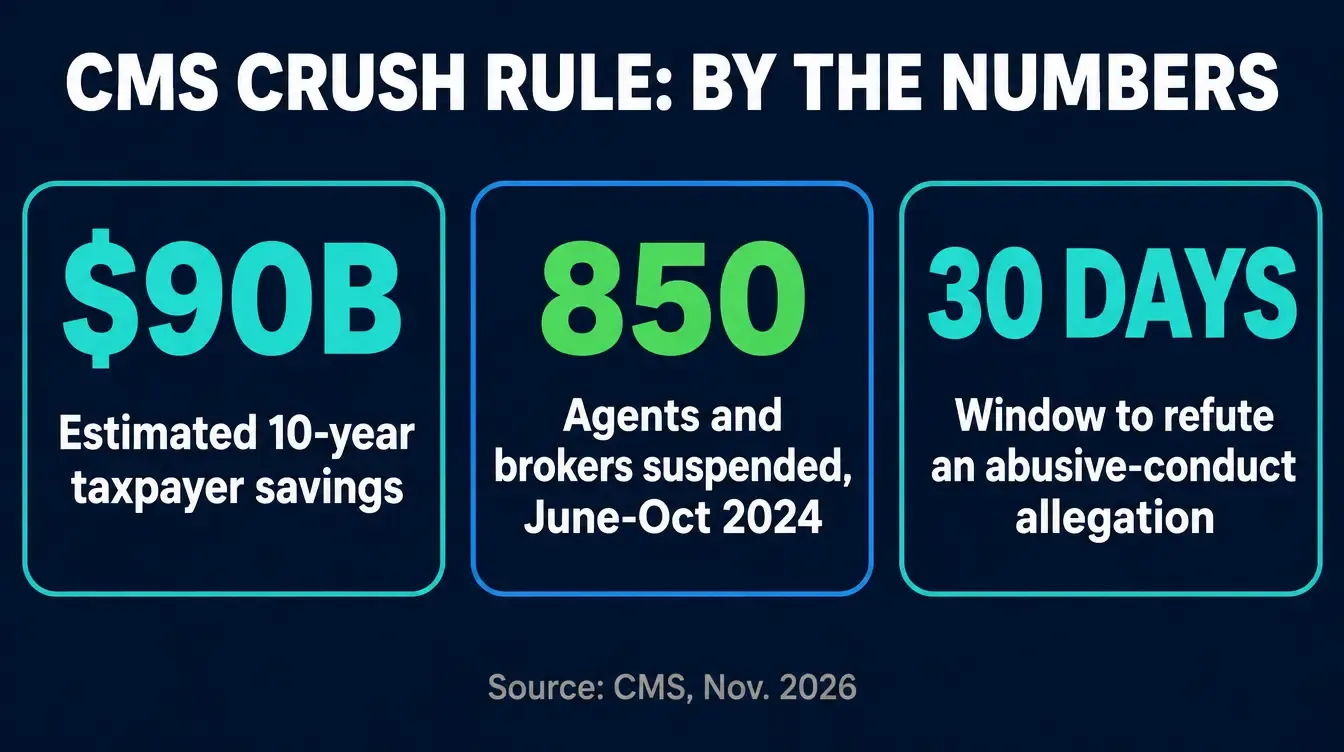
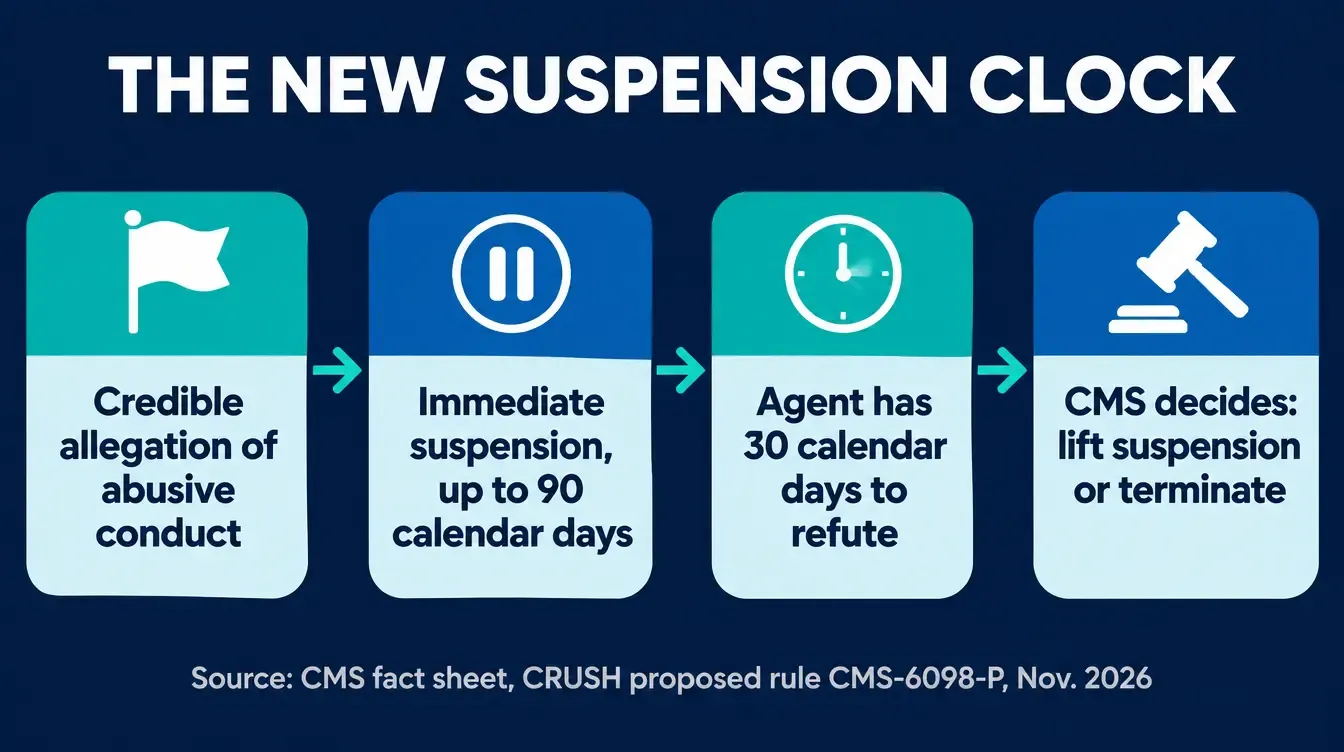
- It would replace the current "reasonable suspicion of fraud" suspension standard (45 CFR 155.220(g)(5)) with a "credible allegation of abusive conduct" standard: up to 90 calendar days of immediate suspension, with a 30-calendar-day window for the agent to refute it.
- Termination for cause would shift from an "opportunity to resolve" noncompliance to an "opportunity to refute" it — meaning fixing the problem within 30 days may no longer be enough to avoid termination.
- A new provision would require agents, brokers, and web-brokers to block Marketplace system access from outside the U.S., explicitly including VPN connections that route traffic abroad — a real issue for any agency using overseas virtual assistants or call centers.
- CMS says the broader CRUSH rule could save taxpayers nearly $90 billion over 10 years, building on Medicare program integrity recoveries that CMS reports grew from $26.3 billion in FY2024 to $41.9 billion in FY2025. Comments on the proposed rule are due January 19, 2027.

The pain: the rule wasn’t written for you, but it doesn’t exempt you either
Here’s the version of this that should actually worry a clean agent, not the version that gets repeated in Facebook groups. You’ve never misrepresented a plan, you’ve never switched someone without consent, and your worst compliance sin this year was a late CE credit. None of that matters if a complaint lands on your name — a disgruntled client who didn’t get the drug coverage they expected, a competitor who files something vindictive, a misunderstanding on a recorded call that reads worse out of context than it sounded live. Under the rule CMS has on the books today, that complaint has to clear “reasonable suspicion of fraud” before CMS can suspend you. Under the rule CMS proposed on November 16, 2026, it only has to clear “a credible allegation of abusive conduct” that “may cause consumer harm” — a materially lower bar, and one CMS’s own fact sheet doesn’t define with a bright line.
This is guidance, not legal or compliance advice
Tech Savvy Insurance is a training and software community, not a law firm, an insurance company, or an insurance agency, and nothing here is insurance, legal, tax, or compliance advice. This article describes a proposed rule as published by CMS on November 16, 2026, which is not yet in effect and may change before any final rule issues. Confirm your own compliance posture, your Exchange agreement obligations, and your state's rules with your own FMO, carrier compliance department, or legal counsel before acting on anything here.
That’s the real stakes of this article. Not “comply with a final rule” — there isn’t one yet — but “understand exactly what’s being proposed, while the comment period is still open, and start building the kind of record that protects you regardless of which version of this eventually takes effect.”
What CMS actually proposed on November 16, 2026
CRUSH is a big rule. CMS’s own press release frames it as a standalone, discretionary program-integrity overhaul touching Medicare Advantage risk-adjustment audits, Medicaid and CHIP fraud reporting, provider ownership transparency, and the ACA Marketplace all at once, and the agency says it “aims to reap nearly $90 billion” in taxpayer savings over the next 10 years (CMS, press release, Nov. 16, 2026). Most of that $90 billion comes from provider- and plan-side provisions that have nothing to do with a licensed agent’s day-to-day work. The piece that does is narrower, and it’s entirely inside 45 CFR Part 155 — the regulations governing agent, broker, and web-broker participation in the Federally-facilitated Exchanges.
CMS’s own fact sheet for CMS-6098-P lays out four specific agent/broker provisions, and it’s worth reading each one in CMS’s own language rather than a paraphrase, because the exact wording is what will matter if and when this becomes final:
| Provision | What CMS's fact sheet says |
|---|---|
| Felony and debarment bar | New authority to "create new limitations on Marketplace participation for A/Bs with certain felony convictions" and for past fraud-related adverse actions. No equivalent authority exists today. |
| Suspension standard | Replaces "reasonable suspicion of fraud" (45 CFR 155.220(g)(5)) with a standard based on "a credible allegation of abusive conduct" found to "may cause consumer harm." Suspension can run up to 90 calendar days; the agent gets 30 calendar days to refute it. |
| Termination standard | Replaces the current "opportunity to resolve" noncompliance within 30 days with an "opportunity to refute" it, and replaces the "sufficiently severe" standard with a defined list of weighing factors. Terminations for cause move to a preponderance-of-the-evidence finding. |
| Non-U.S. access / VPN | Requires "reasonable safeguards to prevent access to Marketplace systems from locations outside the United States," explicitly including "access from within the United States routed outside the country through a virtual private network (VPN)." |
The release itself frames the intent charitably: these reforms, CMS says, are meant “to support the legitimate work of agents and brokers while holding noncompliant ones accountable” (CMS, fact sheet, CMS-6098-P). Whether that balance actually lands that way in practice is exactly what the public comment period exists to test — and it closes January 19, 2027, per a CMS bulletin distributed through its GovDelivery system, with the fact sheet independently confirming a 60-calendar-day comment window from Federal Register publication (CMS bulletin, Nov. 2026; CMS fact sheet, CMS-6098-P).
Why now: the enforcement numbers behind the rule
CRUSH didn’t appear out of nowhere. CMS’s November 2026 press release leans on its own Medicare program integrity results to justify the broader push, and the numbers are specific: Medicare program integrity savings grew from $26.3 billion in FY2024 to $41.9 billion in FY2025, which CMS calls a 59 percent increase and describes as a record. Return on investment moved from $14.60 to $22.30 recovered per dollar CMS spent on program integrity in FY2025 — a 53 percent increase that CMS calls the highest ratio ever recorded (CMS, press release, Nov. 16, 2026).
That last figure is the one worth sitting with. CMS’s own October 2024 press release states plainly: “From June 2024 through October 2024, CMS suspended 850 agents and brokers’ Marketplace Agreements for reasonable suspicion of fraudulent or abusive conduct” related to unauthorized enrollments or unauthorized plan switches, and suspended agents “are now prohibited from participating in Marketplace enrollment, including receiving related commissions” (CMS, press release, Oct. 17, 2024). That’s 850 suspensions in five months, under the standard CRUSH proposes to lower further. If the new “credible allegation of abusive conduct” standard is in fact easier to meet than “reasonable suspicion of fraud” — which is the entire point of the change, per CMS’s own fact sheet — there’s no reason to expect that number to shrink once it’s in effect.
850 suspensions in five months happened under the standard this rule is replacing with something lower. The question isn't whether CMS will use the new standard. It's whether your own records would hold up if it's used against you by mistake.
Mike MooreFelony convictions and debarment: new ground, not a tightening of old rules
This is the provision that’s easiest to misread as “they’re just formalizing what was already true.” It isn’t. CMS’s fact sheet is explicit that today’s regulations give the agency no authority at all to exclude an agent or broker from the Marketplace over a felony conviction or a past fraud-related adverse action — CRUSH would create that authority from scratch. CMS’s fact sheet doesn’t list which felony categories would count, how far back a conviction would reach, or what the process would look like for someone whose conviction predates their license and has had a clean record since. None of that is settled. If you have anything in your history that could plausibly fall under “certain felony convictions” once CMS defines the category in a final rule, that’s a conversation to have with your own attorney now, while the comment period is open and the definition is still movable — not after a final rule locks a definition you had no input on.
The debarment/exclusion half is more concrete: current debarment or exclusion from any federally funded healthcare program (think OIG’s List of Excluded Individuals/Entities, or equivalent federal exclusion databases) would bar Marketplace participation outright. If you’ve never checked whether anyone on your team — a 1099 contractor, a sub-producer, an overseas VA with system access — appears on a federal exclusion list, that’s a five-minute check worth doing this week regardless of whether CRUSH finalizes as written.
Suspension on an allegation: the new “credible allegation of abusive conduct” standard
This is the provision that should get the most attention from a clean agent, because it changes what happens to you before anyone has proven anything. Today, 45 CFR 155.220(g)(5) lets CMS suspend your Exchange agreement on “reasonable suspicion of fraud.” CMS’s CRUSH fact sheet proposes swapping that for a suspension authority built on “a credible allegation of abusive conduct,” paired with a finding that the conduct “may cause consumer harm.” You’d get a 30-calendar-day window to refute the allegation, and CMS would decide whether to lift the suspension “within the 90-calendar day suspension period” (CMS, fact sheet, CMS-6098-P).
Today's standard
CMS needs "reasonable suspicion of fraud" to suspend your Exchange agreement for up to 90 days — a standard tied to a specific, named category of misconduct (fraud), under 45 CFR 155.220(g)(5).
The proposed standard
CMS needs only "a credible allegation of abusive conduct" that may cause consumer harm — a broader, undefined category, and "credible allegation" is a lower evidentiary bar than "reasonable suspicion" of a specific crime. The suspension window and refute window stay the same length; what changes is how easy it is to trigger them.
Final terminations for cause would move to a “preponderance of the evidence” finding — notably, the same evidentiary standard CMS already applies to ACA broker terminations under a separate rule, CMS-9884-F, finalized in June 2025. If that standard sounds familiar, it should: it’s already in effect for terminations, and CRUSH would extend a version of it, paired with a new suspension trigger, to abusive-conduct allegations specifically.
Termination: “opportunity to resolve” becomes “opportunity to refute”
This is a quieter change than the suspension standard, and arguably a more consequential one for an agent who’s confident they can fix any problem CMS flags. Under today’s rule, if CMS identifies noncompliance it considers “sufficiently severe,” you get 30 calendar days to resolve it before termination — the operative word is resolve. Fix the problem, and the standard is generally satisfied. CMS’s fact sheet proposes replacing that with an “opportunity to refute”: you’d still get 30 calendar days, but the question is no longer whether you corrected the issue, it’s whether you can produce evidence that it didn’t happen, or didn’t happen the way it was alleged. CMS also proposes replacing “sufficiently severe” with a defined list of factors it would weigh in deciding whether to terminate.
Fixing the problem may not be the same as refuting it
Under the "opportunity to resolve" framing, correcting a mistake fast was often the whole ballgame. Under "opportunity to refute," correcting a mistake doesn't erase that it happened — and if CMS's weighing factors treat the underlying conduct as serious enough, a prompt fix may not be enough to avoid termination. The practical shift is from "can I fix this" to "can I prove this allegation is wrong," which puts a much higher premium on having contemporaneous records, not just a fast response after the fact.
The VPN and non-U.S. access requirement: a real issue if you use overseas support
This provision gets the least attention in agent forums and may be the most immediately actionable one. CMS’s fact sheet proposes requiring agents, brokers, and web-brokers to “implement and maintain reasonable safeguards to prevent access to Marketplace systems from locations outside the United States,” and it specifically names “access from within the United States routed outside the country through a virtual private network (VPN)” as conduct the safeguard must prevent.
Read that plainly: the rule goes further than “don’t log in from another country.” It also bars routing Marketplace access through infrastructure that exits the country, even when the person at the keyboard is sitting in the U.S. That’s a meaningfully broader target than it first sounds, and it has a specific, practical collision point for a lot of agencies: overseas virtual assistants and overseas call centers. If your agency contracts a VA in the Philippines, India, or anywhere outside the U.S. who logs into your Marketplace-connected systems, or if a domestic call center you work with routes any of its technical support or remote-access tooling through servers outside the U.S., that is exactly the access pattern this provision targets — regardless of whether anyone intended anything improper by it.
A five-minute audit worth doing this week
Ask directly: does anyone with access to your Marketplace-connected accounts — staff, contractor, VA, call center — connect from outside the U.S., or through any remote-access or VPN tool that might route outside the U.S.? If you don't know the answer with confidence, that's the gap. Get the answer from whoever manages your tech stack before this provision is anywhere near final, not after.
Who this actually reaches: ACA Marketplace, not Medicare Advantage, directly
The felony bar, the suspension standard, the termination standard, and the VPN provision all sit inside 45 CFR Part 155 — the regulatory framework for the ACA Health Insurance Marketplace (Exchange) program specifically. None of these four provisions rewrites the Medicare Advantage or Part D rules under 42 CFR 422/423, including the TPMO disclaimer and call recording requirements covered elsewhere on this site.
| Your situation | Reached by these four provisions? |
|---|---|
| You hold an Exchange agreement and sell ACA Marketplace plans | Yes — directly, if and when this finalizes |
| You sell Medicare Advantage or Part D only, no ACA business | No — these specific provisions sit under 45 CFR Part 155, not 42 CFR 422/423 |
| You're a dual-market agent, ACA and Medicare Advantage | The ACA side is reached directly; the Medicare side carries its own separate, already-active TPMO call recording and disclaimer obligations that run in parallel, not instead of these |
| You use an overseas VA or call center with system access, any line of business | Worth checking regardless — the non-U.S. access provision is written around the access pattern, not the specific product being sold |
If you’re a Medicare-only agent reading this and relieved that it doesn’t touch you directly, notice the shape of the thing instead: CMS has spent two years building an enforcement posture of more audits, lower evidentiary bars, and harder documentation requirements, and it’s applying that same posture program by program. The Medicare side already has its own version — a six-year call recording retention requirement and TPMO disclaimer obligations that are separately in effect right now. The lesson from CRUSH isn’t “this doesn’t apply to me.” It’s “this is where CMS’s enforcement logic is heading across every program it runs.”
What it costs: the mechanism, because nobody has a sourced dollar figure for you
We’re not going to invent a dollar figure for what a suspension or termination costs an individual agent — nobody has published a sourced number broken out that way, and making one up would be exactly the kind of unverifiable claim this site doesn’t run. What’s sourced and real is the mechanism, and it’s worse than a single lost sale.
An Exchange agreement isn’t tied to one client. It’s the credential that lets you touch Marketplace enrollment and service work for every ACA client on your book — new enrollments, renewals, plan changes, the works. Suspend it for up to 90 days while you try to refute an allegation, and every one of those clients needs a different path to get serviced during that window, whether that’s another agent at your agency or no agent at all. Terminate it, and that line of business stops for as long as the termination and any resulting registration bar stays in place. The 850 agents and brokers CMS suspended in five months in 2024 weren’t suspended for being bad agents in some abstract sense — they were suspended, and immediately prohibited from “participating in Marketplace enrollment, including receiving related commissions,” per CMS’s own language (CMS, press release, Oct. 17, 2024). That’s the real cost: not a fine, but an abrupt stop to the part of your book that depends on that agreement, for however long the process takes to resolve.
The manual fix: build your abusive-conduct defense file, starting this week
Nothing below requires software, a vendor, or a membership. It requires changing a few habits about how you log client interactions, starting today, plus a pass through recent complaints or close calls to backfill what you can.
Log every complaint the moment you hear about it, not just the ones that escalate
A client who calls annoyed about a drug not being covered, who you resolve in five minutes on the phone, is still a complaint. Write it down the day it happens: who, what they said, what you did about it, and when. Most agents only create a record once something has already escalated to a carrier or CMS — by then you're reconstructing from memory, which is exactly the position "opportunity to refute" punishes.
Keep a dated, version-controlled copy of every script and ad claim you actually used
Not the script you were trained on six months ago — the one you were actually reading from on the call in question. If a complaint alleges you said something you shouldn't have, the single most useful thing you can produce is the exact, dated script you were following, so the allegation can be checked against what you were actually authorized to say.
Document resolution, not just occurrence
"Client complained about X" isn't a defense by itself. "Client complained about X on [date]; I explained Y; client confirmed understanding on [date]; no further contact" is. The second version is what "refuting" an allegation actually requires — proof the issue was addressed and closed, not just that you remember addressing it.
Save the specific consent and disclosure language tied to the enrollment or action in question
If an allegation involves an unauthorized switch or a misrepresentation, the fastest rebuttal is the actual consent record and the actual disclosure language used for that specific transaction — not a general statement that "we always get consent." Tie the record to the specific client and date, every time.
Pre-build your 30-day response packet template now
If a credible-allegation suspension lands, you have 30 calendar days to refute it — not 30 days to figure out where your records live. Build the folder structure and checklist now: complaint log entries, script version used, consent record, resolution notes, any carrier correspondence. Knowing exactly what you'd assemble, and where it already lives, is the difference between a stressful week and an impossible one.
Audit who has remote or VPN access to your Marketplace systems
List every person and every tool that touches your Marketplace-connected accounts, and confirm none of it routes outside the U.S. — including a VA's remote-access software, a call center's VPN, or your own travel habits if you ever work from outside the country. Fix any gap you find before a final rule turns it into a violation.
The test that matters
If CMS alleged abusive conduct against you tomorrow, tied to a specific client interaction from three months ago, could you produce a dated, specific record — not a memory, not a general policy statement — showing what was said, what was done, and how it was resolved, inside 30 calendar days? If the honest answer is no, that's the exact gap this six-step method closes.
Where Ambrose fits, and where it doesn’t
Nothing below makes you compliant, and CRUSH is still a proposal — there’s no finished standard for a tool to automate compliance with yet. What Ambrose’s own documentation confirms is narrower, and it maps directly onto the record-building problem above.
The client-vault spoke is documented as a “client-facing enrollment + policy store,” with four tools: client_get fetches a single client record, client_list_policies lists all of a client’s policies, client_search searches within one client’s data, and client_add_document attaches a new document such as a PDF or image (Ambrose docs, Spoke: client-vault). That last tool is the one that matters here — a complaint log entry, a dated resolution note, or a saved script version can live attached to the specific client record it concerns, instead of scattered across email and a notes app.
The agent-vault spoke — the “agency’s private book of business,” HIPAA posture marked safe, local-only (Ambrose docs, Spokes) — adds vault_search for full-text and structured search across indexed files, vault_list_recent for recently changed or added files, and vault_classify_lob to automatically classify a line of business as MAPD, PDP, Med Supp, ACA, Group, or ICHRA (Ambrose docs, Spoke: agent-vault). For an agency trying to pull every ACA-specific record fast if CMS ever asks, that classification tool does real work.
The phi-gateway spoke is described as “the safety rail every scrubbed-posture spoke calls before egress” — it detects PHI through a layered chain (known contacts, regex, Presidio NER, an insurance dictionary), keeps the real-to-scrubbed value mapping in a local-only, encrypted sqlcipher store, and exposes four tools: phi_scrub, phi_rehydrate, phi_audit_query to query the scrub audit log, and phi_check_baa to check whether a destination is BAA-allowlisted (Ambrose docs, Spoke: phi-gateway). That audit log is a genuine, queryable timestamp trail of what ran and when — relevant to the NAIC AI Model Bulletin’s expectation that an agency using AI tools maintain documentation of what the tool did and when, alongside human oversight of the output.
The War Room’s Compliance persona, Dr. Elena Reyes, is one of nine executive heads you can pose a question to; Ambrose decides which head answers, or convenes a small group, and synthesizes a response with a visible tool-call timeline and a “why this answer” dispatch chain (Ambrose docs, War Room). Asking Dr. Elena Reyes to review a script before it goes out, or to look at a pattern across recent complaint entries, is a real use of that persona — not a guarantee of her findings being legally sufficient, but a genuine second pass before CMS takes one.
And Routines — a cron-scheduled prompt attached to an agent or team, with its output sent to Slack, email, a GoHighLevel note, or a log (Ambrose docs, Routines) — is what turns the complaint-logging habit above from “something I mean to do” into something that actually happens: a weekly sweep of the past week’s logged complaints and their resolution status, posted to the team’s Slack channel every Monday, flagging anything still open.
| Task | Doing it by hand | Running through Ambrose |
|---|---|---|
| Keeping one complaint-and-resolution record per client | Scattered across email threads, sticky notes, and memory | client_add_document attaches the record directly to the client-vault entry |
| Finding every ACA-specific record fast across the whole book | Manually sorting files by product line | agent-vault's vault_classify_lob auto-tags ACA vs. MAPD vs. Med Supp records |
| Proving what ran and when, without exposing raw identifiers | Screenshots and memory, if anything at all | phi-gateway logs every scrub event, queryable via phi_audit_query |
| A second compliance read on a script before it goes out | Whoever happens to be free to look it over | Ask the War Room; Dr. Elena Reyes (Compliance) responds with a visible dispatch chain |
| A recurring check that open complaints don't go stale | Depends on someone remembering, usually right before an audit | A Routine, scheduled on cron syntax, posts the week's status to Slack automatically |
Ambrose is built insurance-native and is described as HIPAA aware by default, not HIPAA certified — PHI only runs against model providers covered by a signed Business Associate Agreement, with Claude through Amazon Bedrock in U.S. regions named as the compliant route, and tenant isolation resolves the acting agency ID on the server, never from user or model input, enforced underneath by Postgres row-level security so that, per Ambrose’s own documentation, “a prompt cannot talk its way into another agency’s rows” (Ambrose docs, Architecture: PHI Rail). If your agency is formalizing a written AI use policy in response to the NAIC AI Model Bulletin’s expectations around documentation and human oversight, that tenant-isolation language and the phi_audit_query tool are two concrete things you can point to in that policy — again, as documented features, not as a certification standing in for your own review.
Everything in the six-step method above works whether you ever open Ambrose or not. One Ambrose seat comes with the Tech Savvy membership specifically because this is the kind of thing that’s faster to set up with someone else watching the screen — wiring client-vault to a real book, confirming a scrub event actually lands in the phi-gateway audit log, and writing the Monday-morning Routine that flags an open complaint before it’s been sitting for three weeks. $97 a month, cancel anytime, and nobody’s going to pitch you a downline while you’re doing it.
What you get by joining
One Ambrose seat, including client-vault, agent-vault, phi-gateway, the War Room, and Routines, comes with the $97/month Tech Savvy Insurance membership — billed monthly, cancel anytime, with the founding rate locked in while the membership stays continuously active. Ambrose usage runs on its own credit ledger, separate from the membership fee, so cost stays visible instead of becoming a surprise. Alongside the seat: weekly Zoom calls with open Q&A and build-with-you sessions, more than 30 hours of recorded training updated monthly, Meta Ads and AI marketing training built for health and life agents, pre-built AI templates and bot deployments, and a free annual in-person member workshop — in an explicit no-recruiting zone, so you can ask a real compliance question without getting DM’d about a downline an hour later.
Build your abusive-conduct defense file before this becomes final
Log every complaint the day it happens, save the dated script and consent language, document resolution not just occurrence, and pre-build your 30-day response packet — the six-step method above is the whole thing, no membership required. If you'd rather set it up with client-vault and the War Room's Compliance persona open on a screen-share, one Ambrose seat comes with the Tech Savvy membership.
Join Tech Savvy — $97/monthRelated reading: our breakdown of the ACA broker registration moratorium and the preponderance-of-the-evidence termination standard it introduced, the exact TPMO disclaimer language required on Medicare calls, texts, and email, the six-year call recording retention rule for Medicare sales calls, and what the NAIC AI Model Bulletin expects an agency to document before using AI tools in its workflow.
The close
CMS built CRUSH around a real, sourced enforcement record: $41.9 billion recovered in FY2025 alone, 850 agents and brokers suspended in five months under a standard it now wants to lower further. None of the four Marketplace provisions here are final, and the public comment period — open through January 19, 2027 — is the one formal window to weigh in before any of this locks into place. Whatever happens to the rule’s exact language between now and a final version, the underlying posture isn’t going away: more audits, lower evidentiary bars, harder documentation requirements. The agents in the best position for whatever CRUSH becomes aren’t necessarily the ones who’ve done the most right. They’re the ones who can prove it fastest, with a dated record, the day CMS asks. Start that record this week, not after a final rule makes it mandatory.
Before you rely on any figure in this article
Tech Savvy Insurance is a training and software community, not an insurance company, agency, or law firm, and does not provide insurance, legal, tax, or compliance advice. Results may vary. CRUSH (CMS-6098-P) is a proposed rule as of this article's publication date and is not in effect; provisions described here may change, narrow, or be dropped before any final rule issues. You are responsible for confirming your own Exchange agreement status, your state's specific rules, and your compliance obligations with your own FMO, carrier, and legal counsel. AI-generated outputs, including anything drafted by an AI tool for your own compliance documentation, may contain errors: always verify.
Frequently asked questions
Sources
- CMS — CMS's CRUSH Proposed Rule Aims to Reap Nearly $90 Billion for Taxpayers in Savings by Targeting Fraud Across Medicare, Medicaid, and the ACA Marketplace (press release, Nov. 16, 2026) — cms.gov
- CMS — Comprehensive Regulations to Uncover Suspicious Healthcare (CRUSH) Proposed Rule CMS-6098-P (fact sheet) — cms.gov
- CMS bulletin — CRUSH proposed rule comment deadline and summary (GovDelivery, Nov. 2026) — content.govdelivery.com
- Federal Register — public inspection copy, CRUSH proposed rule (Doc. 2026-23461) — public-inspection.federalregister.gov
- CMS — CMS Update: Actions to Prevent Unauthorized Agent & Broker Marketplace Activity (press release, Oct. 17, 2024) — cms.gov
- Ambrose docs — War Room — app.hiambrose.com
- Ambrose docs — Spokes (catalog) — app.hiambrose.com
- Ambrose docs — Spoke: client-vault — app.hiambrose.com
- Ambrose docs — Spoke: agent-vault — app.hiambrose.com
- Ambrose docs — Spoke: phi-gateway — app.hiambrose.com
- Ambrose docs — Architecture: PHI Rail — app.hiambrose.com
- Ambrose docs — Routines — app.hiambrose.com
Ready to put this into practice?
Join a private community of Health & Life insurance professionals using AI, Meta Ads, and automation to grow — without draining their bank account.
Join Tech Savvy — $97/month