
If you run your book in AgencyBloc and just read that it’s adding AI, here’s the direct answer: AgencyBloc Intelligence, announced at the company’s BlocBuilder 2026 conference, summarizes your calls and surfaces insights inside AgencyBloc. It does not sync anything to your CRM. Connecting AgencyBloc to the rest of your stack is still a separate job, and it’s still on you to build it, through Zapier, through AgencyBloc’s open API, or through a dedicated connector. This is what a real AgencyBloc integration actually requires in 2026, what it costs to build by hand, and where a purpose-built connector changes the math.
Key takeaways
- AgencyBloc Intelligence, announced April 9, 2026 at BlocBuilder 2026, summarizes calls and voicemails and surfaces client insights inside AgencyBloc. The press release names no CRM or third-party sync (GlobeNewswire, April 9, 2026).
- AgencyBloc's own integrations page names three real paths to an outside system: pre-built connectors for specific quoting/enrollment tools, a Zapier connection, and an open API. GoHighLevel is not one of the named pre-built connectors.
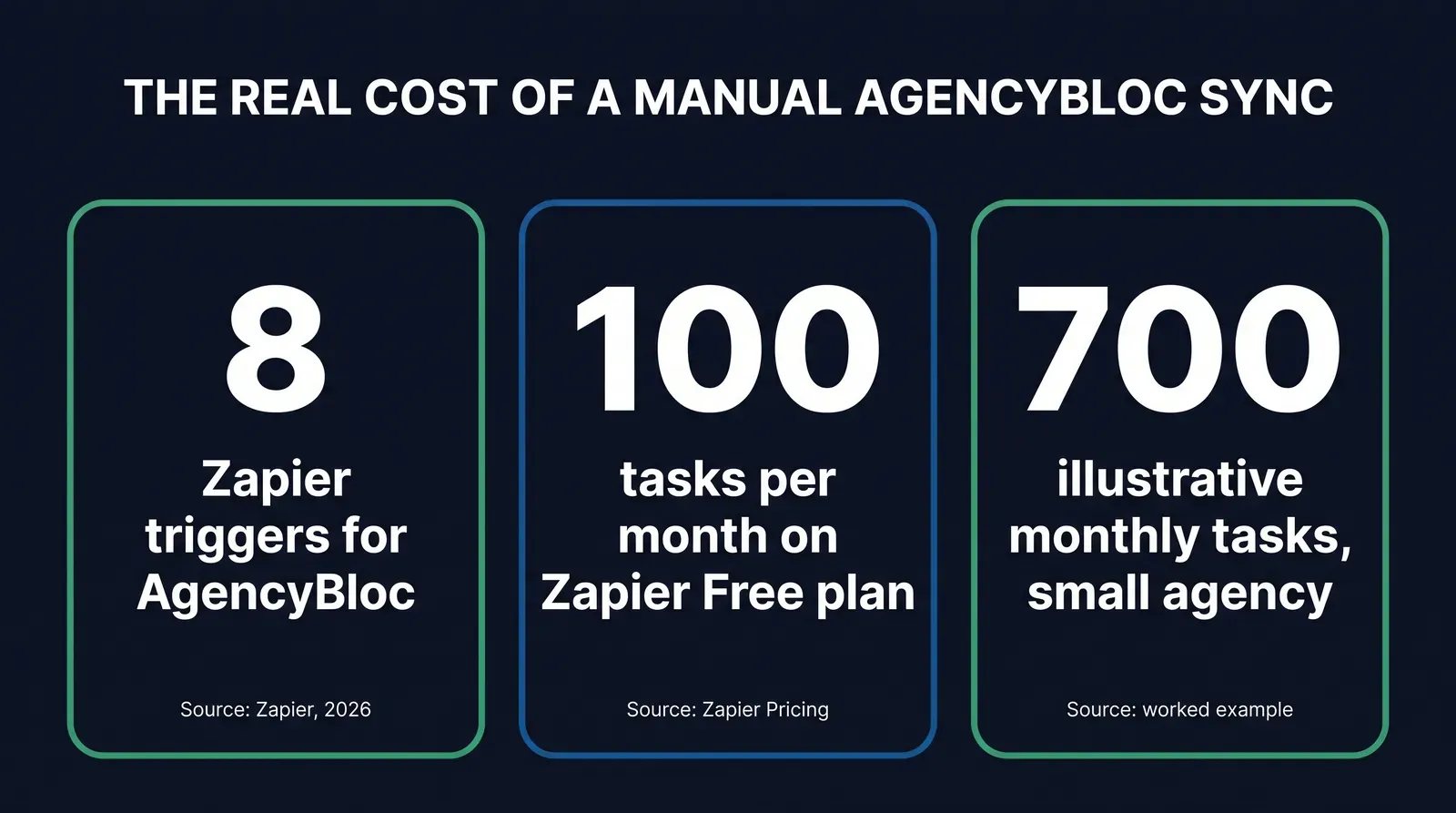
- Zapier's AgencyBloc app exposes 8 triggers and 11 actions. Zapier itself is a paid product past 100 tasks a month: $19.99/month for 750 tasks, $69/month for 2,000 (Zapier Pricing, fetched September 2026).
- The Individual-record triggers carry an optional SSN/Medicare ID masking setting that is off by default. Turning it on is a manual step, not the platform's default behavior.
- Ambrose's agencybloc spoke is a purpose-built, bi-directional connector — pull individuals, groups, policies, activities, notes and commissions in; push Ambrose-generated notes, activities and fields back out — with idempotent writes and an agency-side kill switch, running inside a platform where PHI scrubbing is the default, not an opt-in checkbox.

The pain: your AMS knows everything, and your CRM knows none of it
You wrote the policy in AgencyBloc. The commission is sitting in AgencyBloc. The client’s plan, the effective date, the last call note, all of it lives in AgencyBloc, because that’s what an agency management system is for. Meanwhile your CRM, the one running your follow-up sequences, your renewal reminders, your cross-sell campaigns, knows none of that. It knows whatever you or a team member remembered to type in by hand.
So the same client exists twice: once as a real record with a real policy in AgencyBloc, and once as a name and a phone number in your CRM that somebody has to keep updating manually every time something changes. Miss an update and your renewal reminder fires for a policy that already lapsed, or your cross-sell campaign pitches a Medicare Advantage add-on to someone who already bought it through a different agent last month because nobody moved the status over in time.
This isn’t a hypothetical. Agents on Insurance Forums, an industry discussion board active since long before this year, have been comparing AgencyBloc’s integration options against competitors like Radius Bob for years, and the recurring theme is the same: some integrations are free, others like Zapier and RetireFlo “need to be purchased separately,” and admins need extra time set aside specifically for “workflows, reporting, integrations, and advanced setup” (Insurance Forums, agent discussion threads on AgencyBloc). That’s not a criticism unique to AgencyBloc. It’s what happens whenever an AMS and a CRM are built by two different companies and neither one is responsible for keeping the other current.
Why it happens: AgencyBloc Intelligence keeps the data inside AgencyBloc
When AgencyBloc announced AgencyBloc Intelligence at its BlocBuilder 2026 annual conference on April 9, 2026, it was reasonable to hope the sync problem might finally get addressed as part of the AI push. It wasn’t, at least not based on what the company actually said.
The press release describes two things. First, automatic capture and summarization of client calls and voicemails, so agents spend less time on manual documentation. Second, easier ways to “access and understand client information, interact with their data more naturally and identify revenue opportunities” (GlobeNewswire, AgencyBloc Showcases AgencyBloc Intelligence at BlocBuilder 2026, April 9, 2026). CEO Mike Lamb framed it as a deliberately narrow, practical approach: agents “need real solutions,” not AI for its own sake, aimed specifically at the time agents currently spend “reviewing notes, documenting details, and determining next steps.”
That’s a fair problem to target, and call summarization is a genuinely useful feature on its own. But read the release closely and notice what’s absent: no mention of pushing that summary, or any of the underlying data, out to a CRM. No mention of a new integration surface. The release is explicit that “AI operates on secure, structured data within a controlled environment,” which is a security-forward way of saying the intelligence layer stays inside AgencyBloc’s own walls. The company also didn’t commit to a launch date beyond noting the features roll out “as part of AgencyBloc’s 2026 roadmap, aligned to seasonal demands agencies face throughout the year,” so even the in-platform features aren’t fully live yet as of this writing.
Two different problems, one press release
"AgencyBloc has AI now" and "AgencyBloc data reaches my other tools now" are separate claims. The April 2026 announcement is genuinely about the first one. Nothing in it changes the second, which is the one that actually determines whether your CRM stays current.
That gap is exactly why the sync problem is still yours to solve, whether or not AgencyBloc Intelligence ever ships everything on its roadmap. The good news is that AgencyBloc has never claimed to be a closed system. It publishes a real path out, and the rest of this article shows you exactly how to use it, no membership required.
The manual method: connect AgencyBloc to your CRM yourself
AgencyBloc’s own integrations page lays out three real options, and it’s worth naming all three honestly instead of pretending only one exists.
Pre-built integrations. AgencyBloc states plainly that “AMS+ comes equipped with many pre-built integrations for lead vendors, quoting and enrollment solutions, and more,” naming platforms like Connecture DRX, SunFire, and Quote+ specifically (AgencyBloc, Medicare Quoting & Enrollment Integrations in AMS+). If the tool you’re trying to connect is one of these, you’re done in minutes — this is the cheapest, fastest option, and it’s the first thing to check before building anything.
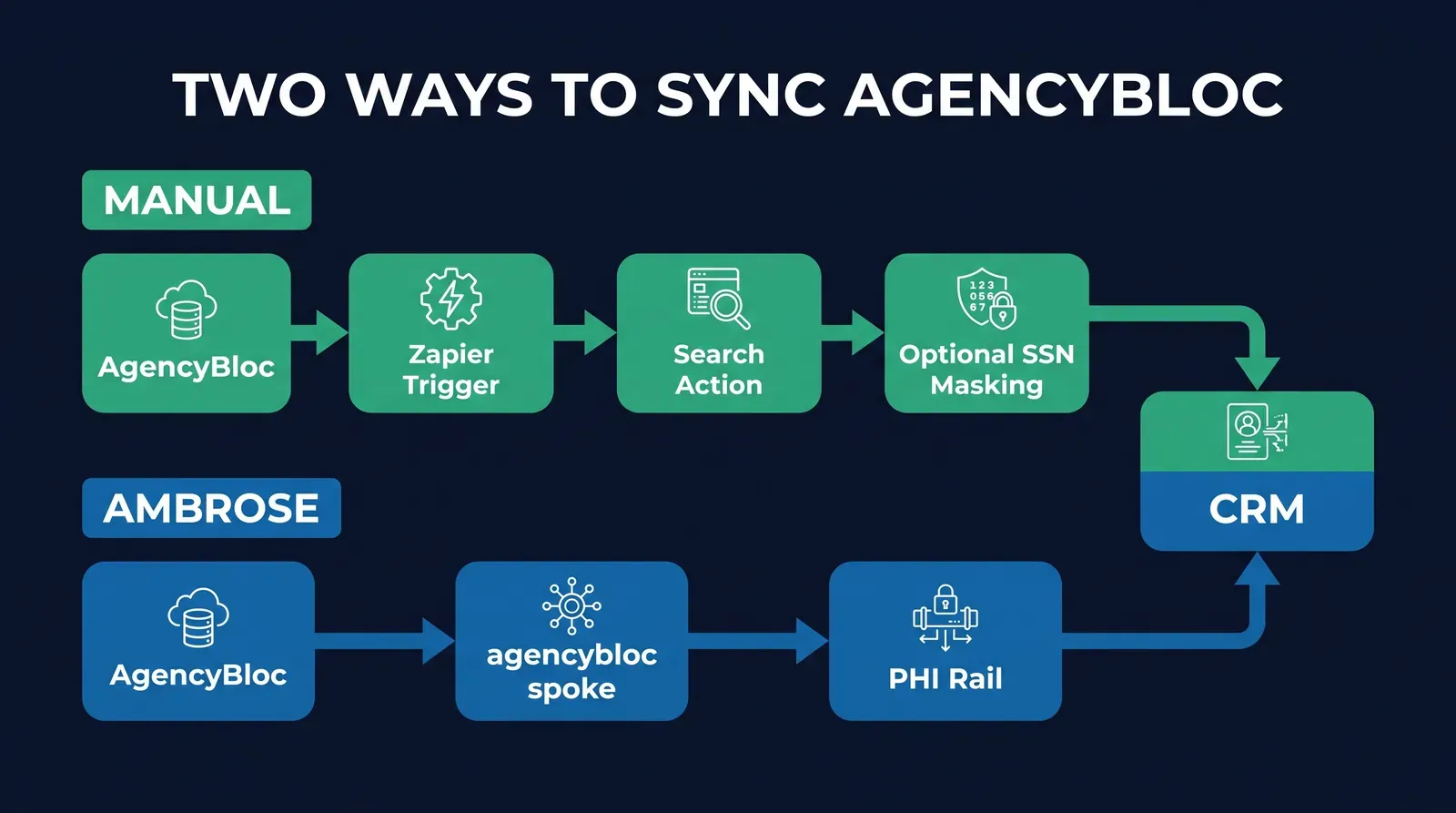
Zapier. For everything else, including a general CRM like GoHighLevel, HubSpot, or Salesforce, AgencyBloc points to Zapier by name as one of its “third-party technology tools” (AgencyBloc, Medicare Quoting & Enrollment Integrations in AMS+). Zapier’s own AgencyBloc app page confirms what that connection actually offers: eight triggers (Activity Created, Activity Updated, Group Created, Group Updated, Individual Created, Individual Updated, Policy Created, Policy Updated), four create actions (Activity, Group, Individual, Policy), and seven search actions that find an existing record by ID, email, phone, or date of birth before you create a duplicate (Zapier, AgencyBloc Integrations). On the other end, Zapier lists 30-plus connectable platforms relevant to an agency’s stack, including HubSpot, Salesforce, QuickBooks Online, Mailchimp, and several calling and texting tools.
The open API. For anything Zapier’s triggers and actions don’t cover, AgencyBloc offers what it calls “an open API and provide[s] documentation to help your team build your own custom integrations” (AgencyBloc, Medicare Quoting & Enrollment Integrations in AMS+). In practice, this is the option for an agency with a developer on staff or on retainer, not a weekend project for most independent agents.
Check the pre-built list first
Log into AgencyBloc, find the integrations or marketplace section, and see whether your quoting, enrollment, or lead-vendor tool is already on the pre-built list. If it is, this is a five-minute setup, not a project.
If it's a general CRM, go to Zapier
Create a Zapier account, search for the AgencyBloc app, and review the eight available triggers against what you actually need. Most agencies start with Policy Created and Policy Updated, since those are the events that should immediately touch a CRM record.
Turn on identifier masking before you connect Individual triggers
If you use the Individual Created or Individual Updated triggers, find the optional masking setting for Social Security numbers and Medicare IDs during setup and turn it on. It is not on by default.
Pair every "create" with a "search" first
Use one of Zapier's seven search actions (by email, phone, or date of birth) ahead of any create action, so an update to an existing client doesn't spawn a second, duplicate record in your CRM.
Count your tasks before you pick a plan
Every trigger firing and every action running is a task under Zapier's pricing. Estimate your monthly volume of policy and individual updates, activities logged, and the search actions that pair with them, before choosing Free, Professional, or Team.
Only reach for the open API if Zapier can't do it
If you need a trigger or action Zapier's AgencyBloc app doesn't expose, that's when AgencyBloc's open API and its documentation come into play, and that's a developer conversation, not a Saturday-afternoon build.
Everything above works with no membership and no Ambrose seat. It’s the real, current, free path to a working AgencyBloc-to-CRM connection, and it’s genuinely worth doing even if you never read past this section.
What it costs: the real math of syncing AgencyBloc by hand
Here’s where the manual method stops being free. Zapier’s Free plan caps you at 100 tasks a month. Its Professional plan starts at $19.99 a month, billed annually, for 750 tasks a month. Its Team plan starts at $69 a month, billed annually, for 2,000 tasks a month (Zapier, Pricing, fetched September 2026). Every trigger and every action is its own task, which means the count climbs faster than it looks like it should.
Take a small agency writing and servicing 150 policies a month, each policy update firing a trigger, each of those paired with a search action to check for duplicates, per the setup step above. That’s already 300 tasks before you count a single individual-record update or logged activity. Add 150 individual record changes a month, each paired with its own search action, and you’re at 600. Add 100 logged call or service activities syncing over as well, and you’ve crossed 700 tasks in a single month, on an agency that most people would call small.
| Monthly event | Trigger | Paired search action | Tasks |
|---|---|---|---|
| 150 policy updates | Policy Updated | Search by policy/individual ID | 300 |
| 150 individual record changes | Individual Updated | Search by email or phone | 300 |
| 100 logged activities | Activity Created | None (direct write) | 100 |
| Total | — | — | 700 |
Illustrative math, not a quote from AgencyBloc or Zapier
The 700-task total is a worked example built from AgencyBloc's and Zapier's own documented triggers, actions, and pricing tiers, not a figure either company published. Your own agency's task count depends entirely on your actual policy, activity, and record volume. Results may vary.
Seven hundred tasks blows past the 100-task Free plan in the first few days of the month and lands the agency in the middle of the $19.99/month Professional tier, with room to spare before hitting Team-plan territory. None of that is a criticism of Zapier’s pricing, which is publicly posted and reasonable for what it does. It’s the actual, arithmetic cost of the free manual method the moment an agency’s volume is real, and it’s a cost most agents never calculate before they start clicking through Zapier’s setup wizard.
Now scale that same math up to an agency with a small team, three or four producers writing and servicing 400 policies a month between them, with 350 individual-record changes and 250 logged activities. Using the same trigger-plus-search pattern, that’s 800 tasks on policies, 700 on individual records, and 250 on activities, for a total of 1,750 tasks a month. That clears the $19.99/month Professional plan’s 750-task ceiling and lands the agency inside the $69/month Team tier, and it does that before anyone has added group-record syncing for commercial or association business, or wired up the commission-related activities that come with a growing book.
| Agency size | Monthly policy + individual + activity events | Illustrative Zapier tasks | Plan it lands in |
|---|---|---|---|
| Solo agent | 150 policies, 150 individuals, 100 activities | 700 | Professional, $19.99/month |
| Small team (3-4 producers) | 400 policies, 350 individuals, 250 activities | 1,750 | Team, $69/month |
Both rows are illustrative math, not vendor-published figures
Both scenarios are worked examples built from AgencyBloc's and Zapier's own documented triggers, actions, and pricing tiers, not numbers either company has published about typical agency usage. Run your own agency's actual monthly counts through the same math before assuming either row applies to you. Results may vary.
Who actually needs to build this, and when it’s overkill
Not every agency needs to solve this today. If you’re a solo agent writing a handful of policies a month and you already check AgencyBloc directly before every call, a manual sync might genuinely cost more setup time than it saves. The math above starts to matter at a specific inflection point: the moment someone on your team makes a decision, a follow-up call, a renewal outreach, a cross-sell pitch, based on what the CRM says rather than what’s actually true in AgencyBloc.
That inflection point usually arrives with one of three changes: you hire a second producer or a service rep who doesn’t have AgencyBloc open all day the way you do; you start running CRM-driven campaigns, renewal sequences, or cross-sell triggers that fire off CRM status fields instead of a person’s judgment; or your book crosses roughly 100 to 150 active policies, the point where nobody can reliably hold the whole picture in their head anymore. Below that line, checking AgencyBloc directly is often genuinely faster than maintaining a sync. Above it, the cost of a stale CRM field, a renewal call that never gets made because the CRM still shows the old policy, starts to outweigh the Zapier bill by a wide margin.
If you’re running a call center or a team of licensed agents working from shared queues, add one more consideration: every agent needs the same current picture at the same time, which is exactly the scenario a manual, one-person-maintained Zapier setup tends to fall behind on first, because nobody owns keeping it current once the person who built it gets busy.
The compliance layer you can’t skip: SSN and Medicare IDs crossing systems
This is the part of a manual AgencyBloc-to-CRM sync that’s easiest to get wrong, because it’s an opt-in setting buried in a trigger configuration screen, not a warning banner.
Zapier’s Individual Created and Individual Updated triggers for AgencyBloc include an optional data-masking setting specifically for Social Security numbers and Medicare IDs (Zapier, AgencyBloc Integrations). Read that sentence again: it’s optional, and optional means off unless someone actively turns it on during setup. If your agency wired up this trigger last year and nobody specifically hunted for that masking toggle, there’s a real chance client SSNs or Medicare IDs have been passing through Zapier’s infrastructure in plain form on every individual-record sync since.
That matters for two separate reasons. First, plain HIPAA hygiene: the fewer systems that see an unmasked SSN or Medicare ID, the smaller your exposure if any one of those systems is ever compromised. Second, regulatory expectation. As of April 1, 2026, 25 jurisdictions, 24 states plus the District of Columbia, have formally adopted the NAIC’s Model Bulletin on the Use of Artificial Intelligence Systems by Insurers, with four more, California, Colorado, New York, and Texas, operating under their own separate insurance-specific AI regulation (NAIC, Implementation of NAIC Model Bulletin map, status as of April 1, 2026).
| Status | Jurisdictions | Count |
|---|---|---|
| Formally adopted the NAIC Model Bulletin | 24 states plus the District of Columbia | 25 |
| Own insurance-specific AI regulation instead | California, Colorado, New York, Texas | 4 |
The NAIC’s bulletin sets governance expectations for how an insurance entity uses AI, including written policies, human oversight, and documentation regulators can request during an exam. A workflow where identifiable client data flows automatically into a general-purpose automation platform, with a masking control that’s off unless you found it, is exactly the kind of thing a written AI-use policy is supposed to name and account for, whether or not your specific state has adopted the bulletin yet.
None of this means don’t use Zapier. It means: if you build this connection yourself, treat the masking setting as mandatory, not optional, document that you turned it on, and check it again any time AgencyBloc or Zapier changes the integration. Ambrose is HIPAA-aware by default, not HIPAA certified, since no such certification exists for a software platform, and that phrasing matters here too: nothing automatically protects data the moment it leaves AgencyBloc unless something is specifically built to do that.
Nothing here is legal, compliance, or HIPAA advice
This section describes a documented product setting and a documented state-adoption map. It does not tell you whether your specific integration setup satisfies your state's requirements or your agency's HIPAA obligations. Confirm your own configuration and your own compliance program with qualified counsel.
How Ambrose’s agencybloc spoke does the same job automatically
Ambrose OS, the AI platform included with a Tech Savvy Insurance membership, ships a dedicated agencybloc spoke, and it’s worth naming exactly what it does rather than waving at “AI handles it.”
Per Ambrose’s own spoke documentation, the agencybloc spoke is a “bi-directional AgencyBloc AMS+ connector” that “pulls Individuals / Groups / Policies / Activities / Notes / Commissions into the vault,” and “pushes Ambrose-generated notes / activities / fields back” (Ambrose docs, agencybloc spoke). Three named tools sit behind it: ab_contact_pull and ab_policy_pull, which bring contact and policy data into the agency’s private vault, and ab_commission_push, which writes commission records and notes back out to AgencyBloc.
Two design details separate this from a hand-built Zapier chain. First, idempotency: every write carries an x-ambrose-trace header specifically so a retried sync doesn’t create a duplicate record, the same problem the manual method above solves with a separate search action bolted onto every create step. Second, a kill switch: an agency can go to Settings → Integrations → AgencyBloc and flip a single flag to halt all pushes immediately, which is a faster stop button than untangling a chain of Zaps.
| What you need | Doing it by hand with Zapier | Ambrose's agencybloc spoke |
|---|---|---|
| Preventing duplicate records | A separate search action paired with every create action, built and maintained by you | Idempotent writes via `x-ambrose-trace` headers, built into the connector |
| Stopping a runaway sync | Disable or edit each Zap individually | One kill-switch flag in Settings → Integrations → AgencyBloc |
| Protecting SSNs and Medicare IDs in transit | An optional masking toggle you have to find and turn on yourself | PHI Rail scrubbing applies by default to anything leaving the agency's BAA allowlist |
| Where the data actually lives | Passes through Zapier's infrastructure on every sync | Pulled into the agency's own private vault |
That last row connects directly to the compliance section above. Per Ambrose’s own architecture documentation, the PHI Rail runs a redact-then-rehydrate pipeline: before client data reaches any destination outside the agency’s BAA allowlist, a detection chain, known vault contacts first, then regex patterns, then Presidio NER, then an insurance-specific dictionary, replaces flagged identifiers with typed aliases like PERSON_xxxx or EMAIL_xxxx, then restores the real values afterward, with every scrub event logged by timestamp, source, and identifier count, never the underlying value itself (Ambrose docs, PHI Rail architecture). Where the manual Zapier path makes SSN and Medicare ID protection something you opt into, the PHI Rail’s scrubbing behavior is the default posture for anything routed through the platform, not a setting to remember.
To be direct about status: this is a spoke described in Ambrose’s own current documentation, not a promise about a future release, and like every spoke it’s worth confirming against the live product before you build a workflow around it, the same way this article confirmed every AgencyBloc and Zapier detail against their own current pages rather than relying on a screenshot from last year.
What you get by joining
One Ambrose seat, including the agencybloc spoke and the PHI Rail behavior described above, comes with a Tech Savvy Insurance membership: $97 a month, billed monthly, cancel anytime, founding rate locked in while the membership stays active. Alongside the seat: weekly Zoom calls with open Q&A and build-with-you sessions, 30-plus hours of recorded training, Meta Ads, AI, and marketing training built for health and life agents specifically, pre-built AI templates and bot deployments, and a free annual in-person member workshop. It’s also an explicit no-recruiting zone, which matters here specifically, because “how do I actually wire my AMS to my CRM” is a real, unglamorous technical question that gets brushed aside fast in a group built around selling you something else.
Everything in the manual method section above works whether you join anything or not. Go build the Zapier connection yourself this week, with the masking setting turned on, and see how far it gets you before the task math above catches up with your own agency’s volume.
Stop re-keying AgencyBloc data into your CRM by hand
Build the Zapier connection yourself with the steps above, no membership required. If you'd rather have the agencybloc spoke and the PHI Rail running the sync automatically, with people watching your screen while you set it up, one Ambrose seat comes with the Tech Savvy membership.
Join Tech Savvy — $97/monthCompliance: what this touches, and what it doesn’t
Nothing in this article is insurance, legal, tax, or compliance advice, and it doesn’t tell you whether your specific integration configuration satisfies your state’s requirements or your agency’s HIPAA program. If any part of your AgencyBloc-to-CRM workflow touches Medicare marketing, a TPMO disclaimer obligation and CMS’s Medicare Communications and Marketing Guidelines apply on top of, and separately from, anything covered here (CMS, Medicare Communications and Marketing Guidelines). Where AI or automated data-sharing touches any part of your marketing, sales, or client-facing workflow, the NAIC’s Model Bulletin on the Use of Artificial Intelligence Systems by Insurers sets governance expectations, adopted so far by 25 jurisdictions with four more running their own insurance-specific frameworks as of April 1, 2026 (NAIC, Implementation of NAIC Model Bulletin map), and a written policy naming your integrations and their data-handling settings is a reasonable way to satisfy that expectation. Ambrose is HIPAA-aware by default, not HIPAA certified, since no such certification exists for a software platform; the PHI Rail’s identifier-aliasing design is one part of that posture, not a substitute for your own agency’s HIPAA program.
The close
Check AgencyBloc’s pre-built integration list first. If your CRM isn’t on it, build the Zapier connection yourself this week, turn on the SSN and Medicare ID masking setting while you’re in there, and pair every create action with a search action so you’re not duplicating records. That’s the entire manual method, it costs nothing beyond whatever Zapier tier your real volume needs, and it works whether or not AgencyBloc Intelligence ever ships everything on its 2026 roadmap. If you’d rather have that sync, the duplicate protection, and the identifier scrubbing running automatically, one Ambrose seat comes with a Tech Savvy membership, and the weekly build-with-you calls are where agents actually wire this up with people who’ve read AgencyBloc’s own API docs: https://techsavvyinsurance.com/.
Before you rely on any figure in this article
Tech Savvy Insurance is a training and software community, not an insurance company, agency, or law firm, and does not provide insurance, legal, tax, or compliance advice. You are responsible for your own licensure and for complying with all applicable CMS, state insurance, HIPAA, NAIC, and carrier regulations. Product features, pricing, and integration options for AgencyBloc, Zapier, and Ambrose change; confirm current details directly with each vendor before relying on any figure here. AI-generated outputs may contain errors: always verify. Results may vary.
Frequently asked questions
Sources
- GlobeNewswire — AgencyBloc Showcases AgencyBloc Intelligence at BlocBuilder 2026, Shaping the Future of Insurance Agency Work — globenewswire.com
- AgencyBloc — Medicare Quoting & Enrollment Integrations in AMS+ — agencybloc.com
- Zapier — AgencyBloc Integrations — zapier.com
- Zapier — Pricing — zapier.com
- NAIC — Implementation of NAIC Model Bulletin: Use of Artificial Intelligence Systems by Insurers (map, status as of April 1, 2026) — content.naic.org
- CMS — Medicare Communications and Marketing Guidelines — cms.gov
- Ambrose docs — agencybloc spoke — app.hiambrose.com
- Ambrose docs — PHI Rail architecture — app.hiambrose.com
- Ambrose docs — Spokes (catalog) — app.hiambrose.com
- Ambrose docs — What is Ambrose — app.hiambrose.com
Ready to put this into practice?
Join a private community of Health & Life insurance professionals using AI, Meta Ads, and automation to grow — without draining their bank account.
Join Tech Savvy — $97/month