
Yes, if you’re advertising individual health insurance, Medicare Advantage, Medigap, Medicaid, short-term, limited-duration, or fixed indemnity coverage to a U.S. audience, Google requires you to hold a third-party certification from G2 Risk Solutions before your ads are allowed to run, and Google can suspend an uncertified account with as little as seven days’ warning. This guide covers exactly what the certification covers, what it doesn’t, what G2’s current application process actually involves, what a recent search benchmark says a click and a lead cost a health and insurance advertiser right now, and where a Tech Savvy Insurance membership and the Ambrose platform fit once you’re running compliant campaigns.
Key takeaways
- Google's advertising policy is explicit: "you must be certified by Google in order to advertise health and medical insurance coverage" in the United States, with government advertisers pre-approved as the only exception (Google Ads Advertising Policies, Health insurance).
- Certification covers individual health insurance, short-term, limited-duration, and fixed indemnity plans, Medicare Advantage, Medigap, and Medicaid. Dental, vision, and travel health insurance ads are explicitly exempt.
- The certificate itself comes from a third-party vendor, G2 Risk Solutions, not Google, and current review takes up to 14 calendar days once your application is complete (G2 Risk Solutions, Health Insurance Providers Certification).
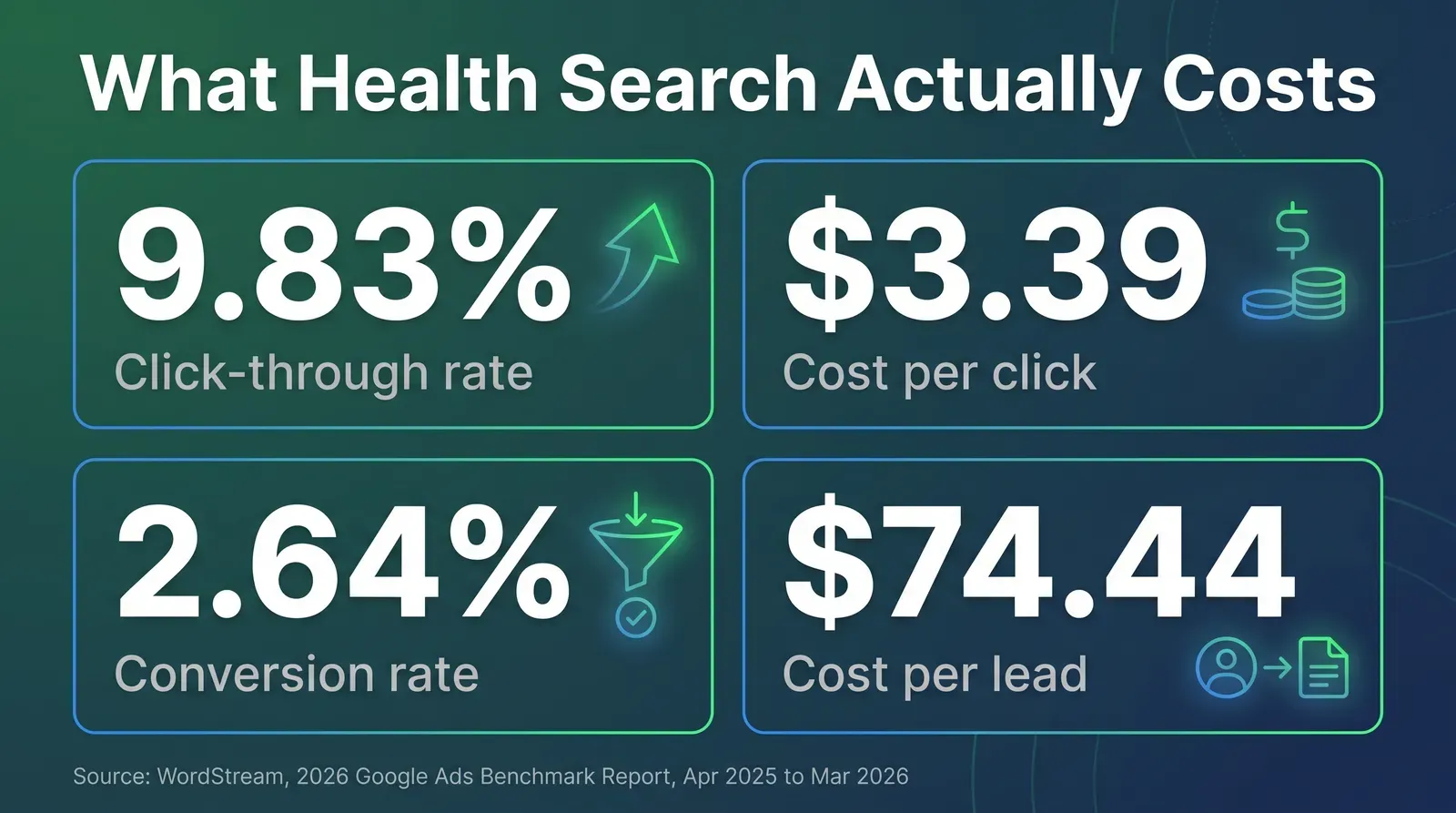
- WordStream's 2026 Google Ads Benchmark Report, built on more than 13,000 search campaigns running April 2025 through March 2026, puts the Finance & Insurance category at a $3.39 median cost per click, a 2.64% conversion rate, and a $74.44 cost per lead.
- In February 2026, Google began letting advertisers apply for certifications directly inside their Ads account instead of only through the Help Center, rolling out incrementally by category (Google Ads Advertising Policies, February 2026 update).
The pain: your health insurance ads got flagged and you didn’t know this was a requirement
You launched a Google Ads campaign for Medicare Advantage leads, or ACA open enrollment, or a fixed indemnity supplement, and either the ads never left “under review,” or they ran fine for a while and then stopped, or you got a policy violation notice that mentions a certification you’ve never heard of. None of this is a targeting mistake or a bidding mistake. It’s a separate compliance gate that sits in front of the ad account itself, and it has nothing to do with your ad copy, your landing page, or your quality score.
Most agents find out about this the hard way: mid-campaign, after spend is already committed, when a notice shows up referencing a “G2” certification nobody mentioned when they set up the account. That’s a bad time to learn about a 14-day review process. The fix is to know about it before you ever launch a health insurance campaign on Google, not after.
This is a Google-wide policy, not a fluke in your account
This isn't a one-off flag or an algorithm mistake specific to your campaign. It's a standing Google Ads policy that applies to every U.S. health insurance advertiser on the platform, and it's been in place since 2021. If you're seeing it for the first time, you're not the exception, you're just the agent who hasn't run into it yet.
Why this happens: Google requires proof you’re actually licensed to sell what you’re advertising
Google’s advertising policy on health insurance states the requirement in one sentence: “In the United States, you must be certified by Google in order to advertise health and medical insurance coverage,” with a carve-out that “government advertisers… will be pre-approved” (Google Ads Advertising Policies, Healthcare and medicines: Health insurance). The policy exists because health insurance advertising has a long history of misleading claims: sites posing as government exchanges, ads implying a plan is more comprehensive than it is, lead-gen operations with no actual licensed relationship to the coverage they’re advertising. Google’s own 2021 announcement of the program framed it as a trust problem to close, saying the company is “committed to creating a high-quality ad experience” for people searching for health coverage information (Google, A new certification for health insurance advertisers in the U.S.).
The certification itself doesn’t come from Google. It’s issued by G2 Risk Solutions, a third-party risk and compliance vendor Google contracts with to verify advertiser credentials before those advertisers are allowed onto the platform for this category. That’s a meaningful distinction: you’re not filling out a form inside your Google Ads account and waiting on Google support. You’re applying to a separate company, getting a separate certificate, and then submitting that certificate as part of your Google Ads application (Google Ads Help, Health Insurance Advertiser).
Google’s policy spells out exactly which products are in scope: individual health insurance, short-term insurance, limited-duration insurance, fixed indemnity health insurance, Medicare Advantage, Medigap (Medicare Supplement), and Medicaid. It also spells out what’s not in scope: “Advertisements exclusively for dental, vision, and/or travel health insurance coverage are not restricted” and don’t require certification (Google Ads Advertising Policies, Health insurance). If you sell a mix — say, Medicare Advantage and a standalone dental plan — the Medicare Advantage side of your campaigns needs certification even though the dental side doesn’t.
| Product | Certification required? |
|---|---|
| Individual health insurance | Yes |
| Short-term / limited-duration insurance | Yes |
| Fixed indemnity health insurance | Yes |
| Medicare Advantage | Yes |
| Medigap / Medicare Supplement | Yes |
| Medicaid | Yes |
| ACA-compliant plans (registered with the government) | Yes, plus a separate ACA-keyword certificate |
| Dental, vision, or travel health insurance (exclusively) | No |
| Government exchanges | No, pre-approved |
Entities registered with the U.S. government to sell ACA-compliant plans need an additional, separate certificate specifically for “ACA health insurance related keywords” on top of the base health insurance certification (Google Ads Advertising Policies, Health insurance). That’s two certificates, not one, if ACA marketplace plans are part of what you sell.
How to check whether your existing account is already certified
If you’re already running Google Ads and reading this because a notice showed up, or because you inherited an account someone else set up, don’t guess. Confirm your actual status before you do anything else.
- Sign into Google Ads and open Tools & Settings, then Policy Manager. Any active suspension or certification requirement tied to your account shows up here, not just in an email you might have missed.
- Search your inbox for G2 Risk Solutions. If someone on your team applied previously, the confirmation and any renewal notices came from G2 directly, not from Google. A missing thread is a real signal nobody has applied yet.
- Ask whoever manages the account, in writing, to confirm the certificate number and its expiration date. “It’s handled” is not an answer. A certificate number and a date is.
- If you can’t confirm either, assume you’re not certified and start the application. The downside of applying when you’re already covered is a redundant application. The downside of assuming you’re covered when you’re not is a suspended account mid-campaign.
What it costs: what a click and a lead run right now, and what the certification itself costs
Health insurance keywords are expensive relative to most other categories, and that’s before you factor in anything about certification. WordStream’s 2026 Google Ads Benchmark Report, drawn from more than 13,000 search advertising campaigns running Google Ads and Microsoft Ads between April 2025 and March 2026, with each subcategory requiring a minimum of 52 unique active campaigns and figures reported as medians to control for outliers, put the Finance & Insurance category at a 9.83% click-through rate, a $3.39 cost per click, a 2.64% conversion rate, and a $74.44 cost per lead (WordStream, 2026 Google Ads Benchmarks). That category folds insurance in with the broader finance vertical rather than isolating health insurance specifically, and WordStream’s own report is upfront that these are medians across a mixed category, not an insurance-only figure — worth remembering before you treat $74.44 as a promise for your specific campaign.
Finance & Insurance category, U.S. search advertising, Apr. 2025-Mar. 2026
WordStream 2026 Google Ads Benchmark Report, 13,000+ campaigns, median figures.
Source: WordStream, 2026 Google Ads Benchmark Report.
Certification adds a second cost most agents don’t budget for: G2 Risk Solutions’ current application page describes a one-time application fee “priced based on the number of US jurisdictions you would like certified,” followed by an annual certification and monitoring fee that “follows the same pricing model,” with the actual dollar amounts shown only inside G2’s payment portal rather than published on the informational page itself (G2 Risk Solutions, Health Insurance Providers Certification). When the program launched in 2021, Word & Brown reported a specific fee table: roughly $39 per state up to 20 states, scaling up to $1,360 plus $19 per additional state past 40 (Word & Brown, Oct. 28, 2021). That figure is five years old as of this article and G2’s current page doesn’t republish it, so treat it as a historical reference point, not a quote — confirm the current number directly with G2 before you budget against it.
The certification fee is a rounding error next to what you'll spend on clicks in year one. The part that actually costs you money is finding out about the requirement after you've already launched.
Mike MooreThere’s a second, non-dollar cost worth naming: time. G2’s current page states review “typically takes 14 calendar days or fewer” for a complete submission, with no expedited option (G2 Risk Solutions, Health Insurance Providers Certification). If you start that clock the same week you planned to launch a campaign, you’re not launching that week. Google’s own policy adds a separate grace window on the enforcement side: “a warning will be issued at least 7 days prior to any suspension” tied to this policy (Google Ads Advertising Policies, Health insurance). Combine those two numbers and the math is unforgiving if you’re already running: a 7-day suspension warning against a 14-day certification review means an existing, uncertified campaign can go dark before the paperwork clears, even if you start the moment the warning lands.
A worked example: two agencies, one certified and one not
Both agencies run the same Medicare Advantage plan comparison campaign, targeting the same three counties, at the same $3.39 median cost per click WordStream’s 2026 benchmark reports for the Finance & Insurance category. Agency A applied for G2 certification the month they set up their Google Ads account, before a single dollar of spend, using their existing NPN and state license documentation they already had on file. Fourteen days later, before their landing page and creative were even finished, their certificate was live. Their launch date didn’t move.
Agency B skipped it, because nobody on the team had heard of G2 and the campaign launched fine at first — Google’s review doesn’t necessarily catch every account at launch. Six weeks in, with real spend committed and real leads in the pipeline, a policy notice landed: uncertified health insurance advertiser, seven-day warning. Agency B started the G2 application that day. The campaign went dark on day eight, a full six days before the certification review could possibly finish, because the two clocks don’t run on the same schedule and starting late means the suspension clock always wins. Leads that would have come in during that gap didn’t, the account’s Quality Score history took a hit from the pause, and Agency B spent the next two weeks re-approving ads on top of finishing the certification they should have started six weeks earlier.
Same product, same targeting, same cost per click. The only difference was which week the G2 application got filed.
The manual method: how to get certified, start to finish
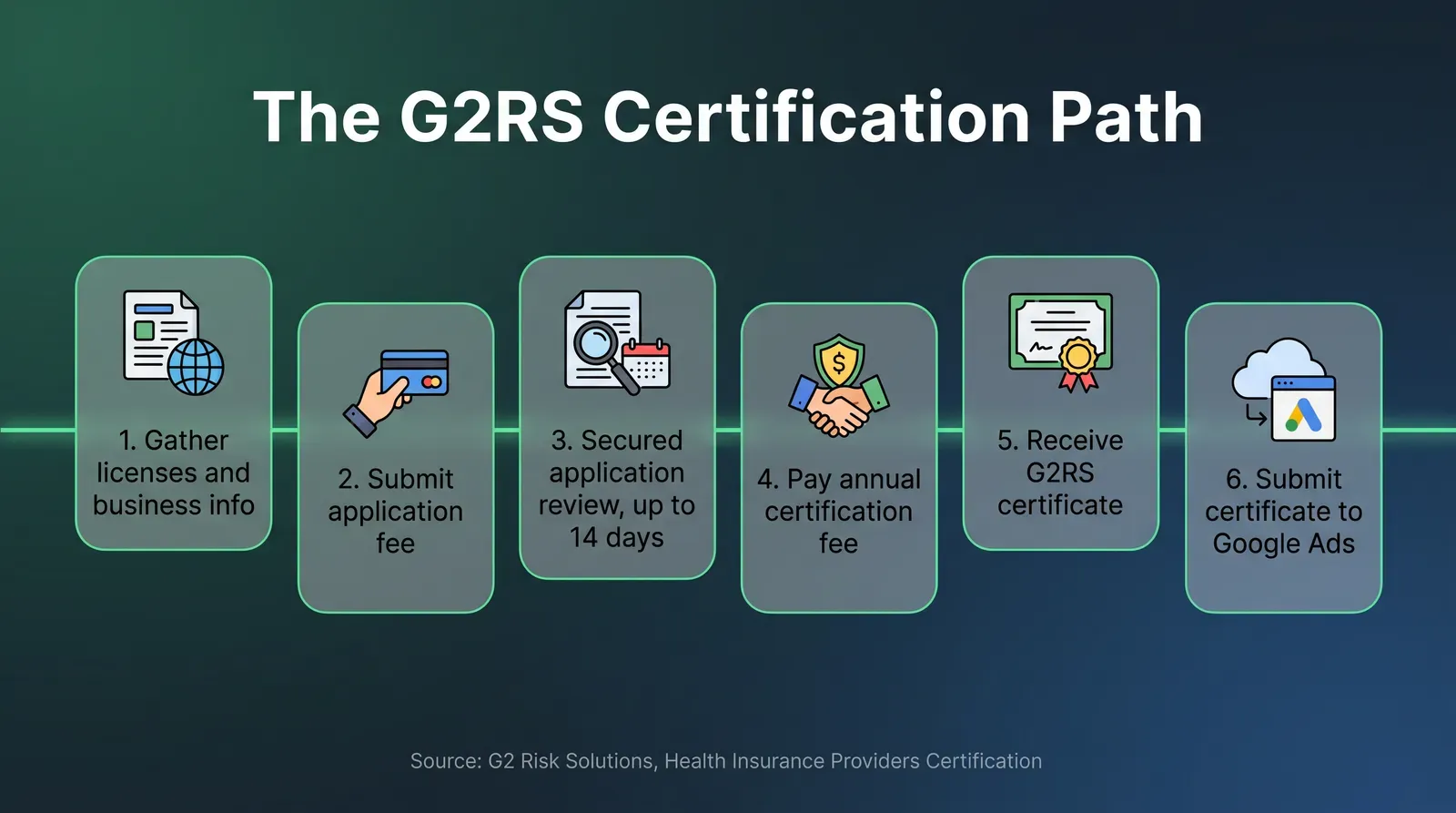
Here’s the entire process, based on G2 Risk Solutions’ own current application page, and none of it requires an agency, a consultant, or a membership.
Gather your documentation before you start
You'll need your business's licensed legal name, the domains you'll advertise from, contact details, your NAIC and NPN codes, and copies of your insurance license or registration for every state or locale where you do business. If you sell ACA-compliant plans, add your Qualified Health Plan (QHP) Agreement, registration certificate, or SERFF tracking number.
Submit the one-time application fee
Pricing is based on how many U.S. jurisdictions you want certified. Check G2's current payment portal for the exact number for your state count rather than relying on a figure from 2021.
Complete and return the secured application
G2 sends a secured application after the fee is submitted. This is where the business information, licensure documentation, and ACA registration proof (if applicable) all get attached.
Wait on review, up to 14 calendar days
G2's page states this timeline for a complete submission and doesn't offer an expedited path, so a missing document that triggers a follow-up request can push you past two weeks. Submit clean the first time.
Pay the first annual certification and monitoring fee
Approval isn't the last payment. The annual fee follows the same per-jurisdiction pricing model as the application fee, and G2 states it will reach out before your next billing cycle if anything additional is needed at renewal.
Submit your G2RS certificate to Google
Once issued, your certification gets submitted as part of Google's own Health Insurance Advertiser application inside your Google Ads account, referencing Google's Healthcare and medicines: Health insurance policy directly.
Apply before you launch, not after a warning
Start the G2 application the same week you decide to run health insurance campaigns on Google, whether or not you've launched anything yet. A completed application sitting in review is a very different position than an active campaign racing a 7-day suspension clock.
What agents get wrong: mixing products, letting it lapse, and assuming an agency handled it
A few specific mistakes account for most of the certification problems agents run into, and all of them are avoidable once you know to look for them.
Mixing a covered product with an exempt one in the same campaign. Dental and vision are exempt; Medicare Advantage and ACA plans aren’t. If one ad group promotes a dental plan and another promotes a Medicare Advantage plan under the same uncertified account, the Medicare Advantage ad group is the one that gets flagged, and depending on how Google’s review reads the account, it can affect the whole account rather than just the offending ad group.
Letting the annual renewal lapse. Certification isn’t a one-time event. G2’s annual certification and monitoring fee keeps the certificate active, and G2 states it will email at the end of your billing cycle to renew. An expired card on file or a missed email is enough to let a certification quietly lapse while campaigns keep running, right up until a policy check catches it.
Assuming a marketing agency or freelancer running your ads already handled this. If you’re the licensed entity selling the product, G2’s application is asking for your licensure information regardless of who’s clicking “submit” on the form. “My ad person handles that” is not the same as confirming a certificate exists, covers the right states, and is current. Ask to see it.
Forgetting the ACA-keyword certificate is separate from the base certificate. An agent who sells both Medicare Advantage and ACA marketplace plans, and only applies for the base health insurance certification, is still uncertified for any campaign bidding on ACA-related keywords. The two aren’t bundled automatically.
Certifying for fewer states than the account actually advertises into. G2’s pricing scales with the number of jurisdictions you request. Adding a new licensed state to your business without going back and adding it to your certification leaves that state’s campaigns running on a certificate that doesn’t cover them.
The default, reactive path
- Launch the campaign first, worry about policy notices if they show up
- Nobody owns the renewal date, so it lives in whoever's inbox got the original email
- State licensing changes and ad certification never get cross-checked against each other
- "The agency handles that" with no certificate number on file to confirm it
What actually holds up to a policy check
- Application filed before launch, with the 14-day review built into the timeline
- One named person owns the renewal date and gets the G2 email directly
- Every new state license triggers a check against current certification coverage
- Certificate number and expiration date on file, confirmed in writing, not assumed
A suspended ad account doesn't just pause spend
It kills your active leads-in-flight pipeline, your Quality Score history resets the trust signals Google uses to keep your cost per click down, and re-approval after a policy suspension is its own process, separate from and slower than a normal certification review. Prevention is cheaper than recovery here in every sense.
What’s changing: Google is moving certification management in-account
In February 2026, Google began letting some advertisers apply for certifications directly inside their Google Ads account rather than exclusively through the Help Center, adding a “Policy > Account” section under Admin. As of the initial rollout, the categories affected were cryptocurrency exchanges and wallets and complex speculative financial products, not health insurance — Google’s own policy page is explicit that “this feature will be released incrementally to all advertisers over a period of time and not all advertisers and certification applications will be affected immediately,” and that existing certifications and pending applications aren’t touched by the rollout (Google Ads Advertising Policies, Update to the Google Ads Certification Process, February 2026).
That’s worth watching rather than acting on today. If Google extends in-account certification management to the health insurance category, it could mean tracking your renewal status alongside your other account policies instead of a separate email thread with G2. Nothing in Google’s current documentation confirms that timeline, so this article isn’t promising it — it’s flagging where to check back.
The compliance layer that doesn’t go away once you’re certified
Certification clears one gate. It doesn’t touch the others, and treating it as the whole compliance picture is its own mistake.
If any part of the campaign or its follow-up touches AI-drafted ad copy, landing page content, or lead-scoring, a growing number of states have adopted the NAIC’s Model Bulletin on the Use of Artificial Intelligence Systems by Insurers, which sets an expectation of documented AI governance: written policies, human oversight before anything goes live, and the ability to show a regulator what a given AI-assisted decision relied on (NAIC, Artificial Intelligence topic page). A certified Google Ads account with AI-generated copy nobody reviewed before publishing is still exposed on that front, separately from anything Google checks.
If the campaign markets a specific Medicare Advantage, Part D, or Medicare Supplement plan’s benefits, the existing CMS Medicare Communications and Marketing Guidelines and TPMO disclaimer requirements apply exactly as they did before you ever touched Google Ads (CMS, Medicare Marketing Guidelines). Google’s certification says nothing about whether your landing page carries the required TPMO disclosure or whether your agents are current on CMS’s annual training and testing requirements. Those are separate obligations that a Google certificate doesn’t clear.
And if your landing page form or a connected chatbot collects anything that touches a health condition, medication, or diagnosis ahead of quoting, that’s protected health information the moment it’s captured, regardless of what platform served the ad that brought the visitor there. General-purpose AI tools and analytics pixels that weren’t built with a BAA in place are not a safe destination for that data. This is exactly the gap the PHI Rail inside Ambrose, the AI platform included with a Tech Savvy membership, exists to close on the automation side — aliasing identifiers before a non-BAA destination ever sees them — but the underlying rule applies whether or not you use Ambrose: know what your form captures and where it goes before you turn traffic loose on it.
Where Ambrose fits, honestly
There isn’t a spoke inside Ambrose that files your G2 application for you, and this article isn’t going to pretend otherwise — that part is a licensing and documentation process you or your team has to walk through directly with G2. Where Ambrose picks up is the step after: once certified campaigns are live and leads start converting into your CRM, Ambrose’s campaign-metrics spoke aggregates funnel performance — opens, clicks, replies, and booked-call rate — across the email and SMS sequences those leads land in, through three query tools (metrics_campaign_summary, metrics_recipient_engagement, metrics_funnel_breakdown), with per-recipient identifiers stripped before any model sees them and only re-entering for action lists you specifically approve (Ambrose docs, spoke-campaign-metrics). That’s the follow-up funnel a Google Ads lead enters once they convert, tracked in one place instead of four separate dashboard exports.
Name the mechanism, not the vibe
Ambrose doesn't have an ad-certification tool today, and this article isn't stretching to invent one. What it does have, documented and live, is funnel tracking on what happens after the click. If a future spoke changes that, it'll get its own honest write-up — not a retrofit of this one.
The rest of what a Tech Savvy Insurance membership adds around this is training, not automation: Meta Ads and Google Ads training built for this industry specifically, weekly Zoom calls where agents work through exactly this kind of account-level compliance question live, and more than 30 hours of recorded sessions to pull from when a policy notice shows up at 9pm and you want to know if anyone else has seen it before.
What you get by joining
A Tech Savvy Insurance membership is $97 a month, billed monthly, cancel anytime, with the founding rate locked in while the membership stays active. It includes one Ambrose AI seat — Ambrose usage itself runs through a separate credit ledger with spend caps, so it’s billed apart from the $97 — plus weekly Zoom calls with open Q&A and build-with-you sessions, more than 30 hours of recorded training, Meta Ads and Google Ads training for health and life agents specifically, pre-built AI templates and bot deployments, and a free annual in-person member workshop. It’s also an explicit no-recruiting zone: you can ask about a Google Ads suspension notice without someone sliding into your DMs about a downline an hour later, which isn’t true of most agent Facebook groups.
Close
Everything above, the fee structure, the application steps, the products that require certification, works whether you ever join anything or not. If you’re planning to run health insurance ads on Google and haven’t started the G2 application, start it this week — the 14-day review clock is the same whether you’re prepared for it or caught by a suspension warning. If you’d rather work through the account-level questions with people who’ve seen the notice before, and want the follow-up funnel from those leads tracked in one place once Ambrose is set up, that’s what the membership is for: https://techsavvyinsurance.com/. See also our breakdown of what a lean agency tech stack actually costs and our guide to AI compliance for insurance agents.
Before you act on any of this
Tech Savvy Insurance is a training and software community, not an insurance company, agency, or law firm, and does not provide insurance, legal, tax, or compliance advice. You are responsible for your own licensure and for complying with Google's advertising policies, G2 Risk Solutions' certification requirements, CMS marketing and TPMO rules where applicable, the NAIC's AI Model Bulletin as adopted in your state, and HIPAA. AI-generated outputs, including from any tool described in this article, may contain errors: always verify before acting on them. Results may vary.
Frequently asked questions
Sources
- Google Ads Advertising Policies — Healthcare and medicines: Health insurance — support.google.com
- Google Ads Help — Health Insurance Advertiser certification — support.google.com
- Google Ads Advertising Policies — Update to the Google Ads Certification Process (February 2026) — support.google.com
- Google — A new certification for health insurance advertisers in the U.S. — blog.google
- G2 Risk Solutions — Health Insurance Providers Certification — g2risksolutions.com
- WordStream — 2026 Google Ads Benchmarks — wordstream.com
- Word & Brown — Understanding Google's Health Insurance Ad Policy Update (Oct. 28, 2021) — wordandbrown.com
- NAIC — Artificial Intelligence (topic page) — content.naic.org
- CMS — Medicare Marketing Guidelines — cms.gov
- Ambrose docs — Spokes — app.hiambrose.com
- Ambrose docs — spoke-campaign-metrics — app.hiambrose.com
Ready to put this into practice?
Join a private community of Health & Life insurance professionals using AI, Meta Ads, and automation to grow — without draining their bank account.
Join Tech Savvy — $97/month