
AEO, answer engine optimization, is the practice of writing content so ChatGPT, Perplexity, and Google AI Overviews can quote a specific passage of it and attribute the quote to you — and for most insurance agents publishing content in 2026, it isn’t happening, because the content isn’t built to be quoted. Only 38% of Google AI Overview citations now come from pages that rank in the organic top 10, down from roughly 76% when Ahrefs ran the same analysis eight months earlier (Ahrefs, March 2, 2026). Ranking well used to be a reasonable proxy for getting cited. It isn’t anymore, and generic AI-generated content, the kind with no named source, no date, and no figure that would survive a fact-check, was never built to be quoted regardless of where it ranks.
Key takeaways
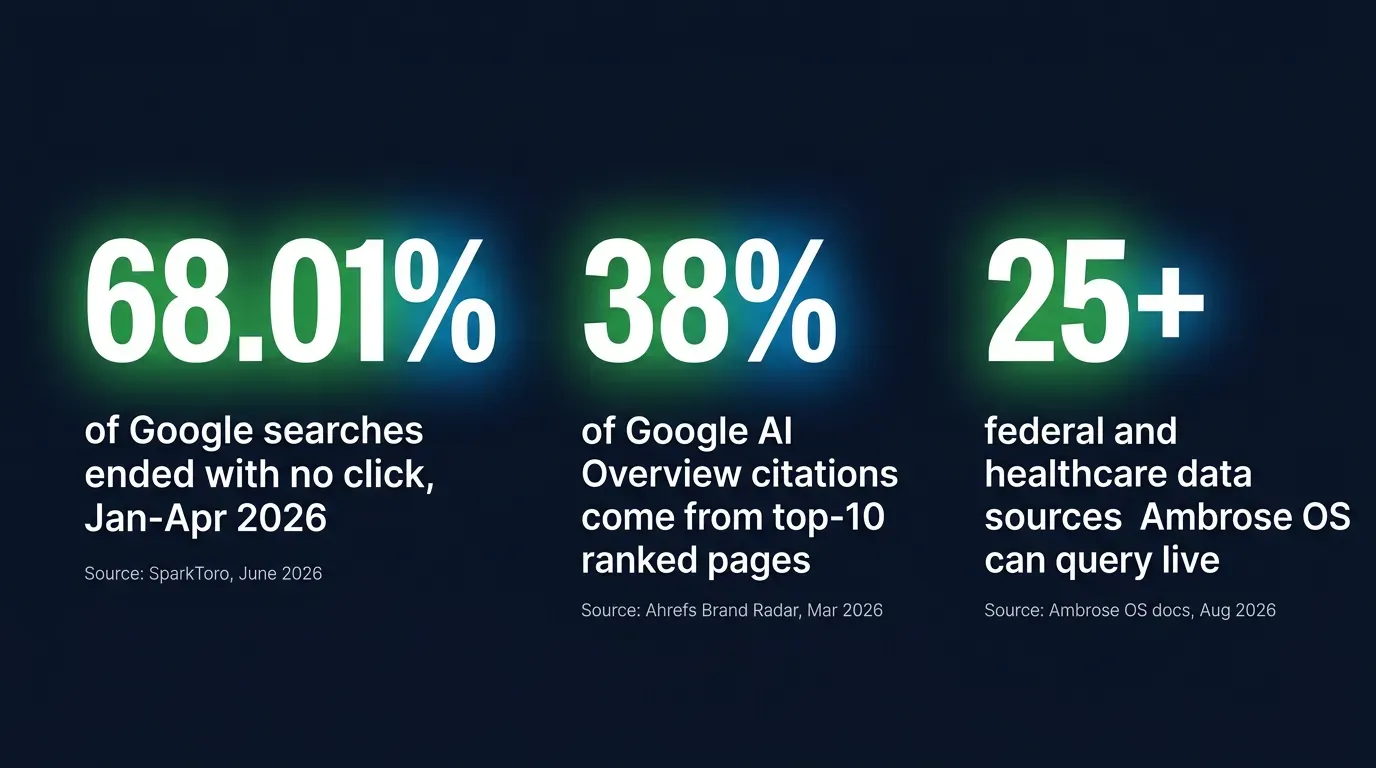
- 68.01% of U.S. Google searches ended with no click at all in the first four months of 2026, up from 58.5% in 2024 (SparkToro, June 2026).
- Only 38% of Google AI Overview citations come from top-10 organic rankings, down from ~76% eight months earlier — ranking well no longer predicts getting quoted (Ahrefs, March 2026).
- Answer engines pull passages that are specific, sourced, and self-contained. "Studies show" and "many agents report" are exactly the phrases that get skipped over.
- Ambrose's Brain fronts more than 25 federal and healthcare data MCPs (CMS, NADAC, FDA, Federal Register, FEMA, and more) an agent can query live while drafting, so a figure comes from the source at write time (Ambrose docs).
- The search-audit spoke scores a page's schema, content, technical setup, and AI-citation surface with three tools: audit_site, audit_score, and audit_compare (Ambrose docs).
What “getting cited by AI” actually means
Getting cited by AI means a system like ChatGPT, Perplexity, or a Google AI Overview reads your page during its retrieval step, decides a specific sentence or two is a clean, attributable answer to the question someone asked, and either quotes it directly with a link back to you or folds the fact into its answer with your site named as the source. That’s a different event from ranking. Ranking is about where your URL sits on a results page a human scrolls through. Citation is about whether an automated system judged a passage inside your page trustworthy and specific enough to lift.
The two used to move together closely enough that optimizing for one mostly optimized for the other. They don’t anymore. Ahrefs’s Brand Radar data, drawn from 863,000 keyword SERPs and roughly 4 million AI Overview URLs, found that only 37.10% of citations came from top-10 pages when looking at standard organic blue links, with 26.20% pulled from positions 11 through 100 and 36.70% coming from pages that didn’t rank in the top 100 at all (Ahrefs, March 2026). A page sitting well outside the top 10 with one clean, sourced, quotable paragraph can out-cite a page ranking third that never states a specific number.
This article is about content structure, not a Medicare marketing script
Everything below is about how you write and source an article so an answer engine can quote it. If the content in question is marketing specific Medicare Advantage, Part D, or Med Supp plan benefits, the CMS marketing rules and TPMO disclaimer requirements still apply on top of everything here — see our AI compliance guide for that layer.
The pain: you paid for content and nothing changed
Here’s the version of this that actually happens. An agency owner signs up for a content service, or points a generic AI tool at a list of keywords, and six months later has forty published articles and no measurable change in calls, leads, or AI mentions. Ask ChatGPT “who’s a good Medicare agent in [your city]” and the agency doesn’t come up. Ask it to explain a plan feature the agency wrote three articles about and it answers from somewhere else entirely, usually a carrier page, a government site, or a competitor with one better-sourced paragraph.
The content wasn’t wrong, exactly. It was generic in the specific way that makes it invisible to a retrieval system: no named source, no stated date, no number that would let a fact-checking layer verify the claim. “AI search is changing how people find insurance agents” is true and useless to an answer engine, because it can’t attribute it to anything specific and there are ten thousand nearly identical sentences already indexed. “68.01% of U.S. Google searches ended with no click at all between January and April 2026, per SparkToro’s clickstream analysis” is a sentence an AI system can quote, because it’s specific, dated, sourced, and not interchangeable with anyone else’s version of the same paragraph.
Why generic AI content gets skipped over
The mechanism isn’t mysterious once you separate two different problems that are easy to conflate. The first is that there’s simply less traffic to fight over: 68.01% of Google searches in the U.S. ended without any click at all between January and April 2026, up from 58.5% in 2024, per SparkToro’s clickstream-panel analysis using Similarweb data (SparkToro, June 2026; SparkToro, 2024 baseline study). Fewer searchers ever reach your site at all, whether or not you rank, because the answer got resolved on the results page or inside a chat window before anyone clicked through.
The second problem is separate and it’s the one most content misses entirely: even among the answers that do get generated, the citation no longer reliably tracks organic rank. That’s the Ahrefs finding above. Put the two together and the math is unforgiving for generic content: a shrinking share of searches ever produce a click, and within the answers an AI system does generate, citation goes to whichever page has the most specific, checkable passage, not necessarily the page that ranks best.
Share of Google AI Overview citations coming from top-10 organic rankings
The same metric, two Ahrefs Brand Radar snapshots eight months apart.
Source: Ahrefs, Update: 38% of AI Overview Citations Pull From Top 10 Pages, March 2, 2026. Single-source metric; Ahrefs is the only outlet that re-ran this exact analysis both times.
This is a single-source figure
The 38% and ~76% citation-overlap figures both come from Ahrefs's own Brand Radar analysis. A separate BrightEdge study reportedly puts citation overlap even lower, but that study wasn't independently fetched and verified this session, so it isn't cited here. Treat the Ahrefs figure as the best available single source, not a cross-verified consensus number.
Ranking third and saying nothing specific loses to ranking fortieth and citing the actual CMS fact sheet. That's not a hypothetical. That's what the retrieval layer is built to prefer.
Mike MooreWhat it costs an agency that skips this
The direct cost isn’t a single dollar figure, because no credible source publishes a “cost per uncited article,” and this site doesn’t print numbers it can’t trace to a primary source. The honest way to size the cost is with the two verified numbers above. If 68.01% of searches produce no click at all, and of the clicks and AI answers that do get generated only 38% track organic rank, then a content strategy built entirely on “write more, rank higher” is optimizing for a shrinking, less-predictive slice of how people now find an agent. Every article published without a checkable, sourced, quotable passage is competing for citation inside the other 62%, the pages that get cited despite not ranking well, purely because they said something specific enough to quote.
The compounding version of this cost is reputational, not just numerical. When a prospect asks ChatGPT or Perplexity a plan-comparison question and gets an answer sourced to a carrier’s own page or a competitor’s article, that’s the moment of first contact with your market, and the agency wasn’t in the room for it. You don’t get a second first impression with an answer engine the way you might get a second look further down a results page.
The manual method, given away completely
None of what follows needs a membership, a subscription, or any tool beyond a browser and the primary sources you’d cite anyway. This is the actual method.
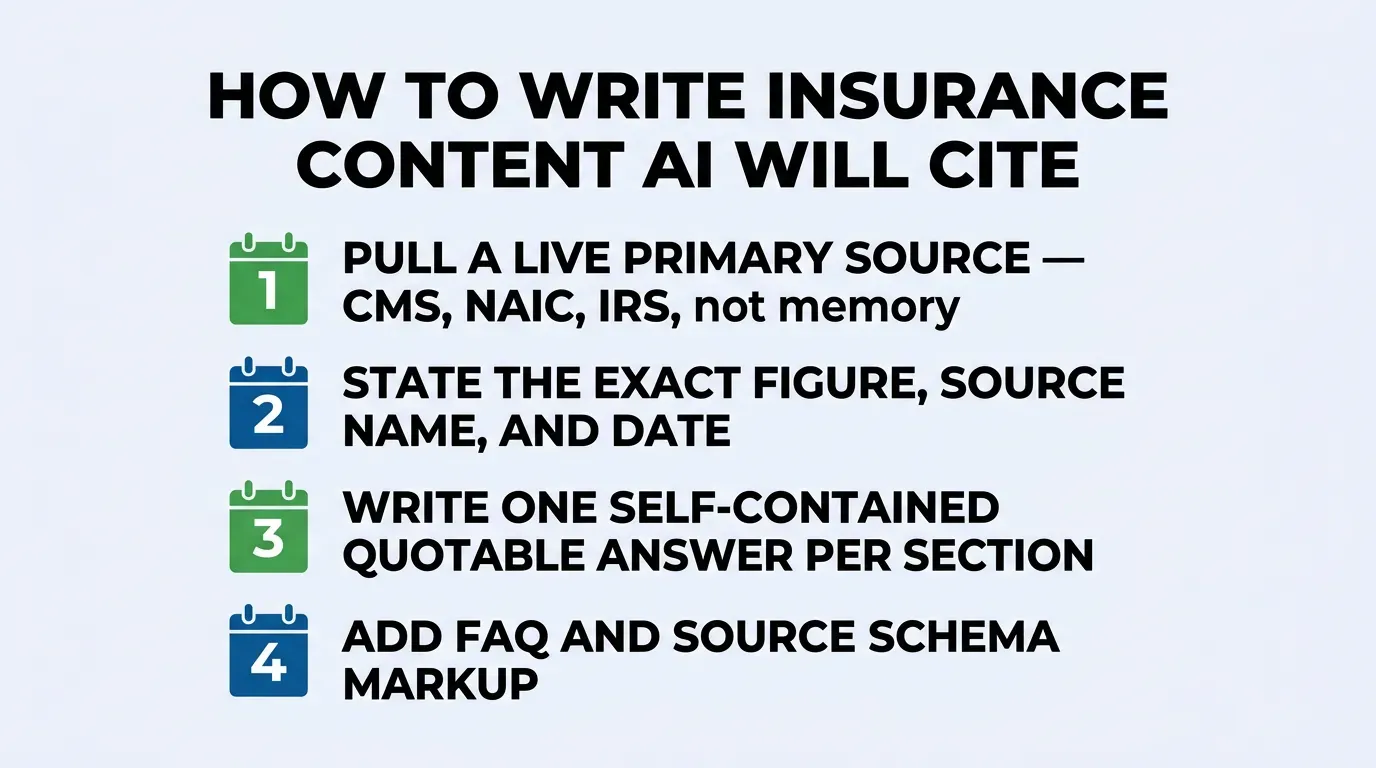
Start from a primary source, not memory
CMS, the NAIC, your state Department of Insurance, the IRS, a platform's own documentation (Meta, Google, HighLevel). Never a number you recall from a previous article, a chatbot's summary, or a listicle that doesn't link its own source.
State four things every time
The figure, the source's name, the exact URL, and the period it covers. "Star Ratings fell" is not a sentence an answer engine can verify. "The enrollment-weighted average Part D rating fell to 3.01 in 2026 from 3.12, per CMS's November 2025 fact sheet" is.
Write one self-contained answer per section
Each H2 should answer its own question in the first two sentences, without requiring the reader to have read the paragraph above it. That self-containment is exactly what lets an AI system quote the passage without also having to quote everything before it for context.
Name the entity, every time
Say "CMS," "the NAIC," "HighLevel," or "Meta Ads Manager" by name instead of "the regulator" or "the platform." Entity clarity is what lets a retrieval system connect your passage to the thing someone actually asked about.
State the year on anything time-sensitive
"Premiums are rising" ages badly and reads as unverifiable six months later. "For plan year 2026" or "as of April 2026" gives an answer engine a date it can reason about when deciding whether your figure is still current.
Add FAQ and source markup
A visible FAQ section answering the direct questions readers actually ask, paired with FAQPage schema and a plain list of your cited sources, gives both the reader and the retrieval system a second, more compact pass at the same claims.
Generic, uncitable
"Many insurance agents are turning to AI to save time on marketing. Studies show automation can boost efficiency and help agencies grow faster in today's competitive market."
Specific, citable
"24 states plus D.C. had adopted the NAIC's AI Model Bulletin as of April 1, 2026 (NAIC adoption map), which means an agency in one of those states using AI to draft marketing content is expected to document a written AI-use policy and a human review step before anything publishes."
Notice what changed in the rewrite. The generic version has no name, no number, no date, and no claim a fact-checker could confirm or deny — it’s the insurance-content equivalent of white noise, and there are thousands of near-identical sentences already indexed saying the same thing. The rewrite names the regulator, states the exact adoption count, gives the date the map reflects, and makes a specific, checkable claim about what that adoption means for an agency’s own process. One of these is quotable. The other is filler a retrieval system has no reason to prefer over the ten other pages saying the same vague thing. If you want to see this format running live at page scale, Strategic AI Architects publishes an answers hub of single-question pages built exactly this way — one self-contained, sourced answer per URL, like whether a real business website can score 99+ on mobile PageSpeed.
| Element | Generic AI content | AEO-structured content |
|---|---|---|
| Claims | "Studies show," "many agents report," no link | Named source, exact figure, dated, linked |
| Section structure | Builds an argument across paragraphs; no single sentence stands alone | Each H2 answers its own question in the first two sentences |
| Entities | "the regulator," "the platform," "recent data" | "CMS," "the NAIC," "Meta Ads Manager," named and dated |
| Structured data | None, or generic Article schema only | FAQPage schema, visible sources list, dated modified field |
| Shelf life | Reads the same in six months, none of it verifiable then either | Dated claims age visibly, prompting an update instead of quietly going stale |
You can run this checklist on an article you already published
Pull up your last three posts and count how many sentences contain a named source, an exact figure, and a date, versus how many contain "many," "often," "studies show," or "growing." That ratio is a rough, honest read on how citable the article already is, with no tool required.
The circulated-statistics trap, and how to trace a number back to its source
Insurance agency content has its own specific version of the sourcing problem, and it’s worth naming directly because it’s the trap that catches even agents who think they’re being careful. A small set of statistics circulate constantly across agent blogs, LinkedIn posts, and vendor decks — client retention percentages, applicant-shortage figures, generational interest-in-insurance-careers numbers, and per-call or per-lead cost benchmarks. They get repeated so often, with so little variation in the wording, that they start to feel verified simply from repetition. Most of the time nobody repeating them has actually traced the number back to where it originated, and a fair number turn out to be a vendor blog’s rounding of another vendor blog’s rounding of a study nobody in the chain actually linked.
The fix isn’t to stop using these categories of numbers. It’s to know which organization actually originates each category, and go there directly instead of citing whoever you saw repeat it most recently.
| Claim category | Where it's usually seen | Where to actually verify it |
|---|---|---|
| Client retention / lapse rates | Vendor blogs citing "industry average" | Your state Department of Insurance's own lapse/complaint ratio filings, or a named carrier's public persistency report — not a vendor's unlinked summary |
| Agent/applicant shortage figures | Recruiting and coaching content | The Bureau of Labor Statistics' Occupational Employment and Wage Statistics or Occupational Outlook Handbook for insurance sales agents, which publishes employment-level and projection data directly |
| Generational interest in insurance careers | "Millennials don't want to sell insurance" posts with no link | LIMRA's own published research (e.g., its industry workforce and consumer studies), which states its sample size and methodology, rather than a paraphrase of it |
| Cost-per-lead / cost-per-call benchmarks | Ad-agency sales pages with a bare number and no date | Your own platform account's reporting (Meta Ads Manager, Google Ads) for your own numbers; there is no reliable public industry-wide benchmark for this that updates fast enough to trust, so don't cite one that isn't your own account's data |
If you can't find the original, don't publish the number
This is the same standard this article holds itself to. Every figure printed above traces to a URL you could open right now and confirm yourself: SparkToro's own post, Ahrefs's own post, the NAIC's own PDF, CMS's own PDF, and Ambrose's own docs. None of it is a secondhand paraphrase. If you can't do the same for a number in your own draft, the honest move is to cut the sentence and describe the situation qualitatively instead, not to soften it into "many agents report" — that phrase is exactly as unverifiable as the number it's replacing.
A worked example: sourcing one sentence, start to finish
Abstract advice about “using primary sources” is easy to agree with and hard to actually picture. Here’s the real five-minute version, using a claim an ACA-focused agent might want in an article this month.
Say you want to state how many people are enrolled in ACA marketplace coverage for the current plan year. The wrong move, the one that produces exactly the uncitable content this whole article is about, is typing a remembered number from a headline you read months ago. The right move: go to CMS’s own Marketplace Open Enrollment data page or its published Effectuated Enrollment snapshot, find the specific report covering the plan year you’re writing about, note the exact figure and the “as of” date printed on the report itself, and write the sentence with all three: the number, “per CMS,” and the reporting period. That’s the entire method. It takes about the same amount of time as typing the vague version, and it produces a sentence that survives a fact-check instead of one that quietly falls apart under it.
The same five-minute pattern applies to a Medicare Star Ratings claim (go to the CMS Star Ratings fact sheet for the year in question), a state-level premium claim (go to that state’s Department of Insurance rate-filing database), or a platform-policy claim (go to Meta’s or Google’s own advertising-policy pages, not a marketing blog’s summary of them). The pattern is identical every time: identify the one organization that actually produces the number, go to their own page, and write down what it says with the date attached — never what someone else said it said.
How Ambrose’s Brain and search-audit spoke do this for you
Everything above is a discipline you can apply by hand with a browser and the primary sources you’d cite anyway. The two things Ambrose OS adds are a live connection to the sources themselves and a way to score whether the finished piece actually hit the mark.
The Brain is documented as an internal Ambrose service that fronts more than 25 federal and healthcare data MCPs (Model Context Protocol servers), with CMS, NADAC, the FDA, the Federal Register, and FEMA named as examples (Ambrose docs, Glossary; Ambrose docs, Architecture). Practically, that means an agent or team with Brain access, drafting an article inside Ambrose, can query one of those federal sources directly and pull the current figure at write time instead of typing a number from memory or an old bookmark. That’s the same discipline as the manual method above, applied automatically: the claim comes with a live source behind it because the source was queried live, not because someone remembered to add a citation afterward.
Once a draft exists, the search-audit spoke is the check on whether it actually worked. It’s documented with three tools: audit_site, which runs a full audit on a URL; audit_score, which returns a composite score breakdown; and audit_compare, which compares two URLs against each other, your own page against a competitor’s, for example (Ambrose docs, spoke-search-audit; Ambrose docs, Spokes). The audit scores a page across schema, content, technical setup, and what Ambrose’s own documentation calls “AI-citation surface” — in plain terms, a structural read on whether a retrieval system could plausibly pull a clean quote from the page. It’s also documented as a free-tier spoke positioned for outbound use, with a stated pitch of “here’s a free AEO audit of your homepage” for prospecting, which tells you it’s built to be run against pages you don’t own too, not only your own.
| Manual step | Ambrose equivalent |
|---|---|
| Look up the current CMS/NAIC/federal figure by hand | The Brain queries the live federal/healthcare source at write time (25+ MCPs, per Ambrose docs) |
| Manually check whether your own draft has schema, sources, and a quotable structure | audit_site / audit_score score the page on schema, content, technical, and AI-citation surface |
| Eyeball how your article compares to a competitor's ranking piece | audit_compare runs the two URLs against each other directly |
To be precise about what this is and isn’t: the Brain gets you a live, sourced figure, and search-audit gets you a structural score. Neither one guarantees a citation from ChatGPT, Perplexity, or Google — no vendor, including Ambrose’s own documentation, claims that, and this article won’t either. What both replace is the manual version of the same two jobs: looking the number up yourself, and eyeballing your own draft for whether it’s actually citable, both of which the checklist above shows you how to do without either tool.
On the exact size of the Brain's data catalog
Ambrose's documentation currently states "25+" federal and healthcare data MCPs behind the Brain, confirmed directly in the Glossary and Architecture pages during this session. That catalog grows over time, so treat "25+" as the accurate figure as of August 2026 and expect it to be larger by the time you read this — check the current docs rather than assuming this number is still exact.
Where this touches compliance, not just content strategy
Writing citable content faster with AI assistance doesn’t remove the compliance layer that already applies to insurance marketing, and it adds one of its own. The NAIC’s AI Model Bulletin, adopted by 24 states plus D.C., 25 jurisdictions total, as of the NAIC’s own status map dated April 1, 2026 (NAIC), sets expectations that flow down from insurers to the agencies producing AI-assisted content on their behalf: a written policy on how AI tools are used, a human reviewing output before it’s published or acted on, and documentation you could produce if a regulator or carrier asked. Applying “a licensed human reads this before it goes live” as a standing rule for AI-assisted content is the safer default whether or not your specific state has formally adopted the bulletin yet.
Separately, if the content in question markets specific Medicare Advantage, Part D, or Medicare Supplement plan benefits rather than general education, the existing CMS Medicare Communications and Marketing Guidelines and TPMO disclaimer requirements under 42 CFR Part 422/423 Subpart V still apply in full, regardless of how well the piece is optimized for AI citation (CMS, 2026 Agent and Broker Training & Testing Guidelines). AEO changes how discoverable a piece of content is. It does not change what a compliant piece of Medicare marketing content is required to say, and a genuinely useful citation strategy doesn’t need to touch that line at all — the examples in this article are built around general education and regulatory reporting, not plan-specific marketing copy.
Watch what you paste into a general-purpose AI tool while researching
Pulling a client's specific plan, claim, or health detail into a consumer AI chatbot to "check something" for an article is a PHI exposure risk with no BAA behind it. Keep research and drafting scoped to public data and your own professional judgment, and if a workflow ever needs to touch real client data, that's exactly the kind of task Ambrose's PHI Rail is built for — it aliases identifying information before any non-BAA destination sees it (Ambrose docs, PHI Rail architecture).
What you get by joining
One Ambrose seat, including Brain access and the search-audit spoke referenced in this article, comes with a Tech Savvy Insurance membership: $97 a month, billed monthly, cancel anytime, with the founding rate locked in while the membership stays active. Usage inside Ambrose runs through its own credit ledger with spend caps, so cost stays visible instead of showing up as a surprise line item (Ambrose docs, What is Ambrose). Alongside the seat: weekly Zoom calls with open Q&A and build-with-you sessions, more than 30 hours of recorded training, Meta Ads and marketing training built for this industry, pre-built AI templates and bot deployments, and a free annual in-person member workshop. It’s also an explicit no-recruiting zone — you can ask a real question about why your own content isn’t getting cited without ending up on someone’s downline pitch list, which isn’t true of most agent Facebook groups.
The manual method above works with or without any of this
Every step in the checklist section, sourcing from primary data, stating the figure and date, writing self-contained answers, adding FAQ schema, is something you can do this week with a browser and no membership. What the seat adds is the live data connection and the scoring pass, not the underlying discipline.
Close
Everything above works whether you join anything or not: pick a primary source, state the figure with its source and date, write each section as its own answer, add the FAQ and source schema. That’s the whole method, and it’s genuinely enough to make a real difference in what gets quoted back to a prospect asking an AI system about you instead of a competitor. If you’d rather have the source lookup and the citation-surface scoring run for you, with people who are running the same audits on their own sites watching your screen while you set it up, one Ambrose seat comes with a Tech Savvy membership: https://techsavvyinsurance.com/.
Before you publish anything AI helped draft
Tech Savvy Insurance is a training and software community, not an insurance company, agency, or law firm, and does not provide insurance, legal, tax, or compliance advice. You are responsible for your own licensure and for complying with all applicable CMS, HIPAA, state, and carrier regulations, including TPMO disclaimer and Medicare marketing rules where they apply. AI-generated outputs, including any figure or audit score referenced here, may contain errors — always verify against the current primary source before publishing. Results may vary.
Frequently asked questions
Sources
- SparkToro — In 2026, Less than One Third of Google Searches Still Send a Click (Jun. 9, 2026) — sparktoro.com
- SparkToro — 2024 Zero-Click Search Study — sparktoro.com
- Ahrefs — Update: 38% of AI Overview Citations Pull From Top 10 Pages (Mar. 2, 2026) — ahrefs.com
- NAIC — Implementation of NAIC Model Bulletin: Use of Artificial Intelligence Systems by Insurers (status as of Apr. 1, 2026) — content.naic.org
- CMS — 2026 Agent and Broker Training & Testing Guidelines — cms.gov
- Ambrose docs — Glossary (the Brain) — app.hiambrose.com
- Ambrose docs — System architecture — app.hiambrose.com
- Ambrose docs — spoke-search-audit — app.hiambrose.com
- Ambrose docs — Spokes — app.hiambrose.com
- Ambrose docs — What is Ambrose — app.hiambrose.com
Ready to put this into practice?
Join a private community of Health & Life insurance professionals using AI, Meta Ads, and automation to grow — without draining their bank account.
Join Tech Savvy — $97/month